Compare commits
321 Commits
fix/step-c
...
update-llm
| Author | SHA1 | Date | |
|---|---|---|---|

|
cb23c8da63 | ||
|
|
35cb7fcf4d | ||
|
|
d2a9a4a4e4 | ||
|
|
e62e9c7401 | ||
|
|
3c5031e711 | ||
|
|
82e84c0f88 | ||
|
|
2c550dc175 | ||
|
|
bdc92deade | ||
|
|
ed1f009c64 | ||
|
|
bb3829a9ed | ||
|
|
0a116202f0 | ||
|
|
4daa88fa59 | ||
|
|
53067f8b92 | ||
|
|
d3a09c3180 | ||
|
|
4d7aacb5f2 | ||
|
|
6b1cf78e41 | ||
|
|
80f1a88b63 | ||
|
|
32da76a2ca | ||
|
|
3aa48dcd58 | ||
|
|
03f1d57463 | ||
|
|
4725d0de0d | ||
|
|
b766af75f2 | ||
|
|
b2c8779f4c | ||
|
|
df266bda01 | ||
|
|
2155acb3a3 | ||
|
|
794574957e | ||
|
|
66b19311a7 | ||
|
|
9fc84fc1ac | ||
|
|
f8f9df6d1d | ||
|
|
6e94edb777 | ||
|
|
bbe896d48c | ||
|
|
9298054436 | ||
|
|
90b7937796 | ||
|
|
520933b4c5 | ||
|
|
fe0813e831 | ||
|
|
33cebea15b | ||
|
|
e723e5ca3f | ||
|
|
24f1a19310 | ||
|
|
d0959573dc | ||
|
|
939afd5f82 | ||
|
|
d42e58e199 | ||
|
|
000bab4cf5 | ||
|
|
8df1042180 | ||
|
|
41a670166a | ||
|
|
a77496a217 | ||
|
|
430260c985 | ||
|
|
334b0959b0 | ||
|
|
2b31e26ba5 | ||
|
|
7122a29a20 | ||
|
|
f3ddb430a7 | ||
|
|
435bfca186 | ||
|
|
2ef896bdd5 | ||
|
|
59c6c29706 | ||
|
|
a1f35e768f | ||
|
|
00eede0d5d | ||
|
|
a3d5c86218 | ||
|
|
60d13bf7e8 | ||
|
|
86825e1769 | ||
|
|
7afc531fbb | ||
|
|
ed0490112b | ||
|
|
66c66e3d84 | ||
|
|
b9b625a70d | ||
|
|
b58253cacc | ||
|
|
fbf8732784 | ||
|
|
8fedbe49cb | ||
|
|
1e8ee247ca | ||
|
|
34d2993456 | ||
|
|
e3c5c174ee | ||
|
|
b4e2db0306 | ||
|
|
9cc759ba32 | ||
|
|
ac9f8b9d5a | ||
|
|
3d4a1e4b18 | ||
|
|
123f302744 | ||
|
|
5bae78639e | ||
|
|
5235442a5b | ||
|
|
c62fb615b1 | ||
|
|
78797c64b0 | ||
|
|
8a7584798b | ||
|
|
b50772a38b | ||
|
|
96a7e8038f | ||
|
|
ec050e5d33 | ||
|
|
e2ce65fc5b | ||
|
|
14503bc43b | ||
|
|
00c2f5043e | ||
|
|
bcd90e26b0 | ||
|
|
4eaa8755eb | ||
|
|
ba66910fbd | ||
|
|
90f1bee602 | ||
|
|
1cb5f57864 | ||
|
|
7dc47adb5c | ||
|
|
ac819bcb6e | ||
|
|
b6d668fc66 | ||
|
|
1b488b6da7 | ||
|
|
d3b398ed52 | ||
|
|
d52fd09602 | ||
|
|
d6800d8957 | ||
|
|
2fd7506ed9 | ||
|
|
161084aff2 | ||
|
|
b145cb3247 | ||
|
|
1adbcf697d | ||
|
|
e51355200a | ||
|
|
47818f4f41 | ||
|
|
9b10fd47b0 | ||
|
|
c408368267 | ||
|
|
90b3145e92 | ||
|
|
fbd0e015d5 | ||
|
|
17e25fb842 | ||
|
|
d6d98ee969 | ||
|
|
e0600e3bb9 | ||
|
|
a79d77dfd7 | ||
|
|
56ec9bc224 | ||
|
|
8eef02739a | ||
|
|
6f4ad532e6 | ||
|
|
74a1de8550 | ||
|
|
e529766391 | ||
|
|
a7f5d574dc | ||
|
|
0cc02d9492 | ||
|
|
fa26f6ebae | ||
|
|
f6c2982619 | ||
|
|
5a8649a97f | ||
|
|
e6100debac | ||
|
|
abee94d056 | ||
|
|
92731544ae | ||
|
|
77c7b7dfa1 | ||
|
|
ea64c29fee | ||
|
|
f4bb040ad8 | ||
|
|
515478473a | ||
|
|
9cf3fadd0f | ||
|
|
89c4b3fe88 | ||
|
|
9e5c599f58 | ||
|
|
a950e67c7d | ||
|
|
de6933b2d2 | ||
|
|
748383d74c | ||
|
|
23b9e10323 | ||
|
|
ddb7958da7 | ||
|
|
477cce321f | ||
|
|
7bed63a693 | ||
|
|
2709a9205a | ||
|
|
d19d7b01ec | ||
|
|
a3ad2c1957 | ||
|
|
c3e7a3ec19 | ||
|
|
cba8c9faec | ||
|
|
bcb7fb27d0 | ||
|
|
c310044bec | ||
|
|
5263df24b6 | ||
|
|
dea6ed7ef0 | ||
|
|
d3a0dad323 | ||
|
|
67bf4aea56 | ||
|
|
8c76bad50f | ||
|
|
e27a15023c | ||
|
|
a836f466f4 | ||
|
|
67f0de1f90 | ||
|
|
c642ebf97e | ||
|
|
a21e310d78 | ||
|
|
aba68da542 | ||
|
|
e254f11933 | ||
|
|
ab2274caf0 | ||
|
|
3e4f112f39 | ||
|
|
cc018bf128 | ||
|
|
46d3e4d4d9 | ||
|
|
627bb3f5f6 | ||
|
|
4a44245de9 | ||
|
|
30d027158a | ||
|
|
3fecde49b6 | ||
|
|
cc129a0bce | ||
|
|
b5779dca12 | ||
|
|
42311d9c7a | ||
|
|
294f2cc3a9 | ||
|
|
3dc442801f | ||
|
|
c12343a8b8 | ||
|
|
835557e648 | ||
|
|
4185ea688f | ||
|
|
0532089246 | ||
|
|
24b155015c | ||
|
|
8ceeec7d36 | ||
|
|
75e68f6fc8 | ||
|
|
3de81cedd6 | ||
|
|
5dc8dd0e8a | ||
|
|
b8d07fee83 | ||
|
|
be8e33daf6 | ||
|
|
efc8323c63 | ||
|
|
831951efc4 | ||
|
|
2131b94ddb | ||
|
|
b3504e768c | ||
|
|
350457b9b8 | ||
|
|
355bf3b48b | ||
|
|
0e94236735 | ||
|
|
673a38c5d9 | ||
|
|
8f57753656 | ||
|
|
a2f839fada | ||
|
|
440883e9e8 | ||
|
|
d3da73136c | ||
|
|
7272fd15ac | ||
|
|
518800239c | ||
|
|
30bd79390a | ||
|
|
d1e2430aac | ||
|
|
bfe2c44f55 | ||
|
|
845951a0db | ||
|
|
c1172a685a | ||
|
|
4bcc3b532d | ||
|
|
ba89e43b62 | ||
|
|
4469461b38 | ||
|
|
a548463fae | ||
|
|
45b802a625 | ||
|
|
ba0965ef87 | ||
|
|
d85898cf29 | ||
|
|
73f328860b | ||
|
|
a0c322a535 | ||
|
|
86f58c95de | ||
|
|
99fe91586d | ||
|
|
0c2d23dfe0 | ||
|
|
2433819c4f | ||
|
|
97fc44c930 | ||
|
|
409892d65f | ||
|
|
62f3df7ed5 | ||
|
|
4cf8913d31 | ||
|
|
82647358b2 | ||
|
|
6cc2f510bf | ||
|
|
9a65abf6b8 | ||
|
|
b3185ad90c | ||
|
|
c887ff1f47 | ||
|
|
22e5d39884 | ||
|
|
9ee6824ccd | ||
|
|
da73865f25 | ||
|
|
627b9f1abb | ||
|
|
1b8001bf98 | ||
|
|
e59e07e4f7 | ||
|
|
ee239b1c06 | ||
|
|
bf459bf983 | ||
|
|
94eaa6740e | ||
|
|
6d7c1b0743 | ||
|
|
6b864ee21d | ||
|
|
1ffa8904db | ||
|
|
ad916abd76 | ||
|
|
9702711094 | ||
|
|
8094754239 | ||
|
|
bc5e303d5f | ||
|
|
ec89e003c8 | ||
|
|
0b0f2d30ab | ||
|
|
1df61aba4c | ||
|
|
da9220fa81 | ||
|
|
da4f356fab | ||
|
|
d932b20c6e | ||
|
|
2f9a2afd9e | ||
|
|
c1df7c410e | ||
|
|
54ebd6cf90 | ||
|
|
6b87d22a70 | ||
|
|
c4f7eaf259 | ||
|
|
236e42d0bc | ||
|
|
8c90db04b5 | ||
|
|
1261ce513f | ||
|
|
b07c51532c | ||
|
|
d763eefc2e | ||
|
|
e01c0a0f4c | ||
|
|
5a7a323f3a | ||
|
|
46be5e8097 | ||
|
|
bc2a86d66a | ||
|
|
11a3d4b840 | ||
|
|
6930b68484 | ||
|
|
c7c0647dd2 | ||
|
|
7b276e6797 | ||
|
|
3daba0c79e | ||
|
|
2c85e8e23a | ||
|
|
b0f1d1fcf0 | ||
|
|
611526596a | ||
|
|
fa373f9660 | ||
|
|
48bb8ef775 | ||
|
|
bbea797b0c | ||
|
|
066ad73423 | ||
|
|
0695c26703 | ||
|
|
4fb3331c6a | ||
|
|
b6c6eea6f5 | ||
|
|
1af95f5146 | ||
|
|
ed3487aa22 | ||
|
|
77af733e44 | ||
|
|
aaf80d1d43 | ||
|
|
9e9b945a46 | ||
|
|
308a8dc925 | ||
|
|
7d9d0ff6f7 | ||
|
|
f8a8e7b2a5 | ||
|
|
3285c1b196 | ||
|
|
4bc23affe0 | ||
|
|
bca56eea48 | ||
|
|
588ad3c4a4 | ||
|
|
c6a6c918e0 | ||
|
|
366bbbbea3 | ||
|
|
293305790d | ||
|
|
8bc09eb054 | ||
|
|
db1b678c3a | ||
|
|
6f32bf52cc | ||
|
|
49d173a02d | ||
|
|
4069b621d5 | ||
|
|
a7147c99c6 | ||
|
|
6fe308202e | ||
|
|
63ecb7395d | ||
|
|
8cf1cd5a62 | ||
|
|
93c0467bba | ||
|
|
8f5f67de41 | ||
|
|
f8ca49d8df | ||
|
|
c119230fd6 | ||
|
|
14a36d3f5e | ||
|
|
fde1ee45f9 | ||
|
|
6774bc2c53 | ||
|
|
94c62263ed | ||
|
|
495c3859af | ||
|
|
3e003f5e32 | ||
|
|
1c8b509d7d | ||
|
|
58af5c08f9 | ||
|
|
55e968c9e0 | ||
|
|
0b9092702b | ||
|
|
8376698534 | ||
|
|
3dc02310b6 | ||
|
|
e70bc94ab6 | ||
|
|
9285ebf8a2 | ||
|
|
4ca785eb15 | ||
|
|
c57cbd8591 | ||
|
|
7fb1289205 | ||
|
|
f02681ae01 | ||
|
|
c725105b1f | ||
|
|
36aa4bcb46 | ||
|
|
b98f8f9fe1 |
3
.github/ISSUE_TEMPLATE/bug_report.yml
vendored
@@ -65,7 +65,6 @@ body:
|
||||
- '3.10'
|
||||
- '3.11'
|
||||
- '3.12'
|
||||
- '3.13'
|
||||
validations:
|
||||
required: true
|
||||
- type: input
|
||||
@@ -113,4 +112,4 @@ body:
|
||||
label: Additional context
|
||||
description: Add any other context about the problem here.
|
||||
validations:
|
||||
required: true
|
||||
required: true
|
||||
|
||||
4
.github/workflows/linter.yml
vendored
@@ -6,11 +6,11 @@ jobs:
|
||||
lint:
|
||||
runs-on: ubuntu-latest
|
||||
steps:
|
||||
- uses: actions/checkout@v3
|
||||
- uses: actions/checkout@v4
|
||||
|
||||
- name: Install Requirements
|
||||
run: |
|
||||
pip install ruff
|
||||
|
||||
- name: Run Ruff Linter
|
||||
run: ruff check --exclude "templates","__init__.py"
|
||||
run: ruff check
|
||||
|
||||
8
.github/workflows/mkdocs.yml
vendored
@@ -13,10 +13,10 @@ jobs:
|
||||
|
||||
steps:
|
||||
- name: Checkout code
|
||||
uses: actions/checkout@v2
|
||||
uses: actions/checkout@v4
|
||||
|
||||
- name: Setup Python
|
||||
uses: actions/setup-python@v4
|
||||
uses: actions/setup-python@v5
|
||||
with:
|
||||
python-version: '3.10'
|
||||
|
||||
@@ -25,7 +25,7 @@ jobs:
|
||||
run: echo "::set-output name=hash::$(sha256sum requirements-doc.txt | awk '{print $1}')"
|
||||
|
||||
- name: Setup cache
|
||||
uses: actions/cache@v3
|
||||
uses: actions/cache@v4
|
||||
with:
|
||||
key: mkdocs-material-${{ steps.req-hash.outputs.hash }}
|
||||
path: .cache
|
||||
@@ -42,4 +42,4 @@ jobs:
|
||||
GH_TOKEN: ${{ secrets.GH_TOKEN }}
|
||||
|
||||
- name: Build and deploy MkDocs
|
||||
run: mkdocs gh-deploy --force
|
||||
run: mkdocs gh-deploy --force
|
||||
|
||||
4
.github/workflows/security-checker.yml
vendored
@@ -11,7 +11,7 @@ jobs:
|
||||
uses: actions/checkout@v4
|
||||
|
||||
- name: Set up Python
|
||||
uses: actions/setup-python@v4
|
||||
uses: actions/setup-python@v5
|
||||
with:
|
||||
python-version: "3.11.9"
|
||||
|
||||
@@ -19,5 +19,5 @@ jobs:
|
||||
run: pip install bandit
|
||||
|
||||
- name: Run Bandit
|
||||
run: bandit -c pyproject.toml -r src/ -lll
|
||||
run: bandit -c pyproject.toml -r src/ -ll
|
||||
|
||||
|
||||
8
.github/workflows/stale.yml
vendored
@@ -1,5 +1,10 @@
|
||||
name: Mark stale issues and pull requests
|
||||
|
||||
permissions:
|
||||
contents: write
|
||||
issues: write
|
||||
pull-requests: write
|
||||
|
||||
on:
|
||||
schedule:
|
||||
- cron: '10 12 * * *'
|
||||
@@ -8,9 +13,6 @@ on:
|
||||
jobs:
|
||||
stale:
|
||||
runs-on: ubuntu-latest
|
||||
permissions:
|
||||
issues: write
|
||||
pull-requests: write
|
||||
steps:
|
||||
- uses: actions/stale@v9
|
||||
with:
|
||||
|
||||
6
.github/workflows/tests.yml
vendored
@@ -23,10 +23,10 @@ jobs:
|
||||
|
||||
|
||||
- name: Set up Python
|
||||
run: uv python install 3.11.9
|
||||
run: uv python install 3.12.8
|
||||
|
||||
- name: Install the project
|
||||
run: uv sync --dev
|
||||
run: uv sync --dev --all-extras
|
||||
|
||||
- name: Run tests
|
||||
run: uv run pytest tests
|
||||
run: uv run pytest tests -vv
|
||||
|
||||
2
.github/workflows/type-checker.yml
vendored
@@ -14,7 +14,7 @@ jobs:
|
||||
uses: actions/checkout@v4
|
||||
|
||||
- name: Setup Python
|
||||
uses: actions/setup-python@v4
|
||||
uses: actions/setup-python@v5
|
||||
with:
|
||||
python-version: "3.11.9"
|
||||
|
||||
|
||||
9
.gitignore
vendored
@@ -17,3 +17,12 @@ rc-tests/*
|
||||
temp/*
|
||||
.vscode/*
|
||||
crew_tasks_output.json
|
||||
.codesight
|
||||
.mypy_cache
|
||||
.ruff_cache
|
||||
.venv
|
||||
agentops.log
|
||||
test_flow.html
|
||||
crewairules.mdc
|
||||
plan.md
|
||||
conceptual_plan.md
|
||||
@@ -1,9 +1,7 @@
|
||||
repos:
|
||||
- repo: https://github.com/astral-sh/ruff-pre-commit
|
||||
rev: v0.4.4
|
||||
rev: v0.8.2
|
||||
hooks:
|
||||
- id: ruff
|
||||
args: ["--fix"]
|
||||
exclude: "templates"
|
||||
- id: ruff-format
|
||||
exclude: "templates"
|
||||
|
||||
9
.ruff.toml
Normal file
@@ -0,0 +1,9 @@
|
||||
exclude = [
|
||||
"templates",
|
||||
"__init__.py",
|
||||
]
|
||||
|
||||
[lint]
|
||||
select = [
|
||||
"I", # isort rules
|
||||
]
|
||||
2
LICENSE
@@ -1,4 +1,4 @@
|
||||
Copyright (c) 2018 The Python Packaging Authority
|
||||
Copyright (c) 2025 crewAI, Inc.
|
||||
|
||||
Permission is hereby granted, free of charge, to any person obtaining a copy
|
||||
of this software and associated documentation files (the "Software"), to deal
|
||||
|
||||
334
README.md
@@ -1,14 +1,47 @@
|
||||
<div align="center">
|
||||
|
||||

|
||||

|
||||
|
||||
# **CrewAI**
|
||||
|
||||
🤖 **CrewAI**: Cutting-edge framework for orchestrating role-playing, autonomous AI agents. By fostering collaborative intelligence, CrewAI empowers agents to work together seamlessly, tackling complex tasks.
|
||||
</div>
|
||||
|
||||
### Fast and Flexible Multi-Agent Automation Framework
|
||||
|
||||
CrewAI is a lean, lightning-fast Python framework built entirely from
|
||||
scratch—completely **independent of LangChain or other agent frameworks**.
|
||||
It empowers developers with both high-level simplicity and precise low-level
|
||||
control, ideal for creating autonomous AI agents tailored to any scenario.
|
||||
|
||||
- **CrewAI Crews**: Optimize for autonomy and collaborative intelligence.
|
||||
- **CrewAI Flows**: Enable granular, event-driven control, single LLM calls for precise task orchestration and supports Crews natively
|
||||
|
||||
With over 100,000 developers certified through our community courses at
|
||||
[learn.crewai.com](https://learn.crewai.com), CrewAI is rapidly becoming the
|
||||
standard for enterprise-ready AI automation.
|
||||
|
||||
# CrewAI Enterprise Suite
|
||||
|
||||
CrewAI Enterprise Suite is a comprehensive bundle tailored for organizations
|
||||
that require secure, scalable, and easy-to-manage agent-driven automation.
|
||||
|
||||
You can try one part of the suite the [Crew Control Plane for free](https://app.crewai.com)
|
||||
|
||||
## Crew Control Plane Key Features:
|
||||
- **Tracing & Observability**: Monitor and track your AI agents and workflows in real-time, including metrics, logs, and traces.
|
||||
- **Unified Control Plane**: A centralized platform for managing, monitoring, and scaling your AI agents and workflows.
|
||||
- **Seamless Integrations**: Easily connect with existing enterprise systems, data sources, and cloud infrastructure.
|
||||
- **Advanced Security**: Built-in robust security and compliance measures ensuring safe deployment and management.
|
||||
- **Actionable Insights**: Real-time analytics and reporting to optimize performance and decision-making.
|
||||
- **24/7 Support**: Dedicated enterprise support to ensure uninterrupted operation and quick resolution of issues.
|
||||
- **On-premise and Cloud Deployment Options**: Deploy CrewAI Enterprise on-premise or in the cloud, depending on your security and compliance requirements.
|
||||
|
||||
CrewAI Enterprise is designed for enterprises seeking a powerful,
|
||||
reliable solution to transform complex business processes into efficient,
|
||||
intelligent automations.
|
||||
|
||||
<h3>
|
||||
|
||||
[Homepage](https://www.crewai.com/) | [Documentation](https://docs.crewai.com/) | [Chat with Docs](https://chatg.pt/DWjSBZn) | [Examples](https://github.com/crewAIInc/crewAI-examples) | [Discourse](https://community.crewai.com)
|
||||
[Homepage](https://www.crewai.com/) | [Documentation](https://docs.crewai.com/) | [Chat with Docs](https://chatg.pt/DWjSBZn) | [Discourse](https://community.crewai.com)
|
||||
|
||||
</h3>
|
||||
|
||||
@@ -22,36 +55,80 @@
|
||||
- [Why CrewAI?](#why-crewai)
|
||||
- [Getting Started](#getting-started)
|
||||
- [Key Features](#key-features)
|
||||
- [Understanding Flows and Crews](#understanding-flows-and-crews)
|
||||
- [CrewAI vs LangGraph](#how-crewai-compares)
|
||||
- [Examples](#examples)
|
||||
- [Quick Tutorial](#quick-tutorial)
|
||||
- [Write Job Descriptions](#write-job-descriptions)
|
||||
- [Trip Planner](#trip-planner)
|
||||
- [Stock Analysis](#stock-analysis)
|
||||
- [Using Crews and Flows Together](#using-crews-and-flows-together)
|
||||
- [Connecting Your Crew to a Model](#connecting-your-crew-to-a-model)
|
||||
- [How CrewAI Compares](#how-crewai-compares)
|
||||
- [Frequently Asked Questions (FAQ)](#frequently-asked-questions-faq)
|
||||
- [Contribution](#contribution)
|
||||
- [Telemetry](#telemetry)
|
||||
- [License](#license)
|
||||
|
||||
## Why CrewAI?
|
||||
|
||||
The power of AI collaboration has too much to offer.
|
||||
CrewAI is designed to enable AI agents to assume roles, share goals, and operate in a cohesive unit - much like a well-oiled crew. Whether you're building a smart assistant platform, an automated customer service ensemble, or a multi-agent research team, CrewAI provides the backbone for sophisticated multi-agent interactions.
|
||||
<div align="center" style="margin-bottom: 30px;">
|
||||
<img src="docs/asset.png" alt="CrewAI Logo" width="100%">
|
||||
</div>
|
||||
|
||||
CrewAI unlocks the true potential of multi-agent automation, delivering the best-in-class combination of speed, flexibility, and control with either Crews of AI Agents or Flows of Events:
|
||||
|
||||
- **Standalone Framework**: Built from scratch, independent of LangChain or any other agent framework.
|
||||
- **High Performance**: Optimized for speed and minimal resource usage, enabling faster execution.
|
||||
- **Flexible Low Level Customization**: Complete freedom to customize at both high and low levels - from overall workflows and system architecture to granular agent behaviors, internal prompts, and execution logic.
|
||||
- **Ideal for Every Use Case**: Proven effective for both simple tasks and highly complex, real-world, enterprise-grade scenarios.
|
||||
- **Robust Community**: Backed by a rapidly growing community of over **100,000 certified** developers offering comprehensive support and resources.
|
||||
|
||||
CrewAI empowers developers and enterprises to confidently build intelligent automations, bridging the gap between simplicity, flexibility, and performance.
|
||||
|
||||
## Getting Started
|
||||
|
||||
### Learning Resources
|
||||
|
||||
Learn CrewAI through our comprehensive courses:
|
||||
- [Multi AI Agent Systems with CrewAI](https://www.deeplearning.ai/short-courses/multi-ai-agent-systems-with-crewai/) - Master the fundamentals of multi-agent systems
|
||||
- [Practical Multi AI Agents and Advanced Use Cases](https://www.deeplearning.ai/short-courses/practical-multi-ai-agents-and-advanced-use-cases-with-crewai/) - Deep dive into advanced implementations
|
||||
|
||||
### Understanding Flows and Crews
|
||||
|
||||
CrewAI offers two powerful, complementary approaches that work seamlessly together to build sophisticated AI applications:
|
||||
|
||||
1. **Crews**: Teams of AI agents with true autonomy and agency, working together to accomplish complex tasks through role-based collaboration. Crews enable:
|
||||
- Natural, autonomous decision-making between agents
|
||||
- Dynamic task delegation and collaboration
|
||||
- Specialized roles with defined goals and expertise
|
||||
- Flexible problem-solving approaches
|
||||
|
||||
2. **Flows**: Production-ready, event-driven workflows that deliver precise control over complex automations. Flows provide:
|
||||
- Fine-grained control over execution paths for real-world scenarios
|
||||
- Secure, consistent state management between tasks
|
||||
- Clean integration of AI agents with production Python code
|
||||
- Conditional branching for complex business logic
|
||||
|
||||
The true power of CrewAI emerges when combining Crews and Flows. This synergy allows you to:
|
||||
- Build complex, production-grade applications
|
||||
- Balance autonomy with precise control
|
||||
- Handle sophisticated real-world scenarios
|
||||
- Maintain clean, maintainable code structure
|
||||
|
||||
### Getting Started with Installation
|
||||
|
||||
To get started with CrewAI, follow these simple steps:
|
||||
|
||||
### 1. Installation
|
||||
|
||||
Ensure you have Python >=3.10 <=3.13 installed on your system. CrewAI uses [UV](https://docs.astral.sh/uv/) for dependency management and package handling, offering a seamless setup and execution experience.
|
||||
Ensure you have Python >=3.10 <3.13 installed on your system. CrewAI uses [UV](https://docs.astral.sh/uv/) for dependency management and package handling, offering a seamless setup and execution experience.
|
||||
|
||||
First, install CrewAI:
|
||||
|
||||
```shell
|
||||
pip install crewai
|
||||
```
|
||||
|
||||
If you want to install the 'crewai' package along with its optional features that include additional tools for agents, you can do so by using the following command:
|
||||
|
||||
```shell
|
||||
@@ -59,6 +136,22 @@ pip install 'crewai[tools]'
|
||||
```
|
||||
The command above installs the basic package and also adds extra components which require more dependencies to function.
|
||||
|
||||
### Troubleshooting Dependencies
|
||||
|
||||
If you encounter issues during installation or usage, here are some common solutions:
|
||||
|
||||
#### Common Issues
|
||||
|
||||
1. **ModuleNotFoundError: No module named 'tiktoken'**
|
||||
- Install tiktoken explicitly: `pip install 'crewai[embeddings]'`
|
||||
- If using embedchain or other tools: `pip install 'crewai[tools]'`
|
||||
|
||||
2. **Failed building wheel for tiktoken**
|
||||
- Ensure Rust compiler is installed (see installation steps above)
|
||||
- For Windows: Verify Visual C++ Build Tools are installed
|
||||
- Try upgrading pip: `pip install --upgrade pip`
|
||||
- If issues persist, use a pre-built wheel: `pip install tiktoken --prefer-binary`
|
||||
|
||||
### 2. Setting Up Your Crew with the YAML Configuration
|
||||
|
||||
To create a new CrewAI project, run the following CLI (Command Line Interface) command:
|
||||
@@ -100,7 +193,7 @@ You can now start developing your crew by editing the files in the `src/my_proje
|
||||
|
||||
#### Example of a simple crew with a sequential process:
|
||||
|
||||
Instatiate your crew:
|
||||
Instantiate your crew:
|
||||
|
||||
```shell
|
||||
crewai create crew latest-ai-development
|
||||
@@ -121,7 +214,7 @@ researcher:
|
||||
You're a seasoned researcher with a knack for uncovering the latest
|
||||
developments in {topic}. Known for your ability to find the most relevant
|
||||
information and present it in a clear and concise manner.
|
||||
|
||||
|
||||
reporting_analyst:
|
||||
role: >
|
||||
{topic} Reporting Analyst
|
||||
@@ -141,7 +234,7 @@ research_task:
|
||||
description: >
|
||||
Conduct a thorough research about {topic}
|
||||
Make sure you find any interesting and relevant information given
|
||||
the current year is 2024.
|
||||
the current year is 2025.
|
||||
expected_output: >
|
||||
A list with 10 bullet points of the most relevant information about {topic}
|
||||
agent: researcher
|
||||
@@ -205,7 +298,7 @@ class LatestAiDevelopmentCrew():
|
||||
tasks=self.tasks, # Automatically created by the @task decorator
|
||||
process=Process.sequential,
|
||||
verbose=True,
|
||||
)
|
||||
)
|
||||
```
|
||||
|
||||
**main.py**
|
||||
@@ -264,15 +357,16 @@ In addition to the sequential process, you can use the hierarchical process, whi
|
||||
|
||||
## Key Features
|
||||
|
||||
- **Role-Based Agent Design**: Customize agents with specific roles, goals, and tools.
|
||||
- **Autonomous Inter-Agent Delegation**: Agents can autonomously delegate tasks and inquire amongst themselves, enhancing problem-solving efficiency.
|
||||
- **Flexible Task Management**: Define tasks with customizable tools and assign them to agents dynamically.
|
||||
- **Processes Driven**: Currently only supports `sequential` task execution and `hierarchical` processes, but more complex processes like consensual and autonomous are being worked on.
|
||||
- **Save output as file**: Save the output of individual tasks as a file, so you can use it later.
|
||||
- **Parse output as Pydantic or Json**: Parse the output of individual tasks as a Pydantic model or as a Json if you want to.
|
||||
- **Works with Open Source Models**: Run your crew using Open AI or open source models refer to the [Connect CrewAI to LLMs](https://docs.crewai.com/how-to/LLM-Connections/) page for details on configuring your agents' connections to models, even ones running locally!
|
||||
CrewAI stands apart as a lean, standalone, high-performance framework delivering simplicity, flexibility, and precise control—free from the complexity and limitations found in other agent frameworks.
|
||||
|
||||

|
||||
- **Standalone & Lean**: Completely independent from other frameworks like LangChain, offering faster execution and lighter resource demands.
|
||||
- **Flexible & Precise**: Easily orchestrate autonomous agents through intuitive [Crews](https://docs.crewai.com/concepts/crews) or precise [Flows](https://docs.crewai.com/concepts/flows), achieving perfect balance for your needs.
|
||||
- **Seamless Integration**: Effortlessly combine Crews (autonomy) and Flows (precision) to create complex, real-world automations.
|
||||
- **Deep Customization**: Tailor every aspect—from high-level workflows down to low-level internal prompts and agent behaviors.
|
||||
- **Reliable Performance**: Consistent results across simple tasks and complex, enterprise-level automations.
|
||||
- **Thriving Community**: Backed by robust documentation and over 100,000 certified developers, providing exceptional support and guidance.
|
||||
|
||||
Choose CrewAI to easily build powerful, adaptable, and production-ready AI automations.
|
||||
|
||||
## Examples
|
||||
|
||||
@@ -305,6 +399,98 @@ You can test different real life examples of AI crews in the [CrewAI-examples re
|
||||
|
||||
[](https://www.youtube.com/watch?v=e0Uj4yWdaAg "Stock Analysis")
|
||||
|
||||
### Using Crews and Flows Together
|
||||
|
||||
CrewAI's power truly shines when combining Crews with Flows to create sophisticated automation pipelines. Here's how you can orchestrate multiple Crews within a Flow:
|
||||
|
||||
```python
|
||||
from crewai.flow.flow import Flow, listen, start, router
|
||||
from crewai import Crew, Agent, Task
|
||||
from pydantic import BaseModel
|
||||
|
||||
# Define structured state for precise control
|
||||
class MarketState(BaseModel):
|
||||
sentiment: str = "neutral"
|
||||
confidence: float = 0.0
|
||||
recommendations: list = []
|
||||
|
||||
class AdvancedAnalysisFlow(Flow[MarketState]):
|
||||
@start()
|
||||
def fetch_market_data(self):
|
||||
# Demonstrate low-level control with structured state
|
||||
self.state.sentiment = "analyzing"
|
||||
return {"sector": "tech", "timeframe": "1W"} # These parameters match the task description template
|
||||
|
||||
@listen(fetch_market_data)
|
||||
def analyze_with_crew(self, market_data):
|
||||
# Show crew agency through specialized roles
|
||||
analyst = Agent(
|
||||
role="Senior Market Analyst",
|
||||
goal="Conduct deep market analysis with expert insight",
|
||||
backstory="You're a veteran analyst known for identifying subtle market patterns"
|
||||
)
|
||||
researcher = Agent(
|
||||
role="Data Researcher",
|
||||
goal="Gather and validate supporting market data",
|
||||
backstory="You excel at finding and correlating multiple data sources"
|
||||
)
|
||||
|
||||
analysis_task = Task(
|
||||
description="Analyze {sector} sector data for the past {timeframe}",
|
||||
expected_output="Detailed market analysis with confidence score",
|
||||
agent=analyst
|
||||
)
|
||||
research_task = Task(
|
||||
description="Find supporting data to validate the analysis",
|
||||
expected_output="Corroborating evidence and potential contradictions",
|
||||
agent=researcher
|
||||
)
|
||||
|
||||
# Demonstrate crew autonomy
|
||||
analysis_crew = Crew(
|
||||
agents=[analyst, researcher],
|
||||
tasks=[analysis_task, research_task],
|
||||
process=Process.sequential,
|
||||
verbose=True
|
||||
)
|
||||
return analysis_crew.kickoff(inputs=market_data) # Pass market_data as named inputs
|
||||
|
||||
@router(analyze_with_crew)
|
||||
def determine_next_steps(self):
|
||||
# Show flow control with conditional routing
|
||||
if self.state.confidence > 0.8:
|
||||
return "high_confidence"
|
||||
elif self.state.confidence > 0.5:
|
||||
return "medium_confidence"
|
||||
return "low_confidence"
|
||||
|
||||
@listen("high_confidence")
|
||||
def execute_strategy(self):
|
||||
# Demonstrate complex decision making
|
||||
strategy_crew = Crew(
|
||||
agents=[
|
||||
Agent(role="Strategy Expert",
|
||||
goal="Develop optimal market strategy")
|
||||
],
|
||||
tasks=[
|
||||
Task(description="Create detailed strategy based on analysis",
|
||||
expected_output="Step-by-step action plan")
|
||||
]
|
||||
)
|
||||
return strategy_crew.kickoff()
|
||||
|
||||
@listen("medium_confidence", "low_confidence")
|
||||
def request_additional_analysis(self):
|
||||
self.state.recommendations.append("Gather more data")
|
||||
return "Additional analysis required"
|
||||
```
|
||||
|
||||
This example demonstrates how to:
|
||||
1. Use Python code for basic data operations
|
||||
2. Create and execute Crews as steps in your workflow
|
||||
3. Use Flow decorators to manage the sequence of operations
|
||||
4. Implement conditional branching based on Crew results
|
||||
|
||||
## Connecting Your Crew to a Model
|
||||
|
||||
CrewAI supports using various LLMs through a variety of connection options. By default your agents will use the OpenAI API when querying the model. However, there are several other ways to allow your agents to connect to models. For example, you can configure your agents to use a local model via the Ollama tool.
|
||||
@@ -313,9 +499,13 @@ Please refer to the [Connect CrewAI to LLMs](https://docs.crewai.com/how-to/LLM-
|
||||
|
||||
## How CrewAI Compares
|
||||
|
||||
**CrewAI's Advantage**: CrewAI is built with production in mind. It offers the flexibility of Autogen's conversational agents and the structured process approach of ChatDev, but without the rigidity. CrewAI's processes are designed to be dynamic and adaptable, fitting seamlessly into both development and production workflows.
|
||||
**CrewAI's Advantage**: CrewAI combines autonomous agent intelligence with precise workflow control through its unique Crews and Flows architecture. The framework excels at both high-level orchestration and low-level customization, enabling complex, production-grade systems with granular control.
|
||||
|
||||
- **Autogen**: While Autogen does good in creating conversational agents capable of working together, it lacks an inherent concept of process. In Autogen, orchestrating agents' interactions requires additional programming, which can become complex and cumbersome as the scale of tasks grows.
|
||||
- **LangGraph**: While LangGraph provides a foundation for building agent workflows, its approach requires significant boilerplate code and complex state management patterns. The framework's tight coupling with LangChain can limit flexibility when implementing custom agent behaviors or integrating with external systems.
|
||||
|
||||
*P.S. CrewAI demonstrates significant performance advantages over LangGraph, executing 5.76x faster in certain cases like this QA task example ([see comparison](https://github.com/crewAIInc/crewAI-examples/tree/main/Notebooks/CrewAI%20Flows%20%26%20Langgraph/QA%20Agent)) while achieving higher evaluation scores with faster completion times in certain coding tasks, like in this example ([detailed analysis](https://github.com/crewAIInc/crewAI-examples/blob/main/Notebooks/CrewAI%20Flows%20%26%20Langgraph/Coding%20Assistant/coding_assistant_eval.ipynb)).*
|
||||
|
||||
- **Autogen**: While Autogen excels at creating conversational agents capable of working together, it lacks an inherent concept of process. In Autogen, orchestrating agents' interactions requires additional programming, which can become complex and cumbersome as the scale of tasks grows.
|
||||
|
||||
- **ChatDev**: ChatDev introduced the idea of processes into the realm of AI agents, but its implementation is quite rigid. Customizations in ChatDev are limited and not geared towards production environments, which can hinder scalability and flexibility in real-world applications.
|
||||
|
||||
@@ -357,7 +547,7 @@ uv run pytest .
|
||||
### Running static type checks
|
||||
|
||||
```bash
|
||||
uvx mypy
|
||||
uvx mypy src
|
||||
```
|
||||
|
||||
### Packaging
|
||||
@@ -376,7 +566,7 @@ pip install dist/*.tar.gz
|
||||
|
||||
CrewAI uses anonymous telemetry to collect usage data with the main purpose of helping us improve the library by focusing our efforts on the most used features, integrations and tools.
|
||||
|
||||
It's pivotal to understand that **NO data is collected** concerning prompts, task descriptions, agents' backstories or goals, usage of tools, API calls, responses, any data processed by the agents, or secrets and environment variables, with the exception of the conditions mentioned. When the `share_crew` feature is enabled, detailed data including task descriptions, agents' backstories or goals, and other specific attributes are collected to provide deeper insights while respecting user privacy. We don't offer a way to disable it now, but we will in the future.
|
||||
It's pivotal to understand that **NO data is collected** concerning prompts, task descriptions, agents' backstories or goals, usage of tools, API calls, responses, any data processed by the agents, or secrets and environment variables, with the exception of the conditions mentioned. When the `share_crew` feature is enabled, detailed data including task descriptions, agents' backstories or goals, and other specific attributes are collected to provide deeper insights while respecting user privacy. Users can disable telemetry by setting the environment variable OTEL_SDK_DISABLED to true.
|
||||
|
||||
Data collected includes:
|
||||
|
||||
@@ -399,7 +589,7 @@ Data collected includes:
|
||||
- Roles of agents in a crew
|
||||
- Understand high level use cases so we can build better tools, integrations and examples about it
|
||||
- Tools names available
|
||||
- Understand out of the publically available tools, which ones are being used the most so we can improve them
|
||||
- Understand out of the publicly available tools, which ones are being used the most so we can improve them
|
||||
|
||||
Users can opt-in to Further Telemetry, sharing the complete telemetry data by setting the `share_crew` attribute to `True` on their Crews. Enabling `share_crew` results in the collection of detailed crew and task execution data, including `goal`, `backstory`, `context`, and `output` of tasks. This enables a deeper insight into usage patterns while respecting the user's choice to share.
|
||||
|
||||
@@ -407,13 +597,39 @@ Users can opt-in to Further Telemetry, sharing the complete telemetry data by se
|
||||
|
||||
CrewAI is released under the [MIT License](https://github.com/crewAIInc/crewAI/blob/main/LICENSE).
|
||||
|
||||
|
||||
## Frequently Asked Questions (FAQ)
|
||||
|
||||
### Q: What is CrewAI?
|
||||
A: CrewAI is a cutting-edge framework for orchestrating role-playing, autonomous AI agents. It enables agents to work together seamlessly, tackling complex tasks through collaborative intelligence.
|
||||
### General
|
||||
- [What exactly is CrewAI?](#q-what-exactly-is-crewai)
|
||||
- [How do I install CrewAI?](#q-how-do-i-install-crewai)
|
||||
- [Does CrewAI depend on LangChain?](#q-does-crewai-depend-on-langchain)
|
||||
- [Is CrewAI open-source?](#q-is-crewai-open-source)
|
||||
- [Does CrewAI collect data from users?](#q-does-crewai-collect-data-from-users)
|
||||
|
||||
### Features and Capabilities
|
||||
- [Can CrewAI handle complex use cases?](#q-can-crewai-handle-complex-use-cases)
|
||||
- [Can I use CrewAI with local AI models?](#q-can-i-use-crewai-with-local-ai-models)
|
||||
- [What makes Crews different from Flows?](#q-what-makes-crews-different-from-flows)
|
||||
- [How is CrewAI better than LangChain?](#q-how-is-crewai-better-than-langchain)
|
||||
- [Does CrewAI support fine-tuning or training custom models?](#q-does-crewai-support-fine-tuning-or-training-custom-models)
|
||||
|
||||
### Resources and Community
|
||||
- [Where can I find real-world CrewAI examples?](#q-where-can-i-find-real-world-crewai-examples)
|
||||
- [How can I contribute to CrewAI?](#q-how-can-i-contribute-to-crewai)
|
||||
|
||||
### Enterprise Features
|
||||
- [What additional features does CrewAI Enterprise offer?](#q-what-additional-features-does-crewai-enterprise-offer)
|
||||
- [Is CrewAI Enterprise available for cloud and on-premise deployments?](#q-is-crewai-enterprise-available-for-cloud-and-on-premise-deployments)
|
||||
- [Can I try CrewAI Enterprise for free?](#q-can-i-try-crewai-enterprise-for-free)
|
||||
|
||||
|
||||
|
||||
### Q: What exactly is CrewAI?
|
||||
A: CrewAI is a standalone, lean, and fast Python framework built specifically for orchestrating autonomous AI agents. Unlike frameworks like LangChain, CrewAI does not rely on external dependencies, making it leaner, faster, and simpler.
|
||||
|
||||
### Q: How do I install CrewAI?
|
||||
A: You can install CrewAI using pip:
|
||||
A: Install CrewAI using pip:
|
||||
```shell
|
||||
pip install crewai
|
||||
```
|
||||
@@ -421,24 +637,62 @@ For additional tools, use:
|
||||
```shell
|
||||
pip install 'crewai[tools]'
|
||||
```
|
||||
### Q: Does CrewAI depend on LangChain?
|
||||
A: No. CrewAI is built entirely from the ground up, with no dependencies on LangChain or other agent frameworks. This ensures a lean, fast, and flexible experience.
|
||||
|
||||
### Q: Can I use CrewAI with local models?
|
||||
A: Yes, CrewAI supports various LLMs, including local models. You can configure your agents to use local models via tools like Ollama & LM Studio. Check the [LLM Connections documentation](https://docs.crewai.com/how-to/LLM-Connections/) for more details.
|
||||
### Q: Can CrewAI handle complex use cases?
|
||||
A: Yes. CrewAI excels at both simple and highly complex real-world scenarios, offering deep customization options at both high and low levels, from internal prompts to sophisticated workflow orchestration.
|
||||
|
||||
### Q: What are the key features of CrewAI?
|
||||
A: Key features include role-based agent design, autonomous inter-agent delegation, flexible task management, process-driven execution, output saving as files, and compatibility with both open-source and proprietary models.
|
||||
### Q: Can I use CrewAI with local AI models?
|
||||
A: Absolutely! CrewAI supports various language models, including local ones. Tools like Ollama and LM Studio allow seamless integration. Check the [LLM Connections documentation](https://docs.crewai.com/how-to/LLM-Connections/) for more details.
|
||||
|
||||
### Q: How does CrewAI compare to other AI orchestration tools?
|
||||
A: CrewAI is designed with production in mind, offering flexibility similar to Autogen's conversational agents and structured processes like ChatDev, but with more adaptability for real-world applications.
|
||||
### Q: What makes Crews different from Flows?
|
||||
A: Crews provide autonomous agent collaboration, ideal for tasks requiring flexible decision-making and dynamic interaction. Flows offer precise, event-driven control, ideal for managing detailed execution paths and secure state management. You can seamlessly combine both for maximum effectiveness.
|
||||
|
||||
### Q: How is CrewAI better than LangChain?
|
||||
A: CrewAI provides simpler, more intuitive APIs, faster execution speeds, more reliable and consistent results, robust documentation, and an active community—addressing common criticisms and limitations associated with LangChain.
|
||||
|
||||
### Q: Is CrewAI open-source?
|
||||
A: Yes, CrewAI is open-source and welcomes contributions from the community.
|
||||
A: Yes, CrewAI is open-source and actively encourages community contributions and collaboration.
|
||||
|
||||
### Q: Does CrewAI collect any data?
|
||||
A: CrewAI uses anonymous telemetry to collect usage data for improvement purposes. No sensitive data (like prompts, task descriptions, or API calls) is collected. Users can opt-in to share more detailed data by setting `share_crew=True` on their Crews.
|
||||
### Q: Does CrewAI collect data from users?
|
||||
A: CrewAI collects anonymous telemetry data strictly for improvement purposes. Sensitive data such as prompts, tasks, or API responses are never collected unless explicitly enabled by the user.
|
||||
|
||||
### Q: Where can I find examples of CrewAI in action?
|
||||
A: You can find various real-life examples in the [CrewAI-examples repository](https://github.com/crewAIInc/crewAI-examples), including trip planners, stock analysis tools, and more.
|
||||
### Q: Where can I find real-world CrewAI examples?
|
||||
A: Check out practical examples in the [CrewAI-examples repository](https://github.com/crewAIInc/crewAI-examples), covering use cases like trip planners, stock analysis, and job postings.
|
||||
|
||||
### Q: How can I contribute to CrewAI?
|
||||
A: Contributions are welcome! You can fork the repository, create a new branch for your feature, add your improvement, and send a pull request. Check the Contribution section in the README for more details.
|
||||
A: Contributions are warmly welcomed! Fork the repository, create your branch, implement your changes, and submit a pull request. See the Contribution section of the README for detailed guidelines.
|
||||
|
||||
### Q: What additional features does CrewAI Enterprise offer?
|
||||
A: CrewAI Enterprise provides advanced features such as a unified control plane, real-time observability, secure integrations, advanced security, actionable insights, and dedicated 24/7 enterprise support.
|
||||
|
||||
### Q: Is CrewAI Enterprise available for cloud and on-premise deployments?
|
||||
A: Yes, CrewAI Enterprise supports both cloud-based and on-premise deployment options, allowing enterprises to meet their specific security and compliance requirements.
|
||||
|
||||
### Q: Can I try CrewAI Enterprise for free?
|
||||
A: Yes, you can explore part of the CrewAI Enterprise Suite by accessing the [Crew Control Plane](https://app.crewai.com) for free.
|
||||
|
||||
### Q: Does CrewAI support fine-tuning or training custom models?
|
||||
A: Yes, CrewAI can integrate with custom-trained or fine-tuned models, allowing you to enhance your agents with domain-specific knowledge and accuracy.
|
||||
|
||||
### Q: Can CrewAI agents interact with external tools and APIs?
|
||||
A: Absolutely! CrewAI agents can easily integrate with external tools, APIs, and databases, empowering them to leverage real-world data and resources.
|
||||
|
||||
### Q: Is CrewAI suitable for production environments?
|
||||
A: Yes, CrewAI is explicitly designed with production-grade standards, ensuring reliability, stability, and scalability for enterprise deployments.
|
||||
|
||||
### Q: How scalable is CrewAI?
|
||||
A: CrewAI is highly scalable, supporting simple automations and large-scale enterprise workflows involving numerous agents and complex tasks simultaneously.
|
||||
|
||||
### Q: Does CrewAI offer debugging and monitoring tools?
|
||||
A: Yes, CrewAI Enterprise includes advanced debugging, tracing, and real-time observability features, simplifying the management and troubleshooting of your automations.
|
||||
|
||||
### Q: What programming languages does CrewAI support?
|
||||
A: CrewAI is primarily Python-based but easily integrates with services and APIs written in any programming language through its flexible API integration capabilities.
|
||||
|
||||
### Q: Does CrewAI offer educational resources for beginners?
|
||||
A: Yes, CrewAI provides extensive beginner-friendly tutorials, courses, and documentation through learn.crewai.com, supporting developers at all skill levels.
|
||||
|
||||
### Q: Can CrewAI automate human-in-the-loop workflows?
|
||||
A: Yes, CrewAI fully supports human-in-the-loop workflows, allowing seamless collaboration between human experts and AI agents for enhanced decision-making.
|
||||
|
||||
BIN
docs/asset.png
Normal file

|
After Width: | Height: | Size: 66 KiB |
187
docs/changelog.mdx
Normal file
@@ -0,0 +1,187 @@
|
||||
---
|
||||
title: Changelog
|
||||
description: View the latest updates and changes to CrewAI
|
||||
icon: timeline
|
||||
---
|
||||
|
||||
<Update label="2025-03-17" description="v0.108.0">
|
||||
**Features**
|
||||
- Converted tabs to spaces in `crew.py` template
|
||||
- Enhanced LLM Streaming Response Handling and Event System
|
||||
- Included `model_name`
|
||||
- Enhanced Event Listener with rich visualization and improved logging
|
||||
- Added fingerprints
|
||||
|
||||
**Bug Fixes**
|
||||
- Fixed Mistral issues
|
||||
- Fixed a bug in documentation
|
||||
- Fixed type check error in fingerprint property
|
||||
|
||||
**Documentation Updates**
|
||||
- Improved tool documentation
|
||||
- Updated installation guide for the `uv` tool package
|
||||
- Added instructions for upgrading crewAI with the `uv` tool
|
||||
- Added documentation for `ApifyActorsTool`
|
||||
</Update>
|
||||
|
||||
<Update label="2025-03-10" description="v0.105.0">
|
||||
**Core Improvements & Fixes**
|
||||
- Fixed issues with missing template variables and user memory configuration
|
||||
- Improved async flow support and addressed agent response formatting
|
||||
- Enhanced memory reset functionality and fixed CLI memory commands
|
||||
- Fixed type issues, tool calling properties, and telemetry decoupling
|
||||
|
||||
**New Features & Enhancements**
|
||||
- Added Flow state export and improved state utilities
|
||||
- Enhanced agent knowledge setup with optional crew embedder
|
||||
- Introduced event emitter for better observability and LLM call tracking
|
||||
- Added support for Python 3.10 and ChatOllama from langchain_ollama
|
||||
- Integrated context window size support for the o3-mini model
|
||||
- Added support for multiple router calls
|
||||
|
||||
**Documentation & Guides**
|
||||
- Improved documentation layout and hierarchical structure
|
||||
- Added QdrantVectorSearchTool guide and clarified event listener usage
|
||||
- Fixed typos in prompts and updated Amazon Bedrock model listings
|
||||
</Update>
|
||||
|
||||
<Update label="2025-02-12" description="v0.102.0">
|
||||
**Core Improvements & Fixes**
|
||||
- Enhanced LLM Support: Improved structured LLM output, parameter handling, and formatting for Anthropic models
|
||||
- Crew & Agent Stability: Fixed issues with cloning agents/crews using knowledge sources, multiple task outputs in conditional tasks, and ignored Crew task callbacks
|
||||
- Memory & Storage Fixes: Fixed short-term memory handling with Bedrock, ensured correct embedder initialization, and added a reset memories function in the crew class
|
||||
- Training & Execution Reliability: Fixed broken training and interpolation issues with dict and list input types
|
||||
|
||||
**New Features & Enhancements**
|
||||
- Advanced Knowledge Management: Improved naming conventions and enhanced embedding configuration with custom embedder support
|
||||
- Expanded Logging & Observability: Added JSON format support for logging and integrated MLflow tracing documentation
|
||||
- Data Handling Improvements: Updated excel_knowledge_source.py to process multi-tab files
|
||||
- General Performance & Codebase Clean-Up: Streamlined enterprise code alignment and resolved linting issues
|
||||
- Adding new tool: `QdrantVectorSearchTool`
|
||||
|
||||
**Documentation & Guides**
|
||||
- Updated AI & Memory Docs: Improved Bedrock, Google AI, and long-term memory documentation
|
||||
- Task & Workflow Clarity: Added "Human Input" row to Task Attributes, Langfuse guide, and FileWriterTool documentation
|
||||
- Fixed Various Typos & Formatting Issues
|
||||
</Update>
|
||||
|
||||
<Update label="2025-01-28" description="v0.100.0">
|
||||
**Features**
|
||||
- Add Composio docs
|
||||
- Add SageMaker as a LLM provider
|
||||
|
||||
**Fixes**
|
||||
- Overall LLM connection issues
|
||||
- Using safe accessors on training
|
||||
- Add version check to crew_chat.py
|
||||
|
||||
**Documentation**
|
||||
- New docs for crewai chat
|
||||
- Improve formatting and clarity in CLI and Composio Tool docs
|
||||
</Update>
|
||||
|
||||
<Update label="2025-01-20" description="v0.98.0">
|
||||
**Features**
|
||||
- Conversation crew v1
|
||||
- Add unique ID to flow states
|
||||
- Add @persist decorator with FlowPersistence interface
|
||||
|
||||
**Integrations**
|
||||
- Add SambaNova integration
|
||||
- Add NVIDIA NIM provider in cli
|
||||
- Introducing VoyageAI
|
||||
|
||||
**Fixes**
|
||||
- Fix API Key Behavior and Entity Handling in Mem0 Integration
|
||||
- Fixed core invoke loop logic and relevant tests
|
||||
- Make tool inputs actual objects and not strings
|
||||
- Add important missing parts to creating tools
|
||||
- Drop litellm version to prevent windows issue
|
||||
- Before kickoff if inputs are none
|
||||
- Fixed typos, nested pydantic model issue, and docling issues
|
||||
</Update>
|
||||
|
||||
<Update label="2025-01-04" description="v0.95.0">
|
||||
**New Features**
|
||||
- Adding Multimodal Abilities to Crew
|
||||
- Programatic Guardrails
|
||||
- HITL multiple rounds
|
||||
- Gemini 2.0 Support
|
||||
- CrewAI Flows Improvements
|
||||
- Add Workflow Permissions
|
||||
- Add support for langfuse with litellm
|
||||
- Portkey Integration with CrewAI
|
||||
- Add interpolate_only method and improve error handling
|
||||
- Docling Support
|
||||
- Weviate Support
|
||||
|
||||
**Fixes**
|
||||
- output_file not respecting system path
|
||||
- disk I/O error when resetting short-term memory
|
||||
- CrewJSONEncoder now accepts enums
|
||||
- Python max version
|
||||
- Interpolation for output_file in Task
|
||||
- Handle coworker role name case/whitespace properly
|
||||
- Add tiktoken as explicit dependency and document Rust requirement
|
||||
- Include agent knowledge in planning process
|
||||
- Change storage initialization to None for KnowledgeStorage
|
||||
- Fix optional storage checks
|
||||
- include event emitter in flows
|
||||
- Docstring, Error Handling, and Type Hints Improvements
|
||||
- Suppressed userWarnings from litellm pydantic issues
|
||||
</Update>
|
||||
|
||||
<Update label="2024-12-05" description="v0.86.0">
|
||||
**Changes**
|
||||
- Remove all references to pipeline and pipeline router
|
||||
- Add Nvidia NIM as provider in Custom LLM
|
||||
- Add knowledge demo + improve knowledge docs
|
||||
- Add HITL multiple rounds of followup
|
||||
- New docs about yaml crew with decorators
|
||||
- Simplify template crew
|
||||
</Update>
|
||||
|
||||
<Update label="2024-12-04" description="v0.85.0">
|
||||
**Features**
|
||||
- Added knowledge to agent level
|
||||
- Feat/remove langchain
|
||||
- Improve typed task outputs
|
||||
- Log in to Tool Repository on crewai login
|
||||
|
||||
**Fixes**
|
||||
- Fixes issues with result as answer not properly exiting LLM loop
|
||||
- Fix missing key name when running with ollama provider
|
||||
- Fix spelling issue found
|
||||
|
||||
**Documentation**
|
||||
- Update readme for running mypy
|
||||
- Add knowledge to mint.json
|
||||
- Update Github actions
|
||||
- Update Agents docs to include two approaches for creating an agent
|
||||
- Improvements to LLM Configuration and Usage
|
||||
</Update>
|
||||
|
||||
<Update label="2024-11-25" description="v0.83.0">
|
||||
**New Features**
|
||||
- New before_kickoff and after_kickoff crew callbacks
|
||||
- Support to pre-seed agents with Knowledge
|
||||
- Add support for retrieving user preferences and memories using Mem0
|
||||
|
||||
**Fixes**
|
||||
- Fix Async Execution
|
||||
- Upgrade chroma and adjust embedder function generator
|
||||
- Update CLI Watson supported models + docs
|
||||
- Reduce level for Bandit
|
||||
- Fixing all tests
|
||||
|
||||
**Documentation**
|
||||
- Update Docs
|
||||
</Update>
|
||||
|
||||
<Update label="2024-11-13" description="v0.80.0">
|
||||
**Fixes**
|
||||
- Fixing Tokens callback replacement bug
|
||||
- Fixing Step callback issue
|
||||
- Add cached prompt tokens info on usage metrics
|
||||
- Fix crew_train_success test
|
||||
</Update>
|
||||
BIN
docs/complexity_precision.png
Normal file

|
After Width: | Height: | Size: 16 KiB |
@@ -1,161 +1,345 @@
|
||||
---
|
||||
title: Agents
|
||||
description: What are CrewAI Agents and how to use them.
|
||||
description: Detailed guide on creating and managing agents within the CrewAI framework.
|
||||
icon: robot
|
||||
---
|
||||
|
||||
## What is an agent?
|
||||
## Overview of an Agent
|
||||
|
||||
An agent is an **autonomous unit** programmed to:
|
||||
<ul>
|
||||
<li class='leading-3'>Perform tasks</li>
|
||||
<li class='leading-3'>Make decisions</li>
|
||||
<li class='leading-3'>Communicate with other agents</li>
|
||||
</ul>
|
||||
In the CrewAI framework, an `Agent` is an autonomous unit that can:
|
||||
- Perform specific tasks
|
||||
- Make decisions based on its role and goal
|
||||
- Use tools to accomplish objectives
|
||||
- Communicate and collaborate with other agents
|
||||
- Maintain memory of interactions
|
||||
- Delegate tasks when allowed
|
||||
|
||||
<Tip>
|
||||
Think of an agent as a member of a team, with specific skills and a particular job to do. Agents can have different roles like `Researcher`, `Writer`, or `Customer Support`, each contributing to the overall goal of the crew.
|
||||
Think of an agent as a specialized team member with specific skills, expertise, and responsibilities. For example, a `Researcher` agent might excel at gathering and analyzing information, while a `Writer` agent might be better at creating content.
|
||||
</Tip>
|
||||
|
||||
## Agent attributes
|
||||
## Agent Attributes
|
||||
|
||||
| Attribute | Parameter | Description |
|
||||
| :------------------------- | :--------- | :--------------------------------------------------------------------------------------------------------------------------------------------------------------------------------------------------------------------------------------------- |
|
||||
| **Role** | `role` | Defines the agent's function within the crew. It determines the kind of tasks the agent is best suited for. |
|
||||
| **Goal** | `goal` | The individual objective that the agent aims to achieve. It guides the agent's decision-making process. |
|
||||
| **Backstory** | `backstory`| Provides context to the agent's role and goal, enriching the interaction and collaboration dynamics. |
|
||||
| **LLM** *(optional)* | `llm` | Represents the language model that will run the agent. It dynamically fetches the model name from the `OPENAI_MODEL_NAME` environment variable, defaulting to "gpt-4" if not specified. |
|
||||
| **Tools** *(optional)* | `tools` | Set of capabilities or functions that the agent can use to perform tasks. Expected to be instances of custom classes compatible with the agent's execution environment. Tools are initialized with a default value of an empty list. |
|
||||
| **Function Calling LLM** *(optional)* | `function_calling_llm` | Specifies the language model that will handle the tool calling for this agent, overriding the crew function calling LLM if passed. Default is `None`. |
|
||||
| **Max Iter** *(optional)* | `max_iter` | Max Iter is the maximum number of iterations the agent can perform before being forced to give its best answer. Default is `25`. |
|
||||
| **Max RPM** *(optional)* | `max_rpm` | Max RPM is the maximum number of requests per minute the agent can perform to avoid rate limits. It's optional and can be left unspecified, with a default value of `None`. |
|
||||
| **Max Execution Time** *(optional)* | `max_execution_time` | Max Execution Time is the maximum execution time for an agent to execute a task. It's optional and can be left unspecified, with a default value of `None`, meaning no max execution time. |
|
||||
| **Verbose** *(optional)* | `verbose` | Setting this to `True` configures the internal logger to provide detailed execution logs, aiding in debugging and monitoring. Default is `False`. |
|
||||
| **Allow Delegation** *(optional)* | `allow_delegation` | Agents can delegate tasks or questions to one another, ensuring that each task is handled by the most suitable agent. Default is `False`. |
|
||||
| **Step Callback** *(optional)* | `step_callback` | A function that is called after each step of the agent. This can be used to log the agent's actions or to perform other operations. It will overwrite the crew `step_callback`. |
|
||||
| **Cache** *(optional)* | `cache` | Indicates if the agent should use a cache for tool usage. Default is `True`. |
|
||||
| **System Template** *(optional)* | `system_template` | Specifies the system format for the agent. Default is `None`. |
|
||||
| **Prompt Template** *(optional)* | `prompt_template` | Specifies the prompt format for the agent. Default is `None`. |
|
||||
| **Response Template** *(optional)* | `response_template` | Specifies the response format for the agent. Default is `None`. |
|
||||
| **Allow Code Execution** *(optional)* | `allow_code_execution` | Enable code execution for the agent. Default is `False`. |
|
||||
| **Max Retry Limit** *(optional)* | `max_retry_limit` | Maximum number of retries for an agent to execute a task when an error occurs. Default is `2`. |
|
||||
| **Use System Prompt** *(optional)* | `use_system_prompt` | Adds the ability to not use system prompt (to support o1 models). Default is `True`. |
|
||||
| **Respect Context Window** *(optional)* | `respect_context_window` | Summary strategy to avoid overflowing the context window. Default is `True`. |
|
||||
| **Code Execution Mode** *(optional)* | `code_execution_mode` | Determines the mode for code execution: 'safe' (using Docker) or 'unsafe' (direct execution on the host machine). Default is `safe`. |
|
||||
| Attribute | Parameter | Type | Description |
|
||||
| :-------------------------------------- | :----------------------- | :---------------------------- | :------------------------------------------------------------------------------------------------------------------- |
|
||||
| **Role** | `role` | `str` | Defines the agent's function and expertise within the crew. |
|
||||
| **Goal** | `goal` | `str` | The individual objective that guides the agent's decision-making. |
|
||||
| **Backstory** | `backstory` | `str` | Provides context and personality to the agent, enriching interactions. |
|
||||
| **LLM** _(optional)_ | `llm` | `Union[str, LLM, Any]` | Language model that powers the agent. Defaults to the model specified in `OPENAI_MODEL_NAME` or "gpt-4". |
|
||||
| **Tools** _(optional)_ | `tools` | `List[BaseTool]` | Capabilities or functions available to the agent. Defaults to an empty list. |
|
||||
| **Function Calling LLM** _(optional)_ | `function_calling_llm` | `Optional[Any]` | Language model for tool calling, overrides crew's LLM if specified. |
|
||||
| **Max Iterations** _(optional)_ | `max_iter` | `int` | Maximum iterations before the agent must provide its best answer. Default is 20. |
|
||||
| **Max RPM** _(optional)_ | `max_rpm` | `Optional[int]` | Maximum requests per minute to avoid rate limits. |
|
||||
| **Max Execution Time** _(optional)_ | `max_execution_time` | `Optional[int]` | Maximum time (in seconds) for task execution. |
|
||||
| **Memory** _(optional)_ | `memory` | `bool` | Whether the agent should maintain memory of interactions. Default is True. |
|
||||
| **Verbose** _(optional)_ | `verbose` | `bool` | Enable detailed execution logs for debugging. Default is False. |
|
||||
| **Allow Delegation** _(optional)_ | `allow_delegation` | `bool` | Allow the agent to delegate tasks to other agents. Default is False. |
|
||||
| **Step Callback** _(optional)_ | `step_callback` | `Optional[Any]` | Function called after each agent step, overrides crew callback. |
|
||||
| **Cache** _(optional)_ | `cache` | `bool` | Enable caching for tool usage. Default is True. |
|
||||
| **System Template** _(optional)_ | `system_template` | `Optional[str]` | Custom system prompt template for the agent. |
|
||||
| **Prompt Template** _(optional)_ | `prompt_template` | `Optional[str]` | Custom prompt template for the agent. |
|
||||
| **Response Template** _(optional)_ | `response_template` | `Optional[str]` | Custom response template for the agent. |
|
||||
| **Allow Code Execution** _(optional)_ | `allow_code_execution` | `Optional[bool]` | Enable code execution for the agent. Default is False. |
|
||||
| **Max Retry Limit** _(optional)_ | `max_retry_limit` | `int` | Maximum number of retries when an error occurs. Default is 2. |
|
||||
| **Respect Context Window** _(optional)_ | `respect_context_window` | `bool` | Keep messages under context window size by summarizing. Default is True. |
|
||||
| **Code Execution Mode** _(optional)_ | `code_execution_mode` | `Literal["safe", "unsafe"]` | Mode for code execution: 'safe' (using Docker) or 'unsafe' (direct). Default is 'safe'. |
|
||||
| **Embedder** _(optional)_ | `embedder` | `Optional[Dict[str, Any]]` | Configuration for the embedder used by the agent. |
|
||||
| **Knowledge Sources** _(optional)_ | `knowledge_sources` | `Optional[List[BaseKnowledgeSource]]` | Knowledge sources available to the agent. |
|
||||
| **Use System Prompt** _(optional)_ | `use_system_prompt` | `Optional[bool]` | Whether to use system prompt (for o1 model support). Default is True. |
|
||||
|
||||
## Creating an agent
|
||||
## Creating Agents
|
||||
|
||||
There are two ways to create agents in CrewAI: using **YAML configuration (recommended)** or defining them **directly in code**.
|
||||
|
||||
### YAML Configuration (Recommended)
|
||||
|
||||
Using YAML configuration provides a cleaner, more maintainable way to define agents. We strongly recommend using this approach in your CrewAI projects.
|
||||
|
||||
After creating your CrewAI project as outlined in the [Installation](/installation) section, navigate to the `src/latest_ai_development/config/agents.yaml` file and modify the template to match your requirements.
|
||||
|
||||
<Note>
|
||||
**Agent interaction**: Agents can interact with each other using CrewAI's built-in delegation and communication mechanisms. This allows for dynamic task management and problem-solving within the crew.
|
||||
Variables in your YAML files (like `{topic}`) will be replaced with values from your inputs when running the crew:
|
||||
```python Code
|
||||
crew.kickoff(inputs={'topic': 'AI Agents'})
|
||||
```
|
||||
</Note>
|
||||
|
||||
To create an agent, you would typically initialize an instance of the `Agent` class with the desired properties. Here's a conceptual example including all attributes:
|
||||
Here's an example of how to configure agents using YAML:
|
||||
|
||||
```python Code example
|
||||
```yaml agents.yaml
|
||||
# src/latest_ai_development/config/agents.yaml
|
||||
researcher:
|
||||
role: >
|
||||
{topic} Senior Data Researcher
|
||||
goal: >
|
||||
Uncover cutting-edge developments in {topic}
|
||||
backstory: >
|
||||
You're a seasoned researcher with a knack for uncovering the latest
|
||||
developments in {topic}. Known for your ability to find the most relevant
|
||||
information and present it in a clear and concise manner.
|
||||
|
||||
reporting_analyst:
|
||||
role: >
|
||||
{topic} Reporting Analyst
|
||||
goal: >
|
||||
Create detailed reports based on {topic} data analysis and research findings
|
||||
backstory: >
|
||||
You're a meticulous analyst with a keen eye for detail. You're known for
|
||||
your ability to turn complex data into clear and concise reports, making
|
||||
it easy for others to understand and act on the information you provide.
|
||||
```
|
||||
|
||||
To use this YAML configuration in your code, create a crew class that inherits from `CrewBase`:
|
||||
|
||||
```python Code
|
||||
# src/latest_ai_development/crew.py
|
||||
from crewai import Agent, Crew, Process
|
||||
from crewai.project import CrewBase, agent, crew
|
||||
from crewai_tools import SerperDevTool
|
||||
|
||||
@CrewBase
|
||||
class LatestAiDevelopmentCrew():
|
||||
"""LatestAiDevelopment crew"""
|
||||
|
||||
agents_config = "config/agents.yaml"
|
||||
|
||||
@agent
|
||||
def researcher(self) -> Agent:
|
||||
return Agent(
|
||||
config=self.agents_config['researcher'],
|
||||
verbose=True,
|
||||
tools=[SerperDevTool()]
|
||||
)
|
||||
|
||||
@agent
|
||||
def reporting_analyst(self) -> Agent:
|
||||
return Agent(
|
||||
config=self.agents_config['reporting_analyst'],
|
||||
verbose=True
|
||||
)
|
||||
```
|
||||
|
||||
<Note>
|
||||
The names you use in your YAML files (`agents.yaml`) should match the method names in your Python code.
|
||||
</Note>
|
||||
|
||||
### Direct Code Definition
|
||||
|
||||
You can create agents directly in code by instantiating the `Agent` class. Here's a comprehensive example showing all available parameters:
|
||||
|
||||
```python Code
|
||||
from crewai import Agent
|
||||
from crewai_tools import SerperDevTool
|
||||
|
||||
# Create an agent with all available parameters
|
||||
agent = Agent(
|
||||
role='Data Analyst',
|
||||
goal='Extract actionable insights',
|
||||
backstory="""You're a data analyst at a large company.
|
||||
You're responsible for analyzing data and providing insights
|
||||
to the business.
|
||||
You're currently working on a project to analyze the
|
||||
performance of our marketing campaigns.""",
|
||||
tools=[my_tool1, my_tool2], # Optional, defaults to an empty list
|
||||
llm=my_llm, # Optional
|
||||
function_calling_llm=my_llm, # Optional
|
||||
max_iter=15, # Optional
|
||||
max_rpm=None, # Optional
|
||||
max_execution_time=None, # Optional
|
||||
verbose=True, # Optional
|
||||
allow_delegation=False, # Optional
|
||||
step_callback=my_intermediate_step_callback, # Optional
|
||||
cache=True, # Optional
|
||||
system_template=my_system_template, # Optional
|
||||
prompt_template=my_prompt_template, # Optional
|
||||
response_template=my_response_template, # Optional
|
||||
config=my_config, # Optional
|
||||
crew=my_crew, # Optional
|
||||
tools_handler=my_tools_handler, # Optional
|
||||
cache_handler=my_cache_handler, # Optional
|
||||
callbacks=[callback1, callback2], # Optional
|
||||
allow_code_execution=True, # Optional
|
||||
max_retry_limit=2, # Optional
|
||||
use_system_prompt=True, # Optional
|
||||
respect_context_window=True, # Optional
|
||||
code_execution_mode='safe', # Optional, defaults to 'safe'
|
||||
role="Senior Data Scientist",
|
||||
goal="Analyze and interpret complex datasets to provide actionable insights",
|
||||
backstory="With over 10 years of experience in data science and machine learning, "
|
||||
"you excel at finding patterns in complex datasets.",
|
||||
llm="gpt-4", # Default: OPENAI_MODEL_NAME or "gpt-4"
|
||||
function_calling_llm=None, # Optional: Separate LLM for tool calling
|
||||
memory=True, # Default: True
|
||||
verbose=False, # Default: False
|
||||
allow_delegation=False, # Default: False
|
||||
max_iter=20, # Default: 20 iterations
|
||||
max_rpm=None, # Optional: Rate limit for API calls
|
||||
max_execution_time=None, # Optional: Maximum execution time in seconds
|
||||
max_retry_limit=2, # Default: 2 retries on error
|
||||
allow_code_execution=False, # Default: False
|
||||
code_execution_mode="safe", # Default: "safe" (options: "safe", "unsafe")
|
||||
respect_context_window=True, # Default: True
|
||||
use_system_prompt=True, # Default: True
|
||||
tools=[SerperDevTool()], # Optional: List of tools
|
||||
knowledge_sources=None, # Optional: List of knowledge sources
|
||||
embedder=None, # Optional: Custom embedder configuration
|
||||
system_template=None, # Optional: Custom system prompt template
|
||||
prompt_template=None, # Optional: Custom prompt template
|
||||
response_template=None, # Optional: Custom response template
|
||||
step_callback=None, # Optional: Callback function for monitoring
|
||||
)
|
||||
```
|
||||
|
||||
## Setting prompt templates
|
||||
Let's break down some key parameter combinations for common use cases:
|
||||
|
||||
Prompt templates are used to format the prompt for the agent. You can use to update the system, regular and response templates for the agent. Here's an example of how to set prompt templates:
|
||||
#### Basic Research Agent
|
||||
```python Code
|
||||
research_agent = Agent(
|
||||
role="Research Analyst",
|
||||
goal="Find and summarize information about specific topics",
|
||||
backstory="You are an experienced researcher with attention to detail",
|
||||
tools=[SerperDevTool()],
|
||||
verbose=True # Enable logging for debugging
|
||||
)
|
||||
```
|
||||
|
||||
```python Code example
|
||||
agent = Agent(
|
||||
role="{topic} specialist",
|
||||
goal="Figure {goal} out",
|
||||
backstory="I am the master of {role}",
|
||||
system_template="""<|start_header_id|>system<|end_header_id|>
|
||||
#### Code Development Agent
|
||||
```python Code
|
||||
dev_agent = Agent(
|
||||
role="Senior Python Developer",
|
||||
goal="Write and debug Python code",
|
||||
backstory="Expert Python developer with 10 years of experience",
|
||||
allow_code_execution=True,
|
||||
code_execution_mode="safe", # Uses Docker for safety
|
||||
max_execution_time=300, # 5-minute timeout
|
||||
max_retry_limit=3 # More retries for complex code tasks
|
||||
)
|
||||
```
|
||||
|
||||
#### Long-Running Analysis Agent
|
||||
```python Code
|
||||
analysis_agent = Agent(
|
||||
role="Data Analyst",
|
||||
goal="Perform deep analysis of large datasets",
|
||||
backstory="Specialized in big data analysis and pattern recognition",
|
||||
memory=True,
|
||||
respect_context_window=True,
|
||||
max_rpm=10, # Limit API calls
|
||||
function_calling_llm="gpt-4o-mini" # Cheaper model for tool calls
|
||||
)
|
||||
```
|
||||
|
||||
#### Custom Template Agent
|
||||
```python Code
|
||||
custom_agent = Agent(
|
||||
role="Customer Service Representative",
|
||||
goal="Assist customers with their inquiries",
|
||||
backstory="Experienced in customer support with a focus on satisfaction",
|
||||
system_template="""<|start_header_id|>system<|end_header_id|>
|
||||
{{ .System }}<|eot_id|>""",
|
||||
prompt_template="""<|start_header_id|>user<|end_header_id|>
|
||||
prompt_template="""<|start_header_id|>user<|end_header_id|>
|
||||
{{ .Prompt }}<|eot_id|>""",
|
||||
response_template="""<|start_header_id|>assistant<|end_header_id|>
|
||||
response_template="""<|start_header_id|>assistant<|end_header_id|>
|
||||
{{ .Response }}<|eot_id|>""",
|
||||
)
|
||||
```
|
||||
|
||||
## Bring your third-party agents
|
||||
### Parameter Details
|
||||
|
||||
Extend your third-party agents like LlamaIndex, Langchain, Autogen or fully custom agents using the the CrewAI's `BaseAgent` class.
|
||||
#### Critical Parameters
|
||||
- `role`, `goal`, and `backstory` are required and shape the agent's behavior
|
||||
- `llm` determines the language model used (default: OpenAI's GPT-4)
|
||||
|
||||
<Note>
|
||||
**BaseAgent** includes attributes and methods required to integrate with your crews to run and delegate tasks to other agents within your own crew.
|
||||
#### Memory and Context
|
||||
- `memory`: Enable to maintain conversation history
|
||||
- `respect_context_window`: Prevents token limit issues
|
||||
- `knowledge_sources`: Add domain-specific knowledge bases
|
||||
|
||||
#### Execution Control
|
||||
- `max_iter`: Maximum attempts before giving best answer
|
||||
- `max_execution_time`: Timeout in seconds
|
||||
- `max_rpm`: Rate limiting for API calls
|
||||
- `max_retry_limit`: Retries on error
|
||||
|
||||
#### Code Execution
|
||||
- `allow_code_execution`: Must be True to run code
|
||||
- `code_execution_mode`:
|
||||
- `"safe"`: Uses Docker (recommended for production)
|
||||
- `"unsafe"`: Direct execution (use only in trusted environments)
|
||||
|
||||
#### Templates
|
||||
- `system_template`: Defines agent's core behavior
|
||||
- `prompt_template`: Structures input format
|
||||
- `response_template`: Formats agent responses
|
||||
|
||||
<Note>
|
||||
When using custom templates, you can use variables like `{role}`, `{goal}`, and `{input}` in your templates. These will be automatically populated during execution.
|
||||
</Note>
|
||||
|
||||
CrewAI is a universal multi-agent framework that allows for all agents to work together to automate tasks and solve problems.
|
||||
## Agent Tools
|
||||
|
||||
```python Code example
|
||||
from crewai import Agent, Task, Crew
|
||||
from custom_agent import CustomAgent # You need to build and extend your own agent logic with the CrewAI BaseAgent class then import it here.
|
||||
Agents can be equipped with various tools to enhance their capabilities. CrewAI supports tools from:
|
||||
- [CrewAI Toolkit](https://github.com/joaomdmoura/crewai-tools)
|
||||
- [LangChain Tools](https://python.langchain.com/docs/integrations/tools)
|
||||
|
||||
from langchain.agents import load_tools
|
||||
Here's how to add tools to an agent:
|
||||
|
||||
langchain_tools = load_tools(["google-serper"], llm=llm)
|
||||
```python Code
|
||||
from crewai import Agent
|
||||
from crewai_tools import SerperDevTool, WikipediaTools
|
||||
|
||||
agent1 = CustomAgent(
|
||||
role="agent role",
|
||||
goal="who is {input}?",
|
||||
backstory="agent backstory",
|
||||
verbose=True,
|
||||
# Create tools
|
||||
search_tool = SerperDevTool()
|
||||
wiki_tool = WikipediaTools()
|
||||
|
||||
# Add tools to agent
|
||||
researcher = Agent(
|
||||
role="AI Technology Researcher",
|
||||
goal="Research the latest AI developments",
|
||||
tools=[search_tool, wiki_tool],
|
||||
verbose=True
|
||||
)
|
||||
|
||||
task1 = Task(
|
||||
expected_output="a short biography of {input}",
|
||||
description="a short biography of {input}",
|
||||
agent=agent1,
|
||||
)
|
||||
|
||||
agent2 = Agent(
|
||||
role="agent role",
|
||||
goal="summarize the short bio for {input} and if needed do more research",
|
||||
backstory="agent backstory",
|
||||
verbose=True,
|
||||
)
|
||||
|
||||
task2 = Task(
|
||||
description="a tldr summary of the short biography",
|
||||
expected_output="5 bullet point summary of the biography",
|
||||
agent=agent2,
|
||||
context=[task1],
|
||||
)
|
||||
|
||||
my_crew = Crew(agents=[agent1, agent2], tasks=[task1, task2])
|
||||
crew = my_crew.kickoff(inputs={"input": "Mark Twain"})
|
||||
```
|
||||
|
||||
## Conclusion
|
||||
## Agent Memory and Context
|
||||
|
||||
Agents are the building blocks of the CrewAI framework. By understanding how to define and interact with agents,
|
||||
you can create sophisticated AI systems that leverage the power of collaborative intelligence. The `code_execution_mode` attribute provides flexibility in how agents execute code, allowing for both secure and direct execution options.
|
||||
Agents can maintain memory of their interactions and use context from previous tasks. This is particularly useful for complex workflows where information needs to be retained across multiple tasks.
|
||||
|
||||
```python Code
|
||||
from crewai import Agent
|
||||
|
||||
analyst = Agent(
|
||||
role="Data Analyst",
|
||||
goal="Analyze and remember complex data patterns",
|
||||
memory=True, # Enable memory
|
||||
verbose=True
|
||||
)
|
||||
```
|
||||
|
||||
<Note>
|
||||
When `memory` is enabled, the agent will maintain context across multiple interactions, improving its ability to handle complex, multi-step tasks.
|
||||
</Note>
|
||||
|
||||
## Important Considerations and Best Practices
|
||||
|
||||
### Security and Code Execution
|
||||
- When using `allow_code_execution`, be cautious with user input and always validate it
|
||||
- Use `code_execution_mode: "safe"` (Docker) in production environments
|
||||
- Consider setting appropriate `max_execution_time` limits to prevent infinite loops
|
||||
|
||||
### Performance Optimization
|
||||
- Use `respect_context_window: true` to prevent token limit issues
|
||||
- Set appropriate `max_rpm` to avoid rate limiting
|
||||
- Enable `cache: true` to improve performance for repetitive tasks
|
||||
- Adjust `max_iter` and `max_retry_limit` based on task complexity
|
||||
|
||||
### Memory and Context Management
|
||||
- Use `memory: true` for tasks requiring historical context
|
||||
- Leverage `knowledge_sources` for domain-specific information
|
||||
- Configure `embedder_config` when using custom embedding models
|
||||
- Use custom templates (`system_template`, `prompt_template`, `response_template`) for fine-grained control over agent behavior
|
||||
|
||||
### Agent Collaboration
|
||||
- Enable `allow_delegation: true` when agents need to work together
|
||||
- Use `step_callback` to monitor and log agent interactions
|
||||
- Consider using different LLMs for different purposes:
|
||||
- Main `llm` for complex reasoning
|
||||
- `function_calling_llm` for efficient tool usage
|
||||
|
||||
### Model Compatibility
|
||||
- Set `use_system_prompt: false` for older models that don't support system messages
|
||||
- Ensure your chosen `llm` supports the features you need (like function calling)
|
||||
|
||||
## Troubleshooting Common Issues
|
||||
|
||||
1. **Rate Limiting**: If you're hitting API rate limits:
|
||||
- Implement appropriate `max_rpm`
|
||||
- Use caching for repetitive operations
|
||||
- Consider batching requests
|
||||
|
||||
2. **Context Window Errors**: If you're exceeding context limits:
|
||||
- Enable `respect_context_window`
|
||||
- Use more efficient prompts
|
||||
- Clear agent memory periodically
|
||||
|
||||
3. **Code Execution Issues**: If code execution fails:
|
||||
- Verify Docker is installed for safe mode
|
||||
- Check execution permissions
|
||||
- Review code sandbox settings
|
||||
|
||||
4. **Memory Issues**: If agent responses seem inconsistent:
|
||||
- Verify memory is enabled
|
||||
- Check knowledge source configuration
|
||||
- Review conversation history management
|
||||
|
||||
Remember that agents are most effective when configured according to their specific use case. Take time to understand your requirements and adjust these parameters accordingly.
|
||||
|
||||
@@ -12,7 +12,7 @@ The CrewAI CLI provides a set of commands to interact with CrewAI, allowing you
|
||||
|
||||
To use the CrewAI CLI, make sure you have CrewAI installed:
|
||||
|
||||
```shell
|
||||
```shell Terminal
|
||||
pip install crewai
|
||||
```
|
||||
|
||||
@@ -20,7 +20,7 @@ pip install crewai
|
||||
|
||||
The basic structure of a CrewAI CLI command is:
|
||||
|
||||
```shell
|
||||
```shell Terminal
|
||||
crewai [COMMAND] [OPTIONS] [ARGUMENTS]
|
||||
```
|
||||
|
||||
@@ -28,34 +28,33 @@ crewai [COMMAND] [OPTIONS] [ARGUMENTS]
|
||||
|
||||
### 1. Create
|
||||
|
||||
Create a new crew or pipeline.
|
||||
Create a new crew or flow.
|
||||
|
||||
```shell
|
||||
```shell Terminal
|
||||
crewai create [OPTIONS] TYPE NAME
|
||||
```
|
||||
|
||||
- `TYPE`: Choose between "crew" or "pipeline"
|
||||
- `NAME`: Name of the crew or pipeline
|
||||
- `--router`: (Optional) Create a pipeline with router functionality
|
||||
- `TYPE`: Choose between "crew" or "flow"
|
||||
- `NAME`: Name of the crew or flow
|
||||
|
||||
Example:
|
||||
```shell
|
||||
```shell Terminal
|
||||
crewai create crew my_new_crew
|
||||
crewai create pipeline my_new_pipeline --router
|
||||
crewai create flow my_new_flow
|
||||
```
|
||||
|
||||
### 2. Version
|
||||
|
||||
Show the installed version of CrewAI.
|
||||
|
||||
```shell
|
||||
```shell Terminal
|
||||
crewai version [OPTIONS]
|
||||
```
|
||||
|
||||
- `--tools`: (Optional) Show the installed version of CrewAI tools
|
||||
|
||||
Example:
|
||||
```shell
|
||||
```shell Terminal
|
||||
crewai version
|
||||
crewai version --tools
|
||||
```
|
||||
@@ -64,7 +63,7 @@ crewai version --tools
|
||||
|
||||
Train the crew for a specified number of iterations.
|
||||
|
||||
```shell
|
||||
```shell Terminal
|
||||
crewai train [OPTIONS]
|
||||
```
|
||||
|
||||
@@ -72,7 +71,7 @@ crewai train [OPTIONS]
|
||||
- `-f, --filename TEXT`: Path to a custom file for training (default: "trained_agents_data.pkl")
|
||||
|
||||
Example:
|
||||
```shell
|
||||
```shell Terminal
|
||||
crewai train -n 10 -f my_training_data.pkl
|
||||
```
|
||||
|
||||
@@ -80,14 +79,14 @@ crewai train -n 10 -f my_training_data.pkl
|
||||
|
||||
Replay the crew execution from a specific task.
|
||||
|
||||
```shell
|
||||
```shell Terminal
|
||||
crewai replay [OPTIONS]
|
||||
```
|
||||
|
||||
- `-t, --task_id TEXT`: Replay the crew from this task ID, including all subsequent tasks
|
||||
|
||||
Example:
|
||||
```shell
|
||||
```shell Terminal
|
||||
crewai replay -t task_123456
|
||||
```
|
||||
|
||||
@@ -95,7 +94,7 @@ crewai replay -t task_123456
|
||||
|
||||
Retrieve your latest crew.kickoff() task outputs.
|
||||
|
||||
```shell
|
||||
```shell Terminal
|
||||
crewai log-tasks-outputs
|
||||
```
|
||||
|
||||
@@ -103,7 +102,7 @@ crewai log-tasks-outputs
|
||||
|
||||
Reset the crew memories (long, short, entity, latest_crew_kickoff_outputs).
|
||||
|
||||
```shell
|
||||
```shell Terminal
|
||||
crewai reset-memories [OPTIONS]
|
||||
```
|
||||
|
||||
@@ -114,7 +113,7 @@ crewai reset-memories [OPTIONS]
|
||||
- `-a, --all`: Reset ALL memories
|
||||
|
||||
Example:
|
||||
```shell
|
||||
```shell Terminal
|
||||
crewai reset-memories --long --short
|
||||
crewai reset-memories --all
|
||||
```
|
||||
@@ -123,7 +122,7 @@ crewai reset-memories --all
|
||||
|
||||
Test the crew and evaluate the results.
|
||||
|
||||
```shell
|
||||
```shell Terminal
|
||||
crewai test [OPTIONS]
|
||||
```
|
||||
|
||||
@@ -131,24 +130,56 @@ crewai test [OPTIONS]
|
||||
- `-m, --model TEXT`: LLM Model to run the tests on the Crew (default: "gpt-4o-mini")
|
||||
|
||||
Example:
|
||||
```shell
|
||||
```shell Terminal
|
||||
crewai test -n 5 -m gpt-3.5-turbo
|
||||
```
|
||||
|
||||
### 8. Run
|
||||
|
||||
Run the crew.
|
||||
Run the crew or flow.
|
||||
|
||||
```shell
|
||||
```shell Terminal
|
||||
crewai run
|
||||
```
|
||||
|
||||
<Note>
|
||||
Starting from version 0.103.0, the `crewai run` command can be used to run both standard crews and flows. For flows, it automatically detects the type from pyproject.toml and runs the appropriate command. This is now the recommended way to run both crews and flows.
|
||||
</Note>
|
||||
|
||||
<Note>
|
||||
Make sure to run these commands from the directory where your CrewAI project is set up.
|
||||
Some commands may require additional configuration or setup within your project structure.
|
||||
</Note>
|
||||
|
||||
### 9. Chat
|
||||
|
||||
### 9. API Keys
|
||||
Starting in version `0.98.0`, when you run the `crewai chat` command, you start an interactive session with your crew. The AI assistant will guide you by asking for necessary inputs to execute the crew. Once all inputs are provided, the crew will execute its tasks.
|
||||
|
||||
After receiving the results, you can continue interacting with the assistant for further instructions or questions.
|
||||
|
||||
```shell Terminal
|
||||
crewai chat
|
||||
```
|
||||
<Note>
|
||||
Ensure you execute these commands from your CrewAI project's root directory.
|
||||
</Note>
|
||||
<Note>
|
||||
IMPORTANT: Set the `chat_llm` property in your `crew.py` file to enable this command.
|
||||
|
||||
```python
|
||||
@crew
|
||||
def crew(self) -> Crew:
|
||||
return Crew(
|
||||
agents=self.agents,
|
||||
tasks=self.tasks,
|
||||
process=Process.sequential,
|
||||
verbose=True,
|
||||
chat_llm="gpt-4o", # LLM for chat orchestration
|
||||
)
|
||||
```
|
||||
</Note>
|
||||
|
||||
### 10. API Keys
|
||||
|
||||
When running ```crewai create crew``` command, the CLI will first show you the top 5 most common LLM providers and ask you to select one.
|
||||
|
||||
@@ -162,6 +193,7 @@ The CLI will initially prompt for API keys for the following services:
|
||||
* Groq
|
||||
* Anthropic
|
||||
* Google Gemini
|
||||
* SambaNova
|
||||
|
||||
When you select a provider, the CLI will prompt you to enter your API key.
|
||||
|
||||
|
||||
@@ -22,16 +22,16 @@ A crew in crewAI represents a collaborative group of agents working together to
|
||||
| **Max RPM** _(optional)_ | `max_rpm` | Maximum requests per minute the crew adheres to during execution. Defaults to `None`. |
|
||||
| **Language** _(optional)_ | `language` | Language used for the crew, defaults to English. |
|
||||
| **Language File** _(optional)_ | `language_file` | Path to the language file to be used for the crew. |
|
||||
| **Memory** _(optional)_ | `memory` | Utilized for storing execution memories (short-term, long-term, entity memory). Defaults to `False`. |
|
||||
| **Cache** _(optional)_ | `cache` | Specifies whether to use a cache for storing the results of tools' execution. Defaults to `True`. |
|
||||
| **Embedder** _(optional)_ | `embedder` | Configuration for the embedder to be used by the crew. Mostly used by memory for now. Default is `{"provider": "openai"}`. |
|
||||
| **Full Output** _(optional)_ | `full_output` | Whether the crew should return the full output with all tasks outputs or just the final output. Defaults to `False`. |
|
||||
| **Memory** _(optional)_ | `memory` | Utilized for storing execution memories (short-term, long-term, entity memory). |
|
||||
| **Memory Config** _(optional)_ | `memory_config` | Configuration for the memory provider to be used by the crew. |
|
||||
| **Cache** _(optional)_ | `cache` | Specifies whether to use a cache for storing the results of tools' execution. Defaults to `True`. |
|
||||
| **Embedder** _(optional)_ | `embedder` | Configuration for the embedder to be used by the crew. Mostly used by memory for now. Default is `{"provider": "openai"}`. |
|
||||
| **Full Output** _(optional)_ | `full_output` | Whether the crew should return the full output with all tasks outputs or just the final output. Defaults to `False`. |
|
||||
| **Step Callback** _(optional)_ | `step_callback` | A function that is called after each step of every agent. This can be used to log the agent's actions or to perform other operations; it won't override the agent-specific `step_callback`. |
|
||||
| **Task Callback** _(optional)_ | `task_callback` | A function that is called after the completion of each task. Useful for monitoring or additional operations post-task execution. |
|
||||
| **Share Crew** _(optional)_ | `share_crew` | Whether you want to share the complete crew information and execution with the crewAI team to make the library better, and allow us to train models. |
|
||||
| **Output Log File** _(optional)_ | `output_log_file` | Whether you want to have a file with the complete crew output and execution. You can set it using True and it will default to the folder you are currently in and it will be called logs.txt or passing a string with the full path and name of the file. |
|
||||
| **Output Log File** _(optional)_ | `output_log_file` | Set to True to save logs as logs.txt in the current directory or provide a file path. Logs will be in JSON format if the filename ends in .json, otherwise .txt. Defautls to `None`. |
|
||||
| **Manager Agent** _(optional)_ | `manager_agent` | `manager` sets a custom agent that will be used as a manager. |
|
||||
| **Manager Callbacks** _(optional)_ | `manager_callbacks` | `manager_callbacks` takes a list of callback handlers to be executed by the manager agent when a hierarchical process is used. |
|
||||
| **Prompt File** _(optional)_ | `prompt_file` | Path to the prompt JSON file to be used for the crew. |
|
||||
| **Planning** *(optional)* | `planning` | Adds planning ability to the Crew. When activated before each Crew iteration, all Crew data is sent to an AgentPlanner that will plan the tasks and this plan will be added to each task description. |
|
||||
| **Planning LLM** *(optional)* | `planning_llm` | The language model used by the AgentPlanner in a planning process. |
|
||||
@@ -40,6 +40,155 @@ A crew in crewAI represents a collaborative group of agents working together to
|
||||
**Crew Max RPM**: The `max_rpm` attribute sets the maximum number of requests per minute the crew can perform to avoid rate limits and will override individual agents' `max_rpm` settings if you set it.
|
||||
</Tip>
|
||||
|
||||
## Creating Crews
|
||||
|
||||
There are two ways to create crews in CrewAI: using **YAML configuration (recommended)** or defining them **directly in code**.
|
||||
|
||||
### YAML Configuration (Recommended)
|
||||
|
||||
Using YAML configuration provides a cleaner, more maintainable way to define crews and is consistent with how agents and tasks are defined in CrewAI projects.
|
||||
|
||||
After creating your CrewAI project as outlined in the [Installation](/installation) section, you can define your crew in a class that inherits from `CrewBase` and uses decorators to define agents, tasks, and the crew itself.
|
||||
|
||||
#### Example Crew Class with Decorators
|
||||
|
||||
```python code
|
||||
from crewai import Agent, Crew, Task, Process
|
||||
from crewai.project import CrewBase, agent, task, crew, before_kickoff, after_kickoff
|
||||
|
||||
|
||||
@CrewBase
|
||||
class YourCrewName:
|
||||
"""Description of your crew"""
|
||||
|
||||
# Paths to your YAML configuration files
|
||||
# To see an example agent and task defined in YAML, checkout the following:
|
||||
# - Task: https://docs.crewai.com/concepts/tasks#yaml-configuration-recommended
|
||||
# - Agents: https://docs.crewai.com/concepts/agents#yaml-configuration-recommended
|
||||
agents_config = 'config/agents.yaml'
|
||||
tasks_config = 'config/tasks.yaml'
|
||||
|
||||
@before_kickoff
|
||||
def prepare_inputs(self, inputs):
|
||||
# Modify inputs before the crew starts
|
||||
inputs['additional_data'] = "Some extra information"
|
||||
return inputs
|
||||
|
||||
@after_kickoff
|
||||
def process_output(self, output):
|
||||
# Modify output after the crew finishes
|
||||
output.raw += "\nProcessed after kickoff."
|
||||
return output
|
||||
|
||||
@agent
|
||||
def agent_one(self) -> Agent:
|
||||
return Agent(
|
||||
config=self.agents_config['agent_one'],
|
||||
verbose=True
|
||||
)
|
||||
|
||||
@agent
|
||||
def agent_two(self) -> Agent:
|
||||
return Agent(
|
||||
config=self.agents_config['agent_two'],
|
||||
verbose=True
|
||||
)
|
||||
|
||||
@task
|
||||
def task_one(self) -> Task:
|
||||
return Task(
|
||||
config=self.tasks_config['task_one']
|
||||
)
|
||||
|
||||
@task
|
||||
def task_two(self) -> Task:
|
||||
return Task(
|
||||
config=self.tasks_config['task_two']
|
||||
)
|
||||
|
||||
@crew
|
||||
def crew(self) -> Crew:
|
||||
return Crew(
|
||||
agents=self.agents, # Automatically collected by the @agent decorator
|
||||
tasks=self.tasks, # Automatically collected by the @task decorator.
|
||||
process=Process.sequential,
|
||||
verbose=True,
|
||||
)
|
||||
```
|
||||
|
||||
<Note>
|
||||
Tasks will be executed in the order they are defined.
|
||||
</Note>
|
||||
|
||||
The `CrewBase` class, along with these decorators, automates the collection of agents and tasks, reducing the need for manual management.
|
||||
|
||||
#### Decorators overview from `annotations.py`
|
||||
|
||||
CrewAI provides several decorators in the `annotations.py` file that are used to mark methods within your crew class for special handling:
|
||||
|
||||
- `@CrewBase`: Marks the class as a crew base class.
|
||||
- `@agent`: Denotes a method that returns an `Agent` object.
|
||||
- `@task`: Denotes a method that returns a `Task` object.
|
||||
- `@crew`: Denotes the method that returns the `Crew` object.
|
||||
- `@before_kickoff`: (Optional) Marks a method to be executed before the crew starts.
|
||||
- `@after_kickoff`: (Optional) Marks a method to be executed after the crew finishes.
|
||||
|
||||
These decorators help in organizing your crew's structure and automatically collecting agents and tasks without manually listing them.
|
||||
|
||||
### Direct Code Definition (Alternative)
|
||||
|
||||
Alternatively, you can define the crew directly in code without using YAML configuration files.
|
||||
|
||||
```python code
|
||||
from crewai import Agent, Crew, Task, Process
|
||||
from crewai_tools import YourCustomTool
|
||||
|
||||
class YourCrewName:
|
||||
def agent_one(self) -> Agent:
|
||||
return Agent(
|
||||
role="Data Analyst",
|
||||
goal="Analyze data trends in the market",
|
||||
backstory="An experienced data analyst with a background in economics",
|
||||
verbose=True,
|
||||
tools=[YourCustomTool()]
|
||||
)
|
||||
|
||||
def agent_two(self) -> Agent:
|
||||
return Agent(
|
||||
role="Market Researcher",
|
||||
goal="Gather information on market dynamics",
|
||||
backstory="A diligent researcher with a keen eye for detail",
|
||||
verbose=True
|
||||
)
|
||||
|
||||
def task_one(self) -> Task:
|
||||
return Task(
|
||||
description="Collect recent market data and identify trends.",
|
||||
expected_output="A report summarizing key trends in the market.",
|
||||
agent=self.agent_one()
|
||||
)
|
||||
|
||||
def task_two(self) -> Task:
|
||||
return Task(
|
||||
description="Research factors affecting market dynamics.",
|
||||
expected_output="An analysis of factors influencing the market.",
|
||||
agent=self.agent_two()
|
||||
)
|
||||
|
||||
def crew(self) -> Crew:
|
||||
return Crew(
|
||||
agents=[self.agent_one(), self.agent_two()],
|
||||
tasks=[self.task_one(), self.task_two()],
|
||||
process=Process.sequential,
|
||||
verbose=True
|
||||
)
|
||||
```
|
||||
|
||||
In this example:
|
||||
|
||||
- Agents and tasks are defined directly within the class without decorators.
|
||||
- We manually create and manage the list of agents and tasks.
|
||||
- This approach provides more control but can be less maintainable for larger projects.
|
||||
|
||||
## Crew Output
|
||||
|
||||
@@ -91,6 +240,23 @@ print(f"Tasks Output: {crew_output.tasks_output}")
|
||||
print(f"Token Usage: {crew_output.token_usage}")
|
||||
```
|
||||
|
||||
## Accessing Crew Logs
|
||||
|
||||
You can see real time log of the crew execution, by setting `output_log_file` as a `True(Boolean)` or a `file_name(str)`. Supports logging of events as both `file_name.txt` and `file_name.json`.
|
||||
In case of `True(Boolean)` will save as `logs.txt`.
|
||||
|
||||
In case of `output_log_file` is set as `False(Booelan)` or `None`, the logs will not be populated.
|
||||
|
||||
```python Code
|
||||
# Save crew logs
|
||||
crew = Crew(output_log_file = True) # Logs will be saved as logs.txt
|
||||
crew = Crew(output_log_file = file_name) # Logs will be saved as file_name.txt
|
||||
crew = Crew(output_log_file = file_name.txt) # Logs will be saved as file_name.txt
|
||||
crew = Crew(output_log_file = file_name.json) # Logs will be saved as file_name.json
|
||||
```
|
||||
|
||||
|
||||
|
||||
## Memory Utilization
|
||||
|
||||
Crews can utilize memory (short-term, long-term, and entity memory) to enhance their execution and learning over time. This feature allows crews to store and recall execution memories, aiding in decision-making and task execution strategies.
|
||||
@@ -130,9 +296,9 @@ print(result)
|
||||
Once your crew is assembled, initiate the workflow with the appropriate kickoff method. CrewAI provides several methods for better control over the kickoff process: `kickoff()`, `kickoff_for_each()`, `kickoff_async()`, and `kickoff_for_each_async()`.
|
||||
|
||||
- `kickoff()`: Starts the execution process according to the defined process flow.
|
||||
- `kickoff_for_each()`: Executes tasks for each agent individually.
|
||||
- `kickoff_for_each()`: Executes tasks sequentially for each provided input event or item in the collection.
|
||||
- `kickoff_async()`: Initiates the workflow asynchronously.
|
||||
- `kickoff_for_each_async()`: Executes tasks for each agent individually in an asynchronous manner.
|
||||
- `kickoff_for_each_async()`: Executes tasks concurrently for each provided input event or item, leveraging asynchronous processing.
|
||||
|
||||
```python Code
|
||||
# Start the crew's task execution
|
||||
@@ -187,4 +353,4 @@ Then, to replay from a specific task, use:
|
||||
crewai replay -t <task_id>
|
||||
```
|
||||
|
||||
These commands let you replay from your latest kickoff tasks, still retaining context from previously executed tasks.
|
||||
These commands let you replay from your latest kickoff tasks, still retaining context from previously executed tasks.
|
||||
|
||||
351
docs/concepts/event-listener.mdx
Normal file
@@ -0,0 +1,351 @@
|
||||
---
|
||||
title: 'Event Listeners'
|
||||
description: 'Tap into CrewAI events to build custom integrations and monitoring'
|
||||
icon: spinner
|
||||
---
|
||||
|
||||
# Event Listeners
|
||||
|
||||
CrewAI provides a powerful event system that allows you to listen for and react to various events that occur during the execution of your Crew. This feature enables you to build custom integrations, monitoring solutions, logging systems, or any other functionality that needs to be triggered based on CrewAI's internal events.
|
||||
|
||||
## How It Works
|
||||
|
||||
CrewAI uses an event bus architecture to emit events throughout the execution lifecycle. The event system is built on the following components:
|
||||
|
||||
1. **CrewAIEventsBus**: A singleton event bus that manages event registration and emission
|
||||
2. **CrewEvent**: Base class for all events in the system
|
||||
3. **BaseEventListener**: Abstract base class for creating custom event listeners
|
||||
|
||||
When specific actions occur in CrewAI (like a Crew starting execution, an Agent completing a task, or a tool being used), the system emits corresponding events. You can register handlers for these events to execute custom code when they occur.
|
||||
|
||||
## Creating a Custom Event Listener
|
||||
|
||||
To create a custom event listener, you need to:
|
||||
|
||||
1. Create a class that inherits from `BaseEventListener`
|
||||
2. Implement the `setup_listeners` method
|
||||
3. Register handlers for the events you're interested in
|
||||
4. Create an instance of your listener in the appropriate file
|
||||
|
||||
Here's a simple example of a custom event listener class:
|
||||
|
||||
```python
|
||||
from crewai.utilities.events import (
|
||||
CrewKickoffStartedEvent,
|
||||
CrewKickoffCompletedEvent,
|
||||
AgentExecutionCompletedEvent,
|
||||
)
|
||||
from crewai.utilities.events.base_event_listener import BaseEventListener
|
||||
|
||||
class MyCustomListener(BaseEventListener):
|
||||
def __init__(self):
|
||||
super().__init__()
|
||||
|
||||
def setup_listeners(self, crewai_event_bus):
|
||||
@crewai_event_bus.on(CrewKickoffStartedEvent)
|
||||
def on_crew_started(source, event):
|
||||
print(f"Crew '{event.crew_name}' has started execution!")
|
||||
|
||||
@crewai_event_bus.on(CrewKickoffCompletedEvent)
|
||||
def on_crew_completed(source, event):
|
||||
print(f"Crew '{event.crew_name}' has completed execution!")
|
||||
print(f"Output: {event.output}")
|
||||
|
||||
@crewai_event_bus.on(AgentExecutionCompletedEvent)
|
||||
def on_agent_execution_completed(source, event):
|
||||
print(f"Agent '{event.agent.role}' completed task")
|
||||
print(f"Output: {event.output}")
|
||||
```
|
||||
|
||||
## Properly Registering Your Listener
|
||||
|
||||
Simply defining your listener class isn't enough. You need to create an instance of it and ensure it's imported in your application. This ensures that:
|
||||
|
||||
1. The event handlers are registered with the event bus
|
||||
2. The listener instance remains in memory (not garbage collected)
|
||||
3. The listener is active when events are emitted
|
||||
|
||||
### Option 1: Import and Instantiate in Your Crew or Flow Implementation
|
||||
|
||||
The most important thing is to create an instance of your listener in the file where your Crew or Flow is defined and executed:
|
||||
|
||||
#### For Crew-based Applications
|
||||
|
||||
Create and import your listener at the top of your Crew implementation file:
|
||||
|
||||
```python
|
||||
# In your crew.py file
|
||||
from crewai import Agent, Crew, Task
|
||||
from my_listeners import MyCustomListener
|
||||
|
||||
# Create an instance of your listener
|
||||
my_listener = MyCustomListener()
|
||||
|
||||
class MyCustomCrew:
|
||||
# Your crew implementation...
|
||||
|
||||
def crew(self):
|
||||
return Crew(
|
||||
agents=[...],
|
||||
tasks=[...],
|
||||
# ...
|
||||
)
|
||||
```
|
||||
|
||||
#### For Flow-based Applications
|
||||
|
||||
Create and import your listener at the top of your Flow implementation file:
|
||||
|
||||
```python
|
||||
# In your main.py or flow.py file
|
||||
from crewai.flow import Flow, listen, start
|
||||
from my_listeners import MyCustomListener
|
||||
|
||||
# Create an instance of your listener
|
||||
my_listener = MyCustomListener()
|
||||
|
||||
class MyCustomFlow(Flow):
|
||||
# Your flow implementation...
|
||||
|
||||
@start()
|
||||
def first_step(self):
|
||||
# ...
|
||||
```
|
||||
|
||||
This ensures that your listener is loaded and active when your Crew or Flow is executed.
|
||||
|
||||
### Option 2: Create a Package for Your Listeners
|
||||
|
||||
For a more structured approach, especially if you have multiple listeners:
|
||||
|
||||
1. Create a package for your listeners:
|
||||
|
||||
```
|
||||
my_project/
|
||||
├── listeners/
|
||||
│ ├── __init__.py
|
||||
│ ├── my_custom_listener.py
|
||||
│ └── another_listener.py
|
||||
```
|
||||
|
||||
2. In `my_custom_listener.py`, define your listener class and create an instance:
|
||||
|
||||
```python
|
||||
# my_custom_listener.py
|
||||
from crewai.utilities.events.base_event_listener import BaseEventListener
|
||||
# ... import events ...
|
||||
|
||||
class MyCustomListener(BaseEventListener):
|
||||
# ... implementation ...
|
||||
|
||||
# Create an instance of your listener
|
||||
my_custom_listener = MyCustomListener()
|
||||
```
|
||||
|
||||
3. In `__init__.py`, import the listener instances to ensure they're loaded:
|
||||
|
||||
```python
|
||||
# __init__.py
|
||||
from .my_custom_listener import my_custom_listener
|
||||
from .another_listener import another_listener
|
||||
|
||||
# Optionally export them if you need to access them elsewhere
|
||||
__all__ = ['my_custom_listener', 'another_listener']
|
||||
```
|
||||
|
||||
4. Import your listeners package in your Crew or Flow file:
|
||||
|
||||
```python
|
||||
# In your crew.py or flow.py file
|
||||
import my_project.listeners # This loads all your listeners
|
||||
|
||||
class MyCustomCrew:
|
||||
# Your crew implementation...
|
||||
```
|
||||
|
||||
This is exactly how CrewAI's built-in `agentops_listener` is registered. In the CrewAI codebase, you'll find:
|
||||
|
||||
```python
|
||||
# src/crewai/utilities/events/third_party/__init__.py
|
||||
from .agentops_listener import agentops_listener
|
||||
```
|
||||
|
||||
This ensures the `agentops_listener` is loaded when the `crewai.utilities.events` package is imported.
|
||||
|
||||
## Available Event Types
|
||||
|
||||
CrewAI provides a wide range of events that you can listen for:
|
||||
|
||||
### Crew Events
|
||||
|
||||
- **CrewKickoffStartedEvent**: Emitted when a Crew starts execution
|
||||
- **CrewKickoffCompletedEvent**: Emitted when a Crew completes execution
|
||||
- **CrewKickoffFailedEvent**: Emitted when a Crew fails to complete execution
|
||||
- **CrewTestStartedEvent**: Emitted when a Crew starts testing
|
||||
- **CrewTestCompletedEvent**: Emitted when a Crew completes testing
|
||||
- **CrewTestFailedEvent**: Emitted when a Crew fails to complete testing
|
||||
- **CrewTrainStartedEvent**: Emitted when a Crew starts training
|
||||
- **CrewTrainCompletedEvent**: Emitted when a Crew completes training
|
||||
- **CrewTrainFailedEvent**: Emitted when a Crew fails to complete training
|
||||
|
||||
### Agent Events
|
||||
|
||||
- **AgentExecutionStartedEvent**: Emitted when an Agent starts executing a task
|
||||
- **AgentExecutionCompletedEvent**: Emitted when an Agent completes executing a task
|
||||
- **AgentExecutionErrorEvent**: Emitted when an Agent encounters an error during execution
|
||||
|
||||
### Task Events
|
||||
|
||||
- **TaskStartedEvent**: Emitted when a Task starts execution
|
||||
- **TaskCompletedEvent**: Emitted when a Task completes execution
|
||||
- **TaskFailedEvent**: Emitted when a Task fails to complete execution
|
||||
- **TaskEvaluationEvent**: Emitted when a Task is evaluated
|
||||
|
||||
### Tool Usage Events
|
||||
|
||||
- **ToolUsageStartedEvent**: Emitted when a tool execution is started
|
||||
- **ToolUsageFinishedEvent**: Emitted when a tool execution is completed
|
||||
- **ToolUsageErrorEvent**: Emitted when a tool execution encounters an error
|
||||
- **ToolValidateInputErrorEvent**: Emitted when a tool input validation encounters an error
|
||||
- **ToolExecutionErrorEvent**: Emitted when a tool execution encounters an error
|
||||
- **ToolSelectionErrorEvent**: Emitted when there's an error selecting a tool
|
||||
|
||||
### Flow Events
|
||||
|
||||
- **FlowCreatedEvent**: Emitted when a Flow is created
|
||||
- **FlowStartedEvent**: Emitted when a Flow starts execution
|
||||
- **FlowFinishedEvent**: Emitted when a Flow completes execution
|
||||
- **FlowPlotEvent**: Emitted when a Flow is plotted
|
||||
- **MethodExecutionStartedEvent**: Emitted when a Flow method starts execution
|
||||
- **MethodExecutionFinishedEvent**: Emitted when a Flow method completes execution
|
||||
- **MethodExecutionFailedEvent**: Emitted when a Flow method fails to complete execution
|
||||
|
||||
### LLM Events
|
||||
|
||||
- **LLMCallStartedEvent**: Emitted when an LLM call starts
|
||||
- **LLMCallCompletedEvent**: Emitted when an LLM call completes
|
||||
- **LLMCallFailedEvent**: Emitted when an LLM call fails
|
||||
- **LLMStreamChunkEvent**: Emitted for each chunk received during streaming LLM responses
|
||||
|
||||
## Event Handler Structure
|
||||
|
||||
Each event handler receives two parameters:
|
||||
|
||||
1. **source**: The object that emitted the event
|
||||
2. **event**: The event instance, containing event-specific data
|
||||
|
||||
The structure of the event object depends on the event type, but all events inherit from `CrewEvent` and include:
|
||||
|
||||
- **timestamp**: The time when the event was emitted
|
||||
- **type**: A string identifier for the event type
|
||||
|
||||
Additional fields vary by event type. For example, `CrewKickoffCompletedEvent` includes `crew_name` and `output` fields.
|
||||
|
||||
## Real-World Example: Integration with AgentOps
|
||||
|
||||
CrewAI includes an example of a third-party integration with [AgentOps](https://github.com/AgentOps-AI/agentops), a monitoring and observability platform for AI agents. Here's how it's implemented:
|
||||
|
||||
```python
|
||||
from typing import Optional
|
||||
|
||||
from crewai.utilities.events import (
|
||||
CrewKickoffCompletedEvent,
|
||||
ToolUsageErrorEvent,
|
||||
ToolUsageStartedEvent,
|
||||
)
|
||||
from crewai.utilities.events.base_event_listener import BaseEventListener
|
||||
from crewai.utilities.events.crew_events import CrewKickoffStartedEvent
|
||||
from crewai.utilities.events.task_events import TaskEvaluationEvent
|
||||
|
||||
try:
|
||||
import agentops
|
||||
AGENTOPS_INSTALLED = True
|
||||
except ImportError:
|
||||
AGENTOPS_INSTALLED = False
|
||||
|
||||
class AgentOpsListener(BaseEventListener):
|
||||
tool_event: Optional["agentops.ToolEvent"] = None
|
||||
session: Optional["agentops.Session"] = None
|
||||
|
||||
def __init__(self):
|
||||
super().__init__()
|
||||
|
||||
def setup_listeners(self, crewai_event_bus):
|
||||
if not AGENTOPS_INSTALLED:
|
||||
return
|
||||
|
||||
@crewai_event_bus.on(CrewKickoffStartedEvent)
|
||||
def on_crew_kickoff_started(source, event: CrewKickoffStartedEvent):
|
||||
self.session = agentops.init()
|
||||
for agent in source.agents:
|
||||
if self.session:
|
||||
self.session.create_agent(
|
||||
name=agent.role,
|
||||
agent_id=str(agent.id),
|
||||
)
|
||||
|
||||
@crewai_event_bus.on(CrewKickoffCompletedEvent)
|
||||
def on_crew_kickoff_completed(source, event: CrewKickoffCompletedEvent):
|
||||
if self.session:
|
||||
self.session.end_session(
|
||||
end_state="Success",
|
||||
end_state_reason="Finished Execution",
|
||||
)
|
||||
|
||||
@crewai_event_bus.on(ToolUsageStartedEvent)
|
||||
def on_tool_usage_started(source, event: ToolUsageStartedEvent):
|
||||
self.tool_event = agentops.ToolEvent(name=event.tool_name)
|
||||
if self.session:
|
||||
self.session.record(self.tool_event)
|
||||
|
||||
@crewai_event_bus.on(ToolUsageErrorEvent)
|
||||
def on_tool_usage_error(source, event: ToolUsageErrorEvent):
|
||||
agentops.ErrorEvent(exception=event.error, trigger_event=self.tool_event)
|
||||
```
|
||||
|
||||
This listener initializes an AgentOps session when a Crew starts, registers agents with AgentOps, tracks tool usage, and ends the session when the Crew completes.
|
||||
|
||||
The AgentOps listener is registered in CrewAI's event system through the import in `src/crewai/utilities/events/third_party/__init__.py`:
|
||||
|
||||
```python
|
||||
from .agentops_listener import agentops_listener
|
||||
```
|
||||
|
||||
This ensures the `agentops_listener` is loaded when the `crewai.utilities.events` package is imported.
|
||||
|
||||
## Advanced Usage: Scoped Handlers
|
||||
|
||||
For temporary event handling (useful for testing or specific operations), you can use the `scoped_handlers` context manager:
|
||||
|
||||
```python
|
||||
from crewai.utilities.events import crewai_event_bus, CrewKickoffStartedEvent
|
||||
|
||||
with crewai_event_bus.scoped_handlers():
|
||||
@crewai_event_bus.on(CrewKickoffStartedEvent)
|
||||
def temp_handler(source, event):
|
||||
print("This handler only exists within this context")
|
||||
|
||||
# Do something that emits events
|
||||
|
||||
# Outside the context, the temporary handler is removed
|
||||
```
|
||||
|
||||
## Use Cases
|
||||
|
||||
Event listeners can be used for a variety of purposes:
|
||||
|
||||
1. **Logging and Monitoring**: Track the execution of your Crew and log important events
|
||||
2. **Analytics**: Collect data about your Crew's performance and behavior
|
||||
3. **Debugging**: Set up temporary listeners to debug specific issues
|
||||
4. **Integration**: Connect CrewAI with external systems like monitoring platforms, databases, or notification services
|
||||
5. **Custom Behavior**: Trigger custom actions based on specific events
|
||||
|
||||
## Best Practices
|
||||
|
||||
1. **Keep Handlers Light**: Event handlers should be lightweight and avoid blocking operations
|
||||
2. **Error Handling**: Include proper error handling in your event handlers to prevent exceptions from affecting the main execution
|
||||
3. **Cleanup**: If your listener allocates resources, ensure they're properly cleaned up
|
||||
4. **Selective Listening**: Only listen for events you actually need to handle
|
||||
5. **Testing**: Test your event listeners in isolation to ensure they behave as expected
|
||||
|
||||
By leveraging CrewAI's event system, you can extend its functionality and integrate it seamlessly with your existing infrastructure.
|
||||
@@ -18,68 +18,79 @@ Flows allow you to create structured, event-driven workflows. They provide a sea
|
||||
|
||||
4. **Flexible Control Flow**: Implement conditional logic, loops, and branching within your workflows.
|
||||
|
||||
5. **Input Flexibility**: Flows can accept inputs to initialize or update their state, with different handling for structured and unstructured state management.
|
||||
|
||||
## Getting Started
|
||||
|
||||
Let's create a simple Flow where you will use OpenAI to generate a random city in one task and then use that city to generate a fun fact in another task.
|
||||
|
||||
### Passing Inputs to Flows
|
||||
```python Code
|
||||
|
||||
Flows can accept inputs to initialize or update their state before execution. The way inputs are handled depends on whether the flow uses structured or unstructured state management.
|
||||
|
||||
#### Structured State Management
|
||||
|
||||
In structured state management, the flow's state is defined using a Pydantic `BaseModel`. Inputs must match the model's schema, and any updates will overwrite the default values.
|
||||
|
||||
```python
|
||||
from crewai.flow.flow import Flow, listen, start
|
||||
from pydantic import BaseModel
|
||||
from dotenv import load_dotenv
|
||||
from litellm import completion
|
||||
|
||||
class ExampleState(BaseModel):
|
||||
counter: int = 0
|
||||
message: str = ""
|
||||
|
||||
class StructuredExampleFlow(Flow[ExampleState]):
|
||||
class ExampleFlow(Flow):
|
||||
model = "gpt-4o-mini"
|
||||
|
||||
@start()
|
||||
def first_method(self):
|
||||
# Implementation
|
||||
def generate_city(self):
|
||||
print("Starting flow")
|
||||
# Each flow state automatically gets a unique ID
|
||||
print(f"Flow State ID: {self.state['id']}")
|
||||
|
||||
flow = StructuredExampleFlow()
|
||||
flow.kickoff(inputs={"counter": 10})
|
||||
```
|
||||
response = completion(
|
||||
model=self.model,
|
||||
messages=[
|
||||
{
|
||||
"role": "user",
|
||||
"content": "Return the name of a random city in the world.",
|
||||
},
|
||||
],
|
||||
)
|
||||
|
||||
In this example, the `counter` is initialized to `10`, while `message` retains its default value.
|
||||
random_city = response["choices"][0]["message"]["content"]
|
||||
# Store the city in our state
|
||||
self.state["city"] = random_city
|
||||
print(f"Random City: {random_city}")
|
||||
|
||||
#### Unstructured State Management
|
||||
return random_city
|
||||
|
||||
In unstructured state management, the flow's state is a dictionary. You can pass any dictionary to update the state.
|
||||
@listen(generate_city)
|
||||
def generate_fun_fact(self, random_city):
|
||||
response = completion(
|
||||
model=self.model,
|
||||
messages=[
|
||||
{
|
||||
"role": "user",
|
||||
"content": f"Tell me a fun fact about {random_city}",
|
||||
},
|
||||
],
|
||||
)
|
||||
|
||||
```python
|
||||
from crewai.flow.flow import Flow, listen, start
|
||||
fun_fact = response["choices"][0]["message"]["content"]
|
||||
# Store the fun fact in our state
|
||||
self.state["fun_fact"] = fun_fact
|
||||
return fun_fact
|
||||
|
||||
class UnstructuredExampleFlow(Flow):
|
||||
@start()
|
||||
def first_method(self):
|
||||
# Implementation
|
||||
|
||||
flow = UnstructuredExampleFlow()
|
||||
flow.kickoff(inputs={"counter": 5, "message": "Initial message"})
|
||||
```
|
||||
|
||||
Here, both `counter` and `message` are updated based on the provided inputs.
|
||||
flow = ExampleFlow()
|
||||
result = flow.kickoff()
|
||||
|
||||
**Note:** Ensure that inputs for structured state management adhere to the defined schema to avoid validation errors.
|
||||
|
||||
### Example Flow
|
||||
|
||||
```python
|
||||
# Existing example code
|
||||
print(f"Generated fun fact: {result}")
|
||||
```
|
||||
|
||||
In the above example, we have created a simple Flow that generates a random city using OpenAI and then generates a fun fact about that city. The Flow consists of two tasks: `generate_city` and `generate_fun_fact`. The `generate_city` task is the starting point of the Flow, and the `generate_fun_fact` task listens for the output of the `generate_city` task.
|
||||
|
||||
When you run the Flow, it will generate a random city and then generate a fun fact about that city. The output will be printed to the console.
|
||||
Each Flow instance automatically receives a unique identifier (UUID) in its state, which helps track and manage flow executions. The state can also store additional data (like the generated city and fun fact) that persists throughout the flow's execution.
|
||||
|
||||
When you run the Flow, it will:
|
||||
1. Generate a unique ID for the flow state
|
||||
2. Generate a random city and store it in the state
|
||||
3. Generate a fun fact about that city and store it in the state
|
||||
4. Print the results to the console
|
||||
|
||||
The state's unique ID and stored data can be useful for tracking flow executions and maintaining context between tasks.
|
||||
|
||||
**Note:** Ensure you have set up your `.env` file to store your `OPENAI_API_KEY`. This key is necessary for authenticating requests to the OpenAI API.
|
||||
|
||||
@@ -97,14 +108,14 @@ The `@listen()` decorator can be used in several ways:
|
||||
|
||||
1. **Listening to a Method by Name**: You can pass the name of the method you want to listen to as a string. When that method completes, the listener method will be triggered.
|
||||
|
||||
```python
|
||||
```python Code
|
||||
@listen("generate_city")
|
||||
def generate_fun_fact(self, random_city):
|
||||
# Implementation
|
||||
```
|
||||
|
||||
2. **Listening to a Method Directly**: You can pass the method itself. When that method completes, the listener method will be triggered.
|
||||
```python
|
||||
```python Code
|
||||
@listen(generate_city)
|
||||
def generate_fun_fact(self, random_city):
|
||||
# Implementation
|
||||
@@ -121,7 +132,7 @@ When you run a Flow, the final output is determined by the last method that comp
|
||||
Here's how you can access the final output:
|
||||
|
||||
<CodeGroup>
|
||||
```python
|
||||
```python Code
|
||||
from crewai.flow.flow import Flow, listen, start
|
||||
|
||||
class OutputExampleFlow(Flow):
|
||||
@@ -133,6 +144,7 @@ class OutputExampleFlow(Flow):
|
||||
def second_method(self, first_output):
|
||||
return f"Second method received: {first_output}"
|
||||
|
||||
|
||||
flow = OutputExampleFlow()
|
||||
final_output = flow.kickoff()
|
||||
|
||||
@@ -140,7 +152,7 @@ print("---- Final Output ----")
|
||||
print(final_output)
|
||||
```
|
||||
|
||||
```text
|
||||
```text Output
|
||||
---- Final Output ----
|
||||
Second method received: Output from first_method
|
||||
```
|
||||
@@ -158,7 +170,7 @@ Here's an example of how to update and access the state:
|
||||
|
||||
<CodeGroup>
|
||||
|
||||
```python
|
||||
```python Code
|
||||
from crewai.flow.flow import Flow, listen, start
|
||||
from pydantic import BaseModel
|
||||
|
||||
@@ -186,7 +198,7 @@ print("Final State:")
|
||||
print(flow.state)
|
||||
```
|
||||
|
||||
```text
|
||||
```text Output
|
||||
Final Output: Hello from first_method - updated by second_method
|
||||
Final State:
|
||||
counter=2 message='Hello from first_method - updated by second_method'
|
||||
@@ -209,33 +221,39 @@ allowing developers to choose the approach that best fits their application's ne
|
||||
|
||||
In unstructured state management, all state is stored in the `state` attribute of the `Flow` class.
|
||||
This approach offers flexibility, enabling developers to add or modify state attributes on the fly without defining a strict schema.
|
||||
Even with unstructured states, CrewAI Flows automatically generates and maintains a unique identifier (UUID) for each state instance.
|
||||
|
||||
```python
|
||||
```python Code
|
||||
from crewai.flow.flow import Flow, listen, start
|
||||
|
||||
class UnstructuredExampleFlow(Flow):
|
||||
|
||||
@start()
|
||||
def first_method(self):
|
||||
self.state.message = "Hello from structured flow"
|
||||
self.state.counter = 0
|
||||
# The state automatically includes an 'id' field
|
||||
print(f"State ID: {self.state['id']}")
|
||||
self.state['counter'] = 0
|
||||
self.state['message'] = "Hello from structured flow"
|
||||
|
||||
@listen(first_method)
|
||||
def second_method(self):
|
||||
self.state.counter += 1
|
||||
self.state.message += " - updated"
|
||||
self.state['counter'] += 1
|
||||
self.state['message'] += " - updated"
|
||||
|
||||
@listen(second_method)
|
||||
def third_method(self):
|
||||
self.state.counter += 1
|
||||
self.state.message += " - updated again"
|
||||
self.state['counter'] += 1
|
||||
self.state['message'] += " - updated again"
|
||||
|
||||
print(f"State after third_method: {self.state}")
|
||||
|
||||
|
||||
flow = UnstructuredExampleFlow()
|
||||
flow.kickoff()
|
||||
```
|
||||
|
||||
**Note:** The `id` field is automatically generated and preserved throughout the flow's execution. You don't need to manage or set it manually, and it will be maintained even when updating the state with new data.
|
||||
|
||||
**Key Points:**
|
||||
|
||||
- **Flexibility:** You can dynamically add attributes to `self.state` without predefined constraints.
|
||||
@@ -246,18 +264,25 @@ flow.kickoff()
|
||||
Structured state management leverages predefined schemas to ensure consistency and type safety across the workflow.
|
||||
By using models like Pydantic's `BaseModel`, developers can define the exact shape of the state, enabling better validation and auto-completion in development environments.
|
||||
|
||||
```python
|
||||
Each state in CrewAI Flows automatically receives a unique identifier (UUID) to help track and manage state instances. This ID is automatically generated and managed by the Flow system.
|
||||
|
||||
```python Code
|
||||
from crewai.flow.flow import Flow, listen, start
|
||||
from pydantic import BaseModel
|
||||
|
||||
|
||||
class ExampleState(BaseModel):
|
||||
# Note: 'id' field is automatically added to all states
|
||||
counter: int = 0
|
||||
message: str = ""
|
||||
|
||||
|
||||
class StructuredExampleFlow(Flow[ExampleState]):
|
||||
|
||||
@start()
|
||||
def first_method(self):
|
||||
# Access the auto-generated ID if needed
|
||||
print(f"State ID: {self.state.id}")
|
||||
self.state.message = "Hello from structured flow"
|
||||
|
||||
@listen(first_method)
|
||||
@@ -272,6 +297,7 @@ class StructuredExampleFlow(Flow[ExampleState]):
|
||||
|
||||
print(f"State after third_method: {self.state}")
|
||||
|
||||
|
||||
flow = StructuredExampleFlow()
|
||||
flow.kickoff()
|
||||
```
|
||||
@@ -297,6 +323,91 @@ flow.kickoff()
|
||||
|
||||
By providing both unstructured and structured state management options, CrewAI Flows empowers developers to build AI workflows that are both flexible and robust, catering to a wide range of application requirements.
|
||||
|
||||
## Flow Persistence
|
||||
|
||||
The @persist decorator enables automatic state persistence in CrewAI Flows, allowing you to maintain flow state across restarts or different workflow executions. This decorator can be applied at either the class level or method level, providing flexibility in how you manage state persistence.
|
||||
|
||||
### Class-Level Persistence
|
||||
|
||||
When applied at the class level, the @persist decorator automatically persists all flow method states:
|
||||
|
||||
```python
|
||||
@persist # Using SQLiteFlowPersistence by default
|
||||
class MyFlow(Flow[MyState]):
|
||||
@start()
|
||||
def initialize_flow(self):
|
||||
# This method will automatically have its state persisted
|
||||
self.state.counter = 1
|
||||
print("Initialized flow. State ID:", self.state.id)
|
||||
|
||||
@listen(initialize_flow)
|
||||
def next_step(self):
|
||||
# The state (including self.state.id) is automatically reloaded
|
||||
self.state.counter += 1
|
||||
print("Flow state is persisted. Counter:", self.state.counter)
|
||||
```
|
||||
|
||||
### Method-Level Persistence
|
||||
|
||||
For more granular control, you can apply @persist to specific methods:
|
||||
|
||||
```python
|
||||
class AnotherFlow(Flow[dict]):
|
||||
@persist # Persists only this method's state
|
||||
@start()
|
||||
def begin(self):
|
||||
if "runs" not in self.state:
|
||||
self.state["runs"] = 0
|
||||
self.state["runs"] += 1
|
||||
print("Method-level persisted runs:", self.state["runs"])
|
||||
```
|
||||
|
||||
### How It Works
|
||||
|
||||
1. **Unique State Identification**
|
||||
- Each flow state automatically receives a unique UUID
|
||||
- The ID is preserved across state updates and method calls
|
||||
- Supports both structured (Pydantic BaseModel) and unstructured (dictionary) states
|
||||
|
||||
2. **Default SQLite Backend**
|
||||
- SQLiteFlowPersistence is the default storage backend
|
||||
- States are automatically saved to a local SQLite database
|
||||
- Robust error handling ensures clear messages if database operations fail
|
||||
|
||||
3. **Error Handling**
|
||||
- Comprehensive error messages for database operations
|
||||
- Automatic state validation during save and load
|
||||
- Clear feedback when persistence operations encounter issues
|
||||
|
||||
### Important Considerations
|
||||
|
||||
- **State Types**: Both structured (Pydantic BaseModel) and unstructured (dictionary) states are supported
|
||||
- **Automatic ID**: The `id` field is automatically added if not present
|
||||
- **State Recovery**: Failed or restarted flows can automatically reload their previous state
|
||||
- **Custom Implementation**: You can provide your own FlowPersistence implementation for specialized storage needs
|
||||
|
||||
### Technical Advantages
|
||||
|
||||
1. **Precise Control Through Low-Level Access**
|
||||
- Direct access to persistence operations for advanced use cases
|
||||
- Fine-grained control via method-level persistence decorators
|
||||
- Built-in state inspection and debugging capabilities
|
||||
- Full visibility into state changes and persistence operations
|
||||
|
||||
2. **Enhanced Reliability**
|
||||
- Automatic state recovery after system failures or restarts
|
||||
- Transaction-based state updates for data integrity
|
||||
- Comprehensive error handling with clear error messages
|
||||
- Robust validation during state save and load operations
|
||||
|
||||
3. **Extensible Architecture**
|
||||
- Customizable persistence backend through FlowPersistence interface
|
||||
- Support for specialized storage solutions beyond SQLite
|
||||
- Compatible with both structured (Pydantic) and unstructured (dict) states
|
||||
- Seamless integration with existing CrewAI flow patterns
|
||||
|
||||
The persistence system's architecture emphasizes technical precision and customization options, allowing developers to maintain full control over state management while benefiting from built-in reliability features.
|
||||
|
||||
## Flow Control
|
||||
|
||||
### Conditional Logic: `or`
|
||||
@@ -305,7 +416,7 @@ The `or_` function in Flows allows you to listen to multiple methods and trigger
|
||||
|
||||
<CodeGroup>
|
||||
|
||||
```python
|
||||
```python Code
|
||||
from crewai.flow.flow import Flow, listen, or_, start
|
||||
|
||||
class OrExampleFlow(Flow):
|
||||
@@ -322,11 +433,13 @@ class OrExampleFlow(Flow):
|
||||
def logger(self, result):
|
||||
print(f"Logger: {result}")
|
||||
|
||||
|
||||
|
||||
flow = OrExampleFlow()
|
||||
flow.kickoff()
|
||||
```
|
||||
|
||||
```text
|
||||
```text Output
|
||||
Logger: Hello from the start method
|
||||
Logger: Hello from the second method
|
||||
```
|
||||
@@ -342,7 +455,7 @@ The `and_` function in Flows allows you to listen to multiple methods and trigge
|
||||
|
||||
<CodeGroup>
|
||||
|
||||
```python
|
||||
```python Code
|
||||
from crewai.flow.flow import Flow, and_, listen, start
|
||||
|
||||
class AndExampleFlow(Flow):
|
||||
@@ -364,7 +477,7 @@ flow = AndExampleFlow()
|
||||
flow.kickoff()
|
||||
```
|
||||
|
||||
```text
|
||||
```text Output
|
||||
---- Logger ----
|
||||
{'greeting': 'Hello from the start method', 'joke': 'What do computers eat? Microchips.'}
|
||||
```
|
||||
@@ -381,7 +494,7 @@ You can specify different routes based on the output of the method, allowing you
|
||||
|
||||
<CodeGroup>
|
||||
|
||||
```python
|
||||
```python Code
|
||||
import random
|
||||
from crewai.flow.flow import Flow, listen, router, start
|
||||
from pydantic import BaseModel
|
||||
@@ -412,11 +525,12 @@ class RouterFlow(Flow[ExampleState]):
|
||||
def fourth_method(self):
|
||||
print("Fourth method running")
|
||||
|
||||
|
||||
flow = RouterFlow()
|
||||
flow.kickoff()
|
||||
```
|
||||
|
||||
```text
|
||||
```text Output
|
||||
Starting the structured flow
|
||||
Third method running
|
||||
Fourth method running
|
||||
@@ -479,7 +593,7 @@ The `main.py` file is where you create your flow and connect the crews together.
|
||||
|
||||
Here's an example of how you can connect the `poem_crew` in the `main.py` file:
|
||||
|
||||
```python
|
||||
```python Code
|
||||
#!/usr/bin/env python
|
||||
from random import randint
|
||||
|
||||
@@ -555,42 +669,6 @@ uv run kickoff
|
||||
|
||||
The flow will execute, and you should see the output in the console.
|
||||
|
||||
|
||||
### Adding Additional Crews Using the CLI
|
||||
|
||||
Once you have created your initial flow, you can easily add additional crews to your project using the CLI. This allows you to expand your flow's capabilities by integrating new crews without starting from scratch.
|
||||
|
||||
To add a new crew to your existing flow, use the following command:
|
||||
|
||||
```bash
|
||||
crewai flow add-crew <crew_name>
|
||||
```
|
||||
|
||||
This command will create a new directory for your crew within the `crews` folder of your flow project. It will include the necessary configuration files and a crew definition file, similar to the initial setup.
|
||||
|
||||
#### Folder Structure
|
||||
|
||||
After adding a new crew, your folder structure will look like this:
|
||||
|
||||
| Directory/File | Description |
|
||||
| :--------------------- | :----------------------------------------------------------------- |
|
||||
| `name_of_flow/` | Root directory for the flow. |
|
||||
| ├── `crews/` | Contains directories for specific crews. |
|
||||
| │ ├── `poem_crew/` | Directory for the "poem_crew" with its configurations and scripts. |
|
||||
| │ │ ├── `config/` | Configuration files directory for the "poem_crew". |
|
||||
| │ │ │ ├── `agents.yaml` | YAML file defining the agents for "poem_crew". |
|
||||
| │ │ │ └── `tasks.yaml` | YAML file defining the tasks for "poem_crew". |
|
||||
| │ │ └── `poem_crew.py` | Script for "poem_crew" functionality. |
|
||||
| └── `name_of_crew/` | Directory for the new crew. |
|
||||
| ├── `config/` | Configuration files directory for the new crew. |
|
||||
| │ ├── `agents.yaml` | YAML file defining the agents for the new crew. |
|
||||
| │ └── `tasks.yaml` | YAML file defining the tasks for the new crew. |
|
||||
| └── `name_of_crew.py` | Script for the new crew functionality. |
|
||||
|
||||
You can then customize the `agents.yaml` and `tasks.yaml` files to define the agents and tasks for your new crew. The `name_of_crew.py` file will contain the crew's logic, which you can modify to suit your needs.
|
||||
|
||||
By using the CLI to add additional crews, you can efficiently build complex AI workflows that leverage multiple crews working together.
|
||||
|
||||
## Plot Flows
|
||||
|
||||
Visualizing your AI workflows can provide valuable insights into the structure and execution paths of your flows. CrewAI offers a powerful visualization tool that allows you to generate interactive plots of your flows, making it easier to understand and optimize your AI workflows.
|
||||
@@ -607,7 +685,7 @@ CrewAI provides two convenient methods to generate plots of your flows:
|
||||
|
||||
If you are working directly with a flow instance, you can generate a plot by calling the `plot()` method on your flow object. This method will create an HTML file containing the interactive plot of your flow.
|
||||
|
||||
```python
|
||||
```python Code
|
||||
# Assuming you have a flow instance
|
||||
flow.plot("my_flow_plot")
|
||||
```
|
||||
@@ -630,114 +708,13 @@ The generated plot will display nodes representing the tasks in your flow, with
|
||||
|
||||
By visualizing your flows, you can gain a clearer understanding of the workflow's structure, making it easier to debug, optimize, and communicate your AI processes to others.
|
||||
|
||||
### Conclusion
|
||||
|
||||
## Advanced
|
||||
|
||||
In this section, we explore more complex use cases of CrewAI Flows, starting with a self-evaluation loop. This pattern is crucial for developing AI systems that can iteratively improve their outputs through feedback.
|
||||
|
||||
### 1) Self-Evaluation Loop
|
||||
|
||||
The self-evaluation loop is a powerful pattern that allows AI workflows to automatically assess and refine their outputs. This example demonstrates how to set up a flow that generates content, evaluates it, and iterates based on feedback until the desired quality is achieved.
|
||||
|
||||
#### Overview
|
||||
|
||||
The self-evaluation loop involves two main Crews:
|
||||
|
||||
1. **ShakespeareanXPostCrew**: Generates a Shakespearean-style post on a given topic.
|
||||
2. **XPostReviewCrew**: Evaluates the generated post, providing feedback on its validity and quality.
|
||||
|
||||
The process iterates until the post meets the criteria or a maximum retry limit is reached. This approach ensures high-quality outputs through iterative refinement.
|
||||
|
||||
#### Importance
|
||||
|
||||
This pattern is essential for building robust AI systems that can adapt and improve over time. By automating the evaluation and feedback loop, developers can ensure that their AI workflows produce reliable and high-quality results.
|
||||
|
||||
#### Main Code Highlights
|
||||
|
||||
Below is the `main.py` file for the self-evaluation loop flow:
|
||||
|
||||
```python
|
||||
from typing import Optional
|
||||
from crewai.flow.flow import Flow, listen, router, start
|
||||
from pydantic import BaseModel
|
||||
from self_evaluation_loop_flow.crews.shakespeare_crew.shakespeare_crew import (
|
||||
ShakespeareanXPostCrew,
|
||||
)
|
||||
from self_evaluation_loop_flow.crews.x_post_review_crew.x_post_review_crew import (
|
||||
XPostReviewCrew,
|
||||
)
|
||||
|
||||
class ShakespeareXPostFlowState(BaseModel):
|
||||
x_post: str = ""
|
||||
feedback: Optional[str] = None
|
||||
valid: bool = False
|
||||
retry_count: int = 0
|
||||
|
||||
class ShakespeareXPostFlow(Flow[ShakespeareXPostFlowState]):
|
||||
|
||||
@start("retry")
|
||||
def generate_shakespeare_x_post(self):
|
||||
print("Generating Shakespearean X post")
|
||||
topic = "Flying cars"
|
||||
result = (
|
||||
ShakespeareanXPostCrew()
|
||||
.crew()
|
||||
.kickoff(inputs={"topic": topic, "feedback": self.state.feedback})
|
||||
)
|
||||
print("X post generated", result.raw)
|
||||
self.state.x_post = result.raw
|
||||
|
||||
@router(generate_shakespeare_x_post)
|
||||
def evaluate_x_post(self):
|
||||
if self.state.retry_count > 3:
|
||||
return "max_retry_exceeded"
|
||||
result = XPostReviewCrew().crew().kickoff(inputs={"x_post": self.state.x_post})
|
||||
self.state.valid = result["valid"]
|
||||
self.state.feedback = result["feedback"]
|
||||
print("valid", self.state.valid)
|
||||
print("feedback", self.state.feedback)
|
||||
self.state.retry_count += 1
|
||||
if self.state.valid:
|
||||
return "complete"
|
||||
return "retry"
|
||||
|
||||
@listen("complete")
|
||||
def save_result(self):
|
||||
print("X post is valid")
|
||||
print("X post:", self.state.x_post)
|
||||
with open("x_post.txt", "w") as file:
|
||||
file.write(self.state.x_post)
|
||||
|
||||
@listen("max_retry_exceeded")
|
||||
def max_retry_exceeded_exit(self):
|
||||
print("Max retry count exceeded")
|
||||
print("X post:", self.state.x_post)
|
||||
print("Feedback:", self.state.feedback)
|
||||
|
||||
def kickoff():
|
||||
shakespeare_flow = ShakespeareXPostFlow()
|
||||
shakespeare_flow.kickoff()
|
||||
|
||||
def plot():
|
||||
shakespeare_flow = ShakespeareXPostFlow()
|
||||
shakespeare_flow.plot()
|
||||
|
||||
if __name__ == "__main__":
|
||||
kickoff()
|
||||
```
|
||||
|
||||
#### Code Highlights
|
||||
|
||||
- **Retry Mechanism**: The flow uses a retry mechanism to regenerate the post if it doesn't meet the criteria, up to a maximum of three retries.
|
||||
- **Feedback Loop**: Feedback from the `XPostReviewCrew` is used to refine the post iteratively.
|
||||
- **State Management**: The flow maintains state using a Pydantic model, ensuring type safety and clarity.
|
||||
|
||||
For a complete example and further details, please refer to the [Self Evaluation Loop Flow repository](https://github.com/crewAIInc/crewAI-examples/tree/main/self_evaluation_loop_flow).
|
||||
|
||||
Plotting your flows is a powerful feature of CrewAI that enhances your ability to design and manage complex AI workflows. Whether you choose to use the `plot()` method or the command line, generating plots will provide you with a visual representation of your workflows, aiding in both development and presentation.
|
||||
|
||||
## Next Steps
|
||||
|
||||
If you're interested in exploring additional examples of flows, we have a variety of recommendations in our examples repository. Here are five specific flow examples, each showcasing unique use cases to help you match your current problem type to a specific example:
|
||||
If you're interested in exploring additional examples of flows, we have a variety of recommendations in our examples repository. Here are four specific flow examples, each showcasing unique use cases to help you match your current problem type to a specific example:
|
||||
|
||||
1. **Email Auto Responder Flow**: This example demonstrates an infinite loop where a background job continually runs to automate email responses. It's a great use case for tasks that need to be performed repeatedly without manual intervention. [View Example](https://github.com/crewAIInc/crewAI-examples/tree/main/email_auto_responder_flow)
|
||||
|
||||
@@ -747,8 +724,6 @@ If you're interested in exploring additional examples of flows, we have a variet
|
||||
|
||||
4. **Meeting Assistant Flow**: This flow demonstrates how to broadcast one event to trigger multiple follow-up actions. For instance, after a meeting is completed, the flow can update a Trello board, send a Slack message, and save the results. It's a great example of handling multiple outcomes from a single event, making it ideal for comprehensive task management and notification systems. [View Example](https://github.com/crewAIInc/crewAI-examples/tree/main/meeting_assistant_flow)
|
||||
|
||||
5. **Self Evaluation Loop Flow**: This flow demonstrates a self-evaluation loop where AI workflows automatically assess and refine their outputs through feedback. It involves generating content, evaluating it, and iterating until the desired quality is achieved. This pattern is crucial for developing robust AI systems that can adapt and improve over time. [View Example](https://github.com/crewAIInc/crewAI-examples/tree/main/self_evaluation_loop_flow)
|
||||
|
||||
By exploring these examples, you can gain insights into how to leverage CrewAI Flows for various use cases, from automating repetitive tasks to managing complex, multi-step processes with dynamic decision-making and human feedback.
|
||||
|
||||
Also, check out our YouTube video on how to use flows in CrewAI below!
|
||||
@@ -763,3 +738,34 @@ Also, check out our YouTube video on how to use flows in CrewAI below!
|
||||
referrerpolicy="strict-origin-when-cross-origin"
|
||||
allowfullscreen
|
||||
></iframe>
|
||||
|
||||
## Running Flows
|
||||
|
||||
There are two ways to run a flow:
|
||||
|
||||
### Using the Flow API
|
||||
|
||||
You can run a flow programmatically by creating an instance of your flow class and calling the `kickoff()` method:
|
||||
|
||||
```python
|
||||
flow = ExampleFlow()
|
||||
result = flow.kickoff()
|
||||
```
|
||||
|
||||
### Using the CLI
|
||||
|
||||
Starting from version 0.103.0, you can run flows using the `crewai run` command:
|
||||
|
||||
```shell
|
||||
crewai run
|
||||
```
|
||||
|
||||
This command automatically detects if your project is a flow (based on the `type = "flow"` setting in your pyproject.toml) and runs it accordingly. This is the recommended way to run flows from the command line.
|
||||
|
||||
For backward compatibility, you can also use:
|
||||
|
||||
```shell
|
||||
crewai flow kickoff
|
||||
```
|
||||
|
||||
However, the `crewai run` command is now the preferred method as it works for both crews and flows.
|
||||
|
||||
626
docs/concepts/knowledge.mdx
Normal file
@@ -0,0 +1,626 @@
|
||||
---
|
||||
title: Knowledge
|
||||
description: What is knowledge in CrewAI and how to use it.
|
||||
icon: book
|
||||
---
|
||||
|
||||
## What is Knowledge?
|
||||
|
||||
Knowledge in CrewAI is a powerful system that allows AI agents to access and utilize external information sources during their tasks.
|
||||
Think of it as giving your agents a reference library they can consult while working.
|
||||
|
||||
<Info>
|
||||
Key benefits of using Knowledge:
|
||||
- Enhance agents with domain-specific information
|
||||
- Support decisions with real-world data
|
||||
- Maintain context across conversations
|
||||
- Ground responses in factual information
|
||||
</Info>
|
||||
|
||||
## Supported Knowledge Sources
|
||||
|
||||
CrewAI supports various types of knowledge sources out of the box:
|
||||
|
||||
<CardGroup cols={2}>
|
||||
<Card title="Text Sources" icon="text">
|
||||
- Raw strings
|
||||
- Text files (.txt)
|
||||
- PDF documents
|
||||
</Card>
|
||||
<Card title="Structured Data" icon="table">
|
||||
- CSV files
|
||||
- Excel spreadsheets
|
||||
- JSON documents
|
||||
</Card>
|
||||
</CardGroup>
|
||||
|
||||
## Supported Knowledge Parameters
|
||||
|
||||
| Parameter | Type | Required | Description |
|
||||
| :--------------------------- | :---------------------------------- | :------- | :---------------------------------------------------------------------------------------------------------------------------------------------------- |
|
||||
| `sources` | **List[BaseKnowledgeSource]** | Yes | List of knowledge sources that provide content to be stored and queried. Can include PDF, CSV, Excel, JSON, text files, or string content. |
|
||||
| `collection_name` | **str** | No | Name of the collection where the knowledge will be stored. Used to identify different sets of knowledge. Defaults to "knowledge" if not provided. |
|
||||
| `storage` | **Optional[KnowledgeStorage]** | No | Custom storage configuration for managing how the knowledge is stored and retrieved. If not provided, a default storage will be created. |
|
||||
|
||||
## Quickstart Example
|
||||
|
||||
<Tip>
|
||||
For file-Based Knowledge Sources, make sure to place your files in a `knowledge` directory at the root of your project.
|
||||
Also, use relative paths from the `knowledge` directory when creating the source.
|
||||
</Tip>
|
||||
|
||||
Here's an example using string-based knowledge:
|
||||
|
||||
```python Code
|
||||
from crewai import Agent, Task, Crew, Process, LLM
|
||||
from crewai.knowledge.source.string_knowledge_source import StringKnowledgeSource
|
||||
|
||||
# Create a knowledge source
|
||||
content = "Users name is John. He is 30 years old and lives in San Francisco."
|
||||
string_source = StringKnowledgeSource(
|
||||
content=content,
|
||||
)
|
||||
|
||||
# Create an LLM with a temperature of 0 to ensure deterministic outputs
|
||||
llm = LLM(model="gpt-4o-mini", temperature=0)
|
||||
|
||||
# Create an agent with the knowledge store
|
||||
agent = Agent(
|
||||
role="About User",
|
||||
goal="You know everything about the user.",
|
||||
backstory="""You are a master at understanding people and their preferences.""",
|
||||
verbose=True,
|
||||
allow_delegation=False,
|
||||
llm=llm,
|
||||
)
|
||||
task = Task(
|
||||
description="Answer the following questions about the user: {question}",
|
||||
expected_output="An answer to the question.",
|
||||
agent=agent,
|
||||
)
|
||||
|
||||
crew = Crew(
|
||||
agents=[agent],
|
||||
tasks=[task],
|
||||
verbose=True,
|
||||
process=Process.sequential,
|
||||
knowledge_sources=[string_source], # Enable knowledge by adding the sources here. You can also add more sources to the sources list.
|
||||
)
|
||||
|
||||
result = crew.kickoff(inputs={"question": "What city does John live in and how old is he?"})
|
||||
```
|
||||
|
||||
|
||||
Here's another example with the `CrewDoclingSource`. The CrewDoclingSource is actually quite versatile and can handle multiple file formats including MD, PDF, DOCX, HTML, and more.
|
||||
|
||||
<Note>
|
||||
You need to install `docling` for the following example to work: `uv add docling`
|
||||
</Note>
|
||||
|
||||
|
||||
|
||||
```python Code
|
||||
from crewai import LLM, Agent, Crew, Process, Task
|
||||
from crewai.knowledge.source.crew_docling_source import CrewDoclingSource
|
||||
|
||||
# Create a knowledge source
|
||||
content_source = CrewDoclingSource(
|
||||
file_paths=[
|
||||
"https://lilianweng.github.io/posts/2024-11-28-reward-hacking",
|
||||
"https://lilianweng.github.io/posts/2024-07-07-hallucination",
|
||||
],
|
||||
)
|
||||
|
||||
# Create an LLM with a temperature of 0 to ensure deterministic outputs
|
||||
llm = LLM(model="gpt-4o-mini", temperature=0)
|
||||
|
||||
# Create an agent with the knowledge store
|
||||
agent = Agent(
|
||||
role="About papers",
|
||||
goal="You know everything about the papers.",
|
||||
backstory="""You are a master at understanding papers and their content.""",
|
||||
verbose=True,
|
||||
allow_delegation=False,
|
||||
llm=llm,
|
||||
)
|
||||
task = Task(
|
||||
description="Answer the following questions about the papers: {question}",
|
||||
expected_output="An answer to the question.",
|
||||
agent=agent,
|
||||
)
|
||||
|
||||
crew = Crew(
|
||||
agents=[agent],
|
||||
tasks=[task],
|
||||
verbose=True,
|
||||
process=Process.sequential,
|
||||
knowledge_sources=[
|
||||
content_source
|
||||
], # Enable knowledge by adding the sources here. You can also add more sources to the sources list.
|
||||
)
|
||||
|
||||
result = crew.kickoff(
|
||||
inputs={
|
||||
"question": "What is the reward hacking paper about? Be sure to provide sources."
|
||||
}
|
||||
)
|
||||
```
|
||||
|
||||
## More Examples
|
||||
|
||||
Here are examples of how to use different types of knowledge sources:
|
||||
|
||||
Note: Please ensure that you create the ./knowldge folder. All source files (e.g., .txt, .pdf, .xlsx, .json) should be placed in this folder for centralized management.
|
||||
|
||||
### Text File Knowledge Source
|
||||
```python
|
||||
from crewai.knowledge.source.text_file_knowledge_source import TextFileKnowledgeSource
|
||||
|
||||
# Create a text file knowledge source
|
||||
text_source = TextFileKnowledgeSource(
|
||||
file_paths=["document.txt", "another.txt"]
|
||||
)
|
||||
|
||||
# Create crew with text file source on agents or crew level
|
||||
agent = Agent(
|
||||
...
|
||||
knowledge_sources=[text_source]
|
||||
)
|
||||
|
||||
crew = Crew(
|
||||
...
|
||||
knowledge_sources=[text_source]
|
||||
)
|
||||
```
|
||||
|
||||
### PDF Knowledge Source
|
||||
```python
|
||||
from crewai.knowledge.source.pdf_knowledge_source import PDFKnowledgeSource
|
||||
|
||||
# Create a PDF knowledge source
|
||||
pdf_source = PDFKnowledgeSource(
|
||||
file_paths=["document.pdf", "another.pdf"]
|
||||
)
|
||||
|
||||
# Create crew with PDF knowledge source on agents or crew level
|
||||
agent = Agent(
|
||||
...
|
||||
knowledge_sources=[pdf_source]
|
||||
)
|
||||
|
||||
crew = Crew(
|
||||
...
|
||||
knowledge_sources=[pdf_source]
|
||||
)
|
||||
```
|
||||
|
||||
### CSV Knowledge Source
|
||||
```python
|
||||
from crewai.knowledge.source.csv_knowledge_source import CSVKnowledgeSource
|
||||
|
||||
# Create a CSV knowledge source
|
||||
csv_source = CSVKnowledgeSource(
|
||||
file_paths=["data.csv"]
|
||||
)
|
||||
|
||||
# Create crew with CSV knowledge source or on agent level
|
||||
agent = Agent(
|
||||
...
|
||||
knowledge_sources=[csv_source]
|
||||
)
|
||||
|
||||
crew = Crew(
|
||||
...
|
||||
knowledge_sources=[csv_source]
|
||||
)
|
||||
```
|
||||
|
||||
### Excel Knowledge Source
|
||||
```python
|
||||
from crewai.knowledge.source.excel_knowledge_source import ExcelKnowledgeSource
|
||||
|
||||
# Create an Excel knowledge source
|
||||
excel_source = ExcelKnowledgeSource(
|
||||
file_paths=["spreadsheet.xlsx"]
|
||||
)
|
||||
|
||||
# Create crew with Excel knowledge source on agents or crew level
|
||||
agent = Agent(
|
||||
...
|
||||
knowledge_sources=[excel_source]
|
||||
)
|
||||
|
||||
crew = Crew(
|
||||
...
|
||||
knowledge_sources=[excel_source]
|
||||
)
|
||||
```
|
||||
|
||||
### JSON Knowledge Source
|
||||
```python
|
||||
from crewai.knowledge.source.json_knowledge_source import JSONKnowledgeSource
|
||||
|
||||
# Create a JSON knowledge source
|
||||
json_source = JSONKnowledgeSource(
|
||||
file_paths=["data.json"]
|
||||
)
|
||||
|
||||
# Create crew with JSON knowledge source on agents or crew level
|
||||
agent = Agent(
|
||||
...
|
||||
knowledge_sources=[json_source]
|
||||
)
|
||||
|
||||
crew = Crew(
|
||||
...
|
||||
knowledge_sources=[json_source]
|
||||
)
|
||||
```
|
||||
|
||||
## Knowledge Configuration
|
||||
|
||||
### Chunking Configuration
|
||||
|
||||
Knowledge sources automatically chunk content for better processing.
|
||||
You can configure chunking behavior in your knowledge sources:
|
||||
|
||||
```python
|
||||
from crewai.knowledge.source.string_knowledge_source import StringKnowledgeSource
|
||||
|
||||
source = StringKnowledgeSource(
|
||||
content="Your content here",
|
||||
chunk_size=4000, # Maximum size of each chunk (default: 4000)
|
||||
chunk_overlap=200 # Overlap between chunks (default: 200)
|
||||
)
|
||||
```
|
||||
|
||||
The chunking configuration helps in:
|
||||
- Breaking down large documents into manageable pieces
|
||||
- Maintaining context through chunk overlap
|
||||
- Optimizing retrieval accuracy
|
||||
|
||||
### Embeddings Configuration
|
||||
|
||||
You can also configure the embedder for the knowledge store.
|
||||
This is useful if you want to use a different embedder for the knowledge store than the one used for the agents.
|
||||
The `embedder` parameter supports various embedding model providers that include:
|
||||
- `openai`: OpenAI's embedding models
|
||||
- `google`: Google's text embedding models
|
||||
- `azure`: Azure OpenAI embeddings
|
||||
- `ollama`: Local embeddings with Ollama
|
||||
- `vertexai`: Google Cloud VertexAI embeddings
|
||||
- `cohere`: Cohere's embedding models
|
||||
- `voyageai`: VoyageAI's embedding models
|
||||
- `bedrock`: AWS Bedrock embeddings
|
||||
- `huggingface`: Hugging Face models
|
||||
- `watson`: IBM Watson embeddings
|
||||
|
||||
Here's an example of how to configure the embedder for the knowledge store using Google's `text-embedding-004` model:
|
||||
<CodeGroup>
|
||||
```python Example
|
||||
from crewai import Agent, Task, Crew, Process, LLM
|
||||
from crewai.knowledge.source.string_knowledge_source import StringKnowledgeSource
|
||||
import os
|
||||
|
||||
# Get the GEMINI API key
|
||||
GEMINI_API_KEY = os.environ.get("GEMINI_API_KEY")
|
||||
|
||||
# Create a knowledge source
|
||||
content = "Users name is John. He is 30 years old and lives in San Francisco."
|
||||
string_source = StringKnowledgeSource(
|
||||
content=content,
|
||||
)
|
||||
|
||||
# Create an LLM with a temperature of 0 to ensure deterministic outputs
|
||||
gemini_llm = LLM(
|
||||
model="gemini/gemini-1.5-pro-002",
|
||||
api_key=GEMINI_API_KEY,
|
||||
temperature=0,
|
||||
)
|
||||
|
||||
# Create an agent with the knowledge store
|
||||
agent = Agent(
|
||||
role="About User",
|
||||
goal="You know everything about the user.",
|
||||
backstory="""You are a master at understanding people and their preferences.""",
|
||||
verbose=True,
|
||||
allow_delegation=False,
|
||||
llm=gemini_llm,
|
||||
embedder={
|
||||
"provider": "google",
|
||||
"config": {
|
||||
"model": "models/text-embedding-004",
|
||||
"api_key": GEMINI_API_KEY,
|
||||
}
|
||||
}
|
||||
)
|
||||
|
||||
task = Task(
|
||||
description="Answer the following questions about the user: {question}",
|
||||
expected_output="An answer to the question.",
|
||||
agent=agent,
|
||||
)
|
||||
|
||||
crew = Crew(
|
||||
agents=[agent],
|
||||
tasks=[task],
|
||||
verbose=True,
|
||||
process=Process.sequential,
|
||||
knowledge_sources=[string_source],
|
||||
embedder={
|
||||
"provider": "google",
|
||||
"config": {
|
||||
"model": "models/text-embedding-004",
|
||||
"api_key": GEMINI_API_KEY,
|
||||
}
|
||||
}
|
||||
)
|
||||
|
||||
result = crew.kickoff(inputs={"question": "What city does John live in and how old is he?"})
|
||||
```
|
||||
```text Output
|
||||
# Agent: About User
|
||||
## Task: Answer the following questions about the user: What city does John live in and how old is he?
|
||||
|
||||
# Agent: About User
|
||||
## Final Answer:
|
||||
John is 30 years old and lives in San Francisco.
|
||||
```
|
||||
</CodeGroup>
|
||||
## Clearing Knowledge
|
||||
|
||||
If you need to clear the knowledge stored in CrewAI, you can use the `crewai reset-memories` command with the `--knowledge` option.
|
||||
|
||||
```bash Command
|
||||
crewai reset-memories --knowledge
|
||||
```
|
||||
|
||||
This is useful when you've updated your knowledge sources and want to ensure that the agents are using the most recent information.
|
||||
|
||||
## Agent-Specific Knowledge
|
||||
|
||||
While knowledge can be provided at the crew level using `crew.knowledge_sources`, individual agents can also have their own knowledge sources using the `knowledge_sources` parameter:
|
||||
|
||||
```python Code
|
||||
from crewai import Agent, Task, Crew
|
||||
from crewai.knowledge.source.string_knowledge_source import StringKnowledgeSource
|
||||
|
||||
# Create agent-specific knowledge about a product
|
||||
product_specs = StringKnowledgeSource(
|
||||
content="""The XPS 13 laptop features:
|
||||
- 13.4-inch 4K display
|
||||
- Intel Core i7 processor
|
||||
- 16GB RAM
|
||||
- 512GB SSD storage
|
||||
- 12-hour battery life""",
|
||||
metadata={"category": "product_specs"}
|
||||
)
|
||||
|
||||
# Create a support agent with product knowledge
|
||||
support_agent = Agent(
|
||||
role="Technical Support Specialist",
|
||||
goal="Provide accurate product information and support.",
|
||||
backstory="You are an expert on our laptop products and specifications.",
|
||||
knowledge_sources=[product_specs] # Agent-specific knowledge
|
||||
)
|
||||
|
||||
# Create a task that requires product knowledge
|
||||
support_task = Task(
|
||||
description="Answer this customer question: {question}",
|
||||
agent=support_agent
|
||||
)
|
||||
|
||||
# Create and run the crew
|
||||
crew = Crew(
|
||||
agents=[support_agent],
|
||||
tasks=[support_task]
|
||||
)
|
||||
|
||||
# Get answer about the laptop's specifications
|
||||
result = crew.kickoff(
|
||||
inputs={"question": "What is the storage capacity of the XPS 13?"}
|
||||
)
|
||||
```
|
||||
|
||||
<Info>
|
||||
Benefits of agent-specific knowledge:
|
||||
- Give agents specialized information for their roles
|
||||
- Maintain separation of concerns between agents
|
||||
- Combine with crew-level knowledge for layered information access
|
||||
</Info>
|
||||
|
||||
## Custom Knowledge Sources
|
||||
|
||||
CrewAI allows you to create custom knowledge sources for any type of data by extending the `BaseKnowledgeSource` class. Let's create a practical example that fetches and processes space news articles.
|
||||
|
||||
#### Space News Knowledge Source Example
|
||||
|
||||
<CodeGroup>
|
||||
|
||||
```python Code
|
||||
from crewai import Agent, Task, Crew, Process, LLM
|
||||
from crewai.knowledge.source.base_knowledge_source import BaseKnowledgeSource
|
||||
import requests
|
||||
from datetime import datetime
|
||||
from typing import Dict, Any
|
||||
from pydantic import BaseModel, Field
|
||||
|
||||
class SpaceNewsKnowledgeSource(BaseKnowledgeSource):
|
||||
"""Knowledge source that fetches data from Space News API."""
|
||||
|
||||
api_endpoint: str = Field(description="API endpoint URL")
|
||||
limit: int = Field(default=10, description="Number of articles to fetch")
|
||||
|
||||
def load_content(self) -> Dict[Any, str]:
|
||||
"""Fetch and format space news articles."""
|
||||
try:
|
||||
response = requests.get(
|
||||
f"{self.api_endpoint}?limit={self.limit}"
|
||||
)
|
||||
response.raise_for_status()
|
||||
|
||||
data = response.json()
|
||||
articles = data.get('results', [])
|
||||
|
||||
formatted_data = self.validate_content(articles)
|
||||
return {self.api_endpoint: formatted_data}
|
||||
except Exception as e:
|
||||
raise ValueError(f"Failed to fetch space news: {str(e)}")
|
||||
|
||||
def validate_content(self, articles: list) -> str:
|
||||
"""Format articles into readable text."""
|
||||
formatted = "Space News Articles:\n\n"
|
||||
for article in articles:
|
||||
formatted += f"""
|
||||
Title: {article['title']}
|
||||
Published: {article['published_at']}
|
||||
Summary: {article['summary']}
|
||||
News Site: {article['news_site']}
|
||||
URL: {article['url']}
|
||||
-------------------"""
|
||||
return formatted
|
||||
|
||||
def add(self) -> None:
|
||||
"""Process and store the articles."""
|
||||
content = self.load_content()
|
||||
for _, text in content.items():
|
||||
chunks = self._chunk_text(text)
|
||||
self.chunks.extend(chunks)
|
||||
|
||||
self._save_documents()
|
||||
|
||||
# Create knowledge source
|
||||
recent_news = SpaceNewsKnowledgeSource(
|
||||
api_endpoint="https://api.spaceflightnewsapi.net/v4/articles",
|
||||
limit=10,
|
||||
)
|
||||
|
||||
# Create specialized agent
|
||||
space_analyst = Agent(
|
||||
role="Space News Analyst",
|
||||
goal="Answer questions about space news accurately and comprehensively",
|
||||
backstory="""You are a space industry analyst with expertise in space exploration,
|
||||
satellite technology, and space industry trends. You excel at answering questions
|
||||
about space news and providing detailed, accurate information.""",
|
||||
knowledge_sources=[recent_news],
|
||||
llm=LLM(model="gpt-4", temperature=0.0)
|
||||
)
|
||||
|
||||
# Create task that handles user questions
|
||||
analysis_task = Task(
|
||||
description="Answer this question about space news: {user_question}",
|
||||
expected_output="A detailed answer based on the recent space news articles",
|
||||
agent=space_analyst
|
||||
)
|
||||
|
||||
# Create and run the crew
|
||||
crew = Crew(
|
||||
agents=[space_analyst],
|
||||
tasks=[analysis_task],
|
||||
verbose=True,
|
||||
process=Process.sequential
|
||||
)
|
||||
|
||||
# Example usage
|
||||
result = crew.kickoff(
|
||||
inputs={"user_question": "What are the latest developments in space exploration?"}
|
||||
)
|
||||
```
|
||||
|
||||
```output Output
|
||||
# Agent: Space News Analyst
|
||||
## Task: Answer this question about space news: What are the latest developments in space exploration?
|
||||
|
||||
|
||||
# Agent: Space News Analyst
|
||||
## Final Answer:
|
||||
The latest developments in space exploration, based on recent space news articles, include the following:
|
||||
|
||||
1. SpaceX has received the final regulatory approvals to proceed with the second integrated Starship/Super Heavy launch, scheduled for as soon as the morning of Nov. 17, 2023. This is a significant step in SpaceX's ambitious plans for space exploration and colonization. [Source: SpaceNews](https://spacenews.com/starship-cleared-for-nov-17-launch/)
|
||||
|
||||
2. SpaceX has also informed the US Federal Communications Commission (FCC) that it plans to begin launching its first next-generation Starlink Gen2 satellites. This represents a major upgrade to the Starlink satellite internet service, which aims to provide high-speed internet access worldwide. [Source: Teslarati](https://www.teslarati.com/spacex-first-starlink-gen2-satellite-launch-2022/)
|
||||
|
||||
3. AI startup Synthetaic has raised $15 million in Series B funding. The company uses artificial intelligence to analyze data from space and air sensors, which could have significant applications in space exploration and satellite technology. [Source: SpaceNews](https://spacenews.com/ai-startup-synthetaic-raises-15-million-in-series-b-funding/)
|
||||
|
||||
4. The Space Force has formally established a unit within the U.S. Indo-Pacific Command, marking a permanent presence in the Indo-Pacific region. This could have significant implications for space security and geopolitics. [Source: SpaceNews](https://spacenews.com/space-force-establishes-permanent-presence-in-indo-pacific-region/)
|
||||
|
||||
5. Slingshot Aerospace, a space tracking and data analytics company, is expanding its network of ground-based optical telescopes to increase coverage of low Earth orbit. This could improve our ability to track and analyze objects in low Earth orbit, including satellites and space debris. [Source: SpaceNews](https://spacenews.com/slingshots-space-tracking-network-to-extend-coverage-of-low-earth-orbit/)
|
||||
|
||||
6. The National Natural Science Foundation of China has outlined a five-year project for researchers to study the assembly of ultra-large spacecraft. This could lead to significant advancements in spacecraft technology and space exploration capabilities. [Source: SpaceNews](https://spacenews.com/china-researching-challenges-of-kilometer-scale-ultra-large-spacecraft/)
|
||||
|
||||
7. The Center for AEroSpace Autonomy Research (CAESAR) at Stanford University is focusing on spacecraft autonomy. The center held a kickoff event on May 22, 2024, to highlight the industry, academia, and government collaboration it seeks to foster. This could lead to significant advancements in autonomous spacecraft technology. [Source: SpaceNews](https://spacenews.com/stanford-center-focuses-on-spacecraft-autonomy/)
|
||||
```
|
||||
|
||||
</CodeGroup>
|
||||
#### Key Components Explained
|
||||
|
||||
1. **Custom Knowledge Source (`SpaceNewsKnowledgeSource`)**:
|
||||
|
||||
- Extends `BaseKnowledgeSource` for integration with CrewAI
|
||||
- Configurable API endpoint and article limit
|
||||
- Implements three key methods:
|
||||
- `load_content()`: Fetches articles from the API
|
||||
- `_format_articles()`: Structures the articles into readable text
|
||||
- `add()`: Processes and stores the content
|
||||
|
||||
2. **Agent Configuration**:
|
||||
|
||||
- Specialized role as a Space News Analyst
|
||||
- Uses the knowledge source to access space news
|
||||
|
||||
3. **Task Setup**:
|
||||
|
||||
- Takes a user question as input through `{user_question}`
|
||||
- Designed to provide detailed answers based on the knowledge source
|
||||
|
||||
4. **Crew Orchestration**:
|
||||
- Manages the workflow between agent and task
|
||||
- Handles input/output through the kickoff method
|
||||
|
||||
This example demonstrates how to:
|
||||
|
||||
- Create a custom knowledge source that fetches real-time data
|
||||
- Process and format external data for AI consumption
|
||||
- Use the knowledge source to answer specific user questions
|
||||
- Integrate everything seamlessly with CrewAI's agent system
|
||||
|
||||
#### About the Spaceflight News API
|
||||
|
||||
The example uses the [Spaceflight News API](https://api.spaceflightnewsapi.net/v4/docs/), which:
|
||||
|
||||
- Provides free access to space-related news articles
|
||||
- Requires no authentication
|
||||
- Returns structured data about space news
|
||||
- Supports pagination and filtering
|
||||
|
||||
You can customize the API query by modifying the endpoint URL:
|
||||
|
||||
```python
|
||||
# Fetch more articles
|
||||
recent_news = SpaceNewsKnowledgeSource(
|
||||
api_endpoint="https://api.spaceflightnewsapi.net/v4/articles",
|
||||
limit=20, # Increase the number of articles
|
||||
)
|
||||
|
||||
# Add search parameters
|
||||
recent_news = SpaceNewsKnowledgeSource(
|
||||
api_endpoint="https://api.spaceflightnewsapi.net/v4/articles?search=NASA", # Search for NASA news
|
||||
limit=10,
|
||||
)
|
||||
```
|
||||
|
||||
## Best Practices
|
||||
|
||||
<AccordionGroup>
|
||||
<Accordion title="Content Organization">
|
||||
- Keep chunk sizes appropriate for your content type
|
||||
- Consider content overlap for context preservation
|
||||
- Organize related information into separate knowledge sources
|
||||
</Accordion>
|
||||
|
||||
<Accordion title="Performance Tips">
|
||||
- Adjust chunk sizes based on content complexity
|
||||
- Configure appropriate embedding models
|
||||
- Consider using local embedding providers for faster processing
|
||||
</Accordion>
|
||||
</AccordionGroup>
|
||||
@@ -7,32 +7,45 @@ icon: link
|
||||
## Using LangChain Tools
|
||||
|
||||
<Info>
|
||||
CrewAI seamlessly integrates with LangChain’s comprehensive [list of tools](https://python.langchain.com/docs/integrations/tools/), all of which can be used with CrewAI.
|
||||
CrewAI seamlessly integrates with LangChain's comprehensive [list of tools](https://python.langchain.com/docs/integrations/tools/), all of which can be used with CrewAI.
|
||||
</Info>
|
||||
|
||||
```python Code
|
||||
import os
|
||||
from crewai import Agent
|
||||
from langchain.agents import Tool
|
||||
from langchain.utilities import GoogleSerperAPIWrapper
|
||||
from dotenv import load_dotenv
|
||||
from crewai import Agent, Task, Crew
|
||||
from crewai.tools import BaseTool
|
||||
from pydantic import Field
|
||||
from langchain_community.utilities import GoogleSerperAPIWrapper
|
||||
|
||||
# Setup API keys
|
||||
os.environ["SERPER_API_KEY"] = "Your Key"
|
||||
# Set up your SERPER_API_KEY key in an .env file, eg:
|
||||
# SERPER_API_KEY=<your api key>
|
||||
load_dotenv()
|
||||
|
||||
search = GoogleSerperAPIWrapper()
|
||||
|
||||
# Create and assign the search tool to an agent
|
||||
serper_tool = Tool(
|
||||
name="Intermediate Answer",
|
||||
func=search.run,
|
||||
description="Useful for search-based queries",
|
||||
)
|
||||
class SearchTool(BaseTool):
|
||||
name: str = "Search"
|
||||
description: str = "Useful for search-based queries. Use this to find current information about markets, companies, and trends."
|
||||
search: GoogleSerperAPIWrapper = Field(default_factory=GoogleSerperAPIWrapper)
|
||||
|
||||
agent = Agent(
|
||||
role='Research Analyst',
|
||||
goal='Provide up-to-date market analysis',
|
||||
backstory='An expert analyst with a keen eye for market trends.',
|
||||
tools=[serper_tool]
|
||||
def _run(self, query: str) -> str:
|
||||
"""Execute the search query and return results"""
|
||||
try:
|
||||
return self.search.run(query)
|
||||
except Exception as e:
|
||||
return f"Error performing search: {str(e)}"
|
||||
|
||||
# Create Agents
|
||||
researcher = Agent(
|
||||
role='Research Analyst',
|
||||
goal='Gather current market data and trends',
|
||||
backstory="""You are an expert research analyst with years of experience in
|
||||
gathering market intelligence. You're known for your ability to find
|
||||
relevant and up-to-date market information and present it in a clear,
|
||||
actionable format.""",
|
||||
tools=[SearchTool()],
|
||||
verbose=True
|
||||
)
|
||||
|
||||
# rest of the code ...
|
||||
@@ -40,6 +53,6 @@ agent = Agent(
|
||||
|
||||
## Conclusion
|
||||
|
||||
Tools are pivotal in extending the capabilities of CrewAI agents, enabling them to undertake a broad spectrum of tasks and collaborate effectively.
|
||||
When building solutions with CrewAI, leverage both custom and existing tools to empower your agents and enhance the AI ecosystem. Consider utilizing error handling, caching mechanisms,
|
||||
and the flexibility of tool arguments to optimize your agents' performance and capabilities.
|
||||
Tools are pivotal in extending the capabilities of CrewAI agents, enabling them to undertake a broad spectrum of tasks and collaborate effectively.
|
||||
When building solutions with CrewAI, leverage both custom and existing tools to empower your agents and enhance the AI ecosystem. Consider utilizing error handling, caching mechanisms,
|
||||
and the flexibility of tool arguments to optimize your agents' performance and capabilities.
|
||||
|
||||
@@ -18,6 +18,7 @@ reason, and learn from past interactions.
|
||||
| **Long-Term Memory** | Preserves valuable insights and learnings from past executions, allowing agents to build and refine their knowledge over time. |
|
||||
| **Entity Memory** | Captures and organizes information about entities (people, places, concepts) encountered during tasks, facilitating deeper understanding and relationship mapping. Uses `RAG` for storing entity information. |
|
||||
| **Contextual Memory**| Maintains the context of interactions by combining `ShortTermMemory`, `LongTermMemory`, and `EntityMemory`, aiding in the coherence and relevance of agent responses over a sequence of tasks or a conversation. |
|
||||
| **User Memory** | Stores user-specific information and preferences, enhancing personalization and user experience. |
|
||||
|
||||
## How Memory Systems Empower Agents
|
||||
|
||||
@@ -57,41 +58,166 @@ my_crew = Crew(
|
||||
### Example: Use Custom Memory Instances e.g FAISS as the VectorDB
|
||||
|
||||
```python Code
|
||||
from crewai import Crew, Agent, Task, Process
|
||||
from crewai import Crew, Process
|
||||
from crewai.memory import LongTermMemory, ShortTermMemory, EntityMemory
|
||||
from crewai.memory.storage.rag_storage import RAGStorage
|
||||
from crewai.memory.storage.ltm_sqlite_storage import LTMSQLiteStorage
|
||||
from typing import List, Optional
|
||||
|
||||
# Assemble your crew with memory capabilities
|
||||
my_crew = Crew(
|
||||
agents=[...],
|
||||
tasks=[...],
|
||||
process="Process.sequential",
|
||||
memory=True,
|
||||
long_term_memory=EnhanceLongTermMemory(
|
||||
my_crew: Crew = Crew(
|
||||
agents = [...],
|
||||
tasks = [...],
|
||||
process = Process.sequential,
|
||||
memory = True,
|
||||
# Long-term memory for persistent storage across sessions
|
||||
long_term_memory = LongTermMemory(
|
||||
storage=LTMSQLiteStorage(
|
||||
db_path="/my_data_dir/my_crew1/long_term_memory_storage.db"
|
||||
db_path="/my_crew1/long_term_memory_storage.db"
|
||||
)
|
||||
),
|
||||
short_term_memory=EnhanceShortTermMemory(
|
||||
storage=CustomRAGStorage(
|
||||
crew_name="my_crew",
|
||||
storage_type="short_term",
|
||||
data_dir="//my_data_dir",
|
||||
model=embedder["model"],
|
||||
dimension=embedder["dimension"],
|
||||
# Short-term memory for current context using RAG
|
||||
short_term_memory = ShortTermMemory(
|
||||
storage = RAGStorage(
|
||||
embedder_config={
|
||||
"provider": "openai",
|
||||
"config": {
|
||||
"model": 'text-embedding-3-small'
|
||||
}
|
||||
},
|
||||
type="short_term",
|
||||
path="/my_crew1/"
|
||||
)
|
||||
),
|
||||
),
|
||||
entity_memory=EnhanceEntityMemory(
|
||||
storage=CustomRAGStorage(
|
||||
crew_name="my_crew",
|
||||
storage_type="entities",
|
||||
data_dir="//my_data_dir",
|
||||
model=embedder["model"],
|
||||
dimension=embedder["dimension"],
|
||||
),
|
||||
# Entity memory for tracking key information about entities
|
||||
entity_memory = EntityMemory(
|
||||
storage=RAGStorage(
|
||||
embedder_config={
|
||||
"provider": "openai",
|
||||
"config": {
|
||||
"model": 'text-embedding-3-small'
|
||||
}
|
||||
},
|
||||
type="short_term",
|
||||
path="/my_crew1/"
|
||||
)
|
||||
),
|
||||
verbose=True,
|
||||
)
|
||||
```
|
||||
|
||||
## Security Considerations
|
||||
|
||||
When configuring memory storage:
|
||||
- Use environment variables for storage paths (e.g., `CREWAI_STORAGE_DIR`)
|
||||
- Never hardcode sensitive information like database credentials
|
||||
- Consider access permissions for storage directories
|
||||
- Use relative paths when possible to maintain portability
|
||||
|
||||
Example using environment variables:
|
||||
```python
|
||||
import os
|
||||
from crewai import Crew
|
||||
from crewai.memory import LongTermMemory
|
||||
from crewai.memory.storage.ltm_sqlite_storage import LTMSQLiteStorage
|
||||
|
||||
# Configure storage path using environment variable
|
||||
storage_path = os.getenv("CREWAI_STORAGE_DIR", "./storage")
|
||||
crew = Crew(
|
||||
memory=True,
|
||||
long_term_memory=LongTermMemory(
|
||||
storage=LTMSQLiteStorage(
|
||||
db_path="{storage_path}/memory.db".format(storage_path=storage_path)
|
||||
)
|
||||
)
|
||||
)
|
||||
```
|
||||
|
||||
## Configuration Examples
|
||||
|
||||
### Basic Memory Configuration
|
||||
```python
|
||||
from crewai import Crew
|
||||
from crewai.memory import LongTermMemory
|
||||
|
||||
# Simple memory configuration
|
||||
crew = Crew(memory=True) # Uses default storage locations
|
||||
```
|
||||
|
||||
### Custom Storage Configuration
|
||||
```python
|
||||
from crewai import Crew
|
||||
from crewai.memory import LongTermMemory
|
||||
from crewai.memory.storage.ltm_sqlite_storage import LTMSQLiteStorage
|
||||
|
||||
# Configure custom storage paths
|
||||
crew = Crew(
|
||||
memory=True,
|
||||
long_term_memory=LongTermMemory(
|
||||
storage=LTMSQLiteStorage(db_path="./memory.db")
|
||||
)
|
||||
)
|
||||
```
|
||||
|
||||
## Integrating Mem0 for Enhanced User Memory
|
||||
|
||||
[Mem0](https://mem0.ai/) is a self-improving memory layer for LLM applications, enabling personalized AI experiences.
|
||||
|
||||
To include user-specific memory you can get your API key [here](https://app.mem0.ai/dashboard/api-keys) and refer the [docs](https://docs.mem0.ai/platform/quickstart#4-1-create-memories) for adding user preferences.
|
||||
|
||||
|
||||
```python Code
|
||||
import os
|
||||
from crewai import Crew, Process
|
||||
from mem0 import MemoryClient
|
||||
|
||||
# Set environment variables for Mem0
|
||||
os.environ["MEM0_API_KEY"] = "m0-xx"
|
||||
|
||||
# Step 1: Record preferences based on past conversation or user input
|
||||
client = MemoryClient()
|
||||
messages = [
|
||||
{"role": "user", "content": "Hi there! I'm planning a vacation and could use some advice."},
|
||||
{"role": "assistant", "content": "Hello! I'd be happy to help with your vacation planning. What kind of destination do you prefer?"},
|
||||
{"role": "user", "content": "I am more of a beach person than a mountain person."},
|
||||
{"role": "assistant", "content": "That's interesting. Do you like hotels or Airbnb?"},
|
||||
{"role": "user", "content": "I like Airbnb more."},
|
||||
]
|
||||
client.add(messages, user_id="john")
|
||||
|
||||
# Step 2: Create a Crew with User Memory
|
||||
|
||||
crew = Crew(
|
||||
agents=[...],
|
||||
tasks=[...],
|
||||
verbose=True,
|
||||
process=Process.sequential,
|
||||
memory=True,
|
||||
memory_config={
|
||||
"provider": "mem0",
|
||||
"config": {"user_id": "john"},
|
||||
},
|
||||
)
|
||||
```
|
||||
|
||||
## Memory Configuration Options
|
||||
If you want to access a specific organization and project, you can set the `org_id` and `project_id` parameters in the memory configuration.
|
||||
|
||||
```python Code
|
||||
from crewai import Crew
|
||||
|
||||
crew = Crew(
|
||||
agents=[...],
|
||||
tasks=[...],
|
||||
verbose=True,
|
||||
memory=True,
|
||||
memory_config={
|
||||
"provider": "mem0",
|
||||
"config": {"user_id": "john", "org_id": "my_org_id", "project_id": "my_project_id"},
|
||||
},
|
||||
)
|
||||
```
|
||||
|
||||
## Additional Embedding Providers
|
||||
|
||||
@@ -126,7 +252,12 @@ my_crew = Crew(
|
||||
process=Process.sequential,
|
||||
memory=True,
|
||||
verbose=True,
|
||||
embedder=OpenAIEmbeddingFunction(api_key=os.getenv("OPENAI_API_KEY"), model_name="text-embedding-3-small"),
|
||||
embedder={
|
||||
"provider": "openai",
|
||||
"config": {
|
||||
"model": 'text-embedding-3-small'
|
||||
}
|
||||
}
|
||||
)
|
||||
```
|
||||
|
||||
@@ -152,6 +283,19 @@ my_crew = Crew(
|
||||
|
||||
### Using Google AI embeddings
|
||||
|
||||
#### Prerequisites
|
||||
Before using Google AI embeddings, ensure you have:
|
||||
- Access to the Gemini API
|
||||
- The necessary API keys and permissions
|
||||
|
||||
You will need to update your *pyproject.toml* dependencies:
|
||||
```YAML
|
||||
dependencies = [
|
||||
"google-generativeai>=0.8.4", #main version in January/2025 - crewai v.0.100.0 and crewai-tools 0.33.0
|
||||
"crewai[tools]>=0.100.0,<1.0.0"
|
||||
]
|
||||
```
|
||||
|
||||
```python Code
|
||||
from crewai import Crew, Agent, Task, Process
|
||||
|
||||
@@ -165,7 +309,7 @@ my_crew = Crew(
|
||||
"provider": "google",
|
||||
"config": {
|
||||
"api_key": "<YOUR_API_KEY>",
|
||||
"model_name": "<model_name>"
|
||||
"model": "<model_name>"
|
||||
}
|
||||
}
|
||||
)
|
||||
@@ -183,13 +327,15 @@ my_crew = Crew(
|
||||
process=Process.sequential,
|
||||
memory=True,
|
||||
verbose=True,
|
||||
embedder=OpenAIEmbeddingFunction(
|
||||
api_key="YOUR_API_KEY",
|
||||
api_base="YOUR_API_BASE_PATH",
|
||||
api_type="azure",
|
||||
api_version="YOUR_API_VERSION",
|
||||
model_name="text-embedding-3-small"
|
||||
)
|
||||
embedder={
|
||||
"provider": "openai",
|
||||
"config": {
|
||||
"api_key": "YOUR_API_KEY",
|
||||
"api_base": "YOUR_API_BASE_PATH",
|
||||
"api_version": "YOUR_API_VERSION",
|
||||
"model_name": 'text-embedding-3-small'
|
||||
}
|
||||
}
|
||||
)
|
||||
```
|
||||
|
||||
@@ -205,12 +351,15 @@ my_crew = Crew(
|
||||
process=Process.sequential,
|
||||
memory=True,
|
||||
verbose=True,
|
||||
embedder=GoogleVertexEmbeddingFunction(
|
||||
project_id="YOUR_PROJECT_ID",
|
||||
region="YOUR_REGION",
|
||||
api_key="YOUR_API_KEY",
|
||||
model_name="textembedding-gecko"
|
||||
)
|
||||
embedder={
|
||||
"provider": "vertexai",
|
||||
"config": {
|
||||
"project_id"="YOUR_PROJECT_ID",
|
||||
"region"="YOUR_REGION",
|
||||
"api_key"="YOUR_API_KEY",
|
||||
"model_name"="textembedding-gecko"
|
||||
}
|
||||
}
|
||||
)
|
||||
```
|
||||
|
||||
@@ -229,7 +378,27 @@ my_crew = Crew(
|
||||
"provider": "cohere",
|
||||
"config": {
|
||||
"api_key": "YOUR_API_KEY",
|
||||
"model_name": "<model_name>"
|
||||
"model": "<model_name>"
|
||||
}
|
||||
}
|
||||
)
|
||||
```
|
||||
### Using VoyageAI embeddings
|
||||
|
||||
```python Code
|
||||
from crewai import Crew, Agent, Task, Process
|
||||
|
||||
my_crew = Crew(
|
||||
agents=[...],
|
||||
tasks=[...],
|
||||
process=Process.sequential,
|
||||
memory=True,
|
||||
verbose=True,
|
||||
embedder={
|
||||
"provider": "voyageai",
|
||||
"config": {
|
||||
"api_key": "YOUR_API_KEY",
|
||||
"model": "<model_name>"
|
||||
}
|
||||
}
|
||||
)
|
||||
@@ -279,7 +448,66 @@ my_crew = Crew(
|
||||
)
|
||||
```
|
||||
|
||||
### Resetting Memory
|
||||
### Using Amazon Bedrock embeddings
|
||||
|
||||
```python Code
|
||||
# Note: Ensure you have installed `boto3` for Bedrock embeddings to work.
|
||||
|
||||
import os
|
||||
import boto3
|
||||
from crewai import Crew, Agent, Task, Process
|
||||
|
||||
boto3_session = boto3.Session(
|
||||
region_name=os.environ.get("AWS_REGION_NAME"),
|
||||
aws_access_key_id=os.environ.get("AWS_ACCESS_KEY_ID"),
|
||||
aws_secret_access_key=os.environ.get("AWS_SECRET_ACCESS_KEY")
|
||||
)
|
||||
|
||||
my_crew = Crew(
|
||||
agents=[...],
|
||||
tasks=[...],
|
||||
process=Process.sequential,
|
||||
memory=True,
|
||||
embedder={
|
||||
"provider": "bedrock",
|
||||
"config":{
|
||||
"session": boto3_session,
|
||||
"model": "amazon.titan-embed-text-v2:0",
|
||||
"vector_dimension": 1024
|
||||
}
|
||||
}
|
||||
verbose=True
|
||||
)
|
||||
```
|
||||
|
||||
### Adding Custom Embedding Function
|
||||
|
||||
```python Code
|
||||
from crewai import Crew, Agent, Task, Process
|
||||
from chromadb import Documents, EmbeddingFunction, Embeddings
|
||||
|
||||
# Create a custom embedding function
|
||||
class CustomEmbedder(EmbeddingFunction):
|
||||
def __call__(self, input: Documents) -> Embeddings:
|
||||
# generate embeddings
|
||||
return [1, 2, 3] # this is a dummy embedding
|
||||
|
||||
my_crew = Crew(
|
||||
agents=[...],
|
||||
tasks=[...],
|
||||
process=Process.sequential,
|
||||
memory=True,
|
||||
verbose=True,
|
||||
embedder={
|
||||
"provider": "custom",
|
||||
"config": {
|
||||
"embedder": CustomEmbedder()
|
||||
}
|
||||
}
|
||||
)
|
||||
```
|
||||
|
||||
### Resetting Memory via cli
|
||||
|
||||
```shell
|
||||
crewai reset-memories [OPTIONS]
|
||||
@@ -293,8 +521,46 @@ crewai reset-memories [OPTIONS]
|
||||
| `-s`, `--short` | Reset SHORT TERM memory. | Flag (boolean) | False |
|
||||
| `-e`, `--entities` | Reset ENTITIES memory. | Flag (boolean) | False |
|
||||
| `-k`, `--kickoff-outputs` | Reset LATEST KICKOFF TASK OUTPUTS. | Flag (boolean) | False |
|
||||
| `-kn`, `--knowledge` | Reset KNOWLEDEGE storage | Flag (boolean) | False |
|
||||
| `-a`, `--all` | Reset ALL memories. | Flag (boolean) | False |
|
||||
|
||||
Note: To use the cli command you need to have your crew in a file called crew.py in the same directory.
|
||||
|
||||
|
||||
|
||||
|
||||
### Resetting Memory via crew object
|
||||
|
||||
```python
|
||||
|
||||
my_crew = Crew(
|
||||
agents=[...],
|
||||
tasks=[...],
|
||||
process=Process.sequential,
|
||||
memory=True,
|
||||
verbose=True,
|
||||
embedder={
|
||||
"provider": "custom",
|
||||
"config": {
|
||||
"embedder": CustomEmbedder()
|
||||
}
|
||||
}
|
||||
)
|
||||
|
||||
my_crew.reset_memories(command_type = 'all') # Resets all the memory
|
||||
```
|
||||
|
||||
#### Resetting Memory Options
|
||||
|
||||
| Command Type | Description |
|
||||
| :----------------- | :------------------------------- |
|
||||
| `long` | Reset LONG TERM memory. |
|
||||
| `short` | Reset SHORT TERM memory. |
|
||||
| `entities` | Reset ENTITIES memory. |
|
||||
| `kickoff_outputs` | Reset LATEST KICKOFF TASK OUTPUTS. |
|
||||
| `knowledge` | Reset KNOWLEDGE memory. |
|
||||
| `all` | Reset ALL memories. |
|
||||
|
||||
|
||||
## Benefits of Using CrewAI's Memory System
|
||||
|
||||
|
||||
@@ -31,7 +31,7 @@ From this point on, your crew will have planning enabled, and the tasks will be
|
||||
|
||||
#### Planning LLM
|
||||
|
||||
Now you can define the LLM that will be used to plan the tasks. You can use any ChatOpenAI LLM model available.
|
||||
Now you can define the LLM that will be used to plan the tasks.
|
||||
|
||||
When running the base case example, you will see something like the output below, which represents the output of the `AgentPlanner`
|
||||
responsible for creating the step-by-step logic to add to the Agents' tasks.
|
||||
@@ -39,7 +39,6 @@ responsible for creating the step-by-step logic to add to the Agents' tasks.
|
||||
<CodeGroup>
|
||||
```python Code
|
||||
from crewai import Crew, Agent, Task, Process
|
||||
from langchain_openai import ChatOpenAI
|
||||
|
||||
# Assemble your crew with planning capabilities and custom LLM
|
||||
my_crew = Crew(
|
||||
@@ -47,7 +46,7 @@ my_crew = Crew(
|
||||
tasks=self.tasks,
|
||||
process=Process.sequential,
|
||||
planning=True,
|
||||
planning_llm=ChatOpenAI(model="gpt-4o")
|
||||
planning_llm="gpt-4o"
|
||||
)
|
||||
|
||||
# Run the crew
|
||||
@@ -82,8 +81,8 @@ my_crew.kickoff()
|
||||
|
||||
3. **Collect Data:**
|
||||
|
||||
- Search for the latest papers, articles, and reports published in 2023 and early 2024.
|
||||
- Use keywords like "Large Language Models 2024", "AI LLM advancements", "AI ethics 2024", etc.
|
||||
- Search for the latest papers, articles, and reports published in 2024 and early 2025.
|
||||
- Use keywords like "Large Language Models 2025", "AI LLM advancements", "AI ethics 2025", etc.
|
||||
|
||||
4. **Analyze Findings:**
|
||||
|
||||
|
||||
@@ -23,9 +23,7 @@ Processes enable individual agents to operate as a cohesive unit, streamlining t
|
||||
To assign a process to a crew, specify the process type upon crew creation to set the execution strategy. For a hierarchical process, ensure to define `manager_llm` or `manager_agent` for the manager agent.
|
||||
|
||||
```python
|
||||
from crewai import Crew
|
||||
from crewai.process import Process
|
||||
from langchain_openai import ChatOpenAI
|
||||
from crewai import Crew, Process
|
||||
|
||||
# Example: Creating a crew with a sequential process
|
||||
crew = Crew(
|
||||
@@ -40,7 +38,7 @@ crew = Crew(
|
||||
agents=my_agents,
|
||||
tasks=my_tasks,
|
||||
process=Process.hierarchical,
|
||||
manager_llm=ChatOpenAI(model="gpt-4")
|
||||
manager_llm="gpt-4o"
|
||||
# or
|
||||
# manager_agent=my_manager_agent
|
||||
)
|
||||
|
||||
@@ -1,48 +1,179 @@
|
||||
---
|
||||
title: Tasks
|
||||
description: Detailed guide on managing and creating tasks within the CrewAI framework, reflecting the latest codebase updates.
|
||||
description: Detailed guide on managing and creating tasks within the CrewAI framework.
|
||||
icon: list-check
|
||||
---
|
||||
|
||||
## Overview of a Task
|
||||
|
||||
In the CrewAI framework, a `Task` is a specific assignment completed by an `Agent`.
|
||||
|
||||
They provide all necessary details for execution, such as a description, the agent responsible, required tools, and more, facilitating a wide range of action complexities.
|
||||
In the CrewAI framework, a `Task` is a specific assignment completed by an `Agent`.
|
||||
|
||||
Tasks provide all necessary details for execution, such as a description, the agent responsible, required tools, and more, facilitating a wide range of action complexities.
|
||||
|
||||
Tasks within CrewAI can be collaborative, requiring multiple agents to work together. This is managed through the task properties and orchestrated by the Crew's process, enhancing teamwork and efficiency.
|
||||
|
||||
### Task Execution Flow
|
||||
|
||||
Tasks can be executed in two ways:
|
||||
- **Sequential**: Tasks are executed in the order they are defined
|
||||
- **Hierarchical**: Tasks are assigned to agents based on their roles and expertise
|
||||
|
||||
The execution flow is defined when creating the crew:
|
||||
```python Code
|
||||
crew = Crew(
|
||||
agents=[agent1, agent2],
|
||||
tasks=[task1, task2],
|
||||
process=Process.sequential # or Process.hierarchical
|
||||
)
|
||||
```
|
||||
|
||||
## Task Attributes
|
||||
|
||||
| Attribute | Parameters | Type | Description |
|
||||
| :------------------------------- | :---------------- | :---------------------------- | :------------------------------------------------------------------------------------------------------------------- |
|
||||
| **Description** | `description` | `str` | A clear, concise statement of what the task entails. |
|
||||
| **Agent** | `agent` | `Optional[BaseAgent]` | The agent responsible for the task, assigned either directly or by the crew's process. |
|
||||
| **Expected Output** | `expected_output` | `str` | A detailed description of what the task's completion looks like. |
|
||||
| **Tools** _(optional)_ | `tools` | `Optional[List[Any]]` | The functions or capabilities the agent can utilize to perform the task. Defaults to an empty list. |
|
||||
| **Async Execution** _(optional)_ | `async_execution` | `Optional[bool]` | If set, the task executes asynchronously, allowing progression without waiting for completion. Defaults to False. |
|
||||
| **Context** _(optional)_ | `context` | `Optional[List["Task"]]` | Specifies tasks whose outputs are used as context for this task. |
|
||||
| **Config** _(optional)_ | `config` | `Optional[Dict[str, Any]]` | Additional configuration details for the agent executing the task, allowing further customization. Defaults to None. |
|
||||
| **Output JSON** _(optional)_ | `output_json` | `Optional[Type[BaseModel]]` | Outputs a JSON object, requiring an OpenAI client. Only one output format can be set. |
|
||||
| **Output Pydantic** _(optional)_ | `output_pydantic` | `Optional[Type[BaseModel]]` | Outputs a Pydantic model object, requiring an OpenAI client. Only one output format can be set. |
|
||||
| **Output File** _(optional)_ | `output_file` | `Optional[str]` | Saves the task output to a file. If used with `Output JSON` or `Output Pydantic`, specifies how the output is saved. |
|
||||
| **Output** _(optional)_ | `output` | `Optional[TaskOutput]` | An instance of `TaskOutput`, containing the raw, JSON, and Pydantic output plus additional details. |
|
||||
| **Callback** _(optional)_ | `callback` | `Optional[Any]` | A callable that is executed with the task's output upon completion. |
|
||||
| **Human Input** _(optional)_ | `human_input` | `Optional[bool]` | Indicates if the task should involve human review at the end, useful for tasks needing human oversight. Defaults to False.|
|
||||
| **Converter Class** _(optional)_ | `converter_cls` | `Optional[Type[Converter]]` | A converter class used to export structured output. Defaults to None. |
|
||||
| **Name** _(optional)_ | `name` | `Optional[str]` | A name identifier for the task. |
|
||||
| **Agent** _(optional)_ | `agent` | `Optional[BaseAgent]` | The agent responsible for executing the task. |
|
||||
| **Tools** _(optional)_ | `tools` | `List[BaseTool]` | The tools/resources the agent is limited to use for this task. |
|
||||
| **Context** _(optional)_ | `context` | `Optional[List["Task"]]` | Other tasks whose outputs will be used as context for this task. |
|
||||
| **Async Execution** _(optional)_ | `async_execution` | `Optional[bool]` | Whether the task should be executed asynchronously. Defaults to False. |
|
||||
| **Human Input** _(optional)_ | `human_input` | `Optional[bool]` | Whether the task should have a human review the final answer of the agent. Defaults to False. |
|
||||
| **Config** _(optional)_ | `config` | `Optional[Dict[str, Any]]` | Task-specific configuration parameters. |
|
||||
| **Output File** _(optional)_ | `output_file` | `Optional[str]` | File path for storing the task output. |
|
||||
| **Output JSON** _(optional)_ | `output_json` | `Optional[Type[BaseModel]]` | A Pydantic model to structure the JSON output. |
|
||||
| **Output Pydantic** _(optional)_ | `output_pydantic` | `Optional[Type[BaseModel]]` | A Pydantic model for task output. |
|
||||
| **Callback** _(optional)_ | `callback` | `Optional[Any]` | Function/object to be executed after task completion. |
|
||||
|
||||
## Creating a Task
|
||||
## Creating Tasks
|
||||
|
||||
Creating a task involves defining its scope, responsible agent, and any additional attributes for flexibility:
|
||||
There are two ways to create tasks in CrewAI: using **YAML configuration (recommended)** or defining them **directly in code**.
|
||||
|
||||
### YAML Configuration (Recommended)
|
||||
|
||||
Using YAML configuration provides a cleaner, more maintainable way to define tasks. We strongly recommend using this approach to define tasks in your CrewAI projects.
|
||||
|
||||
After creating your CrewAI project as outlined in the [Installation](/installation) section, navigate to the `src/latest_ai_development/config/tasks.yaml` file and modify the template to match your specific task requirements.
|
||||
|
||||
<Note>
|
||||
Variables in your YAML files (like `{topic}`) will be replaced with values from your inputs when running the crew:
|
||||
```python Code
|
||||
crew.kickoff(inputs={'topic': 'AI Agents'})
|
||||
```
|
||||
</Note>
|
||||
|
||||
Here's an example of how to configure tasks using YAML:
|
||||
|
||||
```yaml tasks.yaml
|
||||
research_task:
|
||||
description: >
|
||||
Conduct a thorough research about {topic}
|
||||
Make sure you find any interesting and relevant information given
|
||||
the current year is 2025.
|
||||
expected_output: >
|
||||
A list with 10 bullet points of the most relevant information about {topic}
|
||||
agent: researcher
|
||||
|
||||
reporting_task:
|
||||
description: >
|
||||
Review the context you got and expand each topic into a full section for a report.
|
||||
Make sure the report is detailed and contains any and all relevant information.
|
||||
expected_output: >
|
||||
A fully fledge reports with the mains topics, each with a full section of information.
|
||||
Formatted as markdown without '```'
|
||||
agent: reporting_analyst
|
||||
output_file: report.md
|
||||
```
|
||||
|
||||
To use this YAML configuration in your code, create a crew class that inherits from `CrewBase`:
|
||||
|
||||
```python crew.py
|
||||
# src/latest_ai_development/crew.py
|
||||
|
||||
from crewai import Agent, Crew, Process, Task
|
||||
from crewai.project import CrewBase, agent, crew, task
|
||||
from crewai_tools import SerperDevTool
|
||||
|
||||
@CrewBase
|
||||
class LatestAiDevelopmentCrew():
|
||||
"""LatestAiDevelopment crew"""
|
||||
|
||||
@agent
|
||||
def researcher(self) -> Agent:
|
||||
return Agent(
|
||||
config=self.agents_config['researcher'],
|
||||
verbose=True,
|
||||
tools=[SerperDevTool()]
|
||||
)
|
||||
|
||||
@agent
|
||||
def reporting_analyst(self) -> Agent:
|
||||
return Agent(
|
||||
config=self.agents_config['reporting_analyst'],
|
||||
verbose=True
|
||||
)
|
||||
|
||||
@task
|
||||
def research_task(self) -> Task:
|
||||
return Task(
|
||||
config=self.tasks_config['research_task']
|
||||
)
|
||||
|
||||
@task
|
||||
def reporting_task(self) -> Task:
|
||||
return Task(
|
||||
config=self.tasks_config['reporting_task']
|
||||
)
|
||||
|
||||
@crew
|
||||
def crew(self) -> Crew:
|
||||
return Crew(
|
||||
agents=[
|
||||
self.researcher(),
|
||||
self.reporting_analyst()
|
||||
],
|
||||
tasks=[
|
||||
self.research_task(),
|
||||
self.reporting_task()
|
||||
],
|
||||
process=Process.sequential
|
||||
)
|
||||
```
|
||||
|
||||
<Note>
|
||||
The names you use in your YAML files (`agents.yaml` and `tasks.yaml`) should match the method names in your Python code.
|
||||
</Note>
|
||||
|
||||
### Direct Code Definition (Alternative)
|
||||
|
||||
Alternatively, you can define tasks directly in your code without using YAML configuration:
|
||||
|
||||
```python task.py
|
||||
from crewai import Task
|
||||
|
||||
task = Task(
|
||||
description='Find and summarize the latest and most relevant news on AI',
|
||||
agent=sales_agent,
|
||||
expected_output='A bullet list summary of the top 5 most important AI news',
|
||||
research_task = Task(
|
||||
description="""
|
||||
Conduct a thorough research about AI Agents.
|
||||
Make sure you find any interesting and relevant information given
|
||||
the current year is 2025.
|
||||
""",
|
||||
expected_output="""
|
||||
A list with 10 bullet points of the most relevant information about AI Agents
|
||||
""",
|
||||
agent=researcher
|
||||
)
|
||||
|
||||
reporting_task = Task(
|
||||
description="""
|
||||
Review the context you got and expand each topic into a full section for a report.
|
||||
Make sure the report is detailed and contains any and all relevant information.
|
||||
""",
|
||||
expected_output="""
|
||||
A fully fledge reports with the mains topics, each with a full section of information.
|
||||
Formatted as markdown without '```'
|
||||
""",
|
||||
agent=reporting_analyst,
|
||||
output_file="report.md"
|
||||
)
|
||||
```
|
||||
|
||||
@@ -52,6 +183,8 @@ task = Task(
|
||||
|
||||
## Task Output
|
||||
|
||||
Understanding task outputs is crucial for building effective AI workflows. CrewAI provides a structured way to handle task results through the `TaskOutput` class, which supports multiple output formats and can be easily passed between tasks.
|
||||
|
||||
The output of a task in CrewAI framework is encapsulated within the `TaskOutput` class. This class provides a structured way to access results of a task, including various formats such as raw output, JSON, and Pydantic models.
|
||||
|
||||
By default, the `TaskOutput` will only include the `raw` output. A `TaskOutput` will only include the `pydantic` or `json_dict` output if the original `Task` object was configured with `output_pydantic` or `output_json`, respectively.
|
||||
@@ -112,6 +245,326 @@ if task_output.pydantic:
|
||||
print(f"Pydantic Output: {task_output.pydantic}")
|
||||
```
|
||||
|
||||
## Task Dependencies and Context
|
||||
|
||||
Tasks can depend on the output of other tasks using the `context` attribute. For example:
|
||||
|
||||
```python Code
|
||||
research_task = Task(
|
||||
description="Research the latest developments in AI",
|
||||
expected_output="A list of recent AI developments",
|
||||
agent=researcher
|
||||
)
|
||||
|
||||
analysis_task = Task(
|
||||
description="Analyze the research findings and identify key trends",
|
||||
expected_output="Analysis report of AI trends",
|
||||
agent=analyst,
|
||||
context=[research_task] # This task will wait for research_task to complete
|
||||
)
|
||||
```
|
||||
|
||||
## Task Guardrails
|
||||
|
||||
Task guardrails provide a way to validate and transform task outputs before they
|
||||
are passed to the next task. This feature helps ensure data quality and provides
|
||||
feedback to agents when their output doesn't meet specific criteria.
|
||||
|
||||
### Using Task Guardrails
|
||||
|
||||
To add a guardrail to a task, provide a validation function through the `guardrail` parameter:
|
||||
|
||||
```python Code
|
||||
from typing import Tuple, Union, Dict, Any
|
||||
|
||||
def validate_blog_content(result: str) -> Tuple[bool, Union[Dict[str, Any], str]]:
|
||||
"""Validate blog content meets requirements."""
|
||||
try:
|
||||
# Check word count
|
||||
word_count = len(result.split())
|
||||
if word_count > 200:
|
||||
return (False, {
|
||||
"error": "Blog content exceeds 200 words",
|
||||
"code": "WORD_COUNT_ERROR",
|
||||
"context": {"word_count": word_count}
|
||||
})
|
||||
|
||||
# Additional validation logic here
|
||||
return (True, result.strip())
|
||||
except Exception as e:
|
||||
return (False, {
|
||||
"error": "Unexpected error during validation",
|
||||
"code": "SYSTEM_ERROR"
|
||||
})
|
||||
|
||||
blog_task = Task(
|
||||
description="Write a blog post about AI",
|
||||
expected_output="A blog post under 200 words",
|
||||
agent=blog_agent,
|
||||
guardrail=validate_blog_content # Add the guardrail function
|
||||
)
|
||||
```
|
||||
|
||||
### Guardrail Function Requirements
|
||||
|
||||
1. **Function Signature**:
|
||||
- Must accept exactly one parameter (the task output)
|
||||
- Should return a tuple of `(bool, Any)`
|
||||
- Type hints are recommended but optional
|
||||
|
||||
2. **Return Values**:
|
||||
- Success: Return `(True, validated_result)`
|
||||
- Failure: Return `(False, error_details)`
|
||||
|
||||
### Error Handling Best Practices
|
||||
|
||||
1. **Structured Error Responses**:
|
||||
```python Code
|
||||
def validate_with_context(result: str) -> Tuple[bool, Union[Dict[str, Any], str]]:
|
||||
try:
|
||||
# Main validation logic
|
||||
validated_data = perform_validation(result)
|
||||
return (True, validated_data)
|
||||
except ValidationError as e:
|
||||
return (False, {
|
||||
"error": str(e),
|
||||
"code": "VALIDATION_ERROR",
|
||||
"context": {"input": result}
|
||||
})
|
||||
except Exception as e:
|
||||
return (False, {
|
||||
"error": "Unexpected error",
|
||||
"code": "SYSTEM_ERROR"
|
||||
})
|
||||
```
|
||||
|
||||
2. **Error Categories**:
|
||||
- Use specific error codes
|
||||
- Include relevant context
|
||||
- Provide actionable feedback
|
||||
|
||||
3. **Validation Chain**:
|
||||
```python Code
|
||||
from typing import Any, Dict, List, Tuple, Union
|
||||
|
||||
def complex_validation(result: str) -> Tuple[bool, Union[str, Dict[str, Any]]]:
|
||||
"""Chain multiple validation steps."""
|
||||
# Step 1: Basic validation
|
||||
if not result:
|
||||
return (False, {"error": "Empty result", "code": "EMPTY_INPUT"})
|
||||
|
||||
# Step 2: Content validation
|
||||
try:
|
||||
validated = validate_content(result)
|
||||
if not validated:
|
||||
return (False, {"error": "Invalid content", "code": "CONTENT_ERROR"})
|
||||
|
||||
# Step 3: Format validation
|
||||
formatted = format_output(validated)
|
||||
return (True, formatted)
|
||||
except Exception as e:
|
||||
return (False, {
|
||||
"error": str(e),
|
||||
"code": "VALIDATION_ERROR",
|
||||
"context": {"step": "content_validation"}
|
||||
})
|
||||
```
|
||||
|
||||
### Handling Guardrail Results
|
||||
|
||||
When a guardrail returns `(False, error)`:
|
||||
1. The error is sent back to the agent
|
||||
2. The agent attempts to fix the issue
|
||||
3. The process repeats until:
|
||||
- The guardrail returns `(True, result)`
|
||||
- Maximum retries are reached
|
||||
|
||||
Example with retry handling:
|
||||
```python Code
|
||||
from typing import Optional, Tuple, Union
|
||||
|
||||
def validate_json_output(result: str) -> Tuple[bool, Union[Dict[str, Any], str]]:
|
||||
"""Validate and parse JSON output."""
|
||||
try:
|
||||
# Try to parse as JSON
|
||||
data = json.loads(result)
|
||||
return (True, data)
|
||||
except json.JSONDecodeError as e:
|
||||
return (False, {
|
||||
"error": "Invalid JSON format",
|
||||
"code": "JSON_ERROR",
|
||||
"context": {"line": e.lineno, "column": e.colno}
|
||||
})
|
||||
|
||||
task = Task(
|
||||
description="Generate a JSON report",
|
||||
expected_output="A valid JSON object",
|
||||
agent=analyst,
|
||||
guardrail=validate_json_output,
|
||||
max_retries=3 # Limit retry attempts
|
||||
)
|
||||
```
|
||||
|
||||
## Getting Structured Consistent Outputs from Tasks
|
||||
|
||||
<Note>
|
||||
It's also important to note that the output of the final task of a crew becomes the final output of the actual crew itself.
|
||||
</Note>
|
||||
|
||||
### Using `output_pydantic`
|
||||
The `output_pydantic` property allows you to define a Pydantic model that the task output should conform to. This ensures that the output is not only structured but also validated according to the Pydantic model.
|
||||
|
||||
Here’s an example demonstrating how to use output_pydantic:
|
||||
|
||||
```python Code
|
||||
import json
|
||||
|
||||
from crewai import Agent, Crew, Process, Task
|
||||
from pydantic import BaseModel
|
||||
|
||||
|
||||
class Blog(BaseModel):
|
||||
title: str
|
||||
content: str
|
||||
|
||||
|
||||
blog_agent = Agent(
|
||||
role="Blog Content Generator Agent",
|
||||
goal="Generate a blog title and content",
|
||||
backstory="""You are an expert content creator, skilled in crafting engaging and informative blog posts.""",
|
||||
verbose=False,
|
||||
allow_delegation=False,
|
||||
llm="gpt-4o",
|
||||
)
|
||||
|
||||
task1 = Task(
|
||||
description="""Create a blog title and content on a given topic. Make sure the content is under 200 words.""",
|
||||
expected_output="A compelling blog title and well-written content.",
|
||||
agent=blog_agent,
|
||||
output_pydantic=Blog,
|
||||
)
|
||||
|
||||
# Instantiate your crew with a sequential process
|
||||
crew = Crew(
|
||||
agents=[blog_agent],
|
||||
tasks=[task1],
|
||||
verbose=True,
|
||||
process=Process.sequential,
|
||||
)
|
||||
|
||||
result = crew.kickoff()
|
||||
|
||||
# Option 1: Accessing Properties Using Dictionary-Style Indexing
|
||||
print("Accessing Properties - Option 1")
|
||||
title = result["title"]
|
||||
content = result["content"]
|
||||
print("Title:", title)
|
||||
print("Content:", content)
|
||||
|
||||
# Option 2: Accessing Properties Directly from the Pydantic Model
|
||||
print("Accessing Properties - Option 2")
|
||||
title = result.pydantic.title
|
||||
content = result.pydantic.content
|
||||
print("Title:", title)
|
||||
print("Content:", content)
|
||||
|
||||
# Option 3: Accessing Properties Using the to_dict() Method
|
||||
print("Accessing Properties - Option 3")
|
||||
output_dict = result.to_dict()
|
||||
title = output_dict["title"]
|
||||
content = output_dict["content"]
|
||||
print("Title:", title)
|
||||
print("Content:", content)
|
||||
|
||||
# Option 4: Printing the Entire Blog Object
|
||||
print("Accessing Properties - Option 5")
|
||||
print("Blog:", result)
|
||||
|
||||
```
|
||||
In this example:
|
||||
* A Pydantic model Blog is defined with title and content fields.
|
||||
* The task task1 uses the output_pydantic property to specify that its output should conform to the Blog model.
|
||||
* After executing the crew, you can access the structured output in multiple ways as shown.
|
||||
|
||||
#### Explanation of Accessing the Output
|
||||
1. Dictionary-Style Indexing: You can directly access the fields using result["field_name"]. This works because the CrewOutput class implements the __getitem__ method.
|
||||
2. Directly from Pydantic Model: Access the attributes directly from the result.pydantic object.
|
||||
3. Using to_dict() Method: Convert the output to a dictionary and access the fields.
|
||||
4. Printing the Entire Object: Simply print the result object to see the structured output.
|
||||
|
||||
### Using `output_json`
|
||||
The `output_json` property allows you to define the expected output in JSON format. This ensures that the task's output is a valid JSON structure that can be easily parsed and used in your application.
|
||||
|
||||
Here’s an example demonstrating how to use `output_json`:
|
||||
|
||||
```python Code
|
||||
import json
|
||||
|
||||
from crewai import Agent, Crew, Process, Task
|
||||
from pydantic import BaseModel
|
||||
|
||||
|
||||
# Define the Pydantic model for the blog
|
||||
class Blog(BaseModel):
|
||||
title: str
|
||||
content: str
|
||||
|
||||
|
||||
# Define the agent
|
||||
blog_agent = Agent(
|
||||
role="Blog Content Generator Agent",
|
||||
goal="Generate a blog title and content",
|
||||
backstory="""You are an expert content creator, skilled in crafting engaging and informative blog posts.""",
|
||||
verbose=False,
|
||||
allow_delegation=False,
|
||||
llm="gpt-4o",
|
||||
)
|
||||
|
||||
# Define the task with output_json set to the Blog model
|
||||
task1 = Task(
|
||||
description="""Create a blog title and content on a given topic. Make sure the content is under 200 words.""",
|
||||
expected_output="A JSON object with 'title' and 'content' fields.",
|
||||
agent=blog_agent,
|
||||
output_json=Blog,
|
||||
)
|
||||
|
||||
# Instantiate the crew with a sequential process
|
||||
crew = Crew(
|
||||
agents=[blog_agent],
|
||||
tasks=[task1],
|
||||
verbose=True,
|
||||
process=Process.sequential,
|
||||
)
|
||||
|
||||
# Kickoff the crew to execute the task
|
||||
result = crew.kickoff()
|
||||
|
||||
# Option 1: Accessing Properties Using Dictionary-Style Indexing
|
||||
print("Accessing Properties - Option 1")
|
||||
title = result["title"]
|
||||
content = result["content"]
|
||||
print("Title:", title)
|
||||
print("Content:", content)
|
||||
|
||||
# Option 2: Printing the Entire Blog Object
|
||||
print("Accessing Properties - Option 2")
|
||||
print("Blog:", result)
|
||||
```
|
||||
|
||||
In this example:
|
||||
* A Pydantic model Blog is defined with title and content fields, which is used to specify the structure of the JSON output.
|
||||
* The task task1 uses the output_json property to indicate that it expects a JSON output conforming to the Blog model.
|
||||
* After executing the crew, you can access the structured JSON output in two ways as shown.
|
||||
|
||||
#### Explanation of Accessing the Output
|
||||
|
||||
1. Accessing Properties Using Dictionary-Style Indexing: You can access the fields directly using result["field_name"]. This is possible because the CrewOutput class implements the __getitem__ method, allowing you to treat the output like a dictionary. In this option, we're retrieving the title and content from the result.
|
||||
2. Printing the Entire Blog Object: By printing result, you get the string representation of the CrewOutput object. Since the __str__ method is implemented to return the JSON output, this will display the entire output as a formatted string representing the Blog object.
|
||||
|
||||
---
|
||||
|
||||
By using output_pydantic or output_json, you ensure that your tasks produce outputs in a consistent and structured format, making it easier to process and utilize the data within your application or across multiple tasks.
|
||||
|
||||
## Integrating Tools with Tasks
|
||||
|
||||
Leverage tools from the [CrewAI Toolkit](https://github.com/joaomdmoura/crewai-tools) and [LangChain Tools](https://python.langchain.com/docs/integrations/tools) for enhanced task performance and agent interaction.
|
||||
@@ -167,16 +620,16 @@ This is useful when you have a task that depends on the output of another task t
|
||||
# ...
|
||||
|
||||
research_ai_task = Task(
|
||||
description='Find and summarize the latest AI news',
|
||||
expected_output='A bullet list summary of the top 5 most important AI news',
|
||||
description="Research the latest developments in AI",
|
||||
expected_output="A list of recent AI developments",
|
||||
async_execution=True,
|
||||
agent=research_agent,
|
||||
tools=[search_tool]
|
||||
)
|
||||
|
||||
research_ops_task = Task(
|
||||
description='Find and summarize the latest AI Ops news',
|
||||
expected_output='A bullet list summary of the top 5 most important AI Ops news',
|
||||
description="Research the latest developments in AI Ops",
|
||||
expected_output="A list of recent AI Ops developments",
|
||||
async_execution=True,
|
||||
agent=research_agent,
|
||||
tools=[search_tool]
|
||||
@@ -184,7 +637,7 @@ research_ops_task = Task(
|
||||
|
||||
write_blog_task = Task(
|
||||
description="Write a full blog post about the importance of AI and its latest news",
|
||||
expected_output='Full blog post that is 4 paragraphs long',
|
||||
expected_output="Full blog post that is 4 paragraphs long",
|
||||
agent=writer_agent,
|
||||
context=[research_ai_task, research_ops_task]
|
||||
)
|
||||
@@ -296,6 +749,114 @@ While creating and executing tasks, certain validation mechanisms are in place t
|
||||
|
||||
These validations help in maintaining the consistency and reliability of task executions within the crewAI framework.
|
||||
|
||||
## Task Guardrails
|
||||
|
||||
Task guardrails provide a powerful way to validate, transform, or filter task outputs before they are passed to the next task. Guardrails are optional functions that execute before the next task starts, allowing you to ensure that task outputs meet specific requirements or formats.
|
||||
|
||||
### Basic Usage
|
||||
|
||||
```python Code
|
||||
from typing import Tuple, Union
|
||||
from crewai import Task
|
||||
|
||||
def validate_json_output(result: str) -> Tuple[bool, Union[dict, str]]:
|
||||
"""Validate that the output is valid JSON."""
|
||||
try:
|
||||
json_data = json.loads(result)
|
||||
return (True, json_data)
|
||||
except json.JSONDecodeError:
|
||||
return (False, "Output must be valid JSON")
|
||||
|
||||
task = Task(
|
||||
description="Generate JSON data",
|
||||
expected_output="Valid JSON object",
|
||||
guardrail=validate_json_output
|
||||
)
|
||||
```
|
||||
|
||||
### How Guardrails Work
|
||||
|
||||
1. **Optional Attribute**: Guardrails are an optional attribute at the task level, allowing you to add validation only where needed.
|
||||
2. **Execution Timing**: The guardrail function is executed before the next task starts, ensuring valid data flow between tasks.
|
||||
3. **Return Format**: Guardrails must return a tuple of `(success, data)`:
|
||||
- If `success` is `True`, `data` is the validated/transformed result
|
||||
- If `success` is `False`, `data` is the error message
|
||||
4. **Result Routing**:
|
||||
- On success (`True`), the result is automatically passed to the next task
|
||||
- On failure (`False`), the error is sent back to the agent to generate a new answer
|
||||
|
||||
### Common Use Cases
|
||||
|
||||
#### Data Format Validation
|
||||
```python Code
|
||||
def validate_email_format(result: str) -> Tuple[bool, Union[str, str]]:
|
||||
"""Ensure the output contains a valid email address."""
|
||||
import re
|
||||
email_pattern = r'^[\w\.-]+@[\w\.-]+\.\w+$'
|
||||
if re.match(email_pattern, result.strip()):
|
||||
return (True, result.strip())
|
||||
return (False, "Output must be a valid email address")
|
||||
```
|
||||
|
||||
#### Content Filtering
|
||||
```python Code
|
||||
def filter_sensitive_info(result: str) -> Tuple[bool, Union[str, str]]:
|
||||
"""Remove or validate sensitive information."""
|
||||
sensitive_patterns = ['SSN:', 'password:', 'secret:']
|
||||
for pattern in sensitive_patterns:
|
||||
if pattern.lower() in result.lower():
|
||||
return (False, f"Output contains sensitive information ({pattern})")
|
||||
return (True, result)
|
||||
```
|
||||
|
||||
#### Data Transformation
|
||||
```python Code
|
||||
def normalize_phone_number(result: str) -> Tuple[bool, Union[str, str]]:
|
||||
"""Ensure phone numbers are in a consistent format."""
|
||||
import re
|
||||
digits = re.sub(r'\D', '', result)
|
||||
if len(digits) == 10:
|
||||
formatted = f"({digits[:3]}) {digits[3:6]}-{digits[6:]}"
|
||||
return (True, formatted)
|
||||
return (False, "Output must be a 10-digit phone number")
|
||||
```
|
||||
|
||||
### Advanced Features
|
||||
|
||||
#### Chaining Multiple Validations
|
||||
```python Code
|
||||
def chain_validations(*validators):
|
||||
"""Chain multiple validators together."""
|
||||
def combined_validator(result):
|
||||
for validator in validators:
|
||||
success, data = validator(result)
|
||||
if not success:
|
||||
return (False, data)
|
||||
result = data
|
||||
return (True, result)
|
||||
return combined_validator
|
||||
|
||||
# Usage
|
||||
task = Task(
|
||||
description="Get user contact info",
|
||||
expected_output="Email and phone",
|
||||
guardrail=chain_validations(
|
||||
validate_email_format,
|
||||
filter_sensitive_info
|
||||
)
|
||||
)
|
||||
```
|
||||
|
||||
#### Custom Retry Logic
|
||||
```python Code
|
||||
task = Task(
|
||||
description="Generate data",
|
||||
expected_output="Valid data",
|
||||
guardrail=validate_data,
|
||||
max_retries=5 # Override default retry limit
|
||||
)
|
||||
```
|
||||
|
||||
## Creating Directories when Saving Files
|
||||
|
||||
You can now specify if a task should create directories when saving its output to a file. This is particularly useful for organizing outputs and ensuring that file paths are correctly structured.
|
||||
@@ -315,9 +876,22 @@ save_output_task = Task(
|
||||
#...
|
||||
```
|
||||
|
||||
Check out the video below to see how to use structured outputs in CrewAI:
|
||||
|
||||
<iframe
|
||||
width="560"
|
||||
height="315"
|
||||
src="https://www.youtube.com/embed/dNpKQk5uxHw"
|
||||
title="YouTube video player"
|
||||
frameborder="0"
|
||||
allow="accelerometer; autoplay; clipboard-write; encrypted-media; gyroscope; picture-in-picture; web-share"
|
||||
referrerpolicy="strict-origin-when-cross-origin"
|
||||
allowfullscreen
|
||||
></iframe>
|
||||
|
||||
## Conclusion
|
||||
|
||||
Tasks are the driving force behind the actions of agents in CrewAI.
|
||||
By properly defining tasks and their outcomes, you set the stage for your AI agents to work effectively, either independently or as a collaborative unit.
|
||||
Equipping tasks with appropriate tools, understanding the execution process, and following robust validation practices are crucial for maximizing CrewAI's potential,
|
||||
ensuring agents are effectively prepared for their assignments and that tasks are executed as intended.
|
||||
Tasks are the driving force behind the actions of agents in CrewAI.
|
||||
By properly defining tasks and their outcomes, you set the stage for your AI agents to work effectively, either independently or as a collaborative unit.
|
||||
Equipping tasks with appropriate tools, understanding the execution process, and following robust validation practices are crucial for maximizing CrewAI's potential,
|
||||
ensuring agents are effectively prepared for their assignments and that tasks are executed as intended.
|
||||
|
||||
@@ -106,6 +106,7 @@ Here is a list of the available tools and their descriptions:
|
||||
|
||||
| Tool | Description |
|
||||
| :------------------------------- | :--------------------------------------------------------------------------------------------- |
|
||||
| **ApifyActorsTool** | A tool that integrates Apify Actors with your workflows for web scraping and automation tasks. |
|
||||
| **BrowserbaseLoadTool** | A tool for interacting with and extracting data from web browsers. |
|
||||
| **CodeDocsSearchTool** | A RAG tool optimized for searching through code documentation and related technical documents. |
|
||||
| **CodeInterpreterTool** | A tool for interpreting python code. |
|
||||
@@ -150,15 +151,20 @@ There are two main ways for one to create a CrewAI tool:
|
||||
|
||||
```python Code
|
||||
from crewai.tools import BaseTool
|
||||
from pydantic import BaseModel, Field
|
||||
|
||||
class MyToolInput(BaseModel):
|
||||
"""Input schema for MyCustomTool."""
|
||||
argument: str = Field(..., description="Description of the argument.")
|
||||
|
||||
class MyCustomTool(BaseTool):
|
||||
name: str = "Name of my tool"
|
||||
description: str = "Clear description for what this tool is useful for, your agent will need this information to use it."
|
||||
description: str = "What this tool does. It's vital for effective utilization."
|
||||
args_schema: Type[BaseModel] = MyToolInput
|
||||
|
||||
def _run(self, argument: str) -> str:
|
||||
# Implementation goes here
|
||||
return "Result from custom tool"
|
||||
# Your tool's logic here
|
||||
return "Tool's result"
|
||||
```
|
||||
|
||||
### Utilizing the `tool` Decorator
|
||||
@@ -172,6 +178,48 @@ def my_tool(question: str) -> str:
|
||||
return "Result from your custom tool"
|
||||
```
|
||||
|
||||
### Structured Tools
|
||||
|
||||
The `StructuredTool` class wraps functions as tools, providing flexibility and validation while reducing boilerplate. It supports custom schemas and dynamic logic for seamless integration of complex functionalities.
|
||||
|
||||
#### Example:
|
||||
Using `StructuredTool.from_function`, you can wrap a function that interacts with an external API or system, providing a structured interface. This enables robust validation and consistent execution, making it easier to integrate complex functionalities into your applications as demonstrated in the following example:
|
||||
|
||||
```python
|
||||
from crewai.tools.structured_tool import CrewStructuredTool
|
||||
from pydantic import BaseModel
|
||||
|
||||
# Define the schema for the tool's input using Pydantic
|
||||
class APICallInput(BaseModel):
|
||||
endpoint: str
|
||||
parameters: dict
|
||||
|
||||
# Wrapper function to execute the API call
|
||||
def tool_wrapper(*args, **kwargs):
|
||||
# Here, you would typically call the API using the parameters
|
||||
# For demonstration, we'll return a placeholder string
|
||||
return f"Call the API at {kwargs['endpoint']} with parameters {kwargs['parameters']}"
|
||||
|
||||
# Create and return the structured tool
|
||||
def create_structured_tool():
|
||||
return CrewStructuredTool.from_function(
|
||||
name='Wrapper API',
|
||||
description="A tool to wrap API calls with structured input.",
|
||||
args_schema=APICallInput,
|
||||
func=tool_wrapper,
|
||||
)
|
||||
|
||||
# Example usage
|
||||
structured_tool = create_structured_tool()
|
||||
|
||||
# Execute the tool with structured input
|
||||
result = structured_tool._run(**{
|
||||
"endpoint": "https://example.com/api",
|
||||
"parameters": {"key1": "value1", "key2": "value2"}
|
||||
})
|
||||
print(result) # Output: Call the API at https://example.com/api with parameters {'key1': 'value1', 'key2': 'value2'}
|
||||
```
|
||||
|
||||
### Custom Caching Mechanism
|
||||
|
||||
<Tip>
|
||||
|
||||
BIN
docs/crews.png
Normal file

|
After Width: | Height: | Size: 29 KiB |
231
docs/docs.json
Normal file
@@ -0,0 +1,231 @@
|
||||
{
|
||||
"$schema": "https://mintlify.com/docs.json",
|
||||
"theme": "palm",
|
||||
"name": "CrewAI",
|
||||
"colors": {
|
||||
"primary": "#EB6658",
|
||||
"light": "#F3A78B",
|
||||
"dark": "#C94C3C"
|
||||
},
|
||||
"favicon": "favicon.svg",
|
||||
"navigation": {
|
||||
"tabs": [
|
||||
{
|
||||
"tab": "Get Started",
|
||||
"groups": [
|
||||
{
|
||||
"group": "Get Started",
|
||||
"pages": [
|
||||
"introduction",
|
||||
"installation",
|
||||
"quickstart",
|
||||
"changelog"
|
||||
]
|
||||
},
|
||||
{
|
||||
"group": "Guides",
|
||||
"pages": [
|
||||
{
|
||||
"group": "Concepts",
|
||||
"pages": [
|
||||
"guides/concepts/evaluating-use-cases"
|
||||
]
|
||||
},
|
||||
{
|
||||
"group": "Agents",
|
||||
"pages": [
|
||||
"guides/agents/crafting-effective-agents"
|
||||
]
|
||||
},
|
||||
{
|
||||
"group": "Crews",
|
||||
"pages": [
|
||||
"guides/crews/first-crew"
|
||||
]
|
||||
},
|
||||
{
|
||||
"group": "Flows",
|
||||
"pages": [
|
||||
"guides/flows/first-flow",
|
||||
"guides/flows/mastering-flow-state"
|
||||
]
|
||||
},
|
||||
{
|
||||
"group": "Advanced",
|
||||
"pages": [
|
||||
"guides/advanced/customizing-prompts",
|
||||
"guides/advanced/fingerprinting"
|
||||
]
|
||||
}
|
||||
]
|
||||
},
|
||||
{
|
||||
"group": "Core Concepts",
|
||||
"pages": [
|
||||
"concepts/agents",
|
||||
"concepts/tasks",
|
||||
"concepts/crews",
|
||||
"concepts/flows",
|
||||
"concepts/knowledge",
|
||||
"concepts/llms",
|
||||
"concepts/processes",
|
||||
"concepts/collaboration",
|
||||
"concepts/training",
|
||||
"concepts/memory",
|
||||
"concepts/planning",
|
||||
"concepts/testing",
|
||||
"concepts/cli",
|
||||
"concepts/tools",
|
||||
"concepts/event-listener",
|
||||
"concepts/langchain-tools",
|
||||
"concepts/llamaindex-tools"
|
||||
]
|
||||
},
|
||||
{
|
||||
"group": "How to Guides",
|
||||
"pages": [
|
||||
"how-to/create-custom-tools",
|
||||
"how-to/sequential-process",
|
||||
"how-to/hierarchical-process",
|
||||
"how-to/custom-manager-agent",
|
||||
"how-to/llm-connections",
|
||||
"how-to/customizing-agents",
|
||||
"how-to/multimodal-agents",
|
||||
"how-to/coding-agents",
|
||||
"how-to/force-tool-output-as-result",
|
||||
"how-to/human-input-on-execution",
|
||||
"how-to/kickoff-async",
|
||||
"how-to/kickoff-for-each",
|
||||
"how-to/replay-tasks-from-latest-crew-kickoff",
|
||||
"how-to/conditional-tasks"
|
||||
]
|
||||
},
|
||||
{
|
||||
"group": "Agent Monitoring & Observability",
|
||||
"pages": [
|
||||
"how-to/weave-integration",
|
||||
"how-to/agentops-observability",
|
||||
"how-to/langfuse-observability",
|
||||
"how-to/langtrace-observability",
|
||||
"how-to/mlflow-observability",
|
||||
"how-to/openlit-observability",
|
||||
"how-to/portkey-observability"
|
||||
]
|
||||
},
|
||||
{
|
||||
"group": "Tools",
|
||||
"pages": [
|
||||
"tools/aimindtool",
|
||||
"tools/apifyactorstool",
|
||||
"tools/bedrockinvokeagenttool",
|
||||
"tools/bedrockkbretriever",
|
||||
"tools/bravesearchtool",
|
||||
"tools/browserbaseloadtool",
|
||||
"tools/codedocssearchtool",
|
||||
"tools/codeinterpretertool",
|
||||
"tools/composiotool",
|
||||
"tools/csvsearchtool",
|
||||
"tools/dalletool",
|
||||
"tools/directorysearchtool",
|
||||
"tools/directoryreadtool",
|
||||
"tools/docxsearchtool",
|
||||
"tools/exasearchtool",
|
||||
"tools/filereadtool",
|
||||
"tools/filewritetool",
|
||||
"tools/firecrawlcrawlwebsitetool",
|
||||
"tools/firecrawlscrapewebsitetool",
|
||||
"tools/firecrawlsearchtool",
|
||||
"tools/githubsearchtool",
|
||||
"tools/hyperbrowserloadtool",
|
||||
"tools/linkupsearchtool",
|
||||
"tools/llamaindextool",
|
||||
"tools/serperdevtool",
|
||||
"tools/s3readertool",
|
||||
"tools/s3writertool",
|
||||
"tools/scrapegraphscrapetool",
|
||||
"tools/scrapeelementfromwebsitetool",
|
||||
"tools/jsonsearchtool",
|
||||
"tools/mdxsearchtool",
|
||||
"tools/mysqltool",
|
||||
"tools/multiontool",
|
||||
"tools/nl2sqltool",
|
||||
"tools/patronustools",
|
||||
"tools/pdfsearchtool",
|
||||
"tools/pgsearchtool",
|
||||
"tools/qdrantvectorsearchtool",
|
||||
"tools/ragtool",
|
||||
"tools/scrapewebsitetool",
|
||||
"tools/scrapflyscrapetool",
|
||||
"tools/seleniumscrapingtool",
|
||||
"tools/snowflakesearchtool",
|
||||
"tools/spidertool",
|
||||
"tools/txtsearchtool",
|
||||
"tools/visiontool",
|
||||
"tools/weaviatevectorsearchtool",
|
||||
"tools/websitesearchtool",
|
||||
"tools/xmlsearchtool",
|
||||
"tools/youtubechannelsearchtool",
|
||||
"tools/youtubevideosearchtool"
|
||||
]
|
||||
},
|
||||
{
|
||||
"group": "Telemetry",
|
||||
"pages": [
|
||||
"telemetry"
|
||||
]
|
||||
}
|
||||
]
|
||||
},
|
||||
{
|
||||
"tab": "Examples",
|
||||
"groups": [
|
||||
{
|
||||
"group": "Examples",
|
||||
"pages": [
|
||||
"examples/example"
|
||||
]
|
||||
}
|
||||
]
|
||||
}
|
||||
],
|
||||
"global": {
|
||||
"anchors": [
|
||||
{
|
||||
"anchor": "Community",
|
||||
"href": "https://community.crewai.com",
|
||||
"icon": "discourse"
|
||||
}
|
||||
]
|
||||
}
|
||||
},
|
||||
"logo": {
|
||||
"light": "crew_only_logo.png",
|
||||
"dark": "crew_only_logo.png"
|
||||
},
|
||||
"appearance": {
|
||||
"default": "dark",
|
||||
"strict": false
|
||||
},
|
||||
"navbar": {
|
||||
"primary": {
|
||||
"type": "github",
|
||||
"href": "https://github.com/crewAIInc/crewAI"
|
||||
}
|
||||
},
|
||||
"search": {
|
||||
"prompt": "Search CrewAI docs"
|
||||
},
|
||||
"seo": {
|
||||
"indexing": "navigable"
|
||||
},
|
||||
"footer": {
|
||||
"socials": {
|
||||
"website": "https://crewai.com",
|
||||
"x": "https://x.com/crewAIInc",
|
||||
"github": "https://github.com/crewAIInc/crewAI",
|
||||
"linkedin": "https://www.linkedin.com/company/crewai-inc",
|
||||
"youtube": "https://youtube.com/@crewAIInc",
|
||||
"reddit": "https://www.reddit.com/r/crewAIInc/"
|
||||
}
|
||||
}
|
||||
}
|
||||
BIN
docs/flows.png
Normal file

|
After Width: | Height: | Size: 27 KiB |
157
docs/guides/advanced/customizing-prompts.mdx
Normal file
@@ -0,0 +1,157 @@
|
||||
---
|
||||
title: Customizing Prompts
|
||||
description: Dive deeper into low-level prompt customization for CrewAI, enabling super custom and complex use cases for different models and languages.
|
||||
icon: message-pen
|
||||
---
|
||||
|
||||
# Customizing Prompts at a Low Level
|
||||
|
||||
## Why Customize Prompts?
|
||||
|
||||
Although CrewAI's default prompts work well for many scenarios, low-level customization opens the door to significantly more flexible and powerful agent behavior. Here’s why you might want to take advantage of this deeper control:
|
||||
|
||||
1. **Optimize for specific LLMs** – Different models (such as GPT-4, Claude, or Llama) thrive with prompt formats tailored to their unique architectures.
|
||||
2. **Change the language** – Build agents that operate exclusively in languages beyond English, handling nuances with precision.
|
||||
3. **Specialize for complex domains** – Adapt prompts for highly specialized industries like healthcare, finance, or legal.
|
||||
4. **Adjust tone and style** – Make agents more formal, casual, creative, or analytical.
|
||||
5. **Support super custom use cases** – Utilize advanced prompt structures and formatting to meet intricate, project-specific requirements.
|
||||
|
||||
This guide explores how to tap into CrewAI's prompts at a lower level, giving you fine-grained control over how agents think and interact.
|
||||
|
||||
## Understanding CrewAI's Prompt System
|
||||
|
||||
Under the hood, CrewAI employs a modular prompt system that you can customize extensively:
|
||||
|
||||
- **Agent templates** – Govern each agent’s approach to their assigned role.
|
||||
- **Prompt slices** – Control specialized behaviors such as tasks, tool usage, and output structure.
|
||||
- **Error handling** – Direct how agents respond to failures, exceptions, or timeouts.
|
||||
- **Tool-specific prompts** – Define detailed instructions for how tools are invoked or utilized.
|
||||
|
||||
Check out the [original prompt templates in CrewAI's repository](https://github.com/crewAIInc/crewAI/blob/main/src/crewai/translations/en.json) to see how these elements are organized. From there, you can override or adapt them as needed to unlock advanced behaviors.
|
||||
|
||||
## Best Practices for Managing Prompt Files
|
||||
|
||||
When engaging in low-level prompt customization, follow these guidelines to keep things organized and maintainable:
|
||||
|
||||
1. **Keep files separate** – Store your customized prompts in dedicated JSON files outside your main codebase.
|
||||
2. **Version control** – Track changes within your repository, ensuring clear documentation of prompt adjustments over time.
|
||||
3. **Organize by model or language** – Use naming schemes like `prompts_llama.json` or `prompts_es.json` to quickly identify specialized configurations.
|
||||
4. **Document changes** – Provide comments or maintain a README detailing the purpose and scope of your customizations.
|
||||
5. **Minimize alterations** – Only override the specific slices you genuinely need to adjust, keeping default functionality intact for everything else.
|
||||
|
||||
## The Simplest Way to Customize Prompts
|
||||
|
||||
One straightforward approach is to create a JSON file for the prompts you want to override and then point your Crew at that file:
|
||||
|
||||
1. Craft a JSON file with your updated prompt slices.
|
||||
2. Reference that file via the `prompt_file` parameter in your Crew.
|
||||
|
||||
CrewAI then merges your customizations with the defaults, so you don’t have to redefine every prompt. Here’s how:
|
||||
|
||||
### Example: Basic Prompt Customization
|
||||
|
||||
Create a `custom_prompts.json` file with the prompts you want to modify. Ensure you list all top-level prompts it should contain, not just your changes:
|
||||
|
||||
```json
|
||||
{
|
||||
"slices": {
|
||||
"format": "When responding, follow this structure:\n\nTHOUGHTS: Your step-by-step thinking\nACTION: Any tool you're using\nRESULT: Your final answer or conclusion"
|
||||
}
|
||||
}
|
||||
```
|
||||
|
||||
Then integrate it like so:
|
||||
|
||||
```python
|
||||
from crewai import Agent, Crew, Task, Process
|
||||
|
||||
# Create agents and tasks as normal
|
||||
researcher = Agent(
|
||||
role="Research Specialist",
|
||||
goal="Find information on quantum computing",
|
||||
backstory="You are a quantum physics expert",
|
||||
verbose=True
|
||||
)
|
||||
|
||||
research_task = Task(
|
||||
description="Research quantum computing applications",
|
||||
expected_output="A summary of practical applications",
|
||||
agent=researcher
|
||||
)
|
||||
|
||||
# Create a crew with your custom prompt file
|
||||
crew = Crew(
|
||||
agents=[researcher],
|
||||
tasks=[research_task],
|
||||
prompt_file="path/to/custom_prompts.json",
|
||||
verbose=True
|
||||
)
|
||||
|
||||
# Run the crew
|
||||
result = crew.kickoff()
|
||||
```
|
||||
|
||||
With these few edits, you gain low-level control over how your agents communicate and solve tasks.
|
||||
|
||||
## Optimizing for Specific Models
|
||||
|
||||
Different models thrive on differently structured prompts. Making deeper adjustments can significantly boost performance by aligning your prompts with a model’s nuances.
|
||||
|
||||
### Example: Llama 3.3 Prompting Template
|
||||
|
||||
For instance, when dealing with Meta’s Llama 3.3, deeper-level customization may reflect the recommended structure described at:
|
||||
https://www.llama.com/docs/model-cards-and-prompt-formats/llama3_1/#prompt-template
|
||||
|
||||
Here’s an example to highlight how you might fine-tune an Agent to leverage Llama 3.3 in code:
|
||||
|
||||
```python
|
||||
from crewai import Agent, Crew, Task, Process
|
||||
from crewai_tools import DirectoryReadTool, FileReadTool
|
||||
|
||||
# Define templates for system, user (prompt), and assistant (response) messages
|
||||
system_template = """<|begin_of_text|><|start_header_id|>system<|end_header_id|>{{ .System }}<|eot_id|>"""
|
||||
prompt_template = """<|start_header_id|>user<|end_header_id|>{{ .Prompt }}<|eot_id|>"""
|
||||
response_template = """<|start_header_id|>assistant<|end_header_id|>{{ .Response }}<|eot_id|>"""
|
||||
|
||||
# Create an Agent using Llama-specific layouts
|
||||
principal_engineer = Agent(
|
||||
role="Principal Engineer",
|
||||
goal="Oversee AI architecture and make high-level decisions",
|
||||
backstory="You are the lead engineer responsible for critical AI systems",
|
||||
verbose=True,
|
||||
llm="groq/llama-3.3-70b-versatile", # Using the Llama 3 model
|
||||
system_template=system_template,
|
||||
prompt_template=prompt_template,
|
||||
response_template=response_template,
|
||||
tools=[DirectoryReadTool(), FileReadTool()]
|
||||
)
|
||||
|
||||
# Define a sample task
|
||||
engineering_task = Task(
|
||||
description="Review AI implementation files for potential improvements",
|
||||
expected_output="A summary of key findings and recommendations",
|
||||
agent=principal_engineer
|
||||
)
|
||||
|
||||
# Create a Crew for the task
|
||||
llama_crew = Crew(
|
||||
agents=[principal_engineer],
|
||||
tasks=[engineering_task],
|
||||
process=Process.sequential,
|
||||
verbose=True
|
||||
)
|
||||
|
||||
# Execute the crew
|
||||
result = llama_crew.kickoff()
|
||||
print(result.raw)
|
||||
```
|
||||
|
||||
Through this deeper configuration, you can exercise comprehensive, low-level control over your Llama-based workflows without needing a separate JSON file.
|
||||
|
||||
## Conclusion
|
||||
|
||||
Low-level prompt customization in CrewAI opens the door to super custom, complex use cases. By establishing well-organized prompt files (or direct inline templates), you can accommodate various models, languages, and specialized domains. This level of flexibility ensures you can craft precisely the AI behavior you need, all while knowing CrewAI still provides reliable defaults when you don’t override them.
|
||||
|
||||
<Check>
|
||||
You now have the foundation for advanced prompt customizations in CrewAI. Whether you’re adapting for model-specific structures or domain-specific constraints, this low-level approach lets you shape agent interactions in highly specialized ways.
|
||||
</Check>
|
||||
135
docs/guides/advanced/fingerprinting.mdx
Normal file
@@ -0,0 +1,135 @@
|
||||
---
|
||||
title: Fingerprinting
|
||||
description: Learn how to use CrewAI's fingerprinting system to uniquely identify and track components throughout their lifecycle.
|
||||
icon: fingerprint
|
||||
---
|
||||
|
||||
# Fingerprinting in CrewAI
|
||||
|
||||
## Overview
|
||||
|
||||
Fingerprints in CrewAI provide a way to uniquely identify and track components throughout their lifecycle. Each `Agent`, `Crew`, and `Task` automatically receives a unique fingerprint when created, which cannot be manually overridden.
|
||||
|
||||
These fingerprints can be used for:
|
||||
- Auditing and tracking component usage
|
||||
- Ensuring component identity integrity
|
||||
- Attaching metadata to components
|
||||
- Creating a traceable chain of operations
|
||||
|
||||
## How Fingerprints Work
|
||||
|
||||
A fingerprint is an instance of the `Fingerprint` class from the `crewai.security` module. Each fingerprint contains:
|
||||
|
||||
- A UUID string: A unique identifier for the component that is automatically generated and cannot be manually set
|
||||
- A creation timestamp: When the fingerprint was generated, automatically set and cannot be manually modified
|
||||
- Metadata: A dictionary of additional information that can be customized
|
||||
|
||||
Fingerprints are automatically generated and assigned when a component is created. Each component exposes its fingerprint through a read-only property.
|
||||
|
||||
## Basic Usage
|
||||
|
||||
### Accessing Fingerprints
|
||||
|
||||
```python
|
||||
from crewai import Agent, Crew, Task
|
||||
|
||||
# Create components - fingerprints are automatically generated
|
||||
agent = Agent(
|
||||
role="Data Scientist",
|
||||
goal="Analyze data",
|
||||
backstory="Expert in data analysis"
|
||||
)
|
||||
|
||||
crew = Crew(
|
||||
agents=[agent],
|
||||
tasks=[]
|
||||
)
|
||||
|
||||
task = Task(
|
||||
description="Analyze customer data",
|
||||
expected_output="Insights from data analysis",
|
||||
agent=agent
|
||||
)
|
||||
|
||||
# Access the fingerprints
|
||||
agent_fingerprint = agent.fingerprint
|
||||
crew_fingerprint = crew.fingerprint
|
||||
task_fingerprint = task.fingerprint
|
||||
|
||||
# Print the UUID strings
|
||||
print(f"Agent fingerprint: {agent_fingerprint.uuid_str}")
|
||||
print(f"Crew fingerprint: {crew_fingerprint.uuid_str}")
|
||||
print(f"Task fingerprint: {task_fingerprint.uuid_str}")
|
||||
```
|
||||
|
||||
### Working with Fingerprint Metadata
|
||||
|
||||
You can add metadata to fingerprints for additional context:
|
||||
|
||||
```python
|
||||
# Add metadata to the agent's fingerprint
|
||||
agent.security_config.fingerprint.metadata = {
|
||||
"version": "1.0",
|
||||
"department": "Data Science",
|
||||
"project": "Customer Analysis"
|
||||
}
|
||||
|
||||
# Access the metadata
|
||||
print(f"Agent metadata: {agent.fingerprint.metadata}")
|
||||
```
|
||||
|
||||
## Fingerprint Persistence
|
||||
|
||||
Fingerprints are designed to persist and remain unchanged throughout a component's lifecycle. If you modify a component, the fingerprint remains the same:
|
||||
|
||||
```python
|
||||
original_fingerprint = agent.fingerprint.uuid_str
|
||||
|
||||
# Modify the agent
|
||||
agent.goal = "New goal for analysis"
|
||||
|
||||
# The fingerprint remains unchanged
|
||||
assert agent.fingerprint.uuid_str == original_fingerprint
|
||||
```
|
||||
|
||||
## Deterministic Fingerprints
|
||||
|
||||
While you cannot directly set the UUID and creation timestamp, you can create deterministic fingerprints using the `generate` method with a seed:
|
||||
|
||||
```python
|
||||
from crewai.security import Fingerprint
|
||||
|
||||
# Create a deterministic fingerprint using a seed string
|
||||
deterministic_fingerprint = Fingerprint.generate(seed="my-agent-id")
|
||||
|
||||
# The same seed always produces the same fingerprint
|
||||
same_fingerprint = Fingerprint.generate(seed="my-agent-id")
|
||||
assert deterministic_fingerprint.uuid_str == same_fingerprint.uuid_str
|
||||
|
||||
# You can also set metadata
|
||||
custom_fingerprint = Fingerprint.generate(
|
||||
seed="my-agent-id",
|
||||
metadata={"version": "1.0"}
|
||||
)
|
||||
```
|
||||
|
||||
## Advanced Usage
|
||||
|
||||
### Fingerprint Structure
|
||||
|
||||
Each fingerprint has the following structure:
|
||||
|
||||
```python
|
||||
from crewai.security import Fingerprint
|
||||
|
||||
fingerprint = agent.fingerprint
|
||||
|
||||
# UUID string - the unique identifier (auto-generated)
|
||||
uuid_str = fingerprint.uuid_str # e.g., "123e4567-e89b-12d3-a456-426614174000"
|
||||
|
||||
# Creation timestamp (auto-generated)
|
||||
created_at = fingerprint.created_at # A datetime object
|
||||
|
||||
# Metadata - for additional information (can be customized)
|
||||
metadata = fingerprint.metadata # A dictionary, defaults to {}
|
||||
```
|
||||
454
docs/guides/agents/crafting-effective-agents.mdx
Normal file
@@ -0,0 +1,454 @@
|
||||
---
|
||||
title: Crafting Effective Agents
|
||||
description: Learn best practices for designing powerful, specialized AI agents that collaborate effectively to solve complex problems.
|
||||
icon: robot
|
||||
---
|
||||
|
||||
# Crafting Effective Agents
|
||||
|
||||
## The Art and Science of Agent Design
|
||||
|
||||
At the heart of CrewAI lies the agent - a specialized AI entity designed to perform specific roles within a collaborative framework. While creating basic agents is simple, crafting truly effective agents that produce exceptional results requires understanding key design principles and best practices.
|
||||
|
||||
This guide will help you master the art of agent design, enabling you to create specialized AI personas that collaborate effectively, think critically, and produce high-quality outputs tailored to your specific needs.
|
||||
|
||||
### Why Agent Design Matters
|
||||
|
||||
The way you define your agents significantly impacts:
|
||||
|
||||
1. **Output quality**: Well-designed agents produce more relevant, high-quality results
|
||||
2. **Collaboration effectiveness**: Agents with complementary skills work together more efficiently
|
||||
3. **Task performance**: Agents with clear roles and goals execute tasks more effectively
|
||||
4. **System scalability**: Thoughtfully designed agents can be reused across multiple crews and contexts
|
||||
|
||||
Let's explore best practices for creating agents that excel in these dimensions.
|
||||
|
||||
## The 80/20 Rule: Focus on Tasks Over Agents
|
||||
|
||||
When building effective AI systems, remember this crucial principle: **80% of your effort should go into designing tasks, and only 20% into defining agents**.
|
||||
|
||||
Why? Because even the most perfectly defined agent will fail with poorly designed tasks, but well-designed tasks can elevate even a simple agent. This means:
|
||||
|
||||
- Spend most of your time writing clear task instructions
|
||||
- Define detailed inputs and expected outputs
|
||||
- Add examples and context to guide execution
|
||||
- Dedicate the remaining time to agent role, goal, and backstory
|
||||
|
||||
This doesn't mean agent design isn't important - it absolutely is. But task design is where most execution failures occur, so prioritize accordingly.
|
||||
|
||||
## Core Principles of Effective Agent Design
|
||||
|
||||
### 1. The Role-Goal-Backstory Framework
|
||||
|
||||
The most powerful agents in CrewAI are built on a strong foundation of three key elements:
|
||||
|
||||
#### Role: The Agent's Specialized Function
|
||||
|
||||
The role defines what the agent does and their area of expertise. When crafting roles:
|
||||
|
||||
- **Be specific and specialized**: Instead of "Writer," use "Technical Documentation Specialist" or "Creative Storyteller"
|
||||
- **Align with real-world professions**: Base roles on recognizable professional archetypes
|
||||
- **Include domain expertise**: Specify the agent's field of knowledge (e.g., "Financial Analyst specializing in market trends")
|
||||
|
||||
**Examples of effective roles:**
|
||||
```yaml
|
||||
role: "Senior UX Researcher specializing in user interview analysis"
|
||||
role: "Full-Stack Software Architect with expertise in distributed systems"
|
||||
role: "Corporate Communications Director specializing in crisis management"
|
||||
```
|
||||
|
||||
#### Goal: The Agent's Purpose and Motivation
|
||||
|
||||
The goal directs the agent's efforts and shapes their decision-making process. Effective goals should:
|
||||
|
||||
- **Be clear and outcome-focused**: Define what the agent is trying to achieve
|
||||
- **Emphasize quality standards**: Include expectations about the quality of work
|
||||
- **Incorporate success criteria**: Help the agent understand what "good" looks like
|
||||
|
||||
**Examples of effective goals:**
|
||||
```yaml
|
||||
goal: "Uncover actionable user insights by analyzing interview data and identifying recurring patterns, unmet needs, and improvement opportunities"
|
||||
goal: "Design robust, scalable system architectures that balance performance, maintainability, and cost-effectiveness"
|
||||
goal: "Craft clear, empathetic crisis communications that address stakeholder concerns while protecting organizational reputation"
|
||||
```
|
||||
|
||||
#### Backstory: The Agent's Experience and Perspective
|
||||
|
||||
The backstory gives depth to the agent, influencing how they approach problems and interact with others. Good backstories:
|
||||
|
||||
- **Establish expertise and experience**: Explain how the agent gained their skills
|
||||
- **Define working style and values**: Describe how the agent approaches their work
|
||||
- **Create a cohesive persona**: Ensure all elements of the backstory align with the role and goal
|
||||
|
||||
**Examples of effective backstories:**
|
||||
```yaml
|
||||
backstory: "You have spent 15 years conducting and analyzing user research for top tech companies. You have a talent for reading between the lines and identifying patterns that others miss. You believe that good UX is invisible and that the best insights come from listening to what users don't say as much as what they do say."
|
||||
|
||||
backstory: "With 20+ years of experience building distributed systems at scale, you've developed a pragmatic approach to software architecture. You've seen both successful and failed systems and have learned valuable lessons from each. You balance theoretical best practices with practical constraints and always consider the maintenance and operational aspects of your designs."
|
||||
|
||||
backstory: "As a seasoned communications professional who has guided multiple organizations through high-profile crises, you understand the importance of transparency, speed, and empathy in crisis response. You have a methodical approach to crafting messages that address concerns while maintaining organizational credibility."
|
||||
```
|
||||
|
||||
### 2. Specialists Over Generalists
|
||||
|
||||
Agents perform significantly better when given specialized roles rather than general ones. A highly focused agent delivers more precise, relevant outputs:
|
||||
|
||||
**Generic (Less Effective):**
|
||||
```yaml
|
||||
role: "Writer"
|
||||
```
|
||||
|
||||
**Specialized (More Effective):**
|
||||
```yaml
|
||||
role: "Technical Blog Writer specializing in explaining complex AI concepts to non-technical audiences"
|
||||
```
|
||||
|
||||
**Specialist Benefits:**
|
||||
- Clearer understanding of expected output
|
||||
- More consistent performance
|
||||
- Better alignment with specific tasks
|
||||
- Improved ability to make domain-specific judgments
|
||||
|
||||
### 3. Balancing Specialization and Versatility
|
||||
|
||||
Effective agents strike the right balance between specialization (doing one thing extremely well) and versatility (being adaptable to various situations):
|
||||
|
||||
- **Specialize in role, versatile in application**: Create agents with specialized skills that can be applied across multiple contexts
|
||||
- **Avoid overly narrow definitions**: Ensure agents can handle variations within their domain of expertise
|
||||
- **Consider the collaborative context**: Design agents whose specializations complement the other agents they'll work with
|
||||
|
||||
### 4. Setting Appropriate Expertise Levels
|
||||
|
||||
The expertise level you assign to your agent shapes how they approach tasks:
|
||||
|
||||
- **Novice agents**: Good for straightforward tasks, brainstorming, or initial drafts
|
||||
- **Intermediate agents**: Suitable for most standard tasks with reliable execution
|
||||
- **Expert agents**: Best for complex, specialized tasks requiring depth and nuance
|
||||
- **World-class agents**: Reserved for critical tasks where exceptional quality is needed
|
||||
|
||||
Choose the appropriate expertise level based on task complexity and quality requirements. For most collaborative crews, a mix of expertise levels often works best, with higher expertise assigned to core specialized functions.
|
||||
|
||||
## Practical Examples: Before and After
|
||||
|
||||
Let's look at some examples of agent definitions before and after applying these best practices:
|
||||
|
||||
### Example 1: Content Creation Agent
|
||||
|
||||
**Before:**
|
||||
```yaml
|
||||
role: "Writer"
|
||||
goal: "Write good content"
|
||||
backstory: "You are a writer who creates content for websites."
|
||||
```
|
||||
|
||||
**After:**
|
||||
```yaml
|
||||
role: "B2B Technology Content Strategist"
|
||||
goal: "Create compelling, technically accurate content that explains complex topics in accessible language while driving reader engagement and supporting business objectives"
|
||||
backstory: "You have spent a decade creating content for leading technology companies, specializing in translating technical concepts for business audiences. You excel at research, interviewing subject matter experts, and structuring information for maximum clarity and impact. You believe that the best B2B content educates first and sells second, building trust through genuine expertise rather than marketing hype."
|
||||
```
|
||||
|
||||
### Example 2: Research Agent
|
||||
|
||||
**Before:**
|
||||
```yaml
|
||||
role: "Researcher"
|
||||
goal: "Find information"
|
||||
backstory: "You are good at finding information online."
|
||||
```
|
||||
|
||||
**After:**
|
||||
```yaml
|
||||
role: "Academic Research Specialist in Emerging Technologies"
|
||||
goal: "Discover and synthesize cutting-edge research, identifying key trends, methodologies, and findings while evaluating the quality and reliability of sources"
|
||||
backstory: "With a background in both computer science and library science, you've mastered the art of digital research. You've worked with research teams at prestigious universities and know how to navigate academic databases, evaluate research quality, and synthesize findings across disciplines. You're methodical in your approach, always cross-referencing information and tracing claims to primary sources before drawing conclusions."
|
||||
```
|
||||
|
||||
## Crafting Effective Tasks for Your Agents
|
||||
|
||||
While agent design is important, task design is critical for successful execution. Here are best practices for designing tasks that set your agents up for success:
|
||||
|
||||
### The Anatomy of an Effective Task
|
||||
|
||||
A well-designed task has two key components that serve different purposes:
|
||||
|
||||
#### Task Description: The Process
|
||||
The description should focus on what to do and how to do it, including:
|
||||
- Detailed instructions for execution
|
||||
- Context and background information
|
||||
- Scope and constraints
|
||||
- Process steps to follow
|
||||
|
||||
#### Expected Output: The Deliverable
|
||||
The expected output should define what the final result should look like:
|
||||
- Format specifications (markdown, JSON, etc.)
|
||||
- Structure requirements
|
||||
- Quality criteria
|
||||
- Examples of good outputs (when possible)
|
||||
|
||||
### Task Design Best Practices
|
||||
|
||||
#### 1. Single Purpose, Single Output
|
||||
Tasks perform best when focused on one clear objective:
|
||||
|
||||
**Bad Example (Too Broad):**
|
||||
```yaml
|
||||
task_description: "Research market trends, analyze the data, and create a visualization."
|
||||
```
|
||||
|
||||
**Good Example (Focused):**
|
||||
```yaml
|
||||
# Task 1
|
||||
research_task:
|
||||
description: "Research the top 5 market trends in the AI industry for 2024."
|
||||
expected_output: "A markdown list of the 5 trends with supporting evidence."
|
||||
|
||||
# Task 2
|
||||
analysis_task:
|
||||
description: "Analyze the identified trends to determine potential business impacts."
|
||||
expected_output: "A structured analysis with impact ratings (High/Medium/Low)."
|
||||
|
||||
# Task 3
|
||||
visualization_task:
|
||||
description: "Create a visual representation of the analyzed trends."
|
||||
expected_output: "A description of a chart showing trends and their impact ratings."
|
||||
```
|
||||
|
||||
#### 2. Be Explicit About Inputs and Outputs
|
||||
Always clearly specify what inputs the task will use and what the output should look like:
|
||||
|
||||
**Example:**
|
||||
```yaml
|
||||
analysis_task:
|
||||
description: >
|
||||
Analyze the customer feedback data from the CSV file.
|
||||
Focus on identifying recurring themes related to product usability.
|
||||
Consider sentiment and frequency when determining importance.
|
||||
expected_output: >
|
||||
A markdown report with the following sections:
|
||||
1. Executive summary (3-5 bullet points)
|
||||
2. Top 3 usability issues with supporting data
|
||||
3. Recommendations for improvement
|
||||
```
|
||||
|
||||
#### 3. Include Purpose and Context
|
||||
Explain why the task matters and how it fits into the larger workflow:
|
||||
|
||||
**Example:**
|
||||
```yaml
|
||||
competitor_analysis_task:
|
||||
description: >
|
||||
Analyze our three main competitors' pricing strategies.
|
||||
This analysis will inform our upcoming pricing model revision.
|
||||
Focus on identifying patterns in how they price premium features
|
||||
and how they structure their tiered offerings.
|
||||
```
|
||||
|
||||
#### 4. Use Structured Output Tools
|
||||
For machine-readable outputs, specify the format clearly:
|
||||
|
||||
**Example:**
|
||||
```yaml
|
||||
data_extraction_task:
|
||||
description: "Extract key metrics from the quarterly report."
|
||||
expected_output: "JSON object with the following keys: revenue, growth_rate, customer_acquisition_cost, and retention_rate."
|
||||
```
|
||||
|
||||
## Common Mistakes to Avoid
|
||||
|
||||
Based on lessons learned from real-world implementations, here are the most common pitfalls in agent and task design:
|
||||
|
||||
### 1. Unclear Task Instructions
|
||||
|
||||
**Problem:** Tasks lack sufficient detail, making it difficult for agents to execute effectively.
|
||||
|
||||
**Example of Poor Design:**
|
||||
```yaml
|
||||
research_task:
|
||||
description: "Research AI trends."
|
||||
expected_output: "A report on AI trends."
|
||||
```
|
||||
|
||||
**Improved Version:**
|
||||
```yaml
|
||||
research_task:
|
||||
description: >
|
||||
Research the top emerging AI trends for 2024 with a focus on:
|
||||
1. Enterprise adoption patterns
|
||||
2. Technical breakthroughs in the past 6 months
|
||||
3. Regulatory developments affecting implementation
|
||||
|
||||
For each trend, identify key companies, technologies, and potential business impacts.
|
||||
expected_output: >
|
||||
A comprehensive markdown report with:
|
||||
- Executive summary (5 bullet points)
|
||||
- 5-7 major trends with supporting evidence
|
||||
- For each trend: definition, examples, and business implications
|
||||
- References to authoritative sources
|
||||
```
|
||||
|
||||
### 2. "God Tasks" That Try to Do Too Much
|
||||
|
||||
**Problem:** Tasks that combine multiple complex operations into one instruction set.
|
||||
|
||||
**Example of Poor Design:**
|
||||
```yaml
|
||||
comprehensive_task:
|
||||
description: "Research market trends, analyze competitor strategies, create a marketing plan, and design a launch timeline."
|
||||
```
|
||||
|
||||
**Improved Version:**
|
||||
Break this into sequential, focused tasks:
|
||||
```yaml
|
||||
# Task 1: Research
|
||||
market_research_task:
|
||||
description: "Research current market trends in the SaaS project management space."
|
||||
expected_output: "A markdown summary of key market trends."
|
||||
|
||||
# Task 2: Competitive Analysis
|
||||
competitor_analysis_task:
|
||||
description: "Analyze strategies of the top 3 competitors based on the market research."
|
||||
expected_output: "A comparison table of competitor strategies."
|
||||
context: [market_research_task]
|
||||
|
||||
# Continue with additional focused tasks...
|
||||
```
|
||||
|
||||
### 3. Misaligned Description and Expected Output
|
||||
|
||||
**Problem:** The task description asks for one thing while the expected output specifies something different.
|
||||
|
||||
**Example of Poor Design:**
|
||||
```yaml
|
||||
analysis_task:
|
||||
description: "Analyze customer feedback to find areas of improvement."
|
||||
expected_output: "A marketing plan for the next quarter."
|
||||
```
|
||||
|
||||
**Improved Version:**
|
||||
```yaml
|
||||
analysis_task:
|
||||
description: "Analyze customer feedback to identify the top 3 areas for product improvement."
|
||||
expected_output: "A report listing the 3 priority improvement areas with supporting customer quotes and data points."
|
||||
```
|
||||
|
||||
### 4. Not Understanding the Process Yourself
|
||||
|
||||
**Problem:** Asking agents to execute tasks that you yourself don't fully understand.
|
||||
|
||||
**Solution:**
|
||||
1. Try to perform the task manually first
|
||||
2. Document your process, decision points, and information sources
|
||||
3. Use this documentation as the basis for your task description
|
||||
|
||||
### 5. Premature Use of Hierarchical Structures
|
||||
|
||||
**Problem:** Creating unnecessarily complex agent hierarchies where sequential processes would work better.
|
||||
|
||||
**Solution:** Start with sequential processes and only move to hierarchical models when the workflow complexity truly requires it.
|
||||
|
||||
### 6. Vague or Generic Agent Definitions
|
||||
|
||||
**Problem:** Generic agent definitions lead to generic outputs.
|
||||
|
||||
**Example of Poor Design:**
|
||||
```yaml
|
||||
agent:
|
||||
role: "Business Analyst"
|
||||
goal: "Analyze business data"
|
||||
backstory: "You are good at business analysis."
|
||||
```
|
||||
|
||||
**Improved Version:**
|
||||
```yaml
|
||||
agent:
|
||||
role: "SaaS Metrics Specialist focusing on growth-stage startups"
|
||||
goal: "Identify actionable insights from business data that can directly impact customer retention and revenue growth"
|
||||
backstory: "With 10+ years analyzing SaaS business models, you've developed a keen eye for the metrics that truly matter for sustainable growth. You've helped numerous companies identify the leverage points that turned around their business trajectory. You believe in connecting data to specific, actionable recommendations rather than general observations."
|
||||
```
|
||||
|
||||
## Advanced Agent Design Strategies
|
||||
|
||||
### Designing for Collaboration
|
||||
|
||||
When creating agents that will work together in a crew, consider:
|
||||
|
||||
- **Complementary skills**: Design agents with distinct but complementary abilities
|
||||
- **Handoff points**: Define clear interfaces for how work passes between agents
|
||||
- **Constructive tension**: Sometimes, creating agents with slightly different perspectives can lead to better outcomes through productive dialogue
|
||||
|
||||
For example, a content creation crew might include:
|
||||
|
||||
```yaml
|
||||
# Research Agent
|
||||
role: "Research Specialist for technical topics"
|
||||
goal: "Gather comprehensive, accurate information from authoritative sources"
|
||||
backstory: "You are a meticulous researcher with a background in library science..."
|
||||
|
||||
# Writer Agent
|
||||
role: "Technical Content Writer"
|
||||
goal: "Transform research into engaging, clear content that educates and informs"
|
||||
backstory: "You are an experienced writer who excels at explaining complex concepts..."
|
||||
|
||||
# Editor Agent
|
||||
role: "Content Quality Editor"
|
||||
goal: "Ensure content is accurate, well-structured, and polished while maintaining consistency"
|
||||
backstory: "With years of experience in publishing, you have a keen eye for detail..."
|
||||
```
|
||||
|
||||
### Creating Specialized Tool Users
|
||||
|
||||
Some agents can be designed specifically to leverage certain tools effectively:
|
||||
|
||||
```yaml
|
||||
role: "Data Analysis Specialist"
|
||||
goal: "Derive meaningful insights from complex datasets through statistical analysis"
|
||||
backstory: "With a background in data science, you excel at working with structured and unstructured data..."
|
||||
tools: [PythonREPLTool, DataVisualizationTool, CSVAnalysisTool]
|
||||
```
|
||||
|
||||
### Tailoring Agents to LLM Capabilities
|
||||
|
||||
Different LLMs have different strengths. Design your agents with these capabilities in mind:
|
||||
|
||||
```yaml
|
||||
# For complex reasoning tasks
|
||||
analyst:
|
||||
role: "Data Insights Analyst"
|
||||
goal: "..."
|
||||
backstory: "..."
|
||||
llm: openai/gpt-4o
|
||||
|
||||
# For creative content
|
||||
writer:
|
||||
role: "Creative Content Writer"
|
||||
goal: "..."
|
||||
backstory: "..."
|
||||
llm: anthropic/claude-3-opus
|
||||
```
|
||||
|
||||
## Testing and Iterating on Agent Design
|
||||
|
||||
Agent design is often an iterative process. Here's a practical approach:
|
||||
|
||||
1. **Start with a prototype**: Create an initial agent definition
|
||||
2. **Test with sample tasks**: Evaluate performance on representative tasks
|
||||
3. **Analyze outputs**: Identify strengths and weaknesses
|
||||
4. **Refine the definition**: Adjust role, goal, and backstory based on observations
|
||||
5. **Test in collaboration**: Evaluate how the agent performs in a crew setting
|
||||
|
||||
## Conclusion
|
||||
|
||||
Crafting effective agents is both an art and a science. By carefully defining roles, goals, and backstories that align with your specific needs, and combining them with well-designed tasks, you can create specialized AI collaborators that produce exceptional results.
|
||||
|
||||
Remember that agent and task design is an iterative process. Start with these best practices, observe your agents in action, and refine your approach based on what you learn. And always keep in mind the 80/20 rule - focus most of your effort on creating clear, focused tasks to get the best results from your agents.
|
||||
|
||||
<Check>
|
||||
Congratulations! You now understand the principles and practices of effective agent design. Apply these techniques to create powerful, specialized agents that work together seamlessly to accomplish complex tasks.
|
||||
</Check>
|
||||
|
||||
## Next Steps
|
||||
|
||||
- Experiment with different agent configurations for your specific use case
|
||||
- Learn about [building your first crew](/guides/crews/first-crew) to see how agents work together
|
||||
- Explore [CrewAI Flows](/guides/flows/first-flow) for more advanced orchestration
|
||||
505
docs/guides/concepts/evaluating-use-cases.mdx
Normal file
@@ -0,0 +1,505 @@
|
||||
---
|
||||
title: Evaluating Use Cases for CrewAI
|
||||
description: Learn how to assess your AI application needs and choose the right approach between Crews and Flows based on complexity and precision requirements.
|
||||
icon: scale-balanced
|
||||
---
|
||||
|
||||
# Evaluating Use Cases for CrewAI
|
||||
|
||||
## Understanding the Decision Framework
|
||||
|
||||
When building AI applications with CrewAI, one of the most important decisions you'll make is choosing the right approach for your specific use case. Should you use a Crew? A Flow? A combination of both? This guide will help you evaluate your requirements and make informed architectural decisions.
|
||||
|
||||
At the heart of this decision is understanding the relationship between **complexity** and **precision** in your application:
|
||||
|
||||
<Frame caption="Complexity vs. Precision Matrix for CrewAI Applications">
|
||||
<img src="../..//complexity_precision.png" alt="Complexity vs. Precision Matrix" />
|
||||
</Frame>
|
||||
|
||||
This matrix helps visualize how different approaches align with varying requirements for complexity and precision. Let's explore what each quadrant means and how it guides your architectural choices.
|
||||
|
||||
## The Complexity-Precision Matrix Explained
|
||||
|
||||
### What is Complexity?
|
||||
|
||||
In the context of CrewAI applications, **complexity** refers to:
|
||||
|
||||
- The number of distinct steps or operations required
|
||||
- The diversity of tasks that need to be performed
|
||||
- The interdependencies between different components
|
||||
- The need for conditional logic and branching
|
||||
- The sophistication of the overall workflow
|
||||
|
||||
### What is Precision?
|
||||
|
||||
**Precision** in this context refers to:
|
||||
|
||||
- The accuracy required in the final output
|
||||
- The need for structured, predictable results
|
||||
- The importance of reproducibility
|
||||
- The level of control needed over each step
|
||||
- The tolerance for variation in outputs
|
||||
|
||||
### The Four Quadrants
|
||||
|
||||
#### 1. Low Complexity, Low Precision
|
||||
|
||||
**Characteristics:**
|
||||
- Simple, straightforward tasks
|
||||
- Tolerance for some variation in outputs
|
||||
- Limited number of steps
|
||||
- Creative or exploratory applications
|
||||
|
||||
**Recommended Approach:** Simple Crews with minimal agents
|
||||
|
||||
**Example Use Cases:**
|
||||
- Basic content generation
|
||||
- Idea brainstorming
|
||||
- Simple summarization tasks
|
||||
- Creative writing assistance
|
||||
|
||||
#### 2. Low Complexity, High Precision
|
||||
|
||||
**Characteristics:**
|
||||
- Simple workflows that require exact, structured outputs
|
||||
- Need for reproducible results
|
||||
- Limited steps but high accuracy requirements
|
||||
- Often involves data processing or transformation
|
||||
|
||||
**Recommended Approach:** Flows with direct LLM calls or simple Crews with structured outputs
|
||||
|
||||
**Example Use Cases:**
|
||||
- Data extraction and transformation
|
||||
- Form filling and validation
|
||||
- Structured content generation (JSON, XML)
|
||||
- Simple classification tasks
|
||||
|
||||
#### 3. High Complexity, Low Precision
|
||||
|
||||
**Characteristics:**
|
||||
- Multi-stage processes with many steps
|
||||
- Creative or exploratory outputs
|
||||
- Complex interactions between components
|
||||
- Tolerance for variation in final results
|
||||
|
||||
**Recommended Approach:** Complex Crews with multiple specialized agents
|
||||
|
||||
**Example Use Cases:**
|
||||
- Research and analysis
|
||||
- Content creation pipelines
|
||||
- Exploratory data analysis
|
||||
- Creative problem-solving
|
||||
|
||||
#### 4. High Complexity, High Precision
|
||||
|
||||
**Characteristics:**
|
||||
- Complex workflows requiring structured outputs
|
||||
- Multiple interdependent steps with strict accuracy requirements
|
||||
- Need for both sophisticated processing and precise results
|
||||
- Often mission-critical applications
|
||||
|
||||
**Recommended Approach:** Flows orchestrating multiple Crews with validation steps
|
||||
|
||||
**Example Use Cases:**
|
||||
- Enterprise decision support systems
|
||||
- Complex data processing pipelines
|
||||
- Multi-stage document processing
|
||||
- Regulated industry applications
|
||||
|
||||
## Choosing Between Crews and Flows
|
||||
|
||||
### When to Choose Crews
|
||||
|
||||
Crews are ideal when:
|
||||
|
||||
1. **You need collaborative intelligence** - Multiple agents with different specializations need to work together
|
||||
2. **The problem requires emergent thinking** - The solution benefits from different perspectives and approaches
|
||||
3. **The task is primarily creative or analytical** - The work involves research, content creation, or analysis
|
||||
4. **You value adaptability over strict structure** - The workflow can benefit from agent autonomy
|
||||
5. **The output format can be somewhat flexible** - Some variation in output structure is acceptable
|
||||
|
||||
```python
|
||||
# Example: Research Crew for market analysis
|
||||
from crewai import Agent, Crew, Process, Task
|
||||
|
||||
# Create specialized agents
|
||||
researcher = Agent(
|
||||
role="Market Research Specialist",
|
||||
goal="Find comprehensive market data on emerging technologies",
|
||||
backstory="You are an expert at discovering market trends and gathering data."
|
||||
)
|
||||
|
||||
analyst = Agent(
|
||||
role="Market Analyst",
|
||||
goal="Analyze market data and identify key opportunities",
|
||||
backstory="You excel at interpreting market data and spotting valuable insights."
|
||||
)
|
||||
|
||||
# Define their tasks
|
||||
research_task = Task(
|
||||
description="Research the current market landscape for AI-powered healthcare solutions",
|
||||
expected_output="Comprehensive market data including key players, market size, and growth trends",
|
||||
agent=researcher
|
||||
)
|
||||
|
||||
analysis_task = Task(
|
||||
description="Analyze the market data and identify the top 3 investment opportunities",
|
||||
expected_output="Analysis report with 3 recommended investment opportunities and rationale",
|
||||
agent=analyst,
|
||||
context=[research_task]
|
||||
)
|
||||
|
||||
# Create the crew
|
||||
market_analysis_crew = Crew(
|
||||
agents=[researcher, analyst],
|
||||
tasks=[research_task, analysis_task],
|
||||
process=Process.sequential,
|
||||
verbose=True
|
||||
)
|
||||
|
||||
# Run the crew
|
||||
result = market_analysis_crew.kickoff()
|
||||
```
|
||||
|
||||
### When to Choose Flows
|
||||
|
||||
Flows are ideal when:
|
||||
|
||||
1. **You need precise control over execution** - The workflow requires exact sequencing and state management
|
||||
2. **The application has complex state requirements** - You need to maintain and transform state across multiple steps
|
||||
3. **You need structured, predictable outputs** - The application requires consistent, formatted results
|
||||
4. **The workflow involves conditional logic** - Different paths need to be taken based on intermediate results
|
||||
5. **You need to combine AI with procedural code** - The solution requires both AI capabilities and traditional programming
|
||||
|
||||
```python
|
||||
# Example: Customer Support Flow with structured processing
|
||||
from crewai.flow.flow import Flow, listen, router, start
|
||||
from pydantic import BaseModel
|
||||
from typing import List, Dict
|
||||
|
||||
# Define structured state
|
||||
class SupportTicketState(BaseModel):
|
||||
ticket_id: str = ""
|
||||
customer_name: str = ""
|
||||
issue_description: str = ""
|
||||
category: str = ""
|
||||
priority: str = "medium"
|
||||
resolution: str = ""
|
||||
satisfaction_score: int = 0
|
||||
|
||||
class CustomerSupportFlow(Flow[SupportTicketState]):
|
||||
@start()
|
||||
def receive_ticket(self):
|
||||
# In a real app, this might come from an API
|
||||
self.state.ticket_id = "TKT-12345"
|
||||
self.state.customer_name = "Alex Johnson"
|
||||
self.state.issue_description = "Unable to access premium features after payment"
|
||||
return "Ticket received"
|
||||
|
||||
@listen(receive_ticket)
|
||||
def categorize_ticket(self, _):
|
||||
# Use a direct LLM call for categorization
|
||||
from crewai import LLM
|
||||
llm = LLM(model="openai/gpt-4o-mini")
|
||||
|
||||
prompt = f"""
|
||||
Categorize the following customer support issue into one of these categories:
|
||||
- Billing
|
||||
- Account Access
|
||||
- Technical Issue
|
||||
- Feature Request
|
||||
- Other
|
||||
|
||||
Issue: {self.state.issue_description}
|
||||
|
||||
Return only the category name.
|
||||
"""
|
||||
|
||||
self.state.category = llm.call(prompt).strip()
|
||||
return self.state.category
|
||||
|
||||
@router(categorize_ticket)
|
||||
def route_by_category(self, category):
|
||||
# Route to different handlers based on category
|
||||
return category.lower().replace(" ", "_")
|
||||
|
||||
@listen("billing")
|
||||
def handle_billing_issue(self):
|
||||
# Handle billing-specific logic
|
||||
self.state.priority = "high"
|
||||
# More billing-specific processing...
|
||||
return "Billing issue handled"
|
||||
|
||||
@listen("account_access")
|
||||
def handle_access_issue(self):
|
||||
# Handle access-specific logic
|
||||
self.state.priority = "high"
|
||||
# More access-specific processing...
|
||||
return "Access issue handled"
|
||||
|
||||
# Additional category handlers...
|
||||
|
||||
@listen("billing", "account_access", "technical_issue", "feature_request", "other")
|
||||
def resolve_ticket(self, resolution_info):
|
||||
# Final resolution step
|
||||
self.state.resolution = f"Issue resolved: {resolution_info}"
|
||||
return self.state.resolution
|
||||
|
||||
# Run the flow
|
||||
support_flow = CustomerSupportFlow()
|
||||
result = support_flow.kickoff()
|
||||
```
|
||||
|
||||
### When to Combine Crews and Flows
|
||||
|
||||
The most sophisticated applications often benefit from combining Crews and Flows:
|
||||
|
||||
1. **Complex multi-stage processes** - Use Flows to orchestrate the overall process and Crews for complex subtasks
|
||||
2. **Applications requiring both creativity and structure** - Use Crews for creative tasks and Flows for structured processing
|
||||
3. **Enterprise-grade AI applications** - Use Flows to manage state and process flow while leveraging Crews for specialized work
|
||||
|
||||
```python
|
||||
# Example: Content Production Pipeline combining Crews and Flows
|
||||
from crewai.flow.flow import Flow, listen, start
|
||||
from crewai import Agent, Crew, Process, Task
|
||||
from pydantic import BaseModel
|
||||
from typing import List, Dict
|
||||
|
||||
class ContentState(BaseModel):
|
||||
topic: str = ""
|
||||
target_audience: str = ""
|
||||
content_type: str = ""
|
||||
outline: Dict = {}
|
||||
draft_content: str = ""
|
||||
final_content: str = ""
|
||||
seo_score: int = 0
|
||||
|
||||
class ContentProductionFlow(Flow[ContentState]):
|
||||
@start()
|
||||
def initialize_project(self):
|
||||
# Set initial parameters
|
||||
self.state.topic = "Sustainable Investing"
|
||||
self.state.target_audience = "Millennial Investors"
|
||||
self.state.content_type = "Blog Post"
|
||||
return "Project initialized"
|
||||
|
||||
@listen(initialize_project)
|
||||
def create_outline(self, _):
|
||||
# Use a research crew to create an outline
|
||||
researcher = Agent(
|
||||
role="Content Researcher",
|
||||
goal=f"Research {self.state.topic} for {self.state.target_audience}",
|
||||
backstory="You are an expert researcher with deep knowledge of content creation."
|
||||
)
|
||||
|
||||
outliner = Agent(
|
||||
role="Content Strategist",
|
||||
goal=f"Create an engaging outline for a {self.state.content_type}",
|
||||
backstory="You excel at structuring content for maximum engagement."
|
||||
)
|
||||
|
||||
research_task = Task(
|
||||
description=f"Research {self.state.topic} focusing on what would interest {self.state.target_audience}",
|
||||
expected_output="Comprehensive research notes with key points and statistics",
|
||||
agent=researcher
|
||||
)
|
||||
|
||||
outline_task = Task(
|
||||
description=f"Create an outline for a {self.state.content_type} about {self.state.topic}",
|
||||
expected_output="Detailed content outline with sections and key points",
|
||||
agent=outliner,
|
||||
context=[research_task]
|
||||
)
|
||||
|
||||
outline_crew = Crew(
|
||||
agents=[researcher, outliner],
|
||||
tasks=[research_task, outline_task],
|
||||
process=Process.sequential,
|
||||
verbose=True
|
||||
)
|
||||
|
||||
# Run the crew and store the result
|
||||
result = outline_crew.kickoff()
|
||||
|
||||
# Parse the outline (in a real app, you might use a more robust parsing approach)
|
||||
import json
|
||||
try:
|
||||
self.state.outline = json.loads(result.raw)
|
||||
except:
|
||||
# Fallback if not valid JSON
|
||||
self.state.outline = {"sections": result.raw}
|
||||
|
||||
return "Outline created"
|
||||
|
||||
@listen(create_outline)
|
||||
def write_content(self, _):
|
||||
# Use a writing crew to create the content
|
||||
writer = Agent(
|
||||
role="Content Writer",
|
||||
goal=f"Write engaging content for {self.state.target_audience}",
|
||||
backstory="You are a skilled writer who creates compelling content."
|
||||
)
|
||||
|
||||
editor = Agent(
|
||||
role="Content Editor",
|
||||
goal="Ensure content is polished, accurate, and engaging",
|
||||
backstory="You have a keen eye for detail and a talent for improving content."
|
||||
)
|
||||
|
||||
writing_task = Task(
|
||||
description=f"Write a {self.state.content_type} about {self.state.topic} following this outline: {self.state.outline}",
|
||||
expected_output="Complete draft content in markdown format",
|
||||
agent=writer
|
||||
)
|
||||
|
||||
editing_task = Task(
|
||||
description="Edit and improve the draft content for clarity, engagement, and accuracy",
|
||||
expected_output="Polished final content in markdown format",
|
||||
agent=editor,
|
||||
context=[writing_task]
|
||||
)
|
||||
|
||||
writing_crew = Crew(
|
||||
agents=[writer, editor],
|
||||
tasks=[writing_task, editing_task],
|
||||
process=Process.sequential,
|
||||
verbose=True
|
||||
)
|
||||
|
||||
# Run the crew and store the result
|
||||
result = writing_crew.kickoff()
|
||||
self.state.final_content = result.raw
|
||||
|
||||
return "Content created"
|
||||
|
||||
@listen(write_content)
|
||||
def optimize_for_seo(self, _):
|
||||
# Use a direct LLM call for SEO optimization
|
||||
from crewai import LLM
|
||||
llm = LLM(model="openai/gpt-4o-mini")
|
||||
|
||||
prompt = f"""
|
||||
Analyze this content for SEO effectiveness for the keyword "{self.state.topic}".
|
||||
Rate it on a scale of 1-100 and provide 3 specific recommendations for improvement.
|
||||
|
||||
Content: {self.state.final_content[:1000]}... (truncated for brevity)
|
||||
|
||||
Format your response as JSON with the following structure:
|
||||
{{
|
||||
"score": 85,
|
||||
"recommendations": [
|
||||
"Recommendation 1",
|
||||
"Recommendation 2",
|
||||
"Recommendation 3"
|
||||
]
|
||||
}}
|
||||
"""
|
||||
|
||||
seo_analysis = llm.call(prompt)
|
||||
|
||||
# Parse the SEO analysis
|
||||
import json
|
||||
try:
|
||||
analysis = json.loads(seo_analysis)
|
||||
self.state.seo_score = analysis.get("score", 0)
|
||||
return analysis
|
||||
except:
|
||||
self.state.seo_score = 50
|
||||
return {"score": 50, "recommendations": ["Unable to parse SEO analysis"]}
|
||||
|
||||
# Run the flow
|
||||
content_flow = ContentProductionFlow()
|
||||
result = content_flow.kickoff()
|
||||
```
|
||||
|
||||
## Practical Evaluation Framework
|
||||
|
||||
To determine the right approach for your specific use case, follow this step-by-step evaluation framework:
|
||||
|
||||
### Step 1: Assess Complexity
|
||||
|
||||
Rate your application's complexity on a scale of 1-10 by considering:
|
||||
|
||||
1. **Number of steps**: How many distinct operations are required?
|
||||
- 1-3 steps: Low complexity (1-3)
|
||||
- 4-7 steps: Medium complexity (4-7)
|
||||
- 8+ steps: High complexity (8-10)
|
||||
|
||||
2. **Interdependencies**: How interconnected are the different parts?
|
||||
- Few dependencies: Low complexity (1-3)
|
||||
- Some dependencies: Medium complexity (4-7)
|
||||
- Many complex dependencies: High complexity (8-10)
|
||||
|
||||
3. **Conditional logic**: How much branching and decision-making is needed?
|
||||
- Linear process: Low complexity (1-3)
|
||||
- Some branching: Medium complexity (4-7)
|
||||
- Complex decision trees: High complexity (8-10)
|
||||
|
||||
4. **Domain knowledge**: How specialized is the knowledge required?
|
||||
- General knowledge: Low complexity (1-3)
|
||||
- Some specialized knowledge: Medium complexity (4-7)
|
||||
- Deep expertise in multiple domains: High complexity (8-10)
|
||||
|
||||
Calculate your average score to determine overall complexity.
|
||||
|
||||
### Step 2: Assess Precision Requirements
|
||||
|
||||
Rate your precision requirements on a scale of 1-10 by considering:
|
||||
|
||||
1. **Output structure**: How structured must the output be?
|
||||
- Free-form text: Low precision (1-3)
|
||||
- Semi-structured: Medium precision (4-7)
|
||||
- Strictly formatted (JSON, XML): High precision (8-10)
|
||||
|
||||
2. **Accuracy needs**: How important is factual accuracy?
|
||||
- Creative content: Low precision (1-3)
|
||||
- Informational content: Medium precision (4-7)
|
||||
- Critical information: High precision (8-10)
|
||||
|
||||
3. **Reproducibility**: How consistent must results be across runs?
|
||||
- Variation acceptable: Low precision (1-3)
|
||||
- Some consistency needed: Medium precision (4-7)
|
||||
- Exact reproducibility required: High precision (8-10)
|
||||
|
||||
4. **Error tolerance**: What is the impact of errors?
|
||||
- Low impact: Low precision (1-3)
|
||||
- Moderate impact: Medium precision (4-7)
|
||||
- High impact: High precision (8-10)
|
||||
|
||||
Calculate your average score to determine overall precision requirements.
|
||||
|
||||
### Step 3: Map to the Matrix
|
||||
|
||||
Plot your complexity and precision scores on the matrix:
|
||||
|
||||
- **Low Complexity (1-4), Low Precision (1-4)**: Simple Crews
|
||||
- **Low Complexity (1-4), High Precision (5-10)**: Flows with direct LLM calls
|
||||
- **High Complexity (5-10), Low Precision (1-4)**: Complex Crews
|
||||
- **High Complexity (5-10), High Precision (5-10)**: Flows orchestrating Crews
|
||||
|
||||
### Step 4: Consider Additional Factors
|
||||
|
||||
Beyond complexity and precision, consider:
|
||||
|
||||
1. **Development time**: Crews are often faster to prototype
|
||||
2. **Maintenance needs**: Flows provide better long-term maintainability
|
||||
3. **Team expertise**: Consider your team's familiarity with different approaches
|
||||
4. **Scalability requirements**: Flows typically scale better for complex applications
|
||||
5. **Integration needs**: Consider how the solution will integrate with existing systems
|
||||
|
||||
## Conclusion
|
||||
|
||||
Choosing between Crews and Flows—or combining them—is a critical architectural decision that impacts the effectiveness, maintainability, and scalability of your CrewAI application. By evaluating your use case along the dimensions of complexity and precision, you can make informed decisions that align with your specific requirements.
|
||||
|
||||
Remember that the best approach often evolves as your application matures. Start with the simplest solution that meets your needs, and be prepared to refine your architecture as you gain experience and your requirements become clearer.
|
||||
|
||||
<Check>
|
||||
You now have a framework for evaluating CrewAI use cases and choosing the right approach based on complexity and precision requirements. This will help you build more effective, maintainable, and scalable AI applications.
|
||||
</Check>
|
||||
|
||||
## Next Steps
|
||||
|
||||
- Learn more about [crafting effective agents](/guides/agents/crafting-effective-agents)
|
||||
- Explore [building your first crew](/guides/crews/first-crew)
|
||||
- Dive into [mastering flow state management](/guides/flows/mastering-flow-state)
|
||||
- Check out the [core concepts](/concepts/agents) for deeper understanding
|
||||
390
docs/guides/crews/first-crew.mdx
Normal file
@@ -0,0 +1,390 @@
|
||||
---
|
||||
title: Build Your First Crew
|
||||
description: Step-by-step tutorial to create a collaborative AI team that works together to solve complex problems.
|
||||
icon: users-gear
|
||||
---
|
||||
|
||||
# Build Your First Crew
|
||||
|
||||
## Unleashing the Power of Collaborative AI
|
||||
|
||||
Imagine having a team of specialized AI agents working together seamlessly to solve complex problems, each contributing their unique skills to achieve a common goal. This is the power of CrewAI - a framework that enables you to create collaborative AI systems that can accomplish tasks far beyond what a single AI could achieve alone.
|
||||
|
||||
In this guide, we'll walk through creating a research crew that will help us research and analyze a topic, then create a comprehensive report. This practical example demonstrates how AI agents can collaborate to accomplish complex tasks, but it's just the beginning of what's possible with CrewAI.
|
||||
|
||||
### What You'll Build and Learn
|
||||
|
||||
By the end of this guide, you'll have:
|
||||
|
||||
1. **Created a specialized AI research team** with distinct roles and responsibilities
|
||||
2. **Orchestrated collaboration** between multiple AI agents
|
||||
3. **Automated a complex workflow** that involves gathering information, analysis, and report generation
|
||||
4. **Built foundational skills** that you can apply to more ambitious projects
|
||||
|
||||
While we're building a simple research crew in this guide, the same patterns and techniques can be applied to create much more sophisticated teams for tasks like:
|
||||
|
||||
- Multi-stage content creation with specialized writers, editors, and fact-checkers
|
||||
- Complex customer service systems with tiered support agents
|
||||
- Autonomous business analysts that gather data, create visualizations, and generate insights
|
||||
- Product development teams that ideate, design, and plan implementation
|
||||
|
||||
Let's get started building your first crew!
|
||||
|
||||
### Prerequisites
|
||||
|
||||
Before starting, make sure you have:
|
||||
|
||||
1. Installed CrewAI following the [installation guide](/installation)
|
||||
2. Set up your OpenAI API key in your environment variables
|
||||
3. Basic understanding of Python
|
||||
|
||||
## Step 1: Create a New CrewAI Project
|
||||
|
||||
First, let's create a new CrewAI project using the CLI. This command will set up a complete project structure with all the necessary files, allowing you to focus on defining your agents and their tasks rather than setting up boilerplate code.
|
||||
|
||||
```bash
|
||||
crewai create crew research_crew
|
||||
cd research_crew
|
||||
```
|
||||
|
||||
This will generate a project with the basic structure needed for your crew. The CLI automatically creates:
|
||||
|
||||
- A project directory with the necessary files
|
||||
- Configuration files for agents and tasks
|
||||
- A basic crew implementation
|
||||
- A main script to run the crew
|
||||
|
||||
<Frame caption="CrewAI Framework Overview">
|
||||
<img src="../../crews.png" alt="CrewAI Framework Overview" />
|
||||
</Frame>
|
||||
|
||||
|
||||
## Step 2: Explore the Project Structure
|
||||
|
||||
Let's take a moment to understand the project structure created by the CLI. CrewAI follows best practices for Python projects, making it easy to maintain and extend your code as your crews become more complex.
|
||||
|
||||
```
|
||||
research_crew/
|
||||
├── .gitignore
|
||||
├── pyproject.toml
|
||||
├── README.md
|
||||
├── .env
|
||||
└── src/
|
||||
└── research_crew/
|
||||
├── __init__.py
|
||||
├── main.py
|
||||
├── crew.py
|
||||
├── tools/
|
||||
│ ├── custom_tool.py
|
||||
│ └── __init__.py
|
||||
└── config/
|
||||
├── agents.yaml
|
||||
└── tasks.yaml
|
||||
```
|
||||
|
||||
This structure follows best practices for Python projects and makes it easy to organize your code. The separation of configuration files (in YAML) from implementation code (in Python) makes it easy to modify your crew's behavior without changing the underlying code.
|
||||
|
||||
## Step 3: Configure Your Agents
|
||||
|
||||
Now comes the fun part - defining your AI agents! In CrewAI, agents are specialized entities with specific roles, goals, and backstories that shape their behavior. Think of them as characters in a play, each with their own personality and purpose.
|
||||
|
||||
For our research crew, we'll create two agents:
|
||||
1. A **researcher** who excels at finding and organizing information
|
||||
2. An **analyst** who can interpret research findings and create insightful reports
|
||||
|
||||
Let's modify the `agents.yaml` file to define these specialized agents:
|
||||
|
||||
```yaml
|
||||
# src/research_crew/config/agents.yaml
|
||||
researcher:
|
||||
role: >
|
||||
Senior Research Specialist for {topic}
|
||||
goal: >
|
||||
Find comprehensive and accurate information about {topic}
|
||||
with a focus on recent developments and key insights
|
||||
backstory: >
|
||||
You are an experienced research specialist with a talent for
|
||||
finding relevant information from various sources. You excel at
|
||||
organizing information in a clear and structured manner, making
|
||||
complex topics accessible to others.
|
||||
llm: openai/gpt-4o-mini
|
||||
|
||||
analyst:
|
||||
role: >
|
||||
Data Analyst and Report Writer for {topic}
|
||||
goal: >
|
||||
Analyze research findings and create a comprehensive, well-structured
|
||||
report that presents insights in a clear and engaging way
|
||||
backstory: >
|
||||
You are a skilled analyst with a background in data interpretation
|
||||
and technical writing. You have a talent for identifying patterns
|
||||
and extracting meaningful insights from research data, then
|
||||
communicating those insights effectively through well-crafted reports.
|
||||
llm: openai/gpt-4o-mini
|
||||
```
|
||||
|
||||
Notice how each agent has a distinct role, goal, and backstory. These elements aren't just descriptive - they actively shape how the agent approaches its tasks. By crafting these carefully, you can create agents with specialized skills and perspectives that complement each other.
|
||||
|
||||
## Step 4: Define Your Tasks
|
||||
|
||||
With our agents defined, we now need to give them specific tasks to perform. Tasks in CrewAI represent the concrete work that agents will perform, with detailed instructions and expected outputs.
|
||||
|
||||
For our research crew, we'll define two main tasks:
|
||||
1. A **research task** for gathering comprehensive information
|
||||
2. An **analysis task** for creating an insightful report
|
||||
|
||||
Let's modify the `tasks.yaml` file:
|
||||
|
||||
```yaml
|
||||
# src/research_crew/config/tasks.yaml
|
||||
research_task:
|
||||
description: >
|
||||
Conduct thorough research on {topic}. Focus on:
|
||||
1. Key concepts and definitions
|
||||
2. Historical development and recent trends
|
||||
3. Major challenges and opportunities
|
||||
4. Notable applications or case studies
|
||||
5. Future outlook and potential developments
|
||||
|
||||
Make sure to organize your findings in a structured format with clear sections.
|
||||
expected_output: >
|
||||
A comprehensive research document with well-organized sections covering
|
||||
all the requested aspects of {topic}. Include specific facts, figures,
|
||||
and examples where relevant.
|
||||
agent: researcher
|
||||
|
||||
analysis_task:
|
||||
description: >
|
||||
Analyze the research findings and create a comprehensive report on {topic}.
|
||||
Your report should:
|
||||
1. Begin with an executive summary
|
||||
2. Include all key information from the research
|
||||
3. Provide insightful analysis of trends and patterns
|
||||
4. Offer recommendations or future considerations
|
||||
5. Be formatted in a professional, easy-to-read style with clear headings
|
||||
expected_output: >
|
||||
A polished, professional report on {topic} that presents the research
|
||||
findings with added analysis and insights. The report should be well-structured
|
||||
with an executive summary, main sections, and conclusion.
|
||||
agent: analyst
|
||||
context:
|
||||
- research_task
|
||||
output_file: output/report.md
|
||||
```
|
||||
|
||||
Note the `context` field in the analysis task - this is a powerful feature that allows the analyst to access the output of the research task. This creates a workflow where information flows naturally between agents, just as it would in a human team.
|
||||
|
||||
## Step 5: Configure Your Crew
|
||||
|
||||
Now it's time to bring everything together by configuring our crew. The crew is the container that orchestrates how agents work together to complete tasks.
|
||||
|
||||
Let's modify the `crew.py` file:
|
||||
|
||||
```python
|
||||
# src/research_crew/crew.py
|
||||
from crewai import Agent, Crew, Process, Task
|
||||
from crewai.project import CrewBase, agent, crew, task
|
||||
from crewai_tools import SerperDevTool
|
||||
|
||||
@CrewBase
|
||||
class ResearchCrew():
|
||||
"""Research crew for comprehensive topic analysis and reporting"""
|
||||
|
||||
@agent
|
||||
def researcher(self) -> Agent:
|
||||
return Agent(
|
||||
config=self.agents_config['researcher'],
|
||||
verbose=True,
|
||||
tools=[SerperDevTool()]
|
||||
)
|
||||
|
||||
@agent
|
||||
def analyst(self) -> Agent:
|
||||
return Agent(
|
||||
config=self.agents_config['analyst'],
|
||||
verbose=True
|
||||
)
|
||||
|
||||
@task
|
||||
def research_task(self) -> Task:
|
||||
return Task(
|
||||
config=self.tasks_config['research_task']
|
||||
)
|
||||
|
||||
@task
|
||||
def analysis_task(self) -> Task:
|
||||
return Task(
|
||||
config=self.tasks_config['analysis_task'],
|
||||
output_file='output/report.md'
|
||||
)
|
||||
|
||||
@crew
|
||||
def crew(self) -> Crew:
|
||||
"""Creates the research crew"""
|
||||
return Crew(
|
||||
agents=self.agents,
|
||||
tasks=self.tasks,
|
||||
process=Process.sequential,
|
||||
verbose=True,
|
||||
)
|
||||
```
|
||||
|
||||
In this code, we're:
|
||||
1. Creating the researcher agent and equipping it with the SerperDevTool to search the web
|
||||
2. Creating the analyst agent
|
||||
3. Setting up the research and analysis tasks
|
||||
4. Configuring the crew to run tasks sequentially (the analyst will wait for the researcher to finish)
|
||||
|
||||
This is where the magic happens - with just a few lines of code, we've defined a collaborative AI system where specialized agents work together in a coordinated process.
|
||||
|
||||
## Step 6: Set Up Your Main Script
|
||||
|
||||
Now, let's set up the main script that will run our crew. This is where we provide the specific topic we want our crew to research.
|
||||
|
||||
```python
|
||||
#!/usr/bin/env python
|
||||
# src/research_crew/main.py
|
||||
import os
|
||||
from research_crew.crew import ResearchCrew
|
||||
|
||||
# Create output directory if it doesn't exist
|
||||
os.makedirs('output', exist_ok=True)
|
||||
|
||||
def run():
|
||||
"""
|
||||
Run the research crew.
|
||||
"""
|
||||
inputs = {
|
||||
'topic': 'Artificial Intelligence in Healthcare'
|
||||
}
|
||||
|
||||
# Create and run the crew
|
||||
result = ResearchCrew().crew().kickoff(inputs=inputs)
|
||||
|
||||
# Print the result
|
||||
print("\n\n=== FINAL REPORT ===\n\n")
|
||||
print(result.raw)
|
||||
|
||||
print("\n\nReport has been saved to output/report.md")
|
||||
|
||||
if __name__ == "__main__":
|
||||
run()
|
||||
```
|
||||
|
||||
This script prepares the environment, specifies our research topic, and kicks off the crew's work. The power of CrewAI is evident in how simple this code is - all the complexity of managing multiple AI agents is handled by the framework.
|
||||
|
||||
## Step 7: Set Up Your Environment Variables
|
||||
|
||||
Create a `.env` file in your project root with your API keys:
|
||||
|
||||
```
|
||||
OPENAI_API_KEY=your_openai_api_key
|
||||
SERPER_API_KEY=your_serper_api_key
|
||||
```
|
||||
|
||||
You can get a Serper API key from [Serper.dev](https://serper.dev/).
|
||||
|
||||
## Step 8: Install Dependencies
|
||||
|
||||
Install the required dependencies using the CrewAI CLI:
|
||||
|
||||
```bash
|
||||
crewai install
|
||||
```
|
||||
|
||||
This command will:
|
||||
1. Read the dependencies from your project configuration
|
||||
2. Create a virtual environment if needed
|
||||
3. Install all required packages
|
||||
|
||||
## Step 9: Run Your Crew
|
||||
|
||||
Now for the exciting moment - it's time to run your crew and see AI collaboration in action!
|
||||
|
||||
```bash
|
||||
crewai run
|
||||
```
|
||||
|
||||
When you run this command, you'll see your crew spring to life. The researcher will gather information about the specified topic, and the analyst will then create a comprehensive report based on that research. You'll see the agents' thought processes, actions, and outputs in real-time as they work together to complete their tasks.
|
||||
|
||||
## Step 10: Review the Output
|
||||
|
||||
Once the crew completes its work, you'll find the final report in the `output/report.md` file. The report will include:
|
||||
|
||||
1. An executive summary
|
||||
2. Detailed information about the topic
|
||||
3. Analysis and insights
|
||||
4. Recommendations or future considerations
|
||||
|
||||
Take a moment to appreciate what you've accomplished - you've created a system where multiple AI agents collaborated on a complex task, each contributing their specialized skills to produce a result that's greater than what any single agent could achieve alone.
|
||||
|
||||
## Exploring Other CLI Commands
|
||||
|
||||
CrewAI offers several other useful CLI commands for working with crews:
|
||||
|
||||
```bash
|
||||
# View all available commands
|
||||
crewai --help
|
||||
|
||||
# Run the crew
|
||||
crewai run
|
||||
|
||||
# Test the crew
|
||||
crewai test
|
||||
|
||||
# Reset crew memories
|
||||
crewai reset-memories
|
||||
|
||||
# Replay from a specific task
|
||||
crewai replay -t <task_id>
|
||||
```
|
||||
|
||||
## The Art of the Possible: Beyond Your First Crew
|
||||
|
||||
What you've built in this guide is just the beginning. The skills and patterns you've learned can be applied to create increasingly sophisticated AI systems. Here are some ways you could extend this basic research crew:
|
||||
|
||||
### Expanding Your Crew
|
||||
|
||||
You could add more specialized agents to your crew:
|
||||
- A **fact-checker** to verify research findings
|
||||
- A **data visualizer** to create charts and graphs
|
||||
- A **domain expert** with specialized knowledge in a particular area
|
||||
- A **critic** to identify weaknesses in the analysis
|
||||
|
||||
### Adding Tools and Capabilities
|
||||
|
||||
You could enhance your agents with additional tools:
|
||||
- Web browsing tools for real-time research
|
||||
- CSV/database tools for data analysis
|
||||
- Code execution tools for data processing
|
||||
- API connections to external services
|
||||
|
||||
### Creating More Complex Workflows
|
||||
|
||||
You could implement more sophisticated processes:
|
||||
- Hierarchical processes where manager agents delegate to worker agents
|
||||
- Iterative processes with feedback loops for refinement
|
||||
- Parallel processes where multiple agents work simultaneously
|
||||
- Dynamic processes that adapt based on intermediate results
|
||||
|
||||
### Applying to Different Domains
|
||||
|
||||
The same patterns can be applied to create crews for:
|
||||
- **Content creation**: Writers, editors, fact-checkers, and designers working together
|
||||
- **Customer service**: Triage agents, specialists, and quality control working together
|
||||
- **Product development**: Researchers, designers, and planners collaborating
|
||||
- **Data analysis**: Data collectors, analysts, and visualization specialists
|
||||
|
||||
## Next Steps
|
||||
|
||||
Now that you've built your first crew, you can:
|
||||
|
||||
1. Experiment with different agent configurations and personalities
|
||||
2. Try more complex task structures and workflows
|
||||
3. Implement custom tools to give your agents new capabilities
|
||||
4. Apply your crew to different topics or problem domains
|
||||
5. Explore [CrewAI Flows](/guides/flows/first-flow) for more advanced workflows with procedural programming
|
||||
|
||||
<Check>
|
||||
Congratulations! You've successfully built your first CrewAI crew that can research and analyze any topic you provide. This foundational experience has equipped you with the skills to create increasingly sophisticated AI systems that can tackle complex, multi-stage problems through collaborative intelligence.
|
||||
</Check>
|
||||
604
docs/guides/flows/first-flow.mdx
Normal file
@@ -0,0 +1,604 @@
|
||||
---
|
||||
title: Build Your First Flow
|
||||
description: Learn how to create structured, event-driven workflows with precise control over execution.
|
||||
icon: diagram-project
|
||||
---
|
||||
|
||||
# Build Your First Flow
|
||||
|
||||
## Taking Control of AI Workflows with Flows
|
||||
|
||||
CrewAI Flows represent the next level in AI orchestration - combining the collaborative power of AI agent crews with the precision and flexibility of procedural programming. While crews excel at agent collaboration, flows give you fine-grained control over exactly how and when different components of your AI system interact.
|
||||
|
||||
In this guide, we'll walk through creating a powerful CrewAI Flow that generates a comprehensive learning guide on any topic. This tutorial will demonstrate how Flows provide structured, event-driven control over your AI workflows by combining regular code, direct LLM calls, and crew-based processing.
|
||||
|
||||
### What Makes Flows Powerful
|
||||
|
||||
Flows enable you to:
|
||||
|
||||
1. **Combine different AI interaction patterns** - Use crews for complex collaborative tasks, direct LLM calls for simpler operations, and regular code for procedural logic
|
||||
2. **Build event-driven systems** - Define how components respond to specific events and data changes
|
||||
3. **Maintain state across components** - Share and transform data between different parts of your application
|
||||
4. **Integrate with external systems** - Seamlessly connect your AI workflow with databases, APIs, and user interfaces
|
||||
5. **Create complex execution paths** - Design conditional branches, parallel processing, and dynamic workflows
|
||||
|
||||
### What You'll Build and Learn
|
||||
|
||||
By the end of this guide, you'll have:
|
||||
|
||||
1. **Created a sophisticated content generation system** that combines user input, AI planning, and multi-agent content creation
|
||||
2. **Orchestrated the flow of information** between different components of your system
|
||||
3. **Implemented event-driven architecture** where each step responds to the completion of previous steps
|
||||
4. **Built a foundation for more complex AI applications** that you can expand and customize
|
||||
|
||||
This guide creator flow demonstrates fundamental patterns that can be applied to create much more advanced applications, such as:
|
||||
|
||||
- Interactive AI assistants that combine multiple specialized subsystems
|
||||
- Complex data processing pipelines with AI-enhanced transformations
|
||||
- Autonomous agents that integrate with external services and APIs
|
||||
- Multi-stage decision-making systems with human-in-the-loop processes
|
||||
|
||||
Let's dive in and build your first flow!
|
||||
|
||||
## Prerequisites
|
||||
|
||||
Before starting, make sure you have:
|
||||
|
||||
1. Installed CrewAI following the [installation guide](/installation)
|
||||
2. Set up your OpenAI API key in your environment variables
|
||||
3. Basic understanding of Python
|
||||
|
||||
## Step 1: Create a New CrewAI Flow Project
|
||||
|
||||
First, let's create a new CrewAI Flow project using the CLI. This command sets up a scaffolded project with all the necessary directories and template files for your flow.
|
||||
|
||||
```bash
|
||||
crewai create flow guide_creator_flow
|
||||
cd guide_creator_flow
|
||||
```
|
||||
|
||||
This will generate a project with the basic structure needed for your flow.
|
||||
|
||||
<Frame caption="CrewAI Framework Overview">
|
||||
<img src="../../flows.png" alt="CrewAI Framework Overview" />
|
||||
</Frame>
|
||||
|
||||
## Step 2: Understanding the Project Structure
|
||||
|
||||
The generated project has the following structure. Take a moment to familiarize yourself with it, as understanding this structure will help you create more complex flows in the future.
|
||||
|
||||
```
|
||||
guide_creator_flow/
|
||||
├── .gitignore
|
||||
├── pyproject.toml
|
||||
├── README.md
|
||||
├── .env
|
||||
├── main.py
|
||||
├── crews/
|
||||
│ └── poem_crew/
|
||||
│ ├── config/
|
||||
│ │ ├── agents.yaml
|
||||
│ │ └── tasks.yaml
|
||||
│ └── poem_crew.py
|
||||
└── tools/
|
||||
└── custom_tool.py
|
||||
```
|
||||
|
||||
This structure provides a clear separation between different components of your flow:
|
||||
- The main flow logic in the `main.py` file
|
||||
- Specialized crews in the `crews` directory
|
||||
- Custom tools in the `tools` directory
|
||||
|
||||
We'll modify this structure to create our guide creator flow, which will orchestrate the process of generating comprehensive learning guides.
|
||||
|
||||
## Step 3: Add a Content Writer Crew
|
||||
|
||||
Our flow will need a specialized crew to handle the content creation process. Let's use the CrewAI CLI to add a content writer crew:
|
||||
|
||||
```bash
|
||||
crewai flow add-crew content-crew
|
||||
```
|
||||
|
||||
This command automatically creates the necessary directories and template files for your crew. The content writer crew will be responsible for writing and reviewing sections of our guide, working within the overall flow orchestrated by our main application.
|
||||
|
||||
## Step 4: Configure the Content Writer Crew
|
||||
|
||||
Now, let's modify the generated files for the content writer crew. We'll set up two specialized agents - a writer and a reviewer - that will collaborate to create high-quality content for our guide.
|
||||
|
||||
1. First, update the agents configuration file to define our content creation team:
|
||||
|
||||
```yaml
|
||||
# src/guide_creator_flow/crews/content_crew/config/agents.yaml
|
||||
content_writer:
|
||||
role: >
|
||||
Educational Content Writer
|
||||
goal: >
|
||||
Create engaging, informative content that thoroughly explains the assigned topic
|
||||
and provides valuable insights to the reader
|
||||
backstory: >
|
||||
You are a talented educational writer with expertise in creating clear, engaging
|
||||
content. You have a gift for explaining complex concepts in accessible language
|
||||
and organizing information in a way that helps readers build their understanding.
|
||||
llm: openai/gpt-4o-mini
|
||||
|
||||
content_reviewer:
|
||||
role: >
|
||||
Educational Content Reviewer and Editor
|
||||
goal: >
|
||||
Ensure content is accurate, comprehensive, well-structured, and maintains
|
||||
consistency with previously written sections
|
||||
backstory: >
|
||||
You are a meticulous editor with years of experience reviewing educational
|
||||
content. You have an eye for detail, clarity, and coherence. You excel at
|
||||
improving content while maintaining the original author's voice and ensuring
|
||||
consistent quality across multiple sections.
|
||||
llm: openai/gpt-4o-mini
|
||||
```
|
||||
|
||||
These agent definitions establish the specialized roles and perspectives that will shape how our AI agents approach content creation. Notice how each agent has a distinct purpose and expertise.
|
||||
|
||||
2. Next, update the tasks configuration file to define the specific writing and reviewing tasks:
|
||||
|
||||
```yaml
|
||||
# src/guide_creator_flow/crews/content_crew/config/tasks.yaml
|
||||
write_section_task:
|
||||
description: >
|
||||
Write a comprehensive section on the topic: "{section_title}"
|
||||
|
||||
Section description: {section_description}
|
||||
Target audience: {audience_level} level learners
|
||||
|
||||
Your content should:
|
||||
1. Begin with a brief introduction to the section topic
|
||||
2. Explain all key concepts clearly with examples
|
||||
3. Include practical applications or exercises where appropriate
|
||||
4. End with a summary of key points
|
||||
5. Be approximately 500-800 words in length
|
||||
|
||||
Format your content in Markdown with appropriate headings, lists, and emphasis.
|
||||
|
||||
Previously written sections:
|
||||
{previous_sections}
|
||||
|
||||
Make sure your content maintains consistency with previously written sections
|
||||
and builds upon concepts that have already been explained.
|
||||
expected_output: >
|
||||
A well-structured, comprehensive section in Markdown format that thoroughly
|
||||
explains the topic and is appropriate for the target audience.
|
||||
agent: content_writer
|
||||
|
||||
review_section_task:
|
||||
description: >
|
||||
Review and improve the following section on "{section_title}":
|
||||
|
||||
{draft_content}
|
||||
|
||||
Target audience: {audience_level} level learners
|
||||
|
||||
Previously written sections:
|
||||
{previous_sections}
|
||||
|
||||
Your review should:
|
||||
1. Fix any grammatical or spelling errors
|
||||
2. Improve clarity and readability
|
||||
3. Ensure content is comprehensive and accurate
|
||||
4. Verify consistency with previously written sections
|
||||
5. Enhance the structure and flow
|
||||
6. Add any missing key information
|
||||
|
||||
Provide the improved version of the section in Markdown format.
|
||||
expected_output: >
|
||||
An improved, polished version of the section that maintains the original
|
||||
structure but enhances clarity, accuracy, and consistency.
|
||||
agent: content_reviewer
|
||||
context:
|
||||
- write_section_task
|
||||
```
|
||||
|
||||
These task definitions provide detailed instructions to our agents, ensuring they produce content that meets our quality standards. Note how the `context` parameter in the review task creates a workflow where the reviewer has access to the writer's output.
|
||||
|
||||
3. Now, update the crew implementation file to define how our agents and tasks work together:
|
||||
|
||||
```python
|
||||
# src/guide_creator_flow/crews/content_crew/content_crew.py
|
||||
from crewai import Agent, Crew, Process, Task
|
||||
from crewai.project import CrewBase, agent, crew, task
|
||||
|
||||
@CrewBase
|
||||
class ContentCrew():
|
||||
"""Content writing crew"""
|
||||
|
||||
@agent
|
||||
def content_writer(self) -> Agent:
|
||||
return Agent(
|
||||
config=self.agents_config['content_writer'],
|
||||
verbose=True
|
||||
)
|
||||
|
||||
@agent
|
||||
def content_reviewer(self) -> Agent:
|
||||
return Agent(
|
||||
config=self.agents_config['content_reviewer'],
|
||||
verbose=True
|
||||
)
|
||||
|
||||
@task
|
||||
def write_section_task(self) -> Task:
|
||||
return Task(
|
||||
config=self.tasks_config['write_section_task']
|
||||
)
|
||||
|
||||
@task
|
||||
def review_section_task(self) -> Task:
|
||||
return Task(
|
||||
config=self.tasks_config['review_section_task'],
|
||||
context=[self.write_section_task()]
|
||||
)
|
||||
|
||||
@crew
|
||||
def crew(self) -> Crew:
|
||||
"""Creates the content writing crew"""
|
||||
return Crew(
|
||||
agents=self.agents,
|
||||
tasks=self.tasks,
|
||||
process=Process.sequential,
|
||||
verbose=True,
|
||||
)
|
||||
```
|
||||
|
||||
This crew definition establishes the relationship between our agents and tasks, setting up a sequential process where the content writer creates a draft and then the reviewer improves it. While this crew can function independently, in our flow it will be orchestrated as part of a larger system.
|
||||
|
||||
## Step 5: Create the Flow
|
||||
|
||||
Now comes the exciting part - creating the flow that will orchestrate the entire guide creation process. This is where we'll combine regular Python code, direct LLM calls, and our content creation crew into a cohesive system.
|
||||
|
||||
Our flow will:
|
||||
1. Get user input for a topic and audience level
|
||||
2. Make a direct LLM call to create a structured guide outline
|
||||
3. Process each section sequentially using the content writer crew
|
||||
4. Combine everything into a final comprehensive document
|
||||
|
||||
Let's create our flow in the `main.py` file:
|
||||
|
||||
```python
|
||||
#!/usr/bin/env python
|
||||
import json
|
||||
from typing import List, Dict
|
||||
from pydantic import BaseModel, Field
|
||||
from crewai import LLM
|
||||
from crewai.flow.flow import Flow, listen, start
|
||||
from guide_creator_flow.crews.content_crew.content_crew import ContentCrew
|
||||
|
||||
# Define our models for structured data
|
||||
class Section(BaseModel):
|
||||
title: str = Field(description="Title of the section")
|
||||
description: str = Field(description="Brief description of what the section should cover")
|
||||
|
||||
class GuideOutline(BaseModel):
|
||||
title: str = Field(description="Title of the guide")
|
||||
introduction: str = Field(description="Introduction to the topic")
|
||||
target_audience: str = Field(description="Description of the target audience")
|
||||
sections: List[Section] = Field(description="List of sections in the guide")
|
||||
conclusion: str = Field(description="Conclusion or summary of the guide")
|
||||
|
||||
# Define our flow state
|
||||
class GuideCreatorState(BaseModel):
|
||||
topic: str = ""
|
||||
audience_level: str = ""
|
||||
guide_outline: GuideOutline = None
|
||||
sections_content: Dict[str, str] = {}
|
||||
|
||||
class GuideCreatorFlow(Flow[GuideCreatorState]):
|
||||
"""Flow for creating a comprehensive guide on any topic"""
|
||||
|
||||
@start()
|
||||
def get_user_input(self):
|
||||
"""Get input from the user about the guide topic and audience"""
|
||||
print("\n=== Create Your Comprehensive Guide ===\n")
|
||||
|
||||
# Get user input
|
||||
self.state.topic = input("What topic would you like to create a guide for? ")
|
||||
|
||||
# Get audience level with validation
|
||||
while True:
|
||||
audience = input("Who is your target audience? (beginner/intermediate/advanced) ").lower()
|
||||
if audience in ["beginner", "intermediate", "advanced"]:
|
||||
self.state.audience_level = audience
|
||||
break
|
||||
print("Please enter 'beginner', 'intermediate', or 'advanced'")
|
||||
|
||||
print(f"\nCreating a guide on {self.state.topic} for {self.state.audience_level} audience...\n")
|
||||
return self.state
|
||||
|
||||
@listen(get_user_input)
|
||||
def create_guide_outline(self, state):
|
||||
"""Create a structured outline for the guide using a direct LLM call"""
|
||||
print("Creating guide outline...")
|
||||
|
||||
# Initialize the LLM
|
||||
llm = LLM(model="openai/gpt-4o-mini", response_format=GuideOutline)
|
||||
|
||||
# Create the messages for the outline
|
||||
messages = [
|
||||
{"role": "system", "content": "You are a helpful assistant designed to output JSON."},
|
||||
{"role": "user", "content": f"""
|
||||
Create a detailed outline for a comprehensive guide on "{state.topic}" for {state.audience_level} level learners.
|
||||
|
||||
The outline should include:
|
||||
1. A compelling title for the guide
|
||||
2. An introduction to the topic
|
||||
3. 4-6 main sections that cover the most important aspects of the topic
|
||||
4. A conclusion or summary
|
||||
|
||||
For each section, provide a clear title and a brief description of what it should cover.
|
||||
"""}
|
||||
]
|
||||
|
||||
# Make the LLM call with JSON response format
|
||||
response = llm.call(messages=messages)
|
||||
|
||||
# Parse the JSON response
|
||||
outline_dict = json.loads(response)
|
||||
self.state.guide_outline = GuideOutline(**outline_dict)
|
||||
|
||||
# Save the outline to a file
|
||||
with open("output/guide_outline.json", "w") as f:
|
||||
json.dump(outline_dict, f, indent=2)
|
||||
|
||||
print(f"Guide outline created with {len(self.state.guide_outline.sections)} sections")
|
||||
return self.state.guide_outline
|
||||
|
||||
@listen(create_guide_outline)
|
||||
def write_and_compile_guide(self, outline):
|
||||
"""Write all sections and compile the guide"""
|
||||
print("Writing guide sections and compiling...")
|
||||
completed_sections = []
|
||||
|
||||
# Process sections one by one to maintain context flow
|
||||
for section in outline.sections:
|
||||
print(f"Processing section: {section.title}")
|
||||
|
||||
# Build context from previous sections
|
||||
previous_sections_text = ""
|
||||
if completed_sections:
|
||||
previous_sections_text = "# Previously Written Sections\n\n"
|
||||
for title in completed_sections:
|
||||
previous_sections_text += f"## {title}\n\n"
|
||||
previous_sections_text += self.state.sections_content.get(title, "") + "\n\n"
|
||||
else:
|
||||
previous_sections_text = "No previous sections written yet."
|
||||
|
||||
# Run the content crew for this section
|
||||
result = ContentCrew().crew().kickoff(inputs={
|
||||
"section_title": section.title,
|
||||
"section_description": section.description,
|
||||
"audience_level": self.state.audience_level,
|
||||
"previous_sections": previous_sections_text,
|
||||
"draft_content": ""
|
||||
})
|
||||
|
||||
# Store the content
|
||||
self.state.sections_content[section.title] = result.raw
|
||||
completed_sections.append(section.title)
|
||||
print(f"Section completed: {section.title}")
|
||||
|
||||
# Compile the final guide
|
||||
guide_content = f"# {outline.title}\n\n"
|
||||
guide_content += f"## Introduction\n\n{outline.introduction}\n\n"
|
||||
|
||||
# Add each section in order
|
||||
for section in outline.sections:
|
||||
section_content = self.state.sections_content.get(section.title, "")
|
||||
guide_content += f"\n\n{section_content}\n\n"
|
||||
|
||||
# Add conclusion
|
||||
guide_content += f"## Conclusion\n\n{outline.conclusion}\n\n"
|
||||
|
||||
# Save the guide
|
||||
with open("output/complete_guide.md", "w") as f:
|
||||
f.write(guide_content)
|
||||
|
||||
print("\nComplete guide compiled and saved to output/complete_guide.md")
|
||||
return "Guide creation completed successfully"
|
||||
|
||||
def kickoff():
|
||||
"""Run the guide creator flow"""
|
||||
GuideCreatorFlow().kickoff()
|
||||
print("\n=== Flow Complete ===")
|
||||
print("Your comprehensive guide is ready in the output directory.")
|
||||
print("Open output/complete_guide.md to view it.")
|
||||
|
||||
def plot():
|
||||
"""Generate a visualization of the flow"""
|
||||
flow = GuideCreatorFlow()
|
||||
flow.plot("guide_creator_flow")
|
||||
print("Flow visualization saved to guide_creator_flow.html")
|
||||
|
||||
if __name__ == "__main__":
|
||||
kickoff()
|
||||
```
|
||||
|
||||
Let's analyze what's happening in this flow:
|
||||
|
||||
1. We define Pydantic models for structured data, ensuring type safety and clear data representation
|
||||
2. We create a state class to maintain data across different steps of the flow
|
||||
3. We implement three main flow steps:
|
||||
- Getting user input with the `@start()` decorator
|
||||
- Creating a guide outline with a direct LLM call
|
||||
- Processing sections with our content crew
|
||||
4. We use the `@listen()` decorator to establish event-driven relationships between steps
|
||||
|
||||
This is the power of flows - combining different types of processing (user interaction, direct LLM calls, crew-based tasks) into a coherent, event-driven system.
|
||||
|
||||
## Step 6: Set Up Your Environment Variables
|
||||
|
||||
Create a `.env` file in your project root with your API keys:
|
||||
|
||||
```
|
||||
OPENAI_API_KEY=your_openai_api_key
|
||||
```
|
||||
|
||||
## Step 7: Install Dependencies
|
||||
|
||||
Install the required dependencies:
|
||||
|
||||
```bash
|
||||
crewai install
|
||||
```
|
||||
|
||||
## Step 8: Run Your Flow
|
||||
|
||||
Now it's time to see your flow in action! Run it using the CrewAI CLI:
|
||||
|
||||
```bash
|
||||
crewai flow kickoff
|
||||
```
|
||||
|
||||
When you run this command, you'll see your flow spring to life:
|
||||
1. It will prompt you for a topic and audience level
|
||||
2. It will create a structured outline for your guide
|
||||
3. It will process each section, with the content writer and reviewer collaborating on each
|
||||
4. Finally, it will compile everything into a comprehensive guide
|
||||
|
||||
This demonstrates the power of flows to orchestrate complex processes involving multiple components, both AI and non-AI.
|
||||
|
||||
## Step 9: Visualize Your Flow
|
||||
|
||||
One of the powerful features of flows is the ability to visualize their structure:
|
||||
|
||||
```bash
|
||||
crewai flow plot
|
||||
```
|
||||
|
||||
This will create an HTML file that shows the structure of your flow, including the relationships between different steps and the data that flows between them. This visualization can be invaluable for understanding and debugging complex flows.
|
||||
|
||||
## Step 10: Review the Output
|
||||
|
||||
Once the flow completes, you'll find two files in the `output` directory:
|
||||
|
||||
1. `guide_outline.json`: Contains the structured outline of the guide
|
||||
2. `complete_guide.md`: The comprehensive guide with all sections
|
||||
|
||||
Take a moment to review these files and appreciate what you've built - a system that combines user input, direct AI interactions, and collaborative agent work to produce a complex, high-quality output.
|
||||
|
||||
## The Art of the Possible: Beyond Your First Flow
|
||||
|
||||
What you've learned in this guide provides a foundation for creating much more sophisticated AI systems. Here are some ways you could extend this basic flow:
|
||||
|
||||
### Enhancing User Interaction
|
||||
|
||||
You could create more interactive flows with:
|
||||
- Web interfaces for input and output
|
||||
- Real-time progress updates
|
||||
- Interactive feedback and refinement loops
|
||||
- Multi-stage user interactions
|
||||
|
||||
### Adding More Processing Steps
|
||||
|
||||
You could expand your flow with additional steps for:
|
||||
- Research before outline creation
|
||||
- Image generation for illustrations
|
||||
- Code snippet generation for technical guides
|
||||
- Final quality assurance and fact-checking
|
||||
|
||||
### Creating More Complex Flows
|
||||
|
||||
You could implement more sophisticated flow patterns:
|
||||
- Conditional branching based on user preferences or content type
|
||||
- Parallel processing of independent sections
|
||||
- Iterative refinement loops with feedback
|
||||
- Integration with external APIs and services
|
||||
|
||||
### Applying to Different Domains
|
||||
|
||||
The same patterns can be applied to create flows for:
|
||||
- **Interactive storytelling**: Create personalized stories based on user input
|
||||
- **Business intelligence**: Process data, generate insights, and create reports
|
||||
- **Product development**: Facilitate ideation, design, and planning
|
||||
- **Educational systems**: Create personalized learning experiences
|
||||
|
||||
## Key Features Demonstrated
|
||||
|
||||
This guide creator flow demonstrates several powerful features of CrewAI:
|
||||
|
||||
1. **User interaction**: The flow collects input directly from the user
|
||||
2. **Direct LLM calls**: Uses the LLM class for efficient, single-purpose AI interactions
|
||||
3. **Structured data with Pydantic**: Uses Pydantic models to ensure type safety
|
||||
4. **Sequential processing with context**: Writes sections in order, providing previous sections for context
|
||||
5. **Multi-agent crews**: Leverages specialized agents (writer and reviewer) for content creation
|
||||
6. **State management**: Maintains state across different steps of the process
|
||||
7. **Event-driven architecture**: Uses the `@listen` decorator to respond to events
|
||||
|
||||
## Understanding the Flow Structure
|
||||
|
||||
Let's break down the key components of flows to help you understand how to build your own:
|
||||
|
||||
### 1. Direct LLM Calls
|
||||
|
||||
Flows allow you to make direct calls to language models when you need simple, structured responses:
|
||||
|
||||
```python
|
||||
llm = LLM(model="openai/gpt-4o-mini", response_format=GuideOutline)
|
||||
response = llm.call(messages=messages)
|
||||
```
|
||||
|
||||
This is more efficient than using a crew when you need a specific, structured output.
|
||||
|
||||
### 2. Event-Driven Architecture
|
||||
|
||||
Flows use decorators to establish relationships between components:
|
||||
|
||||
```python
|
||||
@start()
|
||||
def get_user_input(self):
|
||||
# First step in the flow
|
||||
# ...
|
||||
|
||||
@listen(get_user_input)
|
||||
def create_guide_outline(self, state):
|
||||
# This runs when get_user_input completes
|
||||
# ...
|
||||
```
|
||||
|
||||
This creates a clear, declarative structure for your application.
|
||||
|
||||
### 3. State Management
|
||||
|
||||
Flows maintain state across steps, making it easy to share data:
|
||||
|
||||
```python
|
||||
class GuideCreatorState(BaseModel):
|
||||
topic: str = ""
|
||||
audience_level: str = ""
|
||||
guide_outline: GuideOutline = None
|
||||
sections_content: Dict[str, str] = {}
|
||||
```
|
||||
|
||||
This provides a type-safe way to track and transform data throughout your flow.
|
||||
|
||||
### 4. Crew Integration
|
||||
|
||||
Flows can seamlessly integrate with crews for complex collaborative tasks:
|
||||
|
||||
```python
|
||||
result = ContentCrew().crew().kickoff(inputs={
|
||||
"section_title": section.title,
|
||||
# ...
|
||||
})
|
||||
```
|
||||
|
||||
This allows you to use the right tool for each part of your application - direct LLM calls for simple tasks and crews for complex collaboration.
|
||||
|
||||
## Next Steps
|
||||
|
||||
Now that you've built your first flow, you can:
|
||||
|
||||
1. Experiment with more complex flow structures and patterns
|
||||
2. Try using `@router()` to create conditional branches in your flows
|
||||
3. Explore the `and_` and `or_` functions for more complex parallel execution
|
||||
4. Connect your flow to external APIs, databases, or user interfaces
|
||||
5. Combine multiple specialized crews in a single flow
|
||||
|
||||
<Check>
|
||||
Congratulations! You've successfully built your first CrewAI Flow that combines regular code, direct LLM calls, and crew-based processing to create a comprehensive guide. These foundational skills enable you to create increasingly sophisticated AI applications that can tackle complex, multi-stage problems through a combination of procedural control and collaborative intelligence.
|
||||
</Check>
|
||||
771
docs/guides/flows/mastering-flow-state.mdx
Normal file
@@ -0,0 +1,771 @@
|
||||
---
|
||||
title: Mastering Flow State Management
|
||||
description: A comprehensive guide to managing, persisting, and leveraging state in CrewAI Flows for building robust AI applications.
|
||||
icon: diagram-project
|
||||
---
|
||||
|
||||
# Mastering Flow State Management
|
||||
|
||||
## Understanding the Power of State in Flows
|
||||
|
||||
State management is the backbone of any sophisticated AI workflow. In CrewAI Flows, the state system allows you to maintain context, share data between steps, and build complex application logic. Mastering state management is essential for creating reliable, maintainable, and powerful AI applications.
|
||||
|
||||
This guide will walk you through everything you need to know about managing state in CrewAI Flows, from basic concepts to advanced techniques, with practical code examples along the way.
|
||||
|
||||
### Why State Management Matters
|
||||
|
||||
Effective state management enables you to:
|
||||
|
||||
1. **Maintain context across execution steps** - Pass information seamlessly between different stages of your workflow
|
||||
2. **Build complex conditional logic** - Make decisions based on accumulated data
|
||||
3. **Create persistent applications** - Save and restore workflow progress
|
||||
4. **Handle errors gracefully** - Implement recovery patterns for more robust applications
|
||||
5. **Scale your applications** - Support complex workflows with proper data organization
|
||||
6. **Enable conversational applications** - Store and access conversation history for context-aware AI interactions
|
||||
|
||||
Let's explore how to leverage these capabilities effectively.
|
||||
|
||||
## State Management Fundamentals
|
||||
|
||||
### The Flow State Lifecycle
|
||||
|
||||
In CrewAI Flows, the state follows a predictable lifecycle:
|
||||
|
||||
1. **Initialization** - When a flow is created, its state is initialized (either as an empty dictionary or a Pydantic model instance)
|
||||
2. **Modification** - Flow methods access and modify the state as they execute
|
||||
3. **Transmission** - State is passed automatically between flow methods
|
||||
4. **Persistence** (optional) - State can be saved to storage and later retrieved
|
||||
5. **Completion** - The final state reflects the cumulative changes from all executed methods
|
||||
|
||||
Understanding this lifecycle is crucial for designing effective flows.
|
||||
|
||||
### Two Approaches to State Management
|
||||
|
||||
CrewAI offers two ways to manage state in your flows:
|
||||
|
||||
1. **Unstructured State** - Using dictionary-like objects for flexibility
|
||||
2. **Structured State** - Using Pydantic models for type safety and validation
|
||||
|
||||
Let's examine each approach in detail.
|
||||
|
||||
## Unstructured State Management
|
||||
|
||||
Unstructured state uses a dictionary-like approach, offering flexibility and simplicity for straightforward applications.
|
||||
|
||||
### How It Works
|
||||
|
||||
With unstructured state:
|
||||
- You access state via `self.state` which behaves like a dictionary
|
||||
- You can freely add, modify, or remove keys at any point
|
||||
- All state is automatically available to all flow methods
|
||||
|
||||
### Basic Example
|
||||
|
||||
Here's a simple example of unstructured state management:
|
||||
|
||||
```python
|
||||
from crewai.flow.flow import Flow, listen, start
|
||||
|
||||
class UnstructuredStateFlow(Flow):
|
||||
@start()
|
||||
def initialize_data(self):
|
||||
print("Initializing flow data")
|
||||
# Add key-value pairs to state
|
||||
self.state["user_name"] = "Alex"
|
||||
self.state["preferences"] = {
|
||||
"theme": "dark",
|
||||
"language": "English"
|
||||
}
|
||||
self.state["items"] = []
|
||||
|
||||
# The flow state automatically gets a unique ID
|
||||
print(f"Flow ID: {self.state['id']}")
|
||||
|
||||
return "Initialized"
|
||||
|
||||
@listen(initialize_data)
|
||||
def process_data(self, previous_result):
|
||||
print(f"Previous step returned: {previous_result}")
|
||||
|
||||
# Access and modify state
|
||||
user = self.state["user_name"]
|
||||
print(f"Processing data for {user}")
|
||||
|
||||
# Add items to a list in state
|
||||
self.state["items"].append("item1")
|
||||
self.state["items"].append("item2")
|
||||
|
||||
# Add a new key-value pair
|
||||
self.state["processed"] = True
|
||||
|
||||
return "Processed"
|
||||
|
||||
@listen(process_data)
|
||||
def generate_summary(self, previous_result):
|
||||
# Access multiple state values
|
||||
user = self.state["user_name"]
|
||||
theme = self.state["preferences"]["theme"]
|
||||
items = self.state["items"]
|
||||
processed = self.state.get("processed", False)
|
||||
|
||||
summary = f"User {user} has {len(items)} items with {theme} theme. "
|
||||
summary += "Data is processed." if processed else "Data is not processed."
|
||||
|
||||
return summary
|
||||
|
||||
# Run the flow
|
||||
flow = UnstructuredStateFlow()
|
||||
result = flow.kickoff()
|
||||
print(f"Final result: {result}")
|
||||
print(f"Final state: {flow.state}")
|
||||
```
|
||||
|
||||
### When to Use Unstructured State
|
||||
|
||||
Unstructured state is ideal for:
|
||||
- Quick prototyping and simple flows
|
||||
- Dynamically evolving state needs
|
||||
- Cases where the structure may not be known in advance
|
||||
- Flows with simple state requirements
|
||||
|
||||
While flexible, unstructured state lacks type checking and schema validation, which can lead to errors in complex applications.
|
||||
|
||||
## Structured State Management
|
||||
|
||||
Structured state uses Pydantic models to define a schema for your flow's state, providing type safety, validation, and better developer experience.
|
||||
|
||||
### How It Works
|
||||
|
||||
With structured state:
|
||||
- You define a Pydantic model that represents your state structure
|
||||
- You pass this model type to your Flow class as a type parameter
|
||||
- You access state via `self.state`, which behaves like a Pydantic model instance
|
||||
- All fields are validated according to their defined types
|
||||
- You get IDE autocompletion and type checking support
|
||||
|
||||
### Basic Example
|
||||
|
||||
Here's how to implement structured state management:
|
||||
|
||||
```python
|
||||
from crewai.flow.flow import Flow, listen, start
|
||||
from pydantic import BaseModel, Field
|
||||
from typing import List, Dict, Optional
|
||||
|
||||
# Define your state model
|
||||
class UserPreferences(BaseModel):
|
||||
theme: str = "light"
|
||||
language: str = "English"
|
||||
|
||||
class AppState(BaseModel):
|
||||
user_name: str = ""
|
||||
preferences: UserPreferences = UserPreferences()
|
||||
items: List[str] = []
|
||||
processed: bool = False
|
||||
completion_percentage: float = 0.0
|
||||
|
||||
# Create a flow with typed state
|
||||
class StructuredStateFlow(Flow[AppState]):
|
||||
@start()
|
||||
def initialize_data(self):
|
||||
print("Initializing flow data")
|
||||
# Set state values (type-checked)
|
||||
self.state.user_name = "Taylor"
|
||||
self.state.preferences.theme = "dark"
|
||||
|
||||
# The ID field is automatically available
|
||||
print(f"Flow ID: {self.state.id}")
|
||||
|
||||
return "Initialized"
|
||||
|
||||
@listen(initialize_data)
|
||||
def process_data(self, previous_result):
|
||||
print(f"Processing data for {self.state.user_name}")
|
||||
|
||||
# Modify state (with type checking)
|
||||
self.state.items.append("item1")
|
||||
self.state.items.append("item2")
|
||||
self.state.processed = True
|
||||
self.state.completion_percentage = 50.0
|
||||
|
||||
return "Processed"
|
||||
|
||||
@listen(process_data)
|
||||
def generate_summary(self, previous_result):
|
||||
# Access state (with autocompletion)
|
||||
summary = f"User {self.state.user_name} has {len(self.state.items)} items "
|
||||
summary += f"with {self.state.preferences.theme} theme. "
|
||||
summary += "Data is processed." if self.state.processed else "Data is not processed."
|
||||
summary += f" Completion: {self.state.completion_percentage}%"
|
||||
|
||||
return summary
|
||||
|
||||
# Run the flow
|
||||
flow = StructuredStateFlow()
|
||||
result = flow.kickoff()
|
||||
print(f"Final result: {result}")
|
||||
print(f"Final state: {flow.state}")
|
||||
```
|
||||
|
||||
### Benefits of Structured State
|
||||
|
||||
Using structured state provides several advantages:
|
||||
|
||||
1. **Type Safety** - Catch type errors at development time
|
||||
2. **Self-Documentation** - The state model clearly documents what data is available
|
||||
3. **Validation** - Automatic validation of data types and constraints
|
||||
4. **IDE Support** - Get autocomplete and inline documentation
|
||||
5. **Default Values** - Easily define fallbacks for missing data
|
||||
|
||||
### When to Use Structured State
|
||||
|
||||
Structured state is recommended for:
|
||||
- Complex flows with well-defined data schemas
|
||||
- Team projects where multiple developers work on the same code
|
||||
- Applications where data validation is important
|
||||
- Flows that need to enforce specific data types and constraints
|
||||
|
||||
## The Automatic State ID
|
||||
|
||||
Both unstructured and structured states automatically receive a unique identifier (UUID) to help track and manage state instances.
|
||||
|
||||
### How It Works
|
||||
|
||||
- For unstructured state, the ID is accessible as `self.state["id"]`
|
||||
- For structured state, the ID is accessible as `self.state.id`
|
||||
- This ID is generated automatically when the flow is created
|
||||
- The ID remains the same throughout the flow's lifecycle
|
||||
- The ID can be used for tracking, logging, and retrieving persisted states
|
||||
|
||||
This UUID is particularly valuable when implementing persistence or tracking multiple flow executions.
|
||||
|
||||
## Dynamic State Updates
|
||||
|
||||
Regardless of whether you're using structured or unstructured state, you can update state dynamically throughout your flow's execution.
|
||||
|
||||
### Passing Data Between Steps
|
||||
|
||||
Flow methods can return values that are then passed as arguments to listening methods:
|
||||
|
||||
```python
|
||||
from crewai.flow.flow import Flow, listen, start
|
||||
|
||||
class DataPassingFlow(Flow):
|
||||
@start()
|
||||
def generate_data(self):
|
||||
# This return value will be passed to listening methods
|
||||
return "Generated data"
|
||||
|
||||
@listen(generate_data)
|
||||
def process_data(self, data_from_previous_step):
|
||||
print(f"Received: {data_from_previous_step}")
|
||||
# You can modify the data and pass it along
|
||||
processed_data = f"{data_from_previous_step} - processed"
|
||||
# Also update state
|
||||
self.state["last_processed"] = processed_data
|
||||
return processed_data
|
||||
|
||||
@listen(process_data)
|
||||
def finalize_data(self, processed_data):
|
||||
print(f"Received processed data: {processed_data}")
|
||||
# Access both the passed data and state
|
||||
last_processed = self.state.get("last_processed", "")
|
||||
return f"Final: {processed_data} (from state: {last_processed})"
|
||||
```
|
||||
|
||||
This pattern allows you to combine direct data passing with state updates for maximum flexibility.
|
||||
|
||||
## Persisting Flow State
|
||||
|
||||
One of CrewAI's most powerful features is the ability to persist flow state across executions. This enables workflows that can be paused, resumed, and even recovered after failures.
|
||||
|
||||
### The @persist Decorator
|
||||
|
||||
The `@persist` decorator automates state persistence, saving your flow's state at key points in execution.
|
||||
|
||||
#### Class-Level Persistence
|
||||
|
||||
When applied at the class level, `@persist` saves state after every method execution:
|
||||
|
||||
```python
|
||||
from crewai.flow.flow import Flow, listen, persist, start
|
||||
from pydantic import BaseModel
|
||||
|
||||
class CounterState(BaseModel):
|
||||
value: int = 0
|
||||
|
||||
@persist # Apply to the entire flow class
|
||||
class PersistentCounterFlow(Flow[CounterState]):
|
||||
@start()
|
||||
def increment(self):
|
||||
self.state.value += 1
|
||||
print(f"Incremented to {self.state.value}")
|
||||
return self.state.value
|
||||
|
||||
@listen(increment)
|
||||
def double(self, value):
|
||||
self.state.value = value * 2
|
||||
print(f"Doubled to {self.state.value}")
|
||||
return self.state.value
|
||||
|
||||
# First run
|
||||
flow1 = PersistentCounterFlow()
|
||||
result1 = flow1.kickoff()
|
||||
print(f"First run result: {result1}")
|
||||
|
||||
# Second run - state is automatically loaded
|
||||
flow2 = PersistentCounterFlow()
|
||||
result2 = flow2.kickoff()
|
||||
print(f"Second run result: {result2}") # Will be higher due to persisted state
|
||||
```
|
||||
|
||||
#### Method-Level Persistence
|
||||
|
||||
For more granular control, you can apply `@persist` to specific methods:
|
||||
|
||||
```python
|
||||
from crewai.flow.flow import Flow, listen, persist, start
|
||||
|
||||
class SelectivePersistFlow(Flow):
|
||||
@start()
|
||||
def first_step(self):
|
||||
self.state["count"] = 1
|
||||
return "First step"
|
||||
|
||||
@persist # Only persist after this method
|
||||
@listen(first_step)
|
||||
def important_step(self, prev_result):
|
||||
self.state["count"] += 1
|
||||
self.state["important_data"] = "This will be persisted"
|
||||
return "Important step completed"
|
||||
|
||||
@listen(important_step)
|
||||
def final_step(self, prev_result):
|
||||
self.state["count"] += 1
|
||||
return f"Complete with count {self.state['count']}"
|
||||
```
|
||||
|
||||
|
||||
## Advanced State Patterns
|
||||
|
||||
### State-Based Conditional Logic
|
||||
|
||||
You can use state to implement complex conditional logic in your flows:
|
||||
|
||||
```python
|
||||
from crewai.flow.flow import Flow, listen, router, start
|
||||
from pydantic import BaseModel
|
||||
|
||||
class PaymentState(BaseModel):
|
||||
amount: float = 0.0
|
||||
is_approved: bool = False
|
||||
retry_count: int = 0
|
||||
|
||||
class PaymentFlow(Flow[PaymentState]):
|
||||
@start()
|
||||
def process_payment(self):
|
||||
# Simulate payment processing
|
||||
self.state.amount = 100.0
|
||||
self.state.is_approved = self.state.amount < 1000
|
||||
return "Payment processed"
|
||||
|
||||
@router(process_payment)
|
||||
def check_approval(self, previous_result):
|
||||
if self.state.is_approved:
|
||||
return "approved"
|
||||
elif self.state.retry_count < 3:
|
||||
return "retry"
|
||||
else:
|
||||
return "rejected"
|
||||
|
||||
@listen("approved")
|
||||
def handle_approval(self):
|
||||
return f"Payment of ${self.state.amount} approved!"
|
||||
|
||||
@listen("retry")
|
||||
def handle_retry(self):
|
||||
self.state.retry_count += 1
|
||||
print(f"Retrying payment (attempt {self.state.retry_count})...")
|
||||
# Could implement retry logic here
|
||||
return "Retry initiated"
|
||||
|
||||
@listen("rejected")
|
||||
def handle_rejection(self):
|
||||
return f"Payment of ${self.state.amount} rejected after {self.state.retry_count} retries."
|
||||
```
|
||||
|
||||
### Handling Complex State Transformations
|
||||
|
||||
For complex state transformations, you can create dedicated methods:
|
||||
|
||||
```python
|
||||
from crewai.flow.flow import Flow, listen, start
|
||||
from pydantic import BaseModel
|
||||
from typing import List, Dict
|
||||
|
||||
class UserData(BaseModel):
|
||||
name: str
|
||||
active: bool = True
|
||||
login_count: int = 0
|
||||
|
||||
class ComplexState(BaseModel):
|
||||
users: Dict[str, UserData] = {}
|
||||
active_user_count: int = 0
|
||||
|
||||
class TransformationFlow(Flow[ComplexState]):
|
||||
@start()
|
||||
def initialize(self):
|
||||
# Add some users
|
||||
self.add_user("alice", "Alice")
|
||||
self.add_user("bob", "Bob")
|
||||
self.add_user("charlie", "Charlie")
|
||||
return "Initialized"
|
||||
|
||||
@listen(initialize)
|
||||
def process_users(self, _):
|
||||
# Increment login counts
|
||||
for user_id in self.state.users:
|
||||
self.increment_login(user_id)
|
||||
|
||||
# Deactivate one user
|
||||
self.deactivate_user("bob")
|
||||
|
||||
# Update active count
|
||||
self.update_active_count()
|
||||
|
||||
return f"Processed {len(self.state.users)} users"
|
||||
|
||||
# Helper methods for state transformations
|
||||
def add_user(self, user_id: str, name: str):
|
||||
self.state.users[user_id] = UserData(name=name)
|
||||
self.update_active_count()
|
||||
|
||||
def increment_login(self, user_id: str):
|
||||
if user_id in self.state.users:
|
||||
self.state.users[user_id].login_count += 1
|
||||
|
||||
def deactivate_user(self, user_id: str):
|
||||
if user_id in self.state.users:
|
||||
self.state.users[user_id].active = False
|
||||
self.update_active_count()
|
||||
|
||||
def update_active_count(self):
|
||||
self.state.active_user_count = sum(
|
||||
1 for user in self.state.users.values() if user.active
|
||||
)
|
||||
```
|
||||
|
||||
This pattern of creating helper methods keeps your flow methods clean while enabling complex state manipulations.
|
||||
|
||||
## State Management with Crews
|
||||
|
||||
One of the most powerful patterns in CrewAI is combining flow state management with crew execution.
|
||||
|
||||
### Passing State to Crews
|
||||
|
||||
You can use flow state to parameterize crews:
|
||||
|
||||
```python
|
||||
from crewai.flow.flow import Flow, listen, start
|
||||
from crewai import Agent, Crew, Process, Task
|
||||
from pydantic import BaseModel
|
||||
|
||||
class ResearchState(BaseModel):
|
||||
topic: str = ""
|
||||
depth: str = "medium"
|
||||
results: str = ""
|
||||
|
||||
class ResearchFlow(Flow[ResearchState]):
|
||||
@start()
|
||||
def get_parameters(self):
|
||||
# In a real app, this might come from user input
|
||||
self.state.topic = "Artificial Intelligence Ethics"
|
||||
self.state.depth = "deep"
|
||||
return "Parameters set"
|
||||
|
||||
@listen(get_parameters)
|
||||
def execute_research(self, _):
|
||||
# Create agents
|
||||
researcher = Agent(
|
||||
role="Research Specialist",
|
||||
goal=f"Research {self.state.topic} in {self.state.depth} detail",
|
||||
backstory="You are an expert researcher with a talent for finding accurate information."
|
||||
)
|
||||
|
||||
writer = Agent(
|
||||
role="Content Writer",
|
||||
goal="Transform research into clear, engaging content",
|
||||
backstory="You excel at communicating complex ideas clearly and concisely."
|
||||
)
|
||||
|
||||
# Create tasks
|
||||
research_task = Task(
|
||||
description=f"Research {self.state.topic} with {self.state.depth} analysis",
|
||||
expected_output="Comprehensive research notes in markdown format",
|
||||
agent=researcher
|
||||
)
|
||||
|
||||
writing_task = Task(
|
||||
description=f"Create a summary on {self.state.topic} based on the research",
|
||||
expected_output="Well-written article in markdown format",
|
||||
agent=writer,
|
||||
context=[research_task]
|
||||
)
|
||||
|
||||
# Create and run crew
|
||||
research_crew = Crew(
|
||||
agents=[researcher, writer],
|
||||
tasks=[research_task, writing_task],
|
||||
process=Process.sequential,
|
||||
verbose=True
|
||||
)
|
||||
|
||||
# Run crew and store result in state
|
||||
result = research_crew.kickoff()
|
||||
self.state.results = result.raw
|
||||
|
||||
return "Research completed"
|
||||
|
||||
@listen(execute_research)
|
||||
def summarize_results(self, _):
|
||||
# Access the stored results
|
||||
result_length = len(self.state.results)
|
||||
return f"Research on {self.state.topic} completed with {result_length} characters of results."
|
||||
```
|
||||
|
||||
### Handling Crew Outputs in State
|
||||
|
||||
When a crew completes, you can process its output and store it in your flow state:
|
||||
|
||||
```python
|
||||
@listen(execute_crew)
|
||||
def process_crew_results(self, _):
|
||||
# Parse the raw results (assuming JSON output)
|
||||
import json
|
||||
try:
|
||||
results_dict = json.loads(self.state.raw_results)
|
||||
self.state.processed_results = {
|
||||
"title": results_dict.get("title", ""),
|
||||
"main_points": results_dict.get("main_points", []),
|
||||
"conclusion": results_dict.get("conclusion", "")
|
||||
}
|
||||
return "Results processed successfully"
|
||||
except json.JSONDecodeError:
|
||||
self.state.error = "Failed to parse crew results as JSON"
|
||||
return "Error processing results"
|
||||
```
|
||||
|
||||
## Best Practices for State Management
|
||||
|
||||
### 1. Keep State Focused
|
||||
|
||||
Design your state to contain only what's necessary:
|
||||
|
||||
```python
|
||||
# Too broad
|
||||
class BloatedState(BaseModel):
|
||||
user_data: Dict = {}
|
||||
system_settings: Dict = {}
|
||||
temporary_calculations: List = []
|
||||
debug_info: Dict = {}
|
||||
# ...many more fields
|
||||
|
||||
# Better: Focused state
|
||||
class FocusedState(BaseModel):
|
||||
user_id: str
|
||||
preferences: Dict[str, str]
|
||||
completion_status: Dict[str, bool]
|
||||
```
|
||||
|
||||
### 2. Use Structured State for Complex Flows
|
||||
|
||||
As your flows grow in complexity, structured state becomes increasingly valuable:
|
||||
|
||||
```python
|
||||
# Simple flow can use unstructured state
|
||||
class SimpleGreetingFlow(Flow):
|
||||
@start()
|
||||
def greet(self):
|
||||
self.state["name"] = "World"
|
||||
return f"Hello, {self.state['name']}!"
|
||||
|
||||
# Complex flow benefits from structured state
|
||||
class UserRegistrationState(BaseModel):
|
||||
username: str
|
||||
email: str
|
||||
verification_status: bool = False
|
||||
registration_date: datetime = Field(default_factory=datetime.now)
|
||||
last_login: Optional[datetime] = None
|
||||
|
||||
class RegistrationFlow(Flow[UserRegistrationState]):
|
||||
# Methods with strongly-typed state access
|
||||
```
|
||||
|
||||
### 3. Document State Transitions
|
||||
|
||||
For complex flows, document how state changes throughout the execution:
|
||||
|
||||
```python
|
||||
@start()
|
||||
def initialize_order(self):
|
||||
"""
|
||||
Initialize order state with empty values.
|
||||
|
||||
State before: {}
|
||||
State after: {order_id: str, items: [], status: 'new'}
|
||||
"""
|
||||
self.state.order_id = str(uuid.uuid4())
|
||||
self.state.items = []
|
||||
self.state.status = "new"
|
||||
return "Order initialized"
|
||||
```
|
||||
|
||||
### 4. Handle State Errors Gracefully
|
||||
|
||||
Implement error handling for state access:
|
||||
|
||||
```python
|
||||
@listen(previous_step)
|
||||
def process_data(self, _):
|
||||
try:
|
||||
# Try to access a value that might not exist
|
||||
user_preference = self.state.preferences.get("theme", "default")
|
||||
except (AttributeError, KeyError):
|
||||
# Handle the error gracefully
|
||||
self.state.errors = self.state.get("errors", [])
|
||||
self.state.errors.append("Failed to access preferences")
|
||||
user_preference = "default"
|
||||
|
||||
return f"Used preference: {user_preference}"
|
||||
```
|
||||
|
||||
### 5. Use State for Progress Tracking
|
||||
|
||||
Leverage state to track progress in long-running flows:
|
||||
|
||||
```python
|
||||
class ProgressTrackingFlow(Flow):
|
||||
@start()
|
||||
def initialize(self):
|
||||
self.state["total_steps"] = 3
|
||||
self.state["current_step"] = 0
|
||||
self.state["progress"] = 0.0
|
||||
self.update_progress()
|
||||
return "Initialized"
|
||||
|
||||
def update_progress(self):
|
||||
"""Helper method to calculate and update progress"""
|
||||
if self.state.get("total_steps", 0) > 0:
|
||||
self.state["progress"] = (self.state.get("current_step", 0) /
|
||||
self.state["total_steps"]) * 100
|
||||
print(f"Progress: {self.state['progress']:.1f}%")
|
||||
|
||||
@listen(initialize)
|
||||
def step_one(self, _):
|
||||
# Do work...
|
||||
self.state["current_step"] = 1
|
||||
self.update_progress()
|
||||
return "Step 1 complete"
|
||||
|
||||
# Additional steps...
|
||||
```
|
||||
|
||||
### 6. Use Immutable Operations When Possible
|
||||
|
||||
Especially with structured state, prefer immutable operations for clarity:
|
||||
|
||||
```python
|
||||
# Instead of modifying lists in place:
|
||||
self.state.items.append(new_item) # Mutable operation
|
||||
|
||||
# Consider creating new state:
|
||||
from pydantic import BaseModel
|
||||
from typing import List
|
||||
|
||||
class ItemState(BaseModel):
|
||||
items: List[str] = []
|
||||
|
||||
class ImmutableFlow(Flow[ItemState]):
|
||||
@start()
|
||||
def add_item(self):
|
||||
# Create new list with the added item
|
||||
self.state.items = [*self.state.items, "new item"]
|
||||
return "Item added"
|
||||
```
|
||||
|
||||
## Debugging Flow State
|
||||
|
||||
### Logging State Changes
|
||||
|
||||
When developing, add logging to track state changes:
|
||||
|
||||
```python
|
||||
import logging
|
||||
logging.basicConfig(level=logging.INFO)
|
||||
|
||||
class LoggingFlow(Flow):
|
||||
def log_state(self, step_name):
|
||||
logging.info(f"State after {step_name}: {self.state}")
|
||||
|
||||
@start()
|
||||
def initialize(self):
|
||||
self.state["counter"] = 0
|
||||
self.log_state("initialize")
|
||||
return "Initialized"
|
||||
|
||||
@listen(initialize)
|
||||
def increment(self, _):
|
||||
self.state["counter"] += 1
|
||||
self.log_state("increment")
|
||||
return f"Incremented to {self.state['counter']}"
|
||||
```
|
||||
|
||||
### State Visualization
|
||||
|
||||
You can add methods to visualize your state for debugging:
|
||||
|
||||
```python
|
||||
def visualize_state(self):
|
||||
"""Create a simple visualization of the current state"""
|
||||
import json
|
||||
from rich.console import Console
|
||||
from rich.panel import Panel
|
||||
|
||||
console = Console()
|
||||
|
||||
if hasattr(self.state, "model_dump"):
|
||||
# Pydantic v2
|
||||
state_dict = self.state.model_dump()
|
||||
elif hasattr(self.state, "dict"):
|
||||
# Pydantic v1
|
||||
state_dict = self.state.dict()
|
||||
else:
|
||||
# Unstructured state
|
||||
state_dict = dict(self.state)
|
||||
|
||||
# Remove id for cleaner output
|
||||
if "id" in state_dict:
|
||||
state_dict.pop("id")
|
||||
|
||||
state_json = json.dumps(state_dict, indent=2, default=str)
|
||||
console.print(Panel(state_json, title="Current Flow State"))
|
||||
```
|
||||
|
||||
## Conclusion
|
||||
|
||||
Mastering state management in CrewAI Flows gives you the power to build sophisticated, robust AI applications that maintain context, make complex decisions, and deliver consistent results.
|
||||
|
||||
Whether you choose unstructured or structured state, implementing proper state management practices will help you create flows that are maintainable, extensible, and effective at solving real-world problems.
|
||||
|
||||
As you develop more complex flows, remember that good state management is about finding the right balance between flexibility and structure, making your code both powerful and easy to understand.
|
||||
|
||||
<Check>
|
||||
You've now mastered the concepts and practices of state management in CrewAI Flows! With this knowledge, you can create robust AI workflows that effectively maintain context, share data between steps, and build sophisticated application logic.
|
||||
</Check>
|
||||
|
||||
## Next Steps
|
||||
|
||||
- Experiment with both structured and unstructured state in your flows
|
||||
- Try implementing state persistence for long-running workflows
|
||||
- Explore [building your first crew](/guides/crews/first-crew) to see how crews and flows can work together
|
||||
- Check out the [Flow reference documentation](/concepts/flows) for more advanced features
|
||||
@@ -1,5 +1,5 @@
|
||||
---
|
||||
title: Agent Monitoring with AgentOps
|
||||
title: AgentOps Integration
|
||||
description: Understanding and logging your agent performance with AgentOps.
|
||||
icon: paperclip
|
||||
---
|
||||
@@ -57,7 +57,7 @@ This feature is useful for debugging and understanding how agents interact with
|
||||
<Step title="Install AgentOps">
|
||||
Install AgentOps with:
|
||||
```bash
|
||||
pip install crewai[agentops]
|
||||
pip install 'crewai[agentops]'
|
||||
```
|
||||
or
|
||||
```bash
|
||||
|
||||
59
docs/how-to/before-and-after-kickoff-hooks.mdx
Normal file
@@ -0,0 +1,59 @@
|
||||
---
|
||||
title: Before and After Kickoff Hooks
|
||||
description: Learn how to use before and after kickoff hooks in CrewAI
|
||||
---
|
||||
|
||||
CrewAI provides hooks that allow you to execute code before and after a crew's kickoff. These hooks are useful for preprocessing inputs or post-processing results.
|
||||
|
||||
## Before Kickoff Hook
|
||||
|
||||
The before kickoff hook is executed before the crew starts its tasks. It receives the input dictionary and can modify it before passing it to the crew. You can use this hook to set up your environment, load necessary data, or preprocess your inputs. This is useful in scenarios where the input data might need enrichment or validation before being processed by the crew.
|
||||
|
||||
Here's an example of defining a before kickoff function in your `crew.py`:
|
||||
|
||||
```python
|
||||
from crewai import CrewBase, before_kickoff
|
||||
|
||||
@CrewBase
|
||||
class MyCrew:
|
||||
@before_kickoff
|
||||
def prepare_data(self, inputs):
|
||||
# Preprocess or modify inputs
|
||||
inputs['processed'] = True
|
||||
return inputs
|
||||
|
||||
#...
|
||||
```
|
||||
|
||||
In this example, the prepare_data function modifies the inputs by adding a new key-value pair indicating that the inputs have been processed.
|
||||
|
||||
## After Kickoff Hook
|
||||
|
||||
The after kickoff hook is executed after the crew has completed its tasks. It receives the result object, which contains the outputs of the crew's execution. This hook is ideal for post-processing results, such as logging, data transformation, or further analysis.
|
||||
|
||||
Here's how you can define an after kickoff function in your `crew.py`:
|
||||
|
||||
```python
|
||||
from crewai import CrewBase, after_kickoff
|
||||
|
||||
@CrewBase
|
||||
class MyCrew:
|
||||
@after_kickoff
|
||||
def log_results(self, result):
|
||||
# Log or modify the results
|
||||
print("Crew execution completed with result:", result)
|
||||
return result
|
||||
|
||||
# ...
|
||||
```
|
||||
|
||||
|
||||
In the `log_results` function, the results of the crew execution are simply printed out. You can extend this to perform more complex operations such as sending notifications or integrating with other services.
|
||||
|
||||
## Utilizing Both Hooks
|
||||
|
||||
Both hooks can be used together to provide a comprehensive setup and teardown process for your crew's execution. They are particularly useful in maintaining clean code architecture by separating concerns and enhancing the modularity of your CrewAI implementations.
|
||||
|
||||
## Conclusion
|
||||
|
||||
Before and after kickoff hooks in CrewAI offer powerful ways to interact with the lifecycle of a crew's execution. By understanding and utilizing these hooks, you can greatly enhance the robustness and flexibility of your AI agents.
|
||||
@@ -73,9 +73,9 @@ result = crew.kickoff()
|
||||
If you're using the hierarchical process and don't want to set a custom manager agent, you can specify the language model for the manager:
|
||||
|
||||
```python Code
|
||||
from langchain_openai import ChatOpenAI
|
||||
from crewai import LLM
|
||||
|
||||
manager_llm = ChatOpenAI(model_name="gpt-4")
|
||||
manager_llm = LLM(model="gpt-4o")
|
||||
|
||||
crew = Crew(
|
||||
agents=[researcher, writer],
|
||||
|
||||
@@ -48,7 +48,6 @@ Define a crew with a designated manager and establish a clear chain of command.
|
||||
</Tip>
|
||||
|
||||
```python Code
|
||||
from langchain_openai import ChatOpenAI
|
||||
from crewai import Crew, Process, Agent
|
||||
|
||||
# Agents are defined with attributes for backstory, cache, and verbose mode
|
||||
@@ -56,38 +55,51 @@ researcher = Agent(
|
||||
role='Researcher',
|
||||
goal='Conduct in-depth analysis',
|
||||
backstory='Experienced data analyst with a knack for uncovering hidden trends.',
|
||||
cache=True,
|
||||
verbose=False,
|
||||
# tools=[] # This can be optionally specified; defaults to an empty list
|
||||
use_system_prompt=True, # Enable or disable system prompts for this agent
|
||||
max_rpm=30, # Limit on the number of requests per minute
|
||||
max_iter=5 # Maximum number of iterations for a final answer
|
||||
)
|
||||
writer = Agent(
|
||||
role='Writer',
|
||||
goal='Create engaging content',
|
||||
backstory='Creative writer passionate about storytelling in technical domains.',
|
||||
cache=True,
|
||||
verbose=False,
|
||||
# tools=[] # Optionally specify tools; defaults to an empty list
|
||||
use_system_prompt=True, # Enable or disable system prompts for this agent
|
||||
max_rpm=30, # Limit on the number of requests per minute
|
||||
max_iter=5 # Maximum number of iterations for a final answer
|
||||
)
|
||||
|
||||
# Establishing the crew with a hierarchical process and additional configurations
|
||||
project_crew = Crew(
|
||||
tasks=[...], # Tasks to be delegated and executed under the manager's supervision
|
||||
agents=[researcher, writer],
|
||||
manager_llm=ChatOpenAI(temperature=0, model="gpt-4"), # Mandatory if manager_agent is not set
|
||||
process=Process.hierarchical, # Specifies the hierarchical management approach
|
||||
respect_context_window=True, # Enable respect of the context window for tasks
|
||||
memory=True, # Enable memory usage for enhanced task execution
|
||||
manager_agent=None, # Optional: explicitly set a specific agent as manager instead of the manager_llm
|
||||
planning=True, # Enable planning feature for pre-execution strategy
|
||||
manager_llm="gpt-4o", # Specify which LLM the manager should use
|
||||
process=Process.hierarchical,
|
||||
planning=True,
|
||||
)
|
||||
```
|
||||
|
||||
### Using a Custom Manager Agent
|
||||
|
||||
Alternatively, you can create a custom manager agent with specific attributes tailored to your project's management needs. This gives you more control over the manager's behavior and capabilities.
|
||||
|
||||
```python
|
||||
# Define a custom manager agent
|
||||
manager = Agent(
|
||||
role="Project Manager",
|
||||
goal="Efficiently manage the crew and ensure high-quality task completion",
|
||||
backstory="You're an experienced project manager, skilled in overseeing complex projects and guiding teams to success.",
|
||||
allow_delegation=True,
|
||||
)
|
||||
|
||||
# Use the custom manager in your crew
|
||||
project_crew = Crew(
|
||||
tasks=[...],
|
||||
agents=[researcher, writer],
|
||||
manager_agent=manager, # Use your custom manager agent
|
||||
process=Process.hierarchical,
|
||||
planning=True,
|
||||
)
|
||||
```
|
||||
|
||||
<Tip>
|
||||
For more details on creating and customizing a manager agent, check out the [Custom Manager Agent documentation](https://docs.crewai.com/how-to/custom-manager-agent#custom-manager-agent).
|
||||
</Tip>
|
||||
|
||||
|
||||
### Workflow in Action
|
||||
|
||||
1. **Task Assignment**: The manager assigns tasks strategically, considering each agent's capabilities and available tools.
|
||||
@@ -97,4 +109,4 @@ project_crew = Crew(
|
||||
## Conclusion
|
||||
|
||||
Adopting the hierarchical process in CrewAI, with the correct configurations and understanding of the system's capabilities, facilitates an organized and efficient approach to project management.
|
||||
Utilize the advanced features and customizations to tailor the workflow to your specific needs, ensuring optimal task execution and project success.
|
||||
Utilize the advanced features and customizations to tailor the workflow to your specific needs, ensuring optimal task execution and project success.
|
||||
|
||||
@@ -60,12 +60,12 @@ writer = Agent(
|
||||
# Create tasks for your agents
|
||||
task1 = Task(
|
||||
description=(
|
||||
"Conduct a comprehensive analysis of the latest advancements in AI in 2024. "
|
||||
"Conduct a comprehensive analysis of the latest advancements in AI in 2025. "
|
||||
"Identify key trends, breakthrough technologies, and potential industry impacts. "
|
||||
"Compile your findings in a detailed report. "
|
||||
"Make sure to check with a human if the draft is good before finalizing your answer."
|
||||
),
|
||||
expected_output='A comprehensive full report on the latest AI advancements in 2024, leave nothing out',
|
||||
expected_output='A comprehensive full report on the latest AI advancements in 2025, leave nothing out',
|
||||
agent=researcher,
|
||||
human_input=True
|
||||
)
|
||||
@@ -76,7 +76,7 @@ task2 = Task(
|
||||
"Your post should be informative yet accessible, catering to a tech-savvy audience. "
|
||||
"Aim for a narrative that captures the essence of these breakthroughs and their implications for the future."
|
||||
),
|
||||
expected_output='A compelling 3 paragraphs blog post formatted as markdown about the latest AI advancements in 2024',
|
||||
expected_output='A compelling 3 paragraphs blog post formatted as markdown about the latest AI advancements in 2025',
|
||||
agent=writer,
|
||||
human_input=True
|
||||
)
|
||||
|
||||
@@ -54,7 +54,8 @@ coding_agent = Agent(
|
||||
# Create a task that requires code execution
|
||||
data_analysis_task = Task(
|
||||
description="Analyze the given dataset and calculate the average age of participants. Ages: {ages}",
|
||||
agent=coding_agent
|
||||
agent=coding_agent,
|
||||
expected_output="The average age of the participants."
|
||||
)
|
||||
|
||||
# Create a crew and add the task
|
||||
@@ -116,4 +117,4 @@ async def async_multiple_crews():
|
||||
|
||||
# Run the async function
|
||||
asyncio.run(async_multiple_crews())
|
||||
```
|
||||
```
|
||||
|
||||
@@ -39,8 +39,7 @@ analysis_crew = Crew(
|
||||
agents=[coding_agent],
|
||||
tasks=[data_analysis_task],
|
||||
verbose=True,
|
||||
memory=False,
|
||||
respect_context_window=True # enable by default
|
||||
memory=False
|
||||
)
|
||||
|
||||
datasets = [
|
||||
|
||||
100
docs/how-to/langfuse-observability.mdx
Normal file
@@ -0,0 +1,100 @@
|
||||
---
|
||||
title: Langfuse Integration
|
||||
description: Learn how to integrate Langfuse with CrewAI via OpenTelemetry using OpenLit
|
||||
icon: vials
|
||||
---
|
||||
|
||||
# Integrate Langfuse with CrewAI
|
||||
|
||||
This notebook demonstrates how to integrate **Langfuse** with **CrewAI** using OpenTelemetry via the **OpenLit** SDK. By the end of this notebook, you will be able to trace your CrewAI applications with Langfuse for improved observability and debugging.
|
||||
|
||||
> **What is Langfuse?** [Langfuse](https://langfuse.com) is an open-source LLM engineering platform. It provides tracing and monitoring capabilities for LLM applications, helping developers debug, analyze, and optimize their AI systems. Langfuse integrates with various tools and frameworks via native integrations, OpenTelemetry, and APIs/SDKs.
|
||||
|
||||
[](https://langfuse.com/watch-demo)
|
||||
|
||||
## Get Started
|
||||
|
||||
We'll walk through a simple example of using CrewAI and integrating it with Langfuse via OpenTelemetry using OpenLit.
|
||||
|
||||
### Step 1: Install Dependencies
|
||||
|
||||
|
||||
```python
|
||||
%pip install langfuse openlit crewai crewai_tools
|
||||
```
|
||||
|
||||
### Step 2: Set Up Environment Variables
|
||||
|
||||
Set your Langfuse API keys and configure OpenTelemetry export settings to send traces to Langfuse. Please refer to the [Langfuse OpenTelemetry Docs](https://langfuse.com/docs/opentelemetry/get-started) for more information on the Langfuse OpenTelemetry endpoint `/api/public/otel` and authentication.
|
||||
|
||||
|
||||
```python
|
||||
import os
|
||||
import base64
|
||||
|
||||
LANGFUSE_PUBLIC_KEY="pk-lf-..."
|
||||
LANGFUSE_SECRET_KEY="sk-lf-..."
|
||||
LANGFUSE_AUTH=base64.b64encode(f"{LANGFUSE_PUBLIC_KEY}:{LANGFUSE_SECRET_KEY}".encode()).decode()
|
||||
|
||||
os.environ["OTEL_EXPORTER_OTLP_ENDPOINT"] = "https://cloud.langfuse.com/api/public/otel" # EU data region
|
||||
# os.environ["OTEL_EXPORTER_OTLP_ENDPOINT"] = "https://us.cloud.langfuse.com/api/public/otel" # US data region
|
||||
os.environ["OTEL_EXPORTER_OTLP_HEADERS"] = f"Authorization=Basic {LANGFUSE_AUTH}"
|
||||
|
||||
# your openai key
|
||||
os.environ["OPENAI_API_KEY"] = "sk-..."
|
||||
```
|
||||
|
||||
### Step 3: Initialize OpenLit
|
||||
|
||||
Initialize the OpenLit OpenTelemetry instrumentation SDK to start capturing OpenTelemetry traces.
|
||||
|
||||
|
||||
```python
|
||||
import openlit
|
||||
|
||||
openlit.init()
|
||||
```
|
||||
|
||||
### Step 4: Create a Simple CrewAI Application
|
||||
|
||||
We'll create a simple CrewAI application where multiple agents collaborate to answer a user's question.
|
||||
|
||||
|
||||
```python
|
||||
from crewai import Agent, Task, Crew
|
||||
|
||||
from crewai_tools import (
|
||||
WebsiteSearchTool
|
||||
)
|
||||
|
||||
web_rag_tool = WebsiteSearchTool()
|
||||
|
||||
writer = Agent(
|
||||
role="Writer",
|
||||
goal="You make math engaging and understandable for young children through poetry",
|
||||
backstory="You're an expert in writing haikus but you know nothing of math.",
|
||||
tools=[web_rag_tool],
|
||||
)
|
||||
|
||||
task = Task(description=("What is {multiplication}?"),
|
||||
expected_output=("Compose a haiku that includes the answer."),
|
||||
agent=writer)
|
||||
|
||||
crew = Crew(
|
||||
agents=[writer],
|
||||
tasks=[task],
|
||||
share_crew=False
|
||||
)
|
||||
```
|
||||
|
||||
### Step 5: See Traces in Langfuse
|
||||
|
||||
After running the agent, you can view the traces generated by your CrewAI application in [Langfuse](https://cloud.langfuse.com). You should see detailed steps of the LLM interactions, which can help you debug and optimize your AI agent.
|
||||
|
||||
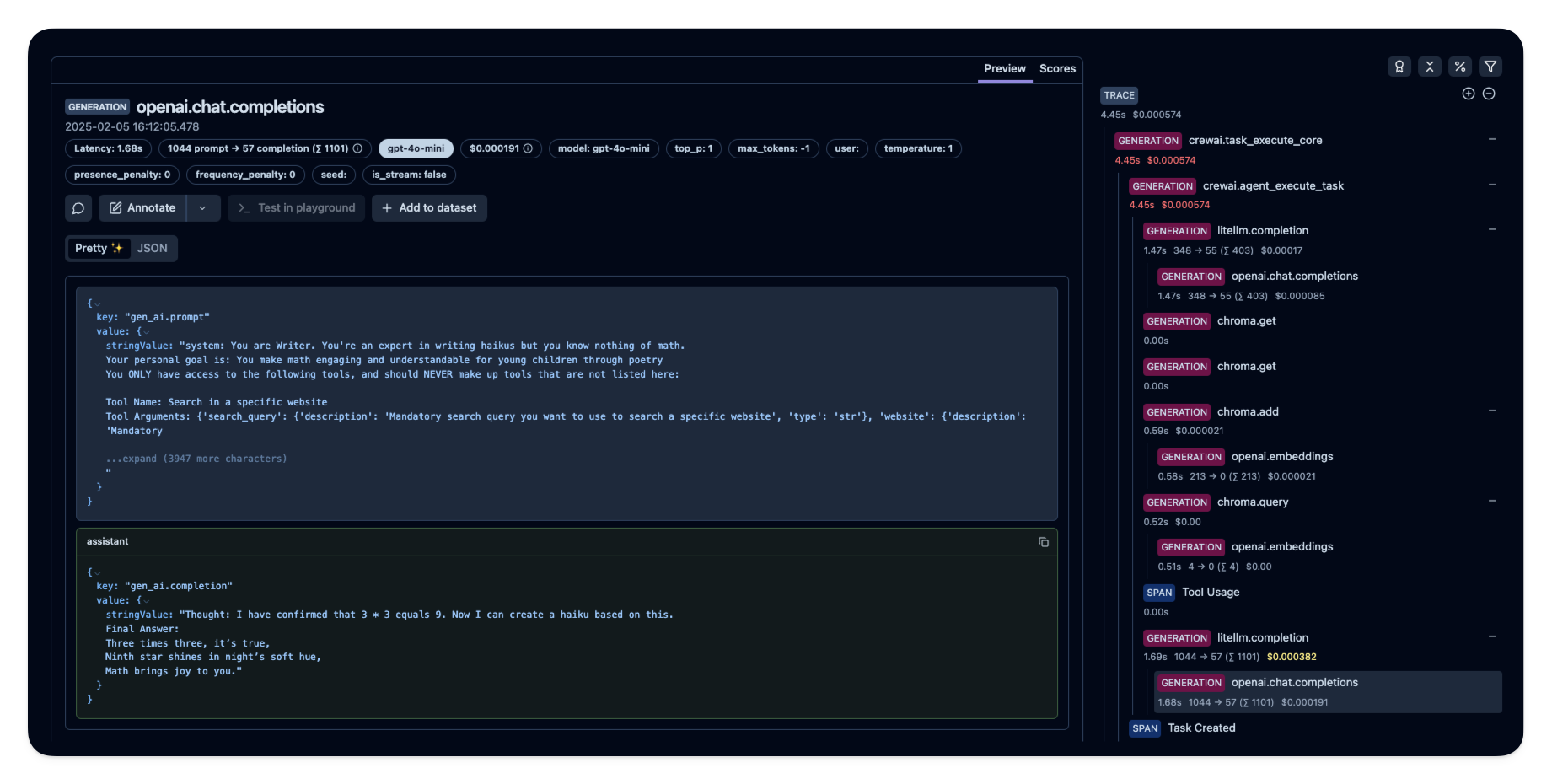
|
||||
|
||||
_[Public example trace in Langfuse](https://cloud.langfuse.com/project/cloramnkj0002jz088vzn1ja4/traces/e2cf380ffc8d47d28da98f136140642b?timestamp=2025-02-05T15%3A12%3A02.717Z&observation=3b32338ee6a5d9af)_
|
||||
|
||||
## References
|
||||
|
||||
- [Langfuse OpenTelemetry Docs](https://langfuse.com/docs/opentelemetry/get-started)
|
||||
@@ -1,5 +1,5 @@
|
||||
---
|
||||
title: Agent Monitoring with Langtrace
|
||||
title: Langtrace Integration
|
||||
description: How to monitor cost, latency, and performance of CrewAI Agents using Langtrace, an external observability tool.
|
||||
icon: chart-line
|
||||
---
|
||||
|
||||
@@ -23,6 +23,7 @@ LiteLLM supports a wide range of providers, including but not limited to:
|
||||
- Azure OpenAI
|
||||
- AWS (Bedrock, SageMaker)
|
||||
- Cohere
|
||||
- VoyageAI
|
||||
- Hugging Face
|
||||
- Ollama
|
||||
- Mistral AI
|
||||
@@ -32,6 +33,8 @@ LiteLLM supports a wide range of providers, including but not limited to:
|
||||
- Cloudflare Workers AI
|
||||
- DeepInfra
|
||||
- Groq
|
||||
- SambaNova
|
||||
- [NVIDIA NIMs](https://docs.api.nvidia.com/nim/reference/models-1)
|
||||
- And many more!
|
||||
|
||||
For a complete and up-to-date list of supported providers, please refer to the [LiteLLM Providers documentation](https://docs.litellm.ai/docs/providers).
|
||||
@@ -125,10 +128,10 @@ You can connect to OpenAI-compatible LLMs using either environment variables or
|
||||
</Tab>
|
||||
<Tab title="Using LLM Class Attributes">
|
||||
<CodeGroup>
|
||||
```python Code
|
||||
llm = LLM(
|
||||
model="custom-model-name",
|
||||
api_key="your-api-key",
|
||||
```python Code
|
||||
llm = LLM(
|
||||
model="custom-model-name",
|
||||
api_key="your-api-key",
|
||||
base_url="https://api.your-provider.com/v1"
|
||||
)
|
||||
agent = Agent(llm=llm, ...)
|
||||
@@ -179,4 +182,4 @@ This is particularly useful when working with OpenAI-compatible APIs or when you
|
||||
|
||||
## Conclusion
|
||||
|
||||
By leveraging LiteLLM, CrewAI offers seamless integration with a vast array of LLMs. This flexibility allows you to choose the most suitable model for your specific needs, whether you prioritize performance, cost-efficiency, or local deployment. Remember to consult the [LiteLLM documentation](https://docs.litellm.ai/docs/) for the most up-to-date information on supported models and configuration options.
|
||||
By leveraging LiteLLM, CrewAI offers seamless integration with a vast array of LLMs. This flexibility allows you to choose the most suitable model for your specific needs, whether you prioritize performance, cost-efficiency, or local deployment. Remember to consult the [LiteLLM documentation](https://docs.litellm.ai/docs/) for the most up-to-date information on supported models and configuration options.
|
||||
|
||||
206
docs/how-to/mlflow-observability.mdx
Normal file
@@ -0,0 +1,206 @@
|
||||
---
|
||||
title: MLflow Integration
|
||||
description: Quickly start monitoring your Agents with MLflow.
|
||||
icon: bars-staggered
|
||||
---
|
||||
|
||||
# MLflow Overview
|
||||
|
||||
[MLflow](https://mlflow.org/) is an open-source platform to assist machine learning practitioners and teams in handling the complexities of the machine learning process.
|
||||
|
||||
It provides a tracing feature that enhances LLM observability in your Generative AI applications by capturing detailed information about the execution of your application’s services.
|
||||
Tracing provides a way to record the inputs, outputs, and metadata associated with each intermediate step of a request, enabling you to easily pinpoint the source of bugs and unexpected behaviors.
|
||||
|
||||

|
||||
|
||||
### Features
|
||||
|
||||
- **Tracing Dashboard**: Monitor activities of your crewAI agents with detailed dashboards that include inputs, outputs and metadata of spans.
|
||||
- **Automated Tracing**: A fully automated integration with crewAI, which can be enabled by running `mlflow.crewai.autolog()`.
|
||||
- **Manual Trace Instrumentation with minor efforts**: Customize trace instrumentation through MLflow's high-level fluent APIs such as decorators, function wrappers and context managers.
|
||||
- **OpenTelemetry Compatibility**: MLflow Tracing supports exporting traces to an OpenTelemetry Collector, which can then be used to export traces to various backends such as Jaeger, Zipkin, and AWS X-Ray.
|
||||
- **Package and Deploy Agents**: Package and deploy your crewAI agents to an inference server with a variety of deployment targets.
|
||||
- **Securely Host LLMs**: Host multiple LLM from various providers in one unified endpoint through MFflow gateway.
|
||||
- **Evaluation**: Evaluate your crewAI agents with a wide range of metrics using a convenient API `mlflow.evaluate()`.
|
||||
|
||||
## Setup Instructions
|
||||
|
||||
<Steps>
|
||||
<Step title="Install MLflow package">
|
||||
```shell
|
||||
# The crewAI integration is available in mlflow>=2.19.0
|
||||
pip install mlflow
|
||||
```
|
||||
</Step>
|
||||
<Step title="Start MFflow tracking server">
|
||||
```shell
|
||||
# This process is optional, but it is recommended to use MLflow tracking server for better visualization and broader features.
|
||||
mlflow server
|
||||
```
|
||||
</Step>
|
||||
<Step title="Initialize MLflow in Your Application">
|
||||
Add the following two lines to your application code:
|
||||
|
||||
```python
|
||||
import mlflow
|
||||
|
||||
mlflow.crewai.autolog()
|
||||
|
||||
# Optional: Set a tracking URI and an experiment name if you have a tracking server
|
||||
mlflow.set_tracking_uri("http://localhost:5000")
|
||||
mlflow.set_experiment("CrewAI")
|
||||
```
|
||||
|
||||
Example Usage for tracing CrewAI Agents:
|
||||
|
||||
```python
|
||||
from crewai import Agent, Crew, Task
|
||||
from crewai.knowledge.source.string_knowledge_source import StringKnowledgeSource
|
||||
from crewai_tools import SerperDevTool, WebsiteSearchTool
|
||||
|
||||
from textwrap import dedent
|
||||
|
||||
content = "Users name is John. He is 30 years old and lives in San Francisco."
|
||||
string_source = StringKnowledgeSource(
|
||||
content=content, metadata={"preference": "personal"}
|
||||
)
|
||||
|
||||
search_tool = WebsiteSearchTool()
|
||||
|
||||
|
||||
class TripAgents:
|
||||
def city_selection_agent(self):
|
||||
return Agent(
|
||||
role="City Selection Expert",
|
||||
goal="Select the best city based on weather, season, and prices",
|
||||
backstory="An expert in analyzing travel data to pick ideal destinations",
|
||||
tools=[
|
||||
search_tool,
|
||||
],
|
||||
verbose=True,
|
||||
)
|
||||
|
||||
def local_expert(self):
|
||||
return Agent(
|
||||
role="Local Expert at this city",
|
||||
goal="Provide the BEST insights about the selected city",
|
||||
backstory="""A knowledgeable local guide with extensive information
|
||||
about the city, it's attractions and customs""",
|
||||
tools=[search_tool],
|
||||
verbose=True,
|
||||
)
|
||||
|
||||
|
||||
class TripTasks:
|
||||
def identify_task(self, agent, origin, cities, interests, range):
|
||||
return Task(
|
||||
description=dedent(
|
||||
f"""
|
||||
Analyze and select the best city for the trip based
|
||||
on specific criteria such as weather patterns, seasonal
|
||||
events, and travel costs. This task involves comparing
|
||||
multiple cities, considering factors like current weather
|
||||
conditions, upcoming cultural or seasonal events, and
|
||||
overall travel expenses.
|
||||
Your final answer must be a detailed
|
||||
report on the chosen city, and everything you found out
|
||||
about it, including the actual flight costs, weather
|
||||
forecast and attractions.
|
||||
|
||||
Traveling from: {origin}
|
||||
City Options: {cities}
|
||||
Trip Date: {range}
|
||||
Traveler Interests: {interests}
|
||||
"""
|
||||
),
|
||||
agent=agent,
|
||||
expected_output="Detailed report on the chosen city including flight costs, weather forecast, and attractions",
|
||||
)
|
||||
|
||||
def gather_task(self, agent, origin, interests, range):
|
||||
return Task(
|
||||
description=dedent(
|
||||
f"""
|
||||
As a local expert on this city you must compile an
|
||||
in-depth guide for someone traveling there and wanting
|
||||
to have THE BEST trip ever!
|
||||
Gather information about key attractions, local customs,
|
||||
special events, and daily activity recommendations.
|
||||
Find the best spots to go to, the kind of place only a
|
||||
local would know.
|
||||
This guide should provide a thorough overview of what
|
||||
the city has to offer, including hidden gems, cultural
|
||||
hotspots, must-visit landmarks, weather forecasts, and
|
||||
high level costs.
|
||||
The final answer must be a comprehensive city guide,
|
||||
rich in cultural insights and practical tips,
|
||||
tailored to enhance the travel experience.
|
||||
|
||||
Trip Date: {range}
|
||||
Traveling from: {origin}
|
||||
Traveler Interests: {interests}
|
||||
"""
|
||||
),
|
||||
agent=agent,
|
||||
expected_output="Comprehensive city guide including hidden gems, cultural hotspots, and practical travel tips",
|
||||
)
|
||||
|
||||
|
||||
class TripCrew:
|
||||
def __init__(self, origin, cities, date_range, interests):
|
||||
self.cities = cities
|
||||
self.origin = origin
|
||||
self.interests = interests
|
||||
self.date_range = date_range
|
||||
|
||||
def run(self):
|
||||
agents = TripAgents()
|
||||
tasks = TripTasks()
|
||||
|
||||
city_selector_agent = agents.city_selection_agent()
|
||||
local_expert_agent = agents.local_expert()
|
||||
|
||||
identify_task = tasks.identify_task(
|
||||
city_selector_agent,
|
||||
self.origin,
|
||||
self.cities,
|
||||
self.interests,
|
||||
self.date_range,
|
||||
)
|
||||
gather_task = tasks.gather_task(
|
||||
local_expert_agent, self.origin, self.interests, self.date_range
|
||||
)
|
||||
|
||||
crew = Crew(
|
||||
agents=[city_selector_agent, local_expert_agent],
|
||||
tasks=[identify_task, gather_task],
|
||||
verbose=True,
|
||||
memory=True,
|
||||
knowledge={
|
||||
"sources": [string_source],
|
||||
"metadata": {"preference": "personal"},
|
||||
},
|
||||
)
|
||||
|
||||
result = crew.kickoff()
|
||||
return result
|
||||
|
||||
|
||||
trip_crew = TripCrew("California", "Tokyo", "Dec 12 - Dec 20", "sports")
|
||||
result = trip_crew.run()
|
||||
|
||||
print(result)
|
||||
```
|
||||
Refer to [MLflow Tracing Documentation](https://mlflow.org/docs/latest/llms/tracing/index.html) for more configurations and use cases.
|
||||
</Step>
|
||||
<Step title="Visualize Activities of Agents">
|
||||
Now traces for your crewAI agents are captured by MLflow.
|
||||
Let's visit MLflow tracking server to view the traces and get insights into your Agents.
|
||||
|
||||
Open `127.0.0.1:5000` on your browser to visit MLflow tracking server.
|
||||
<Frame caption="MLflow Tracing Dashboard">
|
||||
<img src="/images/mlflow1.png" alt="MLflow tracing example with crewai" />
|
||||
</Frame>
|
||||
</Step>
|
||||
</Steps>
|
||||
|
||||
140
docs/how-to/multimodal-agents.mdx
Normal file
@@ -0,0 +1,140 @@
|
||||
---
|
||||
title: Using Multimodal Agents
|
||||
description: Learn how to enable and use multimodal capabilities in your agents for processing images and other non-text content within the CrewAI framework.
|
||||
icon: video
|
||||
---
|
||||
|
||||
## Using Multimodal Agents
|
||||
|
||||
CrewAI supports multimodal agents that can process both text and non-text content like images. This guide will show you how to enable and use multimodal capabilities in your agents.
|
||||
|
||||
### Enabling Multimodal Capabilities
|
||||
|
||||
To create a multimodal agent, simply set the `multimodal` parameter to `True` when initializing your agent:
|
||||
|
||||
```python
|
||||
from crewai import Agent
|
||||
|
||||
agent = Agent(
|
||||
role="Image Analyst",
|
||||
goal="Analyze and extract insights from images",
|
||||
backstory="An expert in visual content interpretation with years of experience in image analysis",
|
||||
multimodal=True # This enables multimodal capabilities
|
||||
)
|
||||
```
|
||||
|
||||
When you set `multimodal=True`, the agent is automatically configured with the necessary tools for handling non-text content, including the `AddImageTool`.
|
||||
|
||||
### Working with Images
|
||||
|
||||
The multimodal agent comes pre-configured with the `AddImageTool`, which allows it to process images. You don't need to manually add this tool - it's automatically included when you enable multimodal capabilities.
|
||||
|
||||
Here's a complete example showing how to use a multimodal agent to analyze an image:
|
||||
|
||||
```python
|
||||
from crewai import Agent, Task, Crew
|
||||
|
||||
# Create a multimodal agent
|
||||
image_analyst = Agent(
|
||||
role="Product Analyst",
|
||||
goal="Analyze product images and provide detailed descriptions",
|
||||
backstory="Expert in visual product analysis with deep knowledge of design and features",
|
||||
multimodal=True
|
||||
)
|
||||
|
||||
# Create a task for image analysis
|
||||
task = Task(
|
||||
description="Analyze the product image at https://example.com/product.jpg and provide a detailed description",
|
||||
expected_output="A detailed description of the product image",
|
||||
agent=image_analyst
|
||||
)
|
||||
|
||||
# Create and run the crew
|
||||
crew = Crew(
|
||||
agents=[image_analyst],
|
||||
tasks=[task]
|
||||
)
|
||||
|
||||
result = crew.kickoff()
|
||||
```
|
||||
|
||||
### Advanced Usage with Context
|
||||
|
||||
You can provide additional context or specific questions about the image when creating tasks for multimodal agents. The task description can include specific aspects you want the agent to focus on:
|
||||
|
||||
```python
|
||||
from crewai import Agent, Task, Crew
|
||||
|
||||
# Create a multimodal agent for detailed analysis
|
||||
expert_analyst = Agent(
|
||||
role="Visual Quality Inspector",
|
||||
goal="Perform detailed quality analysis of product images",
|
||||
backstory="Senior quality control expert with expertise in visual inspection",
|
||||
multimodal=True # AddImageTool is automatically included
|
||||
)
|
||||
|
||||
# Create a task with specific analysis requirements
|
||||
inspection_task = Task(
|
||||
description="""
|
||||
Analyze the product image at https://example.com/product.jpg with focus on:
|
||||
1. Quality of materials
|
||||
2. Manufacturing defects
|
||||
3. Compliance with standards
|
||||
Provide a detailed report highlighting any issues found.
|
||||
""",
|
||||
expected_output="A detailed report highlighting any issues found",
|
||||
agent=expert_analyst
|
||||
)
|
||||
|
||||
# Create and run the crew
|
||||
crew = Crew(
|
||||
agents=[expert_analyst],
|
||||
tasks=[inspection_task]
|
||||
)
|
||||
|
||||
result = crew.kickoff()
|
||||
```
|
||||
|
||||
### Tool Details
|
||||
|
||||
When working with multimodal agents, the `AddImageTool` is automatically configured with the following schema:
|
||||
|
||||
```python
|
||||
class AddImageToolSchema:
|
||||
image_url: str # Required: The URL or path of the image to process
|
||||
action: Optional[str] = None # Optional: Additional context or specific questions about the image
|
||||
```
|
||||
|
||||
The multimodal agent will automatically handle the image processing through its built-in tools, allowing it to:
|
||||
- Access images via URLs or local file paths
|
||||
- Process image content with optional context or specific questions
|
||||
- Provide analysis and insights based on the visual information and task requirements
|
||||
|
||||
### Best Practices
|
||||
|
||||
When working with multimodal agents, keep these best practices in mind:
|
||||
|
||||
1. **Image Access**
|
||||
- Ensure your images are accessible via URLs that the agent can reach
|
||||
- For local images, consider hosting them temporarily or using absolute file paths
|
||||
- Verify that image URLs are valid and accessible before running tasks
|
||||
|
||||
2. **Task Description**
|
||||
- Be specific about what aspects of the image you want the agent to analyze
|
||||
- Include clear questions or requirements in the task description
|
||||
- Consider using the optional `action` parameter for focused analysis
|
||||
|
||||
3. **Resource Management**
|
||||
- Image processing may require more computational resources than text-only tasks
|
||||
- Some language models may require base64 encoding for image data
|
||||
- Consider batch processing for multiple images to optimize performance
|
||||
|
||||
4. **Environment Setup**
|
||||
- Verify that your environment has the necessary dependencies for image processing
|
||||
- Ensure your language model supports multimodal capabilities
|
||||
- Test with small images first to validate your setup
|
||||
|
||||
5. **Error Handling**
|
||||
- Implement proper error handling for image loading failures
|
||||
- Have fallback strategies for when image processing fails
|
||||
- Monitor and log image processing operations for debugging
|
||||
181
docs/how-to/openlit-observability.mdx
Normal file
@@ -0,0 +1,181 @@
|
||||
---
|
||||
title: OpenLIT Integration
|
||||
description: Quickly start monitoring your Agents in just a single line of code with OpenTelemetry.
|
||||
icon: magnifying-glass-chart
|
||||
---
|
||||
|
||||
# OpenLIT Overview
|
||||
|
||||
[OpenLIT](https://github.com/openlit/openlit?src=crewai-docs) is an open-source tool that makes it simple to monitor the performance of AI agents, LLMs, VectorDBs, and GPUs with just **one** line of code.
|
||||
|
||||
It provides OpenTelemetry-native tracing and metrics to track important parameters like cost, latency, interactions and task sequences.
|
||||
This setup enables you to track hyperparameters and monitor for performance issues, helping you find ways to enhance and fine-tune your agents over time.
|
||||
|
||||
<Frame caption="OpenLIT Dashboard">
|
||||
<img src="/images/openlit1.png" alt="Overview Agent usage including cost and tokens" />
|
||||
<img src="/images/openlit2.png" alt="Overview of agent otel traces and metrics" />
|
||||
<img src="/images/openlit3.png" alt="Overview of agent traces in details" />
|
||||
</Frame>
|
||||
|
||||
### Features
|
||||
|
||||
- **Analytics Dashboard**: Monitor your Agents health and performance with detailed dashboards that track metrics, costs, and user interactions.
|
||||
- **OpenTelemetry-native Observability SDK**: Vendor-neutral SDKs to send traces and metrics to your existing observability tools like Grafana, DataDog and more.
|
||||
- **Cost Tracking for Custom and Fine-Tuned Models**: Tailor cost estimations for specific models using custom pricing files for precise budgeting.
|
||||
- **Exceptions Monitoring Dashboard**: Quickly spot and resolve issues by tracking common exceptions and errors with a monitoring dashboard.
|
||||
- **Compliance and Security**: Detect potential threats such as profanity and PII leaks.
|
||||
- **Prompt Injection Detection**: Identify potential code injection and secret leaks.
|
||||
- **API Keys and Secrets Management**: Securely handle your LLM API keys and secrets centrally, avoiding insecure practices.
|
||||
- **Prompt Management**: Manage and version Agent prompts using PromptHub for consistent and easy access across Agents.
|
||||
- **Model Playground** Test and compare different models for your CrewAI agents before deployment.
|
||||
|
||||
## Setup Instructions
|
||||
|
||||
<Steps>
|
||||
<Step title="Deploy OpenLIT">
|
||||
<Steps>
|
||||
<Step title="Git Clone OpenLIT Repository">
|
||||
```shell
|
||||
git clone git@github.com:openlit/openlit.git
|
||||
```
|
||||
</Step>
|
||||
<Step title="Start Docker Compose">
|
||||
From the root directory of the [OpenLIT Repo](https://github.com/openlit/openlit), Run the below command:
|
||||
```shell
|
||||
docker compose up -d
|
||||
```
|
||||
</Step>
|
||||
</Steps>
|
||||
</Step>
|
||||
<Step title="Install OpenLIT SDK">
|
||||
```shell
|
||||
pip install openlit
|
||||
```
|
||||
</Step>
|
||||
<Step title="Initialize OpenLIT in Your Application">
|
||||
Add the following two lines to your application code:
|
||||
<Tabs>
|
||||
<Tab title="Setup using function arguments">
|
||||
```python
|
||||
import openlit
|
||||
openlit.init(otlp_endpoint="http://127.0.0.1:4318")
|
||||
```
|
||||
|
||||
Example Usage for monitoring a CrewAI Agent:
|
||||
|
||||
```python
|
||||
from crewai import Agent, Task, Crew, Process
|
||||
import openlit
|
||||
|
||||
openlit.init(disable_metrics=True)
|
||||
# Define your agents
|
||||
researcher = Agent(
|
||||
role="Researcher",
|
||||
goal="Conduct thorough research and analysis on AI and AI agents",
|
||||
backstory="You're an expert researcher, specialized in technology, software engineering, AI, and startups. You work as a freelancer and are currently researching for a new client.",
|
||||
allow_delegation=False,
|
||||
llm='command-r'
|
||||
)
|
||||
|
||||
|
||||
# Define your task
|
||||
task = Task(
|
||||
description="Generate a list of 5 interesting ideas for an article, then write one captivating paragraph for each idea that showcases the potential of a full article on this topic. Return the list of ideas with their paragraphs and your notes.",
|
||||
expected_output="5 bullet points, each with a paragraph and accompanying notes.",
|
||||
)
|
||||
|
||||
# Define the manager agent
|
||||
manager = Agent(
|
||||
role="Project Manager",
|
||||
goal="Efficiently manage the crew and ensure high-quality task completion",
|
||||
backstory="You're an experienced project manager, skilled in overseeing complex projects and guiding teams to success. Your role is to coordinate the efforts of the crew members, ensuring that each task is completed on time and to the highest standard.",
|
||||
allow_delegation=True,
|
||||
llm='command-r'
|
||||
)
|
||||
|
||||
# Instantiate your crew with a custom manager
|
||||
crew = Crew(
|
||||
agents=[researcher],
|
||||
tasks=[task],
|
||||
manager_agent=manager,
|
||||
process=Process.hierarchical,
|
||||
)
|
||||
|
||||
# Start the crew's work
|
||||
result = crew.kickoff()
|
||||
|
||||
print(result)
|
||||
```
|
||||
</Tab>
|
||||
<Tab title="Setup using Environment Variables">
|
||||
|
||||
Add the following two lines to your application code:
|
||||
```python
|
||||
import openlit
|
||||
|
||||
openlit.init()
|
||||
```
|
||||
|
||||
Run the following command to configure the OTEL export endpoint:
|
||||
```shell
|
||||
export OTEL_EXPORTER_OTLP_ENDPOINT = "http://127.0.0.1:4318"
|
||||
```
|
||||
|
||||
Example Usage for monitoring a CrewAI Async Agent:
|
||||
|
||||
```python
|
||||
import asyncio
|
||||
from crewai import Crew, Agent, Task
|
||||
import openlit
|
||||
|
||||
openlit.init(otlp_endpoint="http://127.0.0.1:4318")
|
||||
|
||||
# Create an agent with code execution enabled
|
||||
coding_agent = Agent(
|
||||
role="Python Data Analyst",
|
||||
goal="Analyze data and provide insights using Python",
|
||||
backstory="You are an experienced data analyst with strong Python skills.",
|
||||
allow_code_execution=True,
|
||||
llm="command-r"
|
||||
)
|
||||
|
||||
# Create a task that requires code execution
|
||||
data_analysis_task = Task(
|
||||
description="Analyze the given dataset and calculate the average age of participants. Ages: {ages}",
|
||||
agent=coding_agent,
|
||||
expected_output="5 bullet points, each with a paragraph and accompanying notes.",
|
||||
)
|
||||
|
||||
# Create a crew and add the task
|
||||
analysis_crew = Crew(
|
||||
agents=[coding_agent],
|
||||
tasks=[data_analysis_task]
|
||||
)
|
||||
|
||||
# Async function to kickoff the crew asynchronously
|
||||
async def async_crew_execution():
|
||||
result = await analysis_crew.kickoff_async(inputs={"ages": [25, 30, 35, 40, 45]})
|
||||
print("Crew Result:", result)
|
||||
|
||||
# Run the async function
|
||||
asyncio.run(async_crew_execution())
|
||||
```
|
||||
</Tab>
|
||||
</Tabs>
|
||||
Refer to OpenLIT [Python SDK repository](https://github.com/openlit/openlit/tree/main/sdk/python) for more advanced configurations and use cases.
|
||||
</Step>
|
||||
<Step title="Visualize and Analyze">
|
||||
With the Agent Observability data now being collected and sent to OpenLIT, the next step is to visualize and analyze this data to get insights into your Agent's performance, behavior, and identify areas of improvement.
|
||||
|
||||
Just head over to OpenLIT at `127.0.0.1:3000` on your browser to start exploring. You can login using the default credentials
|
||||
- **Email**: `user@openlit.io`
|
||||
- **Password**: `openlituser`
|
||||
|
||||
<Frame caption="OpenLIT Dashboard">
|
||||
<img src="/images/openlit1.png" alt="Overview Agent usage including cost and tokens" />
|
||||
<img src="/images/openlit2.png" alt="Overview of agent otel traces and metrics" />
|
||||
</Frame>
|
||||
|
||||
</Step>
|
||||
</Steps>
|
||||
|
||||
202
docs/how-to/portkey-observability.mdx
Normal file
@@ -0,0 +1,202 @@
|
||||
---
|
||||
title: Portkey Integration
|
||||
description: How to use Portkey with CrewAI
|
||||
icon: key
|
||||
---
|
||||
|
||||
<img src="https://raw.githubusercontent.com/siddharthsambharia-portkey/Portkey-Product-Images/main/Portkey-CrewAI.png" alt="Portkey CrewAI Header Image" width="70%" />
|
||||
|
||||
|
||||
[Portkey](https://portkey.ai/?utm_source=crewai&utm_medium=crewai&utm_campaign=crewai) is a 2-line upgrade to make your CrewAI agents reliable, cost-efficient, and fast.
|
||||
|
||||
Portkey adds 4 core production capabilities to any CrewAI agent:
|
||||
1. Routing to **200+ LLMs**
|
||||
2. Making each LLM call more robust
|
||||
3. Full-stack tracing & cost, performance analytics
|
||||
4. Real-time guardrails to enforce behavior
|
||||
|
||||
## Getting Started
|
||||
|
||||
<Steps>
|
||||
<Step title="Install CrewAI and Portkey">
|
||||
```bash
|
||||
pip install -qU crewai portkey-ai
|
||||
```
|
||||
</Step>
|
||||
<Step title="Configure the LLM Client">
|
||||
To build CrewAI Agents with Portkey, you'll need two keys:
|
||||
- **Portkey API Key**: Sign up on the [Portkey app](https://app.portkey.ai/?utm_source=crewai&utm_medium=crewai&utm_campaign=crewai) and copy your API key
|
||||
- **Virtual Key**: Virtual Keys securely manage your LLM API keys in one place. Store your LLM provider API keys securely in Portkey's vault
|
||||
|
||||
```python
|
||||
from crewai import LLM
|
||||
from portkey_ai import createHeaders, PORTKEY_GATEWAY_URL
|
||||
|
||||
gpt_llm = LLM(
|
||||
model="gpt-4",
|
||||
base_url=PORTKEY_GATEWAY_URL,
|
||||
api_key="dummy", # We are using Virtual key
|
||||
extra_headers=createHeaders(
|
||||
api_key="YOUR_PORTKEY_API_KEY",
|
||||
virtual_key="YOUR_VIRTUAL_KEY", # Enter your Virtual key from Portkey
|
||||
)
|
||||
)
|
||||
```
|
||||
</Step>
|
||||
<Step title="Create and Run Your First Agent">
|
||||
```python
|
||||
from crewai import Agent, Task, Crew
|
||||
|
||||
# Define your agents with roles and goals
|
||||
coder = Agent(
|
||||
role='Software developer',
|
||||
goal='Write clear, concise code on demand',
|
||||
backstory='An expert coder with a keen eye for software trends.',
|
||||
llm=gpt_llm
|
||||
)
|
||||
|
||||
# Create tasks for your agents
|
||||
task1 = Task(
|
||||
description="Define the HTML for making a simple website with heading- Hello World! Portkey is working!",
|
||||
expected_output="A clear and concise HTML code",
|
||||
agent=coder
|
||||
)
|
||||
|
||||
# Instantiate your crew
|
||||
crew = Crew(
|
||||
agents=[coder],
|
||||
tasks=[task1],
|
||||
)
|
||||
|
||||
result = crew.kickoff()
|
||||
print(result)
|
||||
```
|
||||
</Step>
|
||||
</Steps>
|
||||
|
||||
## Key Features
|
||||
|
||||
| Feature | Description |
|
||||
|:--------|:------------|
|
||||
| 🌐 Multi-LLM Support | Access OpenAI, Anthropic, Gemini, Azure, and 250+ providers through a unified interface |
|
||||
| 🛡️ Production Reliability | Implement retries, timeouts, load balancing, and fallbacks |
|
||||
| 📊 Advanced Observability | Track 40+ metrics including costs, tokens, latency, and custom metadata |
|
||||
| 🔍 Comprehensive Logging | Debug with detailed execution traces and function call logs |
|
||||
| 🚧 Security Controls | Set budget limits and implement role-based access control |
|
||||
| 🔄 Performance Analytics | Capture and analyze feedback for continuous improvement |
|
||||
| 💾 Intelligent Caching | Reduce costs and latency with semantic or simple caching |
|
||||
|
||||
|
||||
## Production Features with Portkey Configs
|
||||
|
||||
All features mentioned below are through Portkey's Config system. Portkey's Config system allows you to define routing strategies using simple JSON objects in your LLM API calls. You can create and manage Configs directly in your code or through the Portkey Dashboard. Each Config has a unique ID for easy reference.
|
||||
|
||||
<Frame>
|
||||
<img src="https://raw.githubusercontent.com/Portkey-AI/docs-core/refs/heads/main/images/libraries/libraries-3.avif"/>
|
||||
</Frame>
|
||||
|
||||
|
||||
### 1. Use 250+ LLMs
|
||||
Access various LLMs like Anthropic, Gemini, Mistral, Azure OpenAI, and more with minimal code changes. Switch between providers or use them together seamlessly. [Learn more about Universal API](https://portkey.ai/docs/product/ai-gateway/universal-api)
|
||||
|
||||
|
||||
Easily switch between different LLM providers:
|
||||
|
||||
```python
|
||||
# Anthropic Configuration
|
||||
anthropic_llm = LLM(
|
||||
model="claude-3-5-sonnet-latest",
|
||||
base_url=PORTKEY_GATEWAY_URL,
|
||||
api_key="dummy",
|
||||
extra_headers=createHeaders(
|
||||
api_key="YOUR_PORTKEY_API_KEY",
|
||||
virtual_key="YOUR_ANTHROPIC_VIRTUAL_KEY", #You don't need provider when using Virtual keys
|
||||
trace_id="anthropic_agent"
|
||||
)
|
||||
)
|
||||
|
||||
# Azure OpenAI Configuration
|
||||
azure_llm = LLM(
|
||||
model="gpt-4",
|
||||
base_url=PORTKEY_GATEWAY_URL,
|
||||
api_key="dummy",
|
||||
extra_headers=createHeaders(
|
||||
api_key="YOUR_PORTKEY_API_KEY",
|
||||
virtual_key="YOUR_AZURE_VIRTUAL_KEY", #You don't need provider when using Virtual keys
|
||||
trace_id="azure_agent"
|
||||
)
|
||||
)
|
||||
```
|
||||
|
||||
|
||||
### 2. Caching
|
||||
Improve response times and reduce costs with two powerful caching modes:
|
||||
- **Simple Cache**: Perfect for exact matches
|
||||
- **Semantic Cache**: Matches responses for requests that are semantically similar
|
||||
[Learn more about Caching](https://portkey.ai/docs/product/ai-gateway/cache-simple-and-semantic)
|
||||
|
||||
```py
|
||||
config = {
|
||||
"cache": {
|
||||
"mode": "semantic", # or "simple" for exact matching
|
||||
}
|
||||
}
|
||||
```
|
||||
|
||||
### 3. Production Reliability
|
||||
Portkey provides comprehensive reliability features:
|
||||
- **Automatic Retries**: Handle temporary failures gracefully
|
||||
- **Request Timeouts**: Prevent hanging operations
|
||||
- **Conditional Routing**: Route requests based on specific conditions
|
||||
- **Fallbacks**: Set up automatic provider failovers
|
||||
- **Load Balancing**: Distribute requests efficiently
|
||||
|
||||
[Learn more about Reliability Features](https://portkey.ai/docs/product/ai-gateway/)
|
||||
|
||||
|
||||
|
||||
### 4. Metrics
|
||||
|
||||
Agent runs are complex. Portkey automatically logs **40+ comprehensive metrics** for your AI agents, including cost, tokens used, latency, etc. Whether you need a broad overview or granular insights into your agent runs, Portkey's customizable filters provide the metrics you need.
|
||||
|
||||
|
||||
- Cost per agent interaction
|
||||
- Response times and latency
|
||||
- Token usage and efficiency
|
||||
- Success/failure rates
|
||||
- Cache hit rates
|
||||
|
||||
<img src="https://github.com/siddharthsambharia-portkey/Portkey-Product-Images/blob/main/Portkey-Dashboard.png?raw=true" width="70%" alt="Portkey Dashboard" />
|
||||
|
||||
### 5. Detailed Logging
|
||||
Logs are essential for understanding agent behavior, diagnosing issues, and improving performance. They provide a detailed record of agent activities and tool use, which is crucial for debugging and optimizing processes.
|
||||
|
||||
|
||||
Access a dedicated section to view records of agent executions, including parameters, outcomes, function calls, and errors. Filter logs based on multiple parameters such as trace ID, model, tokens used, and metadata.
|
||||
|
||||
<details>
|
||||
<summary><b>Traces</b></summary>
|
||||
<img src="https://raw.githubusercontent.com/siddharthsambharia-portkey/Portkey-Product-Images/main/Portkey-Traces.png" alt="Portkey Traces" width="70%" />
|
||||
</details>
|
||||
|
||||
<details>
|
||||
<summary><b>Logs</b></summary>
|
||||
<img src="https://raw.githubusercontent.com/siddharthsambharia-portkey/Portkey-Product-Images/main/Portkey-Logs.png" alt="Portkey Logs" width="70%" />
|
||||
</details>
|
||||
|
||||
### 6. Enterprise Security Features
|
||||
- Set budget limit and rate limts per Virtual Key (disposable API keys)
|
||||
- Implement role-based access control
|
||||
- Track system changes with audit logs
|
||||
- Configure data retention policies
|
||||
|
||||
|
||||
|
||||
For detailed information on creating and managing Configs, visit the [Portkey documentation](https://docs.portkey.ai/product/ai-gateway/configs).
|
||||
|
||||
## Resources
|
||||
|
||||
- [📘 Portkey Documentation](https://docs.portkey.ai)
|
||||
- [📊 Portkey Dashboard](https://app.portkey.ai/?utm_source=crewai&utm_medium=crewai&utm_campaign=crewai)
|
||||
- [🐦 Twitter](https://twitter.com/portkeyai)
|
||||
- [💬 Discord Community](https://discord.gg/DD7vgKK299)
|
||||
124
docs/how-to/weave-integration.mdx
Normal file
@@ -0,0 +1,124 @@
|
||||
---
|
||||
title: Weave Integration
|
||||
description: Learn how to use Weights & Biases (W&B) Weave to track, experiment with, evaluate, and improve your CrewAI applications.
|
||||
icon: radar
|
||||
---
|
||||
|
||||
# Weave Overview
|
||||
|
||||
[Weights & Biases (W&B) Weave](https://weave-docs.wandb.ai/) is a framework for tracking, experimenting with, evaluating, deploying, and improving LLM-based applications.
|
||||
|
||||

|
||||
|
||||
Weave provides comprehensive support for every stage of your CrewAI application development:
|
||||
|
||||
- **Tracing & Monitoring**: Automatically track LLM calls and application logic to debug and analyze production systems
|
||||
- **Systematic Iteration**: Refine and iterate on prompts, datasets, and models
|
||||
- **Evaluation**: Use custom or pre-built scorers to systematically assess and enhance agent performance
|
||||
- **Guardrails**: Protect your agents with pre- and post-safeguards for content moderation and prompt safety
|
||||
|
||||
Weave automatically captures traces for your CrewAI applications, enabling you to monitor and analyze your agents' performance, interactions, and execution flow. This helps you build better evaluation datasets and optimize your agent workflows.
|
||||
|
||||
## Setup Instructions
|
||||
|
||||
<Steps>
|
||||
<Step title="Install required packages">
|
||||
```shell
|
||||
pip install crewai weave
|
||||
```
|
||||
</Step>
|
||||
<Step title="Set up W&B Account">
|
||||
Sign up for a [Weights & Biases account](https://wandb.ai) if you haven't already. You'll need this to view your traces and metrics.
|
||||
</Step>
|
||||
<Step title="Initialize Weave in Your Application">
|
||||
Add the following code to your application:
|
||||
|
||||
```python
|
||||
import weave
|
||||
|
||||
# Initialize Weave with your project name
|
||||
weave.init(project_name="crewai_demo")
|
||||
```
|
||||
|
||||
After initialization, Weave will provide a URL where you can view your traces and metrics.
|
||||
</Step>
|
||||
<Step title="Create your Crews/Flows">
|
||||
```python
|
||||
from crewai import Agent, Task, Crew, LLM, Process
|
||||
|
||||
# Create an LLM with a temperature of 0 to ensure deterministic outputs
|
||||
llm = LLM(model="gpt-4o", temperature=0)
|
||||
|
||||
# Create agents
|
||||
researcher = Agent(
|
||||
role='Research Analyst',
|
||||
goal='Find and analyze the best investment opportunities',
|
||||
backstory='Expert in financial analysis and market research',
|
||||
llm=llm,
|
||||
verbose=True,
|
||||
allow_delegation=False,
|
||||
)
|
||||
|
||||
writer = Agent(
|
||||
role='Report Writer',
|
||||
goal='Write clear and concise investment reports',
|
||||
backstory='Experienced in creating detailed financial reports',
|
||||
llm=llm,
|
||||
verbose=True,
|
||||
allow_delegation=False,
|
||||
)
|
||||
|
||||
# Create tasks
|
||||
research_task = Task(
|
||||
description='Deep research on the {topic}',
|
||||
expected_output='Comprehensive market data including key players, market size, and growth trends.',
|
||||
agent=researcher
|
||||
)
|
||||
|
||||
writing_task = Task(
|
||||
description='Write a detailed report based on the research',
|
||||
expected_output='The report should be easy to read and understand. Use bullet points where applicable.',
|
||||
agent=writer
|
||||
)
|
||||
|
||||
# Create a crew
|
||||
crew = Crew(
|
||||
agents=[researcher, writer],
|
||||
tasks=[research_task, writing_task],
|
||||
verbose=True,
|
||||
process=Process.sequential,
|
||||
)
|
||||
|
||||
# Run the crew
|
||||
result = crew.kickoff(inputs={"topic": "AI in material science"})
|
||||
print(result)
|
||||
```
|
||||
</Step>
|
||||
<Step title="View Traces in Weave">
|
||||
After running your CrewAI application, visit the Weave URL provided during initialization to view:
|
||||
- LLM calls and their metadata
|
||||
- Agent interactions and task execution flow
|
||||
- Performance metrics like latency and token usage
|
||||
- Any errors or issues that occurred during execution
|
||||
|
||||
<Frame caption="Weave Tracing Dashboard">
|
||||
<img src="/images/weave-tracing.png" alt="Weave tracing example with CrewAI" />
|
||||
</Frame>
|
||||
</Step>
|
||||
</Steps>
|
||||
|
||||
## Features
|
||||
|
||||
- Weave automatically captures all CrewAI operations: agent interactions and task executions; LLM calls with metadata and token usage; tool usage and results.
|
||||
- The integration supports all CrewAI execution methods: `kickoff()`, `kickoff_for_each()`, `kickoff_async()`, and `kickoff_for_each_async()`.
|
||||
- Automatic tracing of all [crewAI-tools](https://github.com/crewAIInc/crewAI-tools).
|
||||
- Flow feature support with decorator patching (`@start`, `@listen`, `@router`, `@or_`, `@and_`).
|
||||
- Track custom guardrails passed to CrewAI `Task` with `@weave.op()`.
|
||||
|
||||
For detailed information on what's supported, visit the [Weave CrewAI documentation](https://weave-docs.wandb.ai/guides/integrations/crewai/#getting-started-with-flow).
|
||||
|
||||
## Resources
|
||||
|
||||
- [📘 Weave Documentation](https://weave-docs.wandb.ai)
|
||||
- [📊 Example Weave x CrewAI dashboard](https://wandb.ai/ayut/crewai_demo/weave/traces?cols=%7B%22wb_run_id%22%3Afalse%2C%22attributes.weave.client_version%22%3Afalse%2C%22attributes.weave.os_name%22%3Afalse%2C%22attributes.weave.os_release%22%3Afalse%2C%22attributes.weave.os_version%22%3Afalse%2C%22attributes.weave.source%22%3Afalse%2C%22attributes.weave.sys_version%22%3Afalse%7D&peekPath=%2Fayut%2Fcrewai_demo%2Fcalls%2F0195c838-38cb-71a2-8a15-651ecddf9d89)
|
||||
- [🐦 X](https://x.com/weave_wb)
|
||||
BIN
docs/images/mlflow-tracing.gif
Normal file

|
After Width: | Height: | Size: 16 MiB |
BIN
docs/images/mlflow1.png
Normal file

|
After Width: | Height: | Size: 382 KiB |
BIN
docs/images/openlit1.png
Normal file

|
After Width: | Height: | Size: 390 KiB |
BIN
docs/images/openlit2.png
Normal file

|
After Width: | Height: | Size: 422 KiB |
BIN
docs/images/openlit3.png
Normal file

|
After Width: | Height: | Size: 799 KiB |
BIN
docs/images/weave-tracing.gif
Normal file

|
After Width: | Height: | Size: 13 MiB |
BIN
docs/images/weave-tracing.png
Normal file

|
After Width: | Height: | Size: 693 KiB |
@@ -1,128 +1,160 @@
|
||||
---
|
||||
title: Installation
|
||||
description:
|
||||
description: Get started with CrewAI - Install, configure, and build your first AI crew
|
||||
icon: wrench
|
||||
---
|
||||
|
||||
This guide will walk you through the installation process for CrewAI and its dependencies.
|
||||
CrewAI is a flexible and powerful AI framework that enables you to create and manage AI agents, tools, and tasks efficiently.
|
||||
Let's get started! 🚀
|
||||
<Note>
|
||||
**Python Version Requirements**
|
||||
|
||||
CrewAI requires `Python >=3.10 and <3.13`. Here's how to check your version:
|
||||
```bash
|
||||
python3 --version
|
||||
```
|
||||
|
||||
If you need to update Python, visit [python.org/downloads](https://python.org/downloads)
|
||||
</Note>
|
||||
|
||||
<Tip>
|
||||
Make sure you have `Python >=3.10 <=3.13` installed on your system before you proceed.
|
||||
</Tip>
|
||||
CrewAI uses the `uv` as its dependency management and package handling tool. It simplifies project setup and execution, offering a seamless experience.
|
||||
|
||||
If you haven't installed `uv` yet, follow **step 1** to quickly get it set up on your system, else you can skip to **step 2**.
|
||||
|
||||
<Steps>
|
||||
<Step title="Install CrewAI">
|
||||
Install the main CrewAI package with the following command:
|
||||
<CodeGroup>
|
||||
```shell Terminal
|
||||
pip install crewai
|
||||
```
|
||||
</CodeGroup>
|
||||
You can also install the main CrewAI package and the tools package that include a series of helpful tools for your agents:
|
||||
<CodeGroup>
|
||||
```shell Terminal
|
||||
pip install 'crewai[tools]'
|
||||
```
|
||||
</CodeGroup>
|
||||
Alternatively, you can also use:
|
||||
<CodeGroup>
|
||||
```shell Terminal
|
||||
pip install crewai crewai-tools
|
||||
```
|
||||
</CodeGroup>
|
||||
</Step>
|
||||
<Step title="Upgrade CrewAI">
|
||||
To upgrade CrewAI and CrewAI Tools to the latest version, run the following command
|
||||
<CodeGroup>
|
||||
```shell Terminal
|
||||
pip install --upgrade crewai crewai-tools
|
||||
```
|
||||
</CodeGroup>
|
||||
<Note>
|
||||
1. If you're using an older version of CrewAI, you may receive a warning about using `Poetry` for dependency management.
|
||||

|
||||
<Step title="Install uv">
|
||||
- **On macOS/Linux:**
|
||||
|
||||
2. In this case, you'll need to run the command below to update your project.
|
||||
This command will migrate your project to use [UV](https://github.com/astral-sh/uv) and update the necessary files.
|
||||
```shell Terminal
|
||||
crewai update
|
||||
Use `curl` to download the script and execute it with `sh`:
|
||||
|
||||
```shell
|
||||
curl -LsSf https://astral.sh/uv/install.sh | sh
|
||||
```
|
||||
3. After running the command above, you should see the following output:
|
||||

|
||||
If your system doesn't have `curl`, you can use `wget`:
|
||||
|
||||
4. You're all set! You can now proceed to the next step! 🎉
|
||||
</Note>
|
||||
```shell
|
||||
wget -qO- https://astral.sh/uv/install.sh | sh
|
||||
```
|
||||
|
||||
- **On Windows:**
|
||||
|
||||
Use `irm` to download the script and `iex` to execute it:
|
||||
|
||||
```shell
|
||||
powershell -ExecutionPolicy ByPass -c "irm https://astral.sh/uv/install.ps1 | iex"
|
||||
```
|
||||
If you run into any issues, refer to [UV's installation guide](https://docs.astral.sh/uv/getting-started/installation/) for more information.
|
||||
</Step>
|
||||
<Step title="Verify the installation">
|
||||
To verify that `crewai` and `crewai-tools` are installed correctly, run the following command
|
||||
<CodeGroup>
|
||||
```shell Terminal
|
||||
pip freeze | grep crewai
|
||||
```
|
||||
</CodeGroup>
|
||||
You should see the version number of `crewai` and `crewai-tools`.
|
||||
<CodeGroup>
|
||||
```markdown Version
|
||||
crewai==X.X.X
|
||||
crewai-tools==X.X.X
|
||||
```
|
||||
</CodeGroup>
|
||||
If you see the version number, then the installation was successful! 🎉
|
||||
|
||||
<Step title="Install CrewAI 🚀">
|
||||
- Run the following command to install `crewai` CLI:
|
||||
```shell
|
||||
uv tool install crewai
|
||||
```
|
||||
<Warning>
|
||||
If you encounter a `PATH` warning, run this command to update your shell:
|
||||
```shell
|
||||
uv tool update-shell
|
||||
```
|
||||
</Warning>
|
||||
|
||||
- To verify that `crewai` is installed, run:
|
||||
```shell
|
||||
uv tool list
|
||||
```
|
||||
- You should see something like:
|
||||
```shell
|
||||
crewai v0.102.0
|
||||
- crewai
|
||||
```
|
||||
- If you need to update `crewai`, run:
|
||||
```shell
|
||||
uv tool install crewai --upgrade
|
||||
```
|
||||
<Check>Installation successful! You're ready to create your first crew! 🎉</Check>
|
||||
</Step>
|
||||
</Steps>
|
||||
|
||||
## Create a new CrewAI project
|
||||
# Creating a CrewAI Project
|
||||
|
||||
The next step is to create a new CrewAI project.
|
||||
We recommend using the YAML Template scaffolding to get started as it provides a structured approach to defining agents and tasks.
|
||||
We recommend using the `YAML` template scaffolding for a structured approach to defining agents and tasks. Here's how to get started:
|
||||
|
||||
<Steps>
|
||||
<Step title="Create a new CrewAI project using the YAML Template Configuration">
|
||||
To create a new CrewAI project, run the following CLI (Command Line Interface) command:
|
||||
<CodeGroup>
|
||||
```shell Terminal
|
||||
crewai create crew <project_name>
|
||||
<Step title="Generate Project Scaffolding">
|
||||
- Run the `crewai` CLI command:
|
||||
```shell
|
||||
crewai create crew <your_project_name>
|
||||
```
|
||||
</CodeGroup>
|
||||
This command creates a new project folder with the following structure:
|
||||
| File/Directory | Description |
|
||||
|:------------------------|:-------------------------------------------------|
|
||||
| `my_project/` | Root directory of the project |
|
||||
| ├── `.gitignore` | Specifies files and directories to ignore in Git |
|
||||
| ├── `pyproject.toml` | Project configuration and dependencies |
|
||||
| ├── `README.md` | Project documentation |
|
||||
| ├── `.env` | Environment variables |
|
||||
| └── `src/` | Source code directory |
|
||||
| └── `my_project/` | Main application package |
|
||||
| ├── `__init__.py` | Marks the directory as a Python package |
|
||||
| ├── `main.py` | Main application script |
|
||||
| ├── `crew.py` | Crew-related functionalities |
|
||||
| ├── `tools/` | Custom tools directory |
|
||||
| │ ├── `custom_tool.py` | Custom tool implementation |
|
||||
| │ └── `__init__.py` | Marks tools directory as a package |
|
||||
| └── `config/` | Configuration files directory |
|
||||
| ├── `agents.yaml` | Agent configurations |
|
||||
| └── `tasks.yaml` | Task configurations |
|
||||
|
||||
You can now start developing your crew by editing the files in the `src/my_project` folder.
|
||||
The `main.py` file is the entry point of the project, the `crew.py` file is where you define your crew, the `agents.yaml` file is where you define your agents,
|
||||
and the `tasks.yaml` file is where you define your tasks.
|
||||
</Step>
|
||||
<Step title="Customize your project">
|
||||
To customize your project, you can:
|
||||
- Modify `src/my_project/config/agents.yaml` to define your agents.
|
||||
- Modify `src/my_project/config/tasks.yaml` to define your tasks.
|
||||
- Modify `src/my_project/crew.py` to add your own logic, tools, and specific arguments.
|
||||
- Modify `src/my_project/main.py` to add custom inputs for your agents and tasks.
|
||||
- Add your environment variables into the `.env` file.
|
||||
- This creates a new project with the following structure:
|
||||
<Frame>
|
||||
```
|
||||
my_project/
|
||||
├── .gitignore
|
||||
├── knowledge/
|
||||
├── pyproject.toml
|
||||
├── README.md
|
||||
├── .env
|
||||
└── src/
|
||||
└── my_project/
|
||||
├── __init__.py
|
||||
├── main.py
|
||||
├── crew.py
|
||||
├── tools/
|
||||
│ ├── custom_tool.py
|
||||
│ └── __init__.py
|
||||
└── config/
|
||||
├── agents.yaml
|
||||
└── tasks.yaml
|
||||
```
|
||||
</Frame>
|
||||
</Step>
|
||||
|
||||
<Step title="Customize Your Project">
|
||||
- Your project will contain these essential files:
|
||||
| File | Purpose |
|
||||
| --- | --- |
|
||||
| `agents.yaml` | Define your AI agents and their roles |
|
||||
| `tasks.yaml` | Set up agent tasks and workflows |
|
||||
| `.env` | Store API keys and environment variables |
|
||||
| `main.py` | Project entry point and execution flow |
|
||||
| `crew.py` | Crew orchestration and coordination |
|
||||
| `tools/` | Directory for custom agent tools |
|
||||
| `knowledge/` | Directory for knowledge base |
|
||||
|
||||
- Start by editing `agents.yaml` and `tasks.yaml` to define your crew's behavior.
|
||||
- Keep sensitive information like API keys in `.env`.
|
||||
</Step>
|
||||
|
||||
<Step title="Run your Crew">
|
||||
- Before you run your crew, make sure to run:
|
||||
```bash
|
||||
crewai install
|
||||
```
|
||||
- If you need to install additional packages, use:
|
||||
```shell
|
||||
uv add <package-name>
|
||||
```
|
||||
- To run your crew, execute the following command in the root of your project:
|
||||
```bash
|
||||
crewai run
|
||||
```
|
||||
</Step>
|
||||
</Steps>
|
||||
|
||||
## Next steps
|
||||
## Next Steps
|
||||
|
||||
Now that you have installed `crewai` and `crewai-tools`, you're ready to spin up your first crew!
|
||||
|
||||
- 👨💻 Build your first agent with CrewAI by following the [Quickstart](/quickstart) guide.
|
||||
- 💬 Join the [Community](https://community.crewai.com) to get help and share your feedback.
|
||||
<CardGroup cols={2}>
|
||||
<Card
|
||||
title="Build Your First Agent"
|
||||
icon="code"
|
||||
href="/quickstart"
|
||||
>
|
||||
Follow our quickstart guide to create your first CrewAI agent and get hands-on experience.
|
||||
</Card>
|
||||
<Card
|
||||
title="Join the Community"
|
||||
icon="comments"
|
||||
href="https://community.crewai.com"
|
||||
>
|
||||
Connect with other developers, get help, and share your CrewAI experiences.
|
||||
</Card>
|
||||
</CardGroup>
|
||||
|
||||
@@ -1,49 +1,163 @@
|
||||
---
|
||||
title: Introduction
|
||||
description: Welcome to CrewAI docs!
|
||||
description: Build AI agent teams that work together to tackle complex tasks
|
||||
icon: handshake
|
||||
---
|
||||
|
||||
# What is CrewAI?
|
||||
|
||||
**CrewAI is a cutting-edge Python framework for orchestrating role-playing, autonomous AI agents.**
|
||||
**CrewAI is a lean, lightning-fast Python framework built entirely from scratch—completely independent of LangChain or other agent frameworks.**
|
||||
|
||||
By fostering collaborative intelligence, CrewAI empowers agents to work together seamlessly, tackling complex tasks.
|
||||
CrewAI empowers developers with both high-level simplicity and precise low-level control, ideal for creating autonomous AI agents tailored to any scenario:
|
||||
|
||||
<Frame caption="CrewAI Mindmap">
|
||||
<img src="crewAI-mindmap.png" alt="CrewAI Mindmap" />
|
||||
</Frame>
|
||||
- **[CrewAI Crews](/guides/crews/first-crew)**: Optimize for autonomy and collaborative intelligence, enabling you to create AI teams where each agent has specific roles, tools, and goals.
|
||||
- **[CrewAI Flows](/guides/flows/first-flow)**: Enable granular, event-driven control, single LLM calls for precise task orchestration and supports Crews natively.
|
||||
|
||||
## Why CrewAI?
|
||||
- 🤼♀️ **Role-Playing Agents**: Agents can take on different roles and personas to better understand and interact with complex systems.
|
||||
- 🤖 **Autonomous Decision Making**: Agents can make decisions autonomously based on the given context and available tools.
|
||||
- 🤝 **Seamless Collaboration**: Agents can work together seamlessly, sharing information and resources to achieve common goals.
|
||||
- 🧠 **Complex Task Tackling**: CrewAI is designed to tackle complex tasks, such as multi-step workflows, decision making, and problem solving.
|
||||
With over 100,000 developers certified through our community courses, CrewAI is rapidly becoming the standard for enterprise-ready AI automation.
|
||||
|
||||
# Get Started with CrewAI
|
||||
## How Crews Work
|
||||
|
||||
<Note>
|
||||
Just like a company has departments (Sales, Engineering, Marketing) working together under leadership to achieve business goals, CrewAI helps you create an organization of AI agents with specialized roles collaborating to accomplish complex tasks.
|
||||
</Note>
|
||||
|
||||
<Frame caption="CrewAI Framework Overview">
|
||||
<img src="crews.png" alt="CrewAI Framework Overview" />
|
||||
</Frame>
|
||||
|
||||
| Component | Description | Key Features |
|
||||
|:----------|:-----------:|:------------|
|
||||
| **Crew** | The top-level organization | • Manages AI agent teams<br/>• Oversees workflows<br/>• Ensures collaboration<br/>• Delivers outcomes |
|
||||
| **AI Agents** | Specialized team members | • Have specific roles (researcher, writer)<br/>• Use designated tools<br/>• Can delegate tasks<br/>• Make autonomous decisions |
|
||||
| **Process** | Workflow management system | • Defines collaboration patterns<br/>• Controls task assignments<br/>• Manages interactions<br/>• Ensures efficient execution |
|
||||
| **Tasks** | Individual assignments | • Have clear objectives<br/>• Use specific tools<br/>• Feed into larger process<br/>• Produce actionable results |
|
||||
|
||||
### How It All Works Together
|
||||
|
||||
1. The **Crew** organizes the overall operation
|
||||
2. **AI Agents** work on their specialized tasks
|
||||
3. The **Process** ensures smooth collaboration
|
||||
4. **Tasks** get completed to achieve the goal
|
||||
|
||||
## Key Features
|
||||
|
||||
<CardGroup cols={2}>
|
||||
<Card title="Role-Based Agents" icon="users">
|
||||
Create specialized agents with defined roles, expertise, and goals - from researchers to analysts to writers
|
||||
</Card>
|
||||
<Card title="Flexible Tools" icon="screwdriver-wrench">
|
||||
Equip agents with custom tools and APIs to interact with external services and data sources
|
||||
</Card>
|
||||
<Card title="Intelligent Collaboration" icon="people-arrows">
|
||||
Agents work together, sharing insights and coordinating tasks to achieve complex objectives
|
||||
</Card>
|
||||
<Card title="Task Management" icon="list-check">
|
||||
Define sequential or parallel workflows, with agents automatically handling task dependencies
|
||||
</Card>
|
||||
</CardGroup>
|
||||
|
||||
## How Flows Work
|
||||
|
||||
<Note>
|
||||
While Crews excel at autonomous collaboration, Flows provide structured automations, offering granular control over workflow execution. Flows ensure tasks are executed reliably, securely, and efficiently, handling conditional logic, loops, and dynamic state management with precision. Flows integrate seamlessly with Crews, enabling you to balance high autonomy with exacting control.
|
||||
</Note>
|
||||
|
||||
<Frame caption="CrewAI Framework Overview">
|
||||
<img src="flows.png" alt="CrewAI Framework Overview" />
|
||||
</Frame>
|
||||
|
||||
| Component | Description | Key Features |
|
||||
|:----------|:-----------:|:------------|
|
||||
| **Flow** | Structured workflow orchestration | • Manages execution paths<br/>• Handles state transitions<br/>• Controls task sequencing<br/>• Ensures reliable execution |
|
||||
| **Events** | Triggers for workflow actions | • Initiate specific processes<br/>• Enable dynamic responses<br/>• Support conditional branching<br/>• Allow for real-time adaptation |
|
||||
| **States** | Workflow execution contexts | • Maintain execution data<br/>• Enable persistence<br/>• Support resumability<br/>• Ensure execution integrity |
|
||||
| **Crew Support** | Enhances workflow automation | • Injects pockets of agency when needed<br/>• Complements structured workflows<br/>• Balances automation with intelligence<br/>• Enables adaptive decision-making |
|
||||
|
||||
### Key Capabilities
|
||||
|
||||
<CardGroup cols={2}>
|
||||
<Card title="Event-Driven Orchestration" icon="bolt">
|
||||
Define precise execution paths responding dynamically to events
|
||||
</Card>
|
||||
<Card title="Fine-Grained Control" icon="sliders">
|
||||
Manage workflow states and conditional execution securely and efficiently
|
||||
</Card>
|
||||
<Card title="Native Crew Integration" icon="puzzle-piece">
|
||||
Effortlessly combine with Crews for enhanced autonomy and intelligence
|
||||
</Card>
|
||||
<Card title="Deterministic Execution" icon="route">
|
||||
Ensure predictable outcomes with explicit control flow and error handling
|
||||
</Card>
|
||||
</CardGroup>
|
||||
|
||||
## When to Use Crews vs. Flows
|
||||
|
||||
<Note>
|
||||
Understanding when to use [Crews](/guides/crews/first-crew) versus [Flows](/guides/flows/first-flow) is key to maximizing the potential of CrewAI in your applications.
|
||||
</Note>
|
||||
|
||||
| Use Case | Recommended Approach | Why? |
|
||||
|:---------|:---------------------|:-----|
|
||||
| **Open-ended research** | [Crews](/guides/crews/first-crew) | When tasks require creative thinking, exploration, and adaptation |
|
||||
| **Content generation** | [Crews](/guides/crews/first-crew) | For collaborative creation of articles, reports, or marketing materials |
|
||||
| **Decision workflows** | [Flows](/guides/flows/first-flow) | When you need predictable, auditable decision paths with precise control |
|
||||
| **API orchestration** | [Flows](/guides/flows/first-flow) | For reliable integration with multiple external services in a specific sequence |
|
||||
| **Hybrid applications** | Combined approach | Use [Flows](/guides/flows/first-flow) to orchestrate overall process with [Crews](/guides/crews/first-crew) handling complex subtasks |
|
||||
|
||||
### Decision Framework
|
||||
|
||||
- **Choose [Crews](/guides/crews/first-crew) when:** You need autonomous problem-solving, creative collaboration, or exploratory tasks
|
||||
- **Choose [Flows](/guides/flows/first-flow) when:** You require deterministic outcomes, auditability, or precise control over execution
|
||||
- **Combine both when:** Your application needs both structured processes and pockets of autonomous intelligence
|
||||
|
||||
## Why Choose CrewAI?
|
||||
|
||||
- 🧠 **Autonomous Operation**: Agents make intelligent decisions based on their roles and available tools
|
||||
- 📝 **Natural Interaction**: Agents communicate and collaborate like human team members
|
||||
- 🛠️ **Extensible Design**: Easy to add new tools, roles, and capabilities
|
||||
- 🚀 **Production Ready**: Built for reliability and scalability in real-world applications
|
||||
- 🔒 **Security-Focused**: Designed with enterprise security requirements in mind
|
||||
- 💰 **Cost-Efficient**: Optimized to minimize token usage and API calls
|
||||
|
||||
## Ready to Start Building?
|
||||
|
||||
<CardGroup cols={2}>
|
||||
<Card
|
||||
title="Quickstart"
|
||||
color="#F3A78B"
|
||||
href="quickstart"
|
||||
icon="terminal"
|
||||
iconType="solid"
|
||||
title="Build Your First Crew"
|
||||
icon="users-gear"
|
||||
href="/guides/crews/first-crew"
|
||||
>
|
||||
Getting started with CrewAI
|
||||
Step-by-step tutorial to create a collaborative AI team that works together to solve complex problems.
|
||||
</Card>
|
||||
<Card
|
||||
title="Build Your First Flow"
|
||||
icon="diagram-project"
|
||||
href="/guides/flows/first-flow"
|
||||
>
|
||||
Learn how to create structured, event-driven workflows with precise control over execution.
|
||||
</Card>
|
||||
</CardGroup>
|
||||
|
||||
<CardGroup cols={3}>
|
||||
<Card
|
||||
title="Install CrewAI"
|
||||
icon="wrench"
|
||||
href="/installation"
|
||||
>
|
||||
Get started with CrewAI in your development environment.
|
||||
</Card>
|
||||
<Card
|
||||
title="Quick Start"
|
||||
icon="bolt"
|
||||
href="/quickstart"
|
||||
>
|
||||
Follow our quickstart guide to create your first CrewAI agent and get hands-on experience.
|
||||
</Card>
|
||||
<Card
|
||||
title="Join the Community"
|
||||
color="#F3A78B"
|
||||
icon="comments"
|
||||
href="https://community.crewai.com"
|
||||
icon="comment-question"
|
||||
iconType="duotone"
|
||||
>
|
||||
Join the CrewAI community and get help with your project!
|
||||
</Card>
|
||||
</CardGroup>
|
||||
|
||||
## Next Step
|
||||
|
||||
- [Install CrewAI](/installation) to get started with your first agent.
|
||||
|
||||
>
|
||||
Connect with other developers, get help, and share your CrewAI experiences.
|
||||
</Card>
|
||||
</CardGroup>
|
||||
164
docs/mint.json
@@ -1,164 +0,0 @@
|
||||
{
|
||||
"name": "CrewAI",
|
||||
"theme": "venus",
|
||||
"logo": {
|
||||
"dark": "crew_only_logo.png",
|
||||
"light": "crew_only_logo.png"
|
||||
},
|
||||
"favicon": "favicon.svg",
|
||||
"colors": {
|
||||
"primary": "#EB6658",
|
||||
"light": "#F3A78B",
|
||||
"dark": "#C94C3C",
|
||||
"anchors": {
|
||||
"from": "#737373",
|
||||
"to": "#EB6658"
|
||||
}
|
||||
},
|
||||
"seo": {
|
||||
"indexHiddenPages": false
|
||||
},
|
||||
"modeToggle": {
|
||||
"default": "dark",
|
||||
"isHidden": false
|
||||
},
|
||||
"feedback": {
|
||||
"suggestEdit": true,
|
||||
"raiseIssue": true,
|
||||
"thumbsRating": true
|
||||
},
|
||||
"topbarCtaButton": {
|
||||
"type": "github",
|
||||
"url": "https://github.com/crewAIInc/crewAI"
|
||||
},
|
||||
"primaryTab": {
|
||||
"name": "Get Started"
|
||||
},
|
||||
"tabs": [
|
||||
{
|
||||
"name": "Examples",
|
||||
"url": "examples"
|
||||
}
|
||||
],
|
||||
"anchors": [
|
||||
{
|
||||
"name": "Community",
|
||||
"icon": "discourse",
|
||||
"url": "https://community.crewai.com"
|
||||
},
|
||||
{
|
||||
"name": "Changelog",
|
||||
"icon": "timeline",
|
||||
"url": "https://github.com/crewAIInc/crewAI/releases"
|
||||
}
|
||||
],
|
||||
"navigation": [
|
||||
{
|
||||
"group": "Get Started",
|
||||
"pages": [
|
||||
"introduction",
|
||||
"installation",
|
||||
"quickstart"
|
||||
]
|
||||
},
|
||||
{
|
||||
"group": "Core Concepts",
|
||||
"pages": [
|
||||
"concepts/agents",
|
||||
"concepts/tasks",
|
||||
"concepts/crews",
|
||||
"concepts/flows",
|
||||
"concepts/llms",
|
||||
"concepts/processes",
|
||||
"concepts/collaboration",
|
||||
"concepts/training",
|
||||
"concepts/memory",
|
||||
"concepts/planning",
|
||||
"concepts/testing",
|
||||
"concepts/cli",
|
||||
"concepts/tools",
|
||||
"concepts/langchain-tools",
|
||||
"concepts/llamaindex-tools"
|
||||
]
|
||||
},
|
||||
{
|
||||
"group": "How to Guides",
|
||||
"pages": [
|
||||
"how-to/create-custom-tools",
|
||||
"how-to/sequential-process",
|
||||
"how-to/hierarchical-process",
|
||||
"how-to/custom-manager-agent",
|
||||
"how-to/llm-connections",
|
||||
"how-to/customizing-agents",
|
||||
"how-to/coding-agents",
|
||||
"how-to/force-tool-output-as-result",
|
||||
"how-to/human-input-on-execution",
|
||||
"how-to/kickoff-async",
|
||||
"how-to/kickoff-for-each",
|
||||
"how-to/replay-tasks-from-latest-crew-kickoff",
|
||||
"how-to/conditional-tasks",
|
||||
"how-to/agentops-observability",
|
||||
"how-to/langtrace-observability"
|
||||
]
|
||||
},
|
||||
{
|
||||
"group": "Examples",
|
||||
"pages": [
|
||||
"examples/example"
|
||||
]
|
||||
},
|
||||
{
|
||||
"group": "Tools",
|
||||
"pages": [
|
||||
"tools/browserbaseloadtool",
|
||||
"tools/codedocssearchtool",
|
||||
"tools/codeinterpretertool",
|
||||
"tools/composiotool",
|
||||
"tools/csvsearchtool",
|
||||
"tools/dalletool",
|
||||
"tools/directorysearchtool",
|
||||
"tools/directoryreadtool",
|
||||
"tools/docxsearchtool",
|
||||
"tools/exasearchtool",
|
||||
"tools/filereadtool",
|
||||
"tools/filewritetool",
|
||||
"tools/firecrawlcrawlwebsitetool",
|
||||
"tools/firecrawlscrapewebsitetool",
|
||||
"tools/firecrawlsearchtool",
|
||||
"tools/githubsearchtool",
|
||||
"tools/serperdevtool",
|
||||
"tools/jsonsearchtool",
|
||||
"tools/mdxsearchtool",
|
||||
"tools/mysqltool",
|
||||
"tools/nl2sqltool",
|
||||
"tools/pdfsearchtool",
|
||||
"tools/pgsearchtool",
|
||||
"tools/scrapewebsitetool",
|
||||
"tools/seleniumscrapingtool",
|
||||
"tools/spidertool",
|
||||
"tools/txtsearchtool",
|
||||
"tools/visiontool",
|
||||
"tools/websitesearchtool",
|
||||
"tools/xmlsearchtool",
|
||||
"tools/youtubechannelsearchtool",
|
||||
"tools/youtubevideosearchtool"
|
||||
]
|
||||
},
|
||||
{
|
||||
"group": "Telemetry",
|
||||
"pages": [
|
||||
"telemetry"
|
||||
]
|
||||
}
|
||||
],
|
||||
"search": {
|
||||
"prompt": "Search CrewAI docs"
|
||||
},
|
||||
"footerSocials": {
|
||||
"website": "https://crewai.com",
|
||||
"x": "https://x.com/crewAIInc",
|
||||
"github": "https://github.com/crewAIInc/crewAI",
|
||||
"linkedin": "https://www.linkedin.com/company/crewai-inc",
|
||||
"youtube": "https://youtube.com/@crewAIInc"
|
||||
}
|
||||
}
|
||||
@@ -8,10 +8,10 @@ icon: rocket
|
||||
|
||||
Let's create a simple crew that will help us `research` and `report` on the `latest AI developments` for a given topic or subject.
|
||||
|
||||
Before we proceed, make sure you have `crewai` and `crewai-tools` installed.
|
||||
Before we proceed, make sure you have finished installing CrewAI.
|
||||
If you haven't installed them yet, you can do so by following the [installation guide](/installation).
|
||||
|
||||
Follow the steps below to get crewing! 🚣♂️
|
||||
Follow the steps below to get Crewing! 🚣♂️
|
||||
|
||||
<Steps>
|
||||
<Step title="Create your crew">
|
||||
@@ -23,7 +23,14 @@ Follow the steps below to get crewing! 🚣♂️
|
||||
```
|
||||
</CodeGroup>
|
||||
</Step>
|
||||
<Step title="Modify your `agents.yaml` file">
|
||||
<Step title="Navigate to your new crew project">
|
||||
<CodeGroup>
|
||||
```shell Terminal
|
||||
cd latest-ai-development
|
||||
```
|
||||
</CodeGroup>
|
||||
</Step>
|
||||
<Step title="Modify your `agents.yaml` file">
|
||||
<Tip>
|
||||
You can also modify the agents as needed to fit your use case or copy and paste as is to your project.
|
||||
Any variable interpolated in your `agents.yaml` and `tasks.yaml` files like `{topic}` will be replaced by the value of the variable in the `main.py` file.
|
||||
@@ -39,7 +46,7 @@ Follow the steps below to get crewing! 🚣♂️
|
||||
You're a seasoned researcher with a knack for uncovering the latest
|
||||
developments in {topic}. Known for your ability to find the most relevant
|
||||
information and present it in a clear and concise manner.
|
||||
|
||||
|
||||
reporting_analyst:
|
||||
role: >
|
||||
{topic} Reporting Analyst
|
||||
@@ -51,14 +58,14 @@ Follow the steps below to get crewing! 🚣♂️
|
||||
it easy for others to understand and act on the information you provide.
|
||||
```
|
||||
</Step>
|
||||
<Step title="Modify your `tasks.yaml` file">
|
||||
<Step title="Modify your `tasks.yaml` file">
|
||||
```yaml tasks.yaml
|
||||
# src/latest_ai_development/config/tasks.yaml
|
||||
research_task:
|
||||
description: >
|
||||
Conduct a thorough research about {topic}
|
||||
Make sure you find any interesting and relevant information given
|
||||
the current year is 2024.
|
||||
the current year is 2025.
|
||||
expected_output: >
|
||||
A list with 10 bullet points of the most relevant information about {topic}
|
||||
agent: researcher
|
||||
@@ -73,8 +80,8 @@ Follow the steps below to get crewing! 🚣♂️
|
||||
agent: reporting_analyst
|
||||
output_file: report.md
|
||||
```
|
||||
</Step>
|
||||
<Step title="Modify your `crew.py` file">
|
||||
</Step>
|
||||
<Step title="Modify your `crew.py` file">
|
||||
```python crew.py
|
||||
# src/latest_ai_development/crew.py
|
||||
from crewai import Agent, Crew, Process, Task
|
||||
@@ -121,10 +128,34 @@ Follow the steps below to get crewing! 🚣♂️
|
||||
tasks=self.tasks, # Automatically created by the @task decorator
|
||||
process=Process.sequential,
|
||||
verbose=True,
|
||||
)
|
||||
)
|
||||
```
|
||||
</Step>
|
||||
<Step title="Feel free to pass custom inputs to your crew">
|
||||
<Step title="[Optional] Add before and after crew functions">
|
||||
```python crew.py
|
||||
# src/latest_ai_development/crew.py
|
||||
from crewai import Agent, Crew, Process, Task
|
||||
from crewai.project import CrewBase, agent, crew, task, before_kickoff, after_kickoff
|
||||
from crewai_tools import SerperDevTool
|
||||
|
||||
@CrewBase
|
||||
class LatestAiDevelopmentCrew():
|
||||
"""LatestAiDevelopment crew"""
|
||||
|
||||
@before_kickoff
|
||||
def before_kickoff_function(self, inputs):
|
||||
print(f"Before kickoff function with inputs: {inputs}")
|
||||
return inputs # You can return the inputs or modify them as needed
|
||||
|
||||
@after_kickoff
|
||||
def after_kickoff_function(self, result):
|
||||
print(f"After kickoff function with result: {result}")
|
||||
return result # You can return the result or modify it as needed
|
||||
|
||||
# ... remaining code
|
||||
```
|
||||
</Step>
|
||||
<Step title="Feel free to pass custom inputs to your crew">
|
||||
For example, you can pass the `topic` input to your crew to customize the research and reporting.
|
||||
```python main.py
|
||||
#!/usr/bin/env python
|
||||
@@ -148,21 +179,26 @@ Follow the steps below to get crewing! 🚣♂️
|
||||
- A [Serper.dev](https://serper.dev/) API key: `SERPER_API_KEY=YOUR_KEY_HERE`
|
||||
</Step>
|
||||
<Step title="Lock and install the dependencies">
|
||||
Lock the dependencies and install them by using the CLI command but first, navigate to your project directory:
|
||||
<CodeGroup>
|
||||
```shell Terminal
|
||||
cd latest-ai-development
|
||||
crewai install
|
||||
```
|
||||
</CodeGroup>
|
||||
- Lock the dependencies and install them by using the CLI command:
|
||||
<CodeGroup>
|
||||
```shell Terminal
|
||||
crewai install
|
||||
```
|
||||
</CodeGroup>
|
||||
- If you have additional packages that you want to install, you can do so by running:
|
||||
<CodeGroup>
|
||||
```shell Terminal
|
||||
uv add <package-name>
|
||||
```
|
||||
</CodeGroup>
|
||||
</Step>
|
||||
<Step title="Run your crew">
|
||||
To run your crew, execute the following command in the root of your project:
|
||||
<CodeGroup>
|
||||
```bash Terminal
|
||||
crewai run
|
||||
```
|
||||
</CodeGroup>
|
||||
- To run your crew, execute the following command in the root of your project:
|
||||
<CodeGroup>
|
||||
```bash Terminal
|
||||
crewai run
|
||||
```
|
||||
</CodeGroup>
|
||||
</Step>
|
||||
<Step title="View your final report">
|
||||
You should see the output in the console and the `report.md` file should be created in the root of your project with the final report.
|
||||
@@ -171,10 +207,10 @@ Follow the steps below to get crewing! 🚣♂️
|
||||
|
||||
<CodeGroup>
|
||||
```markdown output/report.md
|
||||
# Comprehensive Report on the Rise and Impact of AI Agents in 2024
|
||||
# Comprehensive Report on the Rise and Impact of AI Agents in 2025
|
||||
|
||||
## 1. Introduction to AI Agents
|
||||
In 2024, Artificial Intelligence (AI) agents are at the forefront of innovation across various industries. As intelligent systems that can perform tasks typically requiring human cognition, AI agents are paving the way for significant advancements in operational efficiency, decision-making, and overall productivity within sectors like Human Resources (HR) and Finance. This report aims to detail the rise of AI agents, their frameworks, applications, and potential implications on the workforce.
|
||||
In 2025, Artificial Intelligence (AI) agents are at the forefront of innovation across various industries. As intelligent systems that can perform tasks typically requiring human cognition, AI agents are paving the way for significant advancements in operational efficiency, decision-making, and overall productivity within sectors like Human Resources (HR) and Finance. This report aims to detail the rise of AI agents, their frameworks, applications, and potential implications on the workforce.
|
||||
|
||||
## 2. Benefits of AI Agents
|
||||
AI agents bring numerous advantages that are transforming traditional work environments. Key benefits include:
|
||||
@@ -228,23 +264,29 @@ Follow the steps below to get crewing! 🚣♂️
|
||||
To stay competitive and harness the full potential of AI agents, organizations must remain vigilant about latest developments in AI technology and consider continuous learning and adaptation in their strategic planning.
|
||||
|
||||
## 8. Conclusion
|
||||
The emergence of AI agents is undeniably reshaping the workplace landscape in 2024. With their ability to automate tasks, enhance efficiency, and improve decision-making, AI agents are critical in driving operational success. Organizations must embrace and adapt to AI developments to thrive in an increasingly digital business environment.
|
||||
The emergence of AI agents is undeniably reshaping the workplace landscape in 5. With their ability to automate tasks, enhance efficiency, and improve decision-making, AI agents are critical in driving operational success. Organizations must embrace and adapt to AI developments to thrive in an increasingly digital business environment.
|
||||
```
|
||||
</CodeGroup>
|
||||
</Step>
|
||||
</Steps>
|
||||
|
||||
<Check>
|
||||
Congratulations!
|
||||
|
||||
You have successfully set up your crew project and are ready to start building your own agentic workflows!
|
||||
</Check>
|
||||
|
||||
### Note on Consistency in Naming
|
||||
|
||||
The names you use in your YAML files (`agents.yaml` and `tasks.yaml`) should match the method names in your Python code.
|
||||
For example, you can reference the agent for specific tasks from `tasks.yaml` file.
|
||||
For example, you can reference the agent for specific tasks from `tasks.yaml` file.
|
||||
This naming consistency allows CrewAI to automatically link your configurations with your code; otherwise, your task won't recognize the reference properly.
|
||||
|
||||
#### Example References
|
||||
|
||||
<Tip>
|
||||
Note how we use the same name for the agent in the `agents.yaml` (`email_summarizer`) file as the method name in the `crew.py` (`email_summarizer`) file.
|
||||
</Tip>
|
||||
</Tip>
|
||||
|
||||
```yaml agents.yaml
|
||||
email_summarizer:
|
||||
@@ -254,11 +296,11 @@ email_summarizer:
|
||||
Summarize emails into a concise and clear summary
|
||||
backstory: >
|
||||
You will create a 5 bullet point summary of the report
|
||||
llm: mixtal_llm
|
||||
llm: openai/gpt-4o
|
||||
```
|
||||
|
||||
<Tip>
|
||||
Note how we use the same name for the agent in the `tasks.yaml` (`email_summarizer_task`) file as the method name in the `crew.py` (`email_summarizer_task`) file.
|
||||
Note how we use the same name for the task in the `tasks.yaml` (`email_summarizer_task`) file as the method name in the `crew.py` (`email_summarizer_task`) file.
|
||||
</Tip>
|
||||
|
||||
```yaml tasks.yaml
|
||||
@@ -273,61 +315,23 @@ email_summarizer_task:
|
||||
- research_task
|
||||
```
|
||||
|
||||
Use the annotations to properly reference the agent and task in the `crew.py` file.
|
||||
|
||||
### Annotations include:
|
||||
|
||||
* `@agent`
|
||||
* `@task`
|
||||
* `@crew`
|
||||
* `@tool`
|
||||
* `@callback`
|
||||
* `@output_json`
|
||||
* `@output_pydantic`
|
||||
* `@cache_handler`
|
||||
|
||||
```python crew.py
|
||||
# ...
|
||||
@agent
|
||||
def email_summarizer(self) -> Agent:
|
||||
return Agent(
|
||||
config=self.agents_config["email_summarizer"],
|
||||
)
|
||||
|
||||
@task
|
||||
def email_summarizer_task(self) -> Task:
|
||||
return Task(
|
||||
config=self.tasks_config["email_summarizer_task"],
|
||||
)
|
||||
# ...
|
||||
```
|
||||
|
||||
<Tip>
|
||||
In addition to the [sequential process](../how-to/sequential-process), you can use the [hierarchical process](../how-to/hierarchical-process),
|
||||
which automatically assigns a manager to the defined crew to properly coordinate the planning and execution of tasks through delegation and validation of results.
|
||||
You can learn more about the core concepts [here](/concepts).
|
||||
</Tip>
|
||||
|
||||
### Replay Tasks from Latest Crew Kickoff
|
||||
|
||||
CrewAI now includes a replay feature that allows you to list the tasks from the last run and replay from a specific one. To use this feature, run.
|
||||
|
||||
```shell
|
||||
crewai replay <task_id>
|
||||
```
|
||||
|
||||
Replace `<task_id>` with the ID of the task you want to replay.
|
||||
|
||||
### Reset Crew Memory
|
||||
|
||||
If you need to reset the memory of your crew before running it again, you can do so by calling the reset memory feature:
|
||||
|
||||
```shell
|
||||
crewai reset-memory
|
||||
```
|
||||
|
||||
This will clear the crew's memory, allowing for a fresh start.
|
||||
|
||||
## Deploying Your Project
|
||||
|
||||
The easiest way to deploy your crew is through [CrewAI Enterprise](http://app.crewai.com/), where you can deploy your crew in a few clicks.
|
||||
The easiest way to deploy your crew is through [CrewAI Enterprise](http://app.crewai.com), where you can deploy your crew in a few clicks.
|
||||
|
||||
<CardGroup cols={2}>
|
||||
<Card
|
||||
title="Deploy on Enterprise"
|
||||
icon="rocket"
|
||||
href="http://app.crewai.com"
|
||||
>
|
||||
Get started with CrewAI Enterprise and deploy your crew in a production environment with just a few clicks.
|
||||
</Card>
|
||||
<Card
|
||||
title="Join the Community"
|
||||
icon="comments"
|
||||
href="https://community.crewai.com"
|
||||
>
|
||||
Join our open source community to discuss ideas, share your projects, and connect with other CrewAI developers.
|
||||
</Card>
|
||||
</CardGroup>
|
||||
|
||||
118
docs/tools/aimindtool.mdx
Normal file
@@ -0,0 +1,118 @@
|
||||
---
|
||||
title: AI Mind Tool
|
||||
description: The `AIMindTool` is designed to query data sources in natural language.
|
||||
icon: brain
|
||||
---
|
||||
|
||||
# `AIMindTool`
|
||||
|
||||
## Description
|
||||
|
||||
The `AIMindTool` is a wrapper around [AI-Minds](https://mindsdb.com/minds) provided by [MindsDB](https://mindsdb.com/). It allows you to query data sources in natural language by simply configuring their connection parameters. This tool is useful when you need answers to questions from your data stored in various data sources including PostgreSQL, MySQL, MariaDB, ClickHouse, Snowflake, and Google BigQuery.
|
||||
|
||||
Minds are AI systems that work similarly to large language models (LLMs) but go beyond by answering any question from any data. This is accomplished by:
|
||||
- Selecting the most relevant data for an answer using parametric search
|
||||
- Understanding the meaning and providing responses within the correct context through semantic search
|
||||
- Delivering precise answers by analyzing data and using machine learning (ML) models
|
||||
|
||||
## Installation
|
||||
|
||||
To incorporate this tool into your project, you need to install the Minds SDK:
|
||||
|
||||
```shell
|
||||
uv add minds-sdk
|
||||
```
|
||||
|
||||
## Steps to Get Started
|
||||
|
||||
To effectively use the `AIMindTool`, follow these steps:
|
||||
|
||||
1. **Package Installation**: Confirm that the `crewai[tools]` and `minds-sdk` packages are installed in your Python environment.
|
||||
2. **API Key Acquisition**: Sign up for a Minds account [here](https://mdb.ai/register), and obtain an API key.
|
||||
3. **Environment Configuration**: Store your obtained API key in an environment variable named `MINDS_API_KEY` to facilitate its use by the tool.
|
||||
|
||||
## Example
|
||||
|
||||
The following example demonstrates how to initialize the tool and execute a query:
|
||||
|
||||
```python Code
|
||||
from crewai_tools import AIMindTool
|
||||
|
||||
# Initialize the AIMindTool
|
||||
aimind_tool = AIMindTool(
|
||||
datasources=[
|
||||
{
|
||||
"description": "house sales data",
|
||||
"engine": "postgres",
|
||||
"connection_data": {
|
||||
"user": "demo_user",
|
||||
"password": "demo_password",
|
||||
"host": "samples.mindsdb.com",
|
||||
"port": 5432,
|
||||
"database": "demo",
|
||||
"schema": "demo_data"
|
||||
},
|
||||
"tables": ["house_sales"]
|
||||
}
|
||||
]
|
||||
)
|
||||
|
||||
# Run a natural language query
|
||||
result = aimind_tool.run("How many 3 bedroom houses were sold in 2008?")
|
||||
print(result)
|
||||
```
|
||||
|
||||
## Parameters
|
||||
|
||||
The `AIMindTool` accepts the following parameters:
|
||||
|
||||
- **api_key**: Optional. Your Minds API key. If not provided, it will be read from the `MINDS_API_KEY` environment variable.
|
||||
- **datasources**: A list of dictionaries, each containing the following keys:
|
||||
- **description**: A description of the data contained in the datasource.
|
||||
- **engine**: The engine (or type) of the datasource.
|
||||
- **connection_data**: A dictionary containing the connection parameters for the datasource.
|
||||
- **tables**: A list of tables that the data source will use. This is optional and can be omitted if all tables in the data source are to be used.
|
||||
|
||||
A list of supported data sources and their connection parameters can be found [here](https://docs.mdb.ai/docs/data_sources).
|
||||
|
||||
## Agent Integration Example
|
||||
|
||||
Here's how to integrate the `AIMindTool` with a CrewAI agent:
|
||||
|
||||
```python Code
|
||||
from crewai import Agent
|
||||
from crewai.project import agent
|
||||
from crewai_tools import AIMindTool
|
||||
|
||||
# Initialize the tool
|
||||
aimind_tool = AIMindTool(
|
||||
datasources=[
|
||||
{
|
||||
"description": "sales data",
|
||||
"engine": "postgres",
|
||||
"connection_data": {
|
||||
"user": "your_user",
|
||||
"password": "your_password",
|
||||
"host": "your_host",
|
||||
"port": 5432,
|
||||
"database": "your_db",
|
||||
"schema": "your_schema"
|
||||
},
|
||||
"tables": ["sales"]
|
||||
}
|
||||
]
|
||||
)
|
||||
|
||||
# Define an agent with the AIMindTool
|
||||
@agent
|
||||
def data_analyst(self) -> Agent:
|
||||
return Agent(
|
||||
config=self.agents_config["data_analyst"],
|
||||
allow_delegation=False,
|
||||
tools=[aimind_tool]
|
||||
)
|
||||
```
|
||||
|
||||
## Conclusion
|
||||
|
||||
The `AIMindTool` provides a powerful way to query your data sources using natural language, making it easier to extract insights without writing complex SQL queries. By connecting to various data sources and leveraging AI-Minds technology, this tool enables agents to access and analyze data efficiently.
|
||||
99
docs/tools/apifyactorstool.mdx
Normal file
@@ -0,0 +1,99 @@
|
||||
---
|
||||
title: Apify Actors
|
||||
description: "`ApifyActorsTool` lets you call Apify Actors to provide your CrewAI workflows with web scraping, crawling, data extraction, and web automation capabilities."
|
||||
# hack to use custom Apify icon
|
||||
icon: "); -webkit-mask-image: url('https://upload.wikimedia.org/wikipedia/commons/a/ae/Apify.svg');/*"
|
||||
---
|
||||
|
||||
# `ApifyActorsTool`
|
||||
|
||||
Integrate [Apify Actors](https://apify.com/actors) into your CrewAI workflows.
|
||||
|
||||
## Description
|
||||
|
||||
The `ApifyActorsTool` connects [Apify Actors](https://apify.com/actors), cloud-based programs for web scraping and automation, to your CrewAI workflows.
|
||||
Use any of the 4,000+ Actors on [Apify Store](https://apify.com/store) for use cases such as extracting data from social media, search engines, online maps, e-commerce sites, travel portals, or general websites.
|
||||
|
||||
For details, see the [Apify CrewAI integration](https://docs.apify.com/platform/integrations/crewai) in Apify documentation.
|
||||
|
||||
## Steps to get started
|
||||
|
||||
<Steps>
|
||||
<Step title="Install dependencies">
|
||||
Install `crewai[tools]` and `langchain-apify` using pip: `pip install 'crewai[tools]' langchain-apify`.
|
||||
</Step>
|
||||
<Step title="Obtain an Apify API token">
|
||||
Sign up to [Apify Console](https://console.apify.com/) and get your [Apify API token](https://console.apify.com/settings/integrations)..
|
||||
</Step>
|
||||
<Step title="Configure environment">
|
||||
Set your Apify API token as the `APIFY_API_TOKEN` environment variable to enable the tool's functionality.
|
||||
</Step>
|
||||
</Steps>
|
||||
|
||||
## Usage example
|
||||
|
||||
Use the `ApifyActorsTool` manually to run the [RAG Web Browser Actor](https://apify.com/apify/rag-web-browser) to perform a web search:
|
||||
|
||||
```python
|
||||
from crewai_tools import ApifyActorsTool
|
||||
|
||||
# Initialize the tool with an Apify Actor
|
||||
tool = ApifyActorsTool(actor_name="apify/rag-web-browser")
|
||||
|
||||
# Run the tool with input parameters
|
||||
results = tool.run(run_input={"query": "What is CrewAI?", "maxResults": 5})
|
||||
|
||||
# Process the results
|
||||
for result in results:
|
||||
print(f"URL: {result['metadata']['url']}")
|
||||
print(f"Content: {result.get('markdown', 'N/A')[:100]}...")
|
||||
```
|
||||
|
||||
### Expected output
|
||||
|
||||
Here is the output from running the code above:
|
||||
|
||||
```text
|
||||
URL: https://www.example.com/crewai-intro
|
||||
Content: CrewAI is a framework for building AI-powered workflows...
|
||||
URL: https://docs.crewai.com/
|
||||
Content: Official documentation for CrewAI...
|
||||
```
|
||||
|
||||
The `ApifyActorsTool` automatically fetches the Actor definition and input schema from Apify using the provided `actor_name` and then constructs the tool description and argument schema. This means you need to specify only a valid `actor_name`, and the tool handles the rest when used with agents—no need to specify the `run_input`. Here's how it works:
|
||||
|
||||
```python
|
||||
from crewai import Agent
|
||||
from crewai_tools import ApifyActorsTool
|
||||
|
||||
rag_browser = ApifyActorsTool(actor_name="apify/rag-web-browser")
|
||||
|
||||
agent = Agent(
|
||||
role="Research Analyst",
|
||||
goal="Find and summarize information about specific topics",
|
||||
backstory="You are an experienced researcher with attention to detail",
|
||||
tools=[rag_browser],
|
||||
)
|
||||
```
|
||||
|
||||
You can run other Actors from [Apify Store](https://apify.com/store) simply by changing the `actor_name` and, when using it manually, adjusting the `run_input` based on the Actor input schema.
|
||||
|
||||
For an example of usage with agents, see the [CrewAI Actor template](https://apify.com/templates/python-crewai).
|
||||
|
||||
## Configuration
|
||||
|
||||
The `ApifyActorsTool` requires these inputs to work:
|
||||
|
||||
- **`actor_name`**
|
||||
The ID of the Apify Actor to run, e.g., `"apify/rag-web-browser"`. Browse all Actors on [Apify Store](https://apify.com/store).
|
||||
- **`run_input`**
|
||||
A dictionary of input parameters for the Actor when running the tool manually.
|
||||
- For example, for the `apify/rag-web-browser` Actor: `{"query": "search term", "maxResults": 5}`
|
||||
- See the Actor's [input schema](https://apify.com/apify/rag-web-browser/input-schema) for the list of input parameters.
|
||||
|
||||
## Resources
|
||||
|
||||
- **[Apify](https://apify.com/)**: Explore the Apify platform.
|
||||
- **[How to build an AI agent on Apify](https://blog.apify.com/how-to-build-an-ai-agent/)** - A complete step-by-step guide to creating, publishing, and monetizing AI agents on the Apify platform.
|
||||
- **[RAG Web Browser Actor](https://apify.com/apify/rag-web-browser)**: A popular Actor for web search for LLMs.
|
||||
- **[CrewAI Integration Guide](https://docs.apify.com/platform/integrations/crewai)**: Follow the official guide for integrating Apify and CrewAI.
|
||||
187
docs/tools/bedrockinvokeagenttool.mdx
Normal file
@@ -0,0 +1,187 @@
|
||||
---
|
||||
title: Bedrock Invoke Agent Tool
|
||||
description: Enables CrewAI agents to invoke Amazon Bedrock Agents and leverage their capabilities within your workflows
|
||||
icon: aws
|
||||
---
|
||||
|
||||
# `BedrockInvokeAgentTool`
|
||||
|
||||
The `BedrockInvokeAgentTool` enables CrewAI agents to invoke Amazon Bedrock Agents and leverage their capabilities within your workflows.
|
||||
|
||||
## Installation
|
||||
|
||||
```bash
|
||||
uv pip install 'crewai[tools]'
|
||||
```
|
||||
|
||||
## Requirements
|
||||
|
||||
- AWS credentials configured (either through environment variables or AWS CLI)
|
||||
- `boto3` and `python-dotenv` packages
|
||||
- Access to Amazon Bedrock Agents
|
||||
|
||||
## Usage
|
||||
|
||||
Here's how to use the tool with a CrewAI agent:
|
||||
|
||||
```python {2, 4-8}
|
||||
from crewai import Agent, Task, Crew
|
||||
from crewai_tools.aws.bedrock.agents.invoke_agent_tool import BedrockInvokeAgentTool
|
||||
|
||||
# Initialize the tool
|
||||
agent_tool = BedrockInvokeAgentTool(
|
||||
agent_id="your-agent-id",
|
||||
agent_alias_id="your-agent-alias-id"
|
||||
)
|
||||
|
||||
# Create a CrewAI agent that uses the tool
|
||||
aws_expert = Agent(
|
||||
role='AWS Service Expert',
|
||||
goal='Help users understand AWS services and quotas',
|
||||
backstory='I am an expert in AWS services and can provide detailed information about them.',
|
||||
tools=[agent_tool],
|
||||
verbose=True
|
||||
)
|
||||
|
||||
# Create a task for the agent
|
||||
quota_task = Task(
|
||||
description="Find out the current service quotas for EC2 in us-west-2 and explain any recent changes.",
|
||||
agent=aws_expert
|
||||
)
|
||||
|
||||
# Create a crew with the agent
|
||||
crew = Crew(
|
||||
agents=[aws_expert],
|
||||
tasks=[quota_task],
|
||||
verbose=2
|
||||
)
|
||||
|
||||
# Run the crew
|
||||
result = crew.kickoff()
|
||||
print(result)
|
||||
```
|
||||
|
||||
## Tool Arguments
|
||||
|
||||
| Argument | Type | Required | Default | Description |
|
||||
|:---------|:-----|:---------|:--------|:------------|
|
||||
| **agent_id** | `str` | Yes | None | The unique identifier of the Bedrock agent |
|
||||
| **agent_alias_id** | `str` | Yes | None | The unique identifier of the agent alias |
|
||||
| **session_id** | `str` | No | timestamp | The unique identifier of the session |
|
||||
| **enable_trace** | `bool` | No | False | Whether to enable trace for debugging |
|
||||
| **end_session** | `bool` | No | False | Whether to end the session after invocation |
|
||||
| **description** | `str` | No | None | Custom description for the tool |
|
||||
|
||||
## Environment Variables
|
||||
|
||||
```bash
|
||||
BEDROCK_AGENT_ID=your-agent-id # Alternative to passing agent_id
|
||||
BEDROCK_AGENT_ALIAS_ID=your-agent-alias-id # Alternative to passing agent_alias_id
|
||||
AWS_REGION=your-aws-region # Defaults to us-west-2
|
||||
AWS_ACCESS_KEY_ID=your-access-key # Required for AWS authentication
|
||||
AWS_SECRET_ACCESS_KEY=your-secret-key # Required for AWS authentication
|
||||
```
|
||||
|
||||
## Advanced Usage
|
||||
|
||||
### Multi-Agent Workflow with Session Management
|
||||
|
||||
```python {2, 4-22}
|
||||
from crewai import Agent, Task, Crew, Process
|
||||
from crewai_tools.aws.bedrock.agents.invoke_agent_tool import BedrockInvokeAgentTool
|
||||
|
||||
# Initialize tools with session management
|
||||
initial_tool = BedrockInvokeAgentTool(
|
||||
agent_id="your-agent-id",
|
||||
agent_alias_id="your-agent-alias-id",
|
||||
session_id="custom-session-id"
|
||||
)
|
||||
|
||||
followup_tool = BedrockInvokeAgentTool(
|
||||
agent_id="your-agent-id",
|
||||
agent_alias_id="your-agent-alias-id",
|
||||
session_id="custom-session-id"
|
||||
)
|
||||
|
||||
final_tool = BedrockInvokeAgentTool(
|
||||
agent_id="your-agent-id",
|
||||
agent_alias_id="your-agent-alias-id",
|
||||
session_id="custom-session-id",
|
||||
end_session=True
|
||||
)
|
||||
|
||||
# Create agents for different stages
|
||||
researcher = Agent(
|
||||
role='AWS Service Researcher',
|
||||
goal='Gather information about AWS services',
|
||||
backstory='I am specialized in finding detailed AWS service information.',
|
||||
tools=[initial_tool]
|
||||
)
|
||||
|
||||
analyst = Agent(
|
||||
role='Service Compatibility Analyst',
|
||||
goal='Analyze service compatibility and requirements',
|
||||
backstory='I analyze AWS services for compatibility and integration possibilities.',
|
||||
tools=[followup_tool]
|
||||
)
|
||||
|
||||
summarizer = Agent(
|
||||
role='Technical Documentation Writer',
|
||||
goal='Create clear technical summaries',
|
||||
backstory='I specialize in creating clear, concise technical documentation.',
|
||||
tools=[final_tool]
|
||||
)
|
||||
|
||||
# Create tasks
|
||||
research_task = Task(
|
||||
description="Find all available AWS services in us-west-2 region.",
|
||||
agent=researcher
|
||||
)
|
||||
|
||||
analysis_task = Task(
|
||||
description="Analyze which services support IPv6 and their implementation requirements.",
|
||||
agent=analyst
|
||||
)
|
||||
|
||||
summary_task = Task(
|
||||
description="Create a summary of IPv6-compatible services and their key features.",
|
||||
agent=summarizer
|
||||
)
|
||||
|
||||
# Create a crew with the agents and tasks
|
||||
crew = Crew(
|
||||
agents=[researcher, analyst, summarizer],
|
||||
tasks=[research_task, analysis_task, summary_task],
|
||||
process=Process.sequential,
|
||||
verbose=2
|
||||
)
|
||||
|
||||
# Run the crew
|
||||
result = crew.kickoff()
|
||||
```
|
||||
|
||||
## Use Cases
|
||||
|
||||
### Hybrid Multi-Agent Collaborations
|
||||
- Create workflows where CrewAI agents collaborate with managed Bedrock agents running as services in AWS
|
||||
- Enable scenarios where sensitive data processing happens within your AWS environment while other agents operate externally
|
||||
- Bridge on-premises CrewAI agents with cloud-based Bedrock agents for distributed intelligence workflows
|
||||
|
||||
### Data Sovereignty and Compliance
|
||||
- Keep data-sensitive agentic workflows within your AWS environment while allowing external CrewAI agents to orchestrate tasks
|
||||
- Maintain compliance with data residency requirements by processing sensitive information only within your AWS account
|
||||
- Enable secure multi-agent collaborations where some agents cannot access your organization's private data
|
||||
|
||||
### Seamless AWS Service Integration
|
||||
- Access any AWS service through Amazon Bedrock Actions without writing complex integration code
|
||||
- Enable CrewAI agents to interact with AWS services through natural language requests
|
||||
- Leverage pre-built Bedrock agent capabilities to interact with AWS services like Bedrock Knowledge Bases, Lambda, and more
|
||||
|
||||
### Scalable Hybrid Agent Architectures
|
||||
- Offload computationally intensive tasks to managed Bedrock agents while lightweight tasks run in CrewAI
|
||||
- Scale agent processing by distributing workloads between local CrewAI agents and cloud-based Bedrock agents
|
||||
|
||||
### Cross-Organizational Agent Collaboration
|
||||
- Enable secure collaboration between your organization's CrewAI agents and partner organizations' Bedrock agents
|
||||
- Create workflows where external expertise from Bedrock agents can be incorporated without exposing sensitive data
|
||||
- Build agent ecosystems that span organizational boundaries while maintaining security and data control
|
||||
165
docs/tools/bedrockkbretriever.mdx
Normal file
@@ -0,0 +1,165 @@
|
||||
---
|
||||
title: 'Bedrock Knowledge Base Retriever'
|
||||
description: 'Retrieve information from Amazon Bedrock Knowledge Bases using natural language queries'
|
||||
icon: aws
|
||||
---
|
||||
|
||||
# `BedrockKBRetrieverTool`
|
||||
|
||||
The `BedrockKBRetrieverTool` enables CrewAI agents to retrieve information from Amazon Bedrock Knowledge Bases using natural language queries.
|
||||
|
||||
## Installation
|
||||
|
||||
```bash
|
||||
uv pip install 'crewai[tools]'
|
||||
```
|
||||
|
||||
## Requirements
|
||||
|
||||
- AWS credentials configured (either through environment variables or AWS CLI)
|
||||
- `boto3` and `python-dotenv` packages
|
||||
- Access to Amazon Bedrock Knowledge Base
|
||||
|
||||
## Usage
|
||||
|
||||
Here's how to use the tool with a CrewAI agent:
|
||||
|
||||
```python {2, 4-17}
|
||||
from crewai import Agent, Task, Crew
|
||||
from crewai_tools.aws.bedrock.knowledge_base.retriever_tool import BedrockKBRetrieverTool
|
||||
|
||||
# Initialize the tool
|
||||
kb_tool = BedrockKBRetrieverTool(
|
||||
knowledge_base_id="your-kb-id",
|
||||
number_of_results=5
|
||||
)
|
||||
|
||||
# Create a CrewAI agent that uses the tool
|
||||
researcher = Agent(
|
||||
role='Knowledge Base Researcher',
|
||||
goal='Find information about company policies',
|
||||
backstory='I am a researcher specialized in retrieving and analyzing company documentation.',
|
||||
tools=[kb_tool],
|
||||
verbose=True
|
||||
)
|
||||
|
||||
# Create a task for the agent
|
||||
research_task = Task(
|
||||
description="Find our company's remote work policy and summarize the key points.",
|
||||
agent=researcher
|
||||
)
|
||||
|
||||
# Create a crew with the agent
|
||||
crew = Crew(
|
||||
agents=[researcher],
|
||||
tasks=[research_task],
|
||||
verbose=2
|
||||
)
|
||||
|
||||
# Run the crew
|
||||
result = crew.kickoff()
|
||||
print(result)
|
||||
```
|
||||
|
||||
## Tool Arguments
|
||||
|
||||
| Argument | Type | Required | Default | Description |
|
||||
|:---------|:-----|:---------|:---------|:-------------|
|
||||
| **knowledge_base_id** | `str` | Yes | None | The unique identifier of the knowledge base (0-10 alphanumeric characters) |
|
||||
| **number_of_results** | `int` | No | 5 | Maximum number of results to return |
|
||||
| **retrieval_configuration** | `dict` | No | None | Custom configurations for the knowledge base query |
|
||||
| **guardrail_configuration** | `dict` | No | None | Content filtering settings |
|
||||
| **next_token** | `str` | No | None | Token for pagination |
|
||||
|
||||
## Environment Variables
|
||||
|
||||
```bash
|
||||
BEDROCK_KB_ID=your-knowledge-base-id # Alternative to passing knowledge_base_id
|
||||
AWS_REGION=your-aws-region # Defaults to us-east-1
|
||||
AWS_ACCESS_KEY_ID=your-access-key # Required for AWS authentication
|
||||
AWS_SECRET_ACCESS_KEY=your-secret-key # Required for AWS authentication
|
||||
```
|
||||
|
||||
## Response Format
|
||||
|
||||
The tool returns results in JSON format:
|
||||
|
||||
```json
|
||||
{
|
||||
"results": [
|
||||
{
|
||||
"content": "Retrieved text content",
|
||||
"content_type": "text",
|
||||
"source_type": "S3",
|
||||
"source_uri": "s3://bucket/document.pdf",
|
||||
"score": 0.95,
|
||||
"metadata": {
|
||||
"additional": "metadata"
|
||||
}
|
||||
}
|
||||
],
|
||||
"nextToken": "pagination-token",
|
||||
"guardrailAction": "NONE"
|
||||
}
|
||||
```
|
||||
|
||||
## Advanced Usage
|
||||
|
||||
### Custom Retrieval Configuration
|
||||
|
||||
```python
|
||||
kb_tool = BedrockKBRetrieverTool(
|
||||
knowledge_base_id="your-kb-id",
|
||||
retrieval_configuration={
|
||||
"vectorSearchConfiguration": {
|
||||
"numberOfResults": 10,
|
||||
"overrideSearchType": "HYBRID"
|
||||
}
|
||||
}
|
||||
)
|
||||
|
||||
policy_expert = Agent(
|
||||
role='Policy Expert',
|
||||
goal='Analyze company policies in detail',
|
||||
backstory='I am an expert in corporate policy analysis with deep knowledge of regulatory requirements.',
|
||||
tools=[kb_tool]
|
||||
)
|
||||
```
|
||||
|
||||
## Supported Data Sources
|
||||
|
||||
- Amazon S3
|
||||
- Confluence
|
||||
- Salesforce
|
||||
- SharePoint
|
||||
- Web pages
|
||||
- Custom document locations
|
||||
- Amazon Kendra
|
||||
- SQL databases
|
||||
|
||||
## Use Cases
|
||||
|
||||
### Enterprise Knowledge Integration
|
||||
- Enable CrewAI agents to access your organization's proprietary knowledge without exposing sensitive data
|
||||
- Allow agents to make decisions based on your company's specific policies, procedures, and documentation
|
||||
- Create agents that can answer questions based on your internal documentation while maintaining data security
|
||||
|
||||
### Specialized Domain Knowledge
|
||||
- Connect CrewAI agents to domain-specific knowledge bases (legal, medical, technical) without retraining models
|
||||
- Leverage existing knowledge repositories that are already maintained in your AWS environment
|
||||
- Combine CrewAI's reasoning with domain-specific information from your knowledge bases
|
||||
|
||||
### Data-Driven Decision Making
|
||||
- Ground CrewAI agent responses in your actual company data rather than general knowledge
|
||||
- Ensure agents provide recommendations based on your specific business context and documentation
|
||||
- Reduce hallucinations by retrieving factual information from your knowledge bases
|
||||
|
||||
### Scalable Information Access
|
||||
- Access terabytes of organizational knowledge without embedding it all into your models
|
||||
- Dynamically query only the relevant information needed for specific tasks
|
||||
- Leverage AWS's scalable infrastructure to handle large knowledge bases efficiently
|
||||
|
||||
### Compliance and Governance
|
||||
- Ensure CrewAI agents provide responses that align with your company's approved documentation
|
||||
- Create auditable trails of information sources used by your agents
|
||||
- Maintain control over what information sources your agents can access
|
||||
96
docs/tools/bravesearchtool.mdx
Normal file
@@ -0,0 +1,96 @@
|
||||
---
|
||||
title: Brave Search
|
||||
description: The `BraveSearchTool` is designed to search the internet using the Brave Search API.
|
||||
icon: searchengin
|
||||
---
|
||||
|
||||
# `BraveSearchTool`
|
||||
|
||||
## Description
|
||||
|
||||
This tool is designed to perform web searches using the Brave Search API. It allows you to search the internet with a specified query and retrieve relevant results. The tool supports customizable result counts and country-specific searches.
|
||||
|
||||
## Installation
|
||||
|
||||
To incorporate this tool into your project, follow the installation instructions below:
|
||||
|
||||
```shell
|
||||
pip install 'crewai[tools]'
|
||||
```
|
||||
|
||||
## Steps to Get Started
|
||||
|
||||
To effectively use the `BraveSearchTool`, follow these steps:
|
||||
|
||||
1. **Package Installation**: Confirm that the `crewai[tools]` package is installed in your Python environment.
|
||||
2. **API Key Acquisition**: Acquire a Brave Search API key by registering at [Brave Search API](https://api.search.brave.com/app/keys).
|
||||
3. **Environment Configuration**: Store your obtained API key in an environment variable named `BRAVE_API_KEY` to facilitate its use by the tool.
|
||||
|
||||
## Example
|
||||
|
||||
The following example demonstrates how to initialize the tool and execute a search with a given query:
|
||||
|
||||
```python Code
|
||||
from crewai_tools import BraveSearchTool
|
||||
|
||||
# Initialize the tool for internet searching capabilities
|
||||
tool = BraveSearchTool()
|
||||
|
||||
# Execute a search
|
||||
results = tool.run(search_query="CrewAI agent framework")
|
||||
print(results)
|
||||
```
|
||||
|
||||
## Parameters
|
||||
|
||||
The `BraveSearchTool` accepts the following parameters:
|
||||
|
||||
- **search_query**: Mandatory. The search query you want to use to search the internet.
|
||||
- **country**: Optional. Specify the country for the search results. Default is empty string.
|
||||
- **n_results**: Optional. Number of search results to return. Default is `10`.
|
||||
- **save_file**: Optional. Whether to save the search results to a file. Default is `False`.
|
||||
|
||||
## Example with Parameters
|
||||
|
||||
Here is an example demonstrating how to use the tool with additional parameters:
|
||||
|
||||
```python Code
|
||||
from crewai_tools import BraveSearchTool
|
||||
|
||||
# Initialize the tool with custom parameters
|
||||
tool = BraveSearchTool(
|
||||
country="US",
|
||||
n_results=5,
|
||||
save_file=True
|
||||
)
|
||||
|
||||
# Execute a search
|
||||
results = tool.run(search_query="Latest AI developments")
|
||||
print(results)
|
||||
```
|
||||
|
||||
## Agent Integration Example
|
||||
|
||||
Here's how to integrate the `BraveSearchTool` with a CrewAI agent:
|
||||
|
||||
```python Code
|
||||
from crewai import Agent
|
||||
from crewai.project import agent
|
||||
from crewai_tools import BraveSearchTool
|
||||
|
||||
# Initialize the tool
|
||||
brave_search_tool = BraveSearchTool()
|
||||
|
||||
# Define an agent with the BraveSearchTool
|
||||
@agent
|
||||
def researcher(self) -> Agent:
|
||||
return Agent(
|
||||
config=self.agents_config["researcher"],
|
||||
allow_delegation=False,
|
||||
tools=[brave_search_tool]
|
||||
)
|
||||
```
|
||||
|
||||
## Conclusion
|
||||
|
||||
By integrating the `BraveSearchTool` into Python projects, users gain the ability to conduct real-time, relevant searches across the internet directly from their applications. The tool provides a simple interface to the powerful Brave Search API, making it easy to retrieve and process search results programmatically. By adhering to the setup and usage guidelines provided, incorporating this tool into projects is streamlined and straightforward.
|
||||
@@ -8,18 +8,15 @@ icon: code-simple
|
||||
|
||||
## Description
|
||||
|
||||
This tool enables the Agent to execute Python 3 code that it has generated autonomously. The code is run in a secure, isolated environment, ensuring safety regardless of the content.
|
||||
|
||||
This functionality is particularly valuable as it allows the Agent to create code, execute it within the same ecosystem,
|
||||
obtain the results, and utilize that information to inform subsequent decisions and actions.
|
||||
The `CodeInterpreterTool` enables CrewAI agents to execute Python 3 code that they generate autonomously. The code is run in a secure, isolated Docker container, ensuring safety regardless of the content. This functionality is particularly valuable as it allows agents to create code, execute it, obtain the results, and utilize that information to inform subsequent decisions and actions.
|
||||
|
||||
## Requirements
|
||||
|
||||
- Docker
|
||||
- Docker must be installed and running on your system. If you don't have it, you can install it from [here](https://docs.docker.com/get-docker/).
|
||||
|
||||
## Installation
|
||||
|
||||
Install the `crewai_tools` package
|
||||
To use this tool, you need to install the CrewAI tools package:
|
||||
|
||||
```shell
|
||||
pip install 'crewai[tools]'
|
||||
@@ -27,27 +24,153 @@ pip install 'crewai[tools]'
|
||||
|
||||
## Example
|
||||
|
||||
Remember that when using this tool, the code must be generated by the Agent itself.
|
||||
The code must be a Python3 code. And it will take some time for the first time to run
|
||||
because it needs to build the Docker image.
|
||||
The following example demonstrates how to use the `CodeInterpreterTool` with a CrewAI agent:
|
||||
|
||||
```python Code
|
||||
from crewai import Agent
|
||||
from crewai import Agent, Task, Crew, Process
|
||||
from crewai_tools import CodeInterpreterTool
|
||||
|
||||
Agent(
|
||||
...
|
||||
tools=[CodeInterpreterTool()],
|
||||
# Initialize the tool
|
||||
code_interpreter = CodeInterpreterTool()
|
||||
|
||||
# Define an agent that uses the tool
|
||||
programmer_agent = Agent(
|
||||
role="Python Programmer",
|
||||
goal="Write and execute Python code to solve problems",
|
||||
backstory="An expert Python programmer who can write efficient code to solve complex problems.",
|
||||
tools=[code_interpreter],
|
||||
verbose=True,
|
||||
)
|
||||
|
||||
# Example task to generate and execute code
|
||||
coding_task = Task(
|
||||
description="Write a Python function to calculate the Fibonacci sequence up to the 10th number and print the result.",
|
||||
expected_output="The Fibonacci sequence up to the 10th number.",
|
||||
agent=programmer_agent,
|
||||
)
|
||||
|
||||
# Create and run the crew
|
||||
crew = Crew(
|
||||
agents=[programmer_agent],
|
||||
tasks=[coding_task],
|
||||
verbose=True,
|
||||
process=Process.sequential,
|
||||
)
|
||||
result = crew.kickoff()
|
||||
```
|
||||
|
||||
We also provide a simple way to use it directly from the Agent.
|
||||
You can also enable code execution directly when creating an agent:
|
||||
|
||||
```python Code
|
||||
from crewai import Agent
|
||||
|
||||
agent = Agent(
|
||||
...
|
||||
allow_code_execution=True,
|
||||
# Create an agent with code execution enabled
|
||||
programmer_agent = Agent(
|
||||
role="Python Programmer",
|
||||
goal="Write and execute Python code to solve problems",
|
||||
backstory="An expert Python programmer who can write efficient code to solve complex problems.",
|
||||
allow_code_execution=True, # This automatically adds the CodeInterpreterTool
|
||||
verbose=True,
|
||||
)
|
||||
```
|
||||
|
||||
## Parameters
|
||||
|
||||
The `CodeInterpreterTool` accepts the following parameters during initialization:
|
||||
|
||||
- **user_dockerfile_path**: Optional. Path to a custom Dockerfile to use for the code interpreter container.
|
||||
- **user_docker_base_url**: Optional. URL to the Docker daemon to use for running the container.
|
||||
- **unsafe_mode**: Optional. Whether to run code directly on the host machine instead of in a Docker container. Default is `False`. Use with caution!
|
||||
|
||||
When using the tool with an agent, the agent will need to provide:
|
||||
|
||||
- **code**: Required. The Python 3 code to execute.
|
||||
- **libraries_used**: Required. A list of libraries used in the code that need to be installed.
|
||||
|
||||
## Agent Integration Example
|
||||
|
||||
Here's a more detailed example of how to integrate the `CodeInterpreterTool` with a CrewAI agent:
|
||||
|
||||
```python Code
|
||||
from crewai import Agent, Task, Crew
|
||||
from crewai_tools import CodeInterpreterTool
|
||||
|
||||
# Initialize the tool
|
||||
code_interpreter = CodeInterpreterTool()
|
||||
|
||||
# Define an agent that uses the tool
|
||||
data_analyst = Agent(
|
||||
role="Data Analyst",
|
||||
goal="Analyze data using Python code",
|
||||
backstory="""You are an expert data analyst who specializes in using Python
|
||||
to analyze and visualize data. You can write efficient code to process
|
||||
large datasets and extract meaningful insights.""",
|
||||
tools=[code_interpreter],
|
||||
verbose=True,
|
||||
)
|
||||
|
||||
# Create a task for the agent
|
||||
analysis_task = Task(
|
||||
description="""
|
||||
Write Python code to:
|
||||
1. Generate a random dataset of 100 points with x and y coordinates
|
||||
2. Calculate the correlation coefficient between x and y
|
||||
3. Create a scatter plot of the data
|
||||
4. Print the correlation coefficient and save the plot as 'scatter.png'
|
||||
|
||||
Make sure to handle any necessary imports and print the results.
|
||||
""",
|
||||
expected_output="The correlation coefficient and confirmation that the scatter plot has been saved.",
|
||||
agent=data_analyst,
|
||||
)
|
||||
|
||||
# Run the task
|
||||
crew = Crew(
|
||||
agents=[data_analyst],
|
||||
tasks=[analysis_task],
|
||||
verbose=True,
|
||||
process=Process.sequential,
|
||||
)
|
||||
result = crew.kickoff()
|
||||
```
|
||||
|
||||
## Implementation Details
|
||||
|
||||
The `CodeInterpreterTool` uses Docker to create a secure environment for code execution:
|
||||
|
||||
```python Code
|
||||
class CodeInterpreterTool(BaseTool):
|
||||
name: str = "Code Interpreter"
|
||||
description: str = "Interprets Python3 code strings with a final print statement."
|
||||
args_schema: Type[BaseModel] = CodeInterpreterSchema
|
||||
default_image_tag: str = "code-interpreter:latest"
|
||||
|
||||
def _run(self, **kwargs) -> str:
|
||||
code = kwargs.get("code", self.code)
|
||||
libraries_used = kwargs.get("libraries_used", [])
|
||||
|
||||
if self.unsafe_mode:
|
||||
return self.run_code_unsafe(code, libraries_used)
|
||||
else:
|
||||
return self.run_code_in_docker(code, libraries_used)
|
||||
```
|
||||
|
||||
The tool performs the following steps:
|
||||
1. Verifies that the Docker image exists or builds it if necessary
|
||||
2. Creates a Docker container with the current working directory mounted
|
||||
3. Installs any required libraries specified by the agent
|
||||
4. Executes the Python code in the container
|
||||
5. Returns the output of the code execution
|
||||
6. Cleans up by stopping and removing the container
|
||||
|
||||
## Security Considerations
|
||||
|
||||
By default, the `CodeInterpreterTool` runs code in an isolated Docker container, which provides a layer of security. However, there are still some security considerations to keep in mind:
|
||||
|
||||
1. The Docker container has access to the current working directory, so sensitive files could potentially be accessed.
|
||||
2. The `unsafe_mode` parameter allows code to be executed directly on the host machine, which should only be used in trusted environments.
|
||||
3. Be cautious when allowing agents to install arbitrary libraries, as they could potentially include malicious code.
|
||||
|
||||
## Conclusion
|
||||
|
||||
The `CodeInterpreterTool` provides a powerful way for CrewAI agents to execute Python code in a relatively secure environment. By enabling agents to write and run code, it significantly expands their problem-solving capabilities, especially for tasks involving data analysis, calculations, or other computational work. This tool is particularly useful for agents that need to perform complex operations that are more efficiently expressed in code than in natural language.
|
||||
|
||||
@@ -1,78 +1,118 @@
|
||||
---
|
||||
title: Composio Tool
|
||||
description: The `ComposioTool` is a wrapper around the composio set of tools and gives your agent access to a wide variety of tools from the Composio SDK.
|
||||
description: Composio provides 250+ production-ready tools for AI agents with flexible authentication management.
|
||||
icon: gear-code
|
||||
---
|
||||
|
||||
# `ComposioTool`
|
||||
# `ComposioToolSet`
|
||||
|
||||
## Description
|
||||
Composio is an integration platform that allows you to connect your AI agents to 250+ tools. Key features include:
|
||||
|
||||
This tools is a wrapper around the composio set of tools and gives your agent access to a wide variety of tools from the Composio SDK.
|
||||
- **Enterprise-Grade Authentication**: Built-in support for OAuth, API Keys, JWT with automatic token refresh
|
||||
- **Full Observability**: Detailed tool usage logs, execution timestamps, and more
|
||||
|
||||
## Installation
|
||||
|
||||
To incorporate this tool into your project, follow the installation instructions below:
|
||||
To incorporate Composio tools into your project, follow the instructions below:
|
||||
|
||||
```shell
|
||||
pip install composio-core
|
||||
pip install 'crewai[tools]'
|
||||
pip install composio-crewai
|
||||
pip install crewai
|
||||
```
|
||||
|
||||
after the installation is complete, either run `composio login` or export your composio API key as `COMPOSIO_API_KEY`.
|
||||
After the installation is complete, either run `composio login` or export your composio API key as `COMPOSIO_API_KEY`. Get your Composio API key from [here](https://app.composio.dev)
|
||||
|
||||
## Example
|
||||
|
||||
The following example demonstrates how to initialize the tool and execute a github action:
|
||||
|
||||
1. Initialize Composio tools
|
||||
1. Initialize Composio toolset
|
||||
|
||||
```python Code
|
||||
from composio import App
|
||||
from crewai_tools import ComposioTool
|
||||
from crewai import Agent, Task
|
||||
from composio_crewai import ComposioToolSet, App, Action
|
||||
from crewai import Agent, Task, Crew
|
||||
|
||||
|
||||
tools = [ComposioTool.from_action(action=Action.GITHUB_ACTIVITY_STAR_REPO_FOR_AUTHENTICATED_USER)]
|
||||
toolset = ComposioToolSet()
|
||||
```
|
||||
|
||||
If you don't know what action you want to use, use `from_app` and `tags` filter to get relevant actions
|
||||
|
||||
2. Connect your GitHub account
|
||||
<CodeGroup>
|
||||
```shell CLI
|
||||
composio add github
|
||||
```
|
||||
```python Code
|
||||
tools = ComposioTool.from_app(App.GITHUB, tags=["important"])
|
||||
request = toolset.initiate_connection(app=App.GITHUB)
|
||||
print(f"Open this URL to authenticate: {request.redirectUrl}")
|
||||
```
|
||||
</CodeGroup>
|
||||
|
||||
or use `use_case` to search relevant actions
|
||||
3. Get Tools
|
||||
|
||||
- Retrieving all the tools from an app (not recommended for production):
|
||||
```python Code
|
||||
tools = ComposioTool.from_app(App.GITHUB, use_case="Star a github repository")
|
||||
tools = toolset.get_tools(apps=[App.GITHUB])
|
||||
```
|
||||
|
||||
2. Define agent
|
||||
- Filtering tools based on tags:
|
||||
```python Code
|
||||
tag = "users"
|
||||
|
||||
filtered_action_enums = toolset.find_actions_by_tags(
|
||||
App.GITHUB,
|
||||
tags=[tag],
|
||||
)
|
||||
|
||||
tools = toolset.get_tools(actions=filtered_action_enums)
|
||||
```
|
||||
|
||||
- Filtering tools based on use case:
|
||||
```python Code
|
||||
use_case = "Star a repository on GitHub"
|
||||
|
||||
filtered_action_enums = toolset.find_actions_by_use_case(
|
||||
App.GITHUB, use_case=use_case, advanced=False
|
||||
)
|
||||
|
||||
tools = toolset.get_tools(actions=filtered_action_enums)
|
||||
```
|
||||
<Tip>Set `advanced` to True to get actions for complex use cases</Tip>
|
||||
|
||||
- Using specific tools:
|
||||
|
||||
In this demo, we will use the `GITHUB_STAR_A_REPOSITORY_FOR_THE_AUTHENTICATED_USER` action from the GitHub app.
|
||||
```python Code
|
||||
tools = toolset.get_tools(
|
||||
actions=[Action.GITHUB_STAR_A_REPOSITORY_FOR_THE_AUTHENTICATED_USER]
|
||||
)
|
||||
```
|
||||
Learn more about filtering actions [here](https://docs.composio.dev/patterns/tools/use-tools/use-specific-actions)
|
||||
|
||||
4. Define agent
|
||||
|
||||
```python Code
|
||||
crewai_agent = Agent(
|
||||
role="Github Agent",
|
||||
goal="You take action on Github using Github APIs",
|
||||
backstory=(
|
||||
"You are AI agent that is responsible for taking actions on Github "
|
||||
"on users behalf. You need to take action on Github using Github APIs"
|
||||
),
|
||||
role="GitHub Agent",
|
||||
goal="You take action on GitHub using GitHub APIs",
|
||||
backstory="You are AI agent that is responsible for taking actions on GitHub on behalf of users using GitHub APIs",
|
||||
verbose=True,
|
||||
tools=tools,
|
||||
llm= # pass an llm
|
||||
)
|
||||
```
|
||||
|
||||
3. Execute task
|
||||
5. Execute task
|
||||
|
||||
```python Code
|
||||
task = Task(
|
||||
description="Star a repo ComposioHQ/composio on GitHub",
|
||||
description="Star a repo composiohq/composio on GitHub",
|
||||
agent=crewai_agent,
|
||||
expected_output="if the star happened",
|
||||
expected_output="Status of the operation",
|
||||
)
|
||||
|
||||
task.execute()
|
||||
crew = Crew(agents=[crewai_agent], tasks=[task])
|
||||
|
||||
crew.kickoff()
|
||||
```
|
||||
|
||||
* More detailed list of tools can be found [here](https://app.composio.dev)
|
||||
* More detailed list of tools can be found [here](https://app.composio.dev)
|
||||
|
||||
@@ -8,9 +8,9 @@ icon: file-pen
|
||||
|
||||
## Description
|
||||
|
||||
The `FileWriterTool` is a component of the crewai_tools package, designed to simplify the process of writing content to files.
|
||||
The `FileWriterTool` is a component of the crewai_tools package, designed to simplify the process of writing content to files with cross-platform compatibility (Windows, Linux, macOS).
|
||||
It is particularly useful in scenarios such as generating reports, saving logs, creating configuration files, and more.
|
||||
This tool supports creating new directories if they don't exist, making it easier to organize your output.
|
||||
This tool handles path differences across operating systems, supports UTF-8 encoding, and automatically creates directories if they don't exist, making it easier to organize your output reliably across different platforms.
|
||||
|
||||
## Installation
|
||||
|
||||
@@ -43,6 +43,8 @@ print(result)
|
||||
|
||||
## Conclusion
|
||||
|
||||
By integrating the `FileWriterTool` into your crews, the agents can execute the process of writing content to files and creating directories.
|
||||
This tool is essential for tasks that require saving output data, creating structured file systems, and more. By adhering to the setup and usage guidelines provided,
|
||||
incorporating this tool into projects is straightforward and efficient.
|
||||
By integrating the `FileWriterTool` into your crews, the agents can reliably write content to files across different operating systems.
|
||||
This tool is essential for tasks that require saving output data, creating structured file systems, and handling cross-platform file operations.
|
||||
It's particularly recommended for Windows users who may encounter file writing issues with standard Python file operations.
|
||||
|
||||
By adhering to the setup and usage guidelines provided, incorporating this tool into projects is straightforward and ensures consistent file writing behavior across all platforms.
|
||||
|
||||
@@ -34,6 +34,7 @@ from crewai_tools import GithubSearchTool
|
||||
# Initialize the tool for semantic searches within a specific GitHub repository
|
||||
tool = GithubSearchTool(
|
||||
github_repo='https://github.com/example/repo',
|
||||
gh_token='your_github_personal_access_token',
|
||||
content_types=['code', 'issue'] # Options: code, repo, pr, issue
|
||||
)
|
||||
|
||||
@@ -41,6 +42,7 @@ tool = GithubSearchTool(
|
||||
|
||||
# Initialize the tool for semantic searches within a specific GitHub repository, so the agent can search any repository if it learns about during its execution
|
||||
tool = GithubSearchTool(
|
||||
gh_token='your_github_personal_access_token',
|
||||
content_types=['code', 'issue'] # Options: code, repo, pr, issue
|
||||
)
|
||||
```
|
||||
@@ -48,6 +50,7 @@ tool = GithubSearchTool(
|
||||
## Arguments
|
||||
|
||||
- `github_repo` : The URL of the GitHub repository where the search will be conducted. This is a mandatory field and specifies the target repository for your search.
|
||||
- `gh_token` : Your GitHub Personal Access Token (PAT) required for authentication. You can create one in your GitHub account settings under Developer Settings > Personal Access Tokens.
|
||||
- `content_types` : Specifies the types of content to include in your search. You must provide a list of content types from the following options: `code` for searching within the code,
|
||||
`repo` for searching within the repository's general information, `pr` for searching within pull requests, and `issue` for searching within issues.
|
||||
This field is mandatory and allows tailoring the search to specific content types within the GitHub repository.
|
||||
@@ -77,5 +80,4 @@ tool = GithubSearchTool(
|
||||
),
|
||||
),
|
||||
)
|
||||
)
|
||||
```
|
||||
)
|
||||
86
docs/tools/hyperbrowserloadtool.mdx
Normal file
@@ -0,0 +1,86 @@
|
||||
---
|
||||
title: Hyperbrowser Load Tool
|
||||
description: The `HyperbrowserLoadTool` enables web scraping and crawling using Hyperbrowser.
|
||||
icon: globe
|
||||
---
|
||||
|
||||
# `HyperbrowserLoadTool`
|
||||
|
||||
## Description
|
||||
|
||||
The `HyperbrowserLoadTool` enables web scraping and crawling using [Hyperbrowser](https://hyperbrowser.ai), a platform for running and scaling headless browsers. This tool allows you to scrape a single page or crawl an entire site, returning the content in properly formatted markdown or HTML.
|
||||
|
||||
Key Features:
|
||||
- Instant Scalability - Spin up hundreds of browser sessions in seconds without infrastructure headaches
|
||||
- Simple Integration - Works seamlessly with popular tools like Puppeteer and Playwright
|
||||
- Powerful APIs - Easy to use APIs for scraping/crawling any site
|
||||
- Bypass Anti-Bot Measures - Built-in stealth mode, ad blocking, automatic CAPTCHA solving, and rotating proxies
|
||||
|
||||
## Installation
|
||||
|
||||
To use this tool, you need to install the Hyperbrowser SDK:
|
||||
|
||||
```shell
|
||||
uv add hyperbrowser
|
||||
```
|
||||
|
||||
## Steps to Get Started
|
||||
|
||||
To effectively use the `HyperbrowserLoadTool`, follow these steps:
|
||||
|
||||
1. **Sign Up**: Head to [Hyperbrowser](https://app.hyperbrowser.ai/) to sign up and generate an API key.
|
||||
2. **API Key**: Set the `HYPERBROWSER_API_KEY` environment variable or pass it directly to the tool constructor.
|
||||
3. **Install SDK**: Install the Hyperbrowser SDK using the command above.
|
||||
|
||||
## Example
|
||||
|
||||
The following example demonstrates how to initialize the tool and use it to scrape a website:
|
||||
|
||||
```python Code
|
||||
from crewai_tools import HyperbrowserLoadTool
|
||||
from crewai import Agent
|
||||
|
||||
# Initialize the tool with your API key
|
||||
tool = HyperbrowserLoadTool(api_key="your_api_key") # Or use environment variable
|
||||
|
||||
# Define an agent that uses the tool
|
||||
@agent
|
||||
def web_researcher(self) -> Agent:
|
||||
'''
|
||||
This agent uses the HyperbrowserLoadTool to scrape websites
|
||||
and extract information.
|
||||
'''
|
||||
return Agent(
|
||||
config=self.agents_config["web_researcher"],
|
||||
tools=[tool]
|
||||
)
|
||||
```
|
||||
|
||||
## Parameters
|
||||
|
||||
The `HyperbrowserLoadTool` accepts the following parameters:
|
||||
|
||||
### Constructor Parameters
|
||||
- **api_key**: Optional. Your Hyperbrowser API key. If not provided, it will be read from the `HYPERBROWSER_API_KEY` environment variable.
|
||||
|
||||
### Run Parameters
|
||||
- **url**: Required. The website URL to scrape or crawl.
|
||||
- **operation**: Optional. The operation to perform on the website. Either 'scrape' or 'crawl'. Default is 'scrape'.
|
||||
- **params**: Optional. Additional parameters for the scrape or crawl operation.
|
||||
|
||||
## Supported Parameters
|
||||
|
||||
For detailed information on all supported parameters, visit:
|
||||
- [Scrape Parameters](https://docs.hyperbrowser.ai/reference/sdks/python/scrape#start-scrape-job-and-wait)
|
||||
- [Crawl Parameters](https://docs.hyperbrowser.ai/reference/sdks/python/crawl#start-crawl-job-and-wait)
|
||||
|
||||
## Return Format
|
||||
|
||||
The tool returns content in the following format:
|
||||
|
||||
- For **scrape** operations: The content of the page in markdown or HTML format.
|
||||
- For **crawl** operations: The content of each page separated by dividers, including the URL of each page.
|
||||
|
||||
## Conclusion
|
||||
|
||||
The `HyperbrowserLoadTool` provides a powerful way to scrape and crawl websites, handling complex scenarios like anti-bot measures, CAPTCHAs, and more. By leveraging Hyperbrowser's platform, this tool enables agents to access and extract web content efficiently.
|
||||
@@ -7,8 +7,10 @@ icon: file-code
|
||||
# `JSONSearchTool`
|
||||
|
||||
<Note>
|
||||
The JSONSearchTool is currently in an experimental phase. This means the tool is under active development, and users might encounter unexpected behavior or changes.
|
||||
We highly encourage feedback on any issues or suggestions for improvements.
|
||||
The JSONSearchTool is currently in an experimental phase. This means the tool
|
||||
is under active development, and users might encounter unexpected behavior or
|
||||
changes. We highly encourage feedback on any issues or suggestions for
|
||||
improvements.
|
||||
</Note>
|
||||
|
||||
## Description
|
||||
@@ -60,7 +62,7 @@ tool = JSONSearchTool(
|
||||
# stream=true,
|
||||
},
|
||||
},
|
||||
"embedder": {
|
||||
"embedding_model": {
|
||||
"provider": "google", # or openai, ollama, ...
|
||||
"config": {
|
||||
"model": "models/embedding-001",
|
||||
@@ -70,4 +72,4 @@ tool = JSONSearchTool(
|
||||
},
|
||||
}
|
||||
)
|
||||
```
|
||||
```
|
||||
|
||||
112
docs/tools/linkupsearchtool.mdx
Normal file
@@ -0,0 +1,112 @@
|
||||
---
|
||||
title: Linkup Search Tool
|
||||
description: The `LinkupSearchTool` enables querying the Linkup API for contextual information.
|
||||
icon: link
|
||||
---
|
||||
|
||||
# `LinkupSearchTool`
|
||||
|
||||
## Description
|
||||
|
||||
The `LinkupSearchTool` provides the ability to query the Linkup API for contextual information and retrieve structured results. This tool is ideal for enriching workflows with up-to-date and reliable information from Linkup, allowing agents to access relevant data during their tasks.
|
||||
|
||||
## Installation
|
||||
|
||||
To use this tool, you need to install the Linkup SDK:
|
||||
|
||||
```shell
|
||||
uv add linkup-sdk
|
||||
```
|
||||
|
||||
## Steps to Get Started
|
||||
|
||||
To effectively use the `LinkupSearchTool`, follow these steps:
|
||||
|
||||
1. **API Key**: Obtain a Linkup API key.
|
||||
2. **Environment Setup**: Set up your environment with the API key.
|
||||
3. **Install SDK**: Install the Linkup SDK using the command above.
|
||||
|
||||
## Example
|
||||
|
||||
The following example demonstrates how to initialize the tool and use it in an agent:
|
||||
|
||||
```python Code
|
||||
from crewai_tools import LinkupSearchTool
|
||||
from crewai import Agent
|
||||
import os
|
||||
|
||||
# Initialize the tool with your API key
|
||||
linkup_tool = LinkupSearchTool(api_key=os.getenv("LINKUP_API_KEY"))
|
||||
|
||||
# Define an agent that uses the tool
|
||||
@agent
|
||||
def researcher(self) -> Agent:
|
||||
'''
|
||||
This agent uses the LinkupSearchTool to retrieve contextual information
|
||||
from the Linkup API.
|
||||
'''
|
||||
return Agent(
|
||||
config=self.agents_config["researcher"],
|
||||
tools=[linkup_tool]
|
||||
)
|
||||
```
|
||||
|
||||
## Parameters
|
||||
|
||||
The `LinkupSearchTool` accepts the following parameters:
|
||||
|
||||
### Constructor Parameters
|
||||
- **api_key**: Required. Your Linkup API key.
|
||||
|
||||
### Run Parameters
|
||||
- **query**: Required. The search term or phrase.
|
||||
- **depth**: Optional. The search depth. Default is "standard".
|
||||
- **output_type**: Optional. The type of output. Default is "searchResults".
|
||||
|
||||
## Advanced Usage
|
||||
|
||||
You can customize the search parameters for more specific results:
|
||||
|
||||
```python Code
|
||||
# Perform a search with custom parameters
|
||||
results = linkup_tool.run(
|
||||
query="Women Nobel Prize Physics",
|
||||
depth="deep",
|
||||
output_type="searchResults"
|
||||
)
|
||||
```
|
||||
|
||||
## Return Format
|
||||
|
||||
The tool returns results in the following format:
|
||||
|
||||
```json
|
||||
{
|
||||
"success": true,
|
||||
"results": [
|
||||
{
|
||||
"name": "Result Title",
|
||||
"url": "https://example.com/result",
|
||||
"content": "Content of the result..."
|
||||
},
|
||||
// Additional results...
|
||||
]
|
||||
}
|
||||
```
|
||||
|
||||
If an error occurs, the response will be:
|
||||
|
||||
```json
|
||||
{
|
||||
"success": false,
|
||||
"error": "Error message"
|
||||
}
|
||||
```
|
||||
|
||||
## Error Handling
|
||||
|
||||
The tool gracefully handles API errors and provides structured feedback. If the API request fails, the tool will return a dictionary with `success: false` and an error message.
|
||||
|
||||
## Conclusion
|
||||
|
||||
The `LinkupSearchTool` provides a seamless way to integrate Linkup's contextual information retrieval capabilities into your CrewAI agents. By leveraging this tool, agents can access relevant and up-to-date information to enhance their decision-making and task execution.
|
||||
146
docs/tools/llamaindextool.mdx
Normal file
@@ -0,0 +1,146 @@
|
||||
---
|
||||
title: LlamaIndex Tool
|
||||
description: The `LlamaIndexTool` is a wrapper for LlamaIndex tools and query engines.
|
||||
icon: address-book
|
||||
---
|
||||
|
||||
# `LlamaIndexTool`
|
||||
|
||||
## Description
|
||||
|
||||
The `LlamaIndexTool` is designed to be a general wrapper around LlamaIndex tools and query engines, enabling you to leverage LlamaIndex resources in terms of RAG/agentic pipelines as tools to plug into CrewAI agents. This tool allows you to seamlessly integrate LlamaIndex's powerful data processing and retrieval capabilities into your CrewAI workflows.
|
||||
|
||||
## Installation
|
||||
|
||||
To use this tool, you need to install LlamaIndex:
|
||||
|
||||
```shell
|
||||
uv add llama-index
|
||||
```
|
||||
|
||||
## Steps to Get Started
|
||||
|
||||
To effectively use the `LlamaIndexTool`, follow these steps:
|
||||
|
||||
1. **Install LlamaIndex**: Install the LlamaIndex package using the command above.
|
||||
2. **Set Up LlamaIndex**: Follow the [LlamaIndex documentation](https://docs.llamaindex.ai/) to set up a RAG/agent pipeline.
|
||||
3. **Create a Tool or Query Engine**: Create a LlamaIndex tool or query engine that you want to use with CrewAI.
|
||||
|
||||
## Example
|
||||
|
||||
The following examples demonstrate how to initialize the tool from different LlamaIndex components:
|
||||
|
||||
### From a LlamaIndex Tool
|
||||
|
||||
```python Code
|
||||
from crewai_tools import LlamaIndexTool
|
||||
from crewai import Agent
|
||||
from llama_index.core.tools import FunctionTool
|
||||
|
||||
# Example 1: Initialize from FunctionTool
|
||||
def search_data(query: str) -> str:
|
||||
"""Search for information in the data."""
|
||||
# Your implementation here
|
||||
return f"Results for: {query}"
|
||||
|
||||
# Create a LlamaIndex FunctionTool
|
||||
og_tool = FunctionTool.from_defaults(
|
||||
search_data,
|
||||
name="DataSearchTool",
|
||||
description="Search for information in the data"
|
||||
)
|
||||
|
||||
# Wrap it with LlamaIndexTool
|
||||
tool = LlamaIndexTool.from_tool(og_tool)
|
||||
|
||||
# Define an agent that uses the tool
|
||||
@agent
|
||||
def researcher(self) -> Agent:
|
||||
'''
|
||||
This agent uses the LlamaIndexTool to search for information.
|
||||
'''
|
||||
return Agent(
|
||||
config=self.agents_config["researcher"],
|
||||
tools=[tool]
|
||||
)
|
||||
```
|
||||
|
||||
### From LlamaHub Tools
|
||||
|
||||
```python Code
|
||||
from crewai_tools import LlamaIndexTool
|
||||
from llama_index.tools.wolfram_alpha import WolframAlphaToolSpec
|
||||
|
||||
# Initialize from LlamaHub Tools
|
||||
wolfram_spec = WolframAlphaToolSpec(app_id="your_app_id")
|
||||
wolfram_tools = wolfram_spec.to_tool_list()
|
||||
tools = [LlamaIndexTool.from_tool(t) for t in wolfram_tools]
|
||||
```
|
||||
|
||||
### From a LlamaIndex Query Engine
|
||||
|
||||
```python Code
|
||||
from crewai_tools import LlamaIndexTool
|
||||
from llama_index.core import VectorStoreIndex
|
||||
from llama_index.core.readers import SimpleDirectoryReader
|
||||
|
||||
# Load documents
|
||||
documents = SimpleDirectoryReader("./data").load_data()
|
||||
|
||||
# Create an index
|
||||
index = VectorStoreIndex.from_documents(documents)
|
||||
|
||||
# Create a query engine
|
||||
query_engine = index.as_query_engine()
|
||||
|
||||
# Create a LlamaIndexTool from the query engine
|
||||
query_tool = LlamaIndexTool.from_query_engine(
|
||||
query_engine,
|
||||
name="Company Data Query Tool",
|
||||
description="Use this tool to lookup information in company documents"
|
||||
)
|
||||
```
|
||||
|
||||
## Class Methods
|
||||
|
||||
The `LlamaIndexTool` provides two main class methods for creating instances:
|
||||
|
||||
### from_tool
|
||||
|
||||
Creates a `LlamaIndexTool` from a LlamaIndex tool.
|
||||
|
||||
```python Code
|
||||
@classmethod
|
||||
def from_tool(cls, tool: Any, **kwargs: Any) -> "LlamaIndexTool":
|
||||
# Implementation details
|
||||
```
|
||||
|
||||
### from_query_engine
|
||||
|
||||
Creates a `LlamaIndexTool` from a LlamaIndex query engine.
|
||||
|
||||
```python Code
|
||||
@classmethod
|
||||
def from_query_engine(
|
||||
cls,
|
||||
query_engine: Any,
|
||||
name: Optional[str] = None,
|
||||
description: Optional[str] = None,
|
||||
return_direct: bool = False,
|
||||
**kwargs: Any,
|
||||
) -> "LlamaIndexTool":
|
||||
# Implementation details
|
||||
```
|
||||
|
||||
## Parameters
|
||||
|
||||
The `from_query_engine` method accepts the following parameters:
|
||||
|
||||
- **query_engine**: Required. The LlamaIndex query engine to wrap.
|
||||
- **name**: Optional. The name of the tool.
|
||||
- **description**: Optional. The description of the tool.
|
||||
- **return_direct**: Optional. Whether to return the response directly. Default is `False`.
|
||||
|
||||
## Conclusion
|
||||
|
||||
The `LlamaIndexTool` provides a powerful way to integrate LlamaIndex's capabilities into CrewAI agents. By wrapping LlamaIndex tools and query engines, it enables agents to leverage sophisticated data retrieval and processing functionalities, enhancing their ability to work with complex information sources.
|
||||
128
docs/tools/multiontool.mdx
Normal file
@@ -0,0 +1,128 @@
|
||||
---
|
||||
title: MultiOn Tool
|
||||
description: The `MultiOnTool` empowers CrewAI agents with the capability to navigate and interact with the web through natural language instructions.
|
||||
icon: globe
|
||||
---
|
||||
|
||||
# `MultiOnTool`
|
||||
|
||||
## Description
|
||||
|
||||
The `MultiOnTool` is designed to wrap [MultiOn's](https://docs.multion.ai/welcome) web browsing capabilities, enabling CrewAI agents to control web browsers using natural language instructions. This tool facilitates seamless web browsing, making it an essential asset for projects requiring dynamic web data interaction and automation of web-based tasks.
|
||||
|
||||
## Installation
|
||||
|
||||
To use this tool, you need to install the MultiOn package:
|
||||
|
||||
```shell
|
||||
uv add multion
|
||||
```
|
||||
|
||||
You'll also need to install the MultiOn browser extension and enable API usage.
|
||||
|
||||
## Steps to Get Started
|
||||
|
||||
To effectively use the `MultiOnTool`, follow these steps:
|
||||
|
||||
1. **Install CrewAI**: Ensure that the `crewai[tools]` package is installed in your Python environment.
|
||||
2. **Install and use MultiOn**: Follow [MultiOn documentation](https://docs.multion.ai/learn/browser-extension) for installing the MultiOn Browser Extension.
|
||||
3. **Enable API Usage**: Click on the MultiOn extension in the extensions folder of your browser (not the hovering MultiOn icon on the web page) to open the extension configurations. Click the API Enabled toggle to enable the API.
|
||||
|
||||
## Example
|
||||
|
||||
The following example demonstrates how to initialize the tool and execute a web browsing task:
|
||||
|
||||
```python Code
|
||||
from crewai import Agent, Task, Crew
|
||||
from crewai_tools import MultiOnTool
|
||||
|
||||
# Initialize the tool
|
||||
multion_tool = MultiOnTool(api_key="YOUR_MULTION_API_KEY", local=False)
|
||||
|
||||
# Define an agent that uses the tool
|
||||
browser_agent = Agent(
|
||||
role="Browser Agent",
|
||||
goal="Control web browsers using natural language",
|
||||
backstory="An expert browsing agent.",
|
||||
tools=[multion_tool],
|
||||
verbose=True,
|
||||
)
|
||||
|
||||
# Example task to search and summarize news
|
||||
browse_task = Task(
|
||||
description="Summarize the top 3 trending AI News headlines",
|
||||
expected_output="A summary of the top 3 trending AI News headlines",
|
||||
agent=browser_agent,
|
||||
)
|
||||
|
||||
# Create and run the crew
|
||||
crew = Crew(agents=[browser_agent], tasks=[browse_task])
|
||||
result = crew.kickoff()
|
||||
```
|
||||
|
||||
## Parameters
|
||||
|
||||
The `MultiOnTool` accepts the following parameters during initialization:
|
||||
|
||||
- **api_key**: Optional. Specifies the MultiOn API key. If not provided, it will look for the `MULTION_API_KEY` environment variable.
|
||||
- **local**: Optional. Set to `True` to run the agent locally on your browser. Make sure the MultiOn browser extension is installed and API Enabled is checked. Default is `False`.
|
||||
- **max_steps**: Optional. Sets the maximum number of steps the MultiOn agent can take for a command. Default is `3`.
|
||||
|
||||
## Usage
|
||||
|
||||
When using the `MultiOnTool`, the agent will provide natural language instructions that the tool translates into web browsing actions. The tool returns the results of the browsing session along with a status.
|
||||
|
||||
```python Code
|
||||
# Example of using the tool with an agent
|
||||
browser_agent = Agent(
|
||||
role="Web Browser Agent",
|
||||
goal="Search for and summarize information from the web",
|
||||
backstory="An expert at finding and extracting information from websites.",
|
||||
tools=[multion_tool],
|
||||
verbose=True,
|
||||
)
|
||||
|
||||
# Create a task for the agent
|
||||
search_task = Task(
|
||||
description="Search for the latest AI news on TechCrunch and summarize the top 3 headlines",
|
||||
expected_output="A summary of the top 3 AI news headlines from TechCrunch",
|
||||
agent=browser_agent,
|
||||
)
|
||||
|
||||
# Run the task
|
||||
crew = Crew(agents=[browser_agent], tasks=[search_task])
|
||||
result = crew.kickoff()
|
||||
```
|
||||
|
||||
If the status returned is `CONTINUE`, the agent should be instructed to reissue the same instruction to continue execution.
|
||||
|
||||
## Implementation Details
|
||||
|
||||
The `MultiOnTool` is implemented as a subclass of `BaseTool` from CrewAI. It wraps the MultiOn client to provide web browsing capabilities:
|
||||
|
||||
```python Code
|
||||
class MultiOnTool(BaseTool):
|
||||
"""Tool to wrap MultiOn Browse Capabilities."""
|
||||
|
||||
name: str = "Multion Browse Tool"
|
||||
description: str = """Multion gives the ability for LLMs to control web browsers using natural language instructions.
|
||||
If the status is 'CONTINUE', reissue the same instruction to continue execution
|
||||
"""
|
||||
|
||||
# Implementation details...
|
||||
|
||||
def _run(self, cmd: str, *args: Any, **kwargs: Any) -> str:
|
||||
"""
|
||||
Run the Multion client with the given command.
|
||||
|
||||
Args:
|
||||
cmd (str): The detailed and specific natural language instruction for web browsing
|
||||
*args (Any): Additional arguments to pass to the Multion client
|
||||
**kwargs (Any): Additional keyword arguments to pass to the Multion client
|
||||
"""
|
||||
# Implementation details...
|
||||
```
|
||||
|
||||
## Conclusion
|
||||
|
||||
The `MultiOnTool` provides a powerful way to integrate web browsing capabilities into CrewAI agents. By enabling agents to interact with websites through natural language instructions, it opens up a wide range of possibilities for web-based tasks, from data collection and research to automated interactions with web services.
|
||||
195
docs/tools/patronustools.mdx
Normal file
@@ -0,0 +1,195 @@
|
||||
---
|
||||
title: Patronus Evaluation Tools
|
||||
description: The Patronus evaluation tools enable CrewAI agents to evaluate and score model inputs and outputs using the Patronus AI platform.
|
||||
icon: check
|
||||
---
|
||||
|
||||
# `Patronus Evaluation Tools`
|
||||
|
||||
## Description
|
||||
|
||||
The [Patronus evaluation tools](https://patronus.ai) are designed to enable CrewAI agents to evaluate and score model inputs and outputs using the Patronus AI platform. These tools provide different levels of control over the evaluation process, from allowing agents to select the most appropriate evaluator and criteria to using predefined criteria or custom local evaluators.
|
||||
|
||||
There are three main Patronus evaluation tools:
|
||||
|
||||
1. **PatronusEvalTool**: Allows agents to select the most appropriate evaluator and criteria for the evaluation task.
|
||||
2. **PatronusPredefinedCriteriaEvalTool**: Uses predefined evaluator and criteria specified by the user.
|
||||
3. **PatronusLocalEvaluatorTool**: Uses custom function evaluators defined by the user.
|
||||
|
||||
## Installation
|
||||
|
||||
To use these tools, you need to install the Patronus package:
|
||||
|
||||
```shell
|
||||
uv add patronus
|
||||
```
|
||||
|
||||
You'll also need to set up your Patronus API key as an environment variable:
|
||||
|
||||
```shell
|
||||
export PATRONUS_API_KEY="your_patronus_api_key"
|
||||
```
|
||||
|
||||
## Steps to Get Started
|
||||
|
||||
To effectively use the Patronus evaluation tools, follow these steps:
|
||||
|
||||
1. **Install Patronus**: Install the Patronus package using the command above.
|
||||
2. **Set Up API Key**: Set your Patronus API key as an environment variable.
|
||||
3. **Choose the Right Tool**: Select the appropriate Patronus evaluation tool based on your needs.
|
||||
4. **Configure the Tool**: Configure the tool with the necessary parameters.
|
||||
|
||||
## Examples
|
||||
|
||||
### Using PatronusEvalTool
|
||||
|
||||
The following example demonstrates how to use the `PatronusEvalTool`, which allows agents to select the most appropriate evaluator and criteria:
|
||||
|
||||
```python Code
|
||||
from crewai import Agent, Task, Crew
|
||||
from crewai_tools import PatronusEvalTool
|
||||
|
||||
# Initialize the tool
|
||||
patronus_eval_tool = PatronusEvalTool()
|
||||
|
||||
# Define an agent that uses the tool
|
||||
coding_agent = Agent(
|
||||
role="Coding Agent",
|
||||
goal="Generate high quality code and verify that the output is code",
|
||||
backstory="An experienced coder who can generate high quality python code.",
|
||||
tools=[patronus_eval_tool],
|
||||
verbose=True,
|
||||
)
|
||||
|
||||
# Example task to generate and evaluate code
|
||||
generate_code_task = Task(
|
||||
description="Create a simple program to generate the first N numbers in the Fibonacci sequence. Select the most appropriate evaluator and criteria for evaluating your output.",
|
||||
expected_output="Program that generates the first N numbers in the Fibonacci sequence.",
|
||||
agent=coding_agent,
|
||||
)
|
||||
|
||||
# Create and run the crew
|
||||
crew = Crew(agents=[coding_agent], tasks=[generate_code_task])
|
||||
result = crew.kickoff()
|
||||
```
|
||||
|
||||
### Using PatronusPredefinedCriteriaEvalTool
|
||||
|
||||
The following example demonstrates how to use the `PatronusPredefinedCriteriaEvalTool`, which uses predefined evaluator and criteria:
|
||||
|
||||
```python Code
|
||||
from crewai import Agent, Task, Crew
|
||||
from crewai_tools import PatronusPredefinedCriteriaEvalTool
|
||||
|
||||
# Initialize the tool with predefined criteria
|
||||
patronus_eval_tool = PatronusPredefinedCriteriaEvalTool(
|
||||
evaluators=[{"evaluator": "judge", "criteria": "contains-code"}]
|
||||
)
|
||||
|
||||
# Define an agent that uses the tool
|
||||
coding_agent = Agent(
|
||||
role="Coding Agent",
|
||||
goal="Generate high quality code",
|
||||
backstory="An experienced coder who can generate high quality python code.",
|
||||
tools=[patronus_eval_tool],
|
||||
verbose=True,
|
||||
)
|
||||
|
||||
# Example task to generate code
|
||||
generate_code_task = Task(
|
||||
description="Create a simple program to generate the first N numbers in the Fibonacci sequence.",
|
||||
expected_output="Program that generates the first N numbers in the Fibonacci sequence.",
|
||||
agent=coding_agent,
|
||||
)
|
||||
|
||||
# Create and run the crew
|
||||
crew = Crew(agents=[coding_agent], tasks=[generate_code_task])
|
||||
result = crew.kickoff()
|
||||
```
|
||||
|
||||
### Using PatronusLocalEvaluatorTool
|
||||
|
||||
The following example demonstrates how to use the `PatronusLocalEvaluatorTool`, which uses custom function evaluators:
|
||||
|
||||
```python Code
|
||||
from crewai import Agent, Task, Crew
|
||||
from crewai_tools import PatronusLocalEvaluatorTool
|
||||
from patronus import Client, EvaluationResult
|
||||
import random
|
||||
|
||||
# Initialize the Patronus client
|
||||
client = Client()
|
||||
|
||||
# Register a custom evaluator
|
||||
@client.register_local_evaluator("random_evaluator")
|
||||
def random_evaluator(**kwargs):
|
||||
score = random.random()
|
||||
return EvaluationResult(
|
||||
score_raw=score,
|
||||
pass_=score >= 0.5,
|
||||
explanation="example explanation",
|
||||
)
|
||||
|
||||
# Initialize the tool with the custom evaluator
|
||||
patronus_eval_tool = PatronusLocalEvaluatorTool(
|
||||
patronus_client=client,
|
||||
evaluator="random_evaluator",
|
||||
evaluated_model_gold_answer="example label",
|
||||
)
|
||||
|
||||
# Define an agent that uses the tool
|
||||
coding_agent = Agent(
|
||||
role="Coding Agent",
|
||||
goal="Generate high quality code",
|
||||
backstory="An experienced coder who can generate high quality python code.",
|
||||
tools=[patronus_eval_tool],
|
||||
verbose=True,
|
||||
)
|
||||
|
||||
# Example task to generate code
|
||||
generate_code_task = Task(
|
||||
description="Create a simple program to generate the first N numbers in the Fibonacci sequence.",
|
||||
expected_output="Program that generates the first N numbers in the Fibonacci sequence.",
|
||||
agent=coding_agent,
|
||||
)
|
||||
|
||||
# Create and run the crew
|
||||
crew = Crew(agents=[coding_agent], tasks=[generate_code_task])
|
||||
result = crew.kickoff()
|
||||
```
|
||||
|
||||
## Parameters
|
||||
|
||||
### PatronusEvalTool
|
||||
|
||||
The `PatronusEvalTool` does not require any parameters during initialization. It automatically fetches available evaluators and criteria from the Patronus API.
|
||||
|
||||
### PatronusPredefinedCriteriaEvalTool
|
||||
|
||||
The `PatronusPredefinedCriteriaEvalTool` accepts the following parameters during initialization:
|
||||
|
||||
- **evaluators**: Required. A list of dictionaries containing the evaluator and criteria to use. For example: `[{"evaluator": "judge", "criteria": "contains-code"}]`.
|
||||
|
||||
### PatronusLocalEvaluatorTool
|
||||
|
||||
The `PatronusLocalEvaluatorTool` accepts the following parameters during initialization:
|
||||
|
||||
- **patronus_client**: Required. The Patronus client instance.
|
||||
- **evaluator**: Optional. The name of the registered local evaluator to use. Default is an empty string.
|
||||
- **evaluated_model_gold_answer**: Optional. The gold answer to use for evaluation. Default is an empty string.
|
||||
|
||||
## Usage
|
||||
|
||||
When using the Patronus evaluation tools, you provide the model input, output, and context, and the tool returns the evaluation results from the Patronus API.
|
||||
|
||||
For the `PatronusEvalTool` and `PatronusPredefinedCriteriaEvalTool`, the following parameters are required when calling the tool:
|
||||
|
||||
- **evaluated_model_input**: The agent's task description in simple text.
|
||||
- **evaluated_model_output**: The agent's output of the task.
|
||||
- **evaluated_model_retrieved_context**: The agent's context.
|
||||
|
||||
For the `PatronusLocalEvaluatorTool`, the same parameters are required, but the evaluator and gold answer are specified during initialization.
|
||||
|
||||
## Conclusion
|
||||
|
||||
The Patronus evaluation tools provide a powerful way to evaluate and score model inputs and outputs using the Patronus AI platform. By enabling agents to evaluate their own outputs or the outputs of other agents, these tools can help improve the quality and reliability of CrewAI workflows.
|
||||
271
docs/tools/qdrantvectorsearchtool.mdx
Normal file
@@ -0,0 +1,271 @@
|
||||
---
|
||||
title: 'Qdrant Vector Search Tool'
|
||||
description: 'Semantic search capabilities for CrewAI agents using Qdrant vector database'
|
||||
icon: magnifying-glass-plus
|
||||
---
|
||||
|
||||
# `QdrantVectorSearchTool`
|
||||
|
||||
The Qdrant Vector Search Tool enables semantic search capabilities in your CrewAI agents by leveraging [Qdrant](https://qdrant.tech/), a vector similarity search engine. This tool allows your agents to search through documents stored in a Qdrant collection using semantic similarity.
|
||||
|
||||
## Installation
|
||||
|
||||
Install the required packages:
|
||||
|
||||
```bash
|
||||
uv add qdrant-client
|
||||
```
|
||||
|
||||
## Basic Usage
|
||||
|
||||
Here's a minimal example of how to use the tool:
|
||||
|
||||
```python
|
||||
from crewai import Agent
|
||||
from crewai_tools import QdrantVectorSearchTool
|
||||
|
||||
# Initialize the tool
|
||||
qdrant_tool = QdrantVectorSearchTool(
|
||||
qdrant_url="your_qdrant_url",
|
||||
qdrant_api_key="your_qdrant_api_key",
|
||||
collection_name="your_collection"
|
||||
)
|
||||
|
||||
# Create an agent that uses the tool
|
||||
agent = Agent(
|
||||
role="Research Assistant",
|
||||
goal="Find relevant information in documents",
|
||||
tools=[qdrant_tool]
|
||||
)
|
||||
|
||||
# The tool will automatically use OpenAI embeddings
|
||||
# and return the 3 most relevant results with scores > 0.35
|
||||
```
|
||||
|
||||
## Complete Working Example
|
||||
|
||||
Here's a complete example showing how to:
|
||||
1. Extract text from a PDF
|
||||
2. Generate embeddings using OpenAI
|
||||
3. Store in Qdrant
|
||||
4. Create a CrewAI agentic RAG workflow for semantic search
|
||||
|
||||
```python
|
||||
import os
|
||||
import uuid
|
||||
import pdfplumber
|
||||
from openai import OpenAI
|
||||
from dotenv import load_dotenv
|
||||
from crewai import Agent, Task, Crew, Process, LLM
|
||||
from crewai_tools import QdrantVectorSearchTool
|
||||
from qdrant_client import QdrantClient
|
||||
from qdrant_client.models import PointStruct, Distance, VectorParams
|
||||
|
||||
# Load environment variables
|
||||
load_dotenv()
|
||||
|
||||
# Initialize OpenAI client
|
||||
client = OpenAI(api_key=os.getenv("OPENAI_API_KEY"))
|
||||
|
||||
# Extract text from PDF
|
||||
def extract_text_from_pdf(pdf_path):
|
||||
text = []
|
||||
with pdfplumber.open(pdf_path) as pdf:
|
||||
for page in pdf.pages:
|
||||
page_text = page.extract_text()
|
||||
if page_text:
|
||||
text.append(page_text.strip())
|
||||
return text
|
||||
|
||||
# Generate OpenAI embeddings
|
||||
def get_openai_embedding(text):
|
||||
response = client.embeddings.create(
|
||||
input=text,
|
||||
model="text-embedding-3-small"
|
||||
)
|
||||
return response.data[0].embedding
|
||||
|
||||
# Store text and embeddings in Qdrant
|
||||
def load_pdf_to_qdrant(pdf_path, qdrant, collection_name):
|
||||
# Extract text from PDF
|
||||
text_chunks = extract_text_from_pdf(pdf_path)
|
||||
|
||||
# Create Qdrant collection
|
||||
if qdrant.collection_exists(collection_name):
|
||||
qdrant.delete_collection(collection_name)
|
||||
qdrant.create_collection(
|
||||
collection_name=collection_name,
|
||||
vectors_config=VectorParams(size=1536, distance=Distance.COSINE)
|
||||
)
|
||||
|
||||
# Store embeddings
|
||||
points = []
|
||||
for chunk in text_chunks:
|
||||
embedding = get_openai_embedding(chunk)
|
||||
points.append(PointStruct(
|
||||
id=str(uuid.uuid4()),
|
||||
vector=embedding,
|
||||
payload={"text": chunk}
|
||||
))
|
||||
qdrant.upsert(collection_name=collection_name, points=points)
|
||||
|
||||
# Initialize Qdrant client and load data
|
||||
qdrant = QdrantClient(
|
||||
url=os.getenv("QDRANT_URL"),
|
||||
api_key=os.getenv("QDRANT_API_KEY")
|
||||
)
|
||||
collection_name = "example_collection"
|
||||
pdf_path = "path/to/your/document.pdf"
|
||||
load_pdf_to_qdrant(pdf_path, qdrant, collection_name)
|
||||
|
||||
# Initialize Qdrant search tool
|
||||
qdrant_tool = QdrantVectorSearchTool(
|
||||
qdrant_url=os.getenv("QDRANT_URL"),
|
||||
qdrant_api_key=os.getenv("QDRANT_API_KEY"),
|
||||
collection_name=collection_name,
|
||||
limit=3,
|
||||
score_threshold=0.35
|
||||
)
|
||||
|
||||
# Create CrewAI agents
|
||||
search_agent = Agent(
|
||||
role="Senior Semantic Search Agent",
|
||||
goal="Find and analyze documents based on semantic search",
|
||||
backstory="""You are an expert research assistant who can find relevant
|
||||
information using semantic search in a Qdrant database.""",
|
||||
tools=[qdrant_tool],
|
||||
verbose=True
|
||||
)
|
||||
|
||||
answer_agent = Agent(
|
||||
role="Senior Answer Assistant",
|
||||
goal="Generate answers to questions based on the context provided",
|
||||
backstory="""You are an expert answer assistant who can generate
|
||||
answers to questions based on the context provided.""",
|
||||
tools=[qdrant_tool],
|
||||
verbose=True
|
||||
)
|
||||
|
||||
# Define tasks
|
||||
search_task = Task(
|
||||
description="""Search for relevant documents about the {query}.
|
||||
Your final answer should include:
|
||||
- The relevant information found
|
||||
- The similarity scores of the results
|
||||
- The metadata of the relevant documents""",
|
||||
agent=search_agent
|
||||
)
|
||||
|
||||
answer_task = Task(
|
||||
description="""Given the context and metadata of relevant documents,
|
||||
generate a final answer based on the context.""",
|
||||
agent=answer_agent
|
||||
)
|
||||
|
||||
# Run CrewAI workflow
|
||||
crew = Crew(
|
||||
agents=[search_agent, answer_agent],
|
||||
tasks=[search_task, answer_task],
|
||||
process=Process.sequential,
|
||||
verbose=True
|
||||
)
|
||||
|
||||
result = crew.kickoff(
|
||||
inputs={"query": "What is the role of X in the document?"}
|
||||
)
|
||||
print(result)
|
||||
```
|
||||
|
||||
## Tool Parameters
|
||||
|
||||
### Required Parameters
|
||||
- `qdrant_url` (str): The URL of your Qdrant server
|
||||
- `qdrant_api_key` (str): API key for authentication with Qdrant
|
||||
- `collection_name` (str): Name of the Qdrant collection to search
|
||||
|
||||
### Optional Parameters
|
||||
- `limit` (int): Maximum number of results to return (default: 3)
|
||||
- `score_threshold` (float): Minimum similarity score threshold (default: 0.35)
|
||||
- `custom_embedding_fn` (Callable[[str], list[float]]): Custom function for text vectorization
|
||||
|
||||
## Search Parameters
|
||||
|
||||
The tool accepts these parameters in its schema:
|
||||
- `query` (str): The search query to find similar documents
|
||||
- `filter_by` (str, optional): Metadata field to filter on
|
||||
- `filter_value` (str, optional): Value to filter by
|
||||
|
||||
## Return Format
|
||||
|
||||
The tool returns results in JSON format:
|
||||
|
||||
```json
|
||||
[
|
||||
{
|
||||
"metadata": {
|
||||
// Any metadata stored with the document
|
||||
},
|
||||
"context": "The actual text content of the document",
|
||||
"distance": 0.95 // Similarity score
|
||||
}
|
||||
]
|
||||
```
|
||||
|
||||
## Default Embedding
|
||||
|
||||
By default, the tool uses OpenAI's `text-embedding-3-small` model for vectorization. This requires:
|
||||
- OpenAI API key set in environment: `OPENAI_API_KEY`
|
||||
|
||||
## Custom Embeddings
|
||||
|
||||
Instead of using the default embedding model, you might want to use your own embedding function in cases where you:
|
||||
|
||||
1. Want to use a different embedding model (e.g., Cohere, HuggingFace, Ollama models)
|
||||
2. Need to reduce costs by using open-source embedding models
|
||||
3. Have specific requirements for vector dimensions or embedding quality
|
||||
4. Want to use domain-specific embeddings (e.g., for medical or legal text)
|
||||
|
||||
Here's an example using a HuggingFace model:
|
||||
|
||||
```python
|
||||
from transformers import AutoTokenizer, AutoModel
|
||||
import torch
|
||||
|
||||
# Load model and tokenizer
|
||||
tokenizer = AutoTokenizer.from_pretrained('sentence-transformers/all-MiniLM-L6-v2')
|
||||
model = AutoModel.from_pretrained('sentence-transformers/all-MiniLM-L6-v2')
|
||||
|
||||
def custom_embeddings(text: str) -> list[float]:
|
||||
# Tokenize and get model outputs
|
||||
inputs = tokenizer(text, return_tensors="pt", padding=True, truncation=True)
|
||||
outputs = model(**inputs)
|
||||
|
||||
# Use mean pooling to get text embedding
|
||||
embeddings = outputs.last_hidden_state.mean(dim=1)
|
||||
|
||||
# Convert to list of floats and return
|
||||
return embeddings[0].tolist()
|
||||
|
||||
# Use custom embeddings with the tool
|
||||
tool = QdrantVectorSearchTool(
|
||||
qdrant_url="your_url",
|
||||
qdrant_api_key="your_key",
|
||||
collection_name="your_collection",
|
||||
custom_embedding_fn=custom_embeddings # Pass your custom function
|
||||
)
|
||||
```
|
||||
|
||||
## Error Handling
|
||||
|
||||
The tool handles these specific errors:
|
||||
- Raises ImportError if `qdrant-client` is not installed (with option to auto-install)
|
||||
- Raises ValueError if `QDRANT_URL` is not set
|
||||
- Prompts to install `qdrant-client` if missing using `uv add qdrant-client`
|
||||
|
||||
## Environment Variables
|
||||
|
||||
Required environment variables:
|
||||
```bash
|
||||
export QDRANT_URL="your_qdrant_url" # If not provided in constructor
|
||||
export QDRANT_API_KEY="your_api_key" # If not provided in constructor
|
||||
export OPENAI_API_KEY="your_openai_key" # If using default embeddings
|
||||
154
docs/tools/ragtool.mdx
Normal file
@@ -0,0 +1,154 @@
|
||||
---
|
||||
title: RAG Tool
|
||||
description: The `RagTool` is a dynamic knowledge base tool for answering questions using Retrieval-Augmented Generation.
|
||||
icon: vector-square
|
||||
---
|
||||
|
||||
# `RagTool`
|
||||
|
||||
## Description
|
||||
|
||||
The `RagTool` is designed to answer questions by leveraging the power of Retrieval-Augmented Generation (RAG) through EmbedChain.
|
||||
It provides a dynamic knowledge base that can be queried to retrieve relevant information from various data sources.
|
||||
This tool is particularly useful for applications that require access to a vast array of information and need to provide contextually relevant answers.
|
||||
|
||||
## Example
|
||||
|
||||
The following example demonstrates how to initialize the tool and use it with different data sources:
|
||||
|
||||
```python Code
|
||||
from crewai_tools import RagTool
|
||||
|
||||
# Create a RAG tool with default settings
|
||||
rag_tool = RagTool()
|
||||
|
||||
# Add content from a file
|
||||
rag_tool.add(data_type="file", path="path/to/your/document.pdf")
|
||||
|
||||
# Add content from a web page
|
||||
rag_tool.add(data_type="web_page", url="https://example.com")
|
||||
|
||||
# Define an agent with the RagTool
|
||||
@agent
|
||||
def knowledge_expert(self) -> Agent:
|
||||
'''
|
||||
This agent uses the RagTool to answer questions about the knowledge base.
|
||||
'''
|
||||
return Agent(
|
||||
config=self.agents_config["knowledge_expert"],
|
||||
allow_delegation=False,
|
||||
tools=[rag_tool]
|
||||
)
|
||||
```
|
||||
|
||||
## Supported Data Sources
|
||||
|
||||
The `RagTool` can be used with a wide variety of data sources, including:
|
||||
|
||||
- 📰 PDF files
|
||||
- 📊 CSV files
|
||||
- 📃 JSON files
|
||||
- 📝 Text
|
||||
- 📁 Directories/Folders
|
||||
- 🌐 HTML Web pages
|
||||
- 📽️ YouTube Channels
|
||||
- 📺 YouTube Videos
|
||||
- 📚 Documentation websites
|
||||
- 📝 MDX files
|
||||
- 📄 DOCX files
|
||||
- 🧾 XML files
|
||||
- 📬 Gmail
|
||||
- 📝 GitHub repositories
|
||||
- 🐘 PostgreSQL databases
|
||||
- 🐬 MySQL databases
|
||||
- 🤖 Slack conversations
|
||||
- 💬 Discord messages
|
||||
- 🗨️ Discourse forums
|
||||
- 📝 Substack newsletters
|
||||
- 🐝 Beehiiv content
|
||||
- 💾 Dropbox files
|
||||
- 🖼️ Images
|
||||
- ⚙️ Custom data sources
|
||||
|
||||
## Parameters
|
||||
|
||||
The `RagTool` accepts the following parameters:
|
||||
|
||||
- **summarize**: Optional. Whether to summarize the retrieved content. Default is `False`.
|
||||
- **adapter**: Optional. A custom adapter for the knowledge base. If not provided, an EmbedchainAdapter will be used.
|
||||
- **config**: Optional. Configuration for the underlying EmbedChain App.
|
||||
|
||||
## Adding Content
|
||||
|
||||
You can add content to the knowledge base using the `add` method:
|
||||
|
||||
```python Code
|
||||
# Add a PDF file
|
||||
rag_tool.add(data_type="file", path="path/to/your/document.pdf")
|
||||
|
||||
# Add a web page
|
||||
rag_tool.add(data_type="web_page", url="https://example.com")
|
||||
|
||||
# Add a YouTube video
|
||||
rag_tool.add(data_type="youtube_video", url="https://www.youtube.com/watch?v=VIDEO_ID")
|
||||
|
||||
# Add a directory of files
|
||||
rag_tool.add(data_type="directory", path="path/to/your/directory")
|
||||
```
|
||||
|
||||
## Agent Integration Example
|
||||
|
||||
Here's how to integrate the `RagTool` with a CrewAI agent:
|
||||
|
||||
```python Code
|
||||
from crewai import Agent
|
||||
from crewai.project import agent
|
||||
from crewai_tools import RagTool
|
||||
|
||||
# Initialize the tool and add content
|
||||
rag_tool = RagTool()
|
||||
rag_tool.add(data_type="web_page", url="https://docs.crewai.com")
|
||||
rag_tool.add(data_type="file", path="company_data.pdf")
|
||||
|
||||
# Define an agent with the RagTool
|
||||
@agent
|
||||
def knowledge_expert(self) -> Agent:
|
||||
return Agent(
|
||||
config=self.agents_config["knowledge_expert"],
|
||||
allow_delegation=False,
|
||||
tools=[rag_tool]
|
||||
)
|
||||
```
|
||||
|
||||
## Advanced Configuration
|
||||
|
||||
You can customize the behavior of the `RagTool` by providing a configuration dictionary:
|
||||
|
||||
```python Code
|
||||
from crewai_tools import RagTool
|
||||
|
||||
# Create a RAG tool with custom configuration
|
||||
config = {
|
||||
"app": {
|
||||
"name": "custom_app",
|
||||
},
|
||||
"llm": {
|
||||
"provider": "openai",
|
||||
"config": {
|
||||
"model": "gpt-4",
|
||||
}
|
||||
},
|
||||
"embedding_model": {
|
||||
"provider": "openai",
|
||||
"config": {
|
||||
"model": "text-embedding-ada-002"
|
||||
}
|
||||
}
|
||||
}
|
||||
|
||||
rag_tool = RagTool(config=config, summarize=True)
|
||||
```
|
||||
|
||||
## Conclusion
|
||||
|
||||
The `RagTool` provides a powerful way to create and query knowledge bases from various data sources. By leveraging Retrieval-Augmented Generation, it enables agents to access and retrieve relevant information efficiently, enhancing their ability to provide accurate and contextually appropriate responses.
|
||||
144
docs/tools/s3readertool.mdx
Normal file
@@ -0,0 +1,144 @@
|
||||
---
|
||||
title: S3 Reader Tool
|
||||
description: The `S3ReaderTool` enables CrewAI agents to read files from Amazon S3 buckets.
|
||||
icon: aws
|
||||
---
|
||||
|
||||
# `S3ReaderTool`
|
||||
|
||||
## Description
|
||||
|
||||
The `S3ReaderTool` is designed to read files from Amazon S3 buckets. This tool allows CrewAI agents to access and retrieve content stored in S3, making it ideal for workflows that require reading data, configuration files, or any other content stored in AWS S3 storage.
|
||||
|
||||
## Installation
|
||||
|
||||
To use this tool, you need to install the required dependencies:
|
||||
|
||||
```shell
|
||||
uv add boto3
|
||||
```
|
||||
|
||||
## Steps to Get Started
|
||||
|
||||
To effectively use the `S3ReaderTool`, follow these steps:
|
||||
|
||||
1. **Install Dependencies**: Install the required packages using the command above.
|
||||
2. **Configure AWS Credentials**: Set up your AWS credentials as environment variables.
|
||||
3. **Initialize the Tool**: Create an instance of the tool.
|
||||
4. **Specify S3 Path**: Provide the S3 path to the file you want to read.
|
||||
|
||||
## Example
|
||||
|
||||
The following example demonstrates how to use the `S3ReaderTool` to read a file from an S3 bucket:
|
||||
|
||||
```python Code
|
||||
from crewai import Agent, Task, Crew
|
||||
from crewai_tools.aws.s3 import S3ReaderTool
|
||||
|
||||
# Initialize the tool
|
||||
s3_reader_tool = S3ReaderTool()
|
||||
|
||||
# Define an agent that uses the tool
|
||||
file_reader_agent = Agent(
|
||||
role="File Reader",
|
||||
goal="Read files from S3 buckets",
|
||||
backstory="An expert in retrieving and processing files from cloud storage.",
|
||||
tools=[s3_reader_tool],
|
||||
verbose=True,
|
||||
)
|
||||
|
||||
# Example task to read a configuration file
|
||||
read_task = Task(
|
||||
description="Read the configuration file from {my_bucket} and summarize its contents.",
|
||||
expected_output="A summary of the configuration file contents.",
|
||||
agent=file_reader_agent,
|
||||
)
|
||||
|
||||
# Create and run the crew
|
||||
crew = Crew(agents=[file_reader_agent], tasks=[read_task])
|
||||
result = crew.kickoff(inputs={"my_bucket": "s3://my-bucket/config/app-config.json"})
|
||||
```
|
||||
|
||||
## Parameters
|
||||
|
||||
The `S3ReaderTool` accepts the following parameter when used by an agent:
|
||||
|
||||
- **file_path**: Required. The S3 file path in the format `s3://bucket-name/file-name`.
|
||||
|
||||
## AWS Credentials
|
||||
|
||||
The tool requires AWS credentials to access S3 buckets. You can configure these credentials using environment variables:
|
||||
|
||||
- **CREW_AWS_REGION**: The AWS region where your S3 bucket is located. Default is `us-east-1`.
|
||||
- **CREW_AWS_ACCESS_KEY_ID**: Your AWS access key ID.
|
||||
- **CREW_AWS_SEC_ACCESS_KEY**: Your AWS secret access key.
|
||||
|
||||
## Usage
|
||||
|
||||
When using the `S3ReaderTool` with an agent, the agent will need to provide the S3 file path:
|
||||
|
||||
```python Code
|
||||
# Example of using the tool with an agent
|
||||
file_reader_agent = Agent(
|
||||
role="File Reader",
|
||||
goal="Read files from S3 buckets",
|
||||
backstory="An expert in retrieving and processing files from cloud storage.",
|
||||
tools=[s3_reader_tool],
|
||||
verbose=True,
|
||||
)
|
||||
|
||||
# Create a task for the agent to read a specific file
|
||||
read_config_task = Task(
|
||||
description="Read the application configuration file from {my_bucket} and extract the database connection settings.",
|
||||
expected_output="The database connection settings from the configuration file.",
|
||||
agent=file_reader_agent,
|
||||
)
|
||||
|
||||
# Run the task
|
||||
crew = Crew(agents=[file_reader_agent], tasks=[read_config_task])
|
||||
result = crew.kickoff(inputs={"my_bucket": "s3://my-bucket/config/app-config.json"})
|
||||
```
|
||||
|
||||
## Error Handling
|
||||
|
||||
The `S3ReaderTool` includes error handling for common S3 issues:
|
||||
|
||||
- Invalid S3 path format
|
||||
- Missing or inaccessible files
|
||||
- Permission issues
|
||||
- AWS credential problems
|
||||
|
||||
When an error occurs, the tool will return an error message that includes details about the issue.
|
||||
|
||||
## Implementation Details
|
||||
|
||||
The `S3ReaderTool` uses the AWS SDK for Python (boto3) to interact with S3:
|
||||
|
||||
```python Code
|
||||
class S3ReaderTool(BaseTool):
|
||||
name: str = "S3 Reader Tool"
|
||||
description: str = "Reads a file from Amazon S3 given an S3 file path"
|
||||
|
||||
def _run(self, file_path: str) -> str:
|
||||
try:
|
||||
bucket_name, object_key = self._parse_s3_path(file_path)
|
||||
|
||||
s3 = boto3.client(
|
||||
's3',
|
||||
region_name=os.getenv('CREW_AWS_REGION', 'us-east-1'),
|
||||
aws_access_key_id=os.getenv('CREW_AWS_ACCESS_KEY_ID'),
|
||||
aws_secret_access_key=os.getenv('CREW_AWS_SEC_ACCESS_KEY')
|
||||
)
|
||||
|
||||
# Read file content from S3
|
||||
response = s3.get_object(Bucket=bucket_name, Key=object_key)
|
||||
file_content = response['Body'].read().decode('utf-8')
|
||||
|
||||
return file_content
|
||||
except ClientError as e:
|
||||
return f"Error reading file from S3: {str(e)}"
|
||||
```
|
||||
|
||||
## Conclusion
|
||||
|
||||
The `S3ReaderTool` provides a straightforward way to read files from Amazon S3 buckets. By enabling agents to access content stored in S3, it facilitates workflows that require cloud-based file access. This tool is particularly useful for data processing, configuration management, and any task that involves retrieving information from AWS S3 storage.
|
||||
150
docs/tools/s3writertool.mdx
Normal file
@@ -0,0 +1,150 @@
|
||||
---
|
||||
title: S3 Writer Tool
|
||||
description: The `S3WriterTool` enables CrewAI agents to write content to files in Amazon S3 buckets.
|
||||
icon: aws
|
||||
---
|
||||
|
||||
# `S3WriterTool`
|
||||
|
||||
## Description
|
||||
|
||||
The `S3WriterTool` is designed to write content to files in Amazon S3 buckets. This tool allows CrewAI agents to create or update files in S3, making it ideal for workflows that require storing data, saving configuration files, or persisting any other content to AWS S3 storage.
|
||||
|
||||
## Installation
|
||||
|
||||
To use this tool, you need to install the required dependencies:
|
||||
|
||||
```shell
|
||||
uv add boto3
|
||||
```
|
||||
|
||||
## Steps to Get Started
|
||||
|
||||
To effectively use the `S3WriterTool`, follow these steps:
|
||||
|
||||
1. **Install Dependencies**: Install the required packages using the command above.
|
||||
2. **Configure AWS Credentials**: Set up your AWS credentials as environment variables.
|
||||
3. **Initialize the Tool**: Create an instance of the tool.
|
||||
4. **Specify S3 Path and Content**: Provide the S3 path where you want to write the file and the content to be written.
|
||||
|
||||
## Example
|
||||
|
||||
The following example demonstrates how to use the `S3WriterTool` to write content to a file in an S3 bucket:
|
||||
|
||||
```python Code
|
||||
from crewai import Agent, Task, Crew
|
||||
from crewai_tools.aws.s3 import S3WriterTool
|
||||
|
||||
# Initialize the tool
|
||||
s3_writer_tool = S3WriterTool()
|
||||
|
||||
# Define an agent that uses the tool
|
||||
file_writer_agent = Agent(
|
||||
role="File Writer",
|
||||
goal="Write content to files in S3 buckets",
|
||||
backstory="An expert in storing and managing files in cloud storage.",
|
||||
tools=[s3_writer_tool],
|
||||
verbose=True,
|
||||
)
|
||||
|
||||
# Example task to write a report
|
||||
write_task = Task(
|
||||
description="Generate a summary report of the quarterly sales data and save it to {my_bucket}.",
|
||||
expected_output="Confirmation that the report was successfully saved to S3.",
|
||||
agent=file_writer_agent,
|
||||
)
|
||||
|
||||
# Create and run the crew
|
||||
crew = Crew(agents=[file_writer_agent], tasks=[write_task])
|
||||
result = crew.kickoff(inputs={"my_bucket": "s3://my-bucket/reports/quarterly-summary.txt"})
|
||||
```
|
||||
|
||||
## Parameters
|
||||
|
||||
The `S3WriterTool` accepts the following parameters when used by an agent:
|
||||
|
||||
- **file_path**: Required. The S3 file path in the format `s3://bucket-name/file-name`.
|
||||
- **content**: Required. The content to write to the file.
|
||||
|
||||
## AWS Credentials
|
||||
|
||||
The tool requires AWS credentials to access S3 buckets. You can configure these credentials using environment variables:
|
||||
|
||||
- **CREW_AWS_REGION**: The AWS region where your S3 bucket is located. Default is `us-east-1`.
|
||||
- **CREW_AWS_ACCESS_KEY_ID**: Your AWS access key ID.
|
||||
- **CREW_AWS_SEC_ACCESS_KEY**: Your AWS secret access key.
|
||||
|
||||
## Usage
|
||||
|
||||
When using the `S3WriterTool` with an agent, the agent will need to provide both the S3 file path and the content to write:
|
||||
|
||||
```python Code
|
||||
# Example of using the tool with an agent
|
||||
file_writer_agent = Agent(
|
||||
role="File Writer",
|
||||
goal="Write content to files in S3 buckets",
|
||||
backstory="An expert in storing and managing files in cloud storage.",
|
||||
tools=[s3_writer_tool],
|
||||
verbose=True,
|
||||
)
|
||||
|
||||
# Create a task for the agent to write a specific file
|
||||
write_config_task = Task(
|
||||
description="""
|
||||
Create a configuration file with the following database settings:
|
||||
- host: db.example.com
|
||||
- port: 5432
|
||||
- username: app_user
|
||||
- password: secure_password
|
||||
|
||||
Save this configuration as JSON to {my_bucket}.
|
||||
""",
|
||||
expected_output="Confirmation that the configuration file was successfully saved to S3.",
|
||||
agent=file_writer_agent,
|
||||
)
|
||||
|
||||
# Run the task
|
||||
crew = Crew(agents=[file_writer_agent], tasks=[write_config_task])
|
||||
result = crew.kickoff(inputs={"my_bucket": "s3://my-bucket/config/db-config.json"})
|
||||
```
|
||||
|
||||
## Error Handling
|
||||
|
||||
The `S3WriterTool` includes error handling for common S3 issues:
|
||||
|
||||
- Invalid S3 path format
|
||||
- Permission issues (e.g., no write access to the bucket)
|
||||
- AWS credential problems
|
||||
- Bucket does not exist
|
||||
|
||||
When an error occurs, the tool will return an error message that includes details about the issue.
|
||||
|
||||
## Implementation Details
|
||||
|
||||
The `S3WriterTool` uses the AWS SDK for Python (boto3) to interact with S3:
|
||||
|
||||
```python Code
|
||||
class S3WriterTool(BaseTool):
|
||||
name: str = "S3 Writer Tool"
|
||||
description: str = "Writes content to a file in Amazon S3 given an S3 file path"
|
||||
|
||||
def _run(self, file_path: str, content: str) -> str:
|
||||
try:
|
||||
bucket_name, object_key = self._parse_s3_path(file_path)
|
||||
|
||||
s3 = boto3.client(
|
||||
's3',
|
||||
region_name=os.getenv('CREW_AWS_REGION', 'us-east-1'),
|
||||
aws_access_key_id=os.getenv('CREW_AWS_ACCESS_KEY_ID'),
|
||||
aws_secret_access_key=os.getenv('CREW_AWS_SEC_ACCESS_KEY')
|
||||
)
|
||||
|
||||
s3.put_object(Bucket=bucket_name, Key=object_key, Body=content.encode('utf-8'))
|
||||
return f"Successfully wrote content to {file_path}"
|
||||
except ClientError as e:
|
||||
return f"Error writing file to S3: {str(e)}"
|
||||
```
|
||||
|
||||
## Conclusion
|
||||
|
||||
The `S3WriterTool` provides a straightforward way to write content to files in Amazon S3 buckets. By enabling agents to create and update files in S3, it facilitates workflows that require cloud-based file storage. This tool is particularly useful for data persistence, configuration management, report generation, and any task that involves storing information in AWS S3 storage.
|
||||
139
docs/tools/scrapeelementfromwebsitetool.mdx
Normal file
@@ -0,0 +1,139 @@
|
||||
---
|
||||
title: Scrape Element From Website Tool
|
||||
description: The `ScrapeElementFromWebsiteTool` enables CrewAI agents to extract specific elements from websites using CSS selectors.
|
||||
icon: code
|
||||
---
|
||||
|
||||
# `ScrapeElementFromWebsiteTool`
|
||||
|
||||
## Description
|
||||
|
||||
The `ScrapeElementFromWebsiteTool` is designed to extract specific elements from websites using CSS selectors. This tool allows CrewAI agents to scrape targeted content from web pages, making it useful for data extraction tasks where only specific parts of a webpage are needed.
|
||||
|
||||
## Installation
|
||||
|
||||
To use this tool, you need to install the required dependencies:
|
||||
|
||||
```shell
|
||||
uv add requests beautifulsoup4
|
||||
```
|
||||
|
||||
## Steps to Get Started
|
||||
|
||||
To effectively use the `ScrapeElementFromWebsiteTool`, follow these steps:
|
||||
|
||||
1. **Install Dependencies**: Install the required packages using the command above.
|
||||
2. **Identify CSS Selectors**: Determine the CSS selectors for the elements you want to extract from the website.
|
||||
3. **Initialize the Tool**: Create an instance of the tool with the necessary parameters.
|
||||
|
||||
## Example
|
||||
|
||||
The following example demonstrates how to use the `ScrapeElementFromWebsiteTool` to extract specific elements from a website:
|
||||
|
||||
```python Code
|
||||
from crewai import Agent, Task, Crew
|
||||
from crewai_tools import ScrapeElementFromWebsiteTool
|
||||
|
||||
# Initialize the tool
|
||||
scrape_tool = ScrapeElementFromWebsiteTool()
|
||||
|
||||
# Define an agent that uses the tool
|
||||
web_scraper_agent = Agent(
|
||||
role="Web Scraper",
|
||||
goal="Extract specific information from websites",
|
||||
backstory="An expert in web scraping who can extract targeted content from web pages.",
|
||||
tools=[scrape_tool],
|
||||
verbose=True,
|
||||
)
|
||||
|
||||
# Example task to extract headlines from a news website
|
||||
scrape_task = Task(
|
||||
description="Extract the main headlines from the CNN homepage. Use the CSS selector '.headline' to target the headline elements.",
|
||||
expected_output="A list of the main headlines from CNN.",
|
||||
agent=web_scraper_agent,
|
||||
)
|
||||
|
||||
# Create and run the crew
|
||||
crew = Crew(agents=[web_scraper_agent], tasks=[scrape_task])
|
||||
result = crew.kickoff()
|
||||
```
|
||||
|
||||
You can also initialize the tool with predefined parameters:
|
||||
|
||||
```python Code
|
||||
# Initialize the tool with predefined parameters
|
||||
scrape_tool = ScrapeElementFromWebsiteTool(
|
||||
website_url="https://www.example.com",
|
||||
css_element=".main-content"
|
||||
)
|
||||
```
|
||||
|
||||
## Parameters
|
||||
|
||||
The `ScrapeElementFromWebsiteTool` accepts the following parameters during initialization:
|
||||
|
||||
- **website_url**: Optional. The URL of the website to scrape. If provided during initialization, the agent won't need to specify it when using the tool.
|
||||
- **css_element**: Optional. The CSS selector for the elements to extract. If provided during initialization, the agent won't need to specify it when using the tool.
|
||||
- **cookies**: Optional. A dictionary containing cookies to be sent with the request. This can be useful for websites that require authentication.
|
||||
|
||||
## Usage
|
||||
|
||||
When using the `ScrapeElementFromWebsiteTool` with an agent, the agent will need to provide the following parameters (unless they were specified during initialization):
|
||||
|
||||
- **website_url**: The URL of the website to scrape.
|
||||
- **css_element**: The CSS selector for the elements to extract.
|
||||
|
||||
The tool will return the text content of all elements matching the CSS selector, joined by newlines.
|
||||
|
||||
```python Code
|
||||
# Example of using the tool with an agent
|
||||
web_scraper_agent = Agent(
|
||||
role="Web Scraper",
|
||||
goal="Extract specific elements from websites",
|
||||
backstory="An expert in web scraping who can extract targeted content using CSS selectors.",
|
||||
tools=[scrape_tool],
|
||||
verbose=True,
|
||||
)
|
||||
|
||||
# Create a task for the agent to extract specific elements
|
||||
extract_task = Task(
|
||||
description="""
|
||||
Extract all product titles from the featured products section on example.com.
|
||||
Use the CSS selector '.product-title' to target the title elements.
|
||||
""",
|
||||
expected_output="A list of product titles from the website",
|
||||
agent=web_scraper_agent,
|
||||
)
|
||||
|
||||
# Run the task through a crew
|
||||
crew = Crew(agents=[web_scraper_agent], tasks=[extract_task])
|
||||
result = crew.kickoff()
|
||||
```
|
||||
|
||||
## Implementation Details
|
||||
|
||||
The `ScrapeElementFromWebsiteTool` uses the `requests` library to fetch the web page and `BeautifulSoup` to parse the HTML and extract the specified elements:
|
||||
|
||||
```python Code
|
||||
class ScrapeElementFromWebsiteTool(BaseTool):
|
||||
name: str = "Read a website content"
|
||||
description: str = "A tool that can be used to read a website content."
|
||||
|
||||
# Implementation details...
|
||||
|
||||
def _run(self, **kwargs: Any) -> Any:
|
||||
website_url = kwargs.get("website_url", self.website_url)
|
||||
css_element = kwargs.get("css_element", self.css_element)
|
||||
page = requests.get(
|
||||
website_url,
|
||||
headers=self.headers,
|
||||
cookies=self.cookies if self.cookies else {},
|
||||
)
|
||||
parsed = BeautifulSoup(page.content, "html.parser")
|
||||
elements = parsed.select(css_element)
|
||||
return "\n".join([element.get_text() for element in elements])
|
||||
```
|
||||
|
||||
## Conclusion
|
||||
|
||||
The `ScrapeElementFromWebsiteTool` provides a powerful way to extract specific elements from websites using CSS selectors. By enabling agents to target only the content they need, it makes web scraping tasks more efficient and focused. This tool is particularly useful for data extraction, content monitoring, and research tasks where specific information needs to be extracted from web pages.
|
||||
196
docs/tools/scrapegraphscrapetool.mdx
Normal file
@@ -0,0 +1,196 @@
|
||||
---
|
||||
title: Scrapegraph Scrape Tool
|
||||
description: The `ScrapegraphScrapeTool` leverages Scrapegraph AI's SmartScraper API to intelligently extract content from websites.
|
||||
icon: chart-area
|
||||
---
|
||||
|
||||
# `ScrapegraphScrapeTool`
|
||||
|
||||
## Description
|
||||
|
||||
The `ScrapegraphScrapeTool` is designed to leverage Scrapegraph AI's SmartScraper API to intelligently extract content from websites. This tool provides advanced web scraping capabilities with AI-powered content extraction, making it ideal for targeted data collection and content analysis tasks. Unlike traditional web scrapers, it can understand the context and structure of web pages to extract the most relevant information based on natural language prompts.
|
||||
|
||||
## Installation
|
||||
|
||||
To use this tool, you need to install the Scrapegraph Python client:
|
||||
|
||||
```shell
|
||||
uv add scrapegraph-py
|
||||
```
|
||||
|
||||
You'll also need to set up your Scrapegraph API key as an environment variable:
|
||||
|
||||
```shell
|
||||
export SCRAPEGRAPH_API_KEY="your_api_key"
|
||||
```
|
||||
|
||||
You can obtain an API key from [Scrapegraph AI](https://scrapegraphai.com).
|
||||
|
||||
## Steps to Get Started
|
||||
|
||||
To effectively use the `ScrapegraphScrapeTool`, follow these steps:
|
||||
|
||||
1. **Install Dependencies**: Install the required package using the command above.
|
||||
2. **Set Up API Key**: Set your Scrapegraph API key as an environment variable or provide it during initialization.
|
||||
3. **Initialize the Tool**: Create an instance of the tool with the necessary parameters.
|
||||
4. **Define Extraction Prompts**: Create natural language prompts to guide the extraction of specific content.
|
||||
|
||||
## Example
|
||||
|
||||
The following example demonstrates how to use the `ScrapegraphScrapeTool` to extract content from a website:
|
||||
|
||||
```python Code
|
||||
from crewai import Agent, Task, Crew
|
||||
from crewai_tools import ScrapegraphScrapeTool
|
||||
|
||||
# Initialize the tool
|
||||
scrape_tool = ScrapegraphScrapeTool(api_key="your_api_key")
|
||||
|
||||
# Define an agent that uses the tool
|
||||
web_scraper_agent = Agent(
|
||||
role="Web Scraper",
|
||||
goal="Extract specific information from websites",
|
||||
backstory="An expert in web scraping who can extract targeted content from web pages.",
|
||||
tools=[scrape_tool],
|
||||
verbose=True,
|
||||
)
|
||||
|
||||
# Example task to extract product information from an e-commerce site
|
||||
scrape_task = Task(
|
||||
description="Extract product names, prices, and descriptions from the featured products section of example.com.",
|
||||
expected_output="A structured list of product information including names, prices, and descriptions.",
|
||||
agent=web_scraper_agent,
|
||||
)
|
||||
|
||||
# Create and run the crew
|
||||
crew = Crew(agents=[web_scraper_agent], tasks=[scrape_task])
|
||||
result = crew.kickoff()
|
||||
```
|
||||
|
||||
You can also initialize the tool with predefined parameters:
|
||||
|
||||
```python Code
|
||||
# Initialize the tool with predefined parameters
|
||||
scrape_tool = ScrapegraphScrapeTool(
|
||||
website_url="https://www.example.com",
|
||||
user_prompt="Extract all product prices and descriptions",
|
||||
api_key="your_api_key"
|
||||
)
|
||||
```
|
||||
|
||||
## Parameters
|
||||
|
||||
The `ScrapegraphScrapeTool` accepts the following parameters during initialization:
|
||||
|
||||
- **api_key**: Optional. Your Scrapegraph API key. If not provided, it will look for the `SCRAPEGRAPH_API_KEY` environment variable.
|
||||
- **website_url**: Optional. The URL of the website to scrape. If provided during initialization, the agent won't need to specify it when using the tool.
|
||||
- **user_prompt**: Optional. Custom instructions for content extraction. If provided during initialization, the agent won't need to specify it when using the tool.
|
||||
- **enable_logging**: Optional. Whether to enable logging for the Scrapegraph client. Default is `False`.
|
||||
|
||||
## Usage
|
||||
|
||||
When using the `ScrapegraphScrapeTool` with an agent, the agent will need to provide the following parameters (unless they were specified during initialization):
|
||||
|
||||
- **website_url**: The URL of the website to scrape.
|
||||
- **user_prompt**: Optional. Custom instructions for content extraction. Default is "Extract the main content of the webpage".
|
||||
|
||||
The tool will return the extracted content based on the provided prompt.
|
||||
|
||||
```python Code
|
||||
# Example of using the tool with an agent
|
||||
web_scraper_agent = Agent(
|
||||
role="Web Scraper",
|
||||
goal="Extract specific information from websites",
|
||||
backstory="An expert in web scraping who can extract targeted content from web pages.",
|
||||
tools=[scrape_tool],
|
||||
verbose=True,
|
||||
)
|
||||
|
||||
# Create a task for the agent to extract specific content
|
||||
extract_task = Task(
|
||||
description="Extract the main heading and summary from example.com",
|
||||
expected_output="The main heading and summary from the website",
|
||||
agent=web_scraper_agent,
|
||||
)
|
||||
|
||||
# Run the task
|
||||
crew = Crew(agents=[web_scraper_agent], tasks=[extract_task])
|
||||
result = crew.kickoff()
|
||||
```
|
||||
|
||||
## Error Handling
|
||||
|
||||
The `ScrapegraphScrapeTool` may raise the following exceptions:
|
||||
|
||||
- **ValueError**: When API key is missing or URL format is invalid.
|
||||
- **RateLimitError**: When API rate limits are exceeded.
|
||||
- **RuntimeError**: When scraping operation fails (network issues, API errors).
|
||||
|
||||
It's recommended to instruct agents to handle potential errors gracefully:
|
||||
|
||||
```python Code
|
||||
# Create a task that includes error handling instructions
|
||||
robust_extract_task = Task(
|
||||
description="""
|
||||
Extract the main heading from example.com.
|
||||
Be aware that you might encounter errors such as:
|
||||
- Invalid URL format
|
||||
- Missing API key
|
||||
- Rate limit exceeded
|
||||
- Network or API errors
|
||||
|
||||
If you encounter any errors, provide a clear explanation of what went wrong
|
||||
and suggest possible solutions.
|
||||
""",
|
||||
expected_output="Either the extracted heading or a clear error explanation",
|
||||
agent=web_scraper_agent,
|
||||
)
|
||||
```
|
||||
|
||||
## Rate Limiting
|
||||
|
||||
The Scrapegraph API has rate limits that vary based on your subscription plan. Consider the following best practices:
|
||||
|
||||
- Implement appropriate delays between requests when processing multiple URLs.
|
||||
- Handle rate limit errors gracefully in your application.
|
||||
- Check your API plan limits on the Scrapegraph dashboard.
|
||||
|
||||
## Implementation Details
|
||||
|
||||
The `ScrapegraphScrapeTool` uses the Scrapegraph Python client to interact with the SmartScraper API:
|
||||
|
||||
```python Code
|
||||
class ScrapegraphScrapeTool(BaseTool):
|
||||
"""
|
||||
A tool that uses Scrapegraph AI to intelligently scrape website content.
|
||||
"""
|
||||
|
||||
# Implementation details...
|
||||
|
||||
def _run(self, **kwargs: Any) -> Any:
|
||||
website_url = kwargs.get("website_url", self.website_url)
|
||||
user_prompt = (
|
||||
kwargs.get("user_prompt", self.user_prompt)
|
||||
or "Extract the main content of the webpage"
|
||||
)
|
||||
|
||||
if not website_url:
|
||||
raise ValueError("website_url is required")
|
||||
|
||||
# Validate URL format
|
||||
self._validate_url(website_url)
|
||||
|
||||
try:
|
||||
# Make the SmartScraper request
|
||||
response = self._client.smartscraper(
|
||||
website_url=website_url,
|
||||
user_prompt=user_prompt,
|
||||
)
|
||||
|
||||
return response
|
||||
# Error handling...
|
||||
```
|
||||
|
||||
## Conclusion
|
||||
|
||||
The `ScrapegraphScrapeTool` provides a powerful way to extract content from websites using AI-powered understanding of web page structure. By enabling agents to target specific information using natural language prompts, it makes web scraping tasks more efficient and focused. This tool is particularly useful for data extraction, content monitoring, and research tasks where specific information needs to be extracted from web pages.
|
||||
220
docs/tools/scrapflyscrapetool.mdx
Normal file
@@ -0,0 +1,220 @@
|
||||
---
|
||||
title: Scrapfly Scrape Website Tool
|
||||
description: The `ScrapflyScrapeWebsiteTool` leverages Scrapfly's web scraping API to extract content from websites in various formats.
|
||||
icon: spider
|
||||
---
|
||||
|
||||
# `ScrapflyScrapeWebsiteTool`
|
||||
|
||||
## Description
|
||||
|
||||
The `ScrapflyScrapeWebsiteTool` is designed to leverage [Scrapfly](https://scrapfly.io/)'s web scraping API to extract content from websites. This tool provides advanced web scraping capabilities with headless browser support, proxies, and anti-bot bypass features. It allows for extracting web page data in various formats, including raw HTML, markdown, and plain text, making it ideal for a wide range of web scraping tasks.
|
||||
|
||||
## Installation
|
||||
|
||||
To use this tool, you need to install the Scrapfly SDK:
|
||||
|
||||
```shell
|
||||
uv add scrapfly-sdk
|
||||
```
|
||||
|
||||
You'll also need to obtain a Scrapfly API key by registering at [scrapfly.io/register](https://www.scrapfly.io/register/).
|
||||
|
||||
## Steps to Get Started
|
||||
|
||||
To effectively use the `ScrapflyScrapeWebsiteTool`, follow these steps:
|
||||
|
||||
1. **Install Dependencies**: Install the Scrapfly SDK using the command above.
|
||||
2. **Obtain API Key**: Register at Scrapfly to get your API key.
|
||||
3. **Initialize the Tool**: Create an instance of the tool with your API key.
|
||||
4. **Configure Scraping Parameters**: Customize the scraping parameters based on your needs.
|
||||
|
||||
## Example
|
||||
|
||||
The following example demonstrates how to use the `ScrapflyScrapeWebsiteTool` to extract content from a website:
|
||||
|
||||
```python Code
|
||||
from crewai import Agent, Task, Crew
|
||||
from crewai_tools import ScrapflyScrapeWebsiteTool
|
||||
|
||||
# Initialize the tool
|
||||
scrape_tool = ScrapflyScrapeWebsiteTool(api_key="your_scrapfly_api_key")
|
||||
|
||||
# Define an agent that uses the tool
|
||||
web_scraper_agent = Agent(
|
||||
role="Web Scraper",
|
||||
goal="Extract information from websites",
|
||||
backstory="An expert in web scraping who can extract content from any website.",
|
||||
tools=[scrape_tool],
|
||||
verbose=True,
|
||||
)
|
||||
|
||||
# Example task to extract content from a website
|
||||
scrape_task = Task(
|
||||
description="Extract the main content from the product page at https://web-scraping.dev/products and summarize the available products.",
|
||||
expected_output="A summary of the products available on the website.",
|
||||
agent=web_scraper_agent,
|
||||
)
|
||||
|
||||
# Create and run the crew
|
||||
crew = Crew(agents=[web_scraper_agent], tasks=[scrape_task])
|
||||
result = crew.kickoff()
|
||||
```
|
||||
|
||||
You can also customize the scraping parameters:
|
||||
|
||||
```python Code
|
||||
# Example with custom scraping parameters
|
||||
web_scraper_agent = Agent(
|
||||
role="Web Scraper",
|
||||
goal="Extract information from websites with custom parameters",
|
||||
backstory="An expert in web scraping who can extract content from any website.",
|
||||
tools=[scrape_tool],
|
||||
verbose=True,
|
||||
)
|
||||
|
||||
# The agent will use the tool with parameters like:
|
||||
# url="https://web-scraping.dev/products"
|
||||
# scrape_format="markdown"
|
||||
# ignore_scrape_failures=True
|
||||
# scrape_config={
|
||||
# "asp": True, # Bypass scraping blocking solutions, like Cloudflare
|
||||
# "render_js": True, # Enable JavaScript rendering with a cloud headless browser
|
||||
# "proxy_pool": "public_residential_pool", # Select a proxy pool
|
||||
# "country": "us", # Select a proxy location
|
||||
# "auto_scroll": True, # Auto scroll the page
|
||||
# }
|
||||
|
||||
scrape_task = Task(
|
||||
description="Extract the main content from the product page at https://web-scraping.dev/products using advanced scraping options including JavaScript rendering and proxy settings.",
|
||||
expected_output="A detailed summary of the products with all available information.",
|
||||
agent=web_scraper_agent,
|
||||
)
|
||||
```
|
||||
|
||||
## Parameters
|
||||
|
||||
The `ScrapflyScrapeWebsiteTool` accepts the following parameters:
|
||||
|
||||
### Initialization Parameters
|
||||
|
||||
- **api_key**: Required. Your Scrapfly API key.
|
||||
|
||||
### Run Parameters
|
||||
|
||||
- **url**: Required. The URL of the website to scrape.
|
||||
- **scrape_format**: Optional. The format in which to extract the web page content. Options are "raw" (HTML), "markdown", or "text". Default is "markdown".
|
||||
- **scrape_config**: Optional. A dictionary containing additional Scrapfly scraping configuration options.
|
||||
- **ignore_scrape_failures**: Optional. Whether to ignore failures during scraping. If set to `True`, the tool will return `None` instead of raising an exception when scraping fails.
|
||||
|
||||
## Scrapfly Configuration Options
|
||||
|
||||
The `scrape_config` parameter allows you to customize the scraping behavior with the following options:
|
||||
|
||||
- **asp**: Enable anti-scraping protection bypass.
|
||||
- **render_js**: Enable JavaScript rendering with a cloud headless browser.
|
||||
- **proxy_pool**: Select a proxy pool (e.g., "public_residential_pool", "datacenter").
|
||||
- **country**: Select a proxy location (e.g., "us", "uk").
|
||||
- **auto_scroll**: Automatically scroll the page to load lazy-loaded content.
|
||||
- **js**: Execute custom JavaScript code by the headless browser.
|
||||
|
||||
For a complete list of configuration options, refer to the [Scrapfly API documentation](https://scrapfly.io/docs/scrape-api/getting-started).
|
||||
|
||||
## Usage
|
||||
|
||||
When using the `ScrapflyScrapeWebsiteTool` with an agent, the agent will need to provide the URL of the website to scrape and can optionally specify the format and additional configuration options:
|
||||
|
||||
```python Code
|
||||
# Example of using the tool with an agent
|
||||
web_scraper_agent = Agent(
|
||||
role="Web Scraper",
|
||||
goal="Extract information from websites",
|
||||
backstory="An expert in web scraping who can extract content from any website.",
|
||||
tools=[scrape_tool],
|
||||
verbose=True,
|
||||
)
|
||||
|
||||
# Create a task for the agent
|
||||
scrape_task = Task(
|
||||
description="Extract the main content from example.com in markdown format.",
|
||||
expected_output="The main content of example.com in markdown format.",
|
||||
agent=web_scraper_agent,
|
||||
)
|
||||
|
||||
# Run the task
|
||||
crew = Crew(agents=[web_scraper_agent], tasks=[scrape_task])
|
||||
result = crew.kickoff()
|
||||
```
|
||||
|
||||
For more advanced usage with custom configuration:
|
||||
|
||||
```python Code
|
||||
# Create a task with more specific instructions
|
||||
advanced_scrape_task = Task(
|
||||
description="""
|
||||
Extract content from example.com with the following requirements:
|
||||
- Convert the content to plain text format
|
||||
- Enable JavaScript rendering
|
||||
- Use a US-based proxy
|
||||
- Handle any scraping failures gracefully
|
||||
""",
|
||||
expected_output="The extracted content from example.com",
|
||||
agent=web_scraper_agent,
|
||||
)
|
||||
```
|
||||
|
||||
## Error Handling
|
||||
|
||||
By default, the `ScrapflyScrapeWebsiteTool` will raise an exception if scraping fails. Agents can be instructed to handle failures gracefully by specifying the `ignore_scrape_failures` parameter:
|
||||
|
||||
```python Code
|
||||
# Create a task that instructs the agent to handle errors
|
||||
error_handling_task = Task(
|
||||
description="""
|
||||
Extract content from a potentially problematic website and make sure to handle any
|
||||
scraping failures gracefully by setting ignore_scrape_failures to True.
|
||||
""",
|
||||
expected_output="Either the extracted content or a graceful error message",
|
||||
agent=web_scraper_agent,
|
||||
)
|
||||
```
|
||||
|
||||
## Implementation Details
|
||||
|
||||
The `ScrapflyScrapeWebsiteTool` uses the Scrapfly SDK to interact with the Scrapfly API:
|
||||
|
||||
```python Code
|
||||
class ScrapflyScrapeWebsiteTool(BaseTool):
|
||||
name: str = "Scrapfly web scraping API tool"
|
||||
description: str = (
|
||||
"Scrape a webpage url using Scrapfly and return its content as markdown or text"
|
||||
)
|
||||
|
||||
# Implementation details...
|
||||
|
||||
def _run(
|
||||
self,
|
||||
url: str,
|
||||
scrape_format: str = "markdown",
|
||||
scrape_config: Optional[Dict[str, Any]] = None,
|
||||
ignore_scrape_failures: Optional[bool] = None,
|
||||
):
|
||||
from scrapfly import ScrapeApiResponse, ScrapeConfig
|
||||
|
||||
scrape_config = scrape_config if scrape_config is not None else {}
|
||||
try:
|
||||
response: ScrapeApiResponse = self.scrapfly.scrape(
|
||||
ScrapeConfig(url, format=scrape_format, **scrape_config)
|
||||
)
|
||||
return response.scrape_result["content"]
|
||||
except Exception as e:
|
||||
if ignore_scrape_failures:
|
||||
logger.error(f"Error fetching data from {url}, exception: {e}")
|
||||
return None
|
||||
else:
|
||||
raise e
|
||||
```
|
||||
|
||||
## Conclusion
|
||||
|
||||
The `ScrapflyScrapeWebsiteTool` provides a powerful way to extract content from websites using Scrapfly's advanced web scraping capabilities. With features like headless browser support, proxies, and anti-bot bypass, it can handle complex websites and extract content in various formats. This tool is particularly useful for data extraction, content monitoring, and research tasks where reliable web scraping is required.
|
||||
@@ -13,64 +13,183 @@ icon: clipboard-user
|
||||
|
||||
## Description
|
||||
|
||||
The SeleniumScrapingTool is crafted for high-efficiency web scraping tasks.
|
||||
The `SeleniumScrapingTool` is crafted for high-efficiency web scraping tasks.
|
||||
It allows for precise extraction of content from web pages by using CSS selectors to target specific elements.
|
||||
Its design caters to a wide range of scraping needs, offering flexibility to work with any provided website URL.
|
||||
|
||||
## Installation
|
||||
|
||||
To get started with the SeleniumScrapingTool, install the crewai_tools package using pip:
|
||||
To use this tool, you need to install the CrewAI tools package and Selenium:
|
||||
|
||||
```shell
|
||||
pip install 'crewai[tools]'
|
||||
uv add selenium webdriver-manager
|
||||
```
|
||||
|
||||
## Usage Examples
|
||||
You'll also need to have Chrome installed on your system, as the tool uses Chrome WebDriver for browser automation.
|
||||
|
||||
Below are some scenarios where the SeleniumScrapingTool can be utilized:
|
||||
## Example
|
||||
|
||||
The following example demonstrates how to use the `SeleniumScrapingTool` with a CrewAI agent:
|
||||
|
||||
```python Code
|
||||
from crewai import Agent, Task, Crew, Process
|
||||
from crewai_tools import SeleniumScrapingTool
|
||||
|
||||
# Example 1:
|
||||
# Initialize the tool without any parameters to scrape
|
||||
# the current page it navigates to
|
||||
tool = SeleniumScrapingTool()
|
||||
# Initialize the tool
|
||||
selenium_tool = SeleniumScrapingTool()
|
||||
|
||||
# Example 2:
|
||||
# Scrape the entire webpage of a given URL
|
||||
tool = SeleniumScrapingTool(website_url='https://example.com')
|
||||
|
||||
# Example 3:
|
||||
# Target and scrape a specific CSS element from a webpage
|
||||
tool = SeleniumScrapingTool(
|
||||
website_url='https://example.com',
|
||||
css_element='.main-content'
|
||||
# Define an agent that uses the tool
|
||||
web_scraper_agent = Agent(
|
||||
role="Web Scraper",
|
||||
goal="Extract information from websites using Selenium",
|
||||
backstory="An expert web scraper who can extract content from dynamic websites.",
|
||||
tools=[selenium_tool],
|
||||
verbose=True,
|
||||
)
|
||||
|
||||
# Example 4:
|
||||
# Perform scraping with additional parameters for a customized experience
|
||||
tool = SeleniumScrapingTool(
|
||||
# Example task to scrape content from a website
|
||||
scrape_task = Task(
|
||||
description="Extract the main content from the homepage of example.com. Use the CSS selector 'main' to target the main content area.",
|
||||
expected_output="The main content from example.com's homepage.",
|
||||
agent=web_scraper_agent,
|
||||
)
|
||||
|
||||
# Create and run the crew
|
||||
crew = Crew(
|
||||
agents=[web_scraper_agent],
|
||||
tasks=[scrape_task],
|
||||
verbose=True,
|
||||
process=Process.sequential,
|
||||
)
|
||||
result = crew.kickoff()
|
||||
```
|
||||
|
||||
You can also initialize the tool with predefined parameters:
|
||||
|
||||
```python Code
|
||||
# Initialize the tool with predefined parameters
|
||||
selenium_tool = SeleniumScrapingTool(
|
||||
website_url='https://example.com',
|
||||
css_element='.main-content',
|
||||
cookie={'name': 'user', 'value': 'John Doe'},
|
||||
wait_time=10
|
||||
wait_time=5
|
||||
)
|
||||
|
||||
# Define an agent that uses the tool
|
||||
web_scraper_agent = Agent(
|
||||
role="Web Scraper",
|
||||
goal="Extract information from websites using Selenium",
|
||||
backstory="An expert web scraper who can extract content from dynamic websites.",
|
||||
tools=[selenium_tool],
|
||||
verbose=True,
|
||||
)
|
||||
```
|
||||
|
||||
## Arguments
|
||||
## Parameters
|
||||
|
||||
The following parameters can be used to customize the SeleniumScrapingTool's scraping process:
|
||||
The `SeleniumScrapingTool` accepts the following parameters during initialization:
|
||||
|
||||
| Argument | Type | Description |
|
||||
|:---------------|:---------|:-------------------------------------------------------------------------------------------------------------------------------------|
|
||||
| **website_url** | `string` | **Mandatory**. Specifies the URL of the website from which content is to be scraped. |
|
||||
| **css_element** | `string` | **Mandatory**. The CSS selector for a specific element to target on the website, enabling focused scraping of a particular part of a webpage. |
|
||||
| **cookie** | `object` | **Optional**. A dictionary containing cookie information, useful for simulating a logged-in session to access restricted content. |
|
||||
| **wait_time** | `int` | **Optional**. Specifies the delay (in seconds) before scraping, allowing the website and any dynamic content to fully load. |
|
||||
- **website_url**: Optional. The URL of the website to scrape. If provided during initialization, the agent won't need to specify it when using the tool.
|
||||
- **css_element**: Optional. The CSS selector for the elements to extract. If provided during initialization, the agent won't need to specify it when using the tool.
|
||||
- **cookie**: Optional. A dictionary containing cookie information, useful for simulating a logged-in session to access restricted content.
|
||||
- **wait_time**: Optional. Specifies the delay (in seconds) before scraping, allowing the website and any dynamic content to fully load. Default is `3` seconds.
|
||||
- **return_html**: Optional. Whether to return the HTML content instead of just the text. Default is `False`.
|
||||
|
||||
When using the tool with an agent, the agent will need to provide the following parameters (unless they were specified during initialization):
|
||||
|
||||
<Warning>
|
||||
Since the `SeleniumScrapingTool` is under active development, the parameters and functionality may evolve over time.
|
||||
Users are encouraged to keep the tool updated and report any issues or suggestions for enhancements.
|
||||
</Warning>
|
||||
- **website_url**: Required. The URL of the website to scrape.
|
||||
- **css_element**: Required. The CSS selector for the elements to extract.
|
||||
|
||||
## Agent Integration Example
|
||||
|
||||
Here's a more detailed example of how to integrate the `SeleniumScrapingTool` with a CrewAI agent:
|
||||
|
||||
```python Code
|
||||
from crewai import Agent, Task, Crew, Process
|
||||
from crewai_tools import SeleniumScrapingTool
|
||||
|
||||
# Initialize the tool
|
||||
selenium_tool = SeleniumScrapingTool()
|
||||
|
||||
# Define an agent that uses the tool
|
||||
web_scraper_agent = Agent(
|
||||
role="Web Scraper",
|
||||
goal="Extract and analyze information from dynamic websites",
|
||||
backstory="""You are an expert web scraper who specializes in extracting
|
||||
content from dynamic websites that require browser automation. You have
|
||||
extensive knowledge of CSS selectors and can identify the right selectors
|
||||
to target specific content on any website.""",
|
||||
tools=[selenium_tool],
|
||||
verbose=True,
|
||||
)
|
||||
|
||||
# Create a task for the agent
|
||||
scrape_task = Task(
|
||||
description="""
|
||||
Extract the following information from the news website at {website_url}:
|
||||
|
||||
1. The headlines of all featured articles (CSS selector: '.headline')
|
||||
2. The publication dates of these articles (CSS selector: '.pub-date')
|
||||
3. The author names where available (CSS selector: '.author')
|
||||
|
||||
Compile this information into a structured format with each article's details grouped together.
|
||||
""",
|
||||
expected_output="A structured list of articles with their headlines, publication dates, and authors.",
|
||||
agent=web_scraper_agent,
|
||||
)
|
||||
|
||||
# Run the task
|
||||
crew = Crew(
|
||||
agents=[web_scraper_agent],
|
||||
tasks=[scrape_task],
|
||||
verbose=True,
|
||||
process=Process.sequential,
|
||||
)
|
||||
result = crew.kickoff(inputs={"website_url": "https://news-example.com"})
|
||||
```
|
||||
|
||||
## Implementation Details
|
||||
|
||||
The `SeleniumScrapingTool` uses Selenium WebDriver to automate browser interactions:
|
||||
|
||||
```python Code
|
||||
class SeleniumScrapingTool(BaseTool):
|
||||
name: str = "Read a website content"
|
||||
description: str = "A tool that can be used to read a website content."
|
||||
args_schema: Type[BaseModel] = SeleniumScrapingToolSchema
|
||||
|
||||
def _run(self, **kwargs: Any) -> Any:
|
||||
website_url = kwargs.get("website_url", self.website_url)
|
||||
css_element = kwargs.get("css_element", self.css_element)
|
||||
return_html = kwargs.get("return_html", self.return_html)
|
||||
driver = self._create_driver(website_url, self.cookie, self.wait_time)
|
||||
|
||||
content = self._get_content(driver, css_element, return_html)
|
||||
driver.close()
|
||||
|
||||
return "\n".join(content)
|
||||
```
|
||||
|
||||
The tool performs the following steps:
|
||||
1. Creates a headless Chrome browser instance
|
||||
2. Navigates to the specified URL
|
||||
3. Waits for the specified time to allow the page to load
|
||||
4. Adds any cookies if provided
|
||||
5. Extracts content based on the CSS selector
|
||||
6. Returns the extracted content as text or HTML
|
||||
7. Closes the browser instance
|
||||
|
||||
## Handling Dynamic Content
|
||||
|
||||
The `SeleniumScrapingTool` is particularly useful for scraping websites with dynamic content that is loaded via JavaScript. By using a real browser instance, it can:
|
||||
|
||||
1. Execute JavaScript on the page
|
||||
2. Wait for dynamic content to load
|
||||
3. Interact with elements if needed
|
||||
4. Extract content that would not be available with simple HTTP requests
|
||||
|
||||
You can adjust the `wait_time` parameter to ensure that all dynamic content has loaded before extraction.
|
||||
|
||||
## Conclusion
|
||||
|
||||
The `SeleniumScrapingTool` provides a powerful way to extract content from websites using browser automation. By enabling agents to interact with websites as a real user would, it facilitates scraping of dynamic content that would be difficult or impossible to extract using simpler methods. This tool is particularly useful for research, data collection, and monitoring tasks that involve modern web applications with JavaScript-rendered content.
|
||||
|
||||
202
docs/tools/snowflakesearchtool.mdx
Normal file
@@ -0,0 +1,202 @@
|
||||
---
|
||||
title: Snowflake Search Tool
|
||||
description: The `SnowflakeSearchTool` enables CrewAI agents to execute SQL queries and perform semantic search on Snowflake data warehouses.
|
||||
icon: snowflake
|
||||
---
|
||||
|
||||
# `SnowflakeSearchTool`
|
||||
|
||||
## Description
|
||||
|
||||
The `SnowflakeSearchTool` is designed to connect to Snowflake data warehouses and execute SQL queries with advanced features like connection pooling, retry logic, and asynchronous execution. This tool allows CrewAI agents to interact with Snowflake databases, making it ideal for data analysis, reporting, and business intelligence tasks that require access to enterprise data stored in Snowflake.
|
||||
|
||||
## Installation
|
||||
|
||||
To use this tool, you need to install the required dependencies:
|
||||
|
||||
```shell
|
||||
uv add cryptography snowflake-connector-python snowflake-sqlalchemy
|
||||
```
|
||||
|
||||
Or alternatively:
|
||||
|
||||
```shell
|
||||
uv sync --extra snowflake
|
||||
```
|
||||
|
||||
## Steps to Get Started
|
||||
|
||||
To effectively use the `SnowflakeSearchTool`, follow these steps:
|
||||
|
||||
1. **Install Dependencies**: Install the required packages using one of the commands above.
|
||||
2. **Configure Snowflake Connection**: Create a `SnowflakeConfig` object with your Snowflake credentials.
|
||||
3. **Initialize the Tool**: Create an instance of the tool with the necessary configuration.
|
||||
4. **Execute Queries**: Use the tool to run SQL queries against your Snowflake database.
|
||||
|
||||
## Example
|
||||
|
||||
The following example demonstrates how to use the `SnowflakeSearchTool` to query data from a Snowflake database:
|
||||
|
||||
```python Code
|
||||
from crewai import Agent, Task, Crew
|
||||
from crewai_tools import SnowflakeSearchTool, SnowflakeConfig
|
||||
|
||||
# Create Snowflake configuration
|
||||
config = SnowflakeConfig(
|
||||
account="your_account",
|
||||
user="your_username",
|
||||
password="your_password",
|
||||
warehouse="COMPUTE_WH",
|
||||
database="your_database",
|
||||
snowflake_schema="your_schema"
|
||||
)
|
||||
|
||||
# Initialize the tool
|
||||
snowflake_tool = SnowflakeSearchTool(config=config)
|
||||
|
||||
# Define an agent that uses the tool
|
||||
data_analyst_agent = Agent(
|
||||
role="Data Analyst",
|
||||
goal="Analyze data from Snowflake database",
|
||||
backstory="An expert data analyst who can extract insights from enterprise data.",
|
||||
tools=[snowflake_tool],
|
||||
verbose=True,
|
||||
)
|
||||
|
||||
# Example task to query sales data
|
||||
query_task = Task(
|
||||
description="Query the sales data for the last quarter and summarize the top 5 products by revenue.",
|
||||
expected_output="A summary of the top 5 products by revenue for the last quarter.",
|
||||
agent=data_analyst_agent,
|
||||
)
|
||||
|
||||
# Create and run the crew
|
||||
crew = Crew(agents=[data_analyst_agent],
|
||||
tasks=[query_task])
|
||||
result = crew.kickoff()
|
||||
```
|
||||
|
||||
You can also customize the tool with additional parameters:
|
||||
|
||||
```python Code
|
||||
# Initialize the tool with custom parameters
|
||||
snowflake_tool = SnowflakeSearchTool(
|
||||
config=config,
|
||||
pool_size=10,
|
||||
max_retries=5,
|
||||
retry_delay=2.0,
|
||||
enable_caching=True
|
||||
)
|
||||
```
|
||||
|
||||
## Parameters
|
||||
|
||||
### SnowflakeConfig Parameters
|
||||
|
||||
The `SnowflakeConfig` class accepts the following parameters:
|
||||
|
||||
- **account**: Required. Snowflake account identifier.
|
||||
- **user**: Required. Snowflake username.
|
||||
- **password**: Optional*. Snowflake password.
|
||||
- **private_key_path**: Optional*. Path to private key file (alternative to password).
|
||||
- **warehouse**: Required. Snowflake warehouse name.
|
||||
- **database**: Required. Default database.
|
||||
- **snowflake_schema**: Required. Default schema.
|
||||
- **role**: Optional. Snowflake role.
|
||||
- **session_parameters**: Optional. Custom session parameters as a dictionary.
|
||||
|
||||
*Either `password` or `private_key_path` must be provided.
|
||||
|
||||
### SnowflakeSearchTool Parameters
|
||||
|
||||
The `SnowflakeSearchTool` accepts the following parameters during initialization:
|
||||
|
||||
- **config**: Required. A `SnowflakeConfig` object containing connection details.
|
||||
- **pool_size**: Optional. Number of connections in the pool. Default is 5.
|
||||
- **max_retries**: Optional. Maximum retry attempts for failed queries. Default is 3.
|
||||
- **retry_delay**: Optional. Delay between retries in seconds. Default is 1.0.
|
||||
- **enable_caching**: Optional. Whether to enable query result caching. Default is True.
|
||||
|
||||
## Usage
|
||||
|
||||
When using the `SnowflakeSearchTool`, you need to provide the following parameters:
|
||||
|
||||
- **query**: Required. The SQL query to execute.
|
||||
- **database**: Optional. Override the default database specified in the config.
|
||||
- **snowflake_schema**: Optional. Override the default schema specified in the config.
|
||||
- **timeout**: Optional. Query timeout in seconds. Default is 300.
|
||||
|
||||
The tool will return the query results as a list of dictionaries, where each dictionary represents a row with column names as keys.
|
||||
|
||||
```python Code
|
||||
# Example of using the tool with an agent
|
||||
data_analyst = Agent(
|
||||
role="Data Analyst",
|
||||
goal="Analyze sales data from Snowflake",
|
||||
backstory="An expert data analyst with experience in SQL and data visualization.",
|
||||
tools=[snowflake_tool],
|
||||
verbose=True
|
||||
)
|
||||
|
||||
# The agent will use the tool with parameters like:
|
||||
# query="SELECT product_name, SUM(revenue) as total_revenue FROM sales GROUP BY product_name ORDER BY total_revenue DESC LIMIT 5"
|
||||
# timeout=600
|
||||
|
||||
# Create a task for the agent
|
||||
analysis_task = Task(
|
||||
description="Query the sales database and identify the top 5 products by revenue for the last quarter.",
|
||||
expected_output="A detailed analysis of the top 5 products by revenue.",
|
||||
agent=data_analyst
|
||||
)
|
||||
|
||||
# Run the task
|
||||
crew = Crew(
|
||||
agents=[data_analyst],
|
||||
tasks=[analysis_task]
|
||||
)
|
||||
result = crew.kickoff()
|
||||
```
|
||||
|
||||
## Advanced Features
|
||||
|
||||
### Connection Pooling
|
||||
|
||||
The `SnowflakeSearchTool` implements connection pooling to improve performance by reusing database connections. You can control the pool size with the `pool_size` parameter.
|
||||
|
||||
### Automatic Retries
|
||||
|
||||
The tool automatically retries failed queries with exponential backoff. You can configure the retry behavior with the `max_retries` and `retry_delay` parameters.
|
||||
|
||||
### Query Result Caching
|
||||
|
||||
To improve performance for repeated queries, the tool can cache query results. This feature is enabled by default but can be disabled by setting `enable_caching=False`.
|
||||
|
||||
### Key-Pair Authentication
|
||||
|
||||
In addition to password authentication, the tool supports key-pair authentication for enhanced security:
|
||||
|
||||
```python Code
|
||||
config = SnowflakeConfig(
|
||||
account="your_account",
|
||||
user="your_username",
|
||||
private_key_path="/path/to/your/private/key.p8",
|
||||
warehouse="COMPUTE_WH",
|
||||
database="your_database",
|
||||
snowflake_schema="your_schema"
|
||||
)
|
||||
```
|
||||
|
||||
## Error Handling
|
||||
|
||||
The `SnowflakeSearchTool` includes comprehensive error handling for common Snowflake issues:
|
||||
|
||||
- Connection failures
|
||||
- Query timeouts
|
||||
- Authentication errors
|
||||
- Database and schema errors
|
||||
|
||||
When an error occurs, the tool will attempt to retry the operation (if configured) and provide detailed error information.
|
||||
|
||||
## Conclusion
|
||||
|
||||
The `SnowflakeSearchTool` provides a powerful way to integrate Snowflake data warehouses with CrewAI agents. With features like connection pooling, automatic retries, and query caching, it enables efficient and reliable access to enterprise data. This tool is particularly useful for data analysis, reporting, and business intelligence tasks that require access to structured data stored in Snowflake.
|
||||
164
docs/tools/weaviatevectorsearchtool.mdx
Normal file
@@ -0,0 +1,164 @@
|
||||
---
|
||||
title: Weaviate Vector Search
|
||||
description: The `WeaviateVectorSearchTool` is designed to search a Weaviate vector database for semantically similar documents.
|
||||
icon: database
|
||||
---
|
||||
|
||||
# `WeaviateVectorSearchTool`
|
||||
|
||||
## Description
|
||||
|
||||
The `WeaviateVectorSearchTool` is specifically crafted for conducting semantic searches within documents stored in a Weaviate vector database. This tool allows you to find semantically similar documents to a given query, leveraging the power of vector embeddings for more accurate and contextually relevant search results.
|
||||
|
||||
[Weaviate](https://weaviate.io/) is a vector database that stores and queries vector embeddings, enabling semantic search capabilities.
|
||||
|
||||
## Installation
|
||||
|
||||
To incorporate this tool into your project, you need to install the Weaviate client:
|
||||
|
||||
```shell
|
||||
uv add weaviate-client
|
||||
```
|
||||
|
||||
## Steps to Get Started
|
||||
|
||||
To effectively use the `WeaviateVectorSearchTool`, follow these steps:
|
||||
|
||||
1. **Package Installation**: Confirm that the `crewai[tools]` and `weaviate-client` packages are installed in your Python environment.
|
||||
2. **Weaviate Setup**: Set up a Weaviate cluster. You can follow the [Weaviate documentation](https://weaviate.io/developers/wcs/connect) for instructions.
|
||||
3. **API Keys**: Obtain your Weaviate cluster URL and API key.
|
||||
4. **OpenAI API Key**: Ensure you have an OpenAI API key set in your environment variables as `OPENAI_API_KEY`.
|
||||
|
||||
## Example
|
||||
|
||||
The following example demonstrates how to initialize the tool and execute a search:
|
||||
|
||||
```python Code
|
||||
from crewai_tools import WeaviateVectorSearchTool
|
||||
|
||||
# Initialize the tool
|
||||
tool = WeaviateVectorSearchTool(
|
||||
collection_name='example_collections',
|
||||
limit=3,
|
||||
weaviate_cluster_url="https://your-weaviate-cluster-url.com",
|
||||
weaviate_api_key="your-weaviate-api-key",
|
||||
)
|
||||
|
||||
@agent
|
||||
def search_agent(self) -> Agent:
|
||||
'''
|
||||
This agent uses the WeaviateVectorSearchTool to search for
|
||||
semantically similar documents in a Weaviate vector database.
|
||||
'''
|
||||
return Agent(
|
||||
config=self.agents_config["search_agent"],
|
||||
tools=[tool]
|
||||
)
|
||||
```
|
||||
|
||||
## Parameters
|
||||
|
||||
The `WeaviateVectorSearchTool` accepts the following parameters:
|
||||
|
||||
- **collection_name**: Required. The name of the collection to search within.
|
||||
- **weaviate_cluster_url**: Required. The URL of the Weaviate cluster.
|
||||
- **weaviate_api_key**: Required. The API key for the Weaviate cluster.
|
||||
- **limit**: Optional. The number of results to return. Default is `3`.
|
||||
- **vectorizer**: Optional. The vectorizer to use. If not provided, it will use `text2vec_openai` with the `nomic-embed-text` model.
|
||||
- **generative_model**: Optional. The generative model to use. If not provided, it will use OpenAI's `gpt-4o`.
|
||||
|
||||
## Advanced Configuration
|
||||
|
||||
You can customize the vectorizer and generative model used by the tool:
|
||||
|
||||
```python Code
|
||||
from crewai_tools import WeaviateVectorSearchTool
|
||||
from weaviate.classes.config import Configure
|
||||
|
||||
# Setup custom model for vectorizer and generative model
|
||||
tool = WeaviateVectorSearchTool(
|
||||
collection_name='example_collections',
|
||||
limit=3,
|
||||
vectorizer=Configure.Vectorizer.text2vec_openai(model="nomic-embed-text"),
|
||||
generative_model=Configure.Generative.openai(model="gpt-4o-mini"),
|
||||
weaviate_cluster_url="https://your-weaviate-cluster-url.com",
|
||||
weaviate_api_key="your-weaviate-api-key",
|
||||
)
|
||||
```
|
||||
|
||||
## Preloading Documents
|
||||
|
||||
You can preload your Weaviate database with documents before using the tool:
|
||||
|
||||
```python Code
|
||||
import os
|
||||
from crewai_tools import WeaviateVectorSearchTool
|
||||
import weaviate
|
||||
from weaviate.classes.init import Auth
|
||||
|
||||
# Connect to Weaviate
|
||||
client = weaviate.connect_to_weaviate_cloud(
|
||||
cluster_url="https://your-weaviate-cluster-url.com",
|
||||
auth_credentials=Auth.api_key("your-weaviate-api-key"),
|
||||
headers={"X-OpenAI-Api-Key": "your-openai-api-key"}
|
||||
)
|
||||
|
||||
# Get or create collection
|
||||
test_docs = client.collections.get("example_collections")
|
||||
if not test_docs:
|
||||
test_docs = client.collections.create(
|
||||
name="example_collections",
|
||||
vectorizer_config=Configure.Vectorizer.text2vec_openai(model="nomic-embed-text"),
|
||||
generative_config=Configure.Generative.openai(model="gpt-4o"),
|
||||
)
|
||||
|
||||
# Load documents
|
||||
docs_to_load = os.listdir("knowledge")
|
||||
with test_docs.batch.dynamic() as batch:
|
||||
for d in docs_to_load:
|
||||
with open(os.path.join("knowledge", d), "r") as f:
|
||||
content = f.read()
|
||||
batch.add_object(
|
||||
{
|
||||
"content": content,
|
||||
"year": d.split("_")[0],
|
||||
}
|
||||
)
|
||||
|
||||
# Initialize the tool
|
||||
tool = WeaviateVectorSearchTool(
|
||||
collection_name='example_collections',
|
||||
limit=3,
|
||||
weaviate_cluster_url="https://your-weaviate-cluster-url.com",
|
||||
weaviate_api_key="your-weaviate-api-key",
|
||||
)
|
||||
```
|
||||
|
||||
## Agent Integration Example
|
||||
|
||||
Here's how to integrate the `WeaviateVectorSearchTool` with a CrewAI agent:
|
||||
|
||||
```python Code
|
||||
from crewai import Agent
|
||||
from crewai_tools import WeaviateVectorSearchTool
|
||||
|
||||
# Initialize the tool
|
||||
weaviate_tool = WeaviateVectorSearchTool(
|
||||
collection_name='example_collections',
|
||||
limit=3,
|
||||
weaviate_cluster_url="https://your-weaviate-cluster-url.com",
|
||||
weaviate_api_key="your-weaviate-api-key",
|
||||
)
|
||||
|
||||
# Create an agent with the tool
|
||||
rag_agent = Agent(
|
||||
name="rag_agent",
|
||||
role="You are a helpful assistant that can answer questions with the help of the WeaviateVectorSearchTool.",
|
||||
llm="gpt-4o-mini",
|
||||
tools=[weaviate_tool],
|
||||
)
|
||||
```
|
||||
|
||||
## Conclusion
|
||||
|
||||
The `WeaviateVectorSearchTool` provides a powerful way to search for semantically similar documents in a Weaviate vector database. By leveraging vector embeddings, it enables more accurate and contextually relevant search results compared to traditional keyword-based searches. This tool is particularly useful for applications that require finding information based on meaning rather than exact matches.
|
||||
@@ -27,31 +27,73 @@ pip install 'crewai[tools]'
|
||||
|
||||
## Example
|
||||
|
||||
To begin using the YoutubeChannelSearchTool, follow the example below.
|
||||
This demonstrates initializing the tool with a specific Youtube channel handle and conducting a search within that channel's content.
|
||||
The following example demonstrates how to use the `YoutubeChannelSearchTool` with a CrewAI agent:
|
||||
|
||||
```python Code
|
||||
from crewai import Agent, Task, Crew
|
||||
from crewai_tools import YoutubeChannelSearchTool
|
||||
|
||||
# Initialize the tool to search within any Youtube channel's content the agent learns about during its execution
|
||||
tool = YoutubeChannelSearchTool()
|
||||
# Initialize the tool for general YouTube channel searches
|
||||
youtube_channel_tool = YoutubeChannelSearchTool()
|
||||
|
||||
# OR
|
||||
# Define an agent that uses the tool
|
||||
channel_researcher = Agent(
|
||||
role="Channel Researcher",
|
||||
goal="Extract relevant information from YouTube channels",
|
||||
backstory="An expert researcher who specializes in analyzing YouTube channel content.",
|
||||
tools=[youtube_channel_tool],
|
||||
verbose=True,
|
||||
)
|
||||
|
||||
# Initialize the tool with a specific Youtube channel handle to target your search
|
||||
tool = YoutubeChannelSearchTool(youtube_channel_handle='@exampleChannel')
|
||||
# Example task to search for information in a specific channel
|
||||
research_task = Task(
|
||||
description="Search for information about machine learning tutorials in the YouTube channel {youtube_channel_handle}",
|
||||
expected_output="A summary of the key machine learning tutorials available on the channel.",
|
||||
agent=channel_researcher,
|
||||
)
|
||||
|
||||
# Create and run the crew
|
||||
crew = Crew(agents=[channel_researcher], tasks=[research_task])
|
||||
result = crew.kickoff(inputs={"youtube_channel_handle": "@exampleChannel"})
|
||||
```
|
||||
|
||||
## Arguments
|
||||
You can also initialize the tool with a specific YouTube channel handle:
|
||||
|
||||
- `youtube_channel_handle` : A mandatory string representing the Youtube channel handle. This parameter is crucial for initializing the tool to specify the channel you want to search within. The tool is designed to only search within the content of the provided channel handle.
|
||||
```python Code
|
||||
# Initialize the tool with a specific YouTube channel handle
|
||||
youtube_channel_tool = YoutubeChannelSearchTool(
|
||||
youtube_channel_handle='@exampleChannel'
|
||||
)
|
||||
|
||||
## Custom model and embeddings
|
||||
# Define an agent that uses the tool
|
||||
channel_researcher = Agent(
|
||||
role="Channel Researcher",
|
||||
goal="Extract relevant information from a specific YouTube channel",
|
||||
backstory="An expert researcher who specializes in analyzing YouTube channel content.",
|
||||
tools=[youtube_channel_tool],
|
||||
verbose=True,
|
||||
)
|
||||
```
|
||||
|
||||
## Parameters
|
||||
|
||||
The `YoutubeChannelSearchTool` accepts the following parameters:
|
||||
|
||||
- **youtube_channel_handle**: Optional. The handle of the YouTube channel to search within. If provided during initialization, the agent won't need to specify it when using the tool. If the handle doesn't start with '@', it will be automatically added.
|
||||
- **config**: Optional. Configuration for the underlying RAG system, including LLM and embedder settings.
|
||||
- **summarize**: Optional. Whether to summarize the retrieved content. Default is `False`.
|
||||
|
||||
When using the tool with an agent, the agent will need to provide:
|
||||
|
||||
- **search_query**: Required. The search query to find relevant information in the channel content.
|
||||
- **youtube_channel_handle**: Required only if not provided during initialization. The handle of the YouTube channel to search within.
|
||||
|
||||
## Custom Model and Embeddings
|
||||
|
||||
By default, the tool uses OpenAI for both embeddings and summarization. To customize the model, you can use a config dictionary as follows:
|
||||
|
||||
```python Code
|
||||
tool = YoutubeChannelSearchTool(
|
||||
```python Code
|
||||
youtube_channel_tool = YoutubeChannelSearchTool(
|
||||
config=dict(
|
||||
llm=dict(
|
||||
provider="ollama", # or google, openai, anthropic, llama2, ...
|
||||
@@ -72,4 +114,81 @@ tool = YoutubeChannelSearchTool(
|
||||
),
|
||||
)
|
||||
)
|
||||
```
|
||||
```
|
||||
|
||||
## Agent Integration Example
|
||||
|
||||
Here's a more detailed example of how to integrate the `YoutubeChannelSearchTool` with a CrewAI agent:
|
||||
|
||||
```python Code
|
||||
from crewai import Agent, Task, Crew
|
||||
from crewai_tools import YoutubeChannelSearchTool
|
||||
|
||||
# Initialize the tool
|
||||
youtube_channel_tool = YoutubeChannelSearchTool()
|
||||
|
||||
# Define an agent that uses the tool
|
||||
channel_researcher = Agent(
|
||||
role="Channel Researcher",
|
||||
goal="Extract and analyze information from YouTube channels",
|
||||
backstory="""You are an expert channel researcher who specializes in extracting
|
||||
and analyzing information from YouTube channels. You have a keen eye for detail
|
||||
and can quickly identify key points and insights from video content across an entire channel.""",
|
||||
tools=[youtube_channel_tool],
|
||||
verbose=True,
|
||||
)
|
||||
|
||||
# Create a task for the agent
|
||||
research_task = Task(
|
||||
description="""
|
||||
Search for information about data science projects and tutorials
|
||||
in the YouTube channel {youtube_channel_handle}.
|
||||
|
||||
Focus on:
|
||||
1. Key data science techniques covered
|
||||
2. Popular tutorial series
|
||||
3. Most viewed or recommended videos
|
||||
|
||||
Provide a comprehensive summary of these points.
|
||||
""",
|
||||
expected_output="A detailed summary of data science content available on the channel.",
|
||||
agent=channel_researcher,
|
||||
)
|
||||
|
||||
# Run the task
|
||||
crew = Crew(agents=[channel_researcher], tasks=[research_task])
|
||||
result = crew.kickoff(inputs={"youtube_channel_handle": "@exampleDataScienceChannel"})
|
||||
```
|
||||
|
||||
## Implementation Details
|
||||
|
||||
The `YoutubeChannelSearchTool` is implemented as a subclass of `RagTool`, which provides the base functionality for Retrieval-Augmented Generation:
|
||||
|
||||
```python Code
|
||||
class YoutubeChannelSearchTool(RagTool):
|
||||
name: str = "Search a Youtube Channels content"
|
||||
description: str = "A tool that can be used to semantic search a query from a Youtube Channels content."
|
||||
args_schema: Type[BaseModel] = YoutubeChannelSearchToolSchema
|
||||
|
||||
def __init__(self, youtube_channel_handle: Optional[str] = None, **kwargs):
|
||||
super().__init__(**kwargs)
|
||||
if youtube_channel_handle is not None:
|
||||
kwargs["data_type"] = DataType.YOUTUBE_CHANNEL
|
||||
self.add(youtube_channel_handle)
|
||||
self.description = f"A tool that can be used to semantic search a query the {youtube_channel_handle} Youtube Channels content."
|
||||
self.args_schema = FixedYoutubeChannelSearchToolSchema
|
||||
self._generate_description()
|
||||
|
||||
def add(
|
||||
self,
|
||||
youtube_channel_handle: str,
|
||||
**kwargs: Any,
|
||||
) -> None:
|
||||
if not youtube_channel_handle.startswith("@"):
|
||||
youtube_channel_handle = f"@{youtube_channel_handle}"
|
||||
super().add(youtube_channel_handle, **kwargs)
|
||||
```
|
||||
|
||||
## Conclusion
|
||||
|
||||
The `YoutubeChannelSearchTool` provides a powerful way to search and extract information from YouTube channel content using RAG techniques. By enabling agents to search across an entire channel's videos, it facilitates information extraction and analysis tasks that would otherwise be difficult to perform. This tool is particularly useful for research, content analysis, and knowledge extraction from YouTube channels.
|
||||
@@ -29,35 +29,73 @@ pip install 'crewai[tools]'
|
||||
|
||||
## Example
|
||||
|
||||
To integrate the YoutubeVideoSearchTool into your Python projects, follow the example below.
|
||||
This demonstrates how to use the tool both for general Youtube content searches and for targeted searches within a specific video's content.
|
||||
The following example demonstrates how to use the `YoutubeVideoSearchTool` with a CrewAI agent:
|
||||
|
||||
```python Code
|
||||
from crewai import Agent, Task, Crew
|
||||
from crewai_tools import YoutubeVideoSearchTool
|
||||
|
||||
# General search across Youtube content without specifying a video URL,
|
||||
# so the agent can search within any Youtube video content
|
||||
# it learns about its url during its operation
|
||||
tool = YoutubeVideoSearchTool()
|
||||
# Initialize the tool for general YouTube video searches
|
||||
youtube_search_tool = YoutubeVideoSearchTool()
|
||||
|
||||
# Targeted search within a specific Youtube video's content
|
||||
tool = YoutubeVideoSearchTool(
|
||||
# Define an agent that uses the tool
|
||||
video_researcher = Agent(
|
||||
role="Video Researcher",
|
||||
goal="Extract relevant information from YouTube videos",
|
||||
backstory="An expert researcher who specializes in analyzing video content.",
|
||||
tools=[youtube_search_tool],
|
||||
verbose=True,
|
||||
)
|
||||
|
||||
# Example task to search for information in a specific video
|
||||
research_task = Task(
|
||||
description="Search for information about machine learning frameworks in the YouTube video at {youtube_video_url}",
|
||||
expected_output="A summary of the key machine learning frameworks mentioned in the video.",
|
||||
agent=video_researcher,
|
||||
)
|
||||
|
||||
# Create and run the crew
|
||||
crew = Crew(agents=[video_researcher], tasks=[research_task])
|
||||
result = crew.kickoff(inputs={"youtube_video_url": "https://youtube.com/watch?v=example"})
|
||||
```
|
||||
|
||||
You can also initialize the tool with a specific YouTube video URL:
|
||||
|
||||
```python Code
|
||||
# Initialize the tool with a specific YouTube video URL
|
||||
youtube_search_tool = YoutubeVideoSearchTool(
|
||||
youtube_video_url='https://youtube.com/watch?v=example'
|
||||
)
|
||||
|
||||
# Define an agent that uses the tool
|
||||
video_researcher = Agent(
|
||||
role="Video Researcher",
|
||||
goal="Extract relevant information from a specific YouTube video",
|
||||
backstory="An expert researcher who specializes in analyzing video content.",
|
||||
tools=[youtube_search_tool],
|
||||
verbose=True,
|
||||
)
|
||||
```
|
||||
|
||||
## Arguments
|
||||
## Parameters
|
||||
|
||||
The YoutubeVideoSearchTool accepts the following initialization arguments:
|
||||
The `YoutubeVideoSearchTool` accepts the following parameters:
|
||||
|
||||
- `youtube_video_url`: An optional argument at initialization but required if targeting a specific Youtube video. It specifies the Youtube video URL path you want to search within.
|
||||
- **youtube_video_url**: Optional. The URL of the YouTube video to search within. If provided during initialization, the agent won't need to specify it when using the tool.
|
||||
- **config**: Optional. Configuration for the underlying RAG system, including LLM and embedder settings.
|
||||
- **summarize**: Optional. Whether to summarize the retrieved content. Default is `False`.
|
||||
|
||||
## Custom model and embeddings
|
||||
When using the tool with an agent, the agent will need to provide:
|
||||
|
||||
- **search_query**: Required. The search query to find relevant information in the video content.
|
||||
- **youtube_video_url**: Required only if not provided during initialization. The URL of the YouTube video to search within.
|
||||
|
||||
## Custom Model and Embeddings
|
||||
|
||||
By default, the tool uses OpenAI for both embeddings and summarization. To customize the model, you can use a config dictionary as follows:
|
||||
|
||||
```python Code
|
||||
tool = YoutubeVideoSearchTool(
|
||||
youtube_search_tool = YoutubeVideoSearchTool(
|
||||
config=dict(
|
||||
llm=dict(
|
||||
provider="ollama", # or google, openai, anthropic, llama2, ...
|
||||
@@ -78,4 +116,72 @@ tool = YoutubeVideoSearchTool(
|
||||
),
|
||||
)
|
||||
)
|
||||
```
|
||||
```
|
||||
|
||||
## Agent Integration Example
|
||||
|
||||
Here's a more detailed example of how to integrate the `YoutubeVideoSearchTool` with a CrewAI agent:
|
||||
|
||||
```python Code
|
||||
from crewai import Agent, Task, Crew
|
||||
from crewai_tools import YoutubeVideoSearchTool
|
||||
|
||||
# Initialize the tool
|
||||
youtube_search_tool = YoutubeVideoSearchTool()
|
||||
|
||||
# Define an agent that uses the tool
|
||||
video_researcher = Agent(
|
||||
role="Video Researcher",
|
||||
goal="Extract and analyze information from YouTube videos",
|
||||
backstory="""You are an expert video researcher who specializes in extracting
|
||||
and analyzing information from YouTube videos. You have a keen eye for detail
|
||||
and can quickly identify key points and insights from video content.""",
|
||||
tools=[youtube_search_tool],
|
||||
verbose=True,
|
||||
)
|
||||
|
||||
# Create a task for the agent
|
||||
research_task = Task(
|
||||
description="""
|
||||
Search for information about recent advancements in artificial intelligence
|
||||
in the YouTube video at {youtube_video_url}.
|
||||
|
||||
Focus on:
|
||||
1. Key AI technologies mentioned
|
||||
2. Real-world applications discussed
|
||||
3. Future predictions made by the speaker
|
||||
|
||||
Provide a comprehensive summary of these points.
|
||||
""",
|
||||
expected_output="A detailed summary of AI advancements, applications, and future predictions from the video.",
|
||||
agent=video_researcher,
|
||||
)
|
||||
|
||||
# Run the task
|
||||
crew = Crew(agents=[video_researcher], tasks=[research_task])
|
||||
result = crew.kickoff(inputs={"youtube_video_url": "https://youtube.com/watch?v=example"})
|
||||
```
|
||||
|
||||
## Implementation Details
|
||||
|
||||
The `YoutubeVideoSearchTool` is implemented as a subclass of `RagTool`, which provides the base functionality for Retrieval-Augmented Generation:
|
||||
|
||||
```python Code
|
||||
class YoutubeVideoSearchTool(RagTool):
|
||||
name: str = "Search a Youtube Video content"
|
||||
description: str = "A tool that can be used to semantic search a query from a Youtube Video content."
|
||||
args_schema: Type[BaseModel] = YoutubeVideoSearchToolSchema
|
||||
|
||||
def __init__(self, youtube_video_url: Optional[str] = None, **kwargs):
|
||||
super().__init__(**kwargs)
|
||||
if youtube_video_url is not None:
|
||||
kwargs["data_type"] = DataType.YOUTUBE_VIDEO
|
||||
self.add(youtube_video_url)
|
||||
self.description = f"A tool that can be used to semantic search a query the {youtube_video_url} Youtube Video content."
|
||||
self.args_schema = FixedYoutubeVideoSearchToolSchema
|
||||
self._generate_description()
|
||||
```
|
||||
|
||||
## Conclusion
|
||||
|
||||
The `YoutubeVideoSearchTool` provides a powerful way to search and extract information from YouTube video content using RAG techniques. By enabling agents to search within video content, it facilitates information extraction and analysis tasks that would otherwise be difficult to perform. This tool is particularly useful for research, content analysis, and knowledge extraction from video sources.
|
||||
@@ -129,7 +129,6 @@ nav:
|
||||
- Processes: 'core-concepts/Processes.md'
|
||||
- Crews: 'core-concepts/Crews.md'
|
||||
- Collaboration: 'core-concepts/Collaboration.md'
|
||||
- Pipeline: 'core-concepts/Pipeline.md'
|
||||
- Training: 'core-concepts/Training-Crew.md'
|
||||
- Memory: 'core-concepts/Memory.md'
|
||||
- Planning: 'core-concepts/Planning.md'
|
||||
@@ -152,6 +151,8 @@ nav:
|
||||
- Conditional Tasks: 'how-to/Conditional-Tasks.md'
|
||||
- Agent Monitoring with AgentOps: 'how-to/AgentOps-Observability.md'
|
||||
- Agent Monitoring with LangTrace: 'how-to/Langtrace-Observability.md'
|
||||
- Agent Monitoring with OpenLIT: 'how-to/openlit-Observability.md'
|
||||
- Agent Monitoring with MLflow: 'how-to/mlflow-Observability.md'
|
||||
- Tools Docs:
|
||||
- Browserbase Web Loader: 'tools/BrowserbaseLoadTool.md'
|
||||
- Code Docs RAG Search: 'tools/CodeDocsSearchTool.md'
|
||||
|
||||
7507
poetry.lock
generated
@@ -1,34 +1,42 @@
|
||||
[project]
|
||||
name = "crewai"
|
||||
version = "0.79.4"
|
||||
version = "0.108.0"
|
||||
description = "Cutting-edge framework for orchestrating role-playing, autonomous AI agents. By fostering collaborative intelligence, CrewAI empowers agents to work together seamlessly, tackling complex tasks."
|
||||
readme = "README.md"
|
||||
requires-python = ">=3.10,<=3.13"
|
||||
requires-python = ">=3.10,<3.13"
|
||||
authors = [
|
||||
{ name = "Joao Moura", email = "joao@crewai.com" }
|
||||
]
|
||||
dependencies = [
|
||||
# Core Dependencies
|
||||
"pydantic>=2.4.2",
|
||||
"langchain>=0.2.16",
|
||||
"openai>=1.13.3",
|
||||
"opentelemetry-api>=1.22.0",
|
||||
"opentelemetry-sdk>=1.22.0",
|
||||
"opentelemetry-exporter-otlp-proto-http>=1.22.0",
|
||||
"litellm==1.60.2",
|
||||
"instructor>=1.3.3",
|
||||
# Text Processing
|
||||
"pdfplumber>=0.11.4",
|
||||
"regex>=2024.9.11",
|
||||
"crewai-tools>=0.14.0",
|
||||
"click>=8.1.7",
|
||||
# Telemetry and Monitoring
|
||||
"opentelemetry-api>=1.30.0",
|
||||
"opentelemetry-sdk>=1.30.0",
|
||||
"opentelemetry-exporter-otlp-proto-http>=1.30.0",
|
||||
# Data Handling
|
||||
"chromadb>=0.5.23",
|
||||
"openpyxl>=3.1.5",
|
||||
"pyvis>=0.3.2",
|
||||
# Authentication and Security
|
||||
"auth0-python>=4.7.1",
|
||||
"python-dotenv>=1.0.0",
|
||||
# Configuration and Utils
|
||||
"click>=8.1.7",
|
||||
"appdirs>=1.4.4",
|
||||
"jsonref>=1.1.0",
|
||||
"json-repair>=0.25.2",
|
||||
"auth0-python>=4.7.1",
|
||||
"litellm>=1.44.22",
|
||||
"pyvis>=0.3.2",
|
||||
"uv>=0.4.25",
|
||||
"tomli-w>=1.1.0",
|
||||
"chromadb>=0.4.24",
|
||||
"tomli>=2.0.2",
|
||||
"blinker>=1.9.0",
|
||||
"json5>=0.10.0",
|
||||
]
|
||||
|
||||
[project.urls]
|
||||
@@ -37,12 +45,29 @@ Documentation = "https://docs.crewai.com"
|
||||
Repository = "https://github.com/crewAIInc/crewAI"
|
||||
|
||||
[project.optional-dependencies]
|
||||
tools = ["crewai-tools>=0.14.0"]
|
||||
tools = ["crewai-tools>=0.37.0"]
|
||||
embeddings = [
|
||||
"tiktoken~=0.7.0"
|
||||
]
|
||||
agentops = ["agentops>=0.3.0"]
|
||||
fastembed = ["fastembed>=0.4.1"]
|
||||
pdfplumber = [
|
||||
"pdfplumber>=0.11.4",
|
||||
]
|
||||
pandas = [
|
||||
"pandas>=2.2.3",
|
||||
]
|
||||
openpyxl = [
|
||||
"openpyxl>=3.1.5",
|
||||
]
|
||||
mem0 = ["mem0ai>=0.1.29"]
|
||||
docling = [
|
||||
"docling>=2.12.0",
|
||||
]
|
||||
|
||||
[tool.uv]
|
||||
dev-dependencies = [
|
||||
"ruff>=0.4.10",
|
||||
"ruff>=0.8.2",
|
||||
"mypy>=1.10.0",
|
||||
"pre-commit>=3.6.0",
|
||||
"mkdocs>=1.4.3",
|
||||
@@ -52,7 +77,6 @@ dev-dependencies = [
|
||||
"mkdocs-material-extensions>=1.3.1",
|
||||
"pillow>=10.2.0",
|
||||
"cairosvg>=2.7.1",
|
||||
"crewai-tools>=0.14.0",
|
||||
"pytest>=8.0.0",
|
||||
"pytest-vcr>=1.0.2",
|
||||
"python-dotenv>=1.0.0",
|
||||
|
||||
@@ -1,11 +1,11 @@
|
||||
import warnings
|
||||
|
||||
from crewai.agent import Agent
|
||||
from crewai.crew import Crew
|
||||
from crewai.flow.flow import Flow
|
||||
from crewai.knowledge.knowledge import Knowledge
|
||||
from crewai.llm import LLM
|
||||
from crewai.pipeline import Pipeline
|
||||
from crewai.process import Process
|
||||
from crewai.routers import Router
|
||||
from crewai.task import Task
|
||||
|
||||
warnings.filterwarnings(
|
||||
@@ -14,5 +14,13 @@ warnings.filterwarnings(
|
||||
category=UserWarning,
|
||||
module="pydantic.main",
|
||||
)
|
||||
__version__ = "0.79.4"
|
||||
__all__ = ["Agent", "Crew", "Process", "Task", "Pipeline", "Router", "LLM", "Flow"]
|
||||
__version__ = "0.108.0"
|
||||
__all__ = [
|
||||
"Agent",
|
||||
"Crew",
|
||||
"Process",
|
||||
"Task",
|
||||
"LLM",
|
||||
"Flow",
|
||||
"Knowledge",
|
||||
]
|
||||
|
||||
@@ -1,46 +1,36 @@
|
||||
import os
|
||||
import re
|
||||
import shutil
|
||||
import subprocess
|
||||
from typing import Any, List, Literal, Optional, Union
|
||||
from typing import Any, Dict, List, Literal, Optional, Sequence, Union
|
||||
|
||||
from pydantic import Field, InstanceOf, PrivateAttr, model_validator
|
||||
|
||||
from crewai.agents import CacheHandler
|
||||
from crewai.agents.agent_builder.base_agent import BaseAgent
|
||||
from crewai.agents.crew_agent_executor import CrewAgentExecutor
|
||||
from crewai.cli.constants import ENV_VARS
|
||||
from crewai.knowledge.knowledge import Knowledge
|
||||
from crewai.knowledge.source.base_knowledge_source import BaseKnowledgeSource
|
||||
from crewai.knowledge.utils.knowledge_utils import extract_knowledge_context
|
||||
from crewai.llm import LLM
|
||||
from crewai.memory.contextual.contextual_memory import ContextualMemory
|
||||
from crewai.tools.agent_tools.agent_tools import AgentTools
|
||||
from crewai.security import Fingerprint
|
||||
from crewai.task import Task
|
||||
from crewai.tools import BaseTool
|
||||
from crewai.tools.agent_tools.agent_tools import AgentTools
|
||||
from crewai.utilities import Converter, Prompts
|
||||
from crewai.utilities.constants import TRAINED_AGENTS_DATA_FILE, TRAINING_DATA_FILE
|
||||
from crewai.utilities.converter import generate_model_description
|
||||
from crewai.utilities.events.agent_events import (
|
||||
AgentExecutionCompletedEvent,
|
||||
AgentExecutionErrorEvent,
|
||||
AgentExecutionStartedEvent,
|
||||
)
|
||||
from crewai.utilities.events.crewai_event_bus import crewai_event_bus
|
||||
from crewai.utilities.llm_utils import create_llm
|
||||
from crewai.utilities.token_counter_callback import TokenCalcHandler
|
||||
from crewai.utilities.training_handler import CrewTrainingHandler
|
||||
|
||||
|
||||
def mock_agent_ops_provider():
|
||||
def track_agent(*args, **kwargs):
|
||||
def noop(f):
|
||||
return f
|
||||
|
||||
return noop
|
||||
|
||||
return track_agent
|
||||
|
||||
|
||||
agentops = None
|
||||
|
||||
if os.environ.get("AGENTOPS_API_KEY"):
|
||||
try:
|
||||
from agentops import track_agent
|
||||
except ImportError:
|
||||
track_agent = mock_agent_ops_provider()
|
||||
else:
|
||||
track_agent = mock_agent_ops_provider()
|
||||
|
||||
|
||||
@track_agent()
|
||||
class Agent(BaseAgent):
|
||||
"""Represents an agent in a system.
|
||||
|
||||
@@ -52,16 +42,18 @@ class Agent(BaseAgent):
|
||||
role: The role of the agent.
|
||||
goal: The objective of the agent.
|
||||
backstory: The backstory of the agent.
|
||||
knowledge: The knowledge base of the agent.
|
||||
config: Dict representation of agent configuration.
|
||||
llm: The language model that will run the agent.
|
||||
function_calling_llm: The language model that will handle the tool calling for this agent, it overrides the crew function_calling_llm.
|
||||
max_iter: Maximum number of iterations for an agent to execute a task.
|
||||
memory: Whether the agent should have memory or not.
|
||||
max_rpm: Maximum number of requests per minute for the agent execution to be respected.
|
||||
verbose: Whether the agent execution should be in verbose mode.
|
||||
allow_delegation: Whether the agent is allowed to delegate tasks to other agents.
|
||||
tools: Tools at agents disposal
|
||||
step_callback: Callback to be executed after each step of the agent execution.
|
||||
knowledge_sources: Knowledge sources for the agent.
|
||||
embedder: Embedder configuration for the agent.
|
||||
"""
|
||||
|
||||
_times_executed: int = PrivateAttr(default=0)
|
||||
@@ -71,9 +63,6 @@ class Agent(BaseAgent):
|
||||
)
|
||||
agent_ops_agent_name: str = None # type: ignore # Incompatible types in assignment (expression has type "None", variable has type "str")
|
||||
agent_ops_agent_id: str = None # type: ignore # Incompatible types in assignment (expression has type "None", variable has type "str")
|
||||
cache_handler: InstanceOf[CacheHandler] = Field(
|
||||
default=None, description="An instance of the CacheHandler class."
|
||||
)
|
||||
step_callback: Optional[Any] = Field(
|
||||
default=None,
|
||||
description="Callback to be executed after each step of the agent execution.",
|
||||
@@ -85,7 +74,7 @@ class Agent(BaseAgent):
|
||||
llm: Union[str, InstanceOf[LLM], Any] = Field(
|
||||
description="Language model that will run the agent.", default=None
|
||||
)
|
||||
function_calling_llm: Optional[Any] = Field(
|
||||
function_calling_llm: Optional[Union[str, InstanceOf[LLM], Any]] = Field(
|
||||
description="Language model that will run the agent.", default=None
|
||||
)
|
||||
system_template: Optional[str] = Field(
|
||||
@@ -107,119 +96,30 @@ class Agent(BaseAgent):
|
||||
default=True,
|
||||
description="Keep messages under the context window size by summarizing content.",
|
||||
)
|
||||
max_iter: int = Field(
|
||||
default=20,
|
||||
description="Maximum number of iterations for an agent to execute a task before giving it's best answer",
|
||||
)
|
||||
max_retry_limit: int = Field(
|
||||
default=2,
|
||||
description="Maximum number of retries for an agent to execute a task when an error occurs.",
|
||||
)
|
||||
multimodal: bool = Field(
|
||||
default=False,
|
||||
description="Whether the agent is multimodal.",
|
||||
)
|
||||
code_execution_mode: Literal["safe", "unsafe"] = Field(
|
||||
default="safe",
|
||||
description="Mode for code execution: 'safe' (using Docker) or 'unsafe' (direct execution).",
|
||||
)
|
||||
embedder: Optional[Dict[str, Any]] = Field(
|
||||
default=None,
|
||||
description="Embedder configuration for the agent.",
|
||||
)
|
||||
|
||||
@model_validator(mode="after")
|
||||
def post_init_setup(self):
|
||||
self.agent_ops_agent_name = self.role
|
||||
unnacepted_attributes = [
|
||||
"AWS_ACCESS_KEY_ID",
|
||||
"AWS_SECRET_ACCESS_KEY",
|
||||
"AWS_REGION_NAME",
|
||||
]
|
||||
|
||||
# Handle different cases for self.llm
|
||||
if isinstance(self.llm, str):
|
||||
# If it's a string, create an LLM instance
|
||||
self.llm = LLM(model=self.llm)
|
||||
elif isinstance(self.llm, LLM):
|
||||
# If it's already an LLM instance, keep it as is
|
||||
pass
|
||||
elif self.llm is None:
|
||||
# Determine the model name from environment variables or use default
|
||||
model_name = (
|
||||
os.environ.get("OPENAI_MODEL_NAME")
|
||||
or os.environ.get("MODEL")
|
||||
or "gpt-4o-mini"
|
||||
)
|
||||
llm_params = {"model": model_name}
|
||||
|
||||
api_base = os.environ.get("OPENAI_API_BASE") or os.environ.get(
|
||||
"OPENAI_BASE_URL"
|
||||
)
|
||||
if api_base:
|
||||
llm_params["base_url"] = api_base
|
||||
|
||||
set_provider = model_name.split("/")[0] if "/" in model_name else "openai"
|
||||
|
||||
# Iterate over all environment variables to find matching API keys or use defaults
|
||||
for provider, env_vars in ENV_VARS.items():
|
||||
if provider == set_provider:
|
||||
for env_var in env_vars:
|
||||
if env_var["key_name"] in unnacepted_attributes:
|
||||
continue
|
||||
# Check if the environment variable is set
|
||||
if "key_name" in env_var:
|
||||
env_value = os.environ.get(env_var["key_name"])
|
||||
if env_value:
|
||||
# Map key names containing "API_KEY" to "api_key"
|
||||
key_name = (
|
||||
"api_key"
|
||||
if "API_KEY" in env_var["key_name"]
|
||||
else env_var["key_name"]
|
||||
)
|
||||
# Map key names containing "API_BASE" to "api_base"
|
||||
key_name = (
|
||||
"api_base"
|
||||
if "API_BASE" in env_var["key_name"]
|
||||
else key_name
|
||||
)
|
||||
# Map key names containing "API_VERSION" to "api_version"
|
||||
key_name = (
|
||||
"api_version"
|
||||
if "API_VERSION" in env_var["key_name"]
|
||||
else key_name
|
||||
)
|
||||
llm_params[key_name] = env_value
|
||||
# Check for default values if the environment variable is not set
|
||||
elif env_var.get("default", False):
|
||||
for key, value in env_var.items():
|
||||
if key not in ["prompt", "key_name", "default"]:
|
||||
# Only add default if the key is already set in os.environ
|
||||
if key in os.environ:
|
||||
llm_params[key] = value
|
||||
|
||||
self.llm = LLM(**llm_params)
|
||||
else:
|
||||
# For any other type, attempt to extract relevant attributes
|
||||
llm_params = {
|
||||
"model": getattr(self.llm, "model_name", None)
|
||||
or getattr(self.llm, "deployment_name", None)
|
||||
or str(self.llm),
|
||||
"temperature": getattr(self.llm, "temperature", None),
|
||||
"max_tokens": getattr(self.llm, "max_tokens", None),
|
||||
"logprobs": getattr(self.llm, "logprobs", None),
|
||||
"timeout": getattr(self.llm, "timeout", None),
|
||||
"max_retries": getattr(self.llm, "max_retries", None),
|
||||
"api_key": getattr(self.llm, "api_key", None),
|
||||
"base_url": getattr(self.llm, "base_url", None),
|
||||
"organization": getattr(self.llm, "organization", None),
|
||||
}
|
||||
# Remove None values to avoid passing unnecessary parameters
|
||||
llm_params = {k: v for k, v in llm_params.items() if v is not None}
|
||||
self.llm = LLM(**llm_params)
|
||||
|
||||
# Similar handling for function_calling_llm
|
||||
if self.function_calling_llm:
|
||||
if isinstance(self.function_calling_llm, str):
|
||||
self.function_calling_llm = LLM(model=self.function_calling_llm)
|
||||
elif not isinstance(self.function_calling_llm, LLM):
|
||||
self.function_calling_llm = LLM(
|
||||
model=getattr(self.function_calling_llm, "model_name", None)
|
||||
or getattr(self.function_calling_llm, "deployment_name", None)
|
||||
or str(self.function_calling_llm)
|
||||
)
|
||||
self.llm = create_llm(self.llm)
|
||||
if self.function_calling_llm and not isinstance(self.function_calling_llm, LLM):
|
||||
self.function_calling_llm = create_llm(self.function_calling_llm)
|
||||
|
||||
if not self.agent_executor:
|
||||
self._setup_agent_executor()
|
||||
@@ -234,9 +134,29 @@ class Agent(BaseAgent):
|
||||
self.cache_handler = CacheHandler()
|
||||
self.set_cache_handler(self.cache_handler)
|
||||
|
||||
def set_knowledge(self, crew_embedder: Optional[Dict[str, Any]] = None):
|
||||
try:
|
||||
if self.embedder is None and crew_embedder:
|
||||
self.embedder = crew_embedder
|
||||
|
||||
if self.knowledge_sources:
|
||||
full_pattern = re.compile(r"[^a-zA-Z0-9\-_\r\n]|(\.\.)")
|
||||
knowledge_agent_name = f"{re.sub(full_pattern, '_', self.role)}"
|
||||
if isinstance(self.knowledge_sources, list) and all(
|
||||
isinstance(k, BaseKnowledgeSource) for k in self.knowledge_sources
|
||||
):
|
||||
self.knowledge = Knowledge(
|
||||
sources=self.knowledge_sources,
|
||||
embedder=self.embedder,
|
||||
collection_name=knowledge_agent_name,
|
||||
storage=self.knowledge_storage or None,
|
||||
)
|
||||
except (TypeError, ValueError) as e:
|
||||
raise ValueError(f"Invalid Knowledge Configuration: {str(e)}")
|
||||
|
||||
def execute_task(
|
||||
self,
|
||||
task: Any,
|
||||
task: Task,
|
||||
context: Optional[str] = None,
|
||||
tools: Optional[List[BaseTool]] = None,
|
||||
) -> str:
|
||||
@@ -255,6 +175,24 @@ class Agent(BaseAgent):
|
||||
|
||||
task_prompt = task.prompt()
|
||||
|
||||
# If the task requires output in JSON or Pydantic format,
|
||||
# append specific instructions to the task prompt to ensure
|
||||
# that the final answer does not include any code block markers
|
||||
if task.output_json or task.output_pydantic:
|
||||
# Generate the schema based on the output format
|
||||
if task.output_json:
|
||||
# schema = json.dumps(task.output_json, indent=2)
|
||||
schema = generate_model_description(task.output_json)
|
||||
task_prompt += "\n" + self.i18n.slice(
|
||||
"formatted_task_instructions"
|
||||
).format(output_format=schema)
|
||||
|
||||
elif task.output_pydantic:
|
||||
schema = generate_model_description(task.output_pydantic)
|
||||
task_prompt += "\n" + self.i18n.slice(
|
||||
"formatted_task_instructions"
|
||||
).format(output_format=schema)
|
||||
|
||||
if context:
|
||||
task_prompt = self.i18n.slice("task_with_context").format(
|
||||
task=task_prompt, context=context
|
||||
@@ -262,14 +200,32 @@ class Agent(BaseAgent):
|
||||
|
||||
if self.crew and self.crew.memory:
|
||||
contextual_memory = ContextualMemory(
|
||||
self.crew.memory_config,
|
||||
self.crew._short_term_memory,
|
||||
self.crew._long_term_memory,
|
||||
self.crew._entity_memory,
|
||||
self.crew._user_memory,
|
||||
)
|
||||
memory = contextual_memory.build_context_for_task(task, context)
|
||||
if memory.strip() != "":
|
||||
task_prompt += self.i18n.slice("memory").format(memory=memory)
|
||||
|
||||
if self.knowledge:
|
||||
agent_knowledge_snippets = self.knowledge.query([task.prompt()])
|
||||
if agent_knowledge_snippets:
|
||||
agent_knowledge_context = extract_knowledge_context(
|
||||
agent_knowledge_snippets
|
||||
)
|
||||
if agent_knowledge_context:
|
||||
task_prompt += agent_knowledge_context
|
||||
|
||||
if self.crew:
|
||||
knowledge_snippets = self.crew.query_knowledge([task.prompt()])
|
||||
if knowledge_snippets:
|
||||
crew_knowledge_context = extract_knowledge_context(knowledge_snippets)
|
||||
if crew_knowledge_context:
|
||||
task_prompt += crew_knowledge_context
|
||||
|
||||
tools = tools or self.tools or []
|
||||
self.create_agent_executor(tools=tools, task=task)
|
||||
|
||||
@@ -279,6 +235,15 @@ class Agent(BaseAgent):
|
||||
task_prompt = self._use_trained_data(task_prompt=task_prompt)
|
||||
|
||||
try:
|
||||
crewai_event_bus.emit(
|
||||
self,
|
||||
event=AgentExecutionStartedEvent(
|
||||
agent=self,
|
||||
tools=self.tools,
|
||||
task_prompt=task_prompt,
|
||||
task=task,
|
||||
),
|
||||
)
|
||||
result = self.agent_executor.invoke(
|
||||
{
|
||||
"input": task_prompt,
|
||||
@@ -288,8 +253,27 @@ class Agent(BaseAgent):
|
||||
}
|
||||
)["output"]
|
||||
except Exception as e:
|
||||
if e.__class__.__module__.startswith("litellm"):
|
||||
# Do not retry on litellm errors
|
||||
crewai_event_bus.emit(
|
||||
self,
|
||||
event=AgentExecutionErrorEvent(
|
||||
agent=self,
|
||||
task=task,
|
||||
error=str(e),
|
||||
),
|
||||
)
|
||||
raise e
|
||||
self._times_executed += 1
|
||||
if self._times_executed > self.max_retry_limit:
|
||||
crewai_event_bus.emit(
|
||||
self,
|
||||
event=AgentExecutionErrorEvent(
|
||||
agent=self,
|
||||
task=task,
|
||||
error=str(e),
|
||||
),
|
||||
)
|
||||
raise e
|
||||
result = self.execute_task(task, context, tools)
|
||||
|
||||
@@ -302,7 +286,10 @@ class Agent(BaseAgent):
|
||||
for tool_result in self.tools_results: # type: ignore # Item "None" of "list[Any] | None" has no attribute "__iter__" (not iterable)
|
||||
if tool_result.get("result_as_answer", False):
|
||||
result = tool_result["result"]
|
||||
|
||||
crewai_event_bus.emit(
|
||||
self,
|
||||
event=AgentExecutionCompletedEvent(agent=self, task=task, output=result),
|
||||
)
|
||||
return result
|
||||
|
||||
def create_agent_executor(
|
||||
@@ -360,9 +347,14 @@ class Agent(BaseAgent):
|
||||
tools = agent_tools.tools()
|
||||
return tools
|
||||
|
||||
def get_multimodal_tools(self) -> Sequence[BaseTool]:
|
||||
from crewai.tools.agent_tools.add_image_tool import AddImageTool
|
||||
|
||||
return [AddImageTool()]
|
||||
|
||||
def get_code_execution_tools(self):
|
||||
try:
|
||||
from crewai_tools import CodeInterpreterTool
|
||||
from crewai_tools import CodeInterpreterTool # type: ignore
|
||||
|
||||
# Set the unsafe_mode based on the code_execution_mode attribute
|
||||
unsafe_mode = self.code_execution_mode == "unsafe"
|
||||
@@ -384,7 +376,7 @@ class Agent(BaseAgent):
|
||||
|
||||
for tool in tools:
|
||||
if isinstance(tool, CrewAITool):
|
||||
tools_list.append(tool.to_langchain())
|
||||
tools_list.append(tool.to_structured_tool())
|
||||
else:
|
||||
tools_list.append(tool)
|
||||
except ModuleNotFoundError:
|
||||
@@ -481,3 +473,13 @@ class Agent(BaseAgent):
|
||||
|
||||
def __repr__(self):
|
||||
return f"Agent(role={self.role}, goal={self.goal}, backstory={self.backstory})"
|
||||
|
||||
@property
|
||||
def fingerprint(self) -> Fingerprint:
|
||||
"""
|
||||
Get the agent's fingerprint.
|
||||
|
||||
Returns:
|
||||
Fingerprint: The agent's fingerprint
|
||||
"""
|
||||
return self.security_config.fingerprint
|
||||
|
||||
@@ -18,9 +18,14 @@ from pydantic_core import PydanticCustomError
|
||||
from crewai.agents.agent_builder.utilities.base_token_process import TokenProcess
|
||||
from crewai.agents.cache.cache_handler import CacheHandler
|
||||
from crewai.agents.tools_handler import ToolsHandler
|
||||
from crewai.tools import BaseTool
|
||||
from crewai.knowledge.knowledge import Knowledge
|
||||
from crewai.knowledge.source.base_knowledge_source import BaseKnowledgeSource
|
||||
from crewai.security.security_config import SecurityConfig
|
||||
from crewai.tools.base_tool import BaseTool, Tool
|
||||
from crewai.utilities import I18N, Logger, RPMController
|
||||
from crewai.utilities.config import process_config
|
||||
from crewai.utilities.converter import Converter
|
||||
from crewai.utilities.string_utils import interpolate_only
|
||||
|
||||
T = TypeVar("T", bound="BaseAgent")
|
||||
|
||||
@@ -39,7 +44,7 @@ class BaseAgent(ABC, BaseModel):
|
||||
max_rpm (Optional[int]): Maximum number of requests per minute for the agent execution.
|
||||
allow_delegation (bool): Allow delegation of tasks to agents.
|
||||
tools (Optional[List[Any]]): Tools at the agent's disposal.
|
||||
max_iter (Optional[int]): Maximum iterations for an agent to execute a task.
|
||||
max_iter (int): Maximum iterations for an agent to execute a task.
|
||||
agent_executor (InstanceOf): An instance of the CrewAgentExecutor class.
|
||||
llm (Any): Language model that will run the agent.
|
||||
crew (Any): Crew to which the agent belongs.
|
||||
@@ -47,6 +52,9 @@ class BaseAgent(ABC, BaseModel):
|
||||
cache_handler (InstanceOf[CacheHandler]): An instance of the CacheHandler class.
|
||||
tools_handler (InstanceOf[ToolsHandler]): An instance of the ToolsHandler class.
|
||||
max_tokens: Maximum number of tokens for the agent to generate in a response.
|
||||
knowledge_sources: Knowledge sources for the agent.
|
||||
knowledge_storage: Custom knowledge storage for the agent.
|
||||
security_config: Security configuration for the agent, including fingerprinting.
|
||||
|
||||
|
||||
Methods:
|
||||
@@ -109,7 +117,7 @@ class BaseAgent(ABC, BaseModel):
|
||||
tools: Optional[List[BaseTool]] = Field(
|
||||
default_factory=list, description="Tools at agents' disposal"
|
||||
)
|
||||
max_iter: Optional[int] = Field(
|
||||
max_iter: int = Field(
|
||||
default=25, description="Maximum iterations for an agent to execute a task"
|
||||
)
|
||||
agent_executor: InstanceOf = Field(
|
||||
@@ -120,21 +128,66 @@ class BaseAgent(ABC, BaseModel):
|
||||
)
|
||||
crew: Any = Field(default=None, description="Crew to which the agent belongs.")
|
||||
i18n: I18N = Field(default=I18N(), description="Internationalization settings.")
|
||||
cache_handler: InstanceOf[CacheHandler] = Field(
|
||||
cache_handler: Optional[InstanceOf[CacheHandler]] = Field(
|
||||
default=None, description="An instance of the CacheHandler class."
|
||||
)
|
||||
tools_handler: InstanceOf[ToolsHandler] = Field(
|
||||
default=None, description="An instance of the ToolsHandler class."
|
||||
default_factory=ToolsHandler,
|
||||
description="An instance of the ToolsHandler class.",
|
||||
)
|
||||
max_tokens: Optional[int] = Field(
|
||||
default=None, description="Maximum number of tokens for the agent's execution."
|
||||
)
|
||||
knowledge: Optional[Knowledge] = Field(
|
||||
default=None, description="Knowledge for the agent."
|
||||
)
|
||||
knowledge_sources: Optional[List[BaseKnowledgeSource]] = Field(
|
||||
default=None,
|
||||
description="Knowledge sources for the agent.",
|
||||
)
|
||||
knowledge_storage: Optional[Any] = Field(
|
||||
default=None,
|
||||
description="Custom knowledge storage for the agent.",
|
||||
)
|
||||
security_config: SecurityConfig = Field(
|
||||
default_factory=SecurityConfig,
|
||||
description="Security configuration for the agent, including fingerprinting.",
|
||||
)
|
||||
|
||||
@model_validator(mode="before")
|
||||
@classmethod
|
||||
def process_model_config(cls, values):
|
||||
return process_config(values, cls)
|
||||
|
||||
@field_validator("tools")
|
||||
@classmethod
|
||||
def validate_tools(cls, tools: List[Any]) -> List[BaseTool]:
|
||||
"""Validate and process the tools provided to the agent.
|
||||
|
||||
This method ensures that each tool is either an instance of BaseTool
|
||||
or an object with 'name', 'func', and 'description' attributes. If the
|
||||
tool meets these criteria, it is processed and added to the list of
|
||||
tools. Otherwise, a ValueError is raised.
|
||||
"""
|
||||
processed_tools = []
|
||||
for tool in tools:
|
||||
if isinstance(tool, BaseTool):
|
||||
processed_tools.append(tool)
|
||||
elif (
|
||||
hasattr(tool, "name")
|
||||
and hasattr(tool, "func")
|
||||
and hasattr(tool, "description")
|
||||
):
|
||||
# Tool has the required attributes, create a Tool instance
|
||||
processed_tools.append(Tool.from_langchain(tool))
|
||||
else:
|
||||
raise ValueError(
|
||||
f"Invalid tool type: {type(tool)}. "
|
||||
"Tool must be an instance of BaseTool or "
|
||||
"an object with 'name', 'func', and 'description' attributes."
|
||||
)
|
||||
return processed_tools
|
||||
|
||||
@model_validator(mode="after")
|
||||
def validate_and_set_attributes(self):
|
||||
# Validate required fields
|
||||
@@ -153,6 +206,10 @@ class BaseAgent(ABC, BaseModel):
|
||||
if not self._token_process:
|
||||
self._token_process = TokenProcess()
|
||||
|
||||
# Initialize security_config if not provided
|
||||
if self.security_config is None:
|
||||
self.security_config = SecurityConfig()
|
||||
|
||||
return self
|
||||
|
||||
@field_validator("id", mode="before")
|
||||
@@ -209,7 +266,7 @@ class BaseAgent(ABC, BaseModel):
|
||||
@abstractmethod
|
||||
def get_output_converter(
|
||||
self, llm: Any, text: str, model: type[BaseModel] | None, instructions: str
|
||||
):
|
||||
) -> Converter:
|
||||
"""Get the converter class for the agent to create json/pydantic outputs."""
|
||||
pass
|
||||
|
||||
@@ -226,13 +283,44 @@ class BaseAgent(ABC, BaseModel):
|
||||
"tools_handler",
|
||||
"cache_handler",
|
||||
"llm",
|
||||
"knowledge_sources",
|
||||
"knowledge_storage",
|
||||
"knowledge",
|
||||
}
|
||||
|
||||
# Copy llm and clear callbacks
|
||||
# Copy llm
|
||||
existing_llm = shallow_copy(self.llm)
|
||||
copied_knowledge = shallow_copy(self.knowledge)
|
||||
copied_knowledge_storage = shallow_copy(self.knowledge_storage)
|
||||
# Properly copy knowledge sources if they exist
|
||||
existing_knowledge_sources = None
|
||||
if self.knowledge_sources:
|
||||
# Create a shared storage instance for all knowledge sources
|
||||
shared_storage = (
|
||||
self.knowledge_sources[0].storage if self.knowledge_sources else None
|
||||
)
|
||||
|
||||
existing_knowledge_sources = []
|
||||
for source in self.knowledge_sources:
|
||||
copied_source = (
|
||||
source.model_copy()
|
||||
if hasattr(source, "model_copy")
|
||||
else shallow_copy(source)
|
||||
)
|
||||
# Ensure all copied sources use the same storage instance
|
||||
copied_source.storage = shared_storage
|
||||
existing_knowledge_sources.append(copied_source)
|
||||
|
||||
copied_data = self.model_dump(exclude=exclude)
|
||||
copied_data = {k: v for k, v in copied_data.items() if v is not None}
|
||||
copied_agent = type(self)(**copied_data, llm=existing_llm, tools=self.tools)
|
||||
copied_agent = type(self)(
|
||||
**copied_data,
|
||||
llm=existing_llm,
|
||||
tools=self.tools,
|
||||
knowledge_sources=existing_knowledge_sources,
|
||||
knowledge=copied_knowledge,
|
||||
knowledge_storage=copied_knowledge_storage,
|
||||
)
|
||||
|
||||
return copied_agent
|
||||
|
||||
@@ -246,9 +334,15 @@ class BaseAgent(ABC, BaseModel):
|
||||
self._original_backstory = self.backstory
|
||||
|
||||
if inputs:
|
||||
self.role = self._original_role.format(**inputs)
|
||||
self.goal = self._original_goal.format(**inputs)
|
||||
self.backstory = self._original_backstory.format(**inputs)
|
||||
self.role = interpolate_only(
|
||||
input_string=self._original_role, inputs=inputs
|
||||
)
|
||||
self.goal = interpolate_only(
|
||||
input_string=self._original_goal, inputs=inputs
|
||||
)
|
||||
self.backstory = interpolate_only(
|
||||
input_string=self._original_backstory, inputs=inputs
|
||||
)
|
||||
|
||||
def set_cache_handler(self, cache_handler: CacheHandler) -> None:
|
||||
"""Set the cache handler for the agent.
|
||||
@@ -274,3 +368,6 @@ class BaseAgent(ABC, BaseModel):
|
||||
if not self._rpm_controller:
|
||||
self._rpm_controller = rpm_controller
|
||||
self.create_agent_executor()
|
||||
|
||||
def set_knowledge(self, crew_embedder: Optional[Dict[str, Any]] = None):
|
||||
pass
|
||||
|
||||
@@ -3,16 +3,15 @@ from typing import TYPE_CHECKING, Optional
|
||||
|
||||
from crewai.memory.entity.entity_memory_item import EntityMemoryItem
|
||||
from crewai.memory.long_term.long_term_memory_item import LongTermMemoryItem
|
||||
from crewai.utilities import I18N
|
||||
from crewai.utilities.converter import ConverterError
|
||||
from crewai.utilities.evaluators.task_evaluator import TaskEvaluator
|
||||
from crewai.utilities import I18N
|
||||
from crewai.utilities.printer import Printer
|
||||
|
||||
|
||||
if TYPE_CHECKING:
|
||||
from crewai.agents.agent_builder.base_agent import BaseAgent
|
||||
from crewai.crew import Crew
|
||||
from crewai.task import Task
|
||||
from crewai.agents.agent_builder.base_agent import BaseAgent
|
||||
|
||||
|
||||
class CrewAgentExecutorMixin:
|
||||
@@ -20,15 +19,10 @@ class CrewAgentExecutorMixin:
|
||||
agent: Optional["BaseAgent"]
|
||||
task: Optional["Task"]
|
||||
iterations: int
|
||||
have_forced_answer: bool
|
||||
max_iter: int
|
||||
_i18n: I18N
|
||||
_printer: Printer = Printer()
|
||||
|
||||
def _should_force_answer(self) -> bool:
|
||||
"""Determine if a forced answer is required based on iteration count."""
|
||||
return (self.iterations >= self.max_iter) and not self.have_forced_answer
|
||||
|
||||
def _create_short_term_memory(self, output) -> None:
|
||||
"""Create and save a short-term memory item if conditions are met."""
|
||||
if (
|
||||
@@ -100,14 +94,35 @@ class CrewAgentExecutorMixin:
|
||||
print(f"Failed to add to long term memory: {e}")
|
||||
pass
|
||||
|
||||
def _ask_human_input(self, final_answer: dict) -> str:
|
||||
"""Prompt human input for final decision making."""
|
||||
def _ask_human_input(self, final_answer: str) -> str:
|
||||
"""Prompt human input with mode-appropriate messaging."""
|
||||
self._printer.print(
|
||||
content=f"\033[1m\033[95m ## Final Result:\033[00m \033[92m{final_answer}\033[00m"
|
||||
)
|
||||
|
||||
self._printer.print(
|
||||
content="\n\n=====\n## Please provide feedback on the Final Result and the Agent's actions:",
|
||||
color="bold_yellow",
|
||||
)
|
||||
return input()
|
||||
# Training mode prompt (single iteration)
|
||||
if self.crew and getattr(self.crew, "_train", False):
|
||||
prompt = (
|
||||
"\n\n=====\n"
|
||||
"## TRAINING MODE: Provide feedback to improve the agent's performance.\n"
|
||||
"This will be used to train better versions of the agent.\n"
|
||||
"Please provide detailed feedback about the result quality and reasoning process.\n"
|
||||
"=====\n"
|
||||
)
|
||||
# Regular human-in-the-loop prompt (multiple iterations)
|
||||
else:
|
||||
prompt = (
|
||||
"\n\n=====\n"
|
||||
"## HUMAN FEEDBACK: Provide feedback on the Final Result and Agent's actions.\n"
|
||||
"Please follow these guidelines:\n"
|
||||
" - If you are happy with the result, simply hit Enter without typing anything.\n"
|
||||
" - Otherwise, provide specific improvement requests.\n"
|
||||
" - You can provide multiple rounds of feedback until satisfied.\n"
|
||||
"=====\n"
|
||||
)
|
||||
|
||||
self._printer.print(content=prompt, color="bold_yellow")
|
||||
response = input()
|
||||
if response.strip() != "":
|
||||
self._printer.print(content="\nProcessing your feedback...", color="cyan")
|
||||
return response
|
||||
|
||||
@@ -25,17 +25,17 @@ class OutputConverter(BaseModel, ABC):
|
||||
llm: Any = Field(description="The language model to be used to convert the text.")
|
||||
model: Any = Field(description="The model to be used to convert the text.")
|
||||
instructions: str = Field(description="Conversion instructions to the LLM.")
|
||||
max_attempts: Optional[int] = Field(
|
||||
max_attempts: int = Field(
|
||||
description="Max number of attempts to try to get the output formatted.",
|
||||
default=3,
|
||||
)
|
||||
|
||||
@abstractmethod
|
||||
def to_pydantic(self, current_attempt=1):
|
||||
def to_pydantic(self, current_attempt=1) -> BaseModel:
|
||||
"""Convert text to pydantic."""
|
||||
pass
|
||||
|
||||
@abstractmethod
|
||||
def to_json(self, current_attempt=1):
|
||||
def to_json(self, current_attempt=1) -> dict:
|
||||
"""Convert text to json."""
|
||||
pass
|
||||
|
||||
@@ -2,26 +2,32 @@ from crewai.types.usage_metrics import UsageMetrics
|
||||
|
||||
|
||||
class TokenProcess:
|
||||
total_tokens: int = 0
|
||||
prompt_tokens: int = 0
|
||||
completion_tokens: int = 0
|
||||
successful_requests: int = 0
|
||||
def __init__(self) -> None:
|
||||
self.total_tokens: int = 0
|
||||
self.prompt_tokens: int = 0
|
||||
self.cached_prompt_tokens: int = 0
|
||||
self.completion_tokens: int = 0
|
||||
self.successful_requests: int = 0
|
||||
|
||||
def sum_prompt_tokens(self, tokens: int):
|
||||
self.prompt_tokens = self.prompt_tokens + tokens
|
||||
self.total_tokens = self.total_tokens + tokens
|
||||
def sum_prompt_tokens(self, tokens: int) -> None:
|
||||
self.prompt_tokens += tokens
|
||||
self.total_tokens += tokens
|
||||
|
||||
def sum_completion_tokens(self, tokens: int):
|
||||
self.completion_tokens = self.completion_tokens + tokens
|
||||
self.total_tokens = self.total_tokens + tokens
|
||||
def sum_completion_tokens(self, tokens: int) -> None:
|
||||
self.completion_tokens += tokens
|
||||
self.total_tokens += tokens
|
||||
|
||||
def sum_successful_requests(self, requests: int):
|
||||
self.successful_requests = self.successful_requests + requests
|
||||
def sum_cached_prompt_tokens(self, tokens: int) -> None:
|
||||
self.cached_prompt_tokens += tokens
|
||||
|
||||
def sum_successful_requests(self, requests: int) -> None:
|
||||
self.successful_requests += requests
|
||||
|
||||
def get_summary(self) -> UsageMetrics:
|
||||
return UsageMetrics(
|
||||
total_tokens=self.total_tokens,
|
||||
prompt_tokens=self.prompt_tokens,
|
||||
cached_prompt_tokens=self.cached_prompt_tokens,
|
||||
completion_tokens=self.completion_tokens,
|
||||
successful_requests=self.successful_requests,
|
||||
)
|
||||
|
||||