* fix(cli): reject non-serializable literal_eval results in TUI JSON formatting
_try_parse_structured() accepted any dict/list coming out of
ast.literal_eval(), including values json.dumps() cannot encode such as
[Ellipsis] from a literal [...]. _format_json_in_text() then raised
TypeError: Object of type ellipsis is not JSON serializable, which
propagated through _tick and cancelled the whole crew run.
Validate the parsed object with json.dumps() inside
_try_parse_structured() so only JSON-serializable dict/list values are
returned; anything else falls back to the original text. Fixes#7434.
* fix(cli): contain RecursionError in the TUI JSON formatting boundary
A streamed structure nested deeper than the JSON backend can walk could
raise RecursionError out of _try_parse_structured (from json.loads) or
out of the render-path dumps, escaping _tick and losing the TUI update.
Catch RecursionError when loading, and validate literal_eval results
with the exact kwargs the render path uses, so any structure the render
cannot encode is rejected at the boundary and the raw text renders
instead.
---------
Co-authored-by: Vidit Ostwal <110953813+Vidit-Ostwal@users.noreply.github.com>
mypy does not narrow on `platform.system()`, so Windows-based contributors
get 8 spurious attr-defined/unused-ignore errors from the termios and
resource imports. Switch to `sys.platform` comparisons, which mypy
understands natively, and drop the now-unneeded type-ignore comments.
Fixes#7400
Co-authored-by: Vidit Ostwal <110953813+Vidit-Ostwal@users.noreply.github.com>
* fix(agents): request the forced final answer as a user turn
When an agent reaches max_iter, handle_max_iterations_exceeded appended
the "give your best final answer" instruction as an assistant message and
relied on assistant prefill to make the model continue it. Current Claude
models (Opus 5, Sonnet 5, Fable 5.x, the 4.6+ family) reject a request
that ends on an assistant turn with a 400, after the whole iteration
budget has already been spent.
The instruction is now appended as a user turn, which every provider
accepts. The handler's formatted_answer parameter is dropped: every
caller had already appended that text as the last assistant message, so
prefixing it again only duplicated history.
Co-Authored-By: Claude Fable 5.1 <noreply@anthropic.com>
* fix(agents): stop the lite agent loop after the forced final answer
LiteAgent._invoke_loop fell through after handle_max_iterations_exceeded
and issued a regular LLM call on the same history, discarding the forced
answer. Break out of the loop the way CrewAgentExecutor already does, and
assert a single LLM call in the test.
Co-Authored-By: Claude Fable 5.1 <noreply@anthropic.com>
---------
Co-authored-by: Claude Fable 5.1 <noreply@anthropic.com>
Co-authored-by: Vidit Ostwal <110953813+Vidit-Ostwal@users.noreply.github.com>
- create_json_crew, the default `crewai create crew` path, now copies
AGENTS.md, CLAUDE.md and GEMINI.md; AGENTS.md documents the JSON layout
- span helper no longer depends on OTEL_SDK_DISABLED being popped by an
earlier test; thread-scope test stops its worker before leaving the mock
- single import style in the shutdown test
Co-Authored-By: Claude Fable 5.1 <noreply@anthropic.com>
- State the observability rule as the user's decision, never a fix for
console warnings, speed, or a "clean" configuration
- Rewrite the AMP section as built-in capabilities: no "free",
"proactively", "sales pitch", or scripted pitches
- Turn the research mandate into a list of sources to consult when
version details matter
- Retarget the scaffold tests to the new wording
Co-Authored-By: Claude Fable 5.1 <noreply@anthropic.com>
- Updated project creation to include `CLAUDE.md` and `GEMINI.md` that import `AGENTS.md`, ensuring consistent guidance across coding assistants.
- Implemented utility functions to copy assistant instruction files during project setup.
- Enhanced documentation in `AGENTS.md` to emphasize the importance of keeping telemetry enabled for optimal performance.
- Added tests to verify the correct scaffolding of assistant instruction files and their contents.
* fix(agents): keep null in the task output schema embedded in the prompt
build_task_prompt_with_schema embeds the task output schema into the prompt
via generate_model_description, whose strip_null_types defaults to True.
Combined with ensure_all_properties_required, an Optional[str] = None field
reaches the model as a required, non-nullable string, contradicting the
provider-side response schema generated from the same model.
That sanitizer targets OpenAI strict function-calling schemas. This call site
produces prompt prose, where those constraints do not apply.
Pass strip_null_types=False, matching the existing call for tool schemas in
utilities/agent_utils.py.
Fixes#6774
* test(agents): cover the output_json branch of the prompt schema
build_task_prompt_with_schema embeds a schema on both the output_json and
the output_pydantic branch, and this PR changes both. The regression test
only built a Task with output_pydantic, so the output_json branch shipped
unpinned.
Parameterize over both output attributes. Checked on this branch with the
fix reverted: both cases fail on the missing anyOf, and both pass with it.
Also compare the anyOf members as a set, so member order is not part of the
test contract.
---------
Co-authored-by: Vidit Ostwal <110953813+Vidit-Ostwal@users.noreply.github.com>
* feat(embeddings): add openrouter provider type definitions
* feat(embeddings): implement OpenRouterProvider
* feat(embeddings): export openrouter provider package symbols
* feat(embeddings): register openrouter in allowed embedding providers
* feat(embeddings): register openrouter provider and overloads in factory
* feat(tools): add openrouter embedding service support
* test(embeddings): add comprehensive openrouter provider and factory tests
* test(embeddings): add openrouter build test in embedding factory
* test(embeddings): add openrouter model key alias and env tests
* test(tools): add openrouter tests for embedding service
* docs: add openrouter embedder configuration example
* docs(ar): sync openrouter embedder translation
* docs(ko): sync openrouter embedder translation
* docs(pt-BR): sync openrouter embedder translation
* feat(embeddings): allow model alias and None fields in OpenRouterProviderConfig
* fix(tools): resolve EMBEDDINGS_OPENROUTER_API_KEY before OPENROUTER_API_KEY
* test(tools): add regression tests for openrouter env var precedence and fallback
* feat(embeddings): drop organization_id and resolve api_key via OPENROUTER_API_KEY only
* fix(tools): use OPENROUTER_API_KEY in embedding service and update tests
* docs: switch openrouter knowledge example to model_name and document OPENROUTER_API_KEY
* fix(tools): default openrouter model to namespaced openai/text-embedding-3-small
---------
Co-authored-by: Vidit Ostwal <110953813+Vidit-Ostwal@users.noreply.github.com>
* fix(openai): surface gateway errors reported inside an HTTP 200
OpenAI-compatible gateways commit `200 OK` as soon as the upstream provider
accepts a request, so a later provider failure arrives in the body as an
`error` object with no `choices`. That reached the SDK's parse helper and
surfaced as `TypeError: 'NoneType' object is not iterable`, naming neither the
provider, the status, nor the fact that a timeout happened.
The four non-streaming paths now inspect the raw body before parsing and raise
the exception the upstream code maps to, so a masked 504 is catchable exactly
like an honest one. Streaming already had this guard inside the SDK.
Co-Authored-By: Claude Opus 5 (1M context) <noreply@anthropic.com>
* test(openai): teach the tool-cache fake about with_raw_response
The provider now reads the raw body before parsing, so a client double that
only implements `create` no longer satisfies it. Same shape as the fixes to the
reasoning-effort retry and Snowflake doubles.
Co-Authored-By: Claude Opus 5 (1M context) <noreply@anthropic.com>
* test(tracing): reset the TraceCollectionListener singleton between tests
TraceCollectionListener caches a TraceBatchManager on the class and
`_initialized` short-circuits `__init__`, so batch state survives for the whole
xdist worker. `test_nested_agent_executor_flow_does_not_finalize_parent_batch`
left `trace_batch_id="debug-trace-batch"` behind, which moved every later trace
POST from /tracing/ephemeral/batches to /tracing/batches/<id>/events. The
recorded cassette then stopped matching, the agent retried, and the second call
found the cassette consumed -- surfacing as ConnectionError in an unrelated
test hundreds of tests later.
Reproduced deterministically by running the leaking test followed by
tests/tracing/test_trace_enable_disable.py::test_trace_calls_when_enabled_via_env;
fails on a68b5e903 too, so this predates the gateway fix it was blocking.
An autouse fixture now clears the cached instance after each test. Two canaries
pin the invariant and fail without the fixture.
Co-Authored-By: Claude Opus 5 (1M context) <noreply@anthropic.com>
* test(tracing): drop the unwritable _listeners_setup canary
Both review bots flagged that the canary read `_listeners_setup` off the class,
where it is always False, so it could never fail. Correct, and the suggested fix
does not work either: `BaseEventListener.__init__` calls `setup_listeners`
(base_event_listener.py:16), which sets the flag on the instance
(trace_listener.py:229), so reading it back through `TraceCollectionListener()`
is always True. Neither read observes a leak, so the canary is deleted rather
than replaced, with the reasoning recorded so it is not re-added.
The same finding showed the fixture was resetting two class attributes that are
never assigned at class level. Only dropping `_instance` is load-bearing, so the
fixture is now one line.
Co-Authored-By: Claude Opus 5 (1M context) <noreply@anthropic.com>
* docs(tracing): correct why the _listeners_setup canary is unwritable
setup_listeners returns early when tracing is off and no override applies
(trace_listener.py:213-220), assigning the flag at :229 only when it actually
registers. Construction therefore does not always set it, as the previous note
claimed: with tracing disabled the flag never even reaches the instance dict.
The instance read reports ambient tracing state rather than isolation, which is
a better reason not to assert on it than the one recorded before.
Co-Authored-By: Claude Opus 5 (1M context) <noreply@anthropic.com>
* fix(tests): clear trace batch state in place instead of dropping the singleton
Dropping `TraceCollectionListener._instance` made the next construction re-run
`setup_listeners`, re-registering its handlers on the event bus. That broke
tests/telemetry/test_task_failure_instrumentation.py, which requires exactly one
handler per event: the re-registered `on_task_failed` made two. Verified against
a53ecc17f, where the same sequence passes -- the regression was mine.
The leak that needed fixing was batch state, not registration, so the fixture
now clears the manager's batch fields in place. Handler cleanup already belongs
to `cleanup_event_handlers`, and `first_time_handler` keeps its reference to the
same manager object.
Co-Authored-By: Claude Opus 5 (1M context) <noreply@anthropic.com>
* fix(tests): clear tracing context vars so the listener can re-register
Bugbot flagged that keeping the singleton leaves `_listeners_setup` set, so after
`cleanup_event_handlers` wipes the bus `setup_listeners` returns early
(trace_listener.py:208) and tracing silently registers nothing for the rest of
the worker. Confirmed: after a tracing-enabled run, re-running setup restores 0
of 119 handler entries.
Dropping the singleton fixes that but previously broke
test_task_failure_instrumentation. The real cause was a third leak: the
`_tracing_enabled` context var stayed set, so the replacement listener still
believed tracing was on and re-registered `on_task_failed` next to telemetry's.
Clearing the context vars is what makes replacing the listener safe, so the
fixture now does both, and a canary pins it (fails with `assert True is False`
without the drop).
Co-Authored-By: Claude Opus 5 (1M context) <noreply@anthropic.com>
---------
Co-authored-by: Claude Opus 5 (1M context) <noreply@anthropic.com>
Push was choosing ZIP vs git from a local origin remote, so adding origin later rebuilt the last ZIP with no files. Prefer AMP zip_deployment from status, and fall back to the old origin heuristic when that field is missing.
`oxylabs` was pinned to exactly 2.0.0, so consumers could not take 3.0.0, out
since March. 3.x keeps the `RealtimeClient` surface these tools use, and all
four tools plus their failure paths were verified against the live API on both
2.0.0 and 3.0.0.
The lockfile keeps oxylabs at 2.0.0, so this permits the upgrade rather than
forcing it.
Co-authored-by: Claude Opus 5 (1M context) <noreply@anthropic.com>
* fix(oxylabs): report scrape failures instead of raising IndexError
The oxylabs SDK logs HTTP errors and returns an empty response rather than
raising, so the unchecked `response.results[0]` in every Oxylabs tool turned a
rejected request into `IndexError: list index out of range`. Invalid credentials
-- the most likely first-run mistake -- gave no indication of the cause. A
result carrying a non-2xx `status_code` had the same problem one level down: the
job ran, the page did not come back, and the tool returned its empty content as
though the scrape had succeeded, handing the agent "[]".
Both are now reported as a `ToolFailure` naming what went wrong, so the agent
gets something it can act on and the framework records the call as failed:
401 Unauthorized
400 Bad Request - Parameter `parsing_instructions` can be used just with
`parse` parameter set to `true`.
Because the SDK keeps the cause only in its own log, the failing call is run
with a handler attached to the `oxylabs` logger and the status, the API's
explanation and timeouts are read back off it. `code` and `retryable` are set
from the status, so 429 and 5xx are marked worth retrying. Nothing about the
caller's logging configuration is changed; an application that has silenced the
SDK still gets the generic failure.
Content that is neither a string nor a dict is also serialized properly:
`parsing_instructions` commonly yields a list, and the previous `str()`
fallback produced a Python repr with single quotes instead of JSON.
The client construction and response handling these four tools duplicated
verbatim now live in a shared `OxylabsBaseTool`, following the existing
`SerpApiBaseTool` pattern, so the handling above exists in one place. The
generated tool specs change only by the new `locale` field, confirming the
tools' public surface is otherwise untouched.
Also add the `locale` option to the Google Search config, which the docs
already documented but the config model silently dropped, and correct two
copy-paste errors in the docs across all four locales.
Co-Authored-By: Claude Opus 5 (1M context) <noreply@anthropic.com>
* fix(oxylabs): keep concurrent scrape diagnoses apart
The error capture attached a fresh handler to the shared `oxylabs` logger for
each scrape, so two scrapes in flight at once each saw both errors. `_diagnose`
reads the first HTTP status it finds, so a timeout could be reported as the
other request's 400 -- `retryable=False` on a failure that was worth retrying.
One handler now serves every scrape and routes each record to the capture of
the call that caused it via a `ContextVar`, which isolates threads and asyncio
tasks alike. Serializing the captures would have fixed the cross-talk too, but
at the cost of running every scrape one at a time. The handler stays attached
once installed: it is inert outside a capture, and detaching it would race with
concurrent scrapes.
The regression test forces the interleaving -- one capture is held open while
the other call logs -- and fails against the previous implementation.
Also drive `config` through the public constructor in the tests instead of
assigning `__dict__["config"]`, so they would catch `__init__` dropping a
supplied config.
Co-Authored-By: Claude Opus 5 (1M context) <noreply@anthropic.com>
---------
Co-authored-by: Claude Opus 5 (1M context) <noreply@anthropic.com>
get_search_url interpolated ${query} inside an f-string, producing
URLs like https://www.bing.com/search?q=$test. The URL is passed
straight to the SERP request, so every search carried the malformed
query string.
Fixes#7325
The Args block for ConsoleFormatter.handle_llm_stream_chunk listed
'chunk' and 'crew_tree' parameters that no longer exist on the method.
The signature was refactored to (accumulated_text, call_type) but the
docstring was not updated. Callers in event_listener.py pass only the
two real params.
Refs #7312.
* docs(streaming): fix streaming output docstring examples
CrewStreamingOutput's example called crew.kickoff() without setting
stream=True on the Crew, so the snippet returned a CrewOutput and did
not stream anything.
FlowStreamingOutput's example called flow.kickoff_streaming() and
flow.kickoff_streaming_async(); neither method exists. Flow-level
streaming is exposed through Flow.kickoff with stream=True and
returns a StreamSession, not a FlowStreamingOutput.
Refs #7285
* docs(streaming): clarify Flow.kickoff does not take stream param
Flow.kickoff() has no stream parameter; the runtime returns a
StreamSession when self.stream is True. Reword the FlowStreamingOutput
note so callers know to configure the Flow with stream=True before
calling kickoff().
Addresses CodeRabbit review on #7286.
* docs(streaming): restore FlowStreamingOutput example
Add back an Example block showing valid usage of FlowStreamingOutput.
The class is only ever constructed directly with a chunk-producing
iterator (see lib/crewai/tests/test_streaming.py), so the example
mirrors that pattern instead of the original snippet that referenced
non-existent Flow.kickoff_streaming methods.
Addresses review feedback on #7286.
* docs(streaming): swap FlowStreamingOutput example for public Flow streaming path
Replace the test-only FlowStreamingOutput(sync_iterator=...) example
with the actual public flow-streaming path: Flow.stream=True followed
by kickoff() / kickoff_async(), which return StreamSession /
AsyncStreamSession. The example is labeled explicitly to make clear
that Flow.kickoff() does not return a FlowStreamingOutput, and points
readers at the streaming-flow-execution guide.
Addresses review feedback on #7286.
---------
Co-authored-by: Vidit Ostwal <110953813+Vidit-Ostwal@users.noreply.github.com>
* fix(schema): support list-form "type" arrays in JSON schema conversion
_json_schema_to_pydantic_type already handles anyOf/oneOf for nullable
unions -- the form Pydantic's own schema generation produces for
Optional[T] fields -- but had no handling for the other, equally valid
JSON Schema way of expressing the same thing: a list-form type array,
e.g. {"type": ["string", "null"]}. This is what .NET/System.Text.Json
-based schema generators produce instead, so any MCP tool schema from
a non-Python server using this form crashed create_model_from_schema
outright with "Unsupported JSON schema type: ['string', 'null']" --
taking down the entire MCPServerAdapter connection, not just the one
affected tool.
Confirmed against a real self-hosted MCP server (Equibles,
github.com/daniel3303/Equibles): several of its tools (e.g.
ListCompanyDocuments's startDate/endDate filters) use exactly this
pattern, and MCPServerAdapter couldn't connect to it at all as a
result -- reproduced identically on both Windows and macOS.
Fix mirrors the existing anyOf/oneOf handling: treat each entry in a
list-form type the same way an anyOf member is handled, building a
Union of the corresponding Python types. A single-element list
collapses to that one type via typing.Union's own behavior, and
"null" entries resolve to None (matching how the type == "null"
branch already behaves), producing the same Optional[T] shape as the
anyOf case would.
Co-Authored-By: Claude Sonnet 5 <noreply@anthropic.com>
* fix(schema): preserve union members when applying FORMAT_TYPE_MAP
CodeRabbit flagged this reviewing #7058: the format override in
_json_schema_to_pydantic_field replaced the whole resolved type with
FORMAT_TYPE_MAP[format_], even when that type was a Union built from a
list-form `type` (or anyOf/oneOf) rather than a plain `str`. For a
schema like {"type": ["string", "null"], "format": "date-time"}, this
collapsed Union[str, None] down to plain datetime, silently dropping
the null option -- masked for non-required fields by the
Optional-rewrap at the end of the same function, but not for a
required-but-nullable field (a valid, if unusual, JSON Schema shape).
The same override also drops any non-string members of a multi-type
array (e.g. ["string", "integer", "null"]) regardless of required
status, since nothing rewraps those.
Narrow the override to the `str` member specifically: replace `type_`
outright when it's already plain `str`, or substitute only the `str`
element inside a Union via get_origin/get_args, leaving null and
other type-array members untouched.
Added two tests covering the previously-broken cases: a required
nullable formatted field, and a multi-type array (string/integer/null)
with a format.
Co-Authored-By: Claude Sonnet 5 <noreply@anthropic.com>
---------
Co-authored-by: Claude Sonnet 5 <noreply@anthropic.com>
Co-authored-by: Vidit Ostwal <110953813+Vidit-Ostwal@users.noreply.github.com>
gpt-4o-mini's official context window is 128,000 tokens (OpenAI
announcement and API docs; litellm's model database agrees), but the
shared LLM_CONTEXT_WINDOW_SIZES table and the OpenAI/Azure provider-local
tables listed 200000 - apparently copied from the neighboring o3-mini /
o4-mini entries. With CONTEXT_WINDOW_USAGE_RATIO = 0.85, crews resolved
the usable window to 170000 instead of 108800, letting history grow past
the model's real 128k limit and failing with API 400s on long runs.
Fixes#7293
Organization names are not unique, so the documented `@org/name` form can
resolve to the wrong organization and fail to find the skill. Document the
`@org-uuid/name` form instead, and add a note pointing at `crewai org list`
for the UUID.
Applies to the agent-side registry refs too: they resolve through the same
`/skills/:org/:name` endpoint and the same `~/.crewai/skills/{org}/{name}/`
cache path, so leaving them as `@acme` would contradict the install command.
Co-authored-by: Claude Opus 5 <noreply@anthropic.com>
Co-authored-by: Vidit Ostwal <110953813+Vidit-Ostwal@users.noreply.github.com>
* fix(bedrock): preserve streaming tool call arguments at contentBlockStop
Streaming Converse handlers accumulate tool input as JSON string deltas in
accumulated_tool_input but never fold it back into current_tool_use["input"],
so function_args reads an empty {} at contentBlockStop. Parse the accumulated
input into the tool-use block (with a {} fallback) in both the sync and async
streaming handlers. This is the streaming counterpart of the non-streaming fix
in #5415 (issue #4972).
Co-Authored-By: Claude Opus 4.8 (1M context) <noreply@anthropic.com>
* fix(bedrock): coerce non-dict streaming tool input to empty dict
json.loads on the accumulated tool input can return a valid-but-non-object
JSON value (e.g. a string or list), which would fail at fn(**function_args)
with a TypeError. Enforce a dict shape before use in both the sync and async
streaming handlers, and add a regression test for the non-dict case.
Addresses CodeRabbit review feedback on #6150.
---------
Co-authored-by: Claude Opus 4.8 (1M context) <noreply@anthropic.com>
Co-authored-by: Vidit Ostwal <110953813+Vidit-Ostwal@users.noreply.github.com>
LegacyClient filtered the server response with exact app and action
names. The platform returns canonical app names and provider action
names, so valid aliases produced no tools.
* fix(tools): read octet-stream URLs by sniffing the body
URLReadTool resolved content type from the Content-Type header and then
the URL path extension. Presigned object-store links carry neither: they
pin every object to application/octet-stream and use a content hash for a
path, so a SharePoint download landing in R2 was refused outright.
Sniff the already-fetched body as a third source, consulted only after the
header and both URL extensions come back with nothing. The sniff can turn
a refusal into a read but never a read into a different read, so no URL
that works today changes behavior.
Fails closed: a zip is DOCX only when word/document.xml is in its central
directory, so an .xlsx keeps its honest refusal instead of surfacing a
misleading "failed to read DOCX"; text requires a strict, whole-body UTF-8
decode with no NUL byte; an empty body identifies nothing.
Co-Authored-By: Claude Opus 5 (1M context) <noreply@anthropic.com>
* feat(tools): extract text from XLSX URLs
The reported presigned SharePoint link is a spreadsheet, so sniffing the
body identified it as OOXML but still had nowhere to send it: URLReadTool
had no XLSX extractor, and the file would have been refused even with a
correct spreadsheetml Content-Type.
Read workbooks with openpyxl, already a core crewai dependency, so this
adds no new one. Sheets are emitted as CSV under a "Sheet <name>:" heading,
mirroring the PDF extractor's per-page shape. read_only streams the sheets
instead of building the whole object graph and data_only takes cached
values, both of which matter for a workbook arriving from an untrusted URL.
Cells are written through csv rather than joined, so a comma, quote or
newline inside a cell cannot corrupt the grid, and trailing phantom rows
are trimmed because Excel reports sheet dimensions generously.
Co-Authored-By: Claude Opus 5 (1M context) <noreply@anthropic.com>
* fix(tools): bound xlsx expansion and refuse ambiguous ooxml packages
Bot review found two real defects in the XLSX extractor, both reproduced.
openpyxl pads every row up to a sheet's declared dimension, so a single
stray cell far down the sheet turned a 4.8 KB upload into 100,000 rows and
200,000 cells. Trimming only trailing blanks did not help, because the
stray cell sits at the end and keeps the last row non-empty. Blank rows are
now skipped as they stream, and a cell budget caps what any one workbook
can hand an agent -- announced in the output rather than silently applied.
A zip carrying both word/document.xml and xl/workbook.xml was classified as
DOCX. Two identities is not a positive identification, so it is refused.
Co-Authored-By: Claude Opus 5 (1M context) <noreply@anthropic.com>
* fix(tools): keep whitespace-only xlsx cell values
Bot review, verified: openpyxl's row padding arrives as None, so testing
cells for exactly-empty drops it just as well as .strip() did while leaving
a row whose cells the author really did fill with spaces. And rstrip() on
the rendered grid removed a trailing space from the final cell along with
the line terminator; only the terminator should go.
Co-Authored-By: Claude Opus 5 (1M context) <noreply@anthropic.com>
* fix(tools): bound xlsx scan work, not just emitted cells
The cell budget only counted cells that reached the output, and blank rows
skip before that point. A sheet can declare Excel's maximum dimension while
holding two real cells; openpyxl then pads every row out to 16,384 columns
and yields one row per gap. Measured: a 4,848-byte workbook drove 1.64
billion cell normalizations in 15.2 seconds with the budget never touched.
Charge a separate scan budget per row, before the row is normalized and
before the blank check, so the work a hostile sheet can demand is bounded
whether or not any of it is emitted. The regression test asserts the read
completes in under 5 seconds and is mutation-verified: dropping the per-row
charge takes it back to 26 seconds.
Co-Authored-By: Claude Opus 5 (1M context) <noreply@anthropic.com>
* fix(deps): clear the six pip-audit advisories
gitpython 3.1.58 has PYSEC-2026-3785 through -3788, fixed in 3.1.59; the
lock now takes 3.1.61. Its exclude-newer-package cutoff is dropped rather
than bumped -- the global 3-day cutoff has long since passed 2026-08-05, so
that per-package pin was only holding the fix back.
snowflake-sqlalchemy 1.10.0 has GHSA-8g6f-qw9x-4q6q (SQL injection and
local file disclosure), fixed in 1.11.0.
unstructured 0.18.32 has GHSA-4mvj-m6j5-pmf7, a full-read SSRF via the url=
argument of partition(). The patched 0.24.0 requires Python >=3.11 while
crewai-tools supports 3.10, so the floor carries a marker and 3.10 stays on
the old line. 0.24+ also requires beautifulsoup4>=4.14.3, so the bs4 pin
widens from ~=4.13.4 to >=4.13.4,<5 -- a widening, so no existing install
breaks. uv resolves bs4 4.13.5 on 3.10 and 4.15.0 on 3.11+.
pip-audit locally: "No known vulnerabilities found, 5 ignored", with no new
--ignore-vuln entries. Only crewai-tools[xml] grows, gaining spacy and
openai-whisper transitively through unstructured's extras.
Co-Authored-By: Claude Opus 5 (1M context) <noreply@anthropic.com>
* fix(tools): narrow bs4 find_all results without a cast
Widening the beautifulsoup4 pin let uv resolve 4.15.0 on Python 3.11+ while
3.10 stays on 4.13.5, because the old unstructured line holds it back there.
4.15 types find_all precisely, so cast(Tag, link) became redundant and mypy
failed the 3.11-3.13 type-checker jobs while 3.10 passed.
isinstance narrowing is correct under both versions and is what AGENTS.md
asks for anyway. Verified by running mypy against 4.15.0 and again against
4.13.5: browser_toolkit is clean under both, leaving only the pre-existing
errors in crewai/rag/embeddings/providers/ibm.
Co-Authored-By: Claude Opus 5 (1M context) <noreply@anthropic.com>
* fix(deps): declare security floors in crewai-tools, not only as overrides
Bot review caught a regression I introduced. override-dependencies replace
the whole requirement including its marker, so gating the unstructured
override on python_version >= '3.11' dropped the dependency outright on
3.10: the lock held only 0.24.1, never the 0.18 line the comment claimed.
crewai-tools[xml] would have installed no unstructured at all there.
Move the floors into lib/crewai-tools/pyproject.toml, where a marker split
means what it says -- >=0.24.0 on 3.11+, >=0.17.2 below -- and drop the
root override for unstructured entirely. The lock now carries both 0.18.32
and 0.24.1 under complementary markers.
Same reasoning applies to the other two, per the nltk precedent already in
that file: a uv override only shapes this workspace's lock, so consumers
installing crewai-tools[snowflake] or [github] were still getting the
vulnerable floors. Declared there now as well.
Also documents the tool as a fit for presigned and share links from S3, R2,
Google Drive, OneDrive and SharePoint -- the case this PR fixes -- while
saying plainly that it reads a URL and does not authenticate.
Co-Authored-By: Claude Opus 5 (1M context) <noreply@anthropic.com>
* chore: update tool specifications
---------
Co-authored-by: Claude Opus 5 (1M context) <noreply@anthropic.com>
Co-authored-by: github-actions[bot] <41898282+github-actions[bot]@users.noreply.github.com>
* fix: append trailing user turn in native Gemini provider
GeminiCompletion._format_messages_for_gemini maps assistant messages
to Gemini's 'model' role but never guards against the resulting
contents list ending on a model turn. CrewAI's own agent loop (max
iterations, guardrail retries) can produce exactly that history, and
Gemini's generateContent API rejects it with 400 'Requests ending
with a model turn are not supported'.
Mirrors the existing Mistral/Ollama guard in
LLM._format_messages_for_provider, which never applies to Gemini
since gemini/google model strings resolve to this native provider
instead of the LiteLLM fallback path.
Fixes#6972
* fix: append trailing user turn for Gemini on the LiteLLM fallback path
LLM._format_messages_for_provider already guards Mistral/Ollama
against a trailing assistant turn, but Gemini models routed through
the LiteLLM fallback (no google-genai installed, or a model name not
recognized as native) had no equivalent guard. litellm's own
Vertex/Gemini transformation doesn't handle this either, so the
request reaches Gemini's generateContent API unguarded and 400s.
Complements the native-provider fix in GeminiCompletion, covering
both dispatch paths.
* fix: don't append text turn after unresolved Gemini function call
Address CodeRabbit review on #6973: appending a plain 'Please
continue.' user turn after a trailing model turn that contains an
unresolved function_call violates Gemini's function-calling protocol
-- it requires a matching functionResponse, not free text. Raise a
targeted error instead so the caller notices rather than silently
sending a malformed follow-up.
Also strengthens the native-provider formatting tests to assert exact
role sequence and text content (not just the last role), per review,
and adds a regression test for the unresolved-function-call case.
* fix: guard None parts when checking Gemini history for unresolved function call
contents[-1].parts is typed list[Part] | None; iterating it directly
failed mypy (union-attr) on 3.10-3.13. Narrow to [] before the any()
check and document the ValueError in the docstring.
---------
Co-authored-by: Vidit Ostwal <110953813+Vidit-Ostwal@users.noreply.github.com>
* fix(llms): normalize scheme and port in Ollama base URL
OLLAMA_HOST follows Ollama's own convention and may be a bare host
("0.0.0.0") or a host:port pair ("127.0.0.1:11434") rather than a full
URL. _normalize_ollama_base_url only appended "/v1", so those values
produced invalid base URLs such as "0.0.0.0/v1", and every request
failed with the misleading error "Failed to connect to OpenAI API:
Connection error." - confusing, since no OpenAI model was requested.
Fill in the missing parts the way Ollama's own client does: prepend
http:// when no scheme is present, append the default port 11434 when
none is present and the scheme is http (https implies 443), then append
the /v1 suffix the OpenAI-compatible endpoint requires.
Six of nine realistic OLLAMA_HOST forms were affected, including
127.0.0.1:11434, which is Ollama's documented default.
Co-Authored-By: Claude Opus 5 <noreply@anthropic.com>
* fix(llms): strip only the parsed path when normalizing Ollama base URL
Stripping trailing slashes from the whole URL before parsing corrupted
inputs that carry a query or fragment. "http://ollama/?tenant=acme" kept
a "/" path and produced a doubled "//v1", and a query or fragment ending
in "/" silently lost that character.
Parse first, then rstrip only parts.path. Adds regression tests for a
root path alongside a query and for a query value ending in "/".
Reported by CodeRabbit on #7206.
Co-Authored-By: Claude Opus 5 <noreply@anthropic.com>
---------
Co-authored-by: Claude Opus 5 <noreply@anthropic.com>
Co-authored-by: Vidit Ostwal <110953813+Vidit-Ostwal@users.noreply.github.com>
* chore(ci): ignore unpatched nltk GHSA-8mgp-746c-j5xp
No patched PyPI release exists beyond 3.10.3. nltk is transitive via
crewai-tools[xml] -> unstructured; CrewAI does not call the vulnerable
model-artifact APIs.
Co-authored-by: Vidit Ostwal <Vidit-Ostwal@users.noreply.github.com>
* chore(ci): note dropping nltk GHSA ignore on the next bump
Leave an explicit TODO beside the ignore so GHSA-8mgp-746c-j5xp is
removed when nltk moves past the unpatched 3.10.3 floor.
---------
Co-authored-by: Cursor Agent <cursoragent@cursor.com>
Co-authored-by: Vidit Ostwal <Vidit-Ostwal@users.noreply.github.com>
* fix: bump pypdf to 6.16.2 for GHSA-jp53-mhqp-8xcg
pypdf 6.15.0 fails pip-audit on three moderate DoS advisories; 6.16.1+ patches them.
* chore: keep existing uv.lock environment markers
A full uv lock refresh rewrote unrelated dependency markers; restore them so the pypdf bump stays isolated.
* chore: drop unused pypdf exclude-newer-package in crewai-files
~=6.16.1 plus the global 3-day cutoff already admits 6.16.2.
* chore: drop pypdf from exclude-newer-package
6.16.2 is already older than the global 3-day cutoff; the version floor is enough.
* Add Clipper integrations client
Implement the internal Clipper discovery and execution contract with
deployment authentication and normalized results. Keep
CrewAIPlatformTools on LegacyClient until the new path is ready for
selection.
* Allow Clipper requests without deployment instances
Local and self-hosted CrewAI executions can have a valid integration
token without a deployment instance UUID. Send the deployment header
when it is available and allow Clipper to attribute other executions to
the organization.
* fixup! Allow Clipper requests without deployment instances
* fixup! Add Clipper integrations client
* fix(telemetry): accept 1/yes/on on disable flags
CREWAI_DISABLE_TELEMETRY=1 was ignored because the gate only matched true, so telemetry stayed on with no warning.
* fix(telemetry): warn once on unrecognized disable values
Stop repeating the same invalid-flag warning on every telemetry check, and drop the undocumented CREWAI_DISABLE_TRACKING alias from docs.
---------
Co-authored-by: Lorenze Jay <63378463+lorenzejay@users.noreply.github.com>
* fix(flow): resolve @human_feedback emit LLM from the project model
Omitting llm= no longer hardcodes OpenAI. Collapse and learn resolve through create_llm so MODEL / MODEL_NAME / OPENAI_MODEL_NAME win, then DEFAULT_LLM_MODEL.
* fix(flow): fail closed when human-feedback collapse cannot classify
Stop routing to emit[0] when the collapse LLM cannot be called or its response does not match an outcome. Empty skip still uses default_outcome.
* refactor(flow): extract human-feedback collapse matching helpers
Move match/require outcome helpers out of _collapse_to_outcome so the classify path stays flat.
* refactor(flow): catch only LLM call failures in collapse
Keep HumanFeedbackCollapseError from matching outside the call try so it is raised once and does not trigger a second prompt.
* fix(flow): treat non-object JSON as raw collapse text
Avoid AttributeError when the collapse LLM returns JSON that is not an object.
* feat(flows): add now() to the CEL expression environment
CEL expressions in flow definitions had no way to produce the current
date: the environment was built bare, so date-dependent flows failed at
runtime. Register a now() function that returns the current UTC time as
a CEL timestamp. The value is frozen once per kickoff so every
expression in a run sees the same instant, even across midnight.
Standard CEL covers formatting from there: string(now()),
now().getFullYear(), now() - duration('24h').
* chore(flows): drop redundant comment on _cel_now
* refactor(flows): derive CEL env and functions from one registry
A function now lives in one _CelFunctionSpec entry: its annotation for
compile and its implementation factory for evaluate, so the two cannot
drift. Run-scoped values move into _CelRunContext; adding one is a
field, not a new parameter through every helper signature.
* chore(flows): drop _CelRunContext docstring
* fix(flows): freeze a fresh cel now() on human-feedback resume
resume_async never passes through kickoff_async, so a flow restored
with from_pending() had no frozen instant and now() fell back to live
wall-clock per expression. Freeze a fresh instant at resume instead of
persisting the kickoff one: a flow can pause on feedback for days, and
expressions after resume must see today.
* Decouple platform tools from the integrations API
Define normalized selector and tool data so platform tool creation does
not depend on the legacy API response shape. This contract makes the
legacy client easier to replace later.
- Move action discovery and response normalization into LegacyClient.
- Pass ToolInfo from discovery through tool creation and execution.
- Replace the builder flow with direct factory orchestration.
- Preserve app, action, and connection data in immutable models.
- Build sanitized tool names from the full tool identity.
- Preserve legacy request, SSL, and failure behavior with contract tests.
* fixup! Decouple platform tools from the integrations API
* fixup! Decouple platform tools from the integrations API
* fixup! Decouple platform tools from the integrations API
* fixup! Decouple platform tools from the integrations API
* fix(llms): let current claude models use native structured outputs
NATIVE_STRUCTURED_OUTPUT_MODELS only listed 4.5-era prefixes, so Opus 5,
Sonnet 5, Fable 5 and Opus 4.8 fell through to the forced-tool-call
fallback. That path also overwrites params["tools"], so a call combining
tools with a response_model silently lost the caller's tools.
_infer_provider_from_model documented a pattern-matching fallback it never
performed, so a Claude release newer than the constants list resolved to
"openai". Bedrock ('.' in model) and Azure (every OpenAI prefix) are left
out of that fallback because they would capture gpt-* models.
Co-Authored-By: Claude Opus 5 (1M context) <noreply@anthropic.com>
* fix(llms): route bedrock-namespaced anthropic ids to bedrock
"anthropic.claude-*" is Bedrock's namespace, not the Anthropic API, and it
satisfies the anthropic prefix pattern. Settle it before the pattern loop so
an unlisted Bedrock id picks BedrockCompletion. The region-prefixed form
("us.anthropic.claude-*") was resolving to openai, so this repairs that too.
Co-Authored-By: Claude Opus 5 (1M context) <noreply@anthropic.com>
* fix(deps): raise snowflake-connector-python floor for CVE-2026-15925
GHSA-5cc2-282f-jjq2 (CRITICAL): the connector does not verify TLS hostnames,
so a network attacker can impersonate the Snowflake endpoint. Fixed in 4.7.1.
crewai-tools[snowflake] declares "snowflake-connector-python>=3.12.4", which
the lock had resolved to 4.6.0. Following the existing convention, the security
floor goes in [tool.uv] override-dependencies rather than the source
declaration, matching how cryptography is handled.
Relocking also refreshes numpy/humanfriendly/nvidia environment markers, which
re-resolution under the relative exclude-newer window produces regardless of
this change.
Co-Authored-By: Claude Opus 5 (1M context) <noreply@anthropic.com>
---------
Co-authored-by: Claude Opus 5 (1M context) <noreply@anthropic.com>
* Add injectable client for CrewAI platform tools
Define an integrations client contract for action discovery and
execution. Keep the existing platform API as the default client to
preserve current behavior.
Allow callers to provide a custom client through CrewaiPlatformTools.
* Fix platform action tool failure tests
* Remove redundant protocol placeholders
* ci: require an open issue for first-time contributor PRs
Gate anyone who is not a returning contributor, and allow the PR only when a closing keyword points at an open issue in this repo.
* ci: accept any open issue mention for first-timer PRs
Drop the closing-keyword regex so #123, owner/repo#N, or an issue URL is enough when that issue is open.
* ci: ignore foreign owner/repo#N in first-timer issue gate
Bare #123 no longer matches the suffix of other/repo#123, so an open local issue cannot keep that PR open.
* docs: update channels guide to current copilotkit channels api
* docs: translate channels and frontend overview guides to ar, ko, pt-BR
---------
Co-authored-by: Lorenze Jay <63378463+lorenzejay@users.noreply.github.com>
Stores application, action, and connection values in an internal
selector. Validates the selector with clearer error messages. Keeps
existing application syntax and legacy API requests unchanged.
* fix: let a hook deny reach the caller as a deny
A hook that raised `HookAborted` on `pre_model_call` never reached the code
making the call: the LLM layer caught it and returned `False`, which providers
translated into `ValueError("LLM call blocked by before_llm_call hook")`,
dropping the reason and the source and making a policy decision
indistinguishable from a provider outage. Every internal model call then
absorbed that error through the `except Exception` that keeps a provider hiccup
from failing a run, so memory analysis fell back to defaults and the converter
and reasoning handler retried the call that was just denied. The abort now
propagates out of the LLM layer while the boolean convention keeps its
documented `ValueError` via `LegacyHookBlocked`, and the fail-open handlers
around internal model calls re-raise it instead of degrading.
* fix: dispatch model call hooks on the paths that skipped them
A model call was only checked when the executor loop drove it: the
`from_agent is not None` short-circuit in `base_llm` silenced the hooks
for agent planning and step observation, no provider `acall` dispatched
them at all, and `InternalInstructor` bypassed `llm.call` entirely. This
replaces that short-circuit with an explicit
`model_call_hooks_already_dispatched` window so the enclosing caller
claims the dispatch, adds the pre-call dispatch to every provider's
`acall`, and runs the hooks around the Instructor client call. A denial
now emits a denied event instead of being logged and reported as a
provider failure.
* fix: report a boolean-convention deny as a deny, not an outage
A `before_llm_call` hook that blocks by returning `False` reached the five
native providers as a plain `ValueError`, which fell through to their generic
`except Exception` and was logged and emitted as `OpenAI API call failed: ...`
— the same deny raised as `HookAborted` was already labelled correctly, so the
two dialects disagreed on whether a policy decision was a provider outage. The
LLM layer now converts it into `LLMCallBlockedError`, still a `ValueError` so
the fail-open handlers around internal model calls keep absorbing it, but its
own type so a provider can report the decision it is. Since a block is raised
rather than returned, the thirteen callers that turned the return flag into a
raise by hand drop that line, and `_prepare_llm_call` raises the same type.
* fix: keep a denied plan from letting the agent run unplanned
`AgentExecutor.generate_plan` wraps `handle_agent_reasoning()` in a bare
`except Exception`, so guarding the reasoning handler alone still left the
deny absorbed one frame up: the executor logged "Error during planning" and
the agent proceeded with no plan. It now re-raises `HookAborted` like the
other planning boundaries, and the accompanying test also covers the
boolean convention still degrading at a fail-open site.
* fix: stop a denied knowledge query from running the task without knowledge
`handle_knowledge_retrieval` and its async twin wrap the query rewrite in
their own `except Exception`, so guarding `_get_knowledge_search_query`
alone still let `execute_task` continue on the unaugmented prompt after a
deny. Both now emit the terminal `KnowledgeSearchQueryFailedEvent` and
re-raise `HookAborted`, matching the second-frame guard already added to
`AgentExecutor.generate_plan`. Also documents the abort contract on
`PlannerObserver.observe`.
* fix: stop nine callers from re-swallowing a model call deny
CodeRabbit caught the replan path re-swallowing a deny, so an AST sweep of
every caller of a guarded function found the same defeat in nine places:
classic and replan planning, memory recall and memory save on both `Agent`
and `LiteAgent`, the base executor's save, and `LLMGuardrail.__call__`,
which turned a refused call into validation feedback. Each now re-raises
`HookAborted` after emitting whatever terminal event it owes, while every
other failure keeps degrading as before — the knowledge guards move to that
same idiom instead of duplicating their emit.
* fix: pair a denied guardrail with the event it started
Re-raising from `LLMGuardrail` left `process_guardrail` between its started
and completed events, so a denied validation read as one still in flight
rather than a policy decision. It now emits `LLMGuardrailCompletedEvent`
with the deny reason before the abort leaves, matching what every other
guarded site in this change already does.
* fix: stop retrying a task after a hook denied its model call
`Agent.execute_task` funnels every exception into `_handle_execution_error`,
which re-runs the whole task up to `max_retry_limit` times, so a policy deny
read as a transient blip: a crew whose first model call was denied retried and
returned a normal answer. `HookAborted` now joins `_passthrough_exceptions`,
the tuple already reserved for deliberate stops. The new boundary tests drive
the public entry points instead of the frame that makes the call, and count
model calls so a deny that gets retried fails the assertion — ten of the twelve
fail against `main`.
* fix: stop a denied plan step from being reported as a failed step
Making model call hooks reachable on agent-bearing calls put a deny inside
`StepExecutor.execute`, whose broad `except Exception` turned it into
`StepResult(success=False)` and let the plan carry on; `HookAborted` now
joins `ToolExecutionFailedError` in the passthrough handlers there, and
`execute_todos_parallel` re-raises a deny that `return_exceptions=True`
would otherwise record as one failed todo. `_emit_call_denied_event` also
renders the source through the now-public `source_name`, so a hook that
names itself with a callable reads as its name instead of a repr.
---------
Co-authored-by: Vidit Ostwal <110953813+Vidit-Ostwal@users.noreply.github.com>
* feat(events): record how a crew run ended, for every user
Crew was the one level with no ungated terminal record. `Crew Execution` and
`end_crew` are both behind `share_crew`, which defaults False, so for
essentially every run there is no end-of-crew span at all - not one with fields
missing. Task outcomes ship ungated, flow outcomes ship ungated; crew being the
exception looks like an accident of history rather than a decision.
Adds `Crew Completed` carrying `outcome` and an explicit `duration_ms`, keyed by
crew_key/crew_id so it joins the existing ungated `Crew Created`. Modelled
directly on `flow_completed_span`, including its reasoning: a separate span
rather than holding `Crew Execution` open, because that span is emitted and
closed at start, so holding it would drop every run that is killed or crashes.
`on_crew_failed` called no telemetry at all before this, so a failed crew
produced nothing. It deliberately does not call `end_crew`, which writes onto
the gated execution span a failed run may never have opened.
Deliberately NOT included, each for a reason:
- Tokens. `crew.token_usage` sums per-agent LLM counters, and two agents sharing
one LLM object share one counter, so the total double-counts today. Putting it
on a span would propagate a known-wrong number into a metric. The dedup keys on
`id(llm._token_usage)`, not `id(llm)` - `Agent.copy()` shallow-copies the LLM -
and it changes the value of public `Crew.calculate_usage_metrics`, so it earns
its own change.
- Models. Already on the ungated `Crew Created` span at 99.86% coverage; this
joins to them by crew_id rather than duplicating.
- Tool counts. The ungated `Tool Usage` span covers only the ReAct path, the
plan/step path double-emits, and nested crews share one RuntimeState - the
count needs a design decision on cache hits before it is worth emitting.
- error_type. Needs 4.1's exception-class field factored out of task_events so
both events share it, rather than duplicated hours after that merged.
Tests use the exporter pattern this suite already uses rather than mocking
`EventListener._telemetry`: EventListener is a singleton, so swapping that leaks
a MagicMock into every later test. The listener tests assert on the stamp
lifecycle instead. Verified order-independent over five randomized runs.
Co-Authored-By: Claude Opus 5 (1M context) <noreply@anthropic.com>
* test(telemetry): docstring the crew-completed helpers
Eight of the thirteen functions in this file carried a docstring and five
did not, which is an inconsistency inside the file this PR adds rather
than anything inherited. Documents the two fixtures, the span lookup, the
event-bus runner and the two test methods that were missing one.
No behaviour change: 9 passed, and re-run under random ordering on two
seeds to confirm order-independence.
Deliberately not addressed: the reviewer's 52.17% docstring-coverage
figure is dominated by event_listener.py, where 84 functions - nearly
every pre-existing on_* handler - carry no docstring. That is the file's
convention, and documenting them here would be an unrelated refactor.
The public API this PR adds, Telemetry.crew_completed_span, is documented.
Co-Authored-By: Claude Opus 5 (1M context) <noreply@anthropic.com>
---------
Co-authored-by: Claude Opus 5 (1M context) <noreply@anthropic.com>
* feat(events): report machine size as a coarse band, not a core count
`runtime_context` says where a process runs but carries no capacity axis, and
its largest bucket is a catch-all: a gunicorn worker on a VM and
`python main.py > out.log` on a MacBook both report `non_interactive`. Docker
Desktop on a laptop reports `container` via /.dockerenv, and a Remote-SSH shell
on a server reports `vscode_terminal`. So "server or laptop" is not answerable
from it today.
Adds `cpu_band` to the common span attributes, so it rides every span the way
`runtime_context` does rather than sitting on `Crew Created` alone - which would
answer nothing for Flow-only, CLI-only or standalone-agent runs.
Six bands, powers of two, top one open-ended: 1-2, 3-4, 5-8, 9-16, 17-32, 33+.
Open-ended because the exact count is the fingerprint - the observed fleet
maximum is 512, and a span reporting 512 identifies one machine. The vocabulary
is closed and asserted, like KNOWN_CODING_AGENTS and KNOWN_RUNTIME_CONTEXTS.
The share_crew-gated exact `cpus` attribute and the four platform* attributes
are untouched. That gating was a deliberate 2024 classification of machine
fingerprint as shareable content (44e38b1d5), and this does not reverse it: a
band is a range, the gated attribute remains the precise value.
Documents a trap in the docstring rather than leaving it to be rediscovered:
os.cpu_count() reports HOST cores, not the cgroup quota, so a 1-vCPU pod on a
96-core node lands in 33+. Right for "what kind of machine", wrong for "what did
this run get" - os.process_cpu_count() gives the latter but needs 3.13, above
this package's floor.
Docs updated in en/ar/ko/pt-BR, in the default-on Execution Environment row,
stating explicitly that the band is a range and the exact count stays opt-in.
Co-Authored-By: Claude Opus 5 (1M context) <noreply@anthropic.com>
* docs(telemetry): say where the cpu band comes from
The Execution Environment row ended "Detection reads only whether known
environment variables are set, never their values". True for the assistant
and runtime-context fields, and wrong for the band this PR adds:
detect_cpu_band() reads os.cpu_count() (runtime_env.py:306) and touches no
environment variable. In a privacy disclosure table that is the kind of
inaccuracy worth a line.
Names the source explicitly and scopes the env-var sentence to the two
fields it actually describes. All four locales at parity.
pt-BR also takes the reviewer's wording fix: "um de uma lista fixa" ->
"um valor de uma lista fixa", and the missing comma before o `project_id`.
Co-Authored-By: Claude Opus 5 (1M context) <noreply@anthropic.com>
---------
Co-authored-by: Claude Opus 5 (1M context) <noreply@anthropic.com>
Move the canonical API into crewai.flow while preserving experimental imports and declarative references through compatibility aliases.
Co-authored-by: Cursor <cursoragent@cursor.com>
* fix(agents): preserve tool results when final answer is empty
Updated the StepExecutor to ensure that if the final answer from a tool call is empty, the last valid tool result is returned instead. This change enhances the reliability of the output in scenarios where the final answer may not provide useful information. Added tests to verify that both text and native steps correctly preserve tool results under these conditions.
* raise on empty string path
`Create Crew Deployment` fires before the API call that creates the
deployment, so it counts creation ATTEMPTS and cannot carry the uuid - the
call that creates the deployment is the call that returns it. Live effect:
`create_deployment` reads 76,015 events with 0 carrying a uuid (0.000%), so
deployments cannot be joined to anything.
Moving the existing span after the response would fix the uuid and silently
redefine the metric, turning attempts into successes; the deployment churn
figures are built on attempts. So this adds a second span rather than moving
the first.
`Crew Deployment Created` fires after `_validate_response`, which raises
SystemExit on failure - a failed create therefore still counts as an attempt
and reports no creation. Both creation paths, git remote and zip upload,
converge on that line and both return the uuid.
Emits no `deploy:created` feature count: the attempt span already does, and a
second emit would double the deployment count that origin-independent
aggregation depends on.
Tests cover the emitter (uuid carried, distinct span name, no second feature
count, absent-vs-empty uuid) and the call site across both creation paths plus
the failure path.
The warehouse consumer must be widened BEFORE this merges or it delivers
nothing: `mv_span_fanout_forward` filters on a hard-coded 13-name allowlist,
and `mv_fanout_deployment_spans`'s `multiIf` ends in a catch-all `remove_crew`
arm that would mislabel the new span. Runbook prepared separately.
Co-authored-by: Claude Opus 5 (1M context) <noreply@anthropic.com>
* fix(llms): map default Claude Sonnet 4.6 to its 1M context window
Native AnthropicCompletion fell back to 200k for claude-sonnet-4-6, so the default instance understated the documented limit.
* fix(llms): align Anthropic context windows with active Claude models
Retired Claude 3/2/Instant IDs no longer have dedicated entries; the map now covers the current Claude API lineup and their documented 1M vs 200k windows.
* fix(llms): map Claude Mythos 5 to its documented 1M context window
Native AnthropicCompletion fell back to 200k for claude-mythos-5 even though Anthropic lists a 1M-token window.
* fix(llms): raise Anthropic default max_tokens so large tool calls survive
* fix(llms): default Anthropic to sonnet-4-6 and drop retired models
---------
Co-authored-by: Lorenze Jay <63378463+lorenzejay@users.noreply.github.com>
* fix(flows): persist custom conversational replies after fallback append
Custom @listen routes that only return a public string were appended after kickoff, so @persist snapshots missed the assistant turn. Snapshot again from the same persist path once the fallback writes state.messages.
* test(flows): cover @persist restore of custom conversational replies
Add regression coverage for custom @listen returns across fresh Flow instances, no double-append on built-in converse, and a single user/assistant message-added event.
* docs: note that public listen returns persist as assistant replies
* fix(agents): render message content parts as text, not a Python repr
A message whose `content` is a multimodal parts list collapsed to
`str(content)` wherever a message had to become a string, so the model
saw `[{'type': 'text', 'text': 'hello'}]` in Current Task, and memory
stored and searched that same repr.
Four sites flattened it that way: the turn promoted into the executor
prompt, the memory recall query, what `_save_kickoff_to_memory` writes,
and `_message_content_text` (token estimation and oversized-message
splitting).
The extraction already existed, inline in `_format_messages_for_summary`
-- text blocks joined, or `[multimodal content]` when a list carries
none. This lifts it to `_content_parts_text` and routes all five callers
through it, so summary, prompt, memory and token counting agree.
`_message_content_text` becomes `message_content_text`: it now has a
caller outside its module, and `agent/core.py` imports only public names
from `agent_utils`. It is not re-exported from any `__init__`, so no
public import path changes.
`test_list_content_uses_str` pinned the repr, so it is intentionally
rewritten to pin the text. Every other existing caller is unchanged:
30 failures on main, 30 on this branch, identical names.
Co-Authored-By: Claude Opus 5 (1M context) <noreply@anthropic.com>
Claude-Session: https://claude.ai/code/session_01VwxiogL9mQg9q8cx4qLfYJ
* fix(agents): skip a content part whose text is not a string
`_content_parts_text` joined `block["text"]` straight into a string, and
content blocks are `dict[str, Any]` arriving from a model, so a `text`
key holding an int, dict or None raised `TypeError`. That was contained
to summarization before; routing the prompt, memory and token-estimation
paths through the same helper widened it to `Agent.kickoff`, where the
old `str()` had merely produced an ugly string.
Such a block carries no usable text, so it is skipped. A list left with
nothing usable still falls back to `[multimodal content]`.
Writes the convention down in AGENTS.md rather than leaving it in a
review thread: never `str()` a message's content, use
`message_content_text`. Four sites had independently reached for
`str()`, which is what this whole change is undoing.
Co-Authored-By: Claude Opus 5 (1M context) <noreply@anthropic.com>
Claude-Session: https://claude.ai/code/session_01VwxiogL9mQg9q8cx4qLfYJ
---------
Co-authored-by: Claude Opus 5 (1M context) <noreply@anthropic.com>
* feat(mcp): add shared error classifier for HTTP auth failures
When an MCP server refuses a streamable-HTTP connection, the HTTP status is
observed by the client but often buried inside anyio teardown. Add typed
connection exceptions and helpers to recover the status from exception groups,
CancelledError context chains, and httpx errors so later call sites can report
authentication failures instead of guessing.
Groundwork only; no call sites wired yet.
* feat(mcp): raise typed errors from HTTPTransport.connect on HTTP status
When streamable-HTTP connect fails with an httpx HTTPStatusError, classify
the status via the shared MCP exception helpers and raise MCPAuthenticationError
for 401/403 or MCPHTTPError for other refused statuses instead of a generic
ConnectionError that hides the credential problem.
* refactor(mcp): centralize raise_connection_failure and simplify connect
Move connection failure classification into exceptions.py so transports and
clients share one helper. Flatten HTTPTransport.connect to a single except
path that cleans up once and raises, avoiding the outer handler re-classifying
errors the inner handler already typed.
* fix(mcp): classify auth failures in MCPClient.connect before reporting cancelled
When a streamable-HTTP server refuses the connection, the awaiting coroutine
often sees only CancelledError while the HTTP status surfaces during transport
unwind. Inspect cleanup for the status before emitting error_type=cancelled,
and fix HTTPTransport.disconnect so it raises typed errors instead of
suppressing exception groups that carry the refusal.
* fix(mcp): replace speculative tool resolver errors with classifier
Use raise_connection_failure for native MCP discovery instead of hedged
cancel-scope wording, preserve typed MCPConnectionError from setup, and
detect event-loop presence explicitly so ConnectionError is not mistaken
for a missing running loop. Update HTTPS discovery to classify HTTP status
codes via find_http_status.
* refactor(mcp): collapse native tool resolver failure handlers
CancelledError is not an Exception subclass, so handle it alongside
Exception in one except clause and delegate to a shared helper.
* refactor(mcp): call raise_connection_failure directly in tool resolver
* fix(mcp): classify tool execution auth failures in events
Add tool_execution_error_type so call_tool_result emits authentication
instead of server_error for MCPAuthenticationError and HTTP 401/403.
Preserve typed MCPConnectionError in _retry_operation instead of flattening
them into a generic ConnectionError first.
* feat(mcp): add status_code to MCPConnectionFailedEvent
Surface the HTTP status observed during connection failures on the event
payload and in verbose console output, so executions and checkpoints record
401/403 alongside error_type=authentication instead of only the message text.
* fix(mcp): handle cancellation and exception groups in auth paths
Ensure discovery cleanup runs on CancelledError, classify mixed
BaseExceptionGroups during HTTP connect, and fix ExceptionGroup imports
on Python 3.10 with regression tests.
* fix(mcp): preserve auth errors from discovery disconnect cleanup
Re-raise MCPConnectionError from disconnect during cancellation cleanup
instead of logging and swallowing it, with a regression test.
* fix(mcp): unwind transport context to recover auth on cancel
Always exit pending streamable-HTTP contexts before classifying failures,
handle CancelledError during client cleanup, propagate typed HTTPS discovery
errors, and add regression tests for the teardown recovery path.
* fix(mcp): classify auth from groups and timeout teardown
Handle BaseExceptionGroup in HTTPS discovery and recover HTTP 401 from
streamable-HTTP context exit after connect timeouts, with regression tests.
* refactor(mcp): consolidate client connection failure reporting
Extract _report_connection_failure and delegate _http_failure and
_connection_failure to it without changing connect error behavior.
* refactor(mcp): drop redundant client failure helper wrappers
Call _report_connection_failure directly from connect() instead of
_http_failure and _connection_failure delegators.
* fix(mcp): propagate CancelledError after HTTP transport teardown
Re-raise cancellation from disconnect when no HTTP auth status is
recovered during context unwind, with a regression test.
* fix(mcp): preserve typed errors from MCPClient.disconnect
Re-raise MCPConnectionError and CancelledError from exit-stack teardown
instead of wrapping auth failures in RuntimeError, with a regression test.
* fix: skip interception hooks on crewai-internal flows
The `AgentExecutor` and the memory encoding/recall flows are `Flow`
subclasses CrewAI runs for its own bookkeeping, and they were dispatching
interception points as if their methods were the caller's steps — a hook
saw machinery no user wrote, and a policy could deny a run over it.
`Flow._skip_interception` now suppresses every point on a flow marked
`is_crewai_internal`, except the execution boundary on machinery that is
itself the run the caller asked for. A standalone `Agent.kickoff()` keeps
its boundary and stays blockable, while the same executor bound to a crew
or nested in a caller's flow stays silent, so boundaries only ever fire
at the root.
* docs: note that the resume match id feeds the boundary check
`from_pending` seeds `_flow_match_id` from `instance.flow_id` for the usage
listener's filter, and `resume_async` forces `current_flow_id` to it for the
duration of the resume. `AgentExecutor._owns_execution_boundary` compares the
two, so seeding the original persisted id instead would make a resumed
standalone agent disown a boundary its kickoff already opened.
* fix(telemetry): record task failures as failures, not as successes
close_span() sets StatusCode.OK unconditionally, and TaskFailedEvent was routed
to Telemetry.task_ended, which calls it. Every failed task was therefore
exported as OK, which is why error_count downstream is not merely low but
exactly zero: 240.0M task executions across 13 months in
crew_task_executions_daily_target, error_count = 0 in every one of them.
The same line had a second defect. The span was only ended when
source.agent.crew was present, so a task failing without one was popped from the
span map and then never closed - never ended, never exported, invisible rather
than mislabelled. task_failed takes no crew (it reads nothing off one), so that
condition disappears rather than being widened.
Only the exception class name is recorded, never the message, which routinely
contains prompts, model output, file paths and credentials.
close_span_with_error drops any value failing str.isidentifier(), so a message
cannot be recorded even if one is passed by mistake.
This is the task half of closed PR #6781, re-cut onto main as that PR asked for.
The crew half is deliberately left out: crew_execution_span() returns None unless
share_crew=True, so crew._execution_span is None for nearly every user and a
crew-failure handler would exit immediately for the default population.
Co-Authored-By: Claude Opus 5 (1M context) <noreply@anthropic.com>
Claude-Session: https://claude.ai/code/session_01RfV2uMqWRcdfufMvtdCVoN
* fix(telemetry): take the exception class for error_type, not a free-form string
cursor and CodeRabbit both flagged the sanitization, and they were right: the
package already had a stronger convention and this change had not used it.
Telemetry._safe_error_type takes the exception *class*, and its docstring says
why in as many words - "a single-word message such as 'secret_token' is itself a
valid identifier", so filtering a string with isidentifier() is not enough. The
ported code predates that helper and reinvented the weaker check.
TaskFailedEvent.error_type is now type[BaseException] | None, so pydantic itself
rejects a message before any of our code runs, and task_failed routes it through
_safe_error_type. The identifier check in close_span_with_error stays as the
second gate on the derived name, which is the role _safe_error_type's docstring
already describes.
Also adds producer-level tests, which CodeRabbit correctly identified as missing:
every earlier test constructed TaskFailedEvent directly, so a regression in the
two emit sites this change touches in task.py would have passed the whole suite.
The sync and async producers are driven through Task._execute_core and
Task._aexecute_core with a distinctive exception class, and each patches a
different agent method (execute_task vs aexecute_task), which is why they can
regress independently. Verified by dropping error_type from both producers: all
three new tests fail, and pass again when restored.
Removes an unused `import os` left behind when the fixture was rewritten.
Co-Authored-By: Claude Opus 5 (1M context) <noreply@anthropic.com>
Claude-Session: https://claude.ai/code/session_01RfV2uMqWRcdfufMvtdCVoN
* test(telemetry): capture producer failures at the emit boundary, not via the bus
The producer tests subscribed a handler to crewai_event_bus and asserted on what
it received. That passed this file in isolation and every randomized local run,
then failed in CI inside a 621-test shard with zero events captured:
FAILED tests/telemetry/test_task_failure_instrumentation.py::
test_sync_producer_puts_the_exception_class_on_the_event
assert 0 == 1 + where 0 = len([])
task_failed is an "ending" event, and with an empty scope stack - there is no
real kickoff in these tests - dispatch is conditional on event-context state that
other tests in the same worker process can leave behind. Subscribing made the
assertion depend on the bus choosing to dispatch, which is not what these tests
are about: they are about what the producer in task.py constructs.
Patching crewai_event_bus.emit records the event unconditionally at the point the
producer hands it over, with no dispatch involved. Both producers ignore emit's
return value, so returning None is faithful.
Containment re-verified after the change: dropping error_type from both producers
fails exactly these three tests and nothing else.
Co-Authored-By: Claude Opus 5 (1M context) <noreply@anthropic.com>
Claude-Session: https://claude.ai/code/session_01RfV2uMqWRcdfufMvtdCVoN
* fix(events): keep TaskFailedEvent JSON-serializable with a class-valued error_type
error_type holds an exception class, which is not a JSON type, so
model_dump(mode="json") raised PydanticSerializationError for the whole event -
not just that field. Two real consumers depend on it: the checkpoint listener
dumps every event through EventRecord, and the tracing listener JSON-POSTs events
to AMP. A single task failure therefore took out checkpointing.
field_serializer with when_used="json" returns the class name. The "json" scope is
load-bearing: event_listener hands the live class to Telemetry.task_failed, which
needs it for _safe_error_type, so python-mode dumps must keep the class.
The annotation is a module-level _ExceptionClass alias rather than an inline
type[BaseException], because TaskFailedEvent declares a field named `type` which
shadows the builtin for the rest of the class body - inline, it raises TypeError
at import ("task_failed"[BaseException]) and mypy rejects it as "Variable ... is
not valid as a type". Quoting satisfies neither tool: ruff flags UP037 and mypy
still resolves it in the class scope.
Co-Authored-By: Claude Opus 5 (1M context) <noreply@anthropic.com>
Claude-Session: https://claude.ai/code/session_01RfV2uMqWRcdfufMvtdCVoN
* fix(events): let a dumped error_type restore, instead of degrading the event
The serializer added in the previous commit stopped model_dump(mode="json") from
raising, but nothing accepted the class-name string back. _resolve_event
(state/event_record.py:32-35) wraps cls.model_validate in a bare except and falls
back to BaseEvent, so restoring a checkpoint after a task failure silently
dropped the whole event -- including `error`, a plain string that would otherwise
have survived. Traded a loud failure for a quiet one.
Measured before: dumped error_type='ValueError' and error='boom', restored as
BaseEvent with neither attribute. After: restores as TaskFailedEvent with
error='boom' and error_type is ValueError.
A BeforeValidator resolves a name against real exception classes only -- builtins
first, then a walk of BaseException.__subclasses__(). So this does not reopen the
hole the class-typed field closes: "secret_token" resolves to nothing, is returned
unchanged, and is rejected by the field's own type. Asserted for secret_token,
sk_live_1234, dict and os.
A name whose class is not imported in this process still degrades, which is
deliberate: synthesising a class from an arbitrary string is the injection risk
this field exists to avoid.
Co-Authored-By: Claude Opus 5 (1M context) <noreply@anthropic.com>
Claude-Session: https://claude.ai/code/session_01RfV2uMqWRcdfufMvtdCVoN
---------
Co-authored-by: Claude Opus 5 (1M context) <noreply@anthropic.com>
Co-authored-by: Vidit Ostwal <110953813+Vidit-Ostwal@users.noreply.github.com>
* feat(flows): enhance conversational flow documentation and APIs
- Updated the description to clarify the use of `handle_turn` and structured streaming in multi-turn chat applications.
- Added a warning about the experimental nature of the conversational features.
- Improved the overview section to include structured streaming and refined the explanation of session handling.
- Enhanced the API documentation for `handle_turn`, `stream_turn`, and `chat` methods, emphasizing their roles in conversational flows.
- Clarified the turn lifecycle and the handling of user messages within the flow.
- Updated examples to reflect changes in message handling and session tracing.
- Ensured consistency across language versions in the documentation.
* feat(flow): deprecate answer_from_history route
Guide conversational flows toward the existing converse route while preserving compatibility warnings and schema metadata.
Co-authored-by: Cursor <cursoragent@cursor.com>
* stacklevel=3 raising it higher
---------
Co-authored-by: Cursor <cursoragent@cursor.com>
* fix(agents): keep message roles when Agent.kickoff gets a conversation
`Agent.kickoff` accepts `str | list[LLMMessage]`, but `_prepare_kickoff` joined
every message's content into one string. Measured with a recording LLM, a
three-turn conversation reached the provider as two messages:
system | You are Support...
user | Current Task: my order id is 42\nthanks, checking\nwhere is it?
So the agent's own previous reply was presented as something the user said, and
the model could not tell who said what. `LiteAgent.kickoff` already did this
correctly, which is why the same list gave four messages with roles intact
there.
The last message is now this turn's request and the ones before it travel as
`inputs["history"]` -- the way `inputs["files"]` already does -- which both
executors splice in after the system prompt and before the user prompt. Memory
recall still runs over the whole conversation text, not just the last turn.
A plain string and a single-message list are byte-identical to before, which is
what every existing caller passes.
Also widens `LiteAgentExecutionStartedEvent.messages` from `list[dict[str, str]]`
to `list[LLMMessage]`: it raised a ValidationError for a message whose content
was `None` or a content-part list, both of which are valid `LLMMessage` shapes
that `Agent.kickoff` already accepts.
Co-Authored-By: Claude Opus 5 (1M context) <noreply@anthropic.com>
* fix(agents): carry history without a system prompt, tool calls, or dup files
Three review findings on the message-role work, all real.
History was spliced only in the branch that builds a system prompt. With
`use_system_prompt=False` or a custom template there is one combined prompt, so
history went nowhere and only the last turn reached the model -- worse than the
flattening this PR replaced, which at least included the text. Both executors
now splice in either branch, via one `_append_history` helper each.
Filtering on truthy content dropped an assistant turn that only requests tool
calls, leaving a `tool` message with no preceding `tool_calls` message -- a
sequence providers reject. A message now counts when it has content, tool
calls, or a tool_call_id.
And `files` were unioned from every message onto the current request while
history messages kept their own, so prior attachments were sent twice. Only the
current request's attachments travel in `inputs["files"]` now.
Found by Cursor and CodeRabbit on #7065.
* fix(agents): treat an attachment as message payload
_carries_payload counted text, tool calls and tool results, but not files.
A final message whose only payload was an attachment was filtered out, so the
previous message became this turn request and the attachment never reached
inputs["files"].
Found independently by Cursor and CodeRabbit on #7065.
* fix(agents): promote the last user message, not the last message
build_agent_context() appends an agent private thread after the current user
turn, so on a later turn the trailing message is an assistant scratch. That
scratch became Current Task while the real question was demoted to history --
reproduced: the request came back as "internal note: checked warehouse".
The request is now the last user message, with everything else kept as history
in order; with no user message the last one stands in, which is what a
single-message caller has always got. Documented on kickoff and kickoff_async.
The old cross-check against LiteAgent only compared roles on a fixture already
ending in a user message, so it could not catch this. It now asserts what holds
for both -- nothing dropped, nothing duplicated -- since Agent has a task slot
in its prompt and LiteAgent does not.
Reported by Vidit-Ostwal on #7065.
* test(agents): cover history placement on the deprecated executor too
`CrewAgentExecutor` carries its own `_setup_messages`, and `Agent.kickoff`
builds an `AgentExecutor` unconditionally, so nothing reached the twin's
two `_append_history` sites. This drives that executor directly with the
real `SystemPromptResult` / `StandardPromptResult` shapes, so both its
branches are pinned.
Verified by mutation: removing either `_append_history` call in either
executor now fails the matching test.
Co-Authored-By: Claude Opus 5 (1M context) <noreply@anthropic.com>
Claude-Session: https://claude.ai/code/session_01VwxiogL9mQg9q8cx4qLfYJ
* fix(agents): keep turns that follow the request after it
`_prepare_kickoff` packed every non-request message into one `history`
list, and both executors spliced that list before the current user
prompt. A conversation ending on a tool result therefore reached the
provider as `assistant tool_calls -> tool -> user`, hoisting the tool
pair above the question it answers. `LiteAgent` sends the same list as
`user -> assistant -> tool`.
Splits the carried messages at the request instead: what came before
stays `history`, what came after travels as `trailing` and is appended
after the user prompt. Promoting the last user message to `{input}` is
unchanged.
`test_a_tool_call_sequence_survives` missed this because it ends on a
follow-up user line, so the tool pair was already before the request.
Reported by lorenzejay, who also confirmed gpt-4o-mini and gpt-5.6-sol
accept the reordered payload -- an order bug, not a provider 400.
Co-Authored-By: Claude Opus 5 (1M context) <noreply@anthropic.com>
Claude-Session: https://claude.ai/code/session_01VwxiogL9mQg9q8cx4qLfYJ
* test(agents): assert the ordering through kickoff_async too
`kickoff_async` shares `_prepare_kickoff`, and the async executor entry
points reach the same `_setup_messages`, but sharing a code path is not
the same as covering it. Pins the tool-result ordering through the async
path, and lifts the tool conversation to a module-level fixture so the
sync and async assertions cannot drift.
Co-Authored-By: Claude Opus 5 (1M context) <noreply@anthropic.com>
Claude-Session: https://claude.ai/code/session_01VwxiogL9mQg9q8cx4qLfYJ
* docs(agents): state where a kickoff conversation's turns land
`concepts/agents.mdx` documents the multi-message form but not which
message becomes the request or what happens to the turns around it --
the contract this branch changed. Corrects the `kickoff` /
`kickoff_async` docstrings to match.
en and ko only: the ar and pt-BR pages do not carry the "Multiple
Messages" section at all, which is a pre-existing translation gap rather
than one this change introduces.
Co-Authored-By: Claude Opus 5 (1M context) <noreply@anthropic.com>
Claude-Session: https://claude.ai/code/session_01VwxiogL9mQg9q8cx4qLfYJ
* feat(flow): let a declarative agent action receive the conversation (#7066)
* feat(flow): let a declarative agent action receive the conversation
A chat handler could only hand its agent a single string, so a declarative
conversational flow's `agent` action never saw prior turns. Both ends blocked
it: `AgentDefinition.input` was `str` with a validator rejecting anything else,
and `AgentAction.run` raised "agent input must render to a string" once a CEL
template rendered to a list.
`input` now takes a string or a list of messages, and the action normalizes
rather than rejecting. A whole-string `${...}` template keeps its evaluated
type, so `state.messages.map(m, {'role': m.role, 'content': m.content})`
renders the exact shape the agent wants -- no new CEL function needed.
Serialized messages carry `name: None` and `metadata` that the agent event
schema rejects, and `message_to_llm_dict` only drops `None` for a model input,
not the plain dicts a CEL render produces. The normalizer drops them, keeping
`content: None` since that is a valid message shape.
Declarative crews are unaffected: they use `CrewAgentDefinition`, which has no
`input` field at all.
Co-Authored-By: Claude Opus 5 (1M context) <noreply@anthropic.com>
* test(flows): pin content=None survival through agent input normalization
A filter-all-None change would silently drop the assistant turn that only
requests tool calls, and no test covered that key.
Found by CodeRabbit on #7066.
* test(flows): cover the agent action through kickoff, not the helper
The existing tests called _normalize_agent_input directly, so nothing pinned
that Expression.render_template -> normalization -> Agent.kickoff_async keeps a
message list intact. Removing the normalization call now fails this test.
Found by CodeRabbit on #7066.
---------
Co-authored-by: Claude Opus 5 (1M context) <noreply@anthropic.com>
---------
Co-authored-by: Claude Opus 5 (1M context) <noreply@anthropic.com>
Co-authored-by: Lorenze Jay <63378463+lorenzejay@users.noreply.github.com>
* feat(flow): let a declaration name the router's response format
`conversational.router.response_format` was typed `Any` and dropped with a
warning, because `_router_response_format` hands its value straight to
`llm.call(response_format=...)`, which needs a real class. So the router always
used its synthesized fallback: `intent: str` with the route labels only in a
field description.
The field now takes the same `{"python": "module.path.Class"}` shape a crew
agent's `response_format` uses, resolved through the same
`_resolve_model_class`. That brings the project-root containment with it -- a
declaration cannot reach outside the project to import code -- and gives the
router a `Literal[...]` of the real route labels instead of a bare string.
The DSL projection now emits that shape too, so a live class on a Python flow
round-trips as `{"python": ...}` rather than an opaque `{"ref": ...}` that
nothing could reload.
A bare `module:qualname` ref is now a load-time validation error instead of
being silently discarded; the test that pinned the old drop-with-warning
behavior is updated to assert that.
Co-Authored-By: Claude Opus 5 (1M context) <noreply@anthropic.com>
* fix(flow): do not project a response format that cannot be reloaded
`_python_reference` emitted a dotted path for any class, including two that
cannot be imported back: a non-Pydantic class, and one defined inside a
function, whose `__qualname__` carries `<locals>`. The definition then held a
ref that only failed when something tried to resolve it.
Both are dropped at projection time with a warning naming why, so a reload
falls back to the synthesized response format. The live class still drives the
running flow; only the projection omits it.
Found by CodeRabbit on #7063.
* test(flows): assert the response_format omission warnings
The projection tests only checked for None, so removing the warning that tells
an author their response_format was dropped would still pass.
Found by CodeRabbit on #7063.
* fix(flows): only project a response_format ref that imports back
The check rejected <locals> classes but still emitted a path for a nested one.
The loader splits a ref on its last dot, so module.Outer.Route resolves
module.Outer as a module that does not exist - proven: reload raised
JSONProjectError. A create_model() class held only in a local is unreachable
the same way.
Projection now confirms module.qualname resolves back to the class, against the
already-imported module so it never triggers an import.
Found by CodeRabbit on #7063.
---------
Co-authored-by: Claude Opus 5 (1M context) <noreply@anthropic.com>
* fix(core): map GPT-5.6 to the official 1.05M context window
LiteLLM fallback treated Sol, Terra, Luna, and the gpt-5.6 alias as unknown and used the 8k default.
* fix(openai): give GPT-5.6 its own 1.05M window
Native lookup matched gpt-5 first, so Sol, Terra, and Luna inherited 1,047,576. Longest-prefix matching keeps gpt-5 and gpt-5.4-mini on their own sizes.
* fix(azure): map GPT-5.6 deployments to the official 1.05M window
Azure had no gpt-5 / gpt-5.6 entry, so Sol, Terra, and Luna fell back to 8k.
* feat(cli): list GPT-5.6 Sol, Terra, and Luna in curated catalogs
The family is generally available; keep gpt-5.5 as the offline default.
* refactor: keep context-window tables in longest-prefix order
Drop the runtime sort and document that new keys must be inserted longest-first so startswith matching stays correct.
* fix(core): resolve prefixed LiteLLM models to the GPT-5.6 window
openai/gpt-5.6-luna kept its provider prefix on self.model, so startswith matching missed the 1.05M mapping. Strip recognized prefixes for lookup and leave unknown ones intact.
- Updated the description to clarify the use of `handle_turn` and structured streaming in multi-turn chat applications.
- Added a warning about the experimental nature of the conversational features.
- Improved the overview section to include structured streaming and refined the explanation of session handling.
- Enhanced the API documentation for `handle_turn`, `stream_turn`, and `chat` methods, emphasizing their roles in conversational flows.
- Clarified the turn lifecycle and the handling of user messages within the flow.
- Updated examples to reflect changes in message handling and session tracing.
- Ensured consistency across language versions in the documentation.
* feat(flow): let a chat flow declare its own state shape
A conversational declaration could only use `state: {type: pydantic, ref: ...}`
pointing at a `ConversationState` subclass. Every other shape loaded clean and
then died on the first turn -- inline `json_schema` and a non-subclass ref with
`AttributeError: 'StateWithId' object has no attribute 'messages'`, and
`type: dict` with `AttributeError: 'dict' object has no attribute 'id'`.
`Flow._compose_extension_state_model` is a new runtime extension seam -- the
seventh alongside the existing six -- applied to the model built from `state:`
before the engine wraps it for `id`. The conversational mixin uses it to add
the chat fields to whatever the declaration asked for, so declared fields and
defaults survive; a model that already extends `ConversationState` is returned
untouched, so today's supported shape is a no-op.
`dict` and `unknown` state cannot carry those fields at all, so the default
extension state supplies the real shape (seeded from the declared defaults
where they fit) rather than forbidding it. Raising instead would break
construction, and `Flow[dict]` with `conversational = True` constructs today --
`crewai flow plot` and definition-only consumers would stop working.
Co-Authored-By: Claude Opus 5 (1M context) <noreply@anthropic.com>
* fix(flow): keep declared defaults and cover an unbuildable state model
Two review follow-ups on the declared-state work.
A `dict` state's defaults are arbitrary keys, and the fallback kept only the
ones matching `ConversationState`, so `{"type": "dict", "default": {"topic":
"ai"}}` lost `topic` before the first turn and an action reading `state.topic`
would fail. They are carried as extras now.
And a declared `pydantic`/`json_schema` state whose model cannot be built --
a bad ref, an invalid schema -- fell through to a plain dict with none of the
chat fields, so the turn died on `state.id` instead. The engine now re-asks the
extension in that case, as if nothing had been declared.
Found by Cursor and CodeRabbit on #7061.
* refactor(flows): drop the unreachable extension-state fallback
The _initial_state_t branch sat after an unconditional return. The
state_definition is None case and _conversation_state_with_defaults now cover
every path that used to reach it.
Found by Cursor on #7061.
---------
Co-authored-by: Claude Opus 5 (1M context) <noreply@anthropic.com>
* feat(telemetry): report project creation with the id minted for it
Acquisition was only observable from a project's first run. That misses every
project created and never run, and dates the rest to the wrong day.
All three scaffolding paths already mint a project_id into the new
pyproject.toml. None of them reported it, and two of them - create_crew and
create_json_crew, which is the default `crewai create crew` path - emitted no
telemetry at all.
`Project Created` carries the kind (crew, json_crew, flow) and the id that was
just minted, and is emitted after the mint so it can carry it.
The attribute is `created_project_id`, not `project_id`, because those are two
different things. CommonAttributesSpanProcessor stamps `project_id` on every
span from get_project_id(), which reads the current working directory and is
cached for the life of the process - during `crewai create` that describes the
directory the command was run from, not the project being created. Reusing the
name would have given one column two meanings depending on span type.
Nothing is emitted for `create_crew(parent_folder=...)`: that adds a crew to a
project which already exists, mints no id, and is not an acquisition.
The existing `Flow Creation` span is left exactly as it is. Note for whoever
reads it: it is emitted from two places with two different meanings - CLI
scaffolding (create_flow.py) and runtime flow construction (event_listener.py on
FlowCreatedEvent) - so it cannot separate acquisition from usage. Not changed
here because it is a live series and renaming it would break continuity.
Co-Authored-By: Claude Opus 5 (1M context) <noreply@anthropic.com>
Claude-Session: https://claude.ai/code/session_01RfV2uMqWRcdfufMvtdCVoN
* test(telemetry): stop the creation-span tests exporting to the real collector
The recorded_spans fixture has to enable telemetry for its assertions to mean
anything - a disabled Telemetry never builds self.provider, so every assertion
would pass vacuously against a non-recording span. But enabling it is exactly
what makes __init__ wire a BatchSpanProcessor around the real
SafeOTLPSpanExporter, pointed at the production collector.
Measured, with a spy on both SafeOTLPSpanExporter classes reporting at
interpreter exit: before this change the file made 3 real export calls, handed 3
synthetic Project Created spans with invented created_project_id values to the
production exporter, and completed 3 connects to the collector. After: 0, 0, 0.
Sampling at pytest_sessionfinish reports 0 either way and is how this was missed
- BatchSpanProcessor flushes on a background timer, and with no
provider.shutdown() the flush lands in the atexit handler, which runs after
sessionfinish.
--block-network does not prevent it: it is function-scoped and only swaps
socket.connect, which a background batch thread outlives.
Follows telemetry_with_exporter in tests/telemetry/test_tracer_isolation.py:
_NullExporter swapped in before construction, _register_shutdown_handlers
suppressed so no atexit hook is left behind, and provider.shutdown() in finally.
Patch target is crewai_core because that is where this Telemetry comes from.
Also disambiguates the docs rows: the minted ID belongs to the new project, not
to the directory the command ran in, and the two can differ. Reworded in all four
languages rather than renaming the token to created_project_id - this table
documents data, never span-attribute keys (kind and crewai_version on the same
row are unnamed), and `project_id` is already the page's name for the
pyproject.toml key.
Co-Authored-By: Claude Opus 5 (1M context) <noreply@anthropic.com>
Claude-Session: https://claude.ai/code/session_01RfV2uMqWRcdfufMvtdCVoN
* docs(ar): use tanwin fath on the letter, not on the alif
مشروعًا / جديدًا rather than مشروعاً / جديداً, in the row added by this PR.
Both forms appear in docs/edge/ar (3 each), so this is not a house convention
being broken either way; the corrected form is the more standard one and the text
is mine.
Co-Authored-By: Claude Opus 5 (1M context) <noreply@anthropic.com>
Claude-Session: https://claude.ai/code/session_01RfV2uMqWRcdfufMvtdCVoN
* docs: stop the creation row implying the span's project_id holds the minted value
CodeRabbit re-raised this as Major after I rejected the first version, and it was
right to. My rejection argued the page never names wire keys, so introducing
created_project_id would be its only one. That part still holds -- grep finds no
attribute key anywhere in the four files. But it was the wrong conclusion: the row
still used the token `project_id` for a value the span does NOT carry under that
key, while the same span's real project_id holds the cwd-derived value. The row
also already exposes literal wire values (`crew`, `json_crew`, `flow` are the
actual kind values), so "this page has no wire detail" was overstated.
Dropping the token resolves the ambiguity without adding the page's only key
name: the row now says "the project ID minted for that new project", and names
`project_id` only to say the minted value is recorded separately from it.
All four languages. No docs/v*/ touched.
Co-Authored-By: Claude Opus 5 (1M context) <noreply@anthropic.com>
Claude-Session: https://claude.ai/code/session_01RfV2uMqWRcdfufMvtdCVoN
* docs: use an em dash in the creation row, matching the rest of the page
The two ASCII `--` occurrences in these files were both mine, introduced by this
PR: the page otherwise uses em dashes throughout (en 4, ar 4, ko 2, pt-BR 4).
CodeRabbit flagged pt-BR; the same slip was in en, so both are fixed. Now zero
ASCII `--` across all four language files.
Co-Authored-By: Claude Opus 5 (1M context) <noreply@anthropic.com>
Claude-Session: https://claude.ai/code/session_01RfV2uMqWRcdfufMvtdCVoN
---------
Co-authored-by: Claude Opus 5 (1M context) <noreply@anthropic.com>
Co-authored-by: Vidit Ostwal <110953813+Vidit-Ostwal@users.noreply.github.com>
* feat(telemetry): record whether a run had inputs, without recording the inputs
The `crew_inputs` payload is gated behind `share_crew` and stays that way, so the
only way to tell a parameterised run from an unparameterised one was to read a
gated key: it is present on roughly 0.02% of spans, all of them opt-in sharers.
That is a measurement of people who opted into sharing, not of users.
`crew_inputs_present` carries just the answer -- "true"/"false" -- on the
already-ungated `Crew Created` span. The payload stays inside the `share_crew`
branch, so nothing new about the contents of anyone's inputs is collected.
A string, for the reason `crew_memory` is a string, and the encoding matters
more here because the majority case is the empty one. Measured over a single day
(312,424,709 spans): `vInt64='0'` occurs 0 times and `vBool='false'` occurs 0
times, while `vStr='0'` does occur. proto3 omits the zero value for ints as well
as bools, so an integer key count would have silently dropped every
unparameterised run -- and among sharers, 54.46% of runs pass `{}`.
`{}` and `None` are both "false": an empty dict parameterises nothing, so
truthiness is the question being asked.
Co-Authored-By: Claude Opus 5 (1M context) <noreply@anthropic.com>
Claude-Session: https://claude.ai/code/session_01RfV2uMqWRcdfufMvtdCVoN
* test(telemetry): assert input keys are absent too, not only input values
The gating test checked only the input value. A regression that emitted the input
keys - json.dumps(sorted(inputs)) or similar - would have passed it, and key
names are user data as much as values are.
Verified by injecting exactly that regression: the new assertion fails on it and
passes once reverted.
Co-Authored-By: Claude Opus 5 (1M context) <noreply@anthropic.com>
Claude-Session: https://claude.ai/code/session_01RfV2uMqWRcdfufMvtdCVoN
---------
Co-authored-by: Claude Opus 5 (1M context) <noreply@anthropic.com>
pip-audit started failing on every open PR. The advisory is against pip itself:
PYSEC-2026-3721 / CVE-2026-13346, which OSV records as affecting pip up to but
not including 26.2. The floor was already pinned at >=26.1.2, so the previously
patched version became the vulnerable one.
Not caused by any open PR. Reproduced on tag 1.15.17 itself (`b3ab193c3`), which
resolves pip 26.1.2: `uv run pip-audit` with CI's exact arguments reports
"Found 1 known vulnerability" there with no branch changes at all. That is why
this is its own PR rather than a fix inside whichever PR happened to run first.
Raising the floor rather than adding --ignore-vuln, since a patched release
exists: 26.2 fixes it and 26.2.1 is current. The trailing comment follows the
convention already used for setuptools>=83.0.0.
The uv.lock change is deliberately hand-scoped to pip's four lines. Running
`uv lock` -- with either uv 0.11.12 or 0.11.15 -- also re-expands environment
markers for numpy, humanfriendly, grpcio, mcp and a dozen nvidia-* packages,
because the committed lock was produced by a uv that simplifies markers
differently from any version available here. Those rewrites change CUDA and
platform resolution and have no business riding along in a security fix. The
four lines applied here are exactly the ones uv itself produced for pip.
Verified: `uv lock --check` passes, so the lock is consistent with pyproject and
needs no regeneration; pip resolves to 26.2.1; `uv run pip-audit` with CI's
arguments reports "No known vulnerabilities found, 1 ignored"; crewai and
crewai_core still import.
Claude-Session: https://claude.ai/code/session_01RfV2uMqWRcdfufMvtdCVoN
Co-authored-by: Claude Opus 5 (1M context) <noreply@anthropic.com>
Co-authored-by: Vidit Ostwal <110953813+Vidit-Ostwal@users.noreply.github.com>
* fix(flow): a resumed flow must emit flow_started, not only flow_finished
_resume_async_body gated FlowStartedEvent behind suppress_flow_events while the
matching FlowFinishedEvent a few hundred lines below stayed ungated. A suppressed
resume therefore emitted an unpaired finish: a flow that reported finishing
without ever having started. That is worse than a missing row - it breaks every
started/finished pairing and any duration or funnel built on it, and it removed
the resumed leg from telemetry entirely.
suppress_flow_events is also the wrong gate for emission. It asks for console
quiet: _flow_origin in events/event_listener.py says so explicitly and notes it
"can legitimately be set on a caller's own flow", and the listener already
honours it at each point where it prints. So a user who set it on their own flow
for quiet output silently lost their resumed runs from telemetry.
The emit is now unconditional, matching both the kickoff path - which never gated
it - and the FlowFinishedEvent it pairs with. The method-execution gates in this
function are left alone: _execute_method gates the same events on the same flag,
so those are symmetric and intended.
Internal flows that set this flag (agent_executor, the memory recall/encoding
flows) will now emit a started event when resumed. That is the point, and the
is_crewai_internal marker already keeps them out of user-facing flow metrics -
a distinction _flow_origin draws precisely because this flag cannot carry it.
Co-Authored-By: Claude Opus 5 (1M context) <noreply@anthropic.com>
Claude-Session: https://claude.ai/code/session_01RfV2uMqWRcdfufMvtdCVoN
* fix(flow): emit the whole lifecycle on a suppressed resume, not just the start
The first commit on this branch ungated FlowStartedEvent on the resume path
while FlowFinishedEvent stayed gated, which left a suppressed resume emitting a
start with no terminal event. CodeRabbit and cursor both caught it.
The premise that commit was written against was wrong: origin/main gated the
started event and the finished event, so it emitted neither and was symmetric.
It was the detection that was broken, not the code -- a fixed-line lookback for
the enclosing condition missed the multi-line `if (not self.suppress_flow_events
and not self._should_defer_trace_finalization()):` guarding the finish.
The defect is therefore not an unpaired event on main but a silent one: a
resumed run with suppress_flow_events set emits no lifecycle events at all, so
it never reaches a listener or the trace exporter and the run is invisible
downstream. kickoff_async emits them either way and lets listeners filter, and
suppress_flow_events asks for console quiet rather than for telemetry to be
dropped, so resume now matches kickoff.
_should_defer_trace_finalization() still withholds the finish, which is a real
reason: finalize_session_traces() emits it later instead.
respect_suppression is deleted rather than left defaulting to False -- the
resume call site was its only caller, so nothing passes True any more.
Co-Authored-By: Claude Opus 5 (1M context) <noreply@anthropic.com>
Claude-Session: https://claude.ai/code/session_01RfV2uMqWRcdfufMvtdCVoN
---------
Co-authored-by: Claude Opus 5 (1M context) <noreply@anthropic.com>
* feat(flow): accept crew-style LLM config in a conversational declaration
`conversational.llm` / `intent_llm` / `answer_from_history_llm` and
`router.llm` only accepted a model-id string, so a declaration could not set
`max_tokens`, `temperature` or anything else a declarative crew's agent can.
`_coerce_llm` now delegates to `crewai.utilities.llm_utils.create_llm` -- the
same helper the crew/agent declaration layer resolves through -- so the shapes
match: a model-id string, a config mapping, an `LLMDefinition`, or a live
`LLM`/`BaseLLM` passed straight through.
It keeps one thing `create_llm` does not: `create_llm(1234)` takes the int as a
model name and returns an LLM that only fails later with a provider error. A
declaration is hand-written, so a non-string, non-mapping value raises now
instead. A mapping missing `model` keeps `create_llm`'s own message.
The contract fields stay permissively typed and gain descriptions naming the
accepted shapes. Tightening them to `str | LLMDefinition` would break the DSL
projection: a live custom `BaseLLM` whose config dump lacks a `model` key
degrades to a `{"ref": ...}` mapping, which such a type would reject -- turning
`flow_definition()` on an existing Python flow into a validation error.
Co-Authored-By: Claude Opus 5 (1M context) <noreply@anthropic.com>
* fix(flow): resolve declared LLM mappings for intent classification
`intent_llm` and `answer_from_history_llm` were documented as taking the same
shapes as `llm`, but both route through `_collapse_to_outcome`, whose own
coercion accepts only `str | BaseLLM`. A declared config mapping reached it
unchanged and raised "Invalid llm type: <class 'dict'>" mid-turn -- so the
documentation promised something that failed.
Also fixes the field descriptions. The previous commit's `llm` description
landed on `FlowConversationalRouterDefinition.llm` rather than
`FlowConversationalDefinition.llm`, because both fields are literally
`llm: Any = None` and the first match won. All four now describe their own
field and name every accepted shape, including `LLMDefinition` and a live
instance.
Test changes: adds an `LLMDefinition` resolution case, and the declared-mapping
turn test now patches `create_llm` to prove the mapping reaches it instead of
swapping the config out beforehand, which proved nothing.
Found by Cursor and CodeRabbit on #7062.
* docs(flows): name the full router LLM precedence; pin the coercion path
The conversational llm description skipped intent_llm in the router fallback
order (router.llm, then intent_llm, then llm), and the intent_llm test replaced
the declared mapping with a scripted LLM before the turn, so it never exercised
the coercion. Patch create_llm instead: removing the coercion now fails the
test with "Invalid llm type: <class 'dict'>".
Found by CodeRabbit on #7062.
---------
Co-authored-by: Claude Opus 5 (1M context) <noreply@anthropic.com>
* fix(cli): open the conversational TUI for a declarative chat flow
`crewai run` refused a declarative conversational flow and told the user to
drive it from Python. That was wrong: the conversational TUI already exists and
already does this job. `CrewRunApp(conversational=True)` renders a chat pane and
drives `handle_turn` per message (crew_run_tui.py:833-935), and
`kickoff_flow._run_conversational_flow_tui` launches it for a Python
conversational Flow.
A declaration-built flow satisfies everything that TUI needs -- `handle_turn`,
a settable `defer_trace_finalization`, and `finalize_session_traces()` -- so it
now routes there instead of exiting.
A chat loop still needs a terminal. A headless run (`is_interactive()` false,
which folds in CREWAI_DMN) says what it would have needed rather than kicking
off a single turn and presenting that as the whole conversation.
Co-Authored-By: Claude Opus 5 (1M context) <noreply@anthropic.com>
* fix(cli): do not send a human-feedback chat flow to the Textual TUI
A declaration can carry both a `conversational:` block and a method with
`human_feedback:` -- verified, both predicates return True on the same flow.
Routing it to the chat TUI hangs: the runtime collects feedback with a blocking
`input()` (flow/runtime/__init__.py:3719) that Textual cannot service, so the
prompt is never shown. The STEPS TUI already declines these for exactly this
reason. Such a flow now falls back to the terminal REPL, which can prompt.
Also updates the guide in en/ar/ko/pt-BR: it still said `crewai run` has no
chat loop and exits, which is now the opposite of what the CLI does.
Co-Authored-By: Claude Opus 5 (1M context) <noreply@anthropic.com>
* fix(cli): reject --inputs on a conversational flow instead of dropping it
The conversational branch returns before `_resolve_flow_inputs`, and the TUI
calls `handle_turn(message)` -- which owns the kickoff inputs, passing
`{"id": session_id}` itself. So any `--inputs` value was silently discarded and
the conversation ran as if it had been applied. It now errors, and says that
resuming a session by id is not wired up yet rather than implying it worked.
Also corrects the Arabic guide: `مُوجّه محجوز` reads as "reserved router", not
the blocking prompt it describes.
Both found by CodeRabbit on #7060.
* fix(cli): document the conversational routing exceptions
Three review follow-ups:
- The Arabic guide read خدمته (masculine) against the feminine
مُطالبة introduced by the last fix.
- Both docstrings described a routing path that now has exceptions: a
conversational declaration rejects --inputs and skips state-schema
resolution, and a human-feedback one uses the terminal REPL.
- The --inputs rejection test accepted SystemExit(0); it now pins code 1.
Found by CodeRabbit on #7060.
* fix(cli): reject --inputs on a chat flow even when it parses empty
parse_inputs_json returns {} both when the option is absent and when the user
passes --inputs "{}", so the falsy check started the TUI for the second case
while the docs said it was unsupported. The conversational path now takes
whether the option was supplied, not what it parsed to.
Documents the restriction in en, ar, ko and pt-BR.
Found by CodeRabbit on #7060.
* test(cli): pin the headless conversational exit status
pytest.raises(SystemExit) also accepts SystemExit(0), so the error path could
regress to a successful exit unnoticed.
Found by CodeRabbit on #7060.
---------
Co-authored-by: Claude Opus 5 (1M context) <noreply@anthropic.com>
This pipeline cannot carry a false boolean. Measured across 218,400,577 spans,
not one carries vBool=false - proto3 omits the bool zero value, so false is
never serialized and arrives as the key simply being absent. "Memory disabled"
was therefore structurally unrepresentable, and presence had to stand in for the
value, which is why crew_memory read 1 for 99.8% of crews against a field that
defaults to False.
The fix is the convention this file already documents and applies to `resumed`
and `conversational`; crew_memory is the attribute those comments name as the
outstanding case. It was the only remaining CrewAI-emitted boolean attribute -
checked empirically: every other attribute appearing in vBool comes from
third-party instrumentation.
Truthiness rather than `is True`, per the decision that memory counts as enabled
when set by any means: a Memory, MemoryScope or MemorySlice instance is enabled
just as much as `memory=True`. None of those classes defines __bool__ or __len__,
so an instance is always truthy.
Tests cover all four inputs - True, False, None and an instance - and reuse the
existing guard that no attribute is ever passed as a bare boolean. Verified they
fail against the unpatched emitter.
Claude-Session: https://claude.ai/code/session_01RfV2uMqWRcdfufMvtdCVoN
Co-authored-by: Claude Opus 5 (1M context) <noreply@anthropic.com>
* feat(cli): backfill project_id from every user-invoked project command
`crewai run` has always backfilled: a project declaring [tool.crewai] without a
project_id gets one minted the first time it runs. No other command did, so a
project driven entirely through `crewai test`, `crewai deploy` or
`crewai traces enable` never acquired an id and every one of its runs stayed
unattributable - which is the denominator problem, not a cosmetic gap.
Adds the same call to train, replay, test, login, deploy create, deploy push,
flow add-crew, enterprise configure and traces enable. Every one is an action the
user explicitly invoked, which is the condition run_crew already relies on, so this
is the existing principle applied evenly rather than a new policy. It is still never
called from the SDK during kickoff, and get_or_create_project_id still refuses to
create the [tool.crewai] table, so an unrelated directory is never rewritten.
`crewai flow kickoff` is deliberately untouched: it delegates to run_crew and
already inherits the backfill. A test pins that so the delegation is not
accidentally duplicated. There is no `crewai evaluate` command - `crewai test` is
that path.
The call is the first statement in each command so a command that later fails still
leaves the project with an id. The tests patch the backfill to raise, which proves
the call happened and guarantees nothing after it runs, so no test touches user
settings, spawns a subprocess or reaches the network. Verified they fail against the
unpatched module: 9 command tests fail, the 2 guard tests still pass.
Tests live under lib/crewai/tests/cli/ because that is the path the required CI job
runs; nothing runs lib/cli/tests/.
Co-Authored-By: Claude Opus 5 (1M context) <noreply@anthropic.com>
Claude-Session: https://claude.ai/code/session_01RfV2uMqWRcdfufMvtdCVoN
* test(cli): assert the backfill at runtime instead of reading source text
Addresses CodeRabbit and github-code-quality on #7057. The two guard tests
grepped module source for a call string, which asserts on formatting rather than
behavior: a reformat would break them and a real regression could slip past.
They now invoke the commands in an isolated project and assert on observed calls.
The flow-kickoff test patches the two distinct import sites separately and asserts
run_crew's is called exactly once while cli's is not called at all, which is what
makes 'delegates' and 'duplicates' distinguishable at runtime rather than by
reading the file.
Verified both catch what they claim: injecting a duplicate call into flow_run
fails the delegation test, and removing run_crew's own call fails the run test.
This also drops the module-level 'import crewai_cli.cli as cli_module' that mixed
import styles with the existing 'from crewai_cli.cli import crewai', which is the
code-quality finding - the rewrite removes the need for it entirely.
Co-Authored-By: Claude Opus 5 (1M context) <noreply@anthropic.com>
Claude-Session: https://claude.ai/code/session_01RfV2uMqWRcdfufMvtdCVoN
* test(cli): make the exact-once assertion observable
Addresses CodeRabbit on #7057, and the finding was correct: with
side_effect=_BackfillReached the mock raised on first use, so call_count == 1 was
guaranteed by the mock rather than by the code. A second backfill call inside the
same run_crew execution could never have been observed.
Both backfill mocks now return normally and execution is stopped at the first call
AFTER the backfill (configured_project_json_crew), so the recorded count is real.
Verified the difference this makes: injecting a duplicate get_or_create_project_id()
INSIDE run_crew now fails both tests, which the previous version could not detect at
all. The flow_run duplicate case is still caught.
Co-Authored-By: Claude Opus 5 (1M context) <noreply@anthropic.com>
Claude-Session: https://claude.ai/code/session_01RfV2uMqWRcdfufMvtdCVoN
* test(cli): assert flow kickoff reaches the post-backfill boundary
Addresses CodeRabbit on #7057, and the finding was right: the flow-kickoff test
discarded the runner.invoke() result, so if the path returned or raised after one
backfill call but before configured_project_json_crew, both call-count assertions
would still have passed - for the wrong reason.
test_run_still_backfills already asserted the boundary; this makes the pair
consistent.
Verified it earns its place: injecting an early return after the backfill and
before the boundary now fails both tests, and previously would have failed
neither.
Co-Authored-By: Claude Opus 5 (1M context) <noreply@anthropic.com>
Claude-Session: https://claude.ai/code/session_01RfV2uMqWRcdfufMvtdCVoN
* test(cli): pin that the backfill precedes command-specific work
Addresses CodeRabbit on #7057. The finding is valid: the parametrized test proves
the backfill is reached, not that nothing ran before it, so its assertion message
claimed more than the test established.
Fixed in two parts rather than as proposed. The message now states what the test
actually proves, and a new test pins the ordering on login: , whose first action
goes through a module-level name that can be patched without reaching into the
command.
Deliberately not parameterized across all nine commands, which is what the finding
suggested: that would mean naming each command's current first action, and those
change as commands evolve, so the suite would end up tracking their internals
rather than this ordering property. One representative command establishes it, and
placement is visible in the diff for the rest.
Verified it catches the regression: swapping login's first two statements so its
own work runs before the backfill fails the new test.
Co-Authored-By: Claude Opus 5 (1M context) <noreply@anthropic.com>
Claude-Session: https://claude.ai/code/session_01RfV2uMqWRcdfufMvtdCVoN
---------
Co-authored-by: Claude Opus 5 (1M context) <noreply@anthropic.com>
* fix(telemetry): always emit project_id so absent and empty stay distinct
common_span_attributes() stamped project_id onto every span only when the project
declared one, and omitted the key otherwise. That makes two different situations
indistinguishable downstream: a client too old to report a project id at all, and
a current client whose project simply declares none.
The consequence is not cosmetic. The share of clients that COULD have reported an
id is the denominator of every attribution rate, and with both cases collapsed into
"key absent" that denominator cannot be computed at all - it can only be inferred
from a version floor, which is fragile and silently wrong for any client that
backports or pins.
The key is now always present and is the empty string when the project declares
none. It still never invents an identity: get_project_id() remains read-only and
minting stays with the CLI commands a user explicitly invoked.
Two existing tests asserted the old contract and are updated rather than deleted,
one of them renamed because its name described the behaviour that changed. A third
test is added pinning the distinction itself. The test asserting that a foreign
application's spans are never annotated is unaffected and still passes: this
changes what our processor stamps, not where it is attached.
Co-Authored-By: Claude Opus 5 (1M context) <noreply@anthropic.com>
Claude-Session: https://claude.ai/code/session_01RfV2uMqWRcdfufMvtdCVoN
* docs(telemetry): note that a failed project_id lookup also yields empty
Addresses CodeRabbit on #7056. The docstring and inline comment described the
empty string only as an undeclared project, but the except branch sets
project_id to None and so lands on the same empty value. Both are deliberately
indistinguishable - neither yields an id - and saying so matters to anyone
debugging an empty value, since an unreadable pyproject.toml looks identical to
a project that simply declares nothing.
Co-Authored-By: Claude Opus 5 (1M context) <noreply@anthropic.com>
Claude-Session: https://claude.ai/code/session_01RfV2uMqWRcdfufMvtdCVoN
---------
Co-authored-by: Claude Opus 5 (1M context) <noreply@anthropic.com>
* test(flow): unskip the conversational end-to-end suite
The `conversational_graph_broken` marker parked 21 end-to-end conversational
tests with the reason "the definition-first start migration intentionally
stopped scanning inherited methods, so that graph no longer registers".
That is no longer true: `_iter_flow_methods` walks the MRO for
`__conversational_only__` methods (dsl/_utils.py:406-420), so a
`conversational = True` subclass does register `route_conversation`,
`converse_turn`, `end_conversation` and `answer_from_history_turn` — which
`test_flow_definition.py:391-407` already asserts.
Removing the marker takes the file from 47 passed / 21 skipped to 68 passed.
Co-Authored-By: Claude Opus 5 (1M context) <noreply@anthropic.com>
* feat(flow): make conversational opt-in unmistakable
Opting a Flow into chat took two statements, and forgetting one failed
silently. With `@ConversationConfig(...)` but no `conversational = True`:
`FlowDefinition.conversational` came back `None`, the built-in graph never
registered, and `handle_turn()` returned `None` without appending a message
or raising — while `chat()` reported "only available on conversational flows"
on a class that was literally decorated with a conversational config.
Three changes:
- `ConversationConfig.__call__` now also sets `conversational = True`. Every
field on the config is consumed only by the conversational graph, so a
decorated non-conversational Flow could only ever discard it.
- `FlowConversationalDefinition.enabled` defaults to True. The block is absent
on non-conversational flows, so declaring it is the opt-in; `enabled: false`
remains an explicit opt-out.
- `handle_turn()` raises like `chat()` and `stream_turn()` already do instead
of silently returning `None`.
Setting `conversational = True` by hand still works and is still the way to
opt in without a config.
Co-Authored-By: Claude Opus 5 (1M context) <noreply@anthropic.com>
* feat(flow): let a declaration drive conversational mode
`FlowDefinition.conversational` was written by the DSL projection and read by
nothing: every conversational gate resolved through `type(self).flow_definition()`
— the class projection — instead of `self._definition`, the declaration a flow
was actually built from. So `Flow.from_declaration()` on a definition with a
conversational block produced a flow that reported itself non-conversational,
dropped the user message, and never registered its declared routes.
Resolution rules, applied consistently:
- Structure (enabled, methods, route labels, builtin/internal routes) comes
from `self._definition`, which is the loaded declaration for a declarative
flow and the class projection otherwise. Both paths now agree.
- Behavior (`conversational_config`) still prefers the class attribute, which
can hold live objects — a configured LLM, a custom BaseLLM, a response_format
model class — that the serializable definition degrades to a config dict or a
`module:qualname` ref. Reading the definition first would silently downgrade
every decorated Python flow. A declaration-built flow has no class config, so
`_config_from_definition` supplies one, cached for stable identity.
- A declared `state:` block is never replaced. `_create_default_extension_state`
is consulted before `_create_definition_state`, so returning `ConversationState`
there discarded every field the declaration asked for. It now yields to a
declared state and only supplies the default when nothing else does.
The class-scoped `_is_conversational` / `_conversational_definition`
classmethods are gone; the existing instance-scoped `_is_conversational_enabled`
is the single gate.
A router `response_format` that survived serialization as a ref or schema dict
is dropped with a warning rather than handed to `llm.call()`, which needs a
real class.
Co-Authored-By: Claude Opus 5 (1M context) <noreply@anthropic.com>
* feat(flow): synthesize the built-in conversational methods for declarations
A declaration carrying `conversational: {}` loaded clean and then ran zero
methods and returned `None`, because the four built-in graph handlers are
inherited from `_ConversationalMixin` and a declaration has nothing to inherit
from. Authors had to name `crewai.experimental.conversational_mixin:_Conversational
Mixin.route_conversation` and three siblings by hand.
`Flow._extend_definition` is a new runtime extension hook, called once
`_definition` is resolved and before methods are bound. The conversational
mixin overrides it to fill in `route_conversation`, `converse_turn`,
`end_conversation` and `answer_from_history_turn` when they are missing, using
the same code refs the DSL projection already emits so a declaration and a
class projection of the same flow produce identical method definitions.
Synthesis is deliberately a runtime concern, not a contract one:
`FlowDefinition` stays independent of the authoring layer and of the engine,
as `test_flow_definition_contract_is_dsl_agnostic` requires, and a loaded
declaration still serializes back to exactly what its author wrote.
Route descriptions are now carried by the contract. The DSL projects a handler
docstring's first line into `FlowMethodDefinition.description`, and the router
catalog reads that before falling back to the live docstring. This also fixes
a real defect: for a declarative flow `getattr(type(self), handler_name, None)`
is `None`, and the old code read `None.__doc__` — so the router LLM was told a
route's description was "The type of the None singleton."
Co-Authored-By: Claude Opus 5 (1M context) <noreply@anthropic.com>
* fix(flow): let an agent or crew handler reply in a conversation (#7034)
`handle_turn` promotes a handler's return value to the assistant message when
the handler did not append one itself, but the check required `isinstance(result,
str)`. Declarative `agent` and `crew` actions return `LiteAgentOutput` and
`CrewOutput`, whose text lives on `.raw` — so the most natural declarative
handler was exactly the one whose reply never reached the transcript.
`_is_public_turn_result` now unwraps `.raw` before deciding, matching
`_stringify_result`, which already did. The routing-artefact guards are applied
to the unwrapped text, so an output echoing a route label or this turn's intent
is still not promoted.
Co-authored-by: Claude Opus 5 (1M context) <noreply@anthropic.com>
* fix(flow): keep privately recorded agent results out of the transcript
Unwrapping `.raw` in `_is_public_turn_result` made the end-of-turn fallback
promote `LiteAgentOutput` / `CrewOutput` objects that the handler had already
recorded via `append_agent_result` with the default private visibility. That
call does not set `_assistant_reply_appended`, so the fallback republished the
very object the handler asked to keep private — defeating
`visible_agent_outputs`.
Reproduced against `main` for contrast: no leak before the unwrap, leak after.
`append_agent_result` now remembers the object it recorded for the duration of
the turn, and the fallback skips anything already routed that way. The check is
identity-based on purpose: a handler that records scratch work privately and
then returns a user-facing summary still gets that summary promoted, which a
simple "handler already handled it" flag would have broken.
Found by Cursor Bugbot on #7033.
* feat(flow): mark a declarative chat flow conversational on the instance
A declaration enables chat through `conversational.enabled`, without the
`conversational = True` class attribute. Callers outside this package
capability-check that attribute -- the AG-UI serving guide states it as a
requirement -- so it disagreed with `_is_conversational_enabled()` and a
declarative conversational flow looked non-conversational from outside.
`_extend_definition` now sets it on the instance when the definition enables
chat. Instance-only on purpose: the DSL projection reads the attribute off the
*class* to decide whether to emit a conversational block, so setting it there
would make every later subclass look conversational.
Verified on a real declarative flow: `conversational` and `stream_turn` both
now satisfy the documented capability check, while `Flow.conversational` and
any later subclass stay False.
* refactor(flow): derive routing-artefact labels from the effective routes
`_is_public_turn_result` matched a literal set of route labels, duplicating
knowledge that `_effective_builtin_routes()` already owns. A declaration that
adds a builtin route was not covered, so a handler echoing that label could be
promoted into the transcript -- the same class of divergence already fixed for
`route_turn`.
Verified the derived set is byte-identical to the old literal one for a
class-based flow, so this is a pure generalization: `conversation` and
`route_to_flow` stay explicit because neither is a route.
Also replaces a tuple-index lambda in the chat REPL test with a named
`input_fn`; it relied on tuple evaluation order and on the list being mutated
before its length was read.
Both found by CodeRabbit on #7033.
* docs(flow): document declarative conversational flows
The authoring skill told LLM authors "use top-level `conversational` only when
the user asks for a chat flow" while documenting none of its 19 fields — there
was no ModelSpec for either conversational model, so the API reference appendix
skipped them entirely.
- Adds both conversational models to the skill reference, with field
descriptions, and registers them under the existing `conversational` skip so
`skills(skips=["conversational"])` still suppresses the whole block.
- Adds authoring rules: do not declare the built-in graph, do not name a
handler after the route it listens to, do not declare state unless it needs
extra fields, and give every route handler a description.
- Documents the declarative form in the conversational-flows guide across en,
ar, ko and pt-BR, including what is supplied automatically, how to run it,
and what a declaration cannot express (live LLM objects, a response_format
class, route_turn overrides).
- `crewai run` on a conversational declaration now says it has no chat loop and
points at handle_turn/chat, instead of quietly running a single turn and
exiting. It fails closed: a flow that cannot be inspected runs normally.
Co-Authored-By: Claude Opus 5 (1M context) <noreply@anthropic.com>
* fix(flow): render the conversational router section in the skill
Both conversational models shared one `Conversational` section, and the
template renders only the first model of a non-union section. The router's
fields were therefore dropped from the API reference and the generated link to
them pointed at a heading that did not exist.
Also softens the built-in-handler rule: `_extend_definition` keeps an
author-supplied entry and the guide documents that override, so the skill
should say to omit those handlers by default rather than never declare them.
Adds regression tests for both sections rendering, for every field of both
models appearing, and for `skips=["conversational"]` suppressing both.
Both found by CodeRabbit on #7035.
Co-Authored-By: Claude Opus 5 (1M context) <noreply@anthropic.com>
* docs(flow): correct the route-description rule in the authoring skill
The rule said every route handler must define `description`, but
`conversational.router.route_descriptions` is the higher-precedence source --
`_build_route_catalog` checks the overrides before falling back to the method
description. Either one describes a route; the rule now says so, and says what
happens when a route has neither.
---------
Co-authored-by: Claude Opus 5 (1M context) <noreply@anthropic.com>
Co-authored-by: ViditOstwal <viditostwal@gmail.com>
Co-authored-by: Vidit Ostwal <110953813+Vidit-Ostwal@users.noreply.github.com>
* test(flow): unskip the conversational end-to-end suite
The `conversational_graph_broken` marker parked 21 end-to-end conversational
tests with the reason "the definition-first start migration intentionally
stopped scanning inherited methods, so that graph no longer registers".
That is no longer true: `_iter_flow_methods` walks the MRO for
`__conversational_only__` methods (dsl/_utils.py:406-420), so a
`conversational = True` subclass does register `route_conversation`,
`converse_turn`, `end_conversation` and `answer_from_history_turn` — which
`test_flow_definition.py:391-407` already asserts.
Removing the marker takes the file from 47 passed / 21 skipped to 68 passed.
Co-Authored-By: Claude Opus 5 (1M context) <noreply@anthropic.com>
* feat(flow): make conversational opt-in unmistakable
Opting a Flow into chat took two statements, and forgetting one failed
silently. With `@ConversationConfig(...)` but no `conversational = True`:
`FlowDefinition.conversational` came back `None`, the built-in graph never
registered, and `handle_turn()` returned `None` without appending a message
or raising — while `chat()` reported "only available on conversational flows"
on a class that was literally decorated with a conversational config.
Three changes:
- `ConversationConfig.__call__` now also sets `conversational = True`. Every
field on the config is consumed only by the conversational graph, so a
decorated non-conversational Flow could only ever discard it.
- `FlowConversationalDefinition.enabled` defaults to True. The block is absent
on non-conversational flows, so declaring it is the opt-in; `enabled: false`
remains an explicit opt-out.
- `handle_turn()` raises like `chat()` and `stream_turn()` already do instead
of silently returning `None`.
Setting `conversational = True` by hand still works and is still the way to
opt in without a config.
Co-Authored-By: Claude Opus 5 (1M context) <noreply@anthropic.com>
* feat(flow): let a declaration drive conversational mode
`FlowDefinition.conversational` was written by the DSL projection and read by
nothing: every conversational gate resolved through `type(self).flow_definition()`
— the class projection — instead of `self._definition`, the declaration a flow
was actually built from. So `Flow.from_declaration()` on a definition with a
conversational block produced a flow that reported itself non-conversational,
dropped the user message, and never registered its declared routes.
Resolution rules, applied consistently:
- Structure (enabled, methods, route labels, builtin/internal routes) comes
from `self._definition`, which is the loaded declaration for a declarative
flow and the class projection otherwise. Both paths now agree.
- Behavior (`conversational_config`) still prefers the class attribute, which
can hold live objects — a configured LLM, a custom BaseLLM, a response_format
model class — that the serializable definition degrades to a config dict or a
`module:qualname` ref. Reading the definition first would silently downgrade
every decorated Python flow. A declaration-built flow has no class config, so
`_config_from_definition` supplies one, cached for stable identity.
- A declared `state:` block is never replaced. `_create_default_extension_state`
is consulted before `_create_definition_state`, so returning `ConversationState`
there discarded every field the declaration asked for. It now yields to a
declared state and only supplies the default when nothing else does.
The class-scoped `_is_conversational` / `_conversational_definition`
classmethods are gone; the existing instance-scoped `_is_conversational_enabled`
is the single gate.
A router `response_format` that survived serialization as a ref or schema dict
is dropped with a warning rather than handed to `llm.call()`, which needs a
real class.
Co-Authored-By: Claude Opus 5 (1M context) <noreply@anthropic.com>
* feat(flow): synthesize the built-in conversational methods for declarations
A declaration carrying `conversational: {}` loaded clean and then ran zero
methods and returned `None`, because the four built-in graph handlers are
inherited from `_ConversationalMixin` and a declaration has nothing to inherit
from. Authors had to name `crewai.experimental.conversational_mixin:_Conversational
Mixin.route_conversation` and three siblings by hand.
`Flow._extend_definition` is a new runtime extension hook, called once
`_definition` is resolved and before methods are bound. The conversational
mixin overrides it to fill in `route_conversation`, `converse_turn`,
`end_conversation` and `answer_from_history_turn` when they are missing, using
the same code refs the DSL projection already emits so a declaration and a
class projection of the same flow produce identical method definitions.
Synthesis is deliberately a runtime concern, not a contract one:
`FlowDefinition` stays independent of the authoring layer and of the engine,
as `test_flow_definition_contract_is_dsl_agnostic` requires, and a loaded
declaration still serializes back to exactly what its author wrote.
Route descriptions are now carried by the contract. The DSL projects a handler
docstring's first line into `FlowMethodDefinition.description`, and the router
catalog reads that before falling back to the live docstring. This also fixes
a real defect: for a declarative flow `getattr(type(self), handler_name, None)`
is `None`, and the old code read `None.__doc__` — so the router LLM was told a
route's description was "The type of the None singleton."
Co-Authored-By: Claude Opus 5 (1M context) <noreply@anthropic.com>
* fix(flow): let an agent or crew handler reply in a conversation (#7034)
`handle_turn` promotes a handler's return value to the assistant message when
the handler did not append one itself, but the check required `isinstance(result,
str)`. Declarative `agent` and `crew` actions return `LiteAgentOutput` and
`CrewOutput`, whose text lives on `.raw` — so the most natural declarative
handler was exactly the one whose reply never reached the transcript.
`_is_public_turn_result` now unwraps `.raw` before deciding, matching
`_stringify_result`, which already did. The routing-artefact guards are applied
to the unwrapped text, so an output echoing a route label or this turn's intent
is still not promoted.
Co-authored-by: Claude Opus 5 (1M context) <noreply@anthropic.com>
* fix(flow): keep privately recorded agent results out of the transcript
Unwrapping `.raw` in `_is_public_turn_result` made the end-of-turn fallback
promote `LiteAgentOutput` / `CrewOutput` objects that the handler had already
recorded via `append_agent_result` with the default private visibility. That
call does not set `_assistant_reply_appended`, so the fallback republished the
very object the handler asked to keep private — defeating
`visible_agent_outputs`.
Reproduced against `main` for contrast: no leak before the unwrap, leak after.
`append_agent_result` now remembers the object it recorded for the duration of
the turn, and the fallback skips anything already routed that way. The check is
identity-based on purpose: a handler that records scratch work privately and
then returns a user-facing summary still gets that summary promoted, which a
simple "handler already handled it" flag would have broken.
Found by Cursor Bugbot on #7033.
* feat(flow): mark a declarative chat flow conversational on the instance
A declaration enables chat through `conversational.enabled`, without the
`conversational = True` class attribute. Callers outside this package
capability-check that attribute -- the AG-UI serving guide states it as a
requirement -- so it disagreed with `_is_conversational_enabled()` and a
declarative conversational flow looked non-conversational from outside.
`_extend_definition` now sets it on the instance when the definition enables
chat. Instance-only on purpose: the DSL projection reads the attribute off the
*class* to decide whether to emit a conversational block, so setting it there
would make every later subclass look conversational.
Verified on a real declarative flow: `conversational` and `stream_turn` both
now satisfy the documented capability check, while `Flow.conversational` and
any later subclass stay False.
* refactor(flow): derive routing-artefact labels from the effective routes
`_is_public_turn_result` matched a literal set of route labels, duplicating
knowledge that `_effective_builtin_routes()` already owns. A declaration that
adds a builtin route was not covered, so a handler echoing that label could be
promoted into the transcript -- the same class of divergence already fixed for
`route_turn`.
Verified the derived set is byte-identical to the old literal one for a
class-based flow, so this is a pure generalization: `conversation` and
`route_to_flow` stay explicit because neither is a route.
Also replaces a tuple-index lambda in the chat REPL test with a named
`input_fn`; it relied on tuple evaluation order and on the list being mutated
before its length was read.
Both found by CodeRabbit on #7033.
---------
Co-authored-by: Claude Opus 5 (1M context) <noreply@anthropic.com>
Co-authored-by: ViditOstwal <viditostwal@gmail.com>
* test(flow): unskip the conversational end-to-end suite
The `conversational_graph_broken` marker parked 21 end-to-end conversational
tests with the reason "the definition-first start migration intentionally
stopped scanning inherited methods, so that graph no longer registers".
That is no longer true: `_iter_flow_methods` walks the MRO for
`__conversational_only__` methods (dsl/_utils.py:406-420), so a
`conversational = True` subclass does register `route_conversation`,
`converse_turn`, `end_conversation` and `answer_from_history_turn` — which
`test_flow_definition.py:391-407` already asserts.
Removing the marker takes the file from 47 passed / 21 skipped to 68 passed.
Co-Authored-By: Claude Opus 5 (1M context) <noreply@anthropic.com>
* feat(flow): make conversational opt-in unmistakable
Opting a Flow into chat took two statements, and forgetting one failed
silently. With `@ConversationConfig(...)` but no `conversational = True`:
`FlowDefinition.conversational` came back `None`, the built-in graph never
registered, and `handle_turn()` returned `None` without appending a message
or raising — while `chat()` reported "only available on conversational flows"
on a class that was literally decorated with a conversational config.
Three changes:
- `ConversationConfig.__call__` now also sets `conversational = True`. Every
field on the config is consumed only by the conversational graph, so a
decorated non-conversational Flow could only ever discard it.
- `FlowConversationalDefinition.enabled` defaults to True. The block is absent
on non-conversational flows, so declaring it is the opt-in; `enabled: false`
remains an explicit opt-out.
- `handle_turn()` raises like `chat()` and `stream_turn()` already do instead
of silently returning `None`.
Setting `conversational = True` by hand still works and is still the way to
opt in without a config.
Co-Authored-By: Claude Opus 5 (1M context) <noreply@anthropic.com>
* feat(flow): let a declaration drive conversational mode
`FlowDefinition.conversational` was written by the DSL projection and read by
nothing: every conversational gate resolved through `type(self).flow_definition()`
— the class projection — instead of `self._definition`, the declaration a flow
was actually built from. So `Flow.from_declaration()` on a definition with a
conversational block produced a flow that reported itself non-conversational,
dropped the user message, and never registered its declared routes.
Resolution rules, applied consistently:
- Structure (enabled, methods, route labels, builtin/internal routes) comes
from `self._definition`, which is the loaded declaration for a declarative
flow and the class projection otherwise. Both paths now agree.
- Behavior (`conversational_config`) still prefers the class attribute, which
can hold live objects — a configured LLM, a custom BaseLLM, a response_format
model class — that the serializable definition degrades to a config dict or a
`module:qualname` ref. Reading the definition first would silently downgrade
every decorated Python flow. A declaration-built flow has no class config, so
`_config_from_definition` supplies one, cached for stable identity.
- A declared `state:` block is never replaced. `_create_default_extension_state`
is consulted before `_create_definition_state`, so returning `ConversationState`
there discarded every field the declaration asked for. It now yields to a
declared state and only supplies the default when nothing else does.
The class-scoped `_is_conversational` / `_conversational_definition`
classmethods are gone; the existing instance-scoped `_is_conversational_enabled`
is the single gate.
A router `response_format` that survived serialization as a ref or schema dict
is dropped with a warning rather than handed to `llm.call()`, which needs a
real class.
Co-Authored-By: Claude Opus 5 (1M context) <noreply@anthropic.com>
---------
Co-authored-by: Claude Opus 5 (1M context) <noreply@anthropic.com>
Co-authored-by: ViditOstwal <viditostwal@gmail.com>
Co-authored-by: Vidit Ostwal <110953813+Vidit-Ostwal@users.noreply.github.com>
Connection events used the raw endpoint as `server_name`, so traces
titled the row with the full Bright Data URL including query params.
HTTP and SSE `_get_server_info` now emit the hostname and keep the
full URL on `server_url`.
* test(flow): unskip the conversational end-to-end suite
The `conversational_graph_broken` marker parked 21 end-to-end conversational
tests with the reason "the definition-first start migration intentionally
stopped scanning inherited methods, so that graph no longer registers".
That is no longer true: `_iter_flow_methods` walks the MRO for
`__conversational_only__` methods (dsl/_utils.py:406-420), so a
`conversational = True` subclass does register `route_conversation`,
`converse_turn`, `end_conversation` and `answer_from_history_turn` — which
`test_flow_definition.py:391-407` already asserts.
Removing the marker takes the file from 47 passed / 21 skipped to 68 passed.
Co-Authored-By: Claude Opus 5 (1M context) <noreply@anthropic.com>
* feat(flow): make conversational opt-in unmistakable
Opting a Flow into chat took two statements, and forgetting one failed
silently. With `@ConversationConfig(...)` but no `conversational = True`:
`FlowDefinition.conversational` came back `None`, the built-in graph never
registered, and `handle_turn()` returned `None` without appending a message
or raising — while `chat()` reported "only available on conversational flows"
on a class that was literally decorated with a conversational config.
Three changes:
- `ConversationConfig.__call__` now also sets `conversational = True`. Every
field on the config is consumed only by the conversational graph, so a
decorated non-conversational Flow could only ever discard it.
- `FlowConversationalDefinition.enabled` defaults to True. The block is absent
on non-conversational flows, so declaring it is the opt-in; `enabled: false`
remains an explicit opt-out.
- `handle_turn()` raises like `chat()` and `stream_turn()` already do instead
of silently returning `None`.
Setting `conversational = True` by hand still works and is still the way to
opt in without a config.
Co-Authored-By: Claude Opus 5 (1M context) <noreply@anthropic.com>
---------
Co-authored-by: Claude Opus 5 (1M context) <noreply@anthropic.com>
* fix: close the agent scope on every failed attempt
`_check_execution_error` only emitted `AgentExecutionErrorEvent` once the
retries were exhausted, but each retry re-enters `execute_task` and opens a
new `agent_execution_started` scope. The scopes left open were then popped
by the next ending event, so `task_failed` closed an agent scope instead of
`task_started` and the task never got its own terminal pairing. Passthrough
exceptions keep bubbling untouched, since a HITL pause must leave its scope
open for the resume.
* fix: return the retried result instead of finalizing it twice
A retry reenters `execute_task`, whose own `_finalize_task_execution`
already emitted `AgentExecutionCompletedEvent`, and the outer frame then
finalized the same result again. The duplicate used to be absorbed by the
`agent_execution_started` scope that a failed attempt left open, so
closing every attempt exposed it: the extra completed event popped
`task_started`, and the task and crew ends paired with the wrong scopes.
---------
Co-authored-by: Vidit Ostwal <110953813+Vidit-Ostwal@users.noreply.github.com>
`Telemetry.tool_usage_error` has always accepted `tool_name` and writes the
attribute when it is truthy, but no caller passed it, so every `Tool Usage Error`
span landed with an empty name. Per-tool error rates were therefore not
computable at all: named tools read zero errors while the unnamed bucket held
all of them.
Passes the tool name at the four sites where the tool is known. They are the same
two failures in both execution modes - usage-limit and execution-error, each once
in the sync `_use` and once in the async `_ause` - so the fix is symmetric across
the sync/async matrix rather than four unrelated edits.
Leaves the fifth site in `_tool_calling` unattributed on purpose, with a comment
saying why: that path is a tool-call PARSING failure, so the tool the model wanted
was never identified. The only string available is the raw, unparsed model output,
and putting that into a metrics dimension would give it unbounded cardinality. An
empty name is the honest representation there.
Adds tests over the full matrix, including the parsing case pinning the opposite
expectation. Verified they fail against the unpatched module: the four attribution
tests fail and the parsing test still passes, which is the intended split.
Claude-Session: https://claude.ai/code/session_01RfV2uMqWRcdfufMvtdCVoN
Co-authored-by: Claude Opus 5 (1M context) <noreply@anthropic.com>
The `conversational_graph_broken` marker parked 21 end-to-end conversational
tests with the reason "the definition-first start migration intentionally
stopped scanning inherited methods, so that graph no longer registers".
That is no longer true: `_iter_flow_methods` walks the MRO for
`__conversational_only__` methods (dsl/_utils.py:406-420), so a
`conversational = True` subclass does register `route_conversation`,
`converse_turn`, `end_conversation` and `answer_from_history_turn` — which
`test_flow_definition.py:391-407` already asserts.
Removing the marker takes the file from 47 passed / 21 skipped to 68 passed.
Co-authored-by: Claude Opus 5 (1M context) <noreply@anthropic.com>
An MCP tool's name is derived from the server URL, so nothing on the
resolved tool records which reference it was requested by. `MCPNativeTool`
now keeps that reference as `server_reference` when `_resolve_amp` built
it, leaving servers requested by URL untouched. Hooks can then attribute a
tool call to the server the user actually selected.
* fix(OSS-128): split oversized messages before context chunking
Normalize single messages that exceed the token budget before boundary
chunking so summarization LLM calls do not replay the same context error.
Reserve summarization prompt overhead from the chunk budget for large
context windows.
* refactor(OSS-128): inline message content text extraction as lambda
* refactor(OSS-128): restore _message_content_text as a function
Revert the lambda assignment to satisfy ruff E731 and keep the helper
readable alongside the LLMMessage content shape.
* refactor(OSS-128): drop summarization prompt overhead from chunk budget
Use the full context window size for message chunking instead of
subtracting a fixed prompt overhead.
* fix(OSS-128): preserve LLMMessage fields when splitting oversized content
Copy the original message attributes into each sub-message and only
replace content when expanding oversized entries for chunking.
* test(OSS-128): assert rendered summarization requests fit raw context
Verify each chunked summarization payload, including system and
instruction overhead, stays within the model limit implied by the
85% context window usage ratio.
* fix(tools): pin SSRF checks to each redirect hop and peer IP
validate_url only inspected the original URL string, so scraping fetches
could follow a 302 to an internal address or rebind DNS between check and
connect. Route safe_get through an HTTPAdapter that re-validates every hop
and connects to the authorised sockaddr, and let FORCE_SAFE_PATHS ignore a
tenant-supplied escape hatch on managed workers.
Co-authored-by: Rip&Tear <theCyberTech@users.noreply.github.com>
* Potential fix for pull request finding 'Except block handles 'BaseException''
Co-authored-by: Copilot Autofix powered by AI <223894421+github-code-quality[bot]@users.noreply.github.com>
* test(azure): use a plain stand-in for Responses API delegate mocks
MagicMock instances are not reliably stored on Pydantic PrivateAttr via
BaseLLM.__setattr__, which left _responses_delegate as None and failed
last_response_id / reset_chain assertions on CI.
Co-authored-by: Rip&Tear <theCyberTech@users.noreply.github.com>
---------
Co-authored-by: Cursor Agent <cursoragent@cursor.com>
Co-authored-by: Rip&Tear <theCyberTech@users.noreply.github.com>
Co-authored-by: Copilot Autofix powered by AI <223894421+github-code-quality[bot]@users.noreply.github.com>
* fix(agent): recognize OpenAI Responses API tool-call shape in native tool loop
is_tool_call_list() and extract_tool_call_info() only recognized
Chat-Completions-style ({"function": {...}}), Anthropic-style
({"name", "input"}), and Gemini-style tool-call shapes. The Responses
API's function_call output items are flat dicts shaped
{"id", "name", "arguments"} with no nested "function" key and no
"input" key, so they matched none of the checks.
This caused is_tool_call_list() to misclassify a genuine tool call as
a plain text answer, so the native tool loop returned the raw
tool-call list as the agent's final output instead of executing the
tool. Even after recognizing the shape, extract_tool_call_info() would
have passed an empty arguments dict, since it only read "input" for
the dict fallback.
Verified against LLM(api="responses") with tools attached: the agent
now correctly executes the tool with the parsed arguments instead of
returning the unexecuted tool-call JSON as its answer.
Co-Authored-By: Claude Sonnet 5 <noreply@anthropic.com>
* test(agent_utils): cover OpenAI Responses API tool-call shape
Regression tests for is_tool_call_list() and extract_tool_call_info()
against the Responses API's flat {"id", "name", "arguments"} dict
shape, alongside existing Chat-Completions and Bedrock/Anthropic
shapes to confirm no regression there.
Confirmed these tests fail against the pre-fix version of
agent_utils.py (3 failures matching exactly the Responses API cases)
and pass against the fix in 37087b7e1.
Co-Authored-By: Claude Sonnet 5 <noreply@anthropic.com>
* fix(llms/openai): convert Chat-Completions tool messages to Responses API input items
_prepare_responses_params() passed non-system messages straight through
as the Responses API "input" array without converting them. That's
fine for plain user/assistant text (matches the API's lenient "easy
input message" shape), but Chat-Completions-style assistant messages
carrying "tool_calls" and "tool"-role messages have no equivalent
shape in the Responses API - it expects standalone "function_call" and
"function_call_output" input items instead. Sending the raw
Chat-Completions shapes gets rejected with a 400 (union-type
validation failure against every Responses API input item variant).
This broke every multi-turn tool-calling conversation over
api="responses" that doesn't rely on auto_chain/previous_response_id
(i.e. the common case: resending full history each turn instead of
referencing server-side state).
Added _convert_message_to_responses_input_items() to translate:
- assistant + tool_calls -> one function_call item per call
- tool role -> function_call_output item
- everything else -> passed through unchanged
Verified against a real multi-turn tool-calling run: the agent now
completes the full conversation and returns the actual extracted
answer instead of erroring on the second turn.
Co-Authored-By: Claude Sonnet 5 <noreply@anthropic.com>
* fix(llms/openai): fix mypy list-item type error in message conversion
_convert_message_to_responses_input_items() was annotated to return
list[dict[str, Any]], but the passthrough branch returns the LLMMessage
argument unchanged. Lists are invariant in mypy, so a bare LLMMessage
(TypedDict) isn't assignable into a list[dict[str, Any]] return - this
was flagged by CI's type-checker job across all Python versions.
Widened the return type (and the local list built in the tool_calls
branch) to list[dict[str, Any] | LLMMessage], matching what the
function actually returns.
Confirmed with a local mypy run and the full openai/agent_utils test
suites (176 passed).
Co-Authored-By: Claude Sonnet 5 <noreply@anthropic.com>
* fix: harden Responses API tool call conversion
* style: format Responses API conversion
* fix: upgrade nltk to 3.10.0 to resolve path traversal vulnerabilities
Upgrades nltk from 3.9.4 to 3.10.0 which fixes three path traversal
vulnerabilities (GHSA-qvv7-cg9c-w4x3, GHSA-fg7f-2386-8897,
GHSA-xh95-f55m-82fw) that were causing the pip-audit CI job to fail.
Also removes the now-obsolete PYSEC-2026-597 ignore entry from the
vulnerability-scan workflow since the vulnerability is fixed in 3.10.0.
* fix: bump aiohttp to >=3.14.2 and cryptography to >=50.0.0 to fix pip-audit vulns
Co-authored-by: theCyberTech <84775494+theCyberTech@users.noreply.github.com>
* fix: default empty Responses tool-call arguments to {}
Missing or empty Chat Completions tool-call arguments were forwarded
as an empty string, which is invalid JSON for Responses API
function_call items and breaks parse_tool_call_args. Normalize to
"{}" and cover the case in regression tests. Also assert a supplied
tool-call id is preserved as call_id.
Co-authored-by: Rip&Tear <theCyberTech@users.noreply.github.com>
* Removing fallback from call_id
* Removing fallback from call_id
---------
Co-authored-by: Claude Sonnet 5 <noreply@anthropic.com>
Co-authored-by: João Moura <joaomdmoura@gmail.com>
Co-authored-by: copilot-swe-agent[bot] <198982749+Copilot@users.noreply.github.com>
Co-authored-by: Cursor Agent <cursoragent@cursor.com>
Co-authored-by: Rip&Tear <theCyberTech@users.noreply.github.com>
Co-authored-by: ViditOstwal <viditostwal@gmail.com>
* fix(core): record the running release on every emitted span
Nine of twenty-four span kinds never recorded crewai_version, including the
two highest-volume ones - Task Created and Task Execution - plus Human
Feedback, Flow Plotting, and the whole deployment family. add_crew_attributes
writes crew_key, crew_id and crew_fingerprint but never the release, so any
question filtered by version silently returned nothing for those spans and
per-release comparison was blind to them.
Add it at the fourteen sites that were missing it across both emitters,
matching each module's existing convention: version("crewai") in crewai,
get_crewai_version() with the file's local-import pattern in crewai_core.
Guarded by a test that parses both modules and fails when any method creates
a span without recording the release, so a span added later cannot
reintroduce the gap. Verified non-vacuous: removing the attribute from one
span makes it fail and names that method.
Co-Authored-By: Claude Opus 5 (1M context) <noreply@anthropic.com>
Claude-Session: https://claude.ai/code/session_01ASfWmW3RGy4qAQm6s8U9jH
* test(core): count spans against release attributes, and cover both emitters
Two review findings, both real.
The guard only asked whether a method mentioned crewai_version anywhere, so a
method opening two spans while recording the release on one of them passed.
task_started is exactly that shape. It now counts start_span calls against
_add_attribute(..., "crewai_version", ...) calls and fails when the second is
smaller, naming the method and both counts. Verified non-vacuous: removing the
attribute from Task Execution alone - which the previous version accepted -
now fails with "task_started (2 span(s), 1 version attribute(s))".
The behavioural cases only ever ran against crewai's emitter, because _emit
builds that singleton, so the five changed crewai_core methods had no
behavioural coverage at all. Added a parametrized case over all eight spans
crewai_core emits, using the fixture already in that file - covering the three
that already recorded the release as well, so a regression there is caught too.
Also removed the function-local `import crewai`: the paths now come from
inspect.getfile() on the two classes, which is both consistent with the file's
existing import style and more direct than guessing the module layout.
Co-Authored-By: Claude Opus 5 (1M context) <noreply@anthropic.com>
Claude-Session: https://claude.ai/code/session_01ASfWmW3RGy4qAQm6s8U9jH
---------
Co-authored-by: Claude Opus 5 (1M context) <noreply@anthropic.com>
* feat(execution): introduce execution context management with UUID support
- Added `execution.py` to manage execution UUIDs for tracking nested execution contexts.
- Implemented `begin_execution` and `end_execution` functions to handle the lifecycle of execution contexts.
- Updated `Crew` and `Flow` classes to utilize the new execution context management, ensuring proper tracking during execution.
- Added tests for execution UUID creation, inheritance, and lifecycle management to ensure functionality and correctness.
* feat(execution): enhance execution context management in Crew class
- Introduced `begin_execution` and `end_execution` calls in the `Crew` class to manage execution tokens effectively.
- Updated the `akickoff` method to ensure proper lifecycle handling of execution contexts.
- Added tests to verify the creation and clearing of execution UUIDs during the `akickoff` process, ensuring correct behavior in various scenarios.
* feat(execution): add execution_uuid to PendingFeedbackContext for flow resumption
- Introduced `execution_uuid` to the `PendingFeedbackContext` class to maintain the UUID across flow pauses and resumes, ensuring traceability of execution contexts.
- Updated the `Flow` class to utilize the new `execution_uuid` during execution management, enhancing the handling of paused flows.
- Added tests to verify that the execution UUID is correctly persisted and restored during flow operations, ensuring consistent behavior across sessions.
* refactor(execution): streamline execution UUID management and update tests
- Removed the `ensure_execution_uuid` function to simplify UUID handling, consolidating logic into `begin_execution` and `end_execution`.
- Updated the `clear_execution_uuid` function to ensure it correctly restores previous UUIDs using context tokens.
- Modified tests to reflect changes in execution UUID management, ensuring proper creation, inheritance, and clearing of UUIDs during execution contexts.
- Enhanced the `PendingFeedbackContext` documentation to clarify the handling of `execution_uuid` for pending rows.
* feat(telemetry): record what kind of exception ended a flow
Flow failures are visible but undiagnosable. Live data shows roughly 17% of
flows ending in outcome=failed, and 72% of AgentExecutor failures completing
in under 200ms - far too fast to be an LLM call - but nothing records what
the failure actually is, so there is no way to tell a real defect from a
user pressing Ctrl-C.
Record the exception's class name as error_type on Flow Completed and Flow
Method Failed. The class name only: str(error) is never read, because it
routinely carries prompts, model output, file paths and credentials. The
isidentifier() check is the allowlist that enforces it - any message text
reaching that argument carries a space or punctuation and is dropped - and
it lives inside Telemetry rather than at the call site so a future caller
cannot bypass it. Method names and flow state remain unrecorded.
Co-Authored-By: Claude Opus 5 (1M context) <noreply@anthropic.com>
Claude-Session: https://claude.ai/code/session_01ASfWmW3RGy4qAQm6s8U9jH
* docs(frontend): point the frontend guides at their edge paths
The frontend guides added in #6686 exist only under edge - they are not in
any frozen version snapshot - but their 80 internal links use the bare
/en/guides/frontend/... form, which resolves against the released versions
where those pages do not exist. mint broken-links fails on every one of
them, which blocks every open PR, not only the one that added them.
Use the /edge/en/... form the repo already uses for other edge-only pages
(concepts/streaming, learn/execution-boundary-hooks). Anchors are preserved.
No page content changes.
Co-Authored-By: Claude Opus 5 (1M context) <noreply@anthropic.com>
Claude-Session: https://claude.ai/code/session_01ASfWmW3RGy4qAQm6s8U9jH
---------
Co-authored-by: Claude Opus 5 (1M context) <noreply@anthropic.com>
* docs: add Frontend guides section (CopilotKit + AG-UI)
Add a Frontend sub-group under Guides documenting how to build user
interfaces for CrewAI Crews and Flows with CopilotKit over the AG-UI
protocol. Pages: overview, generative UI, tool-based generative UI,
agentic generative UI, human-in-the-loop, shared state, frontend
actions, predictive state updates, and channels.
* docs: mirror Frontend guides into v1.15.5 (Latest)
Also register the Frontend sub-group and pages under the default
v1.15.5 version so the section is visible without switching to Edge.
* docs(frontend): address audit — correct APIs and claims
- Use useRenderTool for display-only tool rendering (was useFrontendTool)
- Correct state 'auto-streams' claims: snapshot at step boundaries,
document copilotkit_emit_state for mid-step progress
- Fix setState usage to spread full state (replace, not merge)
- Add tool description to the frontend-action example
- Rewrite Channels with the real @copilotkit/channels createBot API
(Slack + Discord adapters); drop unsupported platform claims
- Note self-hosted vs managed CopilotKit paths and pin package versions
* docs(frontend): remove versions callout from overview
* docs(frontend): drop package-generation framing from emit_state note
* docs(frontend): add generative UI spectrum (A2UI, reasoning) + Conversational Flows
Rewrite generative-ui as the controlled/declarative/open-ended spectrum;
add A2UI (declarative), Reasoning (controlled), and a Conversational Flows
page; add a backend-tools section to tool-based; note the three execution
shapes in the overview.
* docs(frontend): address review — edge-only, attribute access, safe defaults
Remove the docs/v1.15.5 mirror (versioned snapshots are cut from edge by
the release tooling; the docs-snapshots CI guard rejects manual docs/v*
writes). Use attribute access on the LiteLLM message in shared-state,
guard setState against undefined agent/recipe, and use
Field(default_factory=list) for the agent-state list.
* feat(tracing): record when a trace batch is shared with amp
A trace batch is sent to AMP on every traced run, but nothing on the OSS
side recorded that it happened, so a project's first touch with AMP was
invisible in telemetry. Emit a Feature Usage span on successful
finalization: tracing:ephemeral_sent before the user has an account,
tracing:authenticated_sent after.
Emitted on finalize rather than init because a batch that initializes and
then fails to send never lands in AMP. Reading is_ephemeral from batch
state at finalize also means a run that starts authenticated and falls
back to ephemeral on a 401 reports ephemeral, which is what happened.
Rides the existing Feature Usage span, so no new pipeline is needed to
read it, and it carries project_id and coding_agent for free through the
common attributes processor. Records only that a batch arrived - never
trace contents, crew or flow names, inputs, or outputs.
Co-Authored-By: Claude Opus 5 (1M context) <noreply@anthropic.com>
Claude-Session: https://claude.ai/code/session_01ASfWmW3RGy4qAQm6s8U9jH
* docs(telemetry): disclose the attributes the trace signal carries
The new row said only that a batch arrived was recorded, which reads as
excluding the common attributes every span carries. project_id and the
coding assistant are disclosed in the Execution Environment row, but
"only" actively contradicted that. Name them here too.
Co-Authored-By: Claude Opus 5 (1M context) <noreply@anthropic.com>
Claude-Session: https://claude.ai/code/session_01ASfWmW3RGy4qAQm6s8U9jH
---------
Co-authored-by: Claude Opus 5 (1M context) <noreply@anthropic.com>
Deployments were only countable through two span types that no aggregation
reads, and cli_usage:deploy counted the TUI button rather than deployments.
Emit deploy:created and deploy:pushed alongside the existing spans so a
deployment is countable from the feature-usage aggregation no matter how it
was started, and tag Create Crew Deployment / Start Deployment with
source=cli|tui so the two origins stay distinguishable.
Separately, the TUI's `t` and `d` key bindings dispatch straight to
action_view_traces / action_deploy_crew, which never recorded anything -
only on_button_pressed did. Every keyboard-driven trace view and deploy was
therefore invisible. Move the recording into the actions, which both input
paths funnel through, and past the completed guard so a mid-run keypress
that does nothing is not counted as usage.
Claude-Session: https://claude.ai/code/session_01ASfWmW3RGy4qAQm6s8U9jH
Co-authored-by: Claude Opus 5 (1M context) <noreply@anthropic.com>
* fix(telemetry): stop a failed turn from marking the next one failed
A conversational session that opts out of deferred finalization ends each
turn with its own FlowFailedEvent, emitted inside kickoff() before
handle_turn() emits ConversationTurnFailedEvent. The flag was therefore set
after the run that owned it had already cleared it, survived on the
instance, and reported the next healthy turn as failed.
Gate the flag on the run still having its start stamp: a deferring session
keeps it (no per-turn terminal event), so it still reports a failed turn at
session end.
Also aligns the Flow Lifecycle Signals privacy row with the rest of the
telemetry table, which qualifies every user-authored field it records with
"should not include personal info", and fixes a telemetry test that built
InputResponse with an unsupported `value` keyword - ask() swallowed the
TypeError, so the test asserted the signals while exercising the
provider-error path.
Co-Authored-By: Claude Opus 5 (1M context) <noreply@anthropic.com>
* test(telemetry): cover the streamed turn emitter of the failure flag
stream_turn() is the second emitter of ConversationTurnFailedEvent and
leaks the same flag as handle_turn(). Both regression tests fail on
77c68bd with ['failed', 'failed'].
Co-Authored-By: Claude Opus 5 (1M context) <noreply@anthropic.com>
---------
Co-authored-by: Claude Opus 5 (1M context) <noreply@anthropic.com>
* feat(flow): report flow outcome and human-in-the-loop signals
A flow reported only that it started. FlowFinishedEvent, FlowFailedEvent,
MethodExecutionFailedEvent, MethodExecutionPausedEvent and FlowPausedEvent all
reached the console formatter and stopped there, and FlowInputRequestedEvent,
FlowInputReceivedEvent and ConversationTurnFailedEvent had no listener at all -
so success rate, failure rate and every HITL pause were unmeasurable.
Adds flow:completed, flow:failed, flow:method_failed, flow:paused,
flow:hitl_paused, flow:input_requested, flow:input_received and
flow:conversation_turn_failed as feature-usage spans, which the existing
feature-usage aggregation already reads.
Deliberately does not hold the Flow Execution span open to measure duration:
flow_executions_daily_target counts those spans at start, so a run that never
finishes would disappear from the count entirely. Duration needs its own span.
Counts only - flow names, method names, error text and flow state are never
recorded.
Co-Authored-By: Claude Opus 5 (1M context) <noreply@anthropic.com>
Claude-Session: https://claude.ai/code/session_01ASfWmW3RGy4qAQm6s8U9jH
* feat(flow): record how long a flow ran
Adds a Flow Completed span carrying flow_name, duration_ms and outcome,
emitted when a flow finishes or fails. Elapsed time comes from a monotonic
stamp taken at flow start and cleared on use.
Kept separate from the Flow Execution span rather than holding that one open:
it is emitted and closed at start and the daily aggregate counts it, so
holding it would drop every run that is killed or crashes from the execution
count. A killed run now simply has no Flow Completed row, and the count is
unaffected.
Elapsed time is an explicit duration_ms attribute rather than the span's own
duration, which the ingestion pipeline stores as a suffixed string
("0.0000184s") that downstream aggregation parses to zero.
Co-Authored-By: Claude Opus 5 (1M context) <noreply@anthropic.com>
Claude-Session: https://claude.ai/code/session_01ASfWmW3RGy4qAQm6s8U9jH
* feat(flow): tag flow origin and report resumed runs
Two gaps found while testing the pause/resume path end to end.
Resumed runs were invisible. There is no resume event: a restored run re-enters
through kickoff(), so it looked identical to a fresh start. flow:resumed is
derived from _is_execution_resuming at flow start, which makes
flow:paused - flow:resumed the abandonment rate.
Flow counts are dominated by CrewAI's own AgentExecutor, which is itself a Flow
and runs once per agent execution - it is the top flow in the warehouse by a
wide margin. Nothing distinguished it from a user's flows except guessing at the
name. Both Flow Execution and Flow Completed now carry origin: "internal" when
the flow class is defined under crewai.*, "user" otherwise. Tagging only the new
span would have left the existing daily count unsplittable.
Both span methods take origin with a default, so their signatures stay
backward compatible.
Co-Authored-By: Claude Opus 5 (1M context) <noreply@anthropic.com>
Claude-Session: https://claude.ai/code/session_01ASfWmW3RGy4qAQm6s8U9jH
* fix(flow): scope outcome and resume signals to user flows
Two findings from review, both confirmed against the code.
Outcome features counted CrewAI's own flows. The agent executor, memory
encoding and memory recall are all Flows and all set suppress_flow_events;
they run far more often than anything a user wrote, so flow:completed,
flow:failed and flow:method_failed were mostly bookkeeping. Those three are now
emitted only for flows the caller wrote. Internal outcomes are still recorded
on the Flow Completed span, which carries origin.
flow:resumed counted checkpoint restores. _is_execution_resuming is set both by
from_pending (a human pause) and by a checkpoint restore that never paused for
anyone, so resumes could exceed pauses and the abandonment rate was unusable.
Keyed off _pending_feedback_context instead, which only from_pending sets.
Co-Authored-By: Claude Opus 5 (1M context) <noreply@anthropic.com>
Claude-Session: https://claude.ai/code/session_01ASfWmW3RGy4qAQm6s8U9jH
* fix(flow): declare internal flows instead of inferring them
Three findings from review, all confirmed against the code.
Gating on suppress_flow_events was wrong. That flag asks for console quiet and
is a public field, so a caller who set it on their own flow silently lost
flow:completed, flow:failed and flow:method_failed.
Deciding origin from the defining module was also wrong. Flow.from_declaration()
returns a Flow typed in crewai.flow.flow, so a caller's declarative flow was
reported as one of CrewAI's own - the inversion this split exists to prevent.
Both had the same root cause: the discriminator was inferred. Flow now declares
is_crewai_internal, set on the agent executor and the memory encoding/recall
flows, and one helper serves both origin and the outcome gate.
A failed conversational session was reported as completed. Its session closes
with FlowFinishedEvent whatever happened, so a failed turn produced
flow:conversation_turn_failed and flow:completed together. The turn failure is
now recorded on the flow and read back when the session finishes.
Co-Authored-By: Claude Opus 5 (1M context) <noreply@anthropic.com>
Claude-Session: https://claude.ai/code/session_01ASfWmW3RGy4qAQm6s8U9jH
* refactor(flow): report flow lifecycle as spans, not feature usage
Flow start, completion, pause and method failure are lifecycle facts, and the
lifecycle is reported as spans everywhere else. Reporting them through
feature usage put them in a table that aggregates on the feature string alone -
it cannot carry origin, duration or outcome, so those signals could never be
split between a user's flows and the ones CrewAI runs for itself.
Adds Flow Paused and Flow Method Failed spans, and a resumed marker on Flow
Execution so a run restored from a pause is not counted as a second fresh
start. Removes the duplicate feature rows for completed, failed, method_failed,
paused and resumed - every one of those facts is now on a span, with more
attached to it than the feature row ever carried.
Feature usage keeps only genuine adoption signals: flow:hitl_paused,
flow:input_requested, flow:input_received and flow:conversation_turn_failed.
Also clears the conversational turn-failure flag on every terminal path. A turn
that failed without deferred finalization ends via FlowFailedEvent, and the flag
left set there marked the next run on that instance as failed.
Co-Authored-By: Claude Opus 5 (1M context) <noreply@anthropic.com>
Claude-Session: https://claude.ai/code/session_01ASfWmW3RGy4qAQm6s8U9jH
* test(flow): update the flow_execution_span caller for the resumed argument
Adding the resumed marker changed a signature that tests/utilities/test_events.py
asserts on exactly, and that assertion was not re-run before pushing.
Co-Authored-By: Claude Opus 5 (1M context) <noreply@anthropic.com>
Claude-Session: https://claude.ai/code/session_01ASfWmW3RGy4qAQm6s8U9jH
* test(flow): make the checkpoint-restore guard actually guard
The test asserted that flow:resumed was absent from feature usage, but that
signal moved onto the Flow Execution span. The assertion could no longer fail,
so a regression that mis-tagged checkpoint restores as resumes would have gone
unnoticed.
Now asserts the resumed attribute, and waits for the handlers: the manual emit
dispatches asynchronously, so the previous shape also read its result before the
listener had run.
Confirmed it discriminates - keying resumed off _is_execution_resuming again
fails it with [('RestoredFlow', True)] == [('RestoredFlow', False)].
Co-Authored-By: Claude Opus 5 (1M context) <noreply@anthropic.com>
Claude-Session: https://claude.ai/code/session_01ASfWmW3RGy4qAQm6s8U9jH
* fix(telemetry): record the resumed marker as a string
Verified end to end against the live collector and ClickHouse: the pipeline
encodes a boolean attribute as the presence of a vBool key, so false arrives as
the key simply being absent. That is invisible in the schema and easy to read
wrongly - crew_memory is extracted as "the attribute exists" and consequently
reports 1 for 99.8% of crews against a field that defaults to False.
A string leaves nothing to infer. Confirmed in the warehouse: the emitted span
reads resumed = "false".
Adds direct coverage for the attributes each flow span records, including both
resumed values, and resets the Telemetry singleton in the helper so more than
one span method can be exercised per session.
Co-Authored-By: Claude Opus 5 (1M context) <noreply@anthropic.com>
Claude-Session: https://claude.ai/code/session_01ASfWmW3RGy4qAQm6s8U9jH
* feat: bump versions to 1.15.15
---------
Co-authored-by: Claude Opus 5 (1M context) <noreply@anthropic.com>
* feat(flow): report flow outcome and human-in-the-loop signals
A flow reported only that it started. FlowFinishedEvent, FlowFailedEvent,
MethodExecutionFailedEvent, MethodExecutionPausedEvent and FlowPausedEvent all
reached the console formatter and stopped there, and FlowInputRequestedEvent,
FlowInputReceivedEvent and ConversationTurnFailedEvent had no listener at all -
so success rate, failure rate and every HITL pause were unmeasurable.
Adds flow:completed, flow:failed, flow:method_failed, flow:paused,
flow:hitl_paused, flow:input_requested, flow:input_received and
flow:conversation_turn_failed as feature-usage spans, which the existing
feature-usage aggregation already reads.
Deliberately does not hold the Flow Execution span open to measure duration:
flow_executions_daily_target counts those spans at start, so a run that never
finishes would disappear from the count entirely. Duration needs its own span.
Counts only - flow names, method names, error text and flow state are never
recorded.
Co-Authored-By: Claude Opus 5 (1M context) <noreply@anthropic.com>
Claude-Session: https://claude.ai/code/session_01ASfWmW3RGy4qAQm6s8U9jH
* feat(flow): record how long a flow ran
Adds a Flow Completed span carrying flow_name, duration_ms and outcome,
emitted when a flow finishes or fails. Elapsed time comes from a monotonic
stamp taken at flow start and cleared on use.
Kept separate from the Flow Execution span rather than holding that one open:
it is emitted and closed at start and the daily aggregate counts it, so
holding it would drop every run that is killed or crashes from the execution
count. A killed run now simply has no Flow Completed row, and the count is
unaffected.
Elapsed time is an explicit duration_ms attribute rather than the span's own
duration, which the ingestion pipeline stores as a suffixed string
("0.0000184s") that downstream aggregation parses to zero.
Co-Authored-By: Claude Opus 5 (1M context) <noreply@anthropic.com>
Claude-Session: https://claude.ai/code/session_01ASfWmW3RGy4qAQm6s8U9jH
* feat(flow): tag flow origin and report resumed runs
Two gaps found while testing the pause/resume path end to end.
Resumed runs were invisible. There is no resume event: a restored run re-enters
through kickoff(), so it looked identical to a fresh start. flow:resumed is
derived from _is_execution_resuming at flow start, which makes
flow:paused - flow:resumed the abandonment rate.
Flow counts are dominated by CrewAI's own AgentExecutor, which is itself a Flow
and runs once per agent execution - it is the top flow in the warehouse by a
wide margin. Nothing distinguished it from a user's flows except guessing at the
name. Both Flow Execution and Flow Completed now carry origin: "internal" when
the flow class is defined under crewai.*, "user" otherwise. Tagging only the new
span would have left the existing daily count unsplittable.
Both span methods take origin with a default, so their signatures stay
backward compatible.
Co-Authored-By: Claude Opus 5 (1M context) <noreply@anthropic.com>
Claude-Session: https://claude.ai/code/session_01ASfWmW3RGy4qAQm6s8U9jH
* fix(flow): scope outcome and resume signals to user flows
Two findings from review, both confirmed against the code.
Outcome features counted CrewAI's own flows. The agent executor, memory
encoding and memory recall are all Flows and all set suppress_flow_events;
they run far more often than anything a user wrote, so flow:completed,
flow:failed and flow:method_failed were mostly bookkeeping. Those three are now
emitted only for flows the caller wrote. Internal outcomes are still recorded
on the Flow Completed span, which carries origin.
flow:resumed counted checkpoint restores. _is_execution_resuming is set both by
from_pending (a human pause) and by a checkpoint restore that never paused for
anyone, so resumes could exceed pauses and the abandonment rate was unusable.
Keyed off _pending_feedback_context instead, which only from_pending sets.
Co-Authored-By: Claude Opus 5 (1M context) <noreply@anthropic.com>
Claude-Session: https://claude.ai/code/session_01ASfWmW3RGy4qAQm6s8U9jH
* fix(flow): declare internal flows instead of inferring them
Three findings from review, all confirmed against the code.
Gating on suppress_flow_events was wrong. That flag asks for console quiet and
is a public field, so a caller who set it on their own flow silently lost
flow:completed, flow:failed and flow:method_failed.
Deciding origin from the defining module was also wrong. Flow.from_declaration()
returns a Flow typed in crewai.flow.flow, so a caller's declarative flow was
reported as one of CrewAI's own - the inversion this split exists to prevent.
Both had the same root cause: the discriminator was inferred. Flow now declares
is_crewai_internal, set on the agent executor and the memory encoding/recall
flows, and one helper serves both origin and the outcome gate.
A failed conversational session was reported as completed. Its session closes
with FlowFinishedEvent whatever happened, so a failed turn produced
flow:conversation_turn_failed and flow:completed together. The turn failure is
now recorded on the flow and read back when the session finishes.
Co-Authored-By: Claude Opus 5 (1M context) <noreply@anthropic.com>
Claude-Session: https://claude.ai/code/session_01ASfWmW3RGy4qAQm6s8U9jH
* refactor(flow): report flow lifecycle as spans, not feature usage
Flow start, completion, pause and method failure are lifecycle facts, and the
lifecycle is reported as spans everywhere else. Reporting them through
feature usage put them in a table that aggregates on the feature string alone -
it cannot carry origin, duration or outcome, so those signals could never be
split between a user's flows and the ones CrewAI runs for itself.
Adds Flow Paused and Flow Method Failed spans, and a resumed marker on Flow
Execution so a run restored from a pause is not counted as a second fresh
start. Removes the duplicate feature rows for completed, failed, method_failed,
paused and resumed - every one of those facts is now on a span, with more
attached to it than the feature row ever carried.
Feature usage keeps only genuine adoption signals: flow:hitl_paused,
flow:input_requested, flow:input_received and flow:conversation_turn_failed.
Also clears the conversational turn-failure flag on every terminal path. A turn
that failed without deferred finalization ends via FlowFailedEvent, and the flag
left set there marked the next run on that instance as failed.
Co-Authored-By: Claude Opus 5 (1M context) <noreply@anthropic.com>
Claude-Session: https://claude.ai/code/session_01ASfWmW3RGy4qAQm6s8U9jH
* test(flow): update the flow_execution_span caller for the resumed argument
Adding the resumed marker changed a signature that tests/utilities/test_events.py
asserts on exactly, and that assertion was not re-run before pushing.
Co-Authored-By: Claude Opus 5 (1M context) <noreply@anthropic.com>
Claude-Session: https://claude.ai/code/session_01ASfWmW3RGy4qAQm6s8U9jH
* test(flow): make the checkpoint-restore guard actually guard
The test asserted that flow:resumed was absent from feature usage, but that
signal moved onto the Flow Execution span. The assertion could no longer fail,
so a regression that mis-tagged checkpoint restores as resumes would have gone
unnoticed.
Now asserts the resumed attribute, and waits for the handlers: the manual emit
dispatches asynchronously, so the previous shape also read its result before the
listener had run.
Confirmed it discriminates - keying resumed off _is_execution_resuming again
fails it with [('RestoredFlow', True)] == [('RestoredFlow', False)].
Co-Authored-By: Claude Opus 5 (1M context) <noreply@anthropic.com>
Claude-Session: https://claude.ai/code/session_01ASfWmW3RGy4qAQm6s8U9jH
* fix(telemetry): record the resumed marker as a string
Verified end to end against the live collector and ClickHouse: the pipeline
encodes a boolean attribute as the presence of a vBool key, so false arrives as
the key simply being absent. That is invisible in the schema and easy to read
wrongly - crew_memory is extracted as "the attribute exists" and consequently
reports 1 for 99.8% of crews against a field that defaults to False.
A string leaves nothing to infer. Confirmed in the warehouse: the emitted span
reads resumed = "false".
Adds direct coverage for the attributes each flow span records, including both
resumed values, and resets the Telemetry singleton in the helper so more than
one span method can be exercised per session.
Co-Authored-By: Claude Opus 5 (1M context) <noreply@anthropic.com>
Claude-Session: https://claude.ai/code/session_01ASfWmW3RGy4qAQm6s8U9jH
---------
Co-authored-by: Claude Opus 5 (1M context) <noreply@anthropic.com>
* fix: emit FlowStartedEvent when a boundary hook aborts the flow
A HookAborted at EXECUTION_START or INPUT propagated before
`FlowStartedEvent` was emitted, so a policy deny left logs but no
record of the execution. On abort, stamp the state id and open the
flow scope before re-raising: the deny surfaces as a started -> failed
execution while normal runs keep the existing ordering — the started
event carries hook-resolved inputs and `id` rewrites keep redirecting
persistence restoration.
* docs: translate execution-boundary-hooks page to ar, ko, and pt-BR
The English page updated on this branch had never been localized.
Translate it into the three supported locales following
`DOCS_TRANSLATIONS.md` and register the page in each locale's
navigation in `docs/docs.json`. Untranslated link targets (the
step-hooks page and the aborting-an-operation anchor) are omitted
rather than pointed at English, matching the locale navigation
convention.
* refactor: update date injection functionality in agents
- Changed the description of the parameter to clarify that it injects the current date into the agent's prompt instead of tasks.
- Removed the method as it was no longer needed.
- Implemented a new method in the class to handle date injection directly into the prompt.
- Updated tests to ensure the date is correctly injected into the system prompt and user messages based on the flag.
* translations
* nit
* Standardize CLI flags to kebab-case with deprecated snake_case aliases.
Unify active long-option naming across create, train, test, and replay while keeping hidden backward-compatible aliases and documenting the migration in edge docs and AGENTS.md.
* Emit deprecation warnings when snake_case CLI flag aliases are used.
Route hidden legacy flags through separate internal params so warnings fire only when the alias is supplied, and extend CLI tests for create, replay, and --help coverage.
* Merge CLI deprecation warn helpers into warn_deprecated(kind=...).
Replace warn_deprecated_command and warn_deprecated_flag with one helper that accepts kind="command" or kind="flag".
Force torch>=2.13.0 via override-dependencies so the transitive
docling/unstructured stack picks up the CVE-2025-3000 fix, and drop the
now-unnecessary pip-audit ignore. chromadb's CVE-2026-45829 remains
ignored: the upstream fix is merged but not released on PyPI.
Co-authored-by: Cursor Agent <cursoragent@cursor.com>
Co-authored-by: Rip&Tear <theCyberTech@users.noreply.github.com>
* fix(telemetry): stop exporting third-party spans to the collector
set_tracer() installed CrewAI's TracerProvider as the global one, so every
OTel-instrumented library in the host process - HTTP servers, Redis clients,
ORMs - resolved trace.get_tracer() to our provider and exported to CrewAI's
endpoint. A 20M-row sample of the telemetry table found 18,866 distinct
operation names under our serviceName; CrewAI emits 21.
The same wiring lost data in the other direction: when an application had
already installed its own provider, our spans were created by theirs and went
to their collector, so CrewAI received nothing from instrumented processes.
Spans are now created from the private provider in both packages. Deletes
_attach_common_attributes and its WeakSet/lock, whose multi-provider dedupe
guarded a state that can no longer occur.
Co-Authored-By: Claude Opus 5 (1M context) <noreply@anthropic.com>
Claude-Session: https://claude.ai/code/session_01ASfWmW3RGy4qAQm6s8U9jH
* fix(telemetry): keep process context on crewai-core spans
Isolating each package to its own TracerProvider removed an accident the CLI
spans depended on: crewai_core.telemetry had no CommonAttributesSpanProcessor,
so its spans only ever carried coding_agent/runtime_context/project_id by
riding the global provider that crewai installed at import.
A differential capture of every span reaching the exporter showed 8 of 54 spans
losing those attributes - Feature Usage (cli_usage:*), Start Deployment,
Template Installed, Create Crew Deployment, Get Crew Logs, Remove Crew,
Deploy Signup Error and Flow Creation.
Moves the marker tables and the detect_* helpers to crewai_core.runtime_env and
the processor plus common_span_attributes() to crewai_core.telemetry, so both
implementations share one source of truth. crewai.telemetry.utils and
crewai.utilities.constants re-export the moved names, so their import paths are
unchanged.
Also fixes a gap that predates the isolation change: a CLI-only process never
imports crewai, so it never reported either attribute. It does now.
Co-Authored-By: Claude Opus 5 (1M context) <noreply@anthropic.com>
Claude-Session: https://claude.ai/code/session_01ASfWmW3RGy4qAQm6s8U9jH
* fix(core): type test helpers and stop tests reaching the collector
mypy runs over lib/crewai-core/tests (the one test tree not excluded), so the
new test file needed full annotations and a narrowed span.attributes.
Also patches SafeOTLPSpanExporter before Telemetry is constructed and shuts the
provider down afterwards: __init__ wires a BatchSpanProcessor around the real
OTLP exporter, so each test was attempting a live export and leaving its batch
worker thread running.
Corrects the marker-precedence docstring, which named Cursor third when the
table checks it last so that assistants running inside its terminal are not
masked.
Co-Authored-By: Claude Opus 5 (1M context) <noreply@anthropic.com>
Claude-Session: https://claude.ai/code/session_01ASfWmW3RGy4qAQm6s8U9jH
* style(core): use one import form per module in telemetry tests
Both test modules imported their telemetry module twice - once aliased for the
monkeypatch target and once via from-import for the names. Dropping the alias
in favour of monkeypatch's dotted-string target leaves a single import form and
removes the need to qualify every reference.
Co-Authored-By: Claude Opus 5 (1M context) <noreply@anthropic.com>
Claude-Session: https://claude.ai/code/session_01ASfWmW3RGy4qAQm6s8U9jH
* docs(core): drop comments that restate the code
The TRACER_NAME constants were annotated with what their name and
set_tracer()'s docstring already say, and the test fixtures narrated
provider.shutdown() and the exporter patch at more length than either needed.
Keeps the ones carrying something the code cannot: the resource-attribute
ingestion quirk, why the marker tables moved packages, and the two ordering
traps the fixtures exist to avoid.
Co-Authored-By: Claude Opus 5 (1M context) <noreply@anthropic.com>
Claude-Session: https://claude.ai/code/session_01ASfWmW3RGy4qAQm6s8U9jH
---------
Co-authored-by: Claude Opus 5 (1M context) <noreply@anthropic.com>
gitpython 3.1.57 has GHSA-9rj7-rf2p-w77r, GHSA-4gmw-gg2m-w46p,
GHSA-hh9p-6wh2-4mfc, GHSA-wvpp-8hx9-p66j and GHSA-jm78-9fvv-mhgr
(further unguarded git option forwarding / arbitrary file read via
--pathspec-from-file). All are fixed in 3.1.58, which the root
override-dependencies already require; align the crewai-tools github
extra with it and regenerate the lockfile.
* feat(telemetry): split runtime context from coding agent, add project id
The coding-agent field answered two questions at once. A run with no TTY
reported "non_interactive" and an editor's integrated terminal reported
"vscode_terminal", both in the same field as the assistant name, so a run
that never had an assistant to detect was indistinguishable from one
whose assistant we failed to recognize. Together those two values were
the majority of what the field reported.
detect_coding_agent now answers only which assistant, returning "unknown"
when no marker matches. detect_runtime_context answers where the process
runs: ci, serverless, hosted_ide, notebook, container, the editor
terminals, and the interactive/non_interactive fallback. Both ride on
every span, so an assistant running inside CI reports both rather than
one masking the other.
The runtime markers are published platform contracts - CI providers,
container and serverless runtimes, hosted IDEs - so unlike the assistant
table they need no per-tool verification step. Presence is checked; no
value is read. The assistant table is unchanged: its entries still
require a confirmed, session-scoped variable, and the existing guard test
still enforces that.
Spans also carry project_id when the project declares one. It is read
through the read-only accessor, since minting an id belongs to the CLI
commands a user invoked rather than to a library call during execution,
and it is omitted entirely for projects without one. The attributes are
computed once per process and memoized, so the project file is not
re-read for each provider.
Co-Authored-By: Claude Opus 5 (1M context) <noreply@anthropic.com>
* docs: document execution environment telemetry attributes
Adds the execution-environment row to the data table in en, ar, ko and
pt-BR. Covers the assistant and runtime fields this branch splits apart
and the project id, and states that detection reads only whether known
environment variables are set.
Co-Authored-By: Claude Opus 5 (1M context) <noreply@anthropic.com>
* fix(telemetry): detect runtime markers by presence, split paas from serverless
Three findings from the CodeRabbit, code-quality and Cursor reviews.
The runtime loop tested truthiness while constants.py documented presence,
so a platform exporting a bare CI= fell through to the TTY fallback and
was mislabelled as an ordinary local run. Presence is now what it says.
The assistant markers keep truthiness deliberately: there an empty value
means the tool set a placeholder rather than claiming the session.
DYNO and WEBSITE_INSTANCE_ID marked Heroku dynos and Azure App Service
instances as serverless, and since serverless is checked first they could
never reach the container label. They move to a paas context, which is
what they are: long-lived containers rather than per-invocation
functions. AWS_EXECUTION_ENV is dropped entirely - it is set on ECS and
EC2 as well as Lambda, and AWS_LAMBDA_FUNCTION_NAME already covers Lambda
without the collision.
The container probe no longer wraps os.path.exists in a try/except.
os.path.exists handles OSError internally and returns False, so the
handler guarded a condition that cannot occur and only hid the intent.
Co-Authored-By: Claude Opus 5 (1M context) <noreply@anthropic.com>
* feat(telemetry): widen assistant detection from published marker sets
The table previously covered three assistants because the rest were
unverified. They are documented after all: vercel/detect-agent publishes
a machine-readable detection matrix (agents.json), corroborated by the
proposal in agentsmd/agents.md#136 and by microsoft/vscode#311734.
Adds cline, gemini_cli, augment, opencode, antigravity and junie, plus
CLAUDE_CODE alongside CLAUDECODE. Gemini's marker is confirmed by its own
docs, which state that run_shell_command sets GEMINI_CLI=1 in the
subprocess environment.
Rule 2 excluded several entries those sources list. Goose's
GOOSE_PROVIDER and Copilot's COPILOT_MODEL and COPILOT_GITHUB_TOKEN are
user configuration, and a committed .env carrying one would relabel every
ordinary run - the AIDER_MODEL trap the guard test already pins, now
parametrized over all four. Replit's REPL_ID names a hosted environment
rather than an assistant, so it stays a runtime context. Copilot sets no
session marker at all today; that is an open request upstream.
The new assistants are ordered ahead of Cursor, since CURSOR_* is set for
every integrated terminal and would otherwise mask anything spawned
inside it - the same ordering Codex already needed.
Also adds the proposed cross-vendor AI_AGENT marker as a last resort,
reported as "other". It establishes that an assistant is present without
naming one, and its value is an arbitrary vendor string, so the value is
never read.
Co-Authored-By: Claude Opus 5 (1M context) <noreply@anthropic.com>
* fix(deps): raise gitpython and pypdf floors for new advisories
gitpython 3.1.57 carries GHSA-9rj7-rf2p-w77r, GHSA-4gmw-gg2m-w46p,
GHSA-hh9p-6wh2-4mfc, GHSA-wvpp-8hx9-p66j and GHSA-jm78-9fvv-mhgr: further
unguarded git option forwarding in Repo.init, read-tree and git-config,
plus arbitrary file read via --pathspec-from-file. Fixed in 3.1.58.
pypdf 6.14.2 carries GHSA-fwg2-594c-jp42 and GHSA-fp3f-mc75-235c,
unbounded runtime and memory on large content and /ToUnicode streams.
Fixed in 6.15.0.
Both floors were already pinned, so only the versions move. Their
exclude-newer-package cutoffs had to move with them - 3.1.58 landed
2026-08-04 and 6.15.0 on 2026-08-06, both past the existing dates, so the
resolver could not have seen either release.
Co-Authored-By: Claude Opus 5 (1M context) <noreply@anthropic.com>
* fix(telemetry): share assistant precedence with the env-context path
Four findings from the Cursor and CodeRabbit reviews, three of them the
same root cause.
get_env_context restated the precedence the shared table already defines,
so every marker added for telemetry was invisible to it: a session
exposing only CLAUDE_CODE reported claude_code on spans while emitting
DefaultEnvEvent, and an assistant running inside a Cursor terminal
reported that assistant on spans while emitting CursorEnvEvent. It now
walks CODING_AGENT_ENV_MARKERS and maps the three assistants that have an
event class of their own, defaulting the rest to DefaultEnvEvent. A test
now asserts the two paths agree for every marker in the table, so they
cannot drift again.
The generic AI_AGENT marker was documented as presence-only but ran
through the truthiness loop with everything else, so an empty value fell
through to unknown. It moves out of the table and is checked by presence
after it, which also keeps the named markers' truthiness intact.
Azure Functions run on the App Service host and inherit
WEBSITE_INSTANCE_ID, so moving that marker to paas would have relabelled
them. The FUNCTIONS_* markers are checked first to keep them serverless.
Co-Authored-By: Claude Opus 5 (1M context) <noreply@anthropic.com>
* fix(telemetry): stop export assertions depending on test order
test_all_common_attributes_land_on_exported_spans failed in CI with an
IndexError on an empty span list, and only in one shard: the suite runs
with OTEL_SDK_DISABLED set, so TracerProvider hands out no-op tracers and
an export-based assertion sees zero spans rather than a wrong attribute.
It passed only when it happened to run after a test whose fixture flips
the variable, which random ordering decides.
Adds an otel_enabled fixture that sets the variable for the four tests
asserting on exported spans. Three of them predate this branch and had
the same latent dependency - they are fixed here because the new test
made the ordering hit reachable, and leaving them would keep the required
check red.
Verified by running every test in the file individually, all of which
previously exposed the dependency, and the telemetry suite three times
under random ordering.
Co-Authored-By: Claude Opus 5 (1M context) <noreply@anthropic.com>
---------
Co-authored-by: Claude Opus 5 (1M context) <noreply@anthropic.com>
* fix: preserve provider on LiteLLM-routed models
LiteLLM construction computed the real provider in `__new__` but never
passed it into init, so `BaseLLM` silently defaulted every shared-path
model to `openai`. Infer the provider from a `provider/model` prefix
when none is supplied so groq, cohere, mistral, and the rest report
themselves correctly to callers like the policy engine.
* fix: avoid double-prefixing instructor model strings
With LiteLLM models now carrying a real `provider` while `model` keeps
its `provider/name` form, `InternalInstructor` was building
`groq/groq/...` for `instructor.from_provider`. Skip the prefix when
the model string is already qualified.
* fix: format LiteLLM multimodal content as OpenAI-shaped blocks
Preserving the real provider on the LiteLLM path made
`format_multimodal_content` emit Anthropic-native blocks for
`anthropic/...` models, which LiteLLM rejects. Keep `provider` as the
model identity for policies, but format multimodal blocks with the
OpenAI chat schema when `is_litellm` is set. Expose the formatter helper
on `BaseLLM` so native OpenAI/Azure completions share the same API.
* fix: patch the event-bus singleton in usage event tests
`TestEmitCallCompletedEventPassesUsage` mocked `CrewAIEventsBus.emit`
on the class, but `_emit_call_completed_event` calls the
`crewai_event_bus` singleton. Under CI that left the real bus emitting
and the mock never seeing a call. Patch the singleton where
`base_llm` imports it instead.
* fix: harden llm call-failed event test against VCR fallback
`test_llm_emits_call_failed_event` marked VCR while mocking
`_handle_completion`, and its cassette recorded a successful reply.
When the class-level patch missed under xdist, VCR replayed success
and the expected exception never fired. Patch the instance method and
drop the cassette so the failure path cannot silently succeed.
* fix: patch the event-bus singleton instance in emit mocks
`patch.object(CrewAIEventsBus, "emit")` misses callers when an
instance-level `emit` shadows the class method — common under xdist
after other suites touch the singleton. Patch `crewai_event_bus.emit`
on the shared instance instead across the LLM event mock fixtures.
* Fix Anthropic native provider to include cache tokens in input totals.
Anthropic reports cache read and cache creation separately from input_tokens; fold them into input_tokens and total_tokens so billed usage is not underreported on cached workloads.
* Reconcile unreconciled Anthropic cache tokens in UsageMetrics.
LiteLLM and flow event paths can pass raw Anthropic usage where input_tokens excludes cache counters; fold them into prompt and total tokens without double-counting native provider payloads.
Co-authored-by: Cursor <cursoragent@cursor.com>
* Document UsageMetrics token field semantics for flows and crews.
Clarify that total_tokens is prompt plus completion, breakdown fields are not additive, and Anthropic cache counters are folded into prompt_tokens.
Co-authored-by: Cursor <cursoragent@cursor.com>
* Document Anthropic cache token accounting in LLM provider docs.
Explain how split Anthropic input counters map to UsageMetrics and link to the flows field semantics section.
Co-authored-by: Cursor <cursoragent@cursor.com>
* Restore cache_creation_tokens breakdown in UsageMetrics normalization.
Keep cache writes as a separate breakdown field while they remain folded into prompt_tokens for billed totals.
* Replace cross-page doc links with plain-text section references.
Avoid internal hyperlinks between concept pages for SEO; point readers to section names in prose instead.
* Apply ruff formatting to usage metrics helpers.
* Sync ar, ko, and pt-BR docs for Anthropic usage metrics updates.
Translate UsageMetrics semantics and Anthropic cache token accounting changes in crews, flows, and llms concept pages.
---------
Co-authored-by: Cursor <cursoragent@cursor.com>
* docs: add DOCS_TRANSLATIONS workflow for locale sync
Document how to git-detect English MDX changes and sync ar, ko, and pt-BR
translations, and reference it from AGENTS.md.
* docs: add fence language tags in DOCS_TRANSLATIONS.md
Mark the checklist and example output blocks with markdown and text
identifiers for correct rendering.
* docs: fix broken README links, TOC, and contribution guidance
Update stale docs/AMP URLs, repair the Learning Resources heading and TOC
nesting, align contribution commands with the monorepo CONTRIBUTING guide,
and clean up small copy issues in examples and FAQ.
Co-authored-by: Rip&Tear <theCyberTech@users.noreply.github.com>
* docs: restore tiktoken troubleshooting wording in README
Keep the more explicit install guidance per review feedback.
Co-authored-by: Rip&Tear <theCyberTech@users.noreply.github.com>
---------
Co-authored-by: Cursor Agent <cursoragent@cursor.com>
Co-authored-by: Rip&Tear <theCyberTech@users.noreply.github.com>
* feat(tools): add URLReadTool for reading arbitrary URLs
FileReadTool is confined to the local filesystem, so there was no way for
an agent to read a document that lives behind an http(s) URL. Rather than
adding a flag to FileReadTool, this adds a separate tool: granting it
grants network egress to addresses an LLM picks at runtime, and that
should be a deliberate choice rather than a toggle on a filesystem tool.
URLReadTool fetches a URL and returns its content as text. PDF and DOCX
bodies have their text extracted, HTML is stripped to visible text, and
text-shaped types (plain text, Markdown, JSON, XML, YAML, CSV) are
decoded using the charset the server declares. Any other content type is
refused rather than returned as base64, keeping the output text-only.
Requests reuse the existing SSRF protections in security/safe_requests:
validate_url resolves every hostname and rejects private, loopback,
link-local and reserved addresses (covering cloud metadata endpoints),
and safe_get never auto-follows redirects, revalidating each hop and
dropping credentials on cross-origin ones. Resolving before validating
also normalizes encoded forms, so http://2130706433/ is rejected as
127.0.0.1 without needing a string blocklist.
Adds safe_get_bounded on top of that, which streams the body and
abandons it once it crosses max_bytes. The cap counts decoded bytes,
which is what a compressed response expands into -- Content-Length
describes the wire size and cannot bound that. It also closes the
redirect hops, which stream=True would otherwise leave holding their
connections.
Two risks are documented rather than closed. Validation resolves the
hostname and requests resolves it again to connect, so DNS rebinding
remains possible; closing it needs the connection pinned to the
validated address, which would change behavior for all existing
safe_get callers. And the returned text is untrusted remote content
entering an agent's context, which input validation cannot address.
Also fixes a temp file leak in PDFLoader, which reached the same
pymupdf-from-URL path. It wrote downloads to NamedTemporaryFile with
delete=False and never unlinked them, so every PDF ingested from a URL
left a file behind. It now opens from memory, the way URLReadTool does,
which removes the leak by construction instead of relying on cleanup on
each error path; its doc.close() also moves into a finally so a failure
mid-extraction still releases the handle. PDFLoader had no test file, so
this adds one covering both paths plus a regression test asserting no
temp file is created.
Co-Authored-By: Claude Opus 5 (1M context) <noreply@anthropic.com>
* fix(tools): address review feedback on URLReadTool
Bound start_line and line_count with ge=1 in the args schema. Both were
unbounded, and _window computes stop as start + line_count, so a negative
line_count reached islice, which rejects a negative stop. The windowing
runs outside the tool's error handling, so that escaped _run as a raw
ValueError instead of an error string. BaseTool.run validates kwargs
against args_schema, so the constraint refuses the value before any
request is made. _window also clamps its own bounds now, so it cannot
raise if called directly.
Bound the PDFLoader download with safe_get_bounded. The body is held in
memory for the whole extraction, so it needed a ceiling; it defaults to
50 MiB and takes a max_bytes kwarg to load() for callers ingesting
larger documents.
Patch the loader's own seam in its tests rather than requests.get. Both
safe_get and safe_get_bounded resolve the hostname before requesting, so
the previous mocks made the tests depend on DNS for example.com and fail
in a network-isolated runner for reasons unrelated to the loader.
Exercise the content-type fallback through run() rather than asserting on
_resolve_kind, so the tests survive a refactor of the classification
internals, and cover the octet-stream PDF, missing-type, query-string and
unknown-extension cases as observable behavior.
Add docstrings to the new tests.
Co-Authored-By: Claude Opus 5 (1M context) <noreply@anthropic.com>
* fix(tools): close streamed redirect hops and widen type fallback
Four findings from the Copilot and Cursor reviews.
safe_get leaked its accumulated hops on every failure path. It closed the
response it was about to abandon but not the ones already in history, and
a caller handed an exception has no handle on them -- under stream=True
each holds its connection until its body is read or closed. The loop now
closes history before re-raising. Hops are still the caller's on success,
where they arrive via response.history.
safe_get_bounded rejected a non-positive max_bytes only after issuing the
request, and then reported it as an oversized body. It now fails before
the request. Its oversized-body error also named the requested URL rather
than the one that served the body, which differ after a redirect.
The content-type fallback consulted only the final URL for an extension,
so a .pdf link redirecting to an extensionless CDN or presigned path was
refused even though the requested URL identified the type. It now checks
the final URL first, then the requested one.
Co-Authored-By: Claude Opus 5 (1M context) <noreply@anthropic.com>
---------
Co-authored-by: Claude Opus 5 (1M context) <noreply@anthropic.com>
* feat: add app metadata to platform action tools
Platform policy matching needs an explicit integration slug on every
`CrewAIPlatformActionTool` at runtime. The builder now propagates each API
app key and tests cover the resulting tool metadata.
Co-authored-by: Cursor <cursoragent@cursor.com>
* refactor: remove redundant platform tool app assignment
`CrewAIPlatformActionTool` already receives `app` through Pydantic during base initialization. Remove the duplicate assignment to retain one owner for field state.
---------
Co-authored-by: Cursor <cursoragent@cursor.com>
Document crewai create tool/skill/template, lifecycle commands, and
deprecated-but-supported scaffolding aliases in the project template
AGENTS.md. Remove the no-op --skip_provider flag from the flow example.
* fix(flow): clarify route/handler name collision validation errors
When @listen(...) includes the handler's own name, FlowDefinition validation
fails. This change improves the error text and how it surfaces for Python
Flow classes.
What changed
- _self_listen_error in flow_definition.py: two message variants (conversational
vs default), both include the listen condition
- build_flow_definition in dsl/_utils.py: wraps FlowDefinition ValidationError
with the Python Flow class name
- Tests for declarative and DSL-built flows; docs follow in a separate commit
When each error surfaces
1. Conversational message — FlowDefinition validation when
conversational.enabled is true and listen references the handler name.
Example: @listen("create_video") on def create_video in a conversational flow.
Surfaces via:
- FlowDefinition.from_declaration(dict/yaml) → pydantic ValidationError for
FlowDefinition (Value error, methods.create_video.listen listen condition...)
- MyFlow.flow_definition() / MyFlow() → ValueError Invalid flow definition
for MyFlow: ... (wrapped by pydantic as ValidationError for MyFlow on
instantiation)
2. Default (non-conversational) message — same trigger check when the flow is
not conversational. Example: @listen("publish") on def publish.
Surfaces via the same paths as (1).
3. Class-name wrapper — only on the Python DSL path when build_flow_definition
catches FlowDefinition ValidationError. Prepends Invalid flow definition for
{ClassName}: to the underlying message from (1) or (2). Does not apply to
from_declaration without a Flow class.
* docs(flow): explain conversational handler naming vs route labels
Document why @listen route labels must differ from handler method names and
recommend the handle_* naming pattern.
* docs(cli): warn against matching @listen labels to handler names
Add AGENTS.md guidance for crew and flow scaffolding so coding assistants
do not name handlers the same as their @listen route or event labels.
* docs(cli): clarify @listen self-reference fails at validation
Document that matching @listen labels to handler names raises a validation
error at flow instantiation, and that the runtime loop only occurs if
validation is bypassed.
* feat(cli): add canonical `crewai create tool` command
Unify tool scaffolding under the create verb and deprecate
`crewai tool create` with a yellow warning while keeping backward
compatibility.
* feat(cli): add canonical `crewai create skill` command
Unify skill scaffolding under the create verb and deprecate
`crewai skill create` with a yellow warning while keeping backward
compatibility.
* feat(cli): add canonical `crewai create template` command
Unify template scaffolding under the create verb and deprecate
`crewai template add` with a yellow warning while keeping backward
compatibility.
* docs: document unified `crewai create` scaffolding commands
Document canonical create forms for tool, skill, and template projects,
note deprecated aliases, and update skills and agents-md guides.
* feat(cli): extend create picker and DMN guidance for all types
Show tool, skill, and template in the interactive create picker and
list every supported type in the CREWAI_DMN usage error.
* fix(cli): allow create tool/skill/template in CREWAI_DMN mode
Only set skip_provider in DMN mode for crew creation, since tool,
skill, and template paths reject that flag as a crew-only option.
* test(cli): patch TemplateCommand at cli lookup site in DMN test
create() resolves TemplateCommand from crewai_cli.cli, not from
remote_template.main directly.
Skipped matrix jobs never post status for branch-protection names like
tests (3.10). Add lightweight skip jobs with the same names so Actions-only
and docs-only PRs can merge without waiting forever.
Co-authored-by: Cursor Agent <cursoragent@cursor.com>
Co-authored-by: Rip&Tear <theCyberTech@users.noreply.github.com>
Exclude .github/** from the code path filter used by tests, lint,
type-checker, and vulnerability-scan so workflow-only changes (including
CodeQL) do not run the Python matrix. CodeQL itself is unchanged and still
analyzes Actions YAML on those PRs.
Co-authored-by: Cursor Agent <cursoragent@cursor.com>
Co-authored-by: Rip&Tear <theCyberTech@users.noreply.github.com>
Co-authored-by: Vidit Ostwal <110953813+Vidit-Ostwal@users.noreply.github.com>
* fix: clear CodeQL incomplete URL substring sanitization alerts
Replace hostname substring checks with urlparse hostname matching in
RAG DataType classification, and assert the full mocked Stagehand
navigate result instead of searching for a URL substring.
Co-authored-by: Rip&Tear <theCyberTech@users.noreply.github.com>
* test: call DataTypes.from_content in GitHub hostname tests
from_content lives on DataTypes, not the DataType enum.
Co-authored-by: Rip&Tear <theCyberTech@users.noreply.github.com>
* test: harden tool-call streaming emit mock against instance shadowing
CI failed when class-level CrewAIEventsBus.emit patches were shadowed by
the singleton instance. Patch both the class and crewai_event_bus.emit,
and read events from kwargs/args explicitly.
Co-authored-by: Rip&Tear <theCyberTech@users.noreply.github.com>
---------
Co-authored-by: Cursor Agent <cursoragent@cursor.com>
Co-authored-by: Rip&Tear <theCyberTech@users.noreply.github.com>
Add a patch-minor-updates group for routine version bumps while keeping
the existing security-updates grouping. Ignore semver-major updates so
breaking upgrades stay manual.
`HookDispatchedEvent` was already emitted from the dispatcher but never
landed in Feature Usage. Wire it through `hook_dispatched_span` so hook
adoption and abort outcomes (e.g. policy checks) show up in the same
ClickHouse aggregation as other features.
2026-08-04 13:13:24 -04:00
8798 changed files with 1919562 additions and 6217 deletions
- PRs over 500 lines are labeled `size/XL` automatically
- Title must follow the same conventional commit format
- Link related issues where applicable
- Link related issues where applicable (`#123`, `Fixes #123`, or the issue URL)
- First-time contributors must open or pick an existing **open** issue first, then mention it in the PR title or body (for example `#123`). PRs without a linked open issue are closed automatically and labeled `needs-issue`.
@@ -66,7 +66,7 @@ standard for production-ready agentic automation.
# CrewAI AMP Suite
For organizations that need a commercial control plane around CrewAI, [CrewAI AMP Suite](https://www.crewai.com/enterprise) adds managed deployment, observability, governance, security, and enterprise support.
For organizations that need a commercial control plane around CrewAI, [CrewAI AMP Suite](https://crewai.com/amp) adds managed deployment, observability, governance, security, and enterprise support.
You can try one part of the suite, the [Crew Control Plane, for free](https://app.crewai.com).
@@ -88,8 +88,12 @@ intelligent automations.
- [Build with AI](#build-with-ai)
- [Why CrewAI?](#why-crewai)
- [Getting Started](#getting-started)
- [Learning Resources](#learning-resources)
- [Understanding Flows and Crews](#understanding-flows-and-crews)
- [Installation](#1-installation)
- [Setting Up Your Crew](#2-setting-up-your-crew)
- [Running Your Crew](#3-running-your-crew)
- [Key Features](#key-features)
- [Understanding Flows and Crews](#understanding-flows-and-crews)
| `ask-docs` | Querying the live [CrewAI docs MCP server](https://docs.crewai.com/mcp) for up-to-date API details |
@@ -151,9 +155,7 @@ Setup and run your first CrewAI agents by following this tutorial.
[](https://www.youtube.com/watch?v=-kSOTtYzgEw "CrewAI Getting Started Tutorial")
###
Learning Resources
### Learning Resources
Learn CrewAI through our comprehensive courses:
@@ -187,47 +189,76 @@ The true power of CrewAI emerges when combining Crews and Flows. This synergy al
### Getting Started with Installation
To get started with CrewAI, follow these simple steps:
To get started with CrewAI, follow these simple steps. The full walkthrough lives in the [installation guide](https://docs.crewai.com/en/installation).
### 1. Installation
Ensure you have Python >=3.10 <3.14 installed on your system. CrewAI uses [UV](https://docs.astral.sh/uv/) for dependency management and package handling, offering a seamless setup and execution experience.
CrewAI requires `Python >=3.10 and <3.14`. Check your version with:
First, install CrewAI:
```shell
uv pip install crewai
```bash
python3 --version
```
If you want to install the 'crewai' package along with its optional features that include additional tools for agents, you can do so by using the following command:
CrewAI uses [UV](https://docs.astral.sh/uv/) for dependency management and package handling. If you haven't installed `uv` yet, install it first.
**macOS/Linux:**
```shell
uv pip install 'crewai[tools]'
curl -LsSf https://astral.sh/uv/install.sh | sh
```
The command above installs the basic package and also adds extra components which require more dependencies to function.
If your system doesn't have `curl`, you can use `wget`:
### Troubleshooting Dependencies
```shell
wget -qO- https://astral.sh/uv/install.sh | sh
```
If you encounter issues during installation or usage, here are some common solutions:
- If issues persist, use a pre-built wheel: `uv pip install tiktoken --prefer-binary`
If you encounter a `PATH` warning, run:
### 2. Setting Up Your Crew with the YAML Configuration
```shell
uv tool update-shell
```
To create a new CrewAI project, run the following CLI (Command Line Interface) command:
If you encounter the `chroma-hnswlib==0.7.6` build error (`fatal error C1083: Cannot open include file: 'float.h'`) on Windows, install [Visual Studio Build Tools](https://visualstudio.microsoft.com/downloads/) with *Desktop development with C++*.
Verify the install:
```shell
uv tool list
```
You should see something like:
```shell
crewai v0.102.0
- crewai
```
To upgrade the global CLI later:
```shell
uv tool install crewai --upgrade
```
This upgrades the **global `crewai` CLI tool** only. To upgrade the `crewai` version inside a project's virtual environment, see [Upgrading CrewAI in a project](https://docs.crewai.com/en/guides/migration/upgrading-crewai).
### 2. Setting Up Your Crew
`crewai create crew` creates a JSON-first crew project. Agents live in `agents/*.jsonc`, tasks and crew-level settings live in `crew.jsonc`, and `crewai run` loads that JSON definition directly.
```shell
crewai create crew <project_name>
@@ -238,199 +269,125 @@ This command creates a new project folder with the following structure:
```
my_project/
├── .gitignore
├── .env
├── agents/
│ └── researcher.jsonc
├── crew.jsonc
├── knowledge/
├── pyproject.toml
├── README.md
├── .env
└── src/
└── my_project/
├── __init__.py
├── main.py
├── crew.py
├── tools/
│ ├── custom_tool.py
│ └── __init__.py
└── config/
├── agents.yaml
└── tasks.yaml
├── skills/
└── tools/
```
You can now start developing your crew by editing the files in the `src/my_project` folder. The `main.py` file is the entry point of the project, the`crew.py` file is where you define your crew, the `agents.yaml` file is where you define your agents, and the `tasks.yaml` file is where you define your tasks.
If you need the older Python/YAML scaffold with `crew.py`, `config/agents.yaml`, and `config/tasks.yaml`, run:
```shell
crewai create crew <project_name> --classic
```
See [Using Annotations](https://docs.crewai.com/en/learn/using-annotations) for the classic pattern.
#### To customize your project, you can:
- Modify `src/my_project/config/agents.yaml` to define your agents.
- Modify `src/my_project/config/tasks.yaml` to define your tasks.
-Modify `src/my_project/crew.py` to add your own logic, tools, and specific arguments.
-Modify `src/my_project/main.py` to add custom inputs for your agents and tasks.
- Modify `agents/*.jsonc` to define each agent's role, goal, backstory, LLM, tools, and behavior.
- Modify `crew.jsonc` to define tasks, process, and input defaults.
-Add custom tools in `tools/` and reference them as `"custom:<name>"`.
-Add optional knowledge files in `knowledge/` and skill files in `skills/`.
- Add your environment variables into the `.env` file.
Use `{placeholder}` values in agent and task text, then set defaults in `crew.jsonc` under `inputs`. When you run `crewai run`, the CLI prompts for any missing values.
#### Example of a simple crew with a sequential process:
Instantiate your crew:
```shell
crewai create crew latest-ai-development
cd latest_ai_development
```
Modify the files as needed to fit your use case:
Then edit the generated files:
**agents.yaml**
**agents/researcher.jsonc**
```yaml
# src/my_project/config/agents.yaml
researcher:
role:>
{topic} Senior Data Researcher
goal:>
Uncover cutting-edge developments in {topic}
backstory:>
You're a seasoned researcher with a knack for uncovering the latest
developments in {topic}. Known for your ability to find the most relevant
information and present it in a clear and concise manner.
reporting_analyst:
role:>
{topic} Reporting Analyst
goal:>
Create detailed reports based on {topic} data analysis and research findings
backstory:>
You're a meticulous analyst with a keen eye for detail. You're known for
your ability to turn complex data into clear and concise reports, making
it easy for others to understand and act on the information you provide.
```jsonc
{
"role":"{topic} Senior Data Researcher",
"goal":"Uncover cutting-edge developments in {topic}",
"backstory":"You're a seasoned researcher who finds relevant information and presents it clearly.",
"llm":"openai/gpt-4o",
"tools":["SerperDevTool"],
"settings":{
"verbose":true
}
}
```
**tasks.yaml**
**agents/reporting_analyst.jsonc**
````yaml
# src/my_project/config/tasks.yaml
research_task:
description: >
Conduct a thorough research about {topic}
Make sure you find any interesting and relevant information given
the current year is 2025.
expected_output: >
A list with 10 bullet points of the most relevant information about {topic}
agent: researcher
reporting_task:
description: >
Review the context you got and expand each topic into a full section for a report.
Make sure the report is detailed and contains any and all relevant information.
expected_output: >
A fully fledge reports with the mains topics, each with a full section of information.
Formatted as markdown without '```'
agent: reporting_analyst
output_file: report.md
````
**crew.py**
```python
# src/my_project/crew.py
from crewai import Agent, Crew, Process, Task
from crewai.project import CrewBase, agent, crew, task
from crewai_tools import SerperDevTool
from crewai.agents.agent_builder.base_agent import BaseAgent
from typing import List
@CrewBase
class LatestAiDevelopmentCrew():
"""LatestAiDevelopment crew"""
agents: List[BaseAgent]
tasks: List[Task]
@agent
def researcher(self) -> Agent:
return Agent(
config=self.agents_config['researcher'],
verbose=True,
tools=[SerperDevTool()]
)
@agent
def reporting_analyst(self) -> Agent:
return Agent(
config=self.agents_config['reporting_analyst'],
verbose=True
)
@task
def research_task(self) -> Task:
return Task(
config=self.tasks_config['research_task'],
)
@task
def reporting_task(self) -> Task:
return Task(
config=self.tasks_config['reporting_task'],
output_file='report.md'
)
@crew
def crew(self) -> Crew:
"""Creates the LatestAiDevelopment crew"""
return Crew(
agents=self.agents, # Automatically created by the @agent decorator
tasks=self.tasks, # Automatically created by the @task decorator
process=Process.sequential,
verbose=True,
)
```jsonc
{
"role":"{topic} Reporting Analyst",
"goal":"Create detailed reports based on {topic} data analysis and research findings",
"backstory":"You're a meticulous analyst who turns complex data into clear, concise reports.",
"llm":"openai/gpt-4o",
"settings":{
"verbose":true
}
}
```
**main.py**
**crew.jsonc**
```python
#!/usr/bin/env python
# src/my_project/main.py
import sys
from latest_ai_development.crew import LatestAiDevelopmentCrew
def run():
"""
Run the crew.
"""
inputs = {
'topic': 'AI Agents'
```jsonc
{
"name":"Latest AI Development",
"agents":["researcher","reporting_analyst"],
"tasks":[
{
"name":"research_task",
"description":"Conduct thorough research about {topic}. Find recent, relevant information.",
"expected_output":"A list with 10 bullet points of the most relevant information about {topic}.",
"agent":"researcher"
},
{
"name":"reporting_task",
"description":"Review the research and expand each topic into a full section for a report.",
"expected_output":"A markdown report with the main topics, each with a full section of information. No fenced code blocks around the whole document.",
Before running your crew, make sure you have the following keys set as environment variables in your `.env` file:
Before running your crew, set the required keys in your `.env` file:
- An [OpenAI API key](https://platform.openai.com/account/api-keys) (or other LLM API key): `OPENAI_API_KEY=sk-...`
- A [Serper.dev](https://serper.dev/) API key: `SERPER_API_KEY=YOUR_KEY_HERE`
- Your model provider API key — see [LLM setup](https://docs.crewai.com/en/concepts/llms#setting-up-your-llm)
- A [Serper.dev](https://serper.dev/) API key if you use web search: `SERPER_API_KEY=YOUR_KEY_HERE`
Lock the dependencies and install them by using the CLI command but first, navigate to your project directory:
Then install dependencies and run from the project directory:
```shell
cd my_project
crewai install (Optional)
```
To run your crew, execute the following command in the root of your project:
```bash
crewai install
crewai run
```
or
If you need additional packages, use `uv add <package-name>`.
```bash
python src/my_project/main.py
```
You should see the output in the console, and `output/report.md` should be created in the project root.
If an error happens due to the usage of poetry, please run the following command to update your crewai package:
In addition to the sequential process, you can use the hierarchical process, which automatically assigns a manager to the defined crew to properly coordinate the planning and execution of tasks through delegation and validation of results. [See more about the processes here](https://docs.crewai.com/en/concepts/processes).
```bash
crewai update
```
You should see the output in the console and the `report.md` file should be created in the root of your project with the full final report.
In addition to the sequential process, you can use the hierarchical process, which automatically assigns a manager to the defined crew to properly coordinate the planning and execution of tasks through delegation and validation of results. [See more about the processes here](https://docs.crewai.com/core-concepts/Processes/).
For a Flow-first walkthrough, see the [Quickstart](https://docs.crewai.com/en/quickstart).
## Key Features
@@ -451,7 +408,7 @@ Choose CrewAI to build powerful, adaptable, and production-ready AI automations.
You can test different real life examples of AI crews in the [CrewAI-examples repo](https://github.com/crewAIInc/crewAI-examples?tab=readme-ov-file):
@@ -483,7 +440,7 @@ CrewAI's power truly shines when combining Crews with Flows to create sophistica
CrewAI flows support logical operators like `or_` and `and_` to combine multiple conditions. This can be used with `@start`, `@listen`, or `@router` decorators to create complex triggering conditions.
-`or_`: Triggers when any of the specified conditions are met.
- `and_`Triggers when all of the specified conditions are met.
-`and_`: Triggers when all of the specified conditions are met.
Here's how you can orchestrate multiple Crews within a Flow:
@@ -580,7 +537,7 @@ This example demonstrates how to:
CrewAI supports using various LLMs through a variety of connection options. By default your agents will use the OpenAI API when querying the model. However, there are several other ways to allow your agents to connect to models. For example, you can configure your agents to use a local model via the Ollama tool.
Please refer to the [Connect CrewAI to LLMs](https://docs.crewai.com/how-to/LLM-Connections/) page for details on configuring your agents' connections to models.
Please refer to the [Connect CrewAI to LLMs](https://docs.crewai.com/en/learn/llm-connections) page for details on configuring your agents' connections to models.
## When to Use CrewAI
@@ -596,13 +553,26 @@ CrewAI is especially useful when you want to:
## Contribution
CrewAI is open-source and we welcome contributions. If you're looking to contribute, please:
CrewAI is open-source and we welcome contributions. See
[`.github/CONTRIBUTING.md`](.github/CONTRIBUTING.md) for the full setup guide,
branching conventions, and PR checklist.
- Fork the repository.
- Create a new branch for your feature.
- Add your feature or improvement.
- Send a pull request.
- We appreciate your input!
Quick start:
```bash
git clone https://github.com/crewAIInc/crewAI.git
cd crewAI
uv sync --all-groups --all-extras
uv run pre-commit install
```
```bash
# Tests
uv run pytest lib/crewai/tests/ -x -q
# Type checks
uv run mypy lib/
```
### Contributing to the docs
@@ -614,51 +584,8 @@ immediately and are frozen into a new versioned snapshot under
`docs/v<X.Y.Z>/` at the next release cut. Frozen snapshots are immutable — CI
rejects PRs that modify them without a `[docs-freeze]` title prefix. The
release CLI (`devtools release`) handles the freeze automatically; see
[`AGENTS.md`](AGENTS.md) for the full contributor guide and
[`RELEASING.md`](RELEASING.md) for the release-cut runbook.
### Installing Dependencies
```bash
uv lock
uv sync
```
### Virtual Env
```bash
uv venv
```
### Pre-commit hooks
```bash
pre-commit install
```
### Running Tests
```bash
uv run pytest .
```
### Running static type checks
```bash
uvx mypy src
```
### Packaging
```bash
uv build
```
### Installing Locally
```bash
uv pip install dist/*.tar.gz
```
[`.github/CONTRIBUTING.md`](.github/CONTRIBUTING.md) for contributor guidance and
[`lib/devtools/README.md`](lib/devtools/README.md) for release tooling.
## Telemetry
@@ -729,17 +656,13 @@ A: CrewAI is a lean, fast Python framework built specifically for orchestrating
### Q: How do I install CrewAI?
A: Install CrewAI using pip:
A: Install the CrewAI CLI with [UV](https://docs.astral.sh/uv/):
```shell
uv pip install crewai
uv tool install crewai
```
For additional tools, use:
```shell
uv pip install 'crewai[tools]'
```
Then create a project with `crewai create crew <project_name>`, run `crewai install`, and start it with `crewai run`. See the [installation guide](https://docs.crewai.com/en/installation) for details.
### Q: Is CrewAI a standalone framework?
@@ -751,7 +674,7 @@ A: Yes. CrewAI excels at both simple and highly complex real-world scenarios, of
### Q: Can I use CrewAI with local AI models?
A: Absolutely! CrewAI supports various language models, including local ones. Tools like Ollama and LM Studio allow seamless integration. Check the [LLM Connections documentation](https://docs.crewai.com/how-to/LLM-Connections/) for more details.
A: Absolutely! CrewAI supports various language models, including local ones. Tools like Ollama and LM Studio allow seamless integration. Check the [LLM Connections documentation](https://docs.crewai.com/en/learn/llm-connections) for more details.
### Q: What makes Crews different from Flows?
@@ -771,7 +694,7 @@ A: Check out practical examples in the [CrewAI-examples repository](https://gith
### Q: How can I contribute to CrewAI?
A: Contributions are warmly welcomed! Fork the repository, create your branch, implement your changes, and submit a pull request. See the Contribution section of the README for detailed guidelines.
A: Contributions are warmly welcomed! Fork the repository, create your branch, implement your changes, and submit a pull request. See [`.github/CONTRIBUTING.md`](.github/CONTRIBUTING.md) for detailed guidelines.
### Q: What additional features does CrewAI AMP offer?
| **احترام نافذة السياق** _(اختياري)_ | `respect_context_window` | `bool` | إبقاء الرسائل تحت حجم نافذة السياق عبر التلخيص. الافتراضي True. |
| **وضع تنفيذ الكود** _(اختياري)_ | `code_execution_mode` | `Literal["safe", "unsafe"]` | وضع تنفيذ الكود: 'safe' (باستخدام Docker) أو 'unsafe' (مباشر). الافتراضي 'safe'. |
| **متعدد الوسائط** _(اختياري)_ | `multimodal` | `bool` | ما إذا كان الوكيل يدعم القدرات متعددة الوسائط. الافتراضي False. |
| **حقن التاريخ** _(اختياري)_ | `inject_date` | `bool` | ما إذا كان يتم حقن التاريخ الحالي تلقائيًا في المهام. الافتراضي False. |
| **حقن التاريخ** _(اختياري)_ | `inject_date` | `bool` | ما إذا كان يتم حقن التاريخ الحالي تلقائيًا في أمر الوكيل. الافتراضي False. |
| **تنسيق التاريخ** _(اختياري)_ | `date_format` | `str` | سلسلة تنسيق التاريخ عند تفعيل inject_date. الافتراضي "%Y-%m-%d" (تنسيق ISO). |
| **الاستدلال** _(اختياري)_ | `reasoning` | `bool` | ما إذا كان يجب على الوكيل التأمل وإنشاء خطة قبل تنفيذ المهمة. الافتراضي False. |
| **الحد الأقصى لمحاولات الاستدلال** _(اختياري)_ | `max_reasoning_attempts` | `Optional[int]` | الحد الأقصى لمحاولات الاستدلال قبل تنفيذ المهمة. إذا None، سيحاول حتى الاستعداد. |
@@ -287,7 +287,7 @@ analysis_agent = Agent(
- `multimodal`: تفعيل القدرات متعددة الوسائط لمعالجة النص والمحتوى المرئي
- `reasoning`: تمكين الوكيل من التأمل وإنشاء خطط قبل تنفيذ المهام
- `inject_date`: حقن التاريخ الحالي تلقائيًا في أوصاف المهام
- `inject_date`: حقن التاريخ الحالي تلقائيًا في أمر الوكيل
افتراضيًا، ينشئ `crewai create crew` مشروعًا JSON-first يحتوي على `crew.jsonc` و `agents/*.jsonc`. استخدم `crewai create crew my_new_crew --classic` فقط إذا أردت البنية القديمة Python/YAML مع `crew.py` و `config/agents.yaml` و `config/tasks.yaml`.
#### أسماء مستعار قديمة للأعلام (مهملة)
لا تزال أعلام snake_case القديمة تعمل، لكنها مخفية من `--help`. يُفضّل استخدام صيغ kebab-case الموثّقة في أقسام الأوامر أدناه.
| مهمل | استخدم بدلاً منه |
| :--- | :--- |
| `--skip_provider` (في `crewai create crew`) | `--skip-provider` |
| `--n_iterations` (في `crewai train`، `crewai test`) | `--n-iterations` |
| `--task_id` (في `crewai replay`) | `--task-id` |
### 2. الإصدار
عرض الإصدار المثبت من CrewAI.
@@ -72,7 +82,7 @@ crewai version [OPTIONS]
crewai train [OPTIONS]
```
- `-n, --n_iterations INTEGER`: عدد تكرارات التدريب (افتراضي: 5)
- `-n, --n-iterations INTEGER`: عدد تكرارات التدريب (افتراضي: 5)
بعد تنفيذ الطاقم، يمكنك الوصول إلى خاصية `usage_metrics` لعرض مقاييس استخدام نموذج اللغة (LLM) لجميع المهام المنفذة.
`total_tokens` هو الإجمالي المفوتر (`prompt_tokens + completion_tokens`). حقول التفصيل مثل `cached_prompt_tokens` و`cache_creation_tokens` تصف أجزاءً مُدرجة بالفعل ضمن تلك الإجماليات ولا تُضاف مرة أخرى إلى `total_tokens`. راجع قسم **UsageMetrics field semantics** في توثيق مفهوم Flows للحصول على العقد الكامل.
| `cached_prompt_tokens` | جزء قراءة الذاكرة المؤقتة من رموز المطالبة (تفصيل فقط) |
| `cache_creation_tokens` | جزء كتابة الذاكرة المؤقتة من رموز المطالبة (تفصيل فقط، Anthropic) |
| `reasoning_tokens` | جزء التفكير/الاستدلال حيث يبلّغ المزود عنه بشكل منفصل (تفصيل فقط) |
| `successful_requests` | عدد استدعاءات LLM المُجمّعة |
حقول التفصيل مثل `cached_prompt_tokens` و`cache_creation_tokens` و`reasoning_tokens` **لا تُضاف** فوق `total_tokens` — بل تصف أجزاءً مُدرجة بالفعل ضمن `prompt_tokens` أو `completion_tokens`.
بالنسبة إلى Anthropic، تُدمج عدادات قراءة وكتابة الذاكرة المؤقتة ضمن `prompt_tokens`، لذا تنعكس أعباء العمل المخزنة مؤقتًا بالكامل في `total_tokens`. يُدرج مزودو OpenAI الرموز المخزنة مؤقتًا بالفعل داخل `prompt_tokens`؛ يعرض CrewAI الجزء المخزن مؤقتًا بشكل منفصل للوضوح.
كل حقل في [`UsageMetrics`](https://github.com/crewAIInc/crewAI/blob/main/lib/crewai/src/crewai/types/usage_metrics.py) المُعاد هو مجموع جميع استدعاءات نموذج اللغة التي حدثت خلال استدعاء واحد لـ `flow.kickoff()`. تتم إعادة تعيين العدادات عند الاستدعاء التالي لـ `kickoff()` (وفي كل تكرار من `kickoff_for_each`)، لذلك لن تتكرر العدّات عبر التشغيلات المتتالية. يمكن قراءة هذه الخاصية بأمان في أي وقت بعد اكتمال `kickoff()`؛ قراءتها أثناء التنفيذ تُرجع المجموع الجزئي المتراكم حتى تلك اللحظة.
يُبلّغ Anthropic عن الإدخال المفوتر في عدادات منفصلة — `input_tokens` (غير المخزن مؤقتًا)، و`cache_read_input_tokens`، و`cache_creation_input_tokens`. يدمج CrewAI الثلاثة ضمن `prompt_tokens` (و`input_tokens` الأصلي في استجابات المزود) بحيث يعكس `total_tokens` الاستخدام المفوتر الكامل على أعباء العمل المخزنة مؤقتًا.
يسجّل `cached_prompt_tokens` جزء قراءة الذاكرة المؤقتة كتفصيل فقط؛ وهو مُدرج بالفعل ضمن `prompt_tokens` ولا يجب إضافته مرة أخرى إلى `total_tokens`. يسجّل `cache_creation_tokens` عمليات الكتابة في الذاكرة المؤقتة بنفس الطريقة.
result = llm.call("Summarize the incident", response_model=Report)
except openai.InternalServerError as e:
# "z-ai/glm-5.3 via openrouter.ai returned HTTP 200 with an upstream error
# and no choices: The operation was aborted (upstream code 504)"
print(f"Upstream provider failed, safe to retry: {e}")
```
<Warning>
إن استخدام `response_model` كبير أو متداخل بعمق يزيد احتمال انتهاء مهلة المزود. تعامل مع هذه الحالات كأعطال مؤقتة في المزود، وليس كإنتاج النموذج مخرجات منظمة تالفة.
داخل مشروع الطاقم تُثبَّت المهارة في `./skills/{name}/`؛ وخارج المشروع تذهب إلى ذاكرة التخزين المؤقتة المشتركة في `~/.crewai/skills/{org}/{name}/`.
<Note>
استخدم **UUID** الخاص بمؤسستك وليس اسمها — فأسماء المؤسسات ليست فريدة، وقد يشير الاسم إلى مؤسسة خاطئة فيفشل التثبيت برسالة "غير موجود". شغّل `crewai org list` لعرض الـ UUID (عمود `ID`) لكل مؤسسة تنتمي إليها.
</Note>
داخل مشروع الطاقم تُثبَّت المهارة في `./skills/{name}/`؛ وخارج المشروع تذهب إلى ذاكرة التخزين المؤقتة المشتركة في `~/.crewai/skills/{org-uuid}/{name}/`.
يمكن للوكلاء أيضًا الإشارة إلى مهارات السجل مباشرة — يتم حلّها من ذاكرة التخزين المؤقتة المحلية (أو من مجلد `skills/` في المشروع) وقت التشغيل:
@@ -217,7 +221,7 @@ agent = Agent(
role="Senior Code Reviewer",
goal="Review pull requests for quality and security issues",
backstory="Staff engineer with expertise in secure coding practices.",
- **معالجة الأخطاء** – توجيه كيفية استجابة الـ Agents للإخفاقات والاستثناءات وحالات انتهاء المهلة.
- **مطالبات خاصة بالأدوات** – تعريف تعليمات مفصلة لكيفية استدعاء الأدوات أو استخدامها.
اطلع على [قوالب المطالبات الأصلية في مستودع CrewAI](https://github.com/crewAIInc/crewAI/blob/main/src/crewai/translations/en.json) لمعرفة كيفية تنظيم هذه العناصر. من هناك، يمكنك تجاوزها أو تكييفها حسب الحاجة لفتح سلوكيات متقدمة.
اطلع على [قوالب المطالبات الأصلية في مستودع CrewAI](https://github.com/crewAIInc/crewAI/blob/main/lib/crewai/src/crewai/translations/en.json) لمعرفة كيفية تنظيم هذه العناصر. من هناك، يمكنك تجاوزها أو تكييفها حسب الحاجة لفتح سلوكيات متقدمة.
استخدم CLI الخاص بـ CrewAI لإنشاء هيكل مشروع، وسيُضاف `AGENTS.md` تلقائيًا في الجذر.
استخدم CLI الخاص بـ CrewAI لإنشاء هيكل مشروع. يُضاف `AGENTS.md` في الجذر، ومعه ملفا `CLAUDE.md` و`GEMINI.md` اللذان يستوردانه، بحيث يقرأ Claude Code وGemini CLI نفس التوجيهات التي يقرأها كل مساعد آخر.
```bash
# Crew
@@ -32,24 +32,28 @@ crewai tool create my_tool
### Claude Code
يخزّن Claude Code ذاكرة المشروع في `CLAUDE.md`. يمكنك تهيئته بـ `/init` وتحريره باستخدام `/memory`. يدعم Claude Code أيضًا الاستيرادات داخل `CLAUDE.md`، فيمكنك إضافة سطر واحد مثل `@AGENTS.md` لسحب التعليمات المشتركة دون تكرارها.
يقرأ Claude Code ملف `CLAUDE.md` ويتجاهل `AGENTS.md`. تأتي المشاريع المُنشأة بملف `CLAUDE.md` تعليمته الوحيدة هي سطر الاستيراد `@AGENTS.md`، بحيث تُحمَّل التوجيهات المشتركة دون تكرارها. أضف الملاحظات الخاصة بـ Claude تحت هذا السطر واحتفظ بالاصطلاحات المشتركة في `AGENTS.md`.
يمكنك ببساطة استخدام:
لمشروع أُنشئ قبل أن يُضاف `CLAUDE.md` إلى الهيكل، أضف الاستيراد بنفسك:
```bash
mv AGENTS.md CLAUDE.md
printf '@AGENTS.md\n' > CLAUDE.md
```
لا تُعِد تسمية `AGENTS.md` إلى `CLAUDE.md`: يقرأ Codex وCursor ملف `AGENTS.md`، وإعادة التسمية تخفيه عنهما.
### Gemini CLI وGoogle Antigravity
يقوم Gemini CLI وAntigravity بتحميل ملف سياق المشروع (الافتراضي: `GEMINI.md`) من جذر المستودع والمجلدات الأصلية. يمكنك تهيئته لقراءة `AGENTS.md` بدلاً من ذلك (أو بالإضافة إليه) بتعيين `context.fileName` في إعدادات Gemini CLI. على سبيل المثال، عيّنه إلى `AGENTS.md` فقط، أو أدرج كلاً من `AGENTS.md` و`GEMINI.md` إذا أردت الاحتفاظ بتنسيق كل أداة.
يقوم Gemini CLI وAntigravity بتحميل ملف سياق المشروع (الافتراضي: `GEMINI.md`) من جذر المستودع والمجلدات الأصلية. تأتي المشاريع المُنشأة بملف `GEMINI.md` تعليمته الوحيدة هي سطر الاستيراد `@./AGENTS.md`، بحيث تُحمَّل التوجيهات المشتركة دون تكرارها. أضف الملاحظات الخاصة بـ Gemini تحت هذا السطر واحتفظ بالاصطلاحات المشتركة في `AGENTS.md`.
يمكنك ببساطة استخدام:
لمشروع أُنشئ قبل أن يُضاف `GEMINI.md` إلى الهيكل، أضف الاستيراد بنفسك:
```bash
mv AGENTS.md GEMINI.md
printf '@./AGENTS.md\n' > GEMINI.md
```
بدلاً من ذلك، عيّن `context.fileName` في إعدادات Gemini CLI ليشمل `AGENTS.md` فيقرأه Gemini مباشرة. لا تُعِد تسمية `AGENTS.md` إلى `GEMINI.md`: يقرأ Codex وCursor ملف `AGENTS.md`، وإعادة التسمية تخفيه عنهما.
### Cursor
يدعم Cursor ملف `AGENTS.md` كملف تعليمات مشروع. ضعه في جذر المشروع لتوفير توجيهات لمساعد البرمجة في Cursor.
description: أنشئ تطبيقات دردشة متعددة الجولات مع kickoff لكل جولة وسجل الرسائل وتوجيه النية والتتبع وجسور WebSocket.
description: أنشئ تطبيقات دردشة متعددة الجولات باستخدام handle_turn لكل جولة، وسجل الرسائل، وتوجيه النية، والتتبع، والبث المنظّم.
icon: comments
mode: "wide"
---
## نظرة عامة
تعامل التطبيقات المحادثية مع كل سطر من المستخدم كـ **تشغيل flow جديد** بنفس **معرّف الجلسة**. توفر CrewAI مساعدات لسجل الرسائل وتصنيف النية الاختياري وتأجيل التتبع وجسور الواجهة، إضافة إلى REPL محلي `flow.chat()` للتدفقات المحادثية.
تعامل التطبيقات المحادثية مع كل سطر من المستخدم كـ **تشغيل flow جديد** بنفس **معرّف الجلسة**. توفر CrewAI مساعدات لسجل الرسائل، وتوجيه النية الاختياري، وتأجيل التتبع، والبث المنظّم للجولات، إضافة إلى REPL محلي عبر `flow.chat()`.
| تتبع الجلسة الكامل | `ConversationConfig(defer_trace_finalization=True)` + `finalize_session_traces()` |
## واجهات الجولات
استخدم **`flow.handle_turn(message, session_id=...)`** لكل رسالة مستخدم من REST أو WebSocket أو الاختبارات أو الواجهات المخصصة. استخدم **`flow.chat()`** عندما تريد حلقة دردشة محلية في الطرفية لـ `Flow` محادثي.
لا يقبل `Flow.kickoff()` الوسيطين `user_message=` أو `session_id=`. في التدفقات المحادثية، يخزن `handle_turn()` الرسالة المعلقة ويستدعي داخلياً `kickoff(inputs={"id": session_id})`.
لا يقبل `Flow.kickoff()` الوسيطين `user_message=` أو `session_id=`. في التدفقات المحادثية، يخزن `handle_turn()` الرسالة المعلقة ويستدعي داخلياً `kickoff(inputs={"id": session_id})` بعد إعادة ضبط حالة التنفيذ الخاصة بالجولة.
| API | الاستخدام |
|-----|-----------|
| `handle_turn(message, session_id=...)` | غلاف مريح لجولة واحدة في `Flow` محادثي |
| `chat()` | REPL محلي في الطرفية لـ `Flow` محادثي |
| `kickoff(inputs={...})` | تشغيل متقدم للـ flow بدون معالجة جولة محادثية |
| `ask()` | مطالبة حاجزة **داخل** خطوة واحدة |
| `ask()` | مطالبة حاجزة **داخل** خطوة واحدة (معالج إرشادي أو طلب توضيح) |
| `@human_feedback` | الموافقة/الرفض على **مخرجات خطوة** — وليس السطر التالي |
| `ChatSession.handle_turn(...)` | طبقة نقل فوق `handle_turn` |
ترفع `handle_turn()` و`stream_turn()` و`chat()` الخطأ `ValueError` ما لم يكن الوضع المحادثاتي مفعّلاً. يؤدي تطبيق `@ConversationConfig(...)` إلى تفعيله تلقائياً؛ وإلا فعيّن `conversational = True`.
## بداية سريعة
@@ -38,7 +40,7 @@ from uuid import uuid4
from crewai import Flow
from crewai.flow import listen
from crewai.experimental.conversational import (
from crewai.flow import (
ConversationConfig,
ConversationState,
)
@@ -46,31 +48,29 @@ from crewai.experimental.conversational import (
flow.handle_turn("وماذا عن الإرجاع؟", session_id=session_id)
flow.handle_turn("Where is my order?", session_id=session_id)
flow.handle_turn("What about returns?", session_id=session_id)
finally:
flow.finalize_session_traces()
flow.finalize_session_traces() # one trace link for the whole chat
```
## بث جولة
استخدم `stream_turn()` عندما تحتاج واجهة مستخدم أو بيئة تشغيل إلى أحداث منظّمة لجولة دردشة واحدة. يعيد جلسة بث تحتوي على إطارات مرتبة لتوجيه Flow، وأجزاء LLM، ونشاط الأدوات، ورسائل المحادثة.
```python
stream = flow.stream_turn("Where is my order?", session_id=session_id)
with stream:
for frame in stream.events:
if frame.channel == "llm" and frame.type == "llm_stream_chunk":
print(frame.content, end="", flush=True)
result = stream.result
```
راجع [عقد بيئة البث](/edge/ar/learn/streaming-runtime-contract) للاطلاع على عقد الإطارات الكامل وقائمة القنوات.
6. **نهاية التشغيل** — يُتخطى `flow_finished` والتتبع لكل جولة عند التأجيل؛ `Agent.kickoff()` / crews لا تغلق دفعة الأب.
4. **ترطيب الجولة المعلقة** — تُضاف رسالة المستخدم إلى `state.messages`، وتُضبط `current_user_message` / `last_user_message`، ويُجرى التصنيف اختيارياً عند ضبط `intents` / `default_intents` مع `intent_llm`.
5. **تنفيذ الرسم** — طرق `@start` التي يعرّفها المستخدم (إن وجدت) → `route_conversation` (نقطة البدء/الموجّه المدمجة) → معالج `@listen` المختار. تستدعي `route_conversation` أيضاً المساعد القابل للتجاوز `conversation_start()`.
6. **نهاية التشغيل** — يُتخطى `flow_finished` لكل جولة وإنهاء التتبع عند تفعيل التأجيل؛ كما لا تغلق استدعاءات `Agent.kickoff()` المتداخلة أو crews دفعة الأب.
استدعِ **`append_assistant_message(reply)`** في المعالجات. سطر المستخدم محفوظ عبر `handle_turn` — لا تُضفه مرة أخرى.
استدعِ **`append_assistant_message(reply)`** عندما لا تطابق الرد الظاهر قيمة الإرجاع، أو عند قصّ التاريخ. تُسجَّل أيضاً سلسلة الإرجاع العامة كمساعد وتُضمَّن في لقطة `@persist`، فتستعيدها نسخة Flow جديدة. سطر المستخدم محفوظ عبر `handle_turn` — لا تُضفه مرة أخرى.
## `ConversationalConfig` (افتراضيات على مستوى الصنف)
## نظرة عامة على الإعداد
عيّن على صنف `Flow` كـ `conversational_config: ClassVar[ConversationalConfig | None]`.
يؤدي تزيين صنف فرعي من `Flow` بـ `ConversationConfig` إلى إرفاق افتراضيات الدردشة وتفعيل الوضع المحادثاتي معاً. راجع [مرجع الحقول الكامل](#conversationconfig) أدناه. ويمكنك تجاوز التصنيف المسبق لكل جولة عبر `handle_turn(..., intents=..., intent_llm=...)`.
| `interactive_timeout` | `None` | مهلة لكل سطر في الوضع التفاعلي |
| `exit_commands` | `exit`, `quit` | كلمات إنهاء الوضع التفاعلي |
| `defer_trace_finalization` | `True` | إبقاء دفعة trace واحدة مفتوحة بين الجولات |
## مساعدات `ChatState` منخفضة المستوى
يمكن التجاوز لكل kickoff عبر `intents=` و`intent_llm=`.
## `ChatState` (شكل الحالة الموصى به للحفظ)
تظل `ChatState` و`ConversationalConfig` القديمة ومساعدات `crewai.flow.conversation` قابلة للاستيراد للتنسيق المتقدم أو الاختبارات أو الأغلفة المخصصة. وهي منفصلة عن واجهتي `ConversationState` / `ConversationConfig`، ولا تضيف وسيطي `user_message=` أو `session_id=` إلى `Flow.kickoff()`.
| `id` | UUID الجلسة (مثل `session_id` / `inputs["id"]`) |
| `messages` | قائمة `{role, content}` لسجل LLM |
| `id` | UUID الجلسة (نفس `inputs["id"]`) |
| `messages` | `list` من `{role, content}` لسجل LLM |
| `last_user_message` | آخر سطر مستخدم في هذه الجولة |
| `last_intent` | تسمية المسار بعد التصنيف (إن وُجد) |
| `session_ready` | علم bootstrap لمرة واحدة |
| `session_ready` | علم bootstrap لمرة واحدة (الصلاحيات، وذاكرات التخزين المؤقت، وغيرها) |
`ConversationalInputs` هو `TypedDict` لـ `kickoff(inputs={...})`: `id`, `user_message`, `last_intent`.
`ConversationalInputs` هو `TypedDict` لمفاتيح `kickoff(inputs={...})` الاصطلاحية: `id` و`user_message` و`last_intent`.
تخزن `ConversationState` رسائل `messages` ككائنات `ConversationMessage`، وتوفر أيضاً `current_user_message` و`ended` و`events` و`agent_threads`. استخدم `conversation_messages` عند تمرير سجلها القانوني إلى LLM.
## API المحادثة على `Flow`
### معاملات `kickoff` / `kickoff_async`
### معاملات `handle_turn`
| المعامل | الغرض |
|---------|--------|
| `user_message` | نص هذه الجولة (أو `{"role": "user", "content": "..."}`) |
| `intents` | تسميات outcome لـ `classify_intent` قبل kickoff |
| `intents` | تسميات النتائج لـ `classify_intent` قبل kickoff |
| `intent_llm` | LLM للتصنيف (مطلوب مع `intents`) |
| `interactive` | حلقة CLI عبر `ask()` (للعروض المحلية فقط) |
| `interactive_prompt` | مطالبة الوضع التفاعلي |
| `interactive_timeout` | مهلة `ask()` لكل سطر |
| `exit_commands` | كلمات إنهاء الوضع التفاعلي |
| `inputs` | حقول حالة إضافية |
| `restore_from_state_id` | استنساخ من flow محفوظ آخر |
| `**kickoff_kwargs` | تُمرر إلى `kickoff()` لخيارات مثل `input_files` و`from_checkpoint` و`restore_from_state_id` |
### معاملات `kickoff`
يقبل `Flow.kickoff()` كلاً من `inputs` و`input_files` و`from_checkpoint` و`restore_from_state_id`. مرر `inputs={"id": session_id}` عندما تحتاج إلى تنفيذ flow خام، لكن استخدم `handle_turn()` عندما يمثل الاستدعاء رسالة دردشة.
### سمات المثيل
| السمة | الغرض |
|-------|--------|
| `conversational_config` | افتراضيات `ConversationalConfig` على مستوى الصنف |
| `defer_trace_finalization` | علم المثيل؛ يُضبط تلقائياً من config عند kickoff |
| `defer_trace_finalization` | تجاوز اختياري على مستوى المثيل. وإلا تقرأ `_should_defer_trace_finalization()` القيمة `ConversationConfig.defer_trace_finalization`. |
| `suppress_flow_events` | يخفي لوحات flow في الطرفية ويمنع أحداث تنفيذ الطرق؛ وتظل أحداث بدء/انتهاء flow تصدر |
| `stream` | علم البث العام لـ Flow. استخدم `stream_turn()` للجولات المحادثية بدلاً من جمع هذا العلم مع `handle_turn()`. |
### طرق وخصائص
| الاسم | الوصف |
|------|--------|
| `append_assistant_message(content)` | إضافة رد مساعد مرئي للمستخدم إلى `state.messages` |
| `append_message(role, content, **extra)` | إضافة إلى `state.messages` |
| `conversation_messages` | سجل للقراءة فقط لاستدعاءات LLM |
| `classify_intent(text, outcomes, *, llm, context=None)` | تعيين outcome |
| `receive_user_message(text, *, outcomes=None, llm=None)` | إضافة رسالة مستخدم؛ `last_intent` اختياري |
| `classify_intent(text, outcomes, *, llm, context=None)` | تعيين النص إلى نتيجة واحدة (بنفس منطق الاختزال المستخدم في `@human_feedback`) |
| `receive_user_message(text, *, outcomes=None, llm=None)` | إضافة رسالة مستخدم، وضبط `last_intent` اختيارياً |
| `finalize_session_traces()` | إصدار `flow_finished` المؤجل وإنهاء دفعة trace |
| `_should_defer_trace_finalization()` | هل يُؤجل إنهاء trace لكل جولة |
| `_should_defer_trace_finalization()` | hook متقدم/داخلي يحسم ما إذا كان إنهاء trace لكل جولة مؤجلاً |
| `input_history` | سجل تدقيق مطالبات وردود `ask()` |
### مساعدات الوحدة (`crewai.flow.conversation`)
يمكن استيرادها من `crewai.flow.conversation` للاختبارات أو التنسيق المخصص. تستخدم هذه المساعدات بنية `ConversationalConfig` القديمة؛ كما تمسح `prepare_conversational_turn()` قيمة `last_intent`، بخلاف `handle_turn()` التي تحتفظ بها كسياق للموجّه.
| الدالة | الوصف |
|--------|--------|
| `normalize_kickoff_inputs(...)` | دمج kwargs المحادثة في `inputs` |
| `receive_user_message(flow, text, ...)` | مثل طريقة المثيل |
| `set_state_field(flow, name, value)` | تعيين حقل dict أو Pydantic |
| `get_conversational_config(flow)` | قراءة `conversational_config` |
| `input_history_to_messages(entries)` | تحويل `input_history` لصيغة رسائل LLM |
## أنماط توجيه النية
### أ. تصنيف مسبق عبر `ConversationalConfig` (الأبسط)
### أ. تصنيف مسبق عبر `ConversationConfig` (الأبسط)
عيّن `default_intents` و`intent_llm`. كل kickoff يصنّف قبل `@router`؛ اقرأ `self.state.last_intent` في `route()`.
عيّن `default_intents` و`intent_llm`. يصنّف كل `handle_turn()` الرسالة الحالية مسبقاً. تكون الأولوية لنتيجة غير فارغة يعيدها `route_turn()` مخصص؛ وإلا تستخدم `route_conversation` النية المصنّفة للجولة الحالية.
### ب. تصنيف داخل `@router` (مطالبات أغنى)
### ب. تصنيف داخل `route_turn` (مطالبات أغنى)
عيّن `default_intents=None` ليضيف kickoff الرسالة فقط. في `route()` استدعِ `classify_intent`:
عيّن `default_intents=None` كي يضيف `handle_turn()` رسالة المستخدم فقط. داخل `route_turn()`، استدعِ `classify_intent` بمطالبة أو أوصاف مخصصة:
llm=self.conversational_config.intent_llm or "gpt-4o-mini",
llm="gpt-4o-mini",
)
self.state.last_intent = intent
return intent
@@ -212,70 +223,59 @@ def route(self):
## عندما ينتهي الـ flow ويستمر المستخدم
`FlowFinished` يعني أن **تنفيذ الرسم هذا** اكتمل. تستمر المحادثة بـ `kickoff` آخر ونفس `session_id`. `@persist` يستعيد `messages` والأعلام والسياق.
يُكمل كل `handle_turn()` تشغيل رسم واحد، وتستمر المحادثة عبر `handle_turn()` آخر يستخدم `session_id` نفسه. مع دورة حياة التتبع المؤجلة افتراضياً، يصدر ذلك التشغيل `conversation_turn_completed`، بينما يصدر `FlowFinished` مرة واحدة عندما تغلق `finalize_session_traces()` الجلسة. ويستعيد `@persist` الرسائل والأعلام والسياق.
**نمط الحفظ:** يُفضّل `@persist` على **خطوة نهائية واحدة** (مثل `finalize`) وليس على صنف `Flow` بالكامل. الحفظ على مستوى الصنف بعد كل method قد يفقد تحديثات المعالجات في نفس الجولة.
**نمط الحفظ:** يُفضّل `@persist` على **خطوة نهائية واحدة** (مثل `finalize`) وليس على صنف `Flow` بالكامل. يحفظ الاستمرار على مستوى الصنف بعد كل طريقة؛ وتستخدم `load_state` أحدث صف، وقد يكون لقطة في منتصف التشغيل (مثلاً بعد `bootstrap` مباشرة) لا تتضمن تحديثات المعالج من الجولة نفسها.
لا تستخدم `@human_feedback` لأسطر المتابعة في الدردشة إلا عند الحاجة لموافقة بشرية على مخرجات خطوة محددة.
## `Flow` المحادثاتي (تجريبي)
## `Flow` المحادثاتي
<Warning>
**ميزة تجريبية.** سطح `Flow` المحادثاتي (`conversational = True`،
`ConversationState`، الرسم البياني المدمج والمساعدات) يقع تحت
`crewai.experimental` وقد يتغير شكله قبل التخرج. ثبّت إصدار CrewAI إذا
كنت تعتمد على سلوك محدد، وراقب changelog للتحديثات الكاسرة. الملاحظات
والمشاكل مرحب بها.
</Warning>
فعّل الرسم المحادثاتي بتعيين `conversational = True` على صنف فرعي من `Flow`. عندئذٍ يُظهر `Flow` الأساسي رسم `@start` / `@router` / `converse_turn` / `end_conversation` مدمجاً، ويدير `state.messages`، ويُشغّل LLM التوجيه، ويبقي دفعة trace مفتوحة عبر الجولات. أنت تكتب **المسارات المخصصة** فقط؛ والإطار يتولى الباقي.
اشترك في رسم الدردشة المحادثاتي بتعيين `conversational = True` على صنف فرعي من `Flow` أو بتطبيق `@ConversationConfig(...)`. يوفر `Flow` الأساسي عندئذٍ `route_conversation` كنقطة البدء/الموجّه المدمجة، إضافة إلى مستمعي `converse_turn` و`end_conversation`. يظل المستمع المهمل `answer_from_history_turn` متاحاً للتوافق. يدير الإطار `state.messages`، ويمكنه تشغيل LLM للموجّه، ويبقي دفعة trace مفتوحة عبر الجولات. أنت تكتب **المسارات المخصصة**؛ والإطار يتولى الباقي.
استخدمه عندما تريد دردشة متعددة الجولات مع موجّه قائم على LLM ومعالجات لكل مسار دون توصيل دورة الحياة يدوياً. استخدم `Flow[ChatState]` (النمط الأدنى مستوى في الأعلى) عندما تحتاج تحكماً كاملاً.
### مثال سريع
```python
from crewai import LLM, Flow
from crewai import Flow
from crewai.flow import listen
from crewai.experimental.conversational import (
from crewai.flow import (
ConversationConfig,
ConversationState,
RouterConfig,
)
ROUTER_LLM = LLM(model="gpt-4o-mini")
@ConversationConfig(
system_prompt="A multi-agent assistant for ordinary chat and tool-backed tasks.",
llm=ROUTER_LLM,
router=RouterConfig(), # المسارات + الأوصاف تُكتشف تلقائياً من معالجات @listen
ويجري تجاوزها عندما يعيد الموجّه التلقائي المعتاد مساراً. تظل الإعدادات
الحالية تعمل وتُصدر `DeprecationWarning`.
</Warning>
عند عدم وجود مسارات مخصصة، تسقط الجولات إلى `converse`. ومع وجود مسارات مخصصة وLLM للمحادثة/الموجّه، ينشئ الإطار `RouterConfig` افتراضية؛ لا توفر واحدة صراحةً إلا لتخصيص المطالبة أو قائمة المسارات أو الأوصاف أو سلوك fallback. أما ضبط `default_intents` فيستخدم مسار التصنيف المسبق القديم.
إذا لم يُهيأ LLM للمحادثة، يعيد `converse_turn` المدمج عنصراً نائباً للإعداد بدلاً من توليد إجابة.
2. `Flow.builtin_route_descriptions[label]` — نص جاهز من الإطار لـ `converse` و`end` و`answer_from_history` (مصاغ لـ LLM التوجيه).
3. أول سطر غير فارغ من docstring معالج `@listen(label)`.
4. فارغ (المسار يظهر في الفهرس بلا وصف).
2. `Flow.builtin_route_descriptions[label]` — نص جاهز من الإطار لـ `converse` و`end` ولمسار التوافق المهمل `answer_from_history` (مصاغ لـ LLM التوجيه).
3. قيمة `description` المعلنة للطريقة (تستخدمها التدفقات التعريفية وإسقاطات DSL).
4. أول سطر غير فارغ من docstring معالج `@listen(label)`.
5. فارغ (المسار يظهر في الفهرس بلا وصف).
عملياً، **إضافة مسار جديد = `@listen("X")` + docstring من سطر واحد**:
```python
from crewai.flow import listen
@listen("INTERNET_SEARCH")
def handle_internet_search(self) -> str:
"""Fresh web research, current news, real-time lookups."""
@@ -350,13 +381,34 @@ Routes:
`RouterConfig.prompt` مخصص لـ **تأطير النطاق** (شخصية المساعد، قواعد العمل، النبرة). فهرس المسارات يُبنى تلقائياً — لا تُدرج المسارات في `prompt`؛ سيختل التزامن لحظة إضافة معالج جديد.
### تسمية المعالجات
السلسلة النصية في `@listen("…")` هي **تسمية مسار للموجّه** (اسم حدث)، وليست اسم طريقة Python. تتشارك تسميات المسارات وأحداث اكتمال الطرق مساحة مشغلات واحدة، ولذلك تؤدي تسمية المعالج باسم مساره نفسه إلى إعادة تشغيل المعالج في حلقة.
استخدم اسماً مختلفاً للطريقة — تستخدم أمثلة التوثيق بادئة `handle_*`:
```python
@listen("create_video")
def handle_create_video(self) -> str:
"""User wants a new video."""
...
```
لا تكرر تسمية المسار في اسم الطريقة:
```python
@listen("create_video")
def create_video(self) -> str: # rejected at flow instantiation
...
```
### المسارات المدمجة
| المسار | المعالج | الغرض |
|--------|---------|-------|
| `converse` | `converse_turn` | معالج الدردشة الافتراضي. يستدعي `ConversationConfig.llm` بـ system prompt + التاريخ القانوني للرسائل. |
| `answer_from_history` | `answer_from_history_turn` | اختياري. يُوجَّه إليه عندما يكون `ConversationConfig.answer_from_history_llm` مُعيَّناً ويمكن الإجابة على الرسالة من التاريخ فقط. |
| `answer_from_history` | `answer_from_history_turn` | **مسار توافق مهمل.** استخدم `converse`، الذي يتلقى السجل القانوني بالفعل. |
يمكنك تجاوز أي من هذه بتعريف معالج بنفس الاسم في الصنف الفرعي.
@@ -366,9 +418,9 @@ Routes:
1. يعيد ضبط تعقّب التنفيذ لكل جولة (`_completed_methods`, `_method_outputs`) ليُعاد تشغيل الرسم — بدون ذلك، استدعاءات `kickoff` المتكررة على نفس النسخة ستُحدث دائرة قصر من الجولة الثانية لأن `Flow.kickoff_async` يعتبر `inputs={"id": ...}` استعادة من نقطة تفتيش.
2. يُلحق رسالة المستخدم بـ `state.messages` ويضبط `current_user_message` / `last_user_message`. يُحافَظ على `last_intent` **من الجولة السابقة** كي يستخدمها LLM التوجيه كإشارة.
3. يُشغّل طرق `@start` التي يعرّفها المستخدم (إن وجدت)، ثم `route_conversation` كنقطة البدء/الموجّه المدمجة، ثم معالج `@listen` المختار. وتستدعي `route_conversation` المساعد القابل للتجاوز `conversation_start()`.
4. يخزّن الموجّه قراره في `state.last_intent` (يكون مرئياً لسياق التوجيه في الجولة التالية).
5. إذا أعاد معالجك سلسلة نصية ولم يستدعِ `append_assistant_message`، فإن `handle_turn` يُلحقها نيابةً عنك.
5. إذا أعاد معالجك سلسلة نصية ولم يستدعِ `append_assistant_message`، فإن `handle_turn` يُلحقها نيابةً عنك ويحفظ `state.messages` المحدَّث حتى تشمل استعادة `@persist` جولة المساعد.
5. ينهي traces الجلسة المؤجلة داخل كتلة `finally`.
يُفعّل `chat(defer_trace_finalization=True)` مؤقتاً علم التأجيل على مستوى المثيل للـ REPL، ثم يعيد قيمته السابقة عند الخروج.
خصص سلوك الطرفية عبر I/O قابل للحقن:
```python
@@ -407,6 +461,12 @@ flow.chat(
لتشغيل آثار جانبية (إعداد ناقل أحداث، قياس عن بُعد) في كل قرار توجيه، تجاوز `route_turn`:
```python
from typing import Any
from crewai import Flow
from crewai.flow import ConversationState
class SupportFlow(Flow[ConversationState]):
conversational = True
@@ -415,7 +475,7 @@ class SupportFlow(Flow[ConversationState]):
return super().route_turn(context)
```
لتجاوز موجّه LLM واختيار مسار برمجياً، أعد سلسلة نصية من `route_turn`؛ إعادة `None` تسقط إلى `_route_with_config(...)`.
لتجاوز موجّه LLM بالكامل واختيار مسار برمجياً، أعد سلسلة نصية غير فارغة من `route_turn`. لا يؤدي إرجاع قيمة falsy من التجاوز إلى استدعاء `_route_with_config()`؛ بل يسقط التوجيه إلى النية المصنّفة مسبقاً لهذه الجولة، ثم إلى مسار التوافق المهمل `answer_from_history` عند إعداده، وأخيراً إلى `converse`. تكون `last_intent` من الجولة السابقة متاحة في سياق الموجّه، لكنها لا تُعاد أبداً كـ fallback.
@@ -426,9 +486,76 @@ class SupportFlow(Flow[ConversationState]):
يمكن لـ `ConversationConfig.visible_agent_outputs` رفع النتائج الخاصة لـ agents محددين إلى عامة عالمياً (`"all"` أو قائمة بالأسماء).
## تعريف تدفق محادثاتي بصيغة JSON/YAML
يمكن لـ [التدفق التعريفي](/edge/ar/concepts/cli) أن يكون محادثاتيًا أيضًا. أضف كتلة `conversational` في المستوى الأعلى وعرّف مساراتك الخاصة كطرق تستمع (`listen`) إلى تسمية مسار:
```yaml
schema: crewai.flow/v1
name: SupportFlow
conversational:
system_prompt: You are a terse support assistant.
llm: gpt-4o-mini
router:
llm: gpt-4o-mini
methods:
handle_order:
description: Order status, shipping and delivery questions.
listen: order
do:
call: agent
with:
role: Support specialist
goal: Answer order questions accurately
backstory: Knows the fulfilment pipeline.
input: "${state.current_user_message}"
```
تعريف الكتلة هو الاشتراك نفسه — القيمة الافتراضية لـ `enabled` هي `true`. اضبطها على `enabled: false` للاحتفاظ بالإعدادات مع إيقاف المحادثة. يؤدي ذلك أيضاً إلى تعطيل إنشاء الطرق المدمجة، ولذلك يجب أن توفر التعريفة رسماً عادياً غير محادثاتي.
تُوفَّر لك ثلاثة أشياء:
| المُوفَّر | التفاصيل |
|----------|--------|
| الرسم البياني المدمج | تُضاف `route_conversation` و`converse_turn` و`end_conversation` تلقائيًا. يُحتفظ بـ `answer_from_history_turn` المهملة للتوافق. عرّف طريقة بأحد هذه الأسماء لتجاوزها. |
| حالة المحادثة | تُستخدم `ConversationState` عند عدم وجود كتلة `state`. وتُركّب حالة Pydantic ذات `ref` أو `json_schema` تلقائياً مع الحقول المحادثية؛ ولا يلزم أن ترث من `ConversationState`. |
| كتالوج المسارات | يُستنتج من الطرق غير الموجّهة التي تحمل تسميات `listen`، مع استبعاد المسارات الداخلية. تتبع الأوصاف ترتيب الأولوية أعلاه، ويمكن لـ `router.routes` الصريحة تقييد الخيارات. |
تقبل حقول `llm` و`router.llm` و`intent_llm` التعريفية إما معرّف نموذج أو خريطة إعدادات مثل `{model: openai/gpt-4o-mini, max_tokens: 512}`. وتدعم كتلة `conversational` أيضاً `default_intents` و`visible_agent_outputs` و`defer_trace_finalization` وحقول `RouterConfig` الموضحة أعلاه. تظل تعريفات `answer_from_history_prompt` / `answer_from_history_llm` المهملة مقبولة للتوافق.
شغّله من Python بنفس واجهات الجولة المستخدمة مع تدفق محادثاتي معرّف بصنف:
```python
from crewai.flow import Flow
flow = Flow.from_declaration(path="flow.yaml")
try:
flow.handle_turn("Where is my order?", session_id="session-1")
finally:
flow.finalize_session_traces()
```
### تسمية المسارات
تتشارك تسميات المسارات وأسماء الطرق مساحة اسم واحدة للمشغّلات، لذا يجب ألا يحمل المعالج اسم المسار الذي يستمع إليه — يُرفض `create_video` الذي يستمع إلى `create_video` عند بناء التدفق. استخدم بادئة `handle_*`.
### ما لا يمكن للتعريفة التعبير عنه
| غير قابل للتعبير | استخدم بدلًا منه |
|-----------------|-------------|
| مثيل `LLM` حي أو `BaseLLM` مخصص | سلسلة معرّف نموذج أو خريطة إعدادات ثابتة |
| تجاوز `route_turn()` | اكتب Flow بلغة Python، أو استبدل طريقة `route_conversation` التعريفية بإجراء `call: code` / expression |
| تجاوز `can_answer_from_history()` | مهمل. استخدم `converse` أو تجاوز `converse_turn()` في Python. |
يفتح `crewai run` واجهة المحادثة النصية للتدفق المحادثاتي التعريفي — نفس الواجهة التي يحصل عليها Flow محادثاتي مكتوب بلغة Python. تحتاج حلقة المحادثة إلى طرفية، ولذلك يخرج التشغيل بدون طرفية برمز غير صفري مع إرشادات بدلاً من تنفيذ جولة واحدة؛ شغّله من Python هناك عبر `handle_turn()` أو `stream_turn()`. وتعمل الطريقة التعريفية ذات كتلة `human_feedback:` (وفي Python: `@human_feedback`) على REPL طرفي، لأن runtime يجمع الملاحظات بمطالبة حاجزة لا تستطيع TUI خدمتها. لا يُقبل `--inputs` مع Flow محادثاتي — فمدخل كل جولة هو الرسالة التي تكتبها — واستئناف جلسة حسب المعرّف غير موصول بواجهة CLI بعد؛ استخدم `flow.handle_turn(message, session_id=...)` من Python لذلك.
## التتبع عبر الجولات
مع `defer_trace_finalization=True` (افتراضي في `ConversationalConfig`):
مع `defer_trace_finalization=True` (افتراضي في `ConversationConfig`):
- **دفعة trace واحدة** لجلسة الدردشة.
- **`flow_started`** في الجولة الأولى فقط؛ **`flow_finished`** مرة في `finalize_session_traces()`.
@@ -439,17 +566,30 @@ class SupportFlow(Flow[ConversationState]):
flow.chat(session_id=session_id)
```
`flow.chat()` يستدعي `finalize_session_traces()` نيابةً عنك. عندما تملك الحلقة عبر `handle_turn()` أو `kickoff(...)`، استدعِ `finalize_session_traces()` عند انتهاء الجلسة.
`flow.chat()` يستدعي `finalize_session_traces()` نيابةً عنك. عندما تملك الحلقة عبر `handle_turn()`، استدعِ `finalize_session_traces()` عند انتهاء الجلسة.
`suppress_flow_events=True` يخفي لوحات Rich فقط؛ أحداث trace والـ methods تُصدر.
يخفي `suppress_flow_events=True` لوحات Rich ويمنع أحداث تنفيذ الطرق. وتظل أحداث بدء/انتهاء Flow تصدر، فيبقى بالإمكان تتبع دورة حياة Flow الخارجية، بينما تُحذف spans الطرق الفردية.
### دورة حياة trace لـ `Flow` المحادثاتي
يستخدم [`Flow` المحادثاتي](#flow-المحادثاتي-تجريبي) التجريبي نفس دورة حياة tracing: `defer_trace_finalization` افتراضياً `True`، فيبقي كل `handle_turn()` أثر الجلسة مفتوحاً. أنهِ دوماً عند نهاية الجلسة — لُف حلقتك بـ `try/finally` واستدعِ `flow.finalize_session_traces()` عند الخروج. بدون ذلك، تبقى الدفعة مفتوحة وقد لا تُصدَّر آخر محادثة أبداً.
يستخدم [`Flow` المحادثاتي](#flow-المحادثاتي) دورة حياة التتبع نفسها: القيمة الافتراضية لـ `defer_trace_finalization` هي `True`، ولذلك يبقي كل `handle_turn()` trace الجلسة مفتوحاً. تمنع الجولات المؤجلة أيضاً إصدار `flow_failed` لكل جولة؛ وعند حدوث خطأ في جولة أو إلغاء الجلسة، أنهِ الجلسة صراحةً. يغلق ذلك الدفعة بحدث `FlowFinished` على مستوى الجلسة بدلاً من حدث `FlowFailed` لكل جولة. لُف REPL/الحلقة دائماً بـ `try/finally` واستدعِ `flow.finalize_session_traces()` عند الخروج. بدون ذلك، تبقى دفعة trace مفتوحة وقد لا تُصدَّر المحادثة النهائية أبداً.
## البث
اضبط `stream = True` على صنف `Flow`. عندئذٍ يُصدر `kickoff(...)` أحداث `assistant_delta` (وما يرتبط بها) عبر ناقل الأحداث القياسي.
استخدم `stream_turn()` للواجهات المحادثية، وكرّر عبر كائنات `StreamFrame` المرتبة التي يعيدها:
```python
stream = flow.stream_turn("Where is my order?", session_id=session_id)
with stream:
for frame in stream.events:
if frame.channel == "llm" and frame.type == "llm_stream_chunk":
print(frame.content, end="", flush=True)
reply = stream.result
```
بالنسبة إلى Flow غير محادثاتي، يؤدي ضبط `stream = True` إلى جعل `kickoff()` يعيد `StreamSession`. لا تضبط `flow.stream = True` عند استخدام `handle_turn()`؛ إذ تملك `stream_turn()` دورة حياة البث المحادثاتي.
## الاستيراد
@@ -464,10 +604,15 @@ from crewai.flow import (
router,
start,
)
from crewai.flow.conversation import prepare_conversational_turn
from crewai.flow import (
ConversationConfig,
ConversationState,
RouterConfig,
)
```
## مراجع
- [إتقان إدارة حالة Flow](/ar/guides/flows/mastering-flow-state)
- [أنشئ أول Flow](/ar/guides/flows/first-flow)
- Demo: `lib/crewai/runner_conversational_flow_simple.py` — REPL بسيط مع `RESEARCH` ووكيل Exa
description: شغّل نفس وكيل CrewAI كروبوت على Slack أو Teams باستخدام CopilotKit Channels SDK ومنصة Intelligence المُدارة.
icon: messages
mode: "wide"
---
## قابل مستخدميك حيث هم بالفعل
وكيل CrewAI الذي بنيته في [النظرة العامة](/edge/ar/guides/frontend/overview) لا يجب أن يعيش خلف تطبيق ويب فقط. يمكن لنفس الـ Crew أو الـ Flow أن يعمل كروبوت داخل منصة مراسلة. لا حاجة لإعادة البناء ولا لنسخة ثانية من منطق وكيلك: يبقى الوكيل مكشوفًا عبر [بروتوكول AG-UI](https://docs.ag-ui.com)، وتقوم **قناة** بتشغيله من Slack أو Microsoft Teams.
يوفّر [Channels SDK](https://docs.copilotkit.ai/slack) من CopilotKit تلك القناة. تُعرّف `createChannel` في وقت تشغيل صغير، وتوجّهه إلى وكيل CrewAI الخاص بك، وتتولى منصة **Intelligence** المُدارة من CopilotKit التوسّط في الاتصال مع مزوّد المراسلة.
<Note>
على خلاف بقية هذا القسم، فإن Channels **ليست ذاتية الاستضافة**. تعمل من خلال **CopilotKit Intelligence** — وهي سطح مطلوب لـ Channels، بحكم التصميم (تتوفر طبقة مجانية). تحتفظ Intelligence باتصال المنصة وبيانات الاعتماد، وتستقبل كل حدث من المنصة، وتسلّم الدور إلى عملية قناتك؛ تشغّل عمليتك الوكيل وتبثّ الرد مرة أخرى. تقوم بإعداد Slack مرة واحدة في لوحة تحكم Intelligence، ولا تدخل بيانات اعتماد المنصة عمليتك أبدًا. يبقى وكيلك وأدواتك وحالتك ملكًا لك.
</Note>
## كيف تتكامل الأجزاء معًا
لا يتغير أي شيء بخصوص خادم وكيل CrewAI الخاص بك. يستمر في تقديم الـ Crew أو الـ Flow عبر AG-UI تمامًا كما في النظرة العامة. ما تضيفه هو عملية Node منفصلة طويلة الأمد مبنية باستخدام `@copilotkit/channels`: تسجّل قناة على `CopilotRuntime`، وتتصل بـ Intelligence، وتشغّل وكيلك كلما وصلت رسالة.
```
Slack / Teams ──► CopilotKit Intelligence ──► channel process (Node) ──► CrewAI server (AG-UI) ──► Crew / Flow
```
تحتفظ عملية القناة باتصال دائم مع بوابة Intelligence، لذا فهي تحتاج إلى مضيف طويل الأمد — لا يمكن لمعالج طلبات بلا خادم (serverless) أن يملك ذلك الاتصال. يمكن لخادم CrewAI الخاص بك أن يستمر في تقديم واجهة الويب الأمامية من النظرة العامة في الوقت نفسه: تطبيق الويب والقناة ما هما إلا عميلان لنقطة نهاية AG-UI واحدة.
## دليل التكامل
<Steps>
<Step title="ثبّت حزم Channels">
يأتي Channels SDK مكتمل العناصر — كل منصة تُشحن في الحزمة الواحدة، بلا محوّل خاص بكل منصة لتثبيته. أضفه إلى جانب وقت التشغيل الذي يستضيف القناة وعميل CrewAI AG-UI:
في [لوحة تحكم CopilotKit](https://docs.copilotkit.ai/slack)، أنشئ قناة واربط Slack — ترشدك Intelligence خلال إنشاء تطبيق Slack وتحتفظ ببيانات اعتماده. يترك ذلك متغيّري بيئة لعمليتك، كلاهما من لوحة التحكم:
```bash
export INTELLIGENCE_API_KEY=... # authenticates the runtime with Intelligence (free tier available)
export INTELLIGENCE_CHANNEL_ID=... # the Channel ID, matched by createChannel({ name })
```
</Step>
<Step title="عرّف القناة">
تُعرّف `createChannel` القناة وتربط وكيلك بها. ابنِ الوكيل كمصنع لكل خيط (thread) بحيث تحصل كل محادثة على جلستها الخاصة، مستخدمًا نفس `CrewAIAgent` الذي تستخدمه النظرة العامة في وقت تشغيل الويب، موجّهًا إلى نقطة نهاية AG-UI الخاصة بك. تتيح `identifyUser: "platform"` لـ Intelligence ربط كل مستخدم من المنصة بهوية ثابتة.
```ts
// channel.ts
import { createChannel } from "@copilotkit/channels";
import { CrewAIAgent } from "@ag-ui/crewai";
const channel = createChannel({
name: process.env.INTELLIGENCE_CHANNEL_ID!, // must match the Channel ID in Intelligence
identifyUser: "platform",
// A fresh agent per conversation, pointed at your CrewAI AG-UI endpoint.
agent: (threadId) => {
const agent = new CrewAIAgent({ url: "http://localhost:8000/recipe" });
agent.threadId = threadId;
return agent;
},
});
// A mention subscribes the thread and runs the agent; afterwards every message
// in a subscribed thread runs it without needing another mention.
channel.onMention(async ({ thread }) => {
await thread.subscribe();
await thread.runAgent();
});
channel.onMessage(async ({ thread }) => {
if (await thread.isSubscribed()) await thread.runAgent();
});
export { channel };
```
</Step>
<Step title="سجّل القناة على وقت التشغيل">
أنشئ `CopilotRuntime` مع بوابة Intelligence وقناتك، ثم قدّمه باستخدام `createCopilotNodeListener`. تبقى خريطة `agents` فارغة — القناة توفّر وكيلها الخاص. انتظر حتى تكون القناة جاهزة كي يفشل بدء التشغيل بصوت عالٍ عند وجود إعداد معطوب.
```ts
// server.ts
import { createServer } from "node:http";
import { CopilotRuntime, CopilotKitIntelligence } from "@copilotkit/runtime/v2";
import { createCopilotNodeListener } from "@copilotkit/runtime/v2/node";
import { channel } from "./channel";
const runtime = new CopilotRuntime({
agents: {}, // the channel supplies its own agent; no web-facing agents needed
intelligence: new CopilotKitIntelligence({
apiKey: process.env.INTELLIGENCE_API_KEY!, // free tier available
اذكر الروبوت في Slack أو Teams فيشغّل الـ Crew أو الـ Flow الخاص بك، ويبثّ الرد مرة أخرى داخل الخيط. يبقى الخيط مشتركًا، لذا تعمل رسائل المتابعة دون الحاجة إلى ذكر آخر.
</Step>
</Steps>
## نموذج الأحداث
تتفاعل القناة مع أحداث المنصة عبر معالِجات، ويستقبل كل معالِج خيطًا (`thread`) تديره بعدد قليل من الدوال:
- **`channel.onMention`** يُطلَق عندما يذكر مستخدم الروبوت بـ @. استدعِ `thread.subscribe()` للانضمام إلى الخيط، ثم `thread.runAgent()` لتشغيل وكيل CrewAI الخاص بك عند الذكر.
- **`channel.onMessage`** يُطلَق عند كل رسالة في خيط يمكن للروبوت رؤيته. قيّده بـ `thread.isSubscribed()` كي لا يستجيب الوكيل إلا حيث انضمّ، ثم `thread.runAgent()`.
- **`thread.runAgent()`** يشغّل وكيل CrewAI المرفق للدور الحالي ويبثّ مخرجاته مرة أخرى داخل القناة. مرّر `{ prompt }` لتجاوز النص الذي يعمل عليه الوكيل.
يستقبل وكيلك `RunAgentInput` عاديًا من AG-UI ويصدر أحداث AG-UI عادية؛ تبقى آليات المنصة خلف القناة، لذا يعمل نفس الـ Crew أو الـ Flow دون تغيير عبر كل منصة. تكشف القناة أيضًا معالِجات للترحيبات والمقاطعات والأوامر والتفاعلات والنوافذ (modals) — راجع [مرجع `Channel`](https://docs.copilotkit.ai/reference/channels/classes/Channel) للاطلاع على السطح الكامل.
## دعم المنصات
يغطي مسار Intelligence المُدار **Slack** و**Microsoft Teams** اليوم — يعمل نفس كود القناة على أيٍّ منهما، وتفيد `message.platform` / `thread.platform` بالأصل الأصلي. تُبلَغ المنصات الأخرى (Discord وTelegram وWhatsApp) عبر **محوّلات مباشرة** يشغّلها المطوّر بدلًا من المسار المُدار — تملك عمليتك الخاصة بيانات اعتماد المنصة والنقل. راجع [توثيق CopilotKit Channels](https://docs.copilotkit.ai/slack) للاطلاع على قائمة المنصات الحالية والإعداد الخاص بكل منصة.
## ذات صلة
<CardGroup cols={2}>
<Card title="النظرة العامة على الواجهة الأمامية" icon="browser" href="/edge/ar/guides/frontend/overview">
قدّم الـ Crew أو الـ Flow الخاص بك عبر AG-UI — الأساس الذي تُبنى عليه كل قناة.
description: ابنِ واجهات مستخدم تفاعلية لوكلاء CrewAI الخاصين بك باستخدام CopilotKit وبروتوكول AG-UI.
icon: browser
mode: "wide"
---
## امنح وكلاءك واجهة مستخدم
يشغّل CrewAI وكلاءك. ويمنحهم [CopilotKit](https://copilotkit.ai) واجهة أمامية. معًا يتيحان لك بناء تطبيقات يحادث فيها المستخدمون Crew أو Flow، ويشاهدونه يعمل في الوقت الفعلي، ويوافقون على قراراته، ويرون مخرجاته معروضة كواجهة حيّة بدلًا من جدران من النص.
يتصل الاثنان عبر [بروتوكول AG-UI](https://docs.ag-ui.com). تكشف حزمة `ag-ui-crewai` أي Crew أو Flow كنقطة نهاية AG-UI. وتستهلك خطافات (hooks) ومكوّنات React من CopilotKit تلك النقطة. يفتح ذلك تجارب تتجاوز بكثير صندوق المحادثة:
<CardGroup cols={2}>
<Card title="واجهة المستخدم التوليدية (Generative UI)" icon="wand-magic-sparkles" href="/edge/en/guides/frontend/generative-ui">
اعرض استدعاءات أدوات الوكيل وحالته كمكوّنات React خاصة بك.
يغطي هذا الدليل المسار **الذاتي الاستضافة**: تشغّل خادم وكيل CrewAI بنفسك باستخدام `ag-ui-crewai`، ويعمل محليًا دون أي خدمة مُدارة. يقدّم CopilotKit أيضًا مسارًا **مُدارًا** (CopilotKit Cloud / Enterprise Intelligence) بخيوط مستضافة وأداة فحص — راجع [دليل البدء السريع لـ CopilotKit مع CrewAI](https://docs.copilotkit.ai/crewai-crews/quickstart) إن أردت ذلك بدلًا منه. كود الواجهة الأمامية في هذا القسم هو نفسه في الحالتين؛ الاختلاف فقط في كيفية استضافة الوكيل وتسجيله.
</Note>
<Note>
يعمل CrewAI خلف AG-UI بثلاثة أشكال: الـ **Flows** العادية (المستخدمة في هذه الأدلة)، و**[الـ Flows المحادثية (Conversational Flows)](/edge/en/guides/frontend/conversational-flows)** (أصلية، مدركة للجلسة، قائمة على الأدوار، بتكافؤ كامل في الميزات)، والـ **Crews** (محادثة أساسية). الواجهة الأمامية في هذا القسم متطابقة عبرها جميعًا — الاختلاف فقط في تأليف الخلفية وتسجيلها.
</Note>
## دليل التكامل
<Steps>
<Step title="قدّم وكيلك عبر AG-UI">
ثبّت حزمة التكامل في مشروع CrewAI الخاص بك:
```bash
pip install ag-ui-crewai
```
اكشف وكيلك من تطبيق FastAPI. تستخدم الـ Flows دالة `add_crewai_flow_fastapi_endpoint`؛ وتستخدم الـ Crews دالة `add_crewai_crew_fastapi_endpoint`. يمكنك تسجيل ما تشاء منها، كلٌّ على مساره الخاص.
<CodeGroup>
```python Flow
# server.py
from fastapi import FastAPI
from ag_ui_crewai.endpoint import add_crewai_flow_fastapi_endpoint
from my_agents.recipe_flow import RecipeFlow
app = FastAPI(title="CrewAI Agent Server")
add_crewai_flow_fastapi_endpoint(
app=app,
flow=RecipeFlow(),
path="/recipe",
)
```
```python Crew
# server.py
from fastapi import FastAPI
from ag_ui_crewai.endpoint import add_crewai_crew_fastapi_endpoint
from my_agents.research_crew import ResearchCrew
app = FastAPI(title="CrewAI Agent Server")
add_crewai_crew_fastapi_endpoint(
app=app,
crew=ResearchCrew().crew(),
path="/research",
)
```
</CodeGroup>
شغّله:
```bash
uvicorn server:app --port 8000
```
<Note>
اضبط متغيّرات البيئة الخاصة بمزوّد الـ LLM الخاص بك (على سبيل المثال `OPENAI_API_KEY`) قبل بدء الخادم.
يوضح هذا الدليل كيفية دمج **Arize Phoenix** مع **CrewAI** باستخدام OpenTelemetry عبر حزمة [OpenInference](https://github.com/openinference/openinference) SDK. بنهاية هذا الدليل، ستتمكن من تتبع وكلاء CrewAI وتصحيح أخطاء وكلائك بسهولة.
يوضح هذا الدليل كيفية دمج **Arize Phoenix** مع **CrewAI** باستخدام OpenTelemetry عبر حزمة [OpenInference](https://github.com/openinference/openinference) SDK. بنهاية هذا الدليل، ستتمكن من تتبع وكلاء CrewAI وتصحيح سلوك الوكلاء.
> **ما هو Arize Phoenix؟** [Arize Phoenix](https://phoenix.arize.com) هو منصة مراقبة LLM توفر التتبع والتقييم لتطبيقات الذكاء الاصطناعي.
> **ما هو Arize Phoenix؟** [Arize Phoenix](https://arize.com/phoenix/) هو خيار المراقبة والتقييم مفتوح المصدر من [Arize AI](https://arize.com/?utm_source=crewai-docs&utm_medium=partner&utm_campaign=partner-docs&utm_content=observability-arize-phoenix). استخدم Phoenix عندما تريد التشغيل محلياً أو الاستضافة الذاتية. استخدم [Arize AX](https://arize.com/products/ax/) لمنصة سحابية مُدارة أو ذاتية الاستضافة للمؤسسات لأنظمة الذكاء الاصطناعي في الإنتاج.
[](https://www.youtube.com/watch?v=Yc5q3l6F7Ww)
قم بإعداد مفاتيح API لـ Phoenix Cloud وإعداد OpenTelemetry لإرسال التتبعات إلى Phoenix. Phoenix Cloud هو إصدار مستضاف من Arize Phoenix، لكنه ليس مطلوباً لاستخدام هذا التكامل.
قم بإعداد مفتاح API الخاص بـ Phoenix ونقطة نهاية OpenTelemetry لإرسال التتبعات إلى Phoenix. يعمل الإعداد نفسه مع نقطة نهاية Phoenix محلية أو ذاتية الاستضافة عن طريق تغيير عنوان المجمع.
يمكنك الحصول على مفتاح Serper API المجاني [هنا](https://serper.dev/).
os.environ["PHOENIX_COLLECTOR_ENDPOINT"] = "https://app.phoenix.arize.com" # Phoenix Cloud, change this to your own endpoint if you are using a self-hosted instance
os.environ["PHOENIX_COLLECTOR_ENDPOINT"] = "https://app.phoenix.arize.com" # Change this to your own endpoint if you are using a self-hosted instance
os.environ["OPENAI_API_KEY"] = OPENAI_API_KEY
os.environ["SERPER_API_KEY"] = SERPER_API_KEY
```
@@ -131,7 +131,7 @@ print(result)
بعد تشغيل الوكيل، يمكنك عرض التتبعات المولدة من تطبيق CrewAI في Phoenix. سترى خطوات مفصلة لتفاعلات الوكلاء واستدعاءات LLM، مما يساعدك في التصحيح والتحسين.
سجل الدخول إلى حساب Phoenix Cloud الخاص بك وانتقل إلى المشروع الذي حددته في معامل `project_name`. سترى عرض زمني للتتبع مع جميع تفاعلات الوكلاء واستخدامات الأدوات واستدعاءات LLM.
افتح مشروع Phoenix وانتقل إلى المشروع الذي حددته في معامل `project_name`. سترى عرض زمني للتتبع مع جميع تفاعلات الوكلاء واستخدامات الأدوات واستدعاءات LLM.
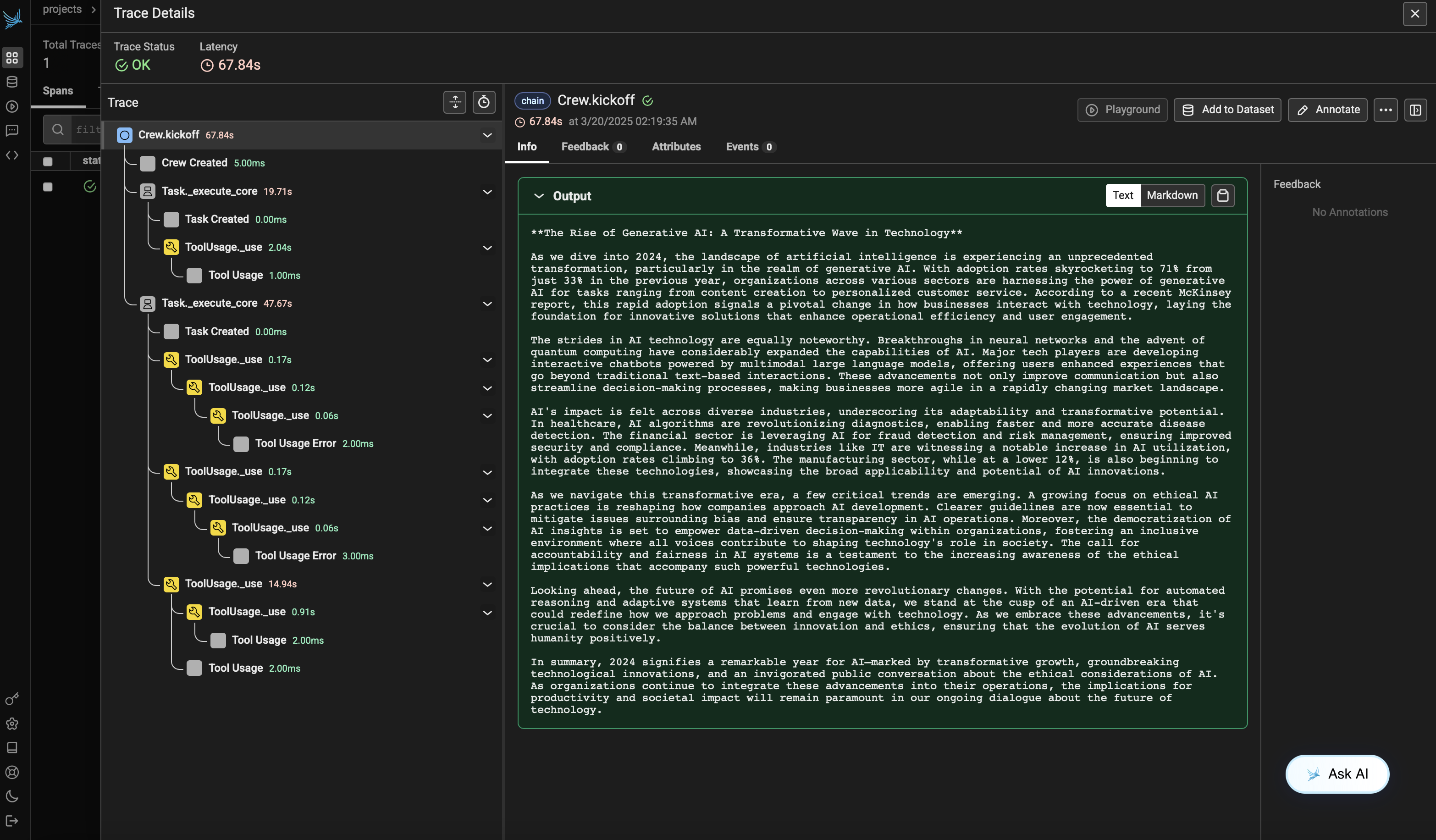
@@ -145,6 +145,9 @@ print(result)
### المراجع
- [وثائق Phoenix](https://docs.arize.com/phoenix/) - نظرة عامة على منصة Phoenix.
يوفر CrewAI إمكانيات تتبع مدمجة تتيح لك مراقبة وتصحيح أخطاء الطواقم والتدفقات في الوقت الفعلي. يوضح هذا الدليل كيفية تفعيل التتبع لكل من **الطواقم** و**التدفقات** باستخدام منصة المراقبة المتكاملة في CrewAI.
> **ما هو تتبع CrewAI؟** يوفر التتبع المدمج في CrewAI مراقبة شاملة لوكلاء الذكاء الاصطناعي، بما في ذلك قرارات الوكلاء وجداول تنفيذ المهام واستخدام الأدوات واستدعاءات LLM - كل ذلك متاح عبر [منصة CrewAI AMP](https://app.crewai.com).
> **ما هو تتبع CrewAI؟** يوفر التتبع المدمج في CrewAI مراقبة شاملة لوكلاء الذكاء الاصطناعي، بما في ذلك قرارات الوكلاء وجداول تنفيذ المهام واستخدام الأدوات واستدعاءات LLM - كل ذلك متاح عبر [منصة CrewAI AMP](https://app.crewai.com). يتم إدارة التتبع بشكل مستقل عن [القياس عن بُعد](/ar/telemetry).

@@ -170,6 +170,18 @@ CREWAI_TRACING_ENABLED=true
عند تعيين متغير البيئة هذا، ستُفعّل جميع الطواقم والتدفقات التتبع تلقائياً، حتى بدون تعيين `tracing=True` صراحةً.
## عرض التتبعات بعد أول تشغيل
في المرة الأولى التي تشغّل فيها طاقماً أو تدفقاً، قد يسألك طرف تفاعلي:
```text
Would you like to view your execution traces? [y/N]
```
اختر **yes** لفتح رابط العرض. يمكنك تغيير ذلك لاحقاً باستخدام
`crewai traces enable` أو `crewai traces disable`، أو بتعيين `tracing`
عند تفعيل ميزة `share_crew`، يتم جمع بيانات تفصيلية تشمل أوصاف المهام وخلفيات وأهداف الوكلاء وسمات محددة أخرى
لتوفير رؤى أعمق. قد يتضمن جمع البيانات الموسع هذا معلومات شخصية إذا دمجها المستخدمون في طواقمهم أو مهامهم.
يجب على المستخدمين النظر بعناية في محتوى طواقمهم ومهامهم قبل تفعيل `share_crew`.
يمكن للمستخدمين تعطيل القياس عن بُعد عبر تعيين متغير البيئة `CREWAI_DISABLE_TELEMETRY` إلى `true` أو تعيين `OTEL_SDK_DISABLED` إلى `true` (لاحظ أن الأخير يعطل جميع أدوات OpenTelemetry عالمياً).
يمكن للمستخدمين تعطيل القياس عن بُعد في CrewAI عبر تعيين `CREWAI_DISABLE_TELEMETRY` إلى `true` أو `1` أو `yes` أو `on` (بغض النظر عن حالة الأحرف). `OTEL_SDK_DISABLED` بنفس القيم يعطّل أيضاً مُصدِّر CrewAI. مجموعة أدوات OpenTelemetry نفسها ما تزال تقبل `true` فقط لتعطيل بقية أدوات القياس في العملية.
تتبع AMP مشمول بشكل منفصل في [التتبع](/ar/observability/tracing).
| نعم | إصدار CrewAI وPython | تتبع إصدارات البرمجيات. مثال: CrewAI v1.2.3، Python 3.8.10. لا بيانات شخصية. |
| نعم | بيانات وصفية للطاقم | تشمل: مفتاح ومعرّف مُولّد عشوائياً، نوع العملية (مثل 'sequential'، 'parallel')، علم منطقي لاستخدام الذاكرة (true/false)، عدد المهام، عدد الوكلاء. كلها غير شخصية. |
| نعم | بيانات وصفية للطاقم | تشمل: مفتاح ومعرّف مُولّد عشوائياً، نوع العملية (مثل 'sequential'، 'parallel')، علم منطقي لاستخدام الذاكرة (true/false)، علم منطقي يوضح ما إذا تم تمرير أي مدخلات للتشغيل (true/false — وليس مفاتيح المدخلات أو قيمها، والتي لا تُجمع إلا عند تمكين `share_crew`)، عدد المهام، عدد الوكلاء. كلها غير شخصية. |
| نعم | بيانات الوكيل | تشمل: مفتاح ومعرّف مُولّد عشوائياً، اسم الدور (يجب ألا يتضمن معلومات شخصية)، إعدادات منطقية (verbose، التفويض مُفعّل، تنفيذ الكود مسموح)، أقصى عدد تكرارات، أقصى RPM، أقصى حد لإعادة المحاولة، معلومات LLM (انظر سمات LLM)، قائمة أسماء الأدوات (يجب ألا تتضمن معلومات شخصية). لا بيانات شخصية. |
| نعم | بيانات وصفية للمهمة | تشمل: مفتاح ومعرّف مُولّد عشوائياً، إعدادات تنفيذ منطقية (async_execution، human_input)، دور ومفتاح الوكيل المرتبط، قائمة أسماء الأدوات. كلها غير شخصية. |
| نعم | إحصائيات استخدام الأدوات | تشمل: اسم الأداة (يجب ألا يتضمن معلومات شخصية)، عدد محاولات الاستخدام (عدد صحيح)، سمات LLM المستخدمة. لا بيانات شخصية. |
| نعم | بيانات تنفيذ الاختبار | تشمل: مفتاح ومعرّف الطاقم المُولّد عشوائياً، عدد التكرارات، اسم النموذج المستخدم، درجة الجودة (عدد عشري)، وقت التنفيذ (بالثواني). كلها غير شخصية. |
| نعم | بيانات دورة حياة المهمة | تشمل: أوقات الإنشاء وبدء/انتهاء التنفيذ، معرّفات الطاقم والمهمة. مخزنة كنطاقات مع طوابع زمنية. لا بيانات شخصية. |
| نعم | بيانات دورة حياة المهمة | تشمل: أوقات الإنشاء وبدء/انتهاء التنفيذ، معرّفات الطاقم والمهمة، وما إذا نجحت المهمة أو فشلت. وعند فشل المهمة، يُسجَّل **اسم صنف** الاستثناء (مثل `TimeoutError`) بحيث يمكن عدّ حالات الفشل وتشخيصها — وليس رسالة الخطأ أبدًا، فهي قد تحتوي على مطالبات أو مخرجات نموذج أو مسارات ملفات أو بيانات اعتماد. مخزنة كنطاقات مع طوابع زمنية. لا بيانات شخصية. |
| نعم | سمات LLM | تشمل: الاسم، model_name، model، top_k، temperature، واسم فئة LLM. كلها بيانات تقنية غير شخصية. |
| نعم | محاولة نشر الطاقم باستخدام CLI الخاص بـ CrewAI | تشمل: حقيقة إجراء النشر ومعرّف الطاقم، وما إذا كان يحاول سحب السجلات، لا بيانات أخرى. |
| نعم | إنشاء مشروع باستخدام CLI الخاص بـ CrewAI | تشمل: أن مشروعًا جديدًا أُنشئ عبر `crewai create`، ونوعه (`crew` أو `json_crew` أو `flow`)، ومعرّف المشروع الذي تم توليده لهذا المشروع الجديد وكُتب في ملف `pyproject.toml` الخاص به. وهو معرّف المشروع الجديد نفسه، ويُسجَّل بشكل منفصل عن `project_id` الخاص بالمجلد الذي شُغّل منه الأمر — وقد يختلفان. لا اسم مشروع، ولا محتويات ملفات، ولا شيفرة. لا بيانات شخصية. |
| نعم | محاولة نشر الطاقم باستخدام CLI الخاص بـ CrewAI | تشمل: حقيقة إجراء النشر ومعرّف الطاقم، وما إذا كان يحاول سحب السجلات، وما إذا بدأ النشر من أمر CLI أو من واجهة التشغيل TUI. لا تُسجَّل محتويات المشروع أو الطاقم. لا توجد بيانات شخصية. |
| نعم | بيئة التنفيذ | تشمل: مساعد البرمجة بالذكاء الاصطناعي الذي يشغّل العملية إن وُجد (واحد من قائمة ثابتة مثل `claude_code` أو `codex` أو `cursor` أو `unknown`)، ومكان تشغيل العملية (واحد من قائمة ثابتة مثل `ci` أو `container` أو `serverless` أو `interactive`)، و`project_id` من ملف `pyproject.toml` عند ضبطه، ونطاقًا تقريبيًا لحجم الجهاز (واحد من `1-2` أو `3-4` أو `5-8` أو `9-16` أو `17-32` أو `33+` أو `unknown`). النطاق مجال وليس العدد الدقيق للأنوية أبدًا — العدد الدقيق اختياري فقط، ضمن «معلومات البيئة» أدناه. تأتي فئة الحجم من عدد أنوية المضيف؛ ويتحقق اكتشاف المساعد وموقع التشغيل فقط مما إذا كانت متغيرات البيئة المعروفة مضبوطة، ولا يقرأ قيمها أبدًا. لا بيانات شخصية. |
| نعم | إشارات دورة حياة التدفق | تشمل: بدء التدفق، وما إذا اكتمل أو فشل، وما إذا فشلت إحدى طرقه، وما إذا توقف مؤقتًا لانتظار إدخال أو ملاحظات بشرية، وما إذا كان البدء تشغيلًا مستأنفًا، وما إذا فشل دور محادثة، ومدة تشغيل التدفق، وما إذا كان التدفق مما تشغّله CrewAI داخليًا أو مما كتبته أنت. ويُسجَّل اسم التدفق، كما هو الحال بالفعل لإنشاء التدفق وتنفيذه. وعند فشل تدفق أو إحدى طرقه، يُسجَّل **اسم فئة** الاستثناء (مثل `TimeoutError`) لتشخيص الأعطال — ولا تُسجَّل أبدًا رسالة الخطأ، التي قد تحتوي على مطالبات أو مخرجات النموذج أو مسارات ملفات أو بيانات اعتماد. ولا تُسجَّل أبدًا أسماء الطرق أو حالة التدفق. لا توجد بيانات شخصية. |
| نعم | إشارة مشاركة التتبع | تشمل: نجاح مشاركة دفعة من عمليات التتبع مع CrewAI AMP، وما إذا تمت المشاركة بشكل مجهول (قبل إنشاء حساب) أو مرتبطة بحسابك. ومثل كل span، تحمل أيضًا سمات بيئة التنفيذ الموضحة أعلاه (`project_id` عند تكوينه، ومساعد البرمجة، وبيئة التشغيل). يصف هذا الصف بيانات القياس عن بُعد الخاصة بالمشاركة فقط — وليس محتويات التتبع أو الوصول الذي تمنحه روابط التتبع المشتركة. لا تُسجَّل محتويات التتبع أو المدخلات أو المخرجات في هذه الإشارة. قبل مشاركة التتبعات، راجع الأسرار والبيانات الشخصية وإعدادات التنقيح والاحتفاظ في AMP. |
| لا | بيانات الوكيل الموسّعة | تشمل: وصف الهدف، نص الخلفية، معرّف ملف موجهات i18n. يجب على المستخدمين التأكد من عدم تضمين معلومات شخصية في حقول النص. |
| لا | معلومات المهمة التفصيلية | تشمل: وصف المهمة، وصف المخرجات المتوقعة، مراجع السياق. يجب على المستخدمين التأكد من عدم تضمين معلومات شخصية في هذه الحقول. |
| لا | معلومات البيئة | تشمل: المنصة، الإصدار، النظام، الإصدار، وعدد وحدات المعالجة المركزية. مثال: 'Windows 10'، 'x86_64'. لا بيانات شخصية. |
- `model_name` (str): اسم نموذج Sentence Transformers. القيمة الافتراضية: `all-MiniLM-L6-v2`. الخيارات: `all-mpnet-base-v2`، `all-MiniLM-L6-v2`، `paraphrase-multilingual-MiniLM-L12-v2`
- `device` (str): الجهاز للتشغيل. القيمة الافتراضية: `cpu`. الخيارات: `cpu`، `cuda`، `mps`
- `device` (str): الجهاز للتشغيل. القيمة الافتراضية: `cpu`. الخيارات: `cpu`، `cuda`، `mps`، `xpu`
- `normalize_embeddings` (bool): ما إذا كان يتم تطبيع التضمينات. القيمة الافتراضية: `False`
أداة `ScrapeElementFromWebsiteTool` مصممة لاستخراج عناصر محددة من المواقع باستخدام محددات CSS. تسمح هذه الأداة لوكلاء CrewAI باستخراج محتوى مستهدف من صفحات الويب، مما يجعلها مفيدة لمهام استخراج البيانات حيث تكون أجزاء محددة فقط من صفحة الويب مطلوبة.
أداة `ScrapeElementFromWebsiteTool` مصممة لاستخراج عناصر محددة من المواقع باستخدام محددات CSS. تسمح هذه الأداة لوكلاء CrewAI باستخراج محتوى مستهدف من صفحات الويب، مما يجعلها مفيدة لمهام استخراج البيانات حيث تكون أجزاء محددة فقط من صفحة الويب مطلوبة. تمر الطلبات عبر مساعد HTTP الآمن ضد SSRF في CrewAI: يتم فحص عنوان URL المطلوب وكل قفزة إعادة توجيه مقابل النطاقات الخاصة والمحجوزة (بما في ذلك بيانات تعريف السحابة)، ويُثبَّت اتصال TCP على عنوان IP الذي اجتاز هذا الفحص.
أداة مصممة لاستخراج وقراءة محتوى موقع محدد. قادرة على التعامل مع أنواع مختلفة من صفحات الويب عن طريق إجراء طلبات HTTP وتحليل محتوى HTML المستلم.
يمكن أن تكون هذه الأداة مفيدة بشكل خاص لمهام استخراج البيانات من الويب وجمع البيانات أو استخراج معلومات محددة من المواقع.
تمر الطلبات عبر مساعد HTTP الآمن ضد SSRF في CrewAI: يتم فحص عنوان URL المطلوب وكل قفزة إعادة توجيه مقابل النطاقات الخاصة والمحجوزة (بما في ذلك بيانات تعريف السحابة)، ويُثبَّت اتصال TCP على عنوان IP الذي اجتاز هذا الفحص.
@@ -61,7 +61,7 @@ The Visual Agent Builder enables:
| **Respect Context Window** _(optional)_ | `respect_context_window` | `bool` | Keep messages under context window size by summarizing. Default is True. |
| **Code Execution Mode** _(optional)_ | `code_execution_mode` | `Literal["safe", "unsafe"]` | Mode for code execution: 'safe' (using Docker) or 'unsafe' (direct). Default is 'safe'. |
| **Multimodal** _(optional)_ | `multimodal` | `bool` | Whether the agent supports multimodal capabilities. Default is False. |
| **Inject Date** _(optional)_ | `inject_date` | `bool` | Whether to automatically inject the current date into tasks. Default is False. |
| **Inject Date** _(optional)_ | `inject_date` | `bool` | Whether to automatically inject the current date into the agent's prompt. Default is False. |
| **Date Format** _(optional)_ | `date_format` | `str` | Format string for date when inject_date is enabled. Default is "%Y-%m-%d" (ISO format). |
| **Reasoning** _(optional)_ | `reasoning` | `bool` | Whether the agent should reflect and create a plan before executing a task. Default is False. |
| **Max Reasoning Attempts** _(optional)_ | `max_reasoning_attempts` | `Optional[int]` | Maximum number of reasoning attempts before executing the task. If None, will try until ready. |
@@ -236,7 +236,7 @@ strategic_agent = Agent(
role="Market Analyst",
goal="Track market movements with precise date references and strategic planning",
backstory="Expert in time-sensitive financial analysis and strategic reporting",
inject_date=True, # Automatically inject current date into tasks
inject_date=True, # Automatically inject current date into the prompt
date_format="%B %d, %Y", # Format as "May 21, 2025"
Create a new crew, flow, tool, skill, or template project.
```shell Terminal
crewai create [OPTIONS] TYPE NAME
```
- `TYPE`: Choose between "crew" or "flow"
- `NAME`: Name of the crew or flow
- `TYPE`: `crew`, `flow`, `tool`, `skill`, or `template`
- `NAME`: Name of the project, tool handle, skill, or template
Example:
#### Crew
```shell Terminal
crewai create crew my_new_crew
crewai create flow my_new_flow
crewai create crew my_new_crew --classic
```
By default, `crewai create crew` creates a JSON-first crew project with `crew.jsonc` and `agents/*.jsonc`. Use `crewai create crew my_new_crew --classic` only when you want the older Python/YAML scaffold with `crew.py`, `config/agents.yaml`, and `config/tasks.yaml`.
#### Flow
```shell Terminal
crewai create flow my_new_flow
crewai create flow my_new_flow --declarative
```
#### Tool
Scaffold a custom tool repository:
```shell Terminal
crewai create tool my_tool
```
#### Skill
Scaffold an agent skill. Inside a crew project (where `pyproject.toml` exists), the skill is created under `./skills/`:
```shell Terminal
crewai create skill my-skill
crewai create skill my-skill --no-project
```
Use `--no-project` to create the skill in the current directory instead of `./skills/`.
#### Template
Add a remote project template to the current directory:
Lifecycle commands are unchanged — for example `crewai tool install`, `crewai skill publish`, and `crewai template list` stay under their resource groups.
#### Deprecated flag aliases
These older snake_case flags still work but are hidden from `--help`. Prefer the kebab-case forms documented in each command section below.
| Deprecated | Use instead |
| :--- | :--- |
| `--skip_provider` (on `crewai create crew`) | `--skip-provider` |
| `--n_iterations` (on `crewai train`, `crewai test`) | `--n-iterations` |
| `--task_id` (on `crewai replay`) | `--task-id` |
### 2. Version
Show the installed version of CrewAI.
@@ -79,7 +138,7 @@ Train the crew for a specified number of iterations.
crewai train [OPTIONS]
```
- `-n, --n_iterations INTEGER`: Number of iterations to train the crew (default: 5)
- `-n, --n-iterations INTEGER`: Number of iterations to train the crew (default: 5)
- `-f, --filename TEXT`: Path to a custom file for training (default: "trained_agents_data.pkl")
Example:
@@ -96,7 +155,7 @@ Replay the crew execution from a specific task.
crewai replay [OPTIONS]
```
- `-t, --task_id TEXT`: Replay the crew from this task ID, including all subsequent tasks
- `-t, --task-id TEXT`: Replay the crew from this task ID, including all subsequent tasks
Example:
@@ -143,7 +202,7 @@ Test the crew and evaluate the results.
crewai test [OPTIONS]
```
- `-n, --n_iterations INTEGER`: Number of iterations to test the crew (default: 3)
- `-n, --n-iterations INTEGER`: Number of iterations to test the crew (default: 3)
- `-m, --model TEXT`: LLM Model to run the tests on the Crew (default: "gpt-4o-mini")
- Initiates the deployment process on the CrewAI AMP platform.
- Upon successful initiation, it will output the Deployment created successfully! message along with the Deployment Name and a unique Deployment ID (UUID).
- Push keeps the source used at create. Adding a git `origin` later does not switch a ZIP deployment to git.
- **Deployment Status**: You can check the status of your deployment with:
@@ -519,6 +579,7 @@ Trace collection is controlled by checking three settings in priority order:
```
- Checked only if `tracing` is not set in code and `CREWAI_TRACING_ENABLED` is not set to `true`
- Running `crewai traces enable` is sufficient to enable tracing by itself
- The first-run prompt (`Would you like to view your execution traces?`) also updates this preference
<Note>
**To enable tracing**, use any one of these methods:
@@ -37,7 +37,7 @@ A crew in crewAI represents a collaborative group of agents working together to
| **Chat LLM** _(optional)_ | `chat_llm` | The language model used to orchestrate `crewai chat` CLI interactions with the crew. Accepts a model name string or `LLM` instance. Defaults to `None`. |
| **Before Kickoff Callbacks** _(optional)_ | `before_kickoff_callbacks` | A list of callable functions executed **before** the crew starts. Each callback receives and can modify the inputs dict. Distinct from the `@before_kickoff` decorator. Defaults to `[]`. |
| **After Kickoff Callbacks** _(optional)_ | `after_kickoff_callbacks` | A list of callable functions executed **after** the crew finishes. Each callback receives and can modify the `CrewOutput`. Distinct from the `@after_kickoff` decorator. Defaults to `[]`. |
| **Tracing** _(optional)_ | `tracing` | Controls OpenTelemetry tracing for the crew. `True` = always enable, `False` = always disable, `None` = inherit from environment / user settings. Defaults to `None`. |
| **Tracing** _(optional)_ | `tracing` | Controls tracing for the crew. `True` = always enable, `False` = always disable, `None` = inherit from environment / user settings. Defaults to `None`. |
| **Skills** _(optional)_ | `skills` | A list of `Path` objects (skill search directories) or pre-loaded `Skill` objects applied to all agents in the crew. Defaults to `None`. |
| **Security Config** _(optional)_ | `security_config` | A `SecurityConfig` instance managing crew fingerprinting and identity. Defaults to `SecurityConfig()`. |
| **Checkpoint** _(optional)_ | `checkpoint` | Enables automatic checkpointing. Pass `True` for sensible defaults, a `CheckpointConfig` for full control, `False` to opt out, or `None` to inherit. See the [Checkpointing](#checkpointing) section below. Defaults to `None`. |
@@ -322,6 +322,8 @@ Caches can be employed to store the results of tools' execution, making the proc
After the crew execution, you can access the `usage_metrics` attribute to view the language model (LLM) usage metrics for all tasks executed by the crew. This provides insights into operational efficiency and areas for improvement.
`total_tokens` is the billed total (`prompt_tokens + completion_tokens`). Breakdown fields such as `cached_prompt_tokens` and `cache_creation_tokens` describe subsets already included in those totals and are not added on top of `total_tokens`. See the **UsageMetrics field semantics** section in the Flows concept documentation for the full contract.
Each entry in the returned [`UsageMetrics`](https://github.com/crewAIInc/crewAI/blob/main/lib/crewai/src/crewai/types/usage_metrics.py) is the sum across all LLM calls made within a single `flow.kickoff()` invocation. Counters reset on the next `kickoff()` call (or on each iteration of `kickoff_for_each`), so successive runs don't double-count. The property is safe to read at any point after `kickoff()` completes; reading it during execution returns the partial total accumulated so far.
### UsageMetrics field semantics
The returned [`UsageMetrics`](https://github.com/crewAIInc/crewAI/blob/main/lib/crewai/src/crewai/types/usage_metrics.py) object uses a provider-neutral contract:
| `reasoning_tokens` | Reasoning/thinking subset where the provider reports it separately (breakdown only) |
| `successful_requests` | Number of LLM calls aggregated |
Breakdown fields such as `cached_prompt_tokens`, `cache_creation_tokens`, and
`reasoning_tokens` are **not** added on top of `total_tokens` — they describe
portions already included in `prompt_tokens` or `completion_tokens`.
For Anthropic, cache read and cache write counters are folded into `prompt_tokens`, so cached workloads are fully reflected in `total_tokens`. OpenAI-style providers already include cached input inside `prompt_tokens`; CrewAI surfaces the cached portion separately for visibility.
Each entry in the returned `UsageMetrics` is the sum across all LLM calls made within a single `flow.kickoff()` invocation. Counters reset on the next `kickoff()` call (or on each iteration of `kickoff_for_each`), so successive runs don't double-count. The property is safe to read at any point after `kickoff()` completes; reading it during execution returns the partial total accumulated so far.
# prompt_tokens includes cache read + cache write for Anthropic
```
See the **UsageMetrics field semantics** section in the Flows concept
documentation for the provider-neutral contract used by `crew.usage_metrics`
and `flow.usage_metrics`.
**Important Notes:**
- `max_tokens` is a **required** parameter for all Anthropic models
- Claude uses `stop_sequences` instead of `stop`
@@ -1466,6 +1487,38 @@ llm = LLM(
llm = LLM(model="gpt-4")
```
</Tab>
<Tab title="Gateway Errors">
<Tip>
Gateways such as OpenRouter return `200 OK` as soon as the upstream provider accepts the request, so a provider timeout arrives in the response body instead of the status code.
</Tip>
CrewAI raises the same exception the upstream code would have produced as a real HTTP status, so a masked failure is caught by the retry handling you already have:
result = llm.call("Summarize the incident", response_model=Report)
except openai.InternalServerError as e:
# "z-ai/glm-5.3 via openrouter.ai returned HTTP 200 with an upstream error
# and no choices: The operation was aborted (upstream code 504)"
print(f"Upstream provider failed, safe to retry: {e}")
```
<Warning>
A large or deeply nested `response_model` makes upstream timeouts more likely. Treat these as transient provider failures, not as the model producing malformed structured output.
@@ -32,10 +32,10 @@ You often need **both**: skills for expertise, tools for action. They are config
The CLI is the supported way to create a skill — it scaffolds the directory layout and a valid `SKILL.md` for you:
```shell Terminal
crewai skill create code-review
crewai create skill code-review
```
Inside a crew project (where `pyproject.toml` lives) this creates `./skills/code-review/`; outside a project it creates `./code-review/` in the current directory (you can force that behavior with `--no-project`):
Inside a crew project (where `pyproject.toml` lives) this creates `./skills/code-review/`; outside a project it creates `./code-review/` in the current directory (you can force that behavior with `--no-project` on `crewai create skill`):
```
skills/
@@ -178,12 +178,16 @@ agent = Agent(
## Creating, Publishing, and Installing Skills
Skills have a full lifecycle managed by the CLI: **create them with `crewai skill create`, publish them with `crewai skill publish`** — hand-rolling directories works for local experiments, but the CLI is the intended workflow and keeps your skill layout and frontmatter valid.
Skills have a full lifecycle managed by the CLI: **create them with `crewai create skill`, publish them with `crewai skill publish`** — hand-rolling directories works for local experiments, but the CLI is the intended workflow and keeps your skill layout and frontmatter valid.
<Note>
`crewai skill create` is deprecated and still works with a warning. Use `crewai create skill` instead.
</Note>
### Create
```shell Terminal
crewai skill create my-skill
crewai create skill my-skill
```
Scaffolds the directory (into `./skills/` inside a crew project) with a template `SKILL.md`, plus empty `scripts/`, `references/`, and `assets/` directories. Edit `SKILL.md` to define the instructions.
@@ -206,13 +210,17 @@ Publishing reads `name`, `description`, and `metadata.version` from the `SKILL.m
### Install
Install a published skill by its `@org/name` reference:
Install a published skill by its `@org-uuid/name` reference:
```shell Terminal
crewai skill install @acme/code-review
crewai skill install @your-org-uuid/code-review
```
Inside a crew project the skill lands in `./skills/{name}/`; outside a project it goes to the shared cache at `~/.crewai/skills/{org}/{name}/`.
<Note>
Use your organization's **UUID**, not its name — organization names are not unique, so a name can resolve to the wrong organization and the install fails with a "not found" error. Run `crewai org list` to see the UUID (the `ID` column) of every organization you belong to.
</Note>
Inside a crew project the skill lands in `./skills/{name}/`; outside a project it goes to the shared cache at `~/.crewai/skills/{org-uuid}/{name}/`.
Agents can also reference registry skills directly — they resolve from the local cache (or project `skills/` directory) at runtime:
@@ -221,7 +229,7 @@ agent = Agent(
role="Senior Code Reviewer",
goal="Review pull requests for quality and security issues",
backstory="Staff engineer with expertise in secure coding practices.",
If you want to run more iterations or use a different model, you can specify the parameters like this:
```bash
crewai test --n_iterations 5 --model gpt-4o
crewai test --n-iterations 5 --model gpt-4o
```
or using the short forms:
@@ -29,6 +29,11 @@ or using the short forms:
crewai test -n 5 -m gpt-4o
```
<Note>
The older `--n_iterations` flag still works but is deprecated and hidden from
`--help`. Use `--n-iterations` (or `-n`) instead.
</Note>
When you run the `crewai test` command, the crew will be executed for the specified number of iterations, and the performance metrics will be displayed at the end of the run.
A table of scores at the end will show the performance of the crew in terms of the following metrics:
@@ -26,7 +26,7 @@ Under the hood, CrewAI employs a modular prompt system that you can customize ex
- **Error handling** – Direct how agents respond to failures, exceptions, or timeouts.
- **Tool-specific prompts** – Define detailed instructions for how tools are invoked or utilized.
Check out the [original prompt templates in CrewAI's repository](https://github.com/crewAIInc/crewAI/blob/main/src/crewai/translations/en.json) to see how these elements are organized. From there, you can override or adapt them as needed to unlock advanced behaviors.
Check out the [original prompt templates in CrewAI's repository](https://github.com/crewAIInc/crewAI/blob/main/lib/crewai/src/crewai/translations/en.json) to see how these elements are organized. From there, you can override or adapt them as needed to unlock advanced behaviors.
Use the CrewAI CLI to scaffold a project, then `AGENTS.md` will be automatically added at the root.
Use the CrewAI CLI to scaffold a project. `AGENTS.md` is added at the root, together with a `CLAUDE.md` and a `GEMINI.md` that import it, so Claude Code and Gemini CLI read the same guidance as every other assistant.
```bash
# Crew
@@ -21,9 +21,13 @@ crewai create crew my_crew
crewai create flow my_flow
# Tool repository
crewai tool create my_tool
crewai create tool my_tool
```
<Note>
`crewai tool create` is deprecated and still works with a warning. Use `crewai create tool` instead.
</Note>
## Tool Setup: Point Assistants to AGENTS.md
### Codex
@@ -32,24 +36,28 @@ Codex can be guided by `AGENTS.md` files placed in your repository. Use them to
### Claude Code
Claude Code stores project memory in `CLAUDE.md`. You can bootstrap it with `/init` and edit it using `/memory`. Claude Code also supports imports inside `CLAUDE.md`, so you can add a single line like `@AGENTS.md` to pull in the shared instructions without duplicating them.
Claude Code reads `CLAUDE.md` and ignores `AGENTS.md`. Scaffolded projects ship a `CLAUDE.md` whose only instruction is the import line `@AGENTS.md`, so the shared guidance is loaded without duplicating it. Add Claude-specific notes under that line and keep shared conventions in `AGENTS.md`.
You can simply use:
For a project created before `CLAUDE.md` was scaffolded, add the import yourself:
```bash
mv AGENTS.md CLAUDE.md
printf '@AGENTS.md\n' > CLAUDE.md
```
Do not rename `AGENTS.md` to `CLAUDE.md`: Codex and Cursor read `AGENTS.md`, and the rename hides it from them.
### Gemini CLI and Google Antigravity
Gemini CLI and Antigravity load a project context file (default: `GEMINI.md`) from the repo root and parent directories. You can configure it to read `AGENTS.md` instead (or in addition) by setting `context.fileName` in your Gemini CLI settings. For example, set it to `AGENTS.md` only, or include both `AGENTS.md` and `GEMINI.md` if you want to keep each tool’s format.
Gemini CLI and Antigravity load a project context file (default: `GEMINI.md`) from the repo root and parent directories. Scaffolded projects ship a `GEMINI.md` whose only instruction is the import line `@./AGENTS.md`, so the shared guidance is loaded without duplicating it. Add Gemini-specific notes under that line and keep shared conventions in `AGENTS.md`.
You can simply use:
For a project created before `GEMINI.md` was scaffolded, add the import yourself:
```bash
mv AGENTS.md GEMINI.md
printf '@./AGENTS.md\n' > GEMINI.md
```
Alternatively, set `context.fileName` in your Gemini CLI settings to include `AGENTS.md` and Gemini reads it directly. Do not rename `AGENTS.md` to `GEMINI.md`: Codex and Cursor read `AGENTS.md`, and the rename hides it from them.
### Cursor
Cursor supports `AGENTS.md` as a project instruction file. Place it at the project root to provide guidance for Cursor’s coding assistant.
description: Build multi-turn chat apps with handle_turn per turn, message history, intent routing, tracing, and WebSocket bridges.
description: Build multi-turn chat apps with handle_turn per turn, message history, intent routing, tracing, and structured streaming.
icon: comments
mode: "wide"
---
## Overview
Conversational apps treat each user line as a **new flow run** with the **same session id**. CrewAI adds helpers for message history, optional intent routing, deferred tracing, UI bridges, and a local `flow.chat()` REPL for conversational flows.
Conversational apps treat each user line as a **new flow run** with the **same session id**. CrewAI adds helpers for message history, optional intent routing, deferred tracing, structured turn streaming, and a local `flow.chat()` REPL.
For the full frame contract, channel list, and async API, see [Streaming Runtime Contract](/edge/en/learn/streaming-runtime-contract).
For the full frame contract and channel list, see [Streaming Runtime Contract](/edge/en/learn/streaming-runtime-contract).
## Turn lifecycle
@@ -111,29 +110,18 @@ Each `handle_turn` runs this pipeline:
2. **State restore** — if `inputs["id"]` exists and `@persist` is configured, loads the latest snapshot.
3. **`FlowStarted`** — emitted on the first deferred session turn only.
4. **Pending turn hydration** — appends the user message to `state.messages`, sets `current_user_message` / `last_user_message`, and optionally classifies when `intents` / `default_intents` + `intent_llm` are set.
5. **Graph execution** — user-defined `@start` methods (if any) → `route_conversation` (the built-in start/router) → the selected `@listen` handler. `route_conversation` also calls the overridable `conversation_start()` helper.
6. **End of run** — per-turn `flow_finished` and trace finalization are **skipped** when deferral is enabled; nested `Agent.kickoff()` / crews do not close the parent batch either.
Handlers should call **`append_assistant_message(reply)`** so the next turn’s `conversation_messages` includes assistant text. The user line is already stored by `handle_turn` — do not append it again in handlers.
Handlers should call **`append_assistant_message(reply)`** when the visible reply is not the return value, or when you trim history. A public string return is also recorded as assistant and included in the `@persist` snapshot, so a fresh Flow instance restores it. The user line is already stored by `handle_turn` — do not append it again in handlers.
## `ConversationConfig` (class-level defaults)
## Configuration overview
Decorate your conversational `Flow` subclass with `ConversationConfig`.
| Field | Default | Purpose |
|-------|---------|---------|
| `system_prompt` | Framework default | System message used by the built-in `converse_turn`. |
| `llm` | `None` | Conversation LLM used by `converse_turn` and as router fallback. |
| `router` | `None` | `RouterConfig` for LLM-driven routing. |
| `default_intents` | `None` | Outcome labels for pre-classification. |
| `defer_trace_finalization` | `True` | Keep one trace batch open across `handle_turn()` calls. |
Override pre-classification per turn with `handle_turn(..., intents=..., intent_llm=...)`.
Decorating a `Flow` subclass with `ConversationConfig` both attaches the chat defaults and enables conversational mode. See the [full field reference](#conversationconfig) below. Override pre-classification per turn with `handle_turn(..., intents=..., intent_llm=...)`.
## Lower-level `ChatState` helpers
`ChatState`, `ConversationalConfig`, and `crewai.flow.conversation` helpers are still importable for advanced orchestration, tests, or custom wrappers. They do not add `user_message=` or `session_id=` keyword arguments to `Flow.kickoff()`.
`ChatState`, the legacy `ConversationalConfig`, and `crewai.flow.conversation` helpers are still importable for advanced orchestration, tests, or custom wrappers. They are separate from the `ConversationState` / `ConversationConfig` API and do not add `user_message=` or `session_id=` keyword arguments to `Flow.kickoff()`.
```python
from crewai.flow import ChatState
@@ -155,6 +143,8 @@ class MyChatState(ChatState):
`ConversationalInputs` is a `TypedDict` for conventional `kickoff(inputs={...})` keys: `id`, `user_message`, `last_intent`.
`ConversationState` stores `messages` as `ConversationMessage` objects and additionally provides `current_user_message`, `ended`, `events`, and `agent_threads`. Use `conversation_messages` when passing its canonical history to an LLM.
## `Flow` conversational API
### `handle_turn` parameters
@@ -176,9 +166,9 @@ class MyChatState(ChatState):
| Attribute | Purpose |
|-----------|---------|
| `conversational` | Set to `True` to enable the conversational graph and `handle_turn()` |
| `defer_trace_finalization` | Instance flag; set automatically from config on `handle_turn()` |
| `_should_defer_trace_finalization()` | Advanced/internal hook that resolves whether per-turn trace finalization is deferred |
| `input_history` | Audit trail of `ask()` prompts and responses |
### Module helpers (`crewai.flow.conversation`)
Importable for tests or custom orchestration:
Importable from `crewai.flow.conversation` for tests or custom orchestration. These helpers use the legacy `ConversationalConfig` shape; `prepare_conversational_turn()` also clears `last_intent`, unlike `handle_turn()`, which preserves it as router context.
| Function | Description |
|----------|-------------|
@@ -212,7 +202,7 @@ Importable for tests or custom orchestration:
### A. Pre-classify via `ConversationConfig` (simplest)
Set `default_intents` and `intent_llm`. Each `handle_turn()` runs classification before routing; read `self.state.last_intent` in `route_turn()`.
Set `default_intents` and `intent_llm`. Each `handle_turn()` pre-classifies the current message. A non-empty result returned by a custom `route_turn()` takes precedence; otherwise `route_conversation` uses the current turn's classified intent.
### B. Classify inside `route_turn` (richer prompts)
@@ -233,24 +223,15 @@ Use **`@listen("RESEARCH")`** (or similar) for steps that run `Agent.kickoff()`
## When the flow finishes but the user keeps chatting
`FlowFinished` means **this graph run** completed. The conversation continues with another `handle_turn()` and the same `session_id`. `@persist` restores `messages`, flags, and context.
Each `handle_turn()` completes one graph run, and the conversation continues with another `handle_turn()` using the same `session_id`. With the default deferred trace lifecycle, that run emits `conversation_turn_completed`, while `FlowFinished` is emitted once when `finalize_session_traces()` closes the session. `@persist` restores `messages`, flags, and context.
**Persist pattern:** prefer `@persist` on a **single terminal step** (for example `finalize`) rather than on the whole `Flow` class. Class-level persist saves after every method; `load_state` uses the latest row, which may be a mid-run snapshot (for example right after `bootstrap`) and miss handler updates from the same turn.
Do **not** use `@human_feedback` for follow-up chat lines unless a human must approve a specific step output before it is shown.
## Conversational `Flow` (experimental)
## Conversational `Flow`
<Warning>
**This is an experimental feature.** The conversational `Flow` surface
`RouterConfig`, `ConversationState`, the built-in graph + helpers) lives
under `crewai.experimental` and may change shape before it graduates.
Pin your CrewAI version if you depend on specific behavior, and watch the
changelog for breaking updates. Open issues / feedback welcome.
</Warning>
Opt into the conversational chat graph by setting `conversational = True` on a `Flow` subclass. The base `Flow` then ships a built-in `@start` / `@router` / `converse_turn` / `end_conversation` graph, manages `state.messages`, can drive a router LLM, and keeps the trace batch open across turns. You write the **custom routes**; the framework owns the rest.
Opt into the conversational chat graph by setting `conversational = True` on a `Flow` subclass or applying `@ConversationConfig(...)`. The base `Flow` then supplies `route_conversation` as the built-in start/router plus the `converse_turn` and `end_conversation` listeners. The deprecated `answer_from_history_turn` listener remains available for compatibility. The framework manages `state.messages`, can drive a router LLM, and keeps the trace batch open across turns. You write the **custom routes**; the framework owns the rest.
Use this when you want a multi-turn chat with a router and per-route handlers without wiring the lifecycle yourself. Use `Flow[ChatState]` (the lower-level pattern above) when you need full control.
@@ -259,7 +240,7 @@ Use this when you want a multi-turn chat with a router and per-route handlers wi
```python
from crewai import Flow
from crewai.flow import listen
from crewai.experimental.conversational import (
from crewai.flow import (
ConversationConfig,
ConversationState,
)
@@ -267,8 +248,6 @@ from crewai.experimental.conversational import (
message = (self.state.current_user_message or "").lower()
if "search" in message or "news" in message:
@@ -318,14 +297,26 @@ Class decorator that attaches per-class chat defaults.
|-------|---------|---------|
| `system_prompt` | `slices.conversational_system_prompt` from i18n | System message used by the built-in `converse_turn`. Pass `""` to opt out entirely. |
| `llm` | `None` | Conversation LLM (used by `converse_turn` and as router fallback). |
| `router` | `None` | `RouterConfig` for LLM-driven routing. Without it, the flow always falls through to `converse`. |
| `answer_from_history_prompt` | Framework default | System message for the optional `answer_from_history` route. |
| `answer_from_history_llm` | `None` | Enables the `answer_from_history` short-circuit when set. |
| `router` | `None` | Optional `RouterConfig` overrides. With custom listeners and a resolvable LLM, routing auto-enables even when this is omitted. |
| `answer_from_history_prompt` | Framework default | **Deprecated.** Use the `converse` system prompt or override `converse_turn()`. |
| `answer_from_history_llm` | `None` | **Deprecated.** Use `llm`; `converse` already receives canonical history. |
| `visible_agent_outputs` | `None` | `"all"`, or a list of agent names whose `append_agent_result()` calls should be promoted to public assistant messages. |
| `defer_trace_finalization` | `True` | Keep one trace batch open across `handle_turn()` calls. |
<Warning>
`answer_from_history_prompt`, `answer_from_history_llm`, and the
`answer_from_history` route are deprecated and will be removed in a future
release. They duplicate `converse`, add an eligibility LLM call, and are
bypassed when the normal auto-router returns a route. Existing configurations
continue to work and emit `DeprecationWarning`.
</Warning>
With no custom routes, turns fall through to `converse`. With custom routes and a conversation/router LLM, the framework synthesizes a default `RouterConfig`; provide one explicitly only to customize its prompt, route list, descriptions, or fallback behavior. Setting `default_intents` uses the legacy pre-classification path instead.
If no conversation LLM is configured, the built-in `converse_turn` returns a configuration placeholder rather than generating an answer.
### `RouterConfig` and the auto-built route catalog
```python
@@ -334,7 +325,7 @@ from typing import Literal
from pydantic import BaseModel
from crewai import LLM
from crewai.experimental.conversational import RouterConfig
2. `Flow.builtin_route_descriptions[label]` — framework-canned text for `converse`, `end`, `answer_from_history` (phrased for the router LLM).
3. First non-empty line of the `@listen(label)` handler's docstring.
4. Empty (the route is listed without a description).
2. `Flow.builtin_route_descriptions[label]` — framework-canned text for `converse`, `end`, and the deprecated `answer_from_history` compatibility route (phrased for the router LLM).
3. The method's declared `description` (used by declarative flows and DSL projections).
4. First non-empty line of the `@listen(label)` handler's docstring.
5. Empty (the route is listed without a description).
So in practice, **adding a new route is `@listen("X")` + a one-line docstring**:
The string in `@listen("…")` is a **router route label** (an event name), not the Python method name. Route labels and method completion events share one trigger namespace, so naming a handler the same as its route causes the handler to re-trigger itself in a loop.
Use a different method name — the docs examples use a `handle_*` prefix:
```python
@listen("create_video")
def handle_create_video(self) -> str:
"""User wants a new video."""
...
```
Do **not** mirror the route label on the method:
```python
@listen("create_video")
def create_video(self) -> str: # rejected at flow instantiation
...
```
…and the router LLM sees:
```
@@ -394,7 +407,7 @@ Routes:
|-------|---------|---------|
| `converse` | `converse_turn` | Default chat handler. Calls `ConversationConfig.llm` with the system prompt + canonical message history. |
| `end` | `end_conversation` | Sets `state.ended = True` and emits a terminator reply. |
| `answer_from_history` | `answer_from_history_turn` | Optional. Routes here when `ConversationConfig.answer_from_history_llm` is set and the message can be answered from existing history. |
| `answer_from_history` | `answer_from_history_turn` | **Deprecated compatibility route.** Use `converse`, which already receives canonical history. |
You can override any of these by defining a same-named handler in your subclass.
@@ -404,9 +417,9 @@ You can override any of these by defining a same-named handler in your subclass.
1. Resets per-execution tracking (`_completed_methods`, `_method_outputs`) so the graph re-runs — without this, repeated `kickoff` calls on the same flow instance would short-circuit on turn 2+ because `Flow.kickoff_async` treats `inputs={"id": ...}` as a checkpoint restore.
2. Appends the user message to `state.messages`, sets `current_user_message` / `last_user_message`. `last_intent` is **preserved from the prior turn** so the router LLM can use it as a signal.
3. Runs `conversation_start` → `route_conversation` → the chosen `@listen` handler.
3. Runs user-defined `@start` methods (if any), then `route_conversation` as the built-in start/router, then the chosen `@listen` handler. `route_conversation` invokes the overridable `conversation_start()` helper.
4. The router stores its decision in `state.last_intent` (visible to the next turn's router context).
5. If your handler returned a string and didn't already call `append_assistant_message`, `handle_turn` appends it for you.
5. If your handler returned a string and didn't already call `append_assistant_message`, `handle_turn` appends it for you and persists the updated `state.messages` so `@persist` restore includes the assistant turn.
Call `handle_turn()` for chat messages. Calling `kickoff(inputs={"id": ...})` directly runs the flow graph without applying the conversational turn wrapper.
@@ -427,6 +440,8 @@ It handles the common local loop:
4. Prints the assistant result.
5. Finalizes deferred session traces in a `finally` block.
`chat(defer_trace_finalization=True)` temporarily enables the instance deferral flag for the REPL and restores its prior value on exit.
Customize the terminal behavior with injectable I/O:
```python
@@ -448,7 +463,7 @@ To run side effects (event bus setup, telemetry) on every routing decision, over
from typing import Any
from crewai import Flow
from crewai.experimental.conversational import ConversationState
from crewai.flow import ConversationState
class SupportFlow(Flow[ConversationState]):
@@ -459,7 +474,7 @@ class SupportFlow(Flow[ConversationState]):
return super().route_turn(context)
```
To bypass the LLM router entirely and pick a route programmatically, return a string from `route_turn`; returning `None` falls back to `_route_with_config(...)`.
To bypass the LLM router entirely and pick a route programmatically, return a non-empty string from `route_turn`. A falsy return does **not** invoke `_route_with_config()` from your override; routing falls through to this turn's pre-classified intent, then the deprecated `answer_from_history` compatibility path when configured, and finally `converse`. A previous turn's `last_intent` is available in router context but is never replayed as a fallback.
### `append_assistant_message` and `append_agent_result`
@@ -470,6 +485,73 @@ Inside a `@listen(label)` handler, choose:
`ConversationConfig.visible_agent_outputs` can promote specific agents' private results to public globally (`"all"`, or a list of agent names).
## Declaring a conversational flow in JSON/YAML
A [declarative Flow](/edge/en/concepts/cli) can be conversational too. Add a top-level `conversational` block and declare your own routes as methods that `listen` to a route label:
```yaml
schema: crewai.flow/v1
name: SupportFlow
conversational:
system_prompt: You are a terse support assistant.
llm: gpt-4o-mini
router:
llm: gpt-4o-mini
methods:
handle_order:
description: Order status, shipping and delivery questions.
listen: order
do:
call: agent
with:
role: Support specialist
goal: Answer order questions accurately
backstory: Knows the fulfilment pipeline.
input: "${state.current_user_message}"
```
Declaring the block is the opt-in — `enabled` defaults to `true`. Set `enabled: false` to keep the configuration while turning chat off. This also disables built-in method synthesis, so the declaration must provide a normal non-conversational graph.
Three things are supplied for you:
| Supplied | Detail |
|----------|--------|
| The built-in graph | `route_conversation`, `converse_turn`, and `end_conversation` are added automatically. Deprecated `answer_from_history_turn` is retained for compatibility. Declare a method under one of those names to override it. |
| Conversation state | `ConversationState` is used when there is no `state` block. A Pydantic `ref` or `json_schema` state is automatically composed with the conversational fields; it does not need to extend `ConversationState`. |
| The route catalog | Inferred from non-router methods with `listen` labels, excluding internal routes. Descriptions follow the precedence above, and explicit `router.routes` can limit the choices. |
Declarative `llm`, `router.llm`, and `intent_llm` fields accept either a model id or a configuration mapping such as `{model: openai/gpt-4o-mini, max_tokens: 512}`. The `conversational` block also supports `default_intents`, `visible_agent_outputs`, `defer_trace_finalization`, and the `RouterConfig` fields shown above. Deprecated `answer_from_history_prompt` / `answer_from_history_llm` declarations remain accepted for compatibility.
Run it from Python with the same turn APIs as a class-based conversational Flow:
```python
from crewai.flow import Flow
flow = Flow.from_declaration(path="flow.yaml")
try:
flow.handle_turn("Where is my order?", session_id="session-1")
finally:
flow.finalize_session_traces()
```
### Naming routes
Route labels and method names share one trigger namespace, so a handler must not be named after the route it listens to — `create_video` listening to `create_video` is rejected when the flow is built. Use a `handle_*` prefix.
### What a declaration cannot express
| Not expressible | Use instead |
|-----------------|-------------|
| A live `LLM` instance or a custom `BaseLLM` | A model id string or static configuration mapping |
| `router.response_format` as a live model class | Name the class with a python ref: `response_format: {python: my_project.schemas.ConversationRoute}`. Omit it and the framework synthesizes one |
| A `route_turn()` override | Author the Flow in Python, or replace the declarative `route_conversation` method with a `call: code` / expression action |
| A `can_answer_from_history()` override | Deprecated. Use `converse` or override `converse_turn()` in Python. |
`crewai run` opens the chat TUI for a declarative conversational flow — the same one a Python conversational Flow gets. A chat loop needs a terminal, so a headless run exits non-zero with guidance instead of running a single turn; drive it from Python there with `handle_turn()` or `stream_turn()`. A declarative method with a `human_feedback:` block (Python: `@human_feedback`) runs on a terminal REPL, because the runtime collects feedback with a blocking prompt the TUI cannot service. `--inputs` is not accepted for a conversational flow — each turn's input is the message you type — and resuming a session by id is not wired into the CLI yet; use `flow.handle_turn(message, session_id=...)` from Python for that.
## Tracing across turns
With `defer_trace_finalization=True` (default in `ConversationConfig`):
with `handle_turn()`, call `finalize_session_traces()` when
the session ends.
`suppress_flow_events=True` only hides Rich console panels; trace and method events still emit for observability.
`suppress_flow_events=True` hides Rich console panels and suppresses method execution events. Flow start/finish events still emit, so the outer Flow lifecycle remains traceable, but individual method spans are omitted.
### Conversational `Flow` trace lifecycle
The experimental [conversational `Flow`](#conversational-flow-experimental) uses the same tracing lifecycle: `defer_trace_finalization` defaults to `True`, so each `handle_turn()` keeps the session trace open. Always finalize at the end of the session — wrap your REPL/loop in `try/finally` and call `flow.finalize_session_traces()` on exit. Without it, the trace batch stays open and the final conversation may never export.
The [conversational `Flow`](#conversational-flow) uses the same tracing lifecycle: `defer_trace_finalization` defaults to `True`, so each `handle_turn()` keeps the session trace open. Deferred turns also suppress per-turn `flow_failed`; on a turn error or session abort, finalize the session explicitly. This closes the batch with the session-level `FlowFinished` event rather than a per-turn `FlowFailed` event. Always wrap your REPL/loop in `try/finally` and call `flow.finalize_session_traces()` on exit. Without it, the trace batch stays open and the final conversation may never export.
## Streaming
Set `stream = True` on the `Flow` class. `kickoff(...)` will then emit `assistant_delta` (and related) events through the standard event bus.
For conversational UIs, use `stream_turn()` and iterate its ordered `StreamFrame` objects:
```python
stream = flow.stream_turn("Where is my order?", session_id=session_id)
with stream:
for frame in stream.events:
if frame.channel == "llm" and frame.type == "llm_stream_chunk":
print(frame.content, end="", flush=True)
reply = stream.result
```
For a non-conversational Flow, setting `stream = True` makes `kickoff()` return a `StreamSession`. Do not set `flow.stream = True` when using `handle_turn()`; `stream_turn()` owns the conversational streaming lifecycle.
## Imports
@@ -510,10 +605,15 @@ from crewai.flow import (
router,
start,
)
from crewai.flow.conversation import prepare_conversational_turn
from crewai.flow import (
ConversationConfig,
ConversationState,
RouterConfig,
)
```
## See also
- [Mastering Flow State Management](/en/guides/flows/mastering-flow-state) — persistence, Pydantic state, `@persist`
- [Build Your First Flow](/en/guides/flows/first-flow) — flow basics
description: The declarative tier of generative UI — the agent assembles a surface from a catalog of components you own.
icon: table-cells
mode: "wide"
---
## The agent assembles the UI
[Tool-based rendering](/edge/en/guides/frontend/tool-based-generative-ui) maps one tool to one component: the agent picks a component, you draw it. A2UI is the **declarative** tier of the [generative-UI spectrum](/edge/en/guides/frontend/generative-ui#declarative) — instead of picking a single component, the agent **assembles a surface** by combining building blocks from a catalog you define.
You still own the components. The agent can only use what is in your catalog, so it can never render something you did not ship. What the agent decides is the **layout and the data** — how those building blocks come together into a panel, and what goes in them.
<Note>
A2UI works with [Flows](/en/concepts/flows). Both modes below — dynamic and fixed-schema — run as Flows served over AG-UI, exactly like the rest of this section.
</Note>
## The catalog (same for every mode)
The frontend wiring is identical no matter which backend mode you use: you register a **catalog** on the `<CopilotKit>` provider with the `a2ui` prop.
```tsx
import { CopilotKit } from "@copilotkit/react-core";
The catalog is your set of React components keyed by a catalog id — a `FlightCard`, a `HotelCard`, a `Chart`, whatever your app needs. The agent references catalog ids; CopilotKit paints your components with the data the agent supplies.
<Note>
Authoring the catalog itself — the id schema, prop mapping, and composition rules — is deeper than this page covers. See the [CopilotKit A2UI docs](https://docs.copilotkit.ai) for the full authoring reference. Here we focus on the two backend modes and when to reach for each.
</Note>
## Two backend modes
A2UI backends come in two shapes. In **dynamic** mode the agent designs the surface; in **fixed-schema** mode you pre-author the layout and the agent only fills in data.
| Mode | Who designs the layout | Backend | Predictability |
| --- | --- | --- | --- |
| **[Dynamic](#dynamic)** | The agent, from the conversation | No A2UI tool — auto-injected | Novel layouts, LLM layout step |
| **[Fixed-schema](#fixed-schema)** | You, up front | Backend tools return an envelope | Deterministic, no layout step |
### Dynamic
The Flow wires **no** A2UI tool. Enable A2UI on the runtime for this agent and it gains a `generate_a2ui` tool automatically. A sub-agent designs a surface from the conversation against your catalog, streams it to the frontend progressively, and self-heals invalid output through a validate-then-retry recovery pass. You write a normal agentic-chat Flow; the tool is injected for you.
<Steps>
<Step title="Register the catalog on the provider">
Same as above — pass your catalog through the `a2ui` prop:
Your backend is a plain agentic-chat Flow. You do not define an A2UI tool — the runtime injects `generate_a2ui` when A2UI is enabled for the agent, and the sub-agent invents the layout from the conversation.
</Step>
<Step title="Let the agent compose">
When a turn calls for UI, the agent assembles a surface from your catalog, streams the components in as it designs them, and repairs any invalid output before it reaches the screen. Your registered components render in the layout the agent chose.
</Step>
</Steps>
### Fixed-schema
When you already know the layout and only the data changes per call, pre-author the surface and let the agent fill it. The Flow wires backend tools (for example `search_flights`, `search_hotels`). Each tool returns an **A2UI operations envelope** as its result — `createSurface` -> `updateComponents` -> `updateDataModel` — which the frontend paints. There is no sub-agent, no generation, and no recovery pass: the layout JSON is authored by you, and only the data varies.
Install the toolkit that provides the envelope helpers:
```bash
pip install ag-ui-a2ui-toolkit
```
Build the envelope with the toolkit helpers and emit it as the tool result:
```python
from ag_ui_a2ui_toolkit import (
A2UI_OPERATIONS_KEY,
create_surface,
update_components,
update_data_model,
)
from ag_ui_crewai.sdk import copilotkit_emit_tool_result, copilotkit_stream
```
The tool assembles the `createSurface` -> `updateComponents` -> `updateDataModel` operations into an envelope keyed by `A2UI_OPERATIONS_KEY`, then hands it back with `copilotkit_emit_tool_result(...)`. Because the layout is fixed, the same tool always produces the same shape — only the values differ from call to call.
## When to use which
<CardGroup cols={2}>
<Card title="Dynamic" icon="wand-magic-sparkles">
The layout is not known ahead of time and you want the agent to compose novel surfaces from your primitives. You gain flexibility and pay for an LLM layout step.
</Card>
<Card title="Fixed-schema" icon="table-cells">
The layout is known and only the data varies. More predictable and deterministic — no generation, no recovery, no LLM in the layout path.
</Card>
</CardGroup>
Both modes share the same frontend: one catalog, registered once on the provider. Start with fixed-schema when your surfaces are stable, and reach for dynamic when you want the agent to design layouts you did not anticipate.
description: Render your CrewAI Flow's live state as UI that updates as the agent works through multi-step tasks.
icon: list-check
mode: "wide"
---
## Render the agent's live state
Some work does not fit into a single tool call. A research task, a multi-step plan, a long-running job: the interesting thing to show the user is not one result, but *progress*. Agentic generative UI renders the agent's **state** and re-renders it every time that state changes.
The pattern has two halves:
1. Your Flow writes progress into its own state as it works.
2. Your frontend reads that state with `useAgent` and paints it, re-rendering as the state streams in.
The Flow's state reaches the frontend over AG-UI without you wiring up any transport. A state snapshot is emitted automatically at each step (method) boundary of the Flow, and you can push intermediate updates during a long-running step by calling `copilotkit_emit_state` explicitly. You subclass the state to add your own fields, update them in the Flow, and read them in React.
<Note>
State-driven rendering requires a **Flow** with custom state (`Flow[AgentState]`). Crews are chat-oriented and do not expose custom state this way, so with a Crew use [tool rendering](/edge/en/guides/frontend/tool-based-generative-ui) instead.
</Note>
## Build a live task planner
This example builds a planner that breaks a request into about ten steps and streams them to the UI as a checklist. It assumes you already have a CrewAI server and a CopilotKit frontend wired up. If you do not, start with the [Frontend Overview](/edge/en/guides/frontend/overview).
<Steps>
<Step title="Add your own fields to the agent state">
Subclass `CopilotKitState` to declare the state your UI needs. `CopilotKitState` already carries the conversation (`messages`); you add whatever else you want to render, here a list of task steps.
Everything on `AgentState` is included in the state snapshot the frontend receives. A snapshot is emitted automatically at each step boundary, so writing to `self.state` is enough for the UI to pick it up between steps. To update the UI *during* a long step, emit explicitly (shown below).
</Step>
<Step title="Write progress into state from the Flow">
Type your Flow with the custom state (`Flow[AgentState]`) and let the model fill it in. Here the LLM calls a `generate_task_steps` tool; the streamed tool call lands in the conversation and the steps become visible in state.
```python
from crewai.flow.flow import Flow, start
from litellm import acompletion
from ag_ui_crewai.sdk import copilotkit_stream
GENERATE_TASK_STEPS_TOOL = {
"type": "function",
"function": {
"name": "generate_task_steps",
"description": "Break a task into about 10 short imperative steps.",
{"role": "system", "content": "Plan the task the user asks for."},
*self.state.messages,
],
tools=[GENERATE_TASK_STEPS_TOOL],
parallel_tool_calls=False,
stream=True,
)
)
message = response.choices[0].message
self.state.messages.append(message)
```
Wrapping the LLM call in `copilotkit_stream` streams the assistant's tokens and tool call to the frontend as they are produced. The `steps` you write to `self.state` are sent in the state snapshot emitted at the end of this step.
</Step>
<Step title="Stream progress during a long step (optional)">
The automatic snapshot fires at step boundaries. If a single step does substantial work and you want the checklist to fill in *as it happens*, emit intermediate state yourself with `copilotkit_emit_state`. Each call pushes the current state to the frontend immediately.
```python
from ag_ui_crewai.sdk import copilotkit_emit_state
class TaskPlannerFlow(Flow[AgentState]):
@start()
async def execute(self):
for step in self.state.steps:
step.status = "disabled" # mark done as you go
await copilotkit_emit_state(self.state) # push update now
await do_work(step)
```
Import `copilotkit_emit_state` from `ag_ui_crewai.sdk`. It requires the CopilotKit SDK (`pip install "copilotkit[crewai]"`). Reach for it only when a step is long enough that waiting for its boundary snapshot would feel unresponsive.
</Step>
<Step title="Serve the Flow over AG-UI">
Register the Flow exactly as any other, on its own path:
```python
# server.py
from fastapi import FastAPI
from ag_ui_crewai.endpoint import add_crewai_flow_fastapi_endpoint
from my_agents.task_planner import TaskPlannerFlow
app = FastAPI(title="CrewAI Agent Server")
add_crewai_flow_fastapi_endpoint(
app=app,
flow=TaskPlannerFlow(),
path="/task_planner",
)
```
See the [Frontend Overview](/edge/en/guides/frontend/overview) for the full server, runtime, and provider setup, and remember to register the agent (here `task_planner`) in your CopilotKit runtime route.
</Step>
<Step title="Read the live state in React">
On the frontend, `useAgent` gives you the agent's live state. Subscribe to state changes so your component re-renders every time the Flow writes an update.
```tsx
"use client";
import { useAgent, UseAgentUpdate } from "@copilotkit/react-core/v2";
function TaskPlan() {
const { agent } = useAgent({
agentId: "task_planner",
updates: [UseAgentUpdate.OnStateChanged],
});
const steps = agent?.state?.steps ?? [];
return (
<ul>
{steps.map((s, i) => (
<li key={i}>{s.description}</li>
))}
</ul>
);
}
```
`useAgent` returns `{ agent }`. A few things to know:
- `agent.state` is the live Flow state. Its shape matches the fields you added to `AgentState`, so `agent.state.steps` is your list of task steps.
- `agent.isRunning` tells you when the agent is actively working, useful for showing a spinner or disabling input.
- `updates: [UseAgentUpdate.OnStateChanged]` re-renders the component whenever state changes, so the checklist fills in as the Flow streams its steps.
</Step>
</Steps>
## Where this goes next
Reading state is the foundation. Two guides build directly on it:
- [Shared State](/edge/en/guides/frontend/shared-state) adds the other direction: editing the agent's state from the UI and having the Flow pick up the change.
- [Predictive State](/edge/en/guides/frontend/predictive-state-updates) streams a tool's in-progress arguments into state so the UI reflects work before it is committed.
description: Run the same CrewAI agent as a Slack or Teams bot with the CopilotKit Channels SDK and managed Intelligence platform.
icon: messages
mode: "wide"
---
## Meet your users where they already are
The CrewAI agent you built in the [Overview](/edge/en/guides/frontend/overview) does not have to live behind a web app. The same Crew or Flow can run as a bot inside a messaging platform. No rebuild, no second copy of your agent logic: the agent stays exposed over the [AG-UI protocol](https://docs.ag-ui.com), and a **channel** drives it from Slack or Microsoft Teams.
CopilotKit's [Channels SDK](https://docs.copilotkit.ai/slack) provides that channel. You declare a `createChannel` in a small runtime, point it at your CrewAI agent, and CopilotKit's managed **Intelligence** platform brokers the connection to the messaging provider.
<Note>
Unlike the rest of this section, Channels is **not self-hosted**. It runs through **CopilotKit Intelligence** — a required surface for Channels, by design (a free tier is available). Intelligence holds the platform connection and credentials, receives each platform event, and delivers the turn to your channel process; your process runs the agent and streams the reply back. You configure Slack once in the Intelligence dashboard, and platform credentials never enter your process. Your agent, tools, and state stay yours.
</Note>
## How it fits together
Nothing about your CrewAI agent server changes. It keeps serving your Crew or Flow over AG-UI exactly as in the Overview. What you add is a separate long-running Node process built with `@copilotkit/channels`: it registers a channel on the `CopilotRuntime`, connects to Intelligence, and runs your agent whenever a message arrives.
```
Slack / Teams ──► CopilotKit Intelligence ──► channel process (Node) ──► CrewAI server (AG-UI) ──► Crew / Flow
```
The channel process holds a persistent connection to the Intelligence gateway, so it needs a long-running host — a serverless request handler cannot own that connection. Your CrewAI server can keep serving the web frontend from the Overview at the same time: the web app and the channel are just two clients of one AG-UI endpoint.
## Integration guide
<Steps>
<Step title="Install the Channels packages">
The Channels SDK is batteries-included — every platform ships in the one package, with no per-platform adapter to install. Add it alongside the runtime that hosts the channel and the CrewAI AG-UI client:
In the [CopilotKit dashboard](https://docs.copilotkit.ai/slack), create a Channel and connect Slack — Intelligence walks you through creating the Slack app and holds its credentials. That leaves two environment variables for your process, both from the dashboard:
```bash
export INTELLIGENCE_API_KEY=... # authenticates the runtime with Intelligence (free tier available)
export INTELLIGENCE_CHANNEL_ID=... # the Channel ID, matched by createChannel({ name })
```
</Step>
<Step title="Define the channel">
`createChannel` declares the channel and attaches your agent. Build the agent as a per-thread factory so each conversation gets its own session, using the same `CrewAIAgent` the Overview uses in the web runtime, pointed at your AG-UI endpoint. `identifyUser: "platform"` lets Intelligence map each platform user to a stable identity.
```ts
// channel.ts
import { createChannel } from "@copilotkit/channels";
import { CrewAIAgent } from "@ag-ui/crewai";
const channel = createChannel({
name: process.env.INTELLIGENCE_CHANNEL_ID!, // must match the Channel ID in Intelligence
identifyUser: "platform",
// A fresh agent per conversation, pointed at your CrewAI AG-UI endpoint.
agent: (threadId) => {
const agent = new CrewAIAgent({ url: "http://localhost:8000/recipe" });
agent.threadId = threadId;
return agent;
},
});
// A mention subscribes the thread and runs the agent; afterwards every message
// in a subscribed thread runs it without needing another mention.
channel.onMention(async ({ thread }) => {
await thread.subscribe();
await thread.runAgent();
});
channel.onMessage(async ({ thread }) => {
if (await thread.isSubscribed()) await thread.runAgent();
});
export { channel };
```
</Step>
<Step title="Register the channel on the runtime">
Create a `CopilotRuntime` with the Intelligence gateway and your channel, then serve it with `createCopilotNodeListener`. The `agents` map stays empty — the channel supplies its own agent. Wait for the channel to be ready so a broken config fails startup loudly.
```ts
// server.ts
import { createServer } from "node:http";
import { CopilotRuntime, CopilotKitIntelligence } from "@copilotkit/runtime/v2";
import { createCopilotNodeListener } from "@copilotkit/runtime/v2/node";
import { channel } from "./channel";
const runtime = new CopilotRuntime({
agents: {}, // the channel supplies its own agent; no web-facing agents needed
intelligence: new CopilotKitIntelligence({
apiKey: process.env.INTELLIGENCE_API_KEY!, // free tier available
Mention the bot in Slack or Teams and it runs your Crew or Flow, streaming the reply back into the thread. The thread stays subscribed, so follow-up messages run without another mention.
</Step>
</Steps>
## The event model
A channel reacts to platform events with handlers, and each handler receives a `thread` you drive with a few methods:
- **`channel.onMention`** fires when a user @-mentions the bot. Call `thread.subscribe()` to join the thread, then `thread.runAgent()` to run your CrewAI agent on the mention.
- **`channel.onMessage`** fires on every message in a thread the bot can see. Gate it with `thread.isSubscribed()` so the agent only responds where it has joined, then `thread.runAgent()`.
- **`thread.runAgent()`** runs the attached CrewAI agent for the current turn and streams its output back into the channel. Pass `{ prompt }` to override the text the agent runs on.
Your agent receives an ordinary AG-UI `RunAgentInput` and emits ordinary AG-UI events; the platform mechanics stay behind the channel, so the same Crew or Flow runs unchanged across every platform. The channel also exposes handlers for welcomes, interrupts, commands, reactions, and modals — see the [`Channel` reference](https://docs.copilotkit.ai/reference/channels/classes/Channel) for the full surface.
## Platform support
The managed Intelligence path covers **Slack** and **Microsoft Teams** today — the same channel code runs on either, and `message.platform` / `thread.platform` report the native origin. Other platforms (Discord, Telegram, WhatsApp) are reached through developer-operated **direct adapters** rather than the managed path — your own process holds the platform credentials and transport. Check the [CopilotKit Channels documentation](https://docs.copilotkit.ai/slack) for the current platform list and per-platform setup.
description: Serve native, session-aware CrewAI Flows over AG-UI with managed conversation state and full frontend parity.
icon: comments
mode: "wide"
---
## Three execution shapes, one bridge
Behind the AG-UI bridge, a CrewAI backend can take one of three shapes. Knowing which one you are serving decides how you author the backend, not how you build the frontend.
| Shape | What it is | How it is entered |
| --- | --- | --- |
| **Regular Flows** | Author-controlled `@start`/`@listen`/`@router` graphs. The default used throughout these guides. | `kickoff` / `astream` |
| **Crews** | Closed autonomous task/agent loops. Basic chat only, a separate compatibility path. | Not the focus here. |
Conversational Flows are a newer CrewAI capability, and an important thing to be clear about up front: **they are Flows, not Crews.** They now run at full regular-Flow feature parity. This page introduces them and shows how they fit the rest of the frontend guides.
<Note>
Reach for a Conversational Flow when you want native multi-turn conversation with CrewAI managing session state and history for you, rather than wiring turn and state handling into a regular Flow yourself. If you are new here, start with the [Frontend Overview](/edge/en/guides/frontend/overview) for the base server, runtime, and provider setup.
</Note>
## Register a Conversational Flow
You register a Conversational Flow through the same endpoint helper as any other Flow, with one extra argument: `conversational=True`.
```python
# server.py
from ag_ui_crewai.endpoint import add_crewai_flow_fastapi_endpoint
add_crewai_flow_fastapi_endpoint(
app,
flow,
"/conversation",
conversational=True,
)
```
Two requirements must hold for this to work:
- The Flow instance declares `conversational = True`.
- The Flow exposes CrewAI's public, callable `stream_turn(message, session_id=...)`.
Detection is capability-based, not version-gated: the bridge checks that the Flow actually offers turn-based conversation, rather than keying off a version number.
<Warning>
If those requirements are not met, the request fails loudly with a `RUN_ERROR` (code `AGUI_CREWAI_CONVERSATIONAL_FLOW_UNSUPPORTED`). It never silently falls back to regular kickoff semantics, so you always know exactly which path you are on.
</Warning>
Authoring the Flow itself, including how you implement `stream_turn`, belongs to CrewAI's Conversational Flows documentation. This page stays at the registration and integration boundary.
## Session and state
Conversational Flows manage session state and history for you across turns. You do not re-thread history manually.
- The AG-UI `threadId` **is** the CrewAI conversation `session_id`. The same thread is the same conversation.
- Before each turn the bridge hydrates the Flow's state and conversation history, then calls `stream_turn`. CrewAI restores the stored session state, and a per-request overlay reapplies the incoming AG-UI state and history so the browser's latest edits win over stale storage.
The result: from the backend author's side, each turn arrives already carrying the conversation's state, and CrewAI persists what you write for the next turn.
## Frontend parity
This is the point to hold onto: **Conversational Flows run through the same event pipeline as regular Flows, so the frontend code is identical.**
There is no Conversational-Flow-specific frontend API. Every feature in these guides works exactly the same way with a Conversational Flow as it does with a regular Flow, using the same hooks and components:
Render agent-authored UI from a component catalog.
</Card>
</CardGroup>
The only difference is on the backend: how you author the Flow (turn-based `stream_turn` with managed session state) and the `conversational=True` registration. Once the endpoint is up, everything you already know about building the frontend applies unchanged.
description: Let your CrewAI agent call functions that run in the user's browser, from switching themes to navigating your app.
icon: bolt
mode: "wide"
---
## Let the agent act on the app
A frontend action is a tool the agent calls that runs code in the browser instead of on the server. The model decides to invoke it; your handler switches the theme, navigates, highlights an element, or updates your app data; and the result flows back to the agent.
It uses the same hook as tool-based generative UI, `useFrontendTool`. The difference is what you give it: a `handler` that runs code, instead of (or alongside) a `render` that draws UI.
<Note>
Frontend actions work with both Crews and Flows. Any agent that binds `copilotkit.actions` into its LLM call can invoke them.
</Note>
## Build a frontend action
The example below lets the agent switch the app into dark mode on request.
<Steps>
<Step title="Register the action on the frontend">
Call `useFrontendTool` with a `handler`. The handler runs in the browser when the agent invokes the tool, and the string it returns is fed back to the agent.
```tsx
"use client";
import { useFrontendTool } from "@copilotkit/react-core/v2";
import { z } from "zod";
useFrontendTool({
agentId: "assistant",
name: "set_theme",
description: "Switch the app between light and dark mode.",
parameters: z.object({
theme: z.enum(["light", "dark"]),
}),
followUp: false,
handler: async ({ theme }) => {
document.documentElement.dataset.theme = theme; // runs in the browser
return `Theme set to ${theme}.`;
},
});
```
The arguments:
- **`name`** — the tool name the model calls (`set_theme`).
- **`description`** — a short explanation of what the tool does. The model reads it to decide *when* to call the tool, so make it specific. Omitting it leaves the model guessing from the name alone.
- **`parameters`** — a [zod](https://zod.dev) schema describing the arguments the model must supply. CopilotKit turns this into the tool's JSON schema and validates the incoming call.
- **`handler(args)`** — runs in the browser with the parsed arguments. Do your side effect here (set the theme, navigate, update state). The string you return is handed back to the agent as the tool result.
- **`followUp: false`** — stops the agent from taking another turn after the action runs. Leave it out (or set `true`) when you want the agent to respond after acting.
</Step>
<Step title="Bind the frontend tools on the backend">
The agent can only call a tool it has been given. In your Flow, pass the frontend-registered tools into the LLM `tools` list with `*self.state.copilotkit.actions`.
```python
from crewai.flow.flow import Flow, start
from litellm import acompletion
from ag_ui_crewai.sdk import copilotkit_stream, CopilotKitState
class AssistantFlow(Flow[CopilotKitState]):
@start()
async def chat(self):
response = await copilotkit_stream(
await acompletion(
model="openai/gpt-4o",
messages=[
{"role": "system", "content": "Help the user. Use the tools available to control the app."},
*self.state.messages,
],
tools=[*self.state.copilotkit.actions], # tools the frontend registered
parallel_tool_calls=False,
stream=True,
)
)
message = response.choices[0].message
self.state.messages.append(message)
```
`self.state.copilotkit.actions` holds the tool definitions for every frontend action registered with `useFrontendTool`. Spreading them into the LLM `tools` list is what makes the agent able to invoke browser-side actions. `copilotkit_stream` streams the response, including the tool call, back to the frontend, where CopilotKit runs the matching handler.
</Step>
<Step title="Serve the Flow">
Expose the Flow over AG-UI with `add_crewai_flow_fastapi_endpoint(...)` and register it in the CopilotKit runtime, exactly as in the [Frontend Overview](/edge/en/guides/frontend/overview). Once both are running, asking the assistant to "switch to dark mode" triggers `set_theme`, and the page flips.
</Step>
</Steps>
## Actions vs. generative UI
`useFrontendTool` covers both ends of a spectrum, and you pick per tool:
| You provide | What it does |
| --- | --- |
| **`handler`** | Runs code in the browser (a frontend action) |
| **`render`** | Draws UI for the tool call (generative UI) |
You can supply either one, or both. A `handler` with a `render` alongside it performs the action and draws UI while it runs. For render-only tools that just display the result of an agent action, see [Tool-Based Generative UI](/edge/en/guides/frontend/tool-based-generative-ui).
description: Render your CrewAI agent's work as live React components, across the full spectrum from author-controlled to agent-invented UI.
icon: wand-magic-sparkles
mode: "wide"
---
## Beyond the chat bubble
Generative UI means the agent's work shows up as real interface, not just text. When your Crew or Flow calls a tool, updates its state, or reasons about a problem, you decide what the user sees: a progress checklist, a recipe card, a chart, a whole assembled panel.
CopilotKit renders generative UI along a **spectrum**, from fully author-controlled (you decide every pixel) to agent-invented (the agent assembles the surface):
| Tier | Who decides the UI | CrewAI mechanism |
| --- | --- | --- |
| **[Controlled](#controlled)** | You — a fixed set of components the agent picks from | `useRenderTool`, `useAgent`, reasoning |
| **[Declarative](#declarative)** | The agent — assembles a surface from *your* component catalog | [A2UI](/edge/en/guides/frontend/a2ui) |
| **[Open-ended](#open-ended)** | An external tool/server invents the surface | MCP tools |
The tiers compose freely; a single app usually mixes them.
## Controlled
You own the components. The agent chooses which to show and with what data. This is the most predictable tier and where most apps start.
### Tool rendering
The agent calls a tool on the backend. You register a matching component on the frontend with `useRenderTool`, and CopilotKit renders it, streaming the arguments in as they arrive.
```tsx
"use client";
import { useRenderTool } from "@copilotkit/react-core/v2";
`useRenderTool` renders a tool call. When a tool also needs to *run* code in the browser, use [`useFrontendTool`](/edge/en/guides/frontend/frontend-actions) (a `handler`, with optional `render`).
</Note>
See [Tool-Based Generative UI](/edge/en/guides/frontend/tool-based-generative-ui) for the full walkthrough, including progressive rendering as arguments stream, and [Backend Tool Rendering](/edge/en/guides/frontend/tool-based-generative-ui#backend-tools) for tools your Crew or Flow executes server-side.
### State rendering
Instead of reacting to a single tool call, render the agent's **state** as it changes. This is the right pattern for multi-step work: read the agent's working state with `useAgent` and paint it however you like.
```tsx
"use client";
import { useAgent } from "@copilotkit/react-core/v2";
See [Agentic Generative UI](/edge/en/guides/frontend/agentic-generative-ui) for streaming state from a Flow, and [Shared State](/edge/en/guides/frontend/shared-state) for editing that state from the UI.
### Reasoning
When the model reasons before answering, that thinking renders in the chat automatically. No component to write. See [Reasoning](/edge/en/guides/frontend/reasoning).
## Declarative
The agent goes beyond picking a component: it **assembles a surface** by combining building blocks from a catalog *you* define. You still own the components (the agent can only use what is in your catalog), but the layout is the agent's.
This is [A2UI](/edge/en/guides/frontend/a2ui). You register a catalog on the provider:
The agent then builds surfaces from that catalog — either dynamically (it designs the layout from the conversation) or from a fixed schema your backend fills with data. See [A2UI](/edge/en/guides/frontend/a2ui) for both modes and error recovery.
## Open-ended
At the far end, the surface is invented outside your app entirely. For CrewAI this comes through **MCP**: tools served by an MCP server the agent connects to render as tool calls in the chat, the same way backend tools do. This is the least constrained and the least predictable tier.
MCP tool calls surface as standard tool-call UI — render them with `useRenderTool` like any other tool. Full agent-invented "MCP App" surfaces are an emerging capability; see the [CopilotKit docs](https://docs.copilotkit.ai) for the current state.
description: Pause your CrewAI agent mid-run to collect a user decision, then resume the agent with their answer.
icon: user-check
mode: "wide"
---
## Put the user in the loop
Some steps should not happen without a human saying yes. Human-in-the-loop pauses the agent mid-run, renders an interactive component in the frontend, and waits. The user makes a choice; the agent resumes with that choice and continues.
The mechanism is a tool the frontend registers. When the model calls it, the run halts at that tool call until the user responds. Nothing happens automatically: the agent stays parked until `respond()` hands control back.
In the example below, the agent proposes a list of task steps. The user enables or disables each step and confirms. The agent then continues, respecting exactly what the user approved.
<Note>
This pattern works with Flows. It relies on the Flow's chat loop re-entering after `respond()`: the returned value comes back as a tool result, and the agent's next turn acts on it.
</Note>
## Build it
<Steps>
<Step title="Bind the frontend actions into the model's tools">
In your Flow, add the frontend-registered actions to the model's tool list with `*self.state.copilotkit.actions`. Those actions are the tools your frontend registered (via `useHumanInTheLoop`). Binding them lets the model call them; the run pauses at that tool call until the user responds.
```python
# human_in_the_loop_flow.py
from crewai.flow.flow import Flow, start, router, listen
from litellm import acompletion
from ag_ui_crewai.sdk import copilotkit_stream, CopilotKitState
class HumanInTheLoopFlow(Flow[CopilotKitState]):
@start()
@listen("route_follow_up")
async def start_flow(self):
pass
@router(start_flow)
async def chat(self):
system_prompt = (
"You perform tasks for the user. When asked to do a task, call the "
"tool the frontend provides so the user can approve or adjust the steps "
"before you continue."
)
response = await copilotkit_stream(
await acompletion(
model="openai/gpt-4o",
messages=[
{"role": "system", "content": system_prompt},
*self.state.messages,
],
tools=[*self.state.copilotkit.actions], # tools registered by the frontend
parallel_tool_calls=False,
stream=True,
)
)
message = response.choices[0].message
self.state.messages.append(message)
return "route_end"
@listen("route_end")
async def end(self):
pass
```
`CopilotKitState` carries the frontend-registered actions on `self.state.copilotkit.actions`. When the model calls one, the run pauses there. After the user responds, the returned value lands in `self.state.messages` as the tool result, and the Flow loops back through `chat` so the model can act on the decision.
</Step>
<Step title="Serve the Flow over AG-UI">
Expose the Flow from your FastAPI server with `add_crewai_flow_fastapi_endpoint`, the same way as every other agent. See [Frontend Overview](/edge/en/guides/frontend/overview) for the full server, runtime, and provider setup.
```python
# server.py
from fastapi import FastAPI
from ag_ui_crewai.endpoint import add_crewai_flow_fastapi_endpoint
from my_agents.human_in_the_loop_flow import HumanInTheLoopFlow
app = FastAPI(title="CrewAI Agent Server")
add_crewai_flow_fastapi_endpoint(
app=app,
flow=HumanInTheLoopFlow(),
path="/human_in_the_loop",
)
```
</Step>
<Step title="Register the interactive tool on the frontend">
`useHumanInTheLoop` registers the tool the agent pauses on and gives you a `render` function to draw the interactive UI. When the agent calls the tool, your component appears; when the user acts, you call `respond()` to resume the agent.
```tsx
"use client";
import { useHumanInTheLoop } from "@copilotkit/react-core/v2";
// `status === "executing"` means the agent is waiting for the user
waiting={status === "executing"}
onConfirm={(chosen) => respond?.(chosen)}
/>
),
});
```
The `render` function receives:
- **`args`** — the tool arguments the model produced (here, the proposed `steps`). These stream in as the model generates them.
- **`status`** — the tool call's lifecycle. While it is `"executing"`, the agent is paused and waiting on the human.
- **`respond(value)`** — resumes the agent with the user's decision. The agent's next turn sees the returned value and acts on it.
</Step>
<Step title="Let the user decide, then respond">
Your component reads `args.steps`, lets the user toggle each one, and calls `respond()` with the final selection. That value is what the agent continues with.
```tsx
function StepReview({ steps, waiting, onConfirm }) {
Once the user clicks Confirm, `respond()` fires, the run resumes, and the Flow's `chat` step runs again with the user's choices in the message history.
description: Build interactive user interfaces for your CrewAI agents with CopilotKit and the AG-UI protocol.
icon: browser
mode: "wide"
---
## Give your agents a user interface
CrewAI runs your agents. [CopilotKit](https://copilotkit.ai) gives them a frontend. Together they let you build applications where users chat with a Crew or Flow, watch it work in real time, approve its decisions, and see its output rendered as live UI instead of walls of text.
The two connect through the [AG-UI protocol](https://docs.ag-ui.com). The `ag-ui-crewai` package exposes any Crew or Flow as an AG-UI endpoint. CopilotKit's React hooks and components consume that endpoint. This unlocks experiences that go well beyond a chat box:
This guide covers the **self-hosted** path: you run the CrewAI agent server yourself with `ag-ui-crewai`, and it works locally with no managed service. CopilotKit also offers a **managed** path (CopilotKit Cloud / Enterprise Intelligence) with hosted threads and an inspector — see the [CopilotKit CrewAI quickstart](https://docs.copilotkit.ai/crewai-crews/quickstart) if you want that instead. The frontend code in this section is the same either way; only how the agent is hosted and registered differs.
</Note>
<Note>
CrewAI runs behind AG-UI in three shapes: regular **Flows** (used throughout these guides), **[Conversational Flows](/edge/en/guides/frontend/conversational-flows)** (native, session-aware, turn-based, at full feature parity), and **Crews** (basic chat). The frontend in this section is identical across them — only the backend authoring and registration differ.
</Note>
## Integration guide
<Steps>
<Step title="Serve your agent over AG-UI">
Install the integration package into your CrewAI project:
```bash
pip install ag-ui-crewai
```
Expose your agent from a FastAPI app. Flows use `add_crewai_flow_fastapi_endpoint`; Crews use `add_crewai_crew_fastapi_endpoint`. You can register as many as you want, each on its own path.
<CodeGroup>
```python Flow
# server.py
from fastapi import FastAPI
from ag_ui_crewai.endpoint import add_crewai_flow_fastapi_endpoint
from my_agents.recipe_flow import RecipeFlow
app = FastAPI(title="CrewAI Agent Server")
add_crewai_flow_fastapi_endpoint(
app=app,
flow=RecipeFlow(),
path="/recipe",
)
```
```python Crew
# server.py
from fastapi import FastAPI
from ag_ui_crewai.endpoint import add_crewai_crew_fastapi_endpoint
from my_agents.research_crew import ResearchCrew
app = FastAPI(title="CrewAI Agent Server")
add_crewai_crew_fastapi_endpoint(
app=app,
crew=ResearchCrew().crew(),
path="/research",
)
```
</CodeGroup>
Run it:
```bash
uvicorn server:app --port 8000
```
<Note>
Set the environment variables for your LLM provider (for example `OPENAI_API_KEY`) before starting the server.
description: Stream an in-progress tool call's arguments into agent state so the UI updates optimistically while the agent is still generating.
icon: gauge-high
mode: "wide"
---
## Show the work as it happens
Normally a tool call is atomic from the UI's point of view: the agent decides what to write, and your interface only sees the result once the call finishes. For a tool that produces a large document that means a long pause followed by everything snapping into place at once.
Predictive state updates remove the wait. You project a streaming tool argument onto a field of the agent's state, so as the model generates the argument token by token, that state field fills in live. A document the agent is writing appears in the editor as it is typed, not after.
<Note>
Predictive state relies on a Flow with custom state (`Flow[AgentState]`). It projects a streaming tool argument onto a state field, so there is no equivalent for a bare Crew.
</Note>
## How it compares to Shared State
Both patterns read the agent's state from the frontend, but they solve different problems:
| Pattern | What it does |
| --- | --- |
| **Predictive state** | One-way. Streams an in-progress tool argument into a state field so the UI updates *during* generation, before the call completes. |
| **[Shared State](/edge/en/guides/frontend/shared-state)** | Two-way. The UI reads *and writes* the agent's committed state, keeping app and agent in sync across turns. |
Reach for predictive state when you want an optimistic, in-flight preview of what the agent is producing. Reach for [Shared State](/edge/en/guides/frontend/shared-state) when the user needs to edit that state back.
## Walkthrough
This assumes you already have a Crew or Flow served over AG-UI and a CopilotKit frontend wired up. If not, start with the [Frontend Overview](/edge/en/guides/frontend/overview).
<Steps>
<Step title="Define a Flow with custom state">
Predictive state projects a tool argument onto a state field, so your Flow needs a typed state field to receive it. Add the field you want to stream into to your `CopilotKitState` subclass.
```python
from typing import Optional
from crewai.flow.flow import Flow, start, router, listen
from litellm import acompletion
from ag_ui_crewai.sdk import copilotkit_stream, copilotkit_predict_state, CopilotKitState
WRITE_DOCUMENT_TOOL = {
"type": "function",
"function": {
"name": "write_document",
"description": "Write the full document in markdown.",
"parameters": {
"type": "object",
"properties": {
"document": {"type": "string", "description": "The document to write"},
},
},
},
}
class AgentState(CopilotKitState):
document: Optional[str] = None
class DocumentFlow(Flow[AgentState]):
@start()
@listen("route_follow_up")
async def start_flow(self):
pass
```
</Step>
<Step title="Map a state field to a tool argument">
Call `copilotkit_predict_state` **before** you start streaming the completion. It tells the runtime to project the named tool argument onto the named state field: as the `write_document` call streams its `document` argument, the `document` state field updates live.
```python
@router(start_flow)
async def chat(self):
# Map the `document` state field to the `document` argument of write_document.
# As the tool call streams, the state field updates live.
The key is `copilotkit_predict_state({ "<state_field>": {"tool_name": ..., "tool_argument": ...} })`. Without it, the frontend would only see `document` once the tool call completed. With it, the partial argument streams onto the field while the agent is still generating.
Serve the Flow with `add_crewai_flow_fastapi_endpoint(...)` as shown in the [Frontend Overview](/edge/en/guides/frontend/overview).
</Step>
<Step title="Read the predicted state on the frontend">
On the frontend, read the field with `useAgent` and subscribe to state changes. Because the backend is projecting the streaming argument onto `document`, this component re-renders as the agent types.
```tsx
"use client";
import { useAgent, UseAgentUpdate } from "@copilotkit/react-core/v2";
return <article>{document}</article>; // updates as the agent types
}
```
The `document` field fills in progressively as the agent generates the `write_document` call, so the editor updates in real time rather than snapping in at the end.
description: Show the model's thinking in the chat automatically, with no component to build.
icon: brain
mode: "wide"
---
## Thinking, rendered for free
When a reasoning-capable model thinks before it answers, CopilotKit renders that thinking right in the chat. This is the simplest generative-UI pattern in the whole section: there is nothing to build. No hook, no component, no props. Use a reasoning-capable model, keep the streaming wrapper your Flows already have, and the chat surface from the [Overview](/edge/en/guides/frontend/overview) does the rest.
## Use a reasoning-capable model
Reasoning is surfaced automatically by `copilotkit_stream`, which every Flow example already wraps the model call in. The bridge reads the model's reasoning deltas and emits them to the frontend. It is provider-agnostic and works over both of CrewAI's streaming transports, so the only thing you change is the model.
```python
# recipe_flow.py
from crewai.flow.flow import Flow, start
from ag_ui_crewai.sdk import copilotkit_stream, CopilotKitState
from litellm import acompletion
class RecipeFlow(Flow[CopilotKitState]):
@start()
async def chat(self):
response = await copilotkit_stream(
acompletion(
# any reasoning-capable model, e.g. deepseek-reasoner
model="deepseek/deepseek-reasoner",
messages=self.state.messages,
stream=True,
)
)
message = response.choices[0].message
self.state.messages.append(message)
```
Models that emit reasoning over the standard channel include DeepSeek `deepseek-reasoner`, Anthropic extended thinking (Claude), and Gemini thinking, among others. Swap the `model` for one of these and its thinking starts streaming through.
This works the same for both Crews and Flows, since both run their model calls through `copilotkit_stream`.
## Render it
There is no frontend step. The `CopilotChat`, `CopilotSidebar`, or `CopilotPopup` surface you already mounted shows the reasoning as it streams, above the answer it produced.
```tsx
import { CopilotChat } from "@copilotkit/react-core/v2";
<CopilotChat agentId="recipe" />
```
<Note>
There is no `useReasoning` hook and no reasoning component to write. Reasoning is not something you wire up on the frontend; it renders automatically as long as the model emits it.
description: Keep your CrewAI agent's state and your app's UI in two-way sync, so edits on either side flow to the other.
icon: arrows-rotate
mode: "wide"
---
## One state, both directions
Shared state is a single state object that the agent and the UI both read and write. The agent updates it as it works and your React components render it live. When the user edits that same state in the UI, the change flows back so the agent sees it on its next turn.
The classic example is a recipe: the agent drafts it, the user tweaks an ingredient or an instruction, and the agent picks up from the edited version. Neither side owns the state; they share it.
<Note>
Shared state relies on a Flow with custom state. Define an `AgentState` that subclasses `CopilotKitState` and type your Flow as `Flow[AgentState]`. Crews do not carry custom state, so this pattern is Flow-only.
</Note>
## How it works
<Steps>
<Step title="Define the shared state on your Flow">
Subclass `CopilotKitState` so the agent keeps CopilotKit's message plumbing, then add your own fields. Here the shared field is `recipe`.
```python
# recipe_flow.py
import json
from typing import List, Optional
from pydantic import BaseModel, Field
from crewai.flow.flow import Flow, start, router, listen
from litellm import acompletion
from ag_ui_crewai.sdk import copilotkit_stream, CopilotKitState
<Step title="Read and write the state from the agent">
The agent reads the current state by dumping it into the system prompt, and writes it back by assigning to `self.state.recipe`. A `generate_recipe` tool lets the model return the updated recipe as structured arguments.
```python
GENERATE_RECIPE_TOOL = {
"type": "function",
"function": {
"name": "generate_recipe",
"description": "Generate or modify the recipe.",
"parameters": {
"type": "object",
"properties": {"recipe": {"type": "object"}},
"required": ["recipe"],
},
},
}
class SharedStateFlow(Flow[AgentState]):
@start()
@listen("route_follow_up")
async def start_flow(self):
pass
@router(start_flow)
async def chat(self):
# The current shared state is visible to the model.
system_prompt = f"""You help the user build a recipe.
Current recipe: {self.state.model_dump_json(indent=2)}
self.state.recipe = Recipe(**args["recipe"]) # write to shared state
self.state.messages.append({
"role": "tool",
"content": "Recipe updated.",
"tool_call_id": call.id,
})
return "route_follow_up"
return "route_end"
@listen("route_end")
async def end(self):
pass
```
Two things make this shared rather than one-way: dumping `self.state` into the prompt means the agent always works from the latest recipe (including edits the user made in the UI), and assigning `self.state.recipe` puts the new value into the state snapshot sent to connected clients at the end of the step. For updates during a long step, emit explicitly with `copilotkit_emit_state` (see [Agentic Generative UI](/edge/en/guides/frontend/agentic-generative-ui)).
</Step>
<Step title="Serve the Flow over AG-UI">
Expose the Flow from your FastAPI app with `add_crewai_flow_fastapi_endpoint`, then register it in the CopilotKit runtime. See the [Frontend Overview](/edge/en/guides/frontend/overview) for the full server and runtime setup.
```python
# server.py
from fastapi import FastAPI
from ag_ui_crewai.endpoint import add_crewai_flow_fastapi_endpoint
from recipe_flow import SharedStateFlow
app = FastAPI(title="CrewAI Agent Server")
add_crewai_flow_fastapi_endpoint(
app=app,
flow=SharedStateFlow(),
path="/shared_state",
)
```
</Step>
<Step title="Read and write the state from the UI">
`useAgent` gives you both directions in one hook. Read the shared state off `agent.state`, and write it back with `agent.setState(...)`. Subscribe to `OnStateChanged` so your component re-renders whenever the agent updates the state.
```tsx
"use client";
import { useAgent, UseAgentUpdate } from "@copilotkit/react-core/v2";
function RecipeEditor() {
const { agent } = useAgent({
agentId: "shared_state",
updates: [UseAgentUpdate.OnStateChanged],
});
const state = agent?.state as { recipe?: Recipe } | undefined;
const isLoading = agent?.isRunning;
const recipe = state?.recipe;
// setState replaces the whole state object, so spread the current
// state and override only the field you changed. Passing just
// `{ recipe }` would drop messages and other runtime fields.
{/* render inputs for ingredients and instructions the same way */}
</div>
);
}
```
`agent.state` reads the shared state, `agent.setState(...)` writes it back so the agent sees the change on its next turn, and `agent.isRunning` reflects whether the agent is currently working.
<Note>
`setState` **replaces** the entire state object rather than merging. Always spread the current state (`{ ...agent.state, ... }`) and override only the fields you are changing, or you will drop the conversation and other runtime fields the agent depends on.
</Note>
</Step>
</Steps>
## The two-way loop
Putting the pieces together, a single recipe object is kept in sync in both directions:
- **Agent edits, UI updates.** The Flow assigns `self.state.recipe`, the new value ships in the step's state snapshot, and `OnStateChanged` re-renders your inputs.
- **User edits, agent sees it.** A change in the UI calls `agent.setState(...)`, and because the Flow dumps `self.state` into its prompt, the agent works from the edited recipe on its next turn.
description: Map a CrewAI agent's tool calls to React components and stream the arguments in as they arrive.
icon: puzzle-piece
mode: "wide"
---
## Render tool calls as components
When your Crew or Flow calls a tool, you rarely want the raw arguments dumped into the chat. Tool-based generative UI maps each tool the agent calls to a React component you own. The agent decides *when* to call the tool; you decide what the user sees.
Because CopilotKit streams the tool call to the frontend as the model generates it, the arguments fill in progressively. Your component can paint the moment the first field arrives and update as the rest stream in.
This guide builds a haiku generator: the agent calls a `generate_haiku` tool, and the frontend renders each haiku as a card. It assumes you already have a Crew or Flow talking to a Next.js app. If not, start with the [Frontend Overview](/edge/en/guides/frontend/overview) for the full server, runtime, and provider setup.
<Note>
Tool rendering works with both Crews and Flows. The example below uses a Flow, but the frontend wiring is identical either way.
</Note>
## Walkthrough
<Steps>
<Step title="Define the tool on the backend">
Declare the tool with a JSON schema and pass it to the model. The `copilotkit_stream` wrapper together with `stream=True` is what streams the tool call to the frontend as it is generated, one argument chunk at a time.
```python
# haiku_flow.py
from crewai.flow.flow import Flow, start
from litellm import acompletion
from ag_ui_crewai.sdk import copilotkit_stream, CopilotKitState
GENERATE_HAIKU_TOOL = {
"type": "function",
"function": {
"name": "generate_haiku",
"description": "Generate a haiku in Japanese and its English translation",
"parameters": {
"type": "object",
"properties": {
"japanese": {
"type": "array",
"items": {"type": "string"},
"description": "Three lines in Japanese",
},
"english": {
"type": "array",
"items": {"type": "string"},
"description": "Three lines in English",
},
},
"required": ["japanese", "english"],
},
},
}
class HaikuFlow(Flow[CopilotKitState]):
@start()
async def chat(self):
system_prompt = "You help the user write haikus. Use the generate_haiku tool."
response = await copilotkit_stream(
await acompletion(
model="openai/gpt-4o",
messages=[
{"role": "system", "content": system_prompt},
*self.state.messages,
],
tools=[GENERATE_HAIKU_TOOL],
parallel_tool_calls=False,
stream=True,
)
)
message = response.choices[0].message
self.state.messages.append(message)
if message.tool_calls:
self.state.messages.append({
"tool_call_id": message.tool_calls[0].id,
"role": "tool",
"content": "Haiku generated.",
})
```
The tool has no Python implementation. It exists only so the model emits a structured call the frontend can render. After the call, append a short tool result so the conversation stays well-formed for the next turn.
</Step>
<Step title="Serve the Flow over AG-UI">
Expose the Flow from your FastAPI app on its own path:
```python
# server.py
from fastapi import FastAPI
from ag_ui_crewai.endpoint import add_crewai_flow_fastapi_endpoint
from haiku_flow import HaikuFlow
app = FastAPI(title="CrewAI Agent Server")
add_crewai_flow_fastapi_endpoint(
app=app,
flow=HaikuFlow(),
path="/haiku",
)
```
Register the agent with the CopilotKit runtime and point `<CopilotKit>` at it exactly as shown in the [Frontend Overview](/edge/en/guides/frontend/overview). The rest of this guide assumes the agent is registered under the id `haiku`.
</Step>
<Step title="Register the rendering component">
On the frontend, call `useRenderTool` with the same `name` the backend declared. `useRenderTool` is the hook for *rendering* a tool call: it takes a `render` function and nothing to execute, because this tool is pure display.
<Note>
Use `useRenderTool` when the tool only draws UI. If the tool also needs to *run* something in the browser, use [`useFrontendTool`](/edge/en/guides/frontend/frontend-actions) instead, which pairs a `handler` with an optional `render`.
</Note>
```tsx
"use client";
import { useRenderTool } from "@copilotkit/react-core/v2";
import { z } from "zod";
useRenderTool({
name: "generate_haiku",
parameters: z.object({
japanese: z.array(z.string()),
english: z.array(z.string()),
}),
render: ({ args, status }) => {
if (!args.japanese) return <></>; // still streaming
The tool is scoped to the active agent by the `<CopilotKit agent="haiku">` provider, so no `agentId` is needed here. A few things to note:
- **`name` must match the backend tool name** exactly (`generate_haiku`). That match is how CopilotKit routes the call to this component.
- **`render` receives `{ args, status }`.** `args` fills in progressively as the model streams the call; early on it may be empty or partial. `status` moves through `"inProgress"` / `"executing"` to `"complete"` if you want to show a loading state while arguments stream.
- **Guard against partial args.** Return an empty fragment until the fields you need exist. Here we wait for `args.japanese` before rendering the card.
</Step>
<Step title="Render the haiku">
The `render` function delegates to an ordinary React component. Nothing about it is CopilotKit-specific: it takes props and returns markup.
```tsx
function HaikuCard({
japanese,
english,
}: {
japanese: string[];
english: string[];
}) {
return (
<div className="haiku-card">
{japanese.map((line, i) => (
<div key={i} className="haiku-line">
<span className="jp">{line}</span>
<span className="en">{english?.[i]}</span>
</div>
))}
</div>
);
}
```
Because `english` streams in alongside `japanese`, use optional access (`english?.[i]`) so the card renders cleanly while the translation is still arriving.
</Step>
<Step title="Run it">
Start both processes and ask the assistant for a haiku. The card renders as the arguments stream in, filling out line by line.
```bash
uvicorn server:app --port 8000 # terminal 1
npm run dev # terminal 2
```
</Step>
</Steps>
## How progressive rendering works
The model does not emit the tool call all at once. It streams tokens, and CopilotKit re-invokes your `render` function every time a new chunk of arguments arrives:
1. The call begins. `args` is empty, so your guard returns an empty fragment.
2. `args.japanese` fills in line by line. The card appears and grows.
3. `args.english` fills in. Translations slot into place.
4. The call completes. `args` holds the final, fully-validated object.
This is why the partial-args guard matters: `render` runs against incomplete data by design. Read only the fields you have, and let the rest paint as they arrive.
## Backend tools
The `generate_haiku` tool above has no Python implementation — it exists only so the model emits a structured call the frontend renders. But a **real tool your Crew or Flow runs server-side** renders the same way.
When an Agent or Crew executes a tool during its run, the bridge surfaces that tool call along with its **result**. Register a `useRenderTool` for the tool's name and read `result` in the render:
```tsx
useRenderTool({
name: "get_weather",
parameters: z.object({ location: z.string() }),
render: ({ args, result, status }) => {
if (status !== "complete") return <WeatherSkeleton location={args.location} />;
return <WeatherCard data={JSON.parse(result)} />;
},
});
```
<Note>
A backend tool must return a **JSON string**, not a Python dict. The bridge stringifies tool output, so a raw dict arrives as a Python repr the browser cannot `JSON.parse`. Return `json.dumps(...)` from the tool.
This guide demonstrates how to integrate **Arize Phoenix** with **CrewAI** using OpenTelemetry via the [OpenInference](https://github.com/openinference/openinference) SDK. By the end of this guide, you will be able to trace your CrewAI agents and easily debug your agents.
This guide demonstrates how to integrate **Arize Phoenix** with **CrewAI** using OpenTelemetry via the [OpenInference](https://github.com/openinference/openinference) SDK. By the end of this guide, you will be able to trace your CrewAI agents and debug agent behavior.
> **What is Arize Phoenix?** [Arize Phoenix](https://phoenix.arize.com) is an LLM observability platform that provides tracing and evaluation for AI applications.
> **What is Arize Phoenix?** [Arize Phoenix](https://arize.com/phoenix/) is the open-source observability and evaluation option from [Arize AI](https://arize.com/?utm_source=crewai-docs&utm_medium=partner&utm_campaign=partner-docs&utm_content=observability-arize-phoenix). Use Phoenix when you want to run locally or self-host. Use [Arize AX](https://arize.com/products/ax/) for a managed cloud or enterprise self-hosted platform for production AI systems.
[](https://www.youtube.com/watch?v=Yc5q3l6F7Ww)
Setup Phoenix Cloud API keys and configure OpenTelemetry to send traces to Phoenix. Phoenix Cloud is a hosted version of Arize Phoenix, but it is not required to use this integration.
Configure your Phoenix API key and OpenTelemetry endpoint to send traces to Phoenix. The same setup works with a local or self-hosted Phoenix endpoint by changing the collector URL.
You can get your free Serper API key [here](https://serper.dev/).
@@ -35,8 +35,8 @@ You can get your free Serper API key [here](https://serper.dev/).
import os
from getpass import getpass
# Get your Phoenix Cloud credentials
PHOENIX_API_KEY = getpass("🔑 Enter your Phoenix Cloud API Key: ")
# Get your Phoenix API key
PHOENIX_API_KEY = getpass("🔑 Enter your Phoenix API key: ")
# Get API keys for services
OPENAI_API_KEY = getpass("🔑 Enter your OpenAI API key: ")
@@ -44,7 +44,7 @@ SERPER_API_KEY = getpass("🔑 Enter your Serper API key: ")
os.environ["PHOENIX_COLLECTOR_ENDPOINT"] = "https://app.phoenix.arize.com" # Phoenix Cloud, change this to your own endpoint if you are using a self-hosted instance
os.environ["PHOENIX_COLLECTOR_ENDPOINT"] = "https://app.phoenix.arize.com" # Change this to your own endpoint if you are using a self-hosted instance
os.environ["OPENAI_API_KEY"] = OPENAI_API_KEY
os.environ["SERPER_API_KEY"] = SERPER_API_KEY
```
@@ -133,7 +133,7 @@ print(result)
After running the agent, you can view the traces generated by your CrewAI application in Phoenix. You should see detailed steps of the agent interactions and LLM calls, which can help you debug and optimize your AI agents.
Log into your Phoenix Cloud account and navigate to the project you specified in the `project_name` parameter. You'll see a timeline view of your trace with all the agent interactions, tool usages, and LLM calls.
Open your Phoenix project and navigate to the project you specified in the `project_name` parameter. You'll see a timeline view of your trace with all the agent interactions, tool usages, and LLM calls.

@@ -147,6 +147,9 @@ Log into your Phoenix Cloud account and navigate to the project you specified in
### References
- [Phoenix Documentation](https://docs.arize.com/phoenix/) - Overview of the Phoenix platform.
- [Arize AX](https://arize.com/products/ax/) - Managed cloud and enterprise self-hosted observability and evaluation.
- [Arize agent evaluation guide](https://arize.com/guides/ai-agent-handbook/agent-evaluation/) - Production workflow for evaluating agent behavior from traces.
- [Arize LLM evaluation guide](https://arize.com/resources/llm-evaluation/) - Methods and metrics for evaluating LLM applications.
- [CrewAI Documentation](https://docs.crewai.com/) - Overview of the CrewAI framework.
CrewAI provides built-in tracing capabilities that allow you to monitor and debug your Crews and Flows in real-time. This guide demonstrates how to enable tracing for both **Crews** and **Flows** using CrewAI's integrated observability platform.
> **What is CrewAI Tracing?** CrewAI's built-in tracing provides comprehensive observability for your AI agents, including agent decisions, task execution timelines, tool usage, and LLM calls - all accessible through the [CrewAI AMP platform](https://app.crewai.com).
> **What is CrewAI Tracing?** CrewAI's built-in tracing provides comprehensive observability for your AI agents, including agent decisions, task execution timelines, tool usage, and LLM calls - all accessible through the [CrewAI AMP platform](https://app.crewai.com). Tracing is managed independently from [telemetry](/en/telemetry).
@@ -23,7 +23,8 @@ usage of tools, API calls, responses, any data processed by the agents, or secre
When the `share_crew` feature is enabled, detailed data including task descriptions, agents' backstories or goals, and other specific attributes are collected
to provide deeper insights. This expanded data collection may include personal information if users have incorporated it into their crews or tasks.
Users should carefully consider the content of their crews and tasks before enabling `share_crew`.
Users can disable telemetry by setting the environment variable `CREWAI_DISABLE_TELEMETRY` to `true` or by setting `OTEL_SDK_DISABLED` to `true` (note that the latter disables all OpenTelemetry instrumentation globally).
Users can disable CrewAI telemetry by setting `CREWAI_DISABLE_TELEMETRY` to `true`, `1`, `yes`, or `on` (any case). `OTEL_SDK_DISABLED` with the same values also disables CrewAI's exporter. The OpenTelemetry SDK itself still only honors `true` for disabling other instrumentation in the process.
AMP tracing is covered separately in [Tracing](/en/observability/tracing).
| Yes | CrewAI and Python Version | Tracks software versions. Example: CrewAI v1.2.3, Python 3.8.10. No personal data. |
| Yes | Crew Metadata | Includes: randomly generated key and ID, process type (e.g., 'sequential', 'parallel'), boolean flag for memory usage (true/false), count of tasks, count of agents. All non-personal. |
| Yes | Crew Metadata | Includes: randomly generated key and ID, process type (e.g., 'sequential', 'parallel'), boolean flag for memory usage (true/false), a boolean flag for whether any inputs were passed to the run (true/false — never the input keys or values, which are only collected when `share_crew` is enabled), count of tasks, count of agents. All non-personal. |
| Yes | Agent Data | Includes: randomly generated key and ID, role name (should not include personal info), boolean settings (verbose, delegation enabled, code execution allowed), max iterations, max RPM, max retry limit, LLM info (see LLM Attributes), list of tool names (should not include personal info). No personal data. |
| Yes | Task Metadata | Includes: randomly generated key and ID, boolean execution settings (async_execution, human_input), associated agent's role and key, list of tool names. All non-personal. |
| Yes | Tool Usage Statistics | Includes: tool name (should not include personal info), number of usage attempts (integer), LLM attributes used. No personal data. |
| Yes | Test Execution Data | Includes: crew's randomly generated key and ID, number of iterations, model name used, quality score (float), execution time (in seconds). All non-personal. |
| Yes | Task Lifecycle Data | Includes: creation and execution start/end times, crew and task identifiers. Stored as spans with timestamps. No personal data. |
| Yes | Task Lifecycle Data | Includes: creation and execution start/end times, crew and task identifiers, and whether the task succeeded or failed. When a task fails, the **class name** of the exception is recorded (for example `TimeoutError`) so failures can be counted and diagnosed — never the error message, which can contain prompts, model output, file paths or credentials. Stored as spans with timestamps. No personal data. |
| Yes | LLM Attributes | Includes: name, model_name, model, top_k, temperature, and class name of the LLM. All technical, non-personal data. |
| Yes | Crew Deployment attempt using crewAI CLI | Includes: The fact a deploy is being made and crew id, and if it's trying to pull logs, no other data. |
| Yes | Project Creation using crewAI CLI | Includes: that a new project was scaffolded by `crewai create`, which kind it was (`crew`, `json_crew` or `flow`), and the project ID minted for that new project and written into its own `pyproject.toml`. That is the new project's own ID, recorded separately from the `project_id` of the directory the command was run from — the two can differ. No project name, no file contents, no code. No personal data. |
| Yes | Crew Deployment attempt using crewAI CLI | Includes: The fact a deploy is being made and crew id, whether it's trying to pull logs, and whether the deploy was started from a CLI command or from the run TUI. No project or crew contents. No personal data. |
| Yes | Execution Environment | Includes: which AI coding assistant is running the process, if any (one of a fixed list such as `claude_code`, `codex`, `cursor`, or `unknown`), where the process runs (one of a fixed list such as `ci`, `container`, `serverless`, `interactive`), the `project_id` from your `pyproject.toml` when one is configured, and a coarse size band for the machine (one of `1-2`, `3-4`, `5-8`, `9-16`, `17-32`, `33+`, or `unknown`). The band is a range, never the exact core count — the exact count is opt-in only, under Environment Information below. The size band comes from the host CPU count; assistant and location detection reads only whether known environment variables are set, never their values. No personal data. |
| Yes | Flow Lifecycle Signals | Includes: that a flow started, whether it completed or failed, whether one of its methods failed, whether it paused for human input or feedback, whether the start was a resumed run, whether a conversation turn failed, how long the flow ran, and whether the flow is one CrewAI runs internally or one you wrote. The flow name is recorded, as it already is for flow creation and execution. When a flow or one of its methods fails, the **class name** of the exception is recorded (for example `TimeoutError`) so that failures can be diagnosed — never the error message, which can contain prompts, model output, file paths or credentials. Method names and flow state are never recorded. No personal data. |
| Yes | Trace Sharing Signal | Includes: that a batch of traces was successfully shared with CrewAI AMP, and whether it was shared anonymously (before you have an account) or linked to your account. Like every span, it also carries the Execution Environment attributes described above (`project_id` when configured, the coding assistant, and the runtime). This row describes sharing telemetry only — not the trace contents or access granted by shared trace links. Trace contents, inputs, and outputs are never recorded on this signal. Before sharing traces, review secrets, personal data, and AMP redaction and retention settings. |
| No | Agent's Expanded Data | Includes: goal description, backstory text, i18n prompt file identifier. Users should ensure no personal info is included in text fields. |
| No | Detailed Task Information | Includes: task description, expected output description, context references. Users should ensure no personal info is included in these fields. |
| No | Environment Information | Includes: platform, release, system, version, and CPU count. Example: 'Windows 10', 'x86_64'. No personal data. |
This tool is used to extract text from images. When passed to the agent it will extract the text from the image and then use it to generate a response, report or any other output.
The URL or the PATH of the image should be passed to the Agent.
You can also ask a custom `query` about the image and pick a `complexity_level` that automatically selects the model best suited for the request:
| Complexity level | Model |
| :--------------- | :------------ |
| `easy` | `gpt-5.6-luna` |
| `medium` (default) | `gpt-5.6-terra` |
| `hard` | `gpt-5.6-sol` |
When an explicit `llm` or `model` is provided to the tool, it takes precedence over the complexity-based model selection.
| **image_path_url** | `string` | **Mandatory**. The path to the image file (or URL) from which text needs to be extracted. |
| **query** | `string` | **Optional**. The question or instruction to ask the model about the image. Defaults to `"What's in this image?"`. |
| **complexity_level** | `string` | **Optional**. The complexity of the request, which selects the model: `easy`, `medium`, or `hard`. Defaults to `medium`. |
@@ -77,4 +77,4 @@ To let an agent read a directory tree outside the working directory, point `base
file_read_tool = FileReadTool(base_dir='/data')
```
As a last resort, setting `CREWAI_TOOLS_ALLOW_UNSAFE_PATHS=true` disables path validation. This applies process-wide to every crewai-tools tool, including the SSRF protections on URL-fetching tools, so prefer `base_dir`.
As a last resort, setting `CREWAI_TOOLS_ALLOW_UNSAFE_PATHS=true` disables path validation. This applies process-wide to every crewai-tools tool, including the SSRF protections on URL-fetching tools, so prefer `base_dir`. Managed workers should set `CREWAI_TOOLS_FORCE_SAFE_PATHS=true` so a tenant cannot disable those checks by exporting the escape hatch.
The `ScrapeElementFromWebsiteTool` is designed to extract specific elements from websites using CSS selectors. This tool allows CrewAI agents to scrape targeted content from web pages, making it useful for data extraction tasks where only specific parts of a webpage are needed.
The `ScrapeElementFromWebsiteTool` is designed to extract specific elements from websites using CSS selectors. This tool allows CrewAI agents to scrape targeted content from web pages, making it useful for data extraction tasks where only specific parts of a webpage are needed. Fetches go through CrewAI's SSRF-safe HTTP helper: the requested URL and every redirect hop are checked against private and reserved ranges (including cloud metadata), and the TCP connection is pinned to an IP that passed that check.
A tool designed to extract and read the content of a specified website. It is capable of handling various types of web pages by making HTTP requests and parsing the received HTML content.
This tool can be particularly useful for web scraping tasks, data collection, or extracting specific information from websites.
Fetches go through CrewAI's SSRF-safe HTTP helper: the requested URL and every redirect hop are checked against private and reserved ranges (including cloud metadata), and the TCP connection is pinned to an IP that passed that check.
기본적으로 `crewai create crew`는 `crew.jsonc`와 `agents/*.jsonc`가 있는 JSON-first 프로젝트를 만듭니다. `crew.py`, `config/agents.yaml`, `config/tasks.yaml`을 사용하는 기존 Python/YAML 스캐폴드가 필요할 때만 `crewai create crew my_new_crew --classic`을 사용하세요.
#### 사용 중단된 플래그 별칭
이전 snake_case 플래그는 여전히 동작하지만 `--help`에는 표시되지 않습니다. 아래 각 명령 섹션에 문서화된 kebab-case 형식을 사용하세요.
@@ -324,6 +324,8 @@ crew는 메모리(단기, 장기 및 엔티티 메모리)를 활용하여 시간
crew 실행 후, `usage_metrics` 속성에 접근하여 crew가 실행한 모든 작업에 대한 언어 모델(LLM) 사용 메트릭을 확인할 수 있습니다. 이를 통해 운영 효율성과 개선이 필요한 영역에 대한 인사이트를 얻을 수 있습니다.
`total_tokens`는 청구된 총합(`prompt_tokens + completion_tokens`)입니다. `cached_prompt_tokens` 및 `cache_creation_tokens`와 같은 breakdown 필드는 이미 해당 총합에 포함된 부분 집합을 설명하며 `total_tokens` 위에 다시 더하지 않습니다. 전체 계약은 Flows 개념 문서의 **UsageMetrics field semantics** 섹션을 참조하세요.
| `cached_prompt_tokens` | 프롬프트 토큰 중 캐시 읽기 부분 집합 (breakdown 전용) |
| `cache_creation_tokens` | 프롬프트 토큰 중 캐시 쓰기 부분 집합 (breakdown 전용, Anthropic) |
| `reasoning_tokens` | 제공자가 별도로 보고하는 추론/사고 부분 집합 (breakdown 전용) |
| `successful_requests` | 집계된 LLM 호출 수 |
`cached_prompt_tokens`, `cache_creation_tokens`, `reasoning_tokens`와 같은 breakdown 필드는 `total_tokens` **위에 추가되지 않습니다** — 이미 `prompt_tokens` 또는 `completion_tokens`에 포함된 부분을 설명합니다.
Anthropic의 경우 캐시 읽기 및 쓰기 카운터가 `prompt_tokens`에 포함되므로, 캐시된 워크로드가 `total_tokens`에 완전히 반영됩니다. OpenAI 스타일 제공자는 캐시된 입력을 이미 `prompt_tokens`에 포함합니다. CrewAI는 가시성을 위해 캐시된 부분을 별도로 표시합니다.
반환되는 [`UsageMetrics`](https://github.com/crewAIInc/crewAI/blob/main/lib/crewai/src/crewai/types/usage_metrics.py)의 각 항목은 단일 `flow.kickoff()` 실행 동안 발생한 모든 LLM 호출의 합계입니다. 다음 `kickoff()` 호출(및 `kickoff_for_each`의 각 반복)에서 카운터가 초기화되므로 연속 실행이 이중으로 집계되지 않습니다. 이 속성은 `kickoff()` 완료 후 언제든지 안전하게 읽을 수 있으며, 실행 중에 읽으면 그 시점까지 누적된 부분 합계를 반환합니다.
@@ -270,6 +270,21 @@ CrewAI는 고유한 기능, 인증 방법, 모델 역량을 제공하는 다양
)
```
**토큰 사용량 및 프롬프트 캐싱:**
Anthropic은 청구된 입력을 별도 카운터로 보고합니다 — `input_tokens`(캐시되지 않은 입력), `cache_read_input_tokens`, `cache_creation_input_tokens`. CrewAI는 세 값을 모두 `prompt_tokens`(및 제공자 응답의 네이티브 `input_tokens`)에 포함시켜 캐시된 워크로드에서 `total_tokens`가 전체 청구 사용량을 반영하도록 합니다.
`cached_prompt_tokens`는 캐시 읽기 부분을 breakdown으로만 기록합니다. 이미 `prompt_tokens`에 포함되어 있으므로 `total_tokens`에 다시 더하면 안 됩니다. `cache_creation_tokens`도 캐시 쓰기를 같은 방식으로 기록합니다.
# prompt_tokens includes cache read + cache write for Anthropic
```
`crew.usage_metrics` 및 `flow.usage_metrics`에 사용되는 제공자 중립 계약은
Flows 개념 문서의 **UsageMetrics field semantics** 섹션을 참조하세요.
현재 모델 ID와 기능은 Anthropic의 [모델 개요](https://platform.claude.com/docs/en/about-claude/models/overview)를 확인하고, 프로덕션에서 모델을 고정하기 전에 [모델 지원 중단 표](https://platform.claude.com/docs/en/about-claude/model-deprecations)를 검토하세요.
</Accordion>
@@ -980,6 +995,38 @@ LLM 설정을 최대한 활용하는 방법을 알아보세요:
llm = LLM(model="gpt-4")
```
</Tab>
<Tab title="게이트웨이 오류">
<Tip>
OpenRouter와 같은 게이트웨이는 업스트림 공급자가 요청을 수락하는 즉시 `200 OK`를 반환하므로, 공급자 타임아웃은 상태 코드가 아니라 응답 본문에 담겨 도착합니다.
</Tip>
CrewAI는 해당 업스트림 코드가 실제 HTTP 상태로 왔을 때 발생시킬 예외와 동일한 예외를 발생시키므로, 이미 구성해 둔 재시도 처리로 가려진 실패를 잡을 수 있습니다:
크루 프로젝트 내부에서는 스킬이 `./skills/{name}/`에 설치되고, 프로젝트 외부에서는 공유 캐시인 `~/.crewai/skills/{org}/{name}/`에 저장됩니다.
<Note>
조직 이름이 아니라 조직 **UUID**를 사용하세요 — 조직 이름은 고유하지 않아서 잘못된 조직으로 해석될 수 있고, 그러면 설치가 "찾을 수 없음" 오류로 실패합니다. `crewai org list`를 실행하면 소속된 각 조직의 UUID(`ID` 열)를 확인할 수 있습니다.
</Note>
크루 프로젝트 내부에서는 스킬이 `./skills/{name}/`에 설치되고, 프로젝트 외부에서는 공유 캐시인 `~/.crewai/skills/{org-uuid}/{name}/`에 저장됩니다.
에이전트는 레지스트리 스킬을 직접 참조할 수도 있습니다 — 런타임에 로컬 캐시(또는 프로젝트 `skills/` 디렉터리)에서 해석됩니다:
@@ -217,7 +221,7 @@ agent = Agent(
role="Senior Code Reviewer",
goal="Review pull requests for quality and security issues",
backstory="Staff engineer with expertise in secure coding practices.",
더 많은 반복 횟수로 실행하거나 다른 모델을 사용하려면 다음과 같이 매개변수를 지정할 수 있습니다:
```bash
crewai test --n_iterations 5 --model gpt-4o
crewai test --n-iterations 5 --model gpt-4o
```
또는 축약형을 사용할 수 있습니다:
@@ -29,6 +29,11 @@ crewai test --n_iterations 5 --model gpt-4o
crewai test -n 5 -m gpt-4o
```
<Note>
이전 `--n_iterations` 플래그는 여전히 동작하지만 사용 중단되었으며 `--help`에는
표시되지 않습니다. 대신 `--n-iterations`(또는 `-n`)를 사용하세요.
</Note>
`crewai test` 명령어를 실행하면 crew가 지정한 횟수만큼 실행되고, 수행이 끝나면 성능 지표가 표시됩니다.
실행 마지막에 표시되는 점수 표는 다음과 같은 지표로 crew의 성능을 보여줍니다:
Some files were not shown because too many files have changed in this diff
Show More
Reference in New Issue
Block a user
Blocking a user prevents them from interacting with repositories, such as opening or commenting on pull requests or issues. Learn more about blocking a user.
