mirror of
https://github.com/crewAIInc/crewAI.git
synced 2026-07-02 13:48:09 +00:00
 93dafe2637
Switch docs.crewai.com from navigation-only versioning (every version
selector entry rendered the same docs/<lang>/* source files) to
Mintlify's directory-based versioning so each version selector entry
renders its own snapshot. Add an "Edge" channel under docs/edge/<lang>/*
that always reflects main HEAD for unreleased work, eliminating
pre-release leakage onto frozen release labels. External links to
canonical /<lang>/* URLs are preserved via wildcard redirects that
always land on the current default version.

Layout:
- docs/edge/<lang>/*         rolling source (you edit here)
- docs/edge/enterprise-api.*.yaml
- docs/v<X.Y.Z>/<lang>/*     frozen, immutable snapshots
- docs/v<X.Y.Z>/enterprise-api.*.yaml
- docs/images/               shared, append-only
- docs/docs.json             nav + redirects

URLs follow the Mintlify-idiomatic shape: /edge/<lang>/<page> for
Edge, /v<X.Y.Z>/<lang>/<page> for every frozen snapshot. The wildcard
redirects /<lang>/:slug* -> /<default>/<lang>/:slug* keep stale links
working, and every freeze rewrites them (plus all per-section/per-page
redirects) so destinations always resolve to the current default
without depending on a second redirect hop.

Release flow integration (devtools release):
- New module crewai_devtools.docs_versioning.freeze() materialises
  docs/v<X.Y.Z>/ from docs/edge/, rewrites openapi: refs inside the
  snapshot, inserts the version into every language block in
  docs.json, and refreshes all redirect destinations.
- _update_docs_and_create_pr() in cli.py now calls that freeze during
  Phase 2 of devtools release. Edge changelogs are updated first (so
  the snapshot freeze picks them up), then the snapshot is staged
  alongside docs.json, branched as docs/freeze-v<X.Y.Z>, and the PR
  is titled [docs-freeze] docs: snapshot and changelog for v<X.Y.Z>
  — the title prefix the new CI guard reads.
- The PR still gates tag, GitHub release, PyPI publish, and the
  enterprise release as before; no new PRs are added.
- Pre-releases (1.X.YaN, 1.X.YbN, ...) skip the snapshot — they ride
  Edge — and the docs PR title omits the [docs-freeze] prefix.
- docs_check (AI-generated docs scaffolding) writes to
  docs/edge/<lang>/* so newly-generated unreleased docs land in Edge
  and never accidentally touch a frozen snapshot.

Migration scripts (one-shot):
- scripts/docs/freeze_historical_versions.py reconstructs all 16
  historical snapshots (v1.10.0 .. v1.14.7) from git tags via
  git archive | tar, rewriting openapi: MDX refs so each snapshot
  reads its own enterprise-api YAML rather than the live one.
- scripts/docs/prefix_version_paths.py one-shot-migrates docs.json:
  rewrites every page path in 16 versioned blocks to point under
  docs/v<X.Y.Z>/, inserts a new Edge entry per language, tags
  v1.14.7 as Latest (default), prunes pages whose target file
  doesn't exist in the snapshot (e.g. docs/ar/ didn't exist before
  v1.12.0), and writes the wildcard + per-section redirects.
- scripts/docs/freeze_current_edge.py is now a thin CLI wrapper
  around docs_versioning.freeze for manual one-off freezes (e.g.
  retroactively snapshotting a forgotten release).

CI guards (.github/workflows/docs-snapshots.yml):
- Frozen snapshots under docs/v[0-9]*/ are immutable; only PRs whose
  title contains [docs-freeze] (i.e. release-cut PRs generated by
  devtools release or the manual wrapper) may modify them.
- Images under docs/images/ are append-only since snapshots share a
  single image directory. Deleting or renaming an image breaks every
  historical snapshot that still references it.

Restored docs/images/crewai-otel-export.png from PR #3673; it was
deleted in PR #4908 but v1.10.0 / v1.10.1 snapshots still reference
it. Restoring instead of editing the snapshots preserves historical
rendering fidelity and validates the new append-only rule
retroactively.

Tests:
- lib/devtools/tests/test_docs_versioning.py covers the freeze: file
  copy, openapi rewrite, version insertion, default demotion, redirect
  upserts, per-section redirect rewriting, idempotency, and invalid
  inputs.

Verified locally with mintlify broken-links: 0 broken links across
the full site (Edge + 16 frozen versions, 4 locales).

AGENTS.md (repo root) is the contributor guide for the new model;
RELEASING.md is the release-cut runbook; README's Contribution
section links to both.

Co-authored-by: Cursor <cursoragent@cursor.com>
153 lines
6.0 KiB
Plaintext
153 lines
6.0 KiB
Plaintext
---
|
|
title: Arize Phoenix
|
|
description: Arize Phoenix integration for CrewAI with OpenTelemetry and OpenInference
|
|
icon: magnifying-glass-chart
|
|
mode: "wide"
|
|
---
|
|
|
|
# Arize Phoenix Integration
|
|
|
|
This guide demonstrates how to integrate **Arize Phoenix** with **CrewAI** using OpenTelemetry via the [OpenInference](https://github.com/openinference/openinference) SDK. By the end of this guide, you will be able to trace your CrewAI agents and easily debug your agents.
|
|
|
|
> **What is Arize Phoenix?** [Arize Phoenix](https://phoenix.arize.com) is an LLM observability platform that provides tracing and evaluation for AI applications.
|
|
|
|
[](https://www.youtube.com/watch?v=Yc5q3l6F7Ww)
|
|
|
|
## Get Started
|
|
|
|
We'll walk through a simple example of using CrewAI and integrating it with Arize Phoenix via OpenTelemetry using OpenInference.
|
|
|
|
You can also access this guide on [Google Colab](https://colab.research.google.com/github/Arize-ai/phoenix/blob/main/tutorials/tracing/crewai_tracing_tutorial.ipynb).
|
|
|
|
### Step 1: Install Dependencies
|
|
|
|
```bash
|
|
pip install openinference-instrumentation-crewai crewai crewai-tools arize-phoenix-otel
|
|
```
|
|
|
|
### Step 2: Set Up Environment Variables
|
|
|
|
Setup Phoenix Cloud API keys and configure OpenTelemetry to send traces to Phoenix. Phoenix Cloud is a hosted version of Arize Phoenix, but it is not required to use this integration.
|
|
|
|
You can get your free Serper API key [here](https://serper.dev/).
|
|
|
|
```python
|
|
import os
|
|
from getpass import getpass
|
|
|
|
# Get your Phoenix Cloud credentials
|
|
PHOENIX_API_KEY = getpass("🔑 Enter your Phoenix Cloud API Key: ")
|
|
|
|
# Get API keys for services
|
|
OPENAI_API_KEY = getpass("🔑 Enter your OpenAI API key: ")
|
|
SERPER_API_KEY = getpass("🔑 Enter your Serper API key: ")
|
|
|
|
# Set environment variables
|
|
os.environ["PHOENIX_CLIENT_HEADERS"] = f"api_key={PHOENIX_API_KEY}"
|
|
os.environ["PHOENIX_COLLECTOR_ENDPOINT"] = "https://app.phoenix.arize.com" # Phoenix Cloud, change this to your own endpoint if you are using a self-hosted instance
|
|
os.environ["OPENAI_API_KEY"] = OPENAI_API_KEY
|
|
os.environ["SERPER_API_KEY"] = SERPER_API_KEY
|
|
```
|
|
|
|
### Step 3: Initialize OpenTelemetry with Phoenix
|
|
|
|
Initialize the OpenInference OpenTelemetry instrumentation SDK to start capturing traces and send them to Phoenix.
|
|
|
|
```python
|
|
from phoenix.otel import register
|
|
|
|
tracer_provider = register(
|
|
project_name="crewai-tracing-demo",
|
|
auto_instrument=True,
|
|
)
|
|
```
|
|
|
|
### Step 4: Create a CrewAI Application
|
|
|
|
We'll create a CrewAI application where two agents collaborate to research and write a blog post about AI advancements.
|
|
|
|
```python
|
|
from crewai import Agent, Crew, Process, Task
|
|
from crewai_tools import SerperDevTool
|
|
from openinference.instrumentation.crewai import CrewAIInstrumentor
|
|
from phoenix.otel import register
|
|
|
|
# setup monitoring for your crew
|
|
tracer_provider = register(
|
|
endpoint="http://localhost:6006/v1/traces")
|
|
CrewAIInstrumentor().instrument(skip_dep_check=True, tracer_provider=tracer_provider)
|
|
search_tool = SerperDevTool()
|
|
|
|
# Define your agents with roles and goals
|
|
researcher = Agent(
|
|
role="Senior Research Analyst",
|
|
goal="Uncover cutting-edge developments in AI and data science",
|
|
backstory="""You work at a leading tech think tank.
|
|
Your expertise lies in identifying emerging trends.
|
|
You have a knack for dissecting complex data and presenting actionable insights.""",
|
|
verbose=True,
|
|
allow_delegation=False,
|
|
# You can pass an optional llm attribute specifying what model you wanna use.
|
|
# llm=ChatOpenAI(model_name="gpt-3.5", temperature=0.7),
|
|
tools=[search_tool],
|
|
)
|
|
writer = Agent(
|
|
role="Tech Content Strategist",
|
|
goal="Craft compelling content on tech advancements",
|
|
backstory="""You are a renowned Content Strategist, known for your insightful and engaging articles.
|
|
You transform complex concepts into compelling narratives.""",
|
|
verbose=True,
|
|
allow_delegation=True,
|
|
)
|
|
|
|
# Create tasks for your agents
|
|
task1 = Task(
|
|
description="""Conduct a comprehensive analysis of the latest advancements in AI in 2024.
|
|
Identify key trends, breakthrough technologies, and potential industry impacts.""",
|
|
expected_output="Full analysis report in bullet points",
|
|
agent=researcher,
|
|
)
|
|
|
|
task2 = Task(
|
|
description="""Using the insights provided, develop an engaging blog
|
|
post that highlights the most significant AI advancements.
|
|
Your post should be informative yet accessible, catering to a tech-savvy audience.
|
|
Make it sound cool, avoid complex words so it doesn't sound like AI.""",
|
|
expected_output="Full blog post of at least 4 paragraphs",
|
|
agent=writer,
|
|
)
|
|
|
|
# Instantiate your crew with a sequential process
|
|
crew = Crew(
|
|
agents=[researcher, writer], tasks=[task1, task2], verbose=1, process=Process.sequential
|
|
)
|
|
|
|
# Get your crew to work!
|
|
result = crew.kickoff()
|
|
|
|
print("######################")
|
|
print(result)
|
|
```
|
|
|
|
### Step 5: View Traces in Phoenix
|
|
|
|
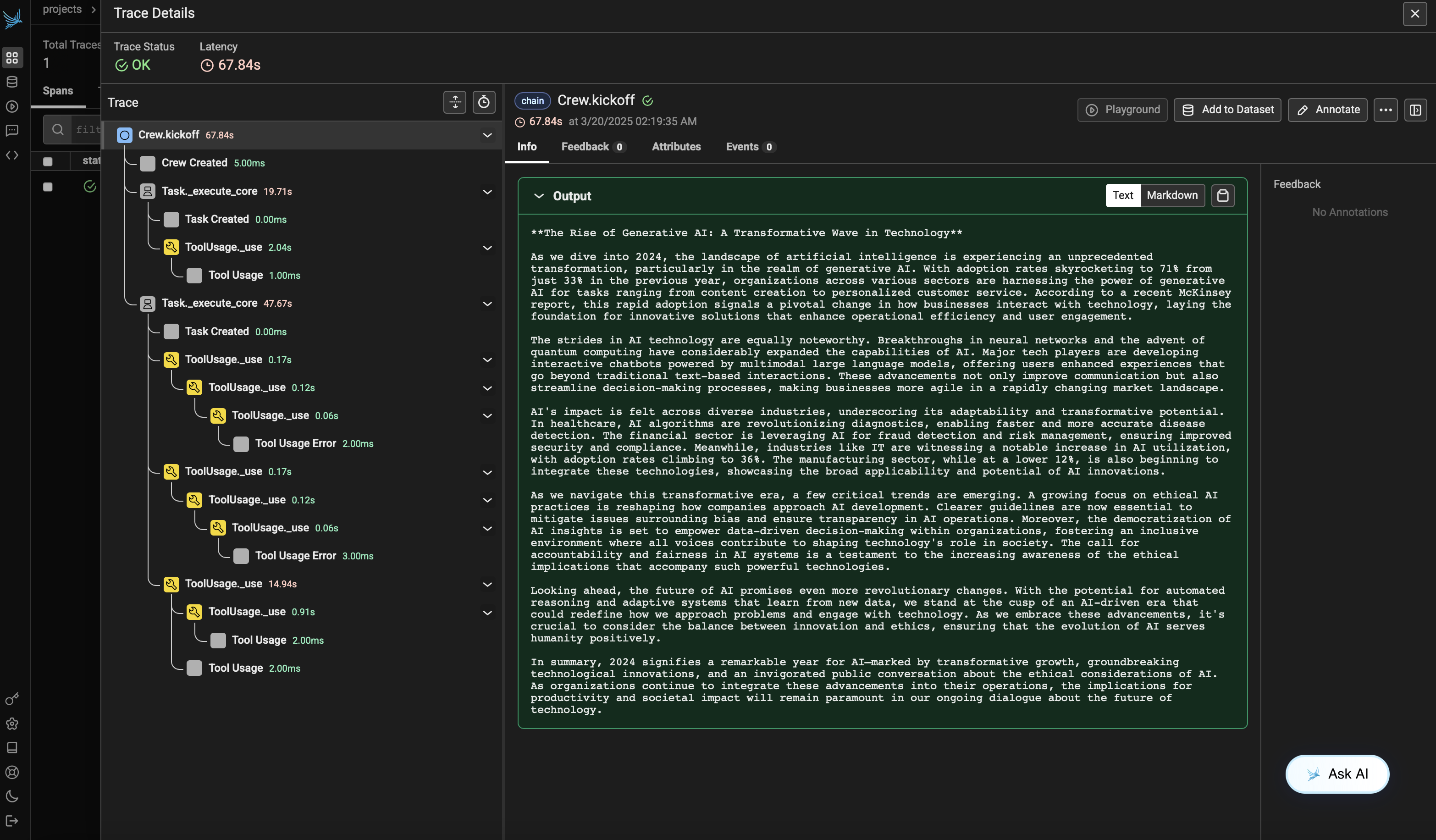
After running the agent, you can view the traces generated by your CrewAI application in Phoenix. You should see detailed steps of the agent interactions and LLM calls, which can help you debug and optimize your AI agents.
|
|
|
|
Log into your Phoenix Cloud account and navigate to the project you specified in the `project_name` parameter. You'll see a timeline view of your trace with all the agent interactions, tool usages, and LLM calls.
|
|
|
|
|
|
|
|
|
|
### Version Compatibility Information
|
|
- Python 3.8+
|
|
- CrewAI >= 0.86.0
|
|
- Arize Phoenix >= 7.0.1
|
|
- OpenTelemetry SDK >= 1.31.0
|
|
|
|
|
|
### References
|
|
- [Phoenix Documentation](https://docs.arize.com/phoenix/) - Overview of the Phoenix platform.
|
|
- [CrewAI Documentation](https://docs.crewai.com/) - Overview of the CrewAI framework.
|
|
- [OpenTelemetry Docs](https://opentelemetry.io/docs/) - OpenTelemetry guide
|
|
- [OpenInference GitHub](https://github.com/openinference/openinference) - Source code for OpenInference SDK.
|