mirror of
https://github.com/crewAIInc/crewAI.git
synced 2026-07-02 21:58:11 +00:00
 a237ebabba
* feat: adopt directory-based docs versioning with Edge channel

Switch docs.crewai.com from navigation-only versioning (every version
selector entry rendered the same docs/<lang>/* source files) to
Mintlify's directory-based versioning so each version selector entry
renders its own snapshot. Add an "Edge" channel under docs/edge/<lang>/*
that always reflects main HEAD for unreleased work, eliminating
pre-release leakage onto frozen release labels. External links to
canonical /<lang>/* URLs are preserved via wildcard redirects that
always land on the current default version.

Layout:
- docs/edge/<lang>/*         rolling source (you edit here)
- docs/edge/enterprise-api.*.yaml
- docs/v<X.Y.Z>/<lang>/*     frozen, immutable snapshots
- docs/v<X.Y.Z>/enterprise-api.*.yaml
- docs/images/               shared, append-only
- docs/docs.json             nav + redirects

URLs follow the Mintlify-idiomatic shape: /edge/<lang>/<page> for
Edge, /v<X.Y.Z>/<lang>/<page> for every frozen snapshot. The wildcard
redirects /<lang>/:slug* -> /<default>/<lang>/:slug* keep stale links
working, and every freeze rewrites them (plus all per-section/per-page
redirects) so destinations always resolve to the current default
without depending on a second redirect hop.

Release flow integration (devtools release):
- New module crewai_devtools.docs_versioning.freeze() materialises
  docs/v<X.Y.Z>/ from docs/edge/, rewrites openapi: refs inside the
  snapshot, inserts the version into every language block in
  docs.json, and refreshes all redirect destinations.
- _update_docs_and_create_pr() in cli.py now calls that freeze during
  Phase 2 of devtools release. Edge changelogs are updated first (so
  the snapshot freeze picks them up), then the snapshot is staged
  alongside docs.json, branched as docs/freeze-v<X.Y.Z>, and the PR
  is titled [docs-freeze] docs: snapshot and changelog for v<X.Y.Z>
  — the title prefix the new CI guard reads.
- The PR still gates tag, GitHub release, PyPI publish, and the
  enterprise release as before; no new PRs are added.
- Pre-releases (1.X.YaN, 1.X.YbN, ...) skip the snapshot — they ride
  Edge — and the docs PR title omits the [docs-freeze] prefix.
- docs_check (AI-generated docs scaffolding) writes to
  docs/edge/<lang>/* so newly-generated unreleased docs land in Edge
  and never accidentally touch a frozen snapshot.

Migration scripts (one-shot):
- scripts/docs/freeze_historical_versions.py reconstructs all 16
  historical snapshots (v1.10.0 .. v1.14.7) from git tags via
  git archive | tar, rewriting openapi: MDX refs so each snapshot
  reads its own enterprise-api YAML rather than the live one.
- scripts/docs/prefix_version_paths.py one-shot-migrates docs.json:
  rewrites every page path in 16 versioned blocks to point under
  docs/v<X.Y.Z>/, inserts a new Edge entry per language, tags
  v1.14.7 as Latest (default), prunes pages whose target file
  doesn't exist in the snapshot (e.g. docs/ar/ didn't exist before
  v1.12.0), and writes the wildcard + per-section redirects.
- scripts/docs/freeze_current_edge.py is now a thin CLI wrapper
  around docs_versioning.freeze for manual one-off freezes (e.g.
  retroactively snapshotting a forgotten release).

CI guards (.github/workflows/docs-snapshots.yml):
- Frozen snapshots under docs/v[0-9]*/ are immutable; only PRs whose
  title contains [docs-freeze] (i.e. release-cut PRs generated by
  devtools release or the manual wrapper) may modify them.
- Images under docs/images/ are append-only since snapshots share a
  single image directory. Deleting or renaming an image breaks every
  historical snapshot that still references it.

Restored docs/images/crewai-otel-export.png from PR #3673; it was
deleted in PR #4908 but v1.10.0 / v1.10.1 snapshots still reference
it. Restoring instead of editing the snapshots preserves historical
rendering fidelity and validates the new append-only rule
retroactively.

Tests:
- lib/devtools/tests/test_docs_versioning.py covers the freeze: file
  copy, openapi rewrite, version insertion, default demotion, redirect
  upserts, per-section redirect rewriting, idempotency, and invalid
  inputs.

Verified locally with mintlify broken-links: 0 broken links across
the full site (Edge + 16 frozen versions, 4 locales).

AGENTS.md (repo root) is the contributor guide for the new model;
RELEASING.md is the release-cut runbook; README's Contribution
section links to both.

Co-authored-by: Cursor <cursoragent@cursor.com>

* style: resolve linter issues

---------

Co-authored-by: Cursor <cursoragent@cursor.com>
149 lines
4.2 KiB
Plaintext
149 lines
4.2 KiB
Plaintext
---
|
||
title: Integração Maxim
|
||
description: Inicie o monitoramento, avaliação e observabilidade de agentes
|
||
icon: bars-staggered
|
||
mode: "wide"
|
||
---
|
||
|
||
# Integração Maxim
|
||
|
||
Maxim AI oferece monitoramento completo de agentes, avaliação e observabilidade para suas aplicações CrewAI. Com a integração de uma linha do Maxim, você pode facilmente rastrear e analisar interações dos agentes, métricas de desempenho e muito mais.
|
||
|
||
## Funcionalidades: Integração com Uma Linha
|
||
|
||
- **Rastreamento de Agentes de Ponta a Ponta**: Monitore todo o ciclo de vida dos seus agentes
|
||
- **Análise de Desempenho**: Acompanhe latência, tokens consumidos e custos
|
||
- **Monitoramento de Hiperparâmetros**: Visualize detalhes de configuração das execuções dos agentes
|
||
- **Rastreamento de Chamadas de Ferramentas**: Observe quando e como os agentes usam suas ferramentas
|
||
- **Visualização Avançada**: Entenda as trajetórias dos agentes através de dashboards intuitivos
|
||
|
||
## Começando
|
||
|
||
### Pré-requisitos
|
||
|
||
- Python versão >=3.10
|
||
- Uma conta Maxim ([cadastre-se aqui](https://getmaxim.ai/))
|
||
- Um projeto CrewAI
|
||
|
||
### Instalação
|
||
|
||
Instale o SDK do Maxim via pip:
|
||
|
||
```python
|
||
pip install maxim-py>=3.6.2
|
||
```
|
||
|
||
Ou adicione ao seu `requirements.txt`:
|
||
|
||
```
|
||
maxim-py>=3.6.2
|
||
```
|
||
|
||
### Configuração Básica
|
||
|
||
### 1. Configure as variáveis de ambiente
|
||
|
||
```python
|
||
### Configuração de Variáveis de Ambiente
|
||
|
||
# Crie um arquivo `.env` na raiz do seu projeto:
|
||
|
||
# Configuração da API Maxim
|
||
MAXIM_API_KEY=your_api_key_here
|
||
MAXIM_LOG_REPO_ID=your_repo_id_here
|
||
```
|
||
|
||
### 2. Importe os pacotes necessários
|
||
|
||
```python
|
||
from crewai import Agent, Task, Crew, Process
|
||
from maxim import Maxim
|
||
from maxim.logger.crewai import instrument_crewai
|
||
```
|
||
|
||
### 3. Inicialize o Maxim com sua chave de API
|
||
|
||
```python
|
||
# Inicialize o logger do Maxim
|
||
logger = Maxim().logger()
|
||
|
||
# Instrumente o CrewAI com apenas uma linha
|
||
instrument_crewai(logger)
|
||
```
|
||
|
||
### 4. Crie e execute sua aplicação CrewAI normalmente
|
||
|
||
```python
|
||
pesquisador = Agent(
|
||
role='Pesquisador Sênior',
|
||
goal='Descobrir os avanços mais recentes em IA',
|
||
backstory="Você é um pesquisador especialista em um think tank de tecnologia...",
|
||
verbose=True,
|
||
llm=llm
|
||
)
|
||
|
||
# Defina a tarefa
|
||
research_task = Task(
|
||
description="Pesquise os avanços mais recentes em IA...",
|
||
expected_output="",
|
||
agent=pesquisador
|
||
)
|
||
|
||
# Configure e execute a crew
|
||
crew = Crew(
|
||
agents=[pesquisador],
|
||
tasks=[research_task],
|
||
verbose=True
|
||
)
|
||
|
||
try:
|
||
result = crew.kickoff()
|
||
finally:
|
||
maxim.cleanup() # Garanta o cleanup mesmo em caso de erros
|
||
```
|
||
|
||
É isso! Todas as interações dos seus agentes CrewAI agora serão registradas e estarão disponíveis em seu painel Maxim.
|
||
|
||
Confira este Google Colab Notebook para referência rápida – [Notebook](https://colab.research.google.com/drive/1ZKIZWsmgQQ46n8TH9zLsT1negKkJA6K8?usp=sharing)
|
||
|
||
## Visualizando Seus Rastreamentos
|
||
|
||
Após executar sua aplicação CrewAI:
|
||
|
||
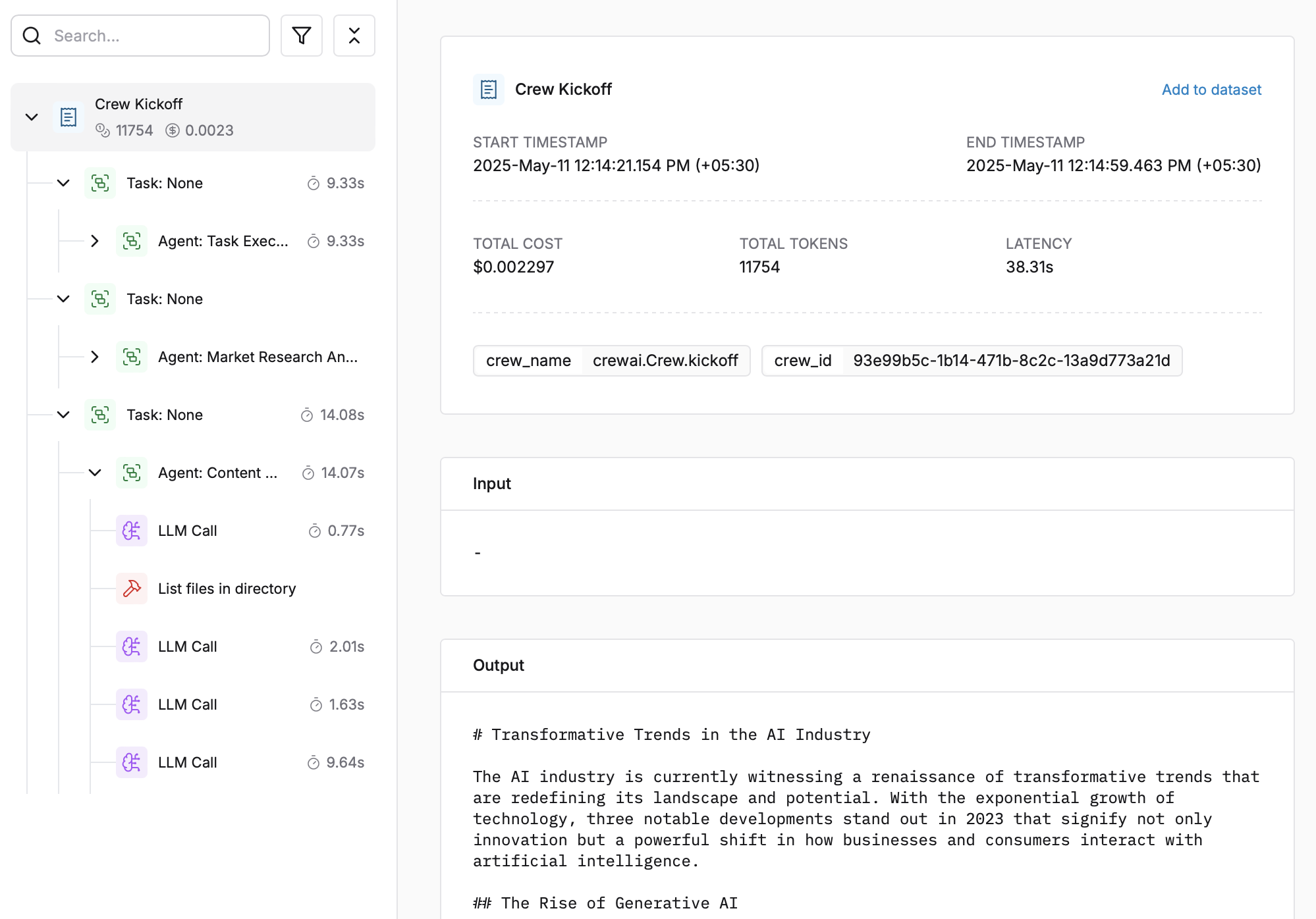
|
||
|
||
1. Faça login no seu [Painel Maxim](https://getmaxim.ai/dashboard)
|
||
2. Navegue até seu repositório
|
||
3. Visualize rastreamentos detalhados de agentes, incluindo:
|
||
- Conversas dos agentes
|
||
- Padrões de uso de ferramentas
|
||
- Métricas de desempenho
|
||
- Análises de custos
|
||
|
||
## Solução de Problemas
|
||
|
||
### Problemas Comuns
|
||
|
||
- **Nenhum rastreamento aparecendo**: Certifique-se de que sua chave de API e o ID do repositório estão corretos
|
||
- Certifique-se de que você **chamou `instrument_crewai()`** ***antes*** de executar sua crew. Isso inicializa corretamente os hooks de logging.
|
||
- Defina `debug=True` na chamada do `instrument_crewai()` para expor erros internos:
|
||
|
||
```python
|
||
instrument_crewai(logger, debug=True)
|
||
```
|
||
|
||
- Configure seus agentes com `verbose=True` para capturar logs detalhados:
|
||
|
||
```python
|
||
|
||
agent = CrewAgent(..., verbose=True)
|
||
```
|
||
|
||
- Verifique cuidadosamente se `instrument_crewai()` foi chamado **antes** de criar ou executar agentes. Isso pode parecer óbvio, mas é um erro comum.
|
||
|
||
### Suporte
|
||
|
||
Se você encontrar algum problema:
|
||
|
||
- Consulte a [Documentação do Maxim](https://getmaxim.ai/docs)
|
||
- Maxim Github [Link](https://github.com/maximhq) |