---
title: Portkey Integration
description: How to use Portkey with CrewAI
icon: key
---
 [Portkey](https://portkey.ai/?utm_source=crewai&utm_medium=crewai&utm_campaign=crewai) is a comprehensive AI gateway that enhances CrewAI agents with production-ready capabilities for reliability, cost-efficiency, and performance optimization.
Portkey adds 4 core production capabilities to any CrewAI agent:
1. Routing to **250+ LLMs** with unified API
2. Enhanced reliability with retries, fallbacks, and load balancing
3. Comprehensive observability with 40+ metrics and detailed tracing
4. Advanced security controls and real-time guardrails
## Getting Started
```bash
pip install -qU crewai portkey-ai
```
To build CrewAI Agents with Portkey, you'll need two keys:
- **Portkey API Key**: Sign up on the [Portkey app](https://app.portkey.ai/?utm_source=crewai&utm_medium=crewai&utm_campaign=crewai) and copy your API key
- **Virtual Key**: Virtual Keys securely manage your LLM API keys in one place. Store your LLM provider API keys securely in Portkey's vault
### Environment Variable Validation
Before setting up your LLM, validate your Portkey configuration to prevent runtime issues:
```python
import os
from typing import Dict, List
class PortkeyConfigurationError(Exception):
"""Raised when Portkey configuration is invalid or incomplete"""
pass
def validate_portkey_configuration() -> None:
"""
Validates that all required Portkey environment variables are set.
Raises:
PortkeyConfigurationError: If any required variables are missing
"""
required_vars: Dict[str, str] = {
"PORTKEY_API_KEY": "Get from https://app.portkey.ai",
"PORTKEY_VIRTUAL_KEY": "Create in Portkey dashboard"
}
missing_vars: List[str] = []
for var, help_text in required_vars.items():
if not os.getenv(var):
missing_vars.append(f"{var} ({help_text})")
if missing_vars:
raise PortkeyConfigurationError(
"Missing required Portkey configuration:\n" +
"\n".join(f"- {var}" for var in missing_vars)
)
```
### Modern Integration (Recommended)
The latest Portkey SDK (v1.13.0+) is built directly on top of the OpenAI SDK, providing seamless compatibility:
```python
from crewai import LLM
import os
from typing import Optional
# Validate configuration before proceeding
validate_portkey_configuration()
# Set environment variables
os.environ["PORTKEY_API_KEY"] = "YOUR_PORTKEY_API_KEY"
os.environ["PORTKEY_VIRTUAL_KEY"] = "YOUR_VIRTUAL_KEY"
def create_portkey_llm(
model: str = "gpt-4",
api_key: Optional[str] = None,
virtual_key: Optional[str] = None
) -> LLM:
"""
Create a CrewAI LLM instance configured with Portkey.
Args:
model: The model name to use (e.g., "gpt-4", "claude-3-sonnet")
api_key: Portkey API key (defaults to PORTKEY_API_KEY env var)
virtual_key: Portkey Virtual key (defaults to PORTKEY_VIRTUAL_KEY env var)
Returns:
Configured LLM instance with Portkey integration
Example:
>>> llm = create_portkey_llm("gpt-4")
>>> # Use with CrewAI agents
>>> agent = Agent(llm=llm, ...)
"""
portkey_api_key = api_key or os.environ["PORTKEY_API_KEY"]
portkey_virtual_key = virtual_key or os.environ["PORTKEY_VIRTUAL_KEY"]
return LLM(
model=model,
base_url="https://api.portkey.ai/v1",
api_key=portkey_virtual_key,
extra_headers={
"x-portkey-api-key": portkey_api_key,
"x-portkey-virtual-key": portkey_virtual_key
}
)
# Create LLM instance
gpt_llm = create_portkey_llm("gpt-4")
```
### Legacy Integration (Deprecated)
For backward compatibility, the older pattern is still supported but not recommended:
```python
from crewai import LLM
from portkey_ai import createHeaders, PORTKEY_GATEWAY_URL
gpt_llm = LLM(
model="gpt-4",
base_url=PORTKEY_GATEWAY_URL,
api_key="dummy",
extra_headers=createHeaders(
api_key="YOUR_PORTKEY_API_KEY",
virtual_key="YOUR_VIRTUAL_KEY"
)
)
```
```python
from crewai import Agent, Task, Crew
# Define your agents with roles and goals
coder = Agent(
role='Software developer',
goal='Write clear, concise code on demand',
backstory='An expert coder with a keen eye for software trends.',
llm=gpt_llm
)
# Create tasks for your agents
task1 = Task(
description="Define the HTML for making a simple website with heading- Hello World! Portkey is working!",
expected_output="A clear and concise HTML code",
agent=coder
)
# Instantiate your crew with Portkey observability
crew = Crew(
agents=[coder],
tasks=[task1],
)
result = crew.kickoff()
print(result)
```
## Async Support
Portkey fully supports async operations with CrewAI for high-performance applications:
```python
import asyncio
from crewai import Agent, Task, Crew, LLM
import os
# Configure async LLM with Portkey
async_llm = LLM(
model="gpt-4",
base_url="https://api.portkey.ai/v1",
api_key=os.environ["PORTKEY_VIRTUAL_KEY"],
extra_headers={
"x-portkey-api-key": os.environ["PORTKEY_API_KEY"],
"x-portkey-virtual-key": os.environ["PORTKEY_VIRTUAL_KEY"]
}
)
async def run_async_crew():
agent = Agent(
role='Data Analyst',
goal='Analyze data efficiently',
backstory='Expert in data analysis and insights.',
llm=async_llm
)
task = Task(
description="Analyze the latest market trends",
expected_output="Comprehensive market analysis report",
agent=agent
)
crew = Crew(agents=[agent], tasks=[task])
result = await crew.kickoff_async()
return result
# Run async crew
result = asyncio.run(run_async_crew())
```
## Key Features
| Feature | Description |
|:--------|:------------|
| 🌐 Multi-LLM Support | Access OpenAI, Anthropic, Gemini, Azure, and 250+ providers through a unified interface |
| 🛡️ Production Reliability | Implement retries, timeouts, load balancing, and fallbacks |
| 📊 Advanced Observability | Track 40+ metrics including costs, tokens, latency, and custom metadata |
| 🔍 Comprehensive Logging | Debug with detailed execution traces and function call logs |
| 🚧 Security Controls | Set budget limits and implement role-based access control |
| 🔄 Performance Analytics | Capture and analyze feedback for continuous improvement |
| 💾 Intelligent Caching | Reduce costs and latency with semantic or simple caching |
## Production Features with Portkey Configs
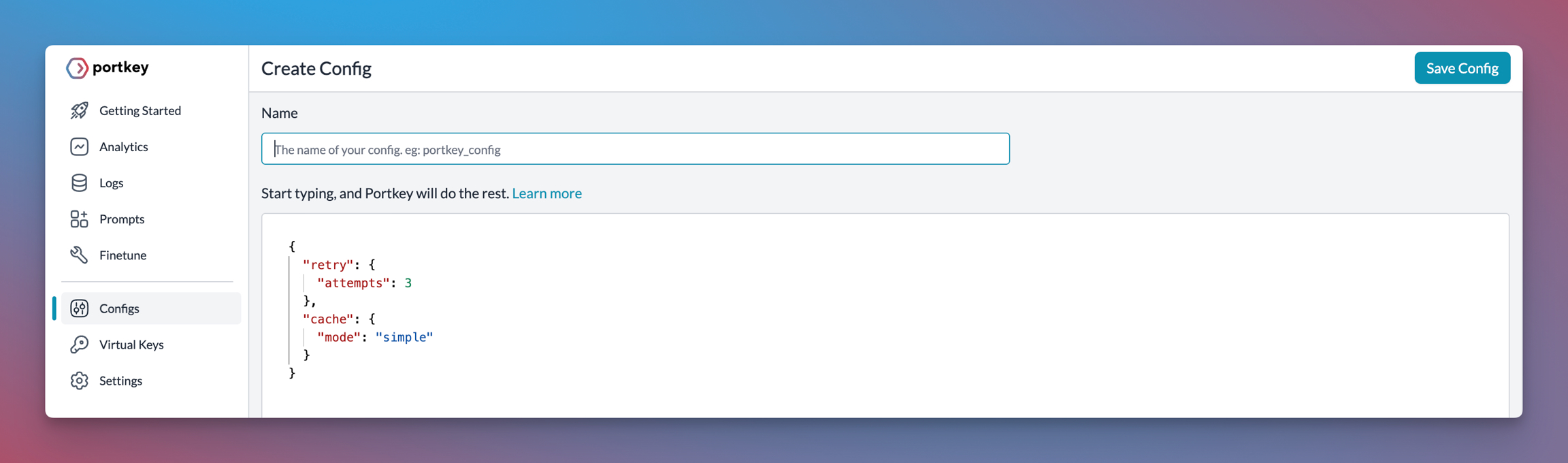
All features mentioned below are through Portkey's Config system. Portkey's Config system allows you to define routing strategies using simple JSON objects in your LLM API calls. You can create and manage Configs directly in your code or through the Portkey Dashboard. Each Config has a unique ID for easy reference.
[Portkey](https://portkey.ai/?utm_source=crewai&utm_medium=crewai&utm_campaign=crewai) is a comprehensive AI gateway that enhances CrewAI agents with production-ready capabilities for reliability, cost-efficiency, and performance optimization.
Portkey adds 4 core production capabilities to any CrewAI agent:
1. Routing to **250+ LLMs** with unified API
2. Enhanced reliability with retries, fallbacks, and load balancing
3. Comprehensive observability with 40+ metrics and detailed tracing
4. Advanced security controls and real-time guardrails
## Getting Started
```bash
pip install -qU crewai portkey-ai
```
To build CrewAI Agents with Portkey, you'll need two keys:
- **Portkey API Key**: Sign up on the [Portkey app](https://app.portkey.ai/?utm_source=crewai&utm_medium=crewai&utm_campaign=crewai) and copy your API key
- **Virtual Key**: Virtual Keys securely manage your LLM API keys in one place. Store your LLM provider API keys securely in Portkey's vault
### Environment Variable Validation
Before setting up your LLM, validate your Portkey configuration to prevent runtime issues:
```python
import os
from typing import Dict, List
class PortkeyConfigurationError(Exception):
"""Raised when Portkey configuration is invalid or incomplete"""
pass
def validate_portkey_configuration() -> None:
"""
Validates that all required Portkey environment variables are set.
Raises:
PortkeyConfigurationError: If any required variables are missing
"""
required_vars: Dict[str, str] = {
"PORTKEY_API_KEY": "Get from https://app.portkey.ai",
"PORTKEY_VIRTUAL_KEY": "Create in Portkey dashboard"
}
missing_vars: List[str] = []
for var, help_text in required_vars.items():
if not os.getenv(var):
missing_vars.append(f"{var} ({help_text})")
if missing_vars:
raise PortkeyConfigurationError(
"Missing required Portkey configuration:\n" +
"\n".join(f"- {var}" for var in missing_vars)
)
```
### Modern Integration (Recommended)
The latest Portkey SDK (v1.13.0+) is built directly on top of the OpenAI SDK, providing seamless compatibility:
```python
from crewai import LLM
import os
from typing import Optional
# Validate configuration before proceeding
validate_portkey_configuration()
# Set environment variables
os.environ["PORTKEY_API_KEY"] = "YOUR_PORTKEY_API_KEY"
os.environ["PORTKEY_VIRTUAL_KEY"] = "YOUR_VIRTUAL_KEY"
def create_portkey_llm(
model: str = "gpt-4",
api_key: Optional[str] = None,
virtual_key: Optional[str] = None
) -> LLM:
"""
Create a CrewAI LLM instance configured with Portkey.
Args:
model: The model name to use (e.g., "gpt-4", "claude-3-sonnet")
api_key: Portkey API key (defaults to PORTKEY_API_KEY env var)
virtual_key: Portkey Virtual key (defaults to PORTKEY_VIRTUAL_KEY env var)
Returns:
Configured LLM instance with Portkey integration
Example:
>>> llm = create_portkey_llm("gpt-4")
>>> # Use with CrewAI agents
>>> agent = Agent(llm=llm, ...)
"""
portkey_api_key = api_key or os.environ["PORTKEY_API_KEY"]
portkey_virtual_key = virtual_key or os.environ["PORTKEY_VIRTUAL_KEY"]
return LLM(
model=model,
base_url="https://api.portkey.ai/v1",
api_key=portkey_virtual_key,
extra_headers={
"x-portkey-api-key": portkey_api_key,
"x-portkey-virtual-key": portkey_virtual_key
}
)
# Create LLM instance
gpt_llm = create_portkey_llm("gpt-4")
```
### Legacy Integration (Deprecated)
For backward compatibility, the older pattern is still supported but not recommended:
```python
from crewai import LLM
from portkey_ai import createHeaders, PORTKEY_GATEWAY_URL
gpt_llm = LLM(
model="gpt-4",
base_url=PORTKEY_GATEWAY_URL,
api_key="dummy",
extra_headers=createHeaders(
api_key="YOUR_PORTKEY_API_KEY",
virtual_key="YOUR_VIRTUAL_KEY"
)
)
```
```python
from crewai import Agent, Task, Crew
# Define your agents with roles and goals
coder = Agent(
role='Software developer',
goal='Write clear, concise code on demand',
backstory='An expert coder with a keen eye for software trends.',
llm=gpt_llm
)
# Create tasks for your agents
task1 = Task(
description="Define the HTML for making a simple website with heading- Hello World! Portkey is working!",
expected_output="A clear and concise HTML code",
agent=coder
)
# Instantiate your crew with Portkey observability
crew = Crew(
agents=[coder],
tasks=[task1],
)
result = crew.kickoff()
print(result)
```
## Async Support
Portkey fully supports async operations with CrewAI for high-performance applications:
```python
import asyncio
from crewai import Agent, Task, Crew, LLM
import os
# Configure async LLM with Portkey
async_llm = LLM(
model="gpt-4",
base_url="https://api.portkey.ai/v1",
api_key=os.environ["PORTKEY_VIRTUAL_KEY"],
extra_headers={
"x-portkey-api-key": os.environ["PORTKEY_API_KEY"],
"x-portkey-virtual-key": os.environ["PORTKEY_VIRTUAL_KEY"]
}
)
async def run_async_crew():
agent = Agent(
role='Data Analyst',
goal='Analyze data efficiently',
backstory='Expert in data analysis and insights.',
llm=async_llm
)
task = Task(
description="Analyze the latest market trends",
expected_output="Comprehensive market analysis report",
agent=agent
)
crew = Crew(agents=[agent], tasks=[task])
result = await crew.kickoff_async()
return result
# Run async crew
result = asyncio.run(run_async_crew())
```
## Key Features
| Feature | Description |
|:--------|:------------|
| 🌐 Multi-LLM Support | Access OpenAI, Anthropic, Gemini, Azure, and 250+ providers through a unified interface |
| 🛡️ Production Reliability | Implement retries, timeouts, load balancing, and fallbacks |
| 📊 Advanced Observability | Track 40+ metrics including costs, tokens, latency, and custom metadata |
| 🔍 Comprehensive Logging | Debug with detailed execution traces and function call logs |
| 🚧 Security Controls | Set budget limits and implement role-based access control |
| 🔄 Performance Analytics | Capture and analyze feedback for continuous improvement |
| 💾 Intelligent Caching | Reduce costs and latency with semantic or simple caching |
## Production Features with Portkey Configs
All features mentioned below are through Portkey's Config system. Portkey's Config system allows you to define routing strategies using simple JSON objects in your LLM API calls. You can create and manage Configs directly in your code or through the Portkey Dashboard. Each Config has a unique ID for easy reference.
 ### 1. Use 250+ LLMs
Access various LLMs like Anthropic, Gemini, Mistral, Azure OpenAI, and more with minimal code changes. Switch between providers or use them together seamlessly. [Learn more about Universal API](https://portkey.ai/docs/product/ai-gateway/universal-api)
Easily switch between different LLM providers using the modern integration pattern:
```python
import os
# Anthropic Configuration
anthropic_llm = LLM(
model="claude-3-5-sonnet-latest",
base_url="https://api.portkey.ai/v1",
api_key=os.environ["ANTHROPIC_VIRTUAL_KEY"],
extra_headers={
"x-portkey-api-key": os.environ["PORTKEY_API_KEY"],
"x-portkey-virtual-key": os.environ["ANTHROPIC_VIRTUAL_KEY"],
"x-portkey-trace-id": "anthropic_agent"
}
)
# Azure OpenAI Configuration
azure_llm = LLM(
model="gpt-4",
base_url="https://api.portkey.ai/v1",
api_key=os.environ["AZURE_VIRTUAL_KEY"],
extra_headers={
"x-portkey-api-key": os.environ["PORTKEY_API_KEY"],
"x-portkey-virtual-key": os.environ["AZURE_VIRTUAL_KEY"],
"x-portkey-trace-id": "azure_agent"
}
)
# Google Gemini Configuration
gemini_llm = LLM(
model="gemini-2.0-flash-exp",
base_url="https://api.portkey.ai/v1",
api_key=os.environ["GEMINI_VIRTUAL_KEY"],
extra_headers={
"x-portkey-api-key": os.environ["PORTKEY_API_KEY"],
"x-portkey-virtual-key": os.environ["GEMINI_VIRTUAL_KEY"],
"x-portkey-trace-id": "gemini_agent"
}
)
# Mistral Configuration
mistral_llm = LLM(
model="mistral-large-latest",
base_url="https://api.portkey.ai/v1",
api_key=os.environ["MISTRAL_VIRTUAL_KEY"],
extra_headers={
"x-portkey-api-key": os.environ["PORTKEY_API_KEY"],
"x-portkey-virtual-key": os.environ["MISTRAL_VIRTUAL_KEY"],
"x-portkey-trace-id": "mistral_agent"
}
)
```
### 2. Caching
Improve response times and reduce costs with two powerful caching modes:
- **Simple Cache**: Perfect for exact matches
- **Semantic Cache**: Matches responses for requests that are semantically similar
[Learn more about Caching](https://portkey.ai/docs/product/ai-gateway/cache-simple-and-semantic)
```python
import json
# Enable caching for CrewAI agents
cached_llm = LLM(
model="gpt-4",
base_url="https://api.portkey.ai/v1",
api_key=os.environ["PORTKEY_VIRTUAL_KEY"],
extra_headers={
"x-portkey-api-key": os.environ["PORTKEY_API_KEY"],
"x-portkey-virtual-key": os.environ["PORTKEY_VIRTUAL_KEY"],
"x-portkey-config": json.dumps({
"cache": {
"mode": "semantic", # or "simple" for exact matching
"max_age": 3600 # Cache for 1 hour
}
})
}
)
# Use with CrewAI agents for improved performance
research_agent = Agent(
role='Research Analyst',
goal='Conduct thorough research with cached responses',
backstory='Expert researcher who values efficiency.',
llm=cached_llm
)
```
### 3. Production Reliability
Portkey provides comprehensive reliability features essential for production CrewAI deployments:
#### Automatic Retries and Fallbacks
```python
import json
# Configure LLM with automatic retries and fallbacks
reliable_llm = LLM(
model="gpt-4",
base_url="https://api.portkey.ai/v1",
api_key=os.environ["PORTKEY_VIRTUAL_KEY"],
extra_headers={
"x-portkey-api-key": os.environ["PORTKEY_API_KEY"],
"x-portkey-config": json.dumps({
"retry": {
"attempts": 3,
"on_status_codes": [429, 500, 502, 503, 504]
},
"fallbacks": [
{"virtual_key": os.environ["OPENAI_VIRTUAL_KEY"]},
{"virtual_key": os.environ["ANTHROPIC_VIRTUAL_KEY"]}
]
})
}
)
```
#### Load Balancing
```python
# Distribute requests across multiple models for optimal performance
load_balanced_llm = LLM(
model="gpt-4",
base_url="https://api.portkey.ai/v1",
api_key=os.environ["PORTKEY_VIRTUAL_KEY"],
extra_headers={
"x-portkey-api-key": os.environ["PORTKEY_API_KEY"],
"x-portkey-config": json.dumps({
"strategy": {
"mode": "loadbalance",
"targets": [
{"virtual_key": os.environ["OPENAI_VIRTUAL_KEY"], "weight": 70},
{"virtual_key": os.environ["ANTHROPIC_VIRTUAL_KEY"], "weight": 30}
]
}
})
}
)
```
#### Request Timeouts and Conditional Routing
```python
# Configure timeouts and conditional routing for CrewAI workflows
production_llm = LLM(
model="gpt-4",
base_url="https://api.portkey.ai/v1",
api_key=os.environ["PORTKEY_VIRTUAL_KEY"],
extra_headers={
"x-portkey-api-key": os.environ["PORTKEY_API_KEY"],
"x-portkey-config": json.dumps({
"request_timeout": 30000, # 30 seconds
"conditional_routing": {
"rules": [
{
"condition": "request.model == 'gpt-4'",
"target": {"virtual_key": os.environ["OPENAI_VIRTUAL_KEY"]}
}
]
}
})
}
)
```
[Learn more about Reliability Features](https://portkey.ai/docs/product/ai-gateway/)
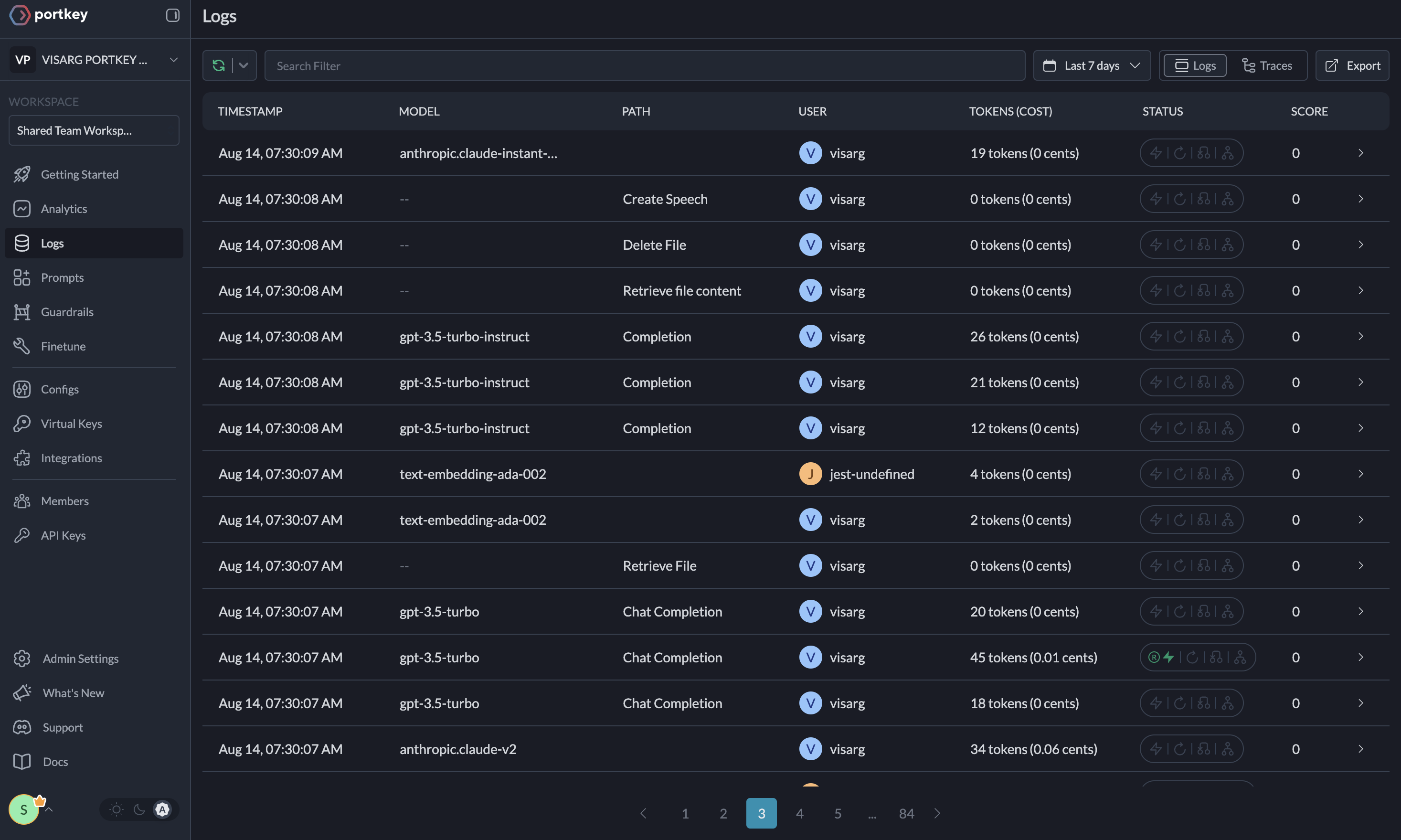
### 4. Comprehensive Observability
CrewAI workflows involve complex multi-agent interactions. Portkey automatically logs **40+ comprehensive metrics** for your AI agents, providing deep insights into agent behavior, performance, and costs.
#### Key Metrics for CrewAI Workflows
- **Agent Performance**: Individual agent response times and success rates
- **Task Execution**: Time spent on each task and completion rates
- **Cost Analysis**: Token usage and costs per agent, task, and crew
- **Multi-Agent Coordination**: Communication patterns between agents
- **Tool Usage**: Frequency and success rates of tool calls
- **Memory Operations**: Knowledge retrieval and storage metrics
- **Cache Efficiency**: Hit rates and performance improvements
#### Custom Metadata for CrewAI
```python
import json
# Add custom metadata to track CrewAI-specific metrics
crew_llm = LLM(
model="gpt-4",
base_url="https://api.portkey.ai/v1",
api_key=os.environ["PORTKEY_VIRTUAL_KEY"],
extra_headers={
"x-portkey-api-key": os.environ["PORTKEY_API_KEY"],
"x-portkey-virtual-key": os.environ["PORTKEY_VIRTUAL_KEY"],
"x-portkey-metadata": json.dumps({
"crew_id": "marketing_crew_v1",
"agent_role": "content_writer",
"task_type": "blog_generation",
"environment": "production"
})
}
)
```
### 1. Use 250+ LLMs
Access various LLMs like Anthropic, Gemini, Mistral, Azure OpenAI, and more with minimal code changes. Switch between providers or use them together seamlessly. [Learn more about Universal API](https://portkey.ai/docs/product/ai-gateway/universal-api)
Easily switch between different LLM providers using the modern integration pattern:
```python
import os
# Anthropic Configuration
anthropic_llm = LLM(
model="claude-3-5-sonnet-latest",
base_url="https://api.portkey.ai/v1",
api_key=os.environ["ANTHROPIC_VIRTUAL_KEY"],
extra_headers={
"x-portkey-api-key": os.environ["PORTKEY_API_KEY"],
"x-portkey-virtual-key": os.environ["ANTHROPIC_VIRTUAL_KEY"],
"x-portkey-trace-id": "anthropic_agent"
}
)
# Azure OpenAI Configuration
azure_llm = LLM(
model="gpt-4",
base_url="https://api.portkey.ai/v1",
api_key=os.environ["AZURE_VIRTUAL_KEY"],
extra_headers={
"x-portkey-api-key": os.environ["PORTKEY_API_KEY"],
"x-portkey-virtual-key": os.environ["AZURE_VIRTUAL_KEY"],
"x-portkey-trace-id": "azure_agent"
}
)
# Google Gemini Configuration
gemini_llm = LLM(
model="gemini-2.0-flash-exp",
base_url="https://api.portkey.ai/v1",
api_key=os.environ["GEMINI_VIRTUAL_KEY"],
extra_headers={
"x-portkey-api-key": os.environ["PORTKEY_API_KEY"],
"x-portkey-virtual-key": os.environ["GEMINI_VIRTUAL_KEY"],
"x-portkey-trace-id": "gemini_agent"
}
)
# Mistral Configuration
mistral_llm = LLM(
model="mistral-large-latest",
base_url="https://api.portkey.ai/v1",
api_key=os.environ["MISTRAL_VIRTUAL_KEY"],
extra_headers={
"x-portkey-api-key": os.environ["PORTKEY_API_KEY"],
"x-portkey-virtual-key": os.environ["MISTRAL_VIRTUAL_KEY"],
"x-portkey-trace-id": "mistral_agent"
}
)
```
### 2. Caching
Improve response times and reduce costs with two powerful caching modes:
- **Simple Cache**: Perfect for exact matches
- **Semantic Cache**: Matches responses for requests that are semantically similar
[Learn more about Caching](https://portkey.ai/docs/product/ai-gateway/cache-simple-and-semantic)
```python
import json
# Enable caching for CrewAI agents
cached_llm = LLM(
model="gpt-4",
base_url="https://api.portkey.ai/v1",
api_key=os.environ["PORTKEY_VIRTUAL_KEY"],
extra_headers={
"x-portkey-api-key": os.environ["PORTKEY_API_KEY"],
"x-portkey-virtual-key": os.environ["PORTKEY_VIRTUAL_KEY"],
"x-portkey-config": json.dumps({
"cache": {
"mode": "semantic", # or "simple" for exact matching
"max_age": 3600 # Cache for 1 hour
}
})
}
)
# Use with CrewAI agents for improved performance
research_agent = Agent(
role='Research Analyst',
goal='Conduct thorough research with cached responses',
backstory='Expert researcher who values efficiency.',
llm=cached_llm
)
```
### 3. Production Reliability
Portkey provides comprehensive reliability features essential for production CrewAI deployments:
#### Automatic Retries and Fallbacks
```python
import json
# Configure LLM with automatic retries and fallbacks
reliable_llm = LLM(
model="gpt-4",
base_url="https://api.portkey.ai/v1",
api_key=os.environ["PORTKEY_VIRTUAL_KEY"],
extra_headers={
"x-portkey-api-key": os.environ["PORTKEY_API_KEY"],
"x-portkey-config": json.dumps({
"retry": {
"attempts": 3,
"on_status_codes": [429, 500, 502, 503, 504]
},
"fallbacks": [
{"virtual_key": os.environ["OPENAI_VIRTUAL_KEY"]},
{"virtual_key": os.environ["ANTHROPIC_VIRTUAL_KEY"]}
]
})
}
)
```
#### Load Balancing
```python
# Distribute requests across multiple models for optimal performance
load_balanced_llm = LLM(
model="gpt-4",
base_url="https://api.portkey.ai/v1",
api_key=os.environ["PORTKEY_VIRTUAL_KEY"],
extra_headers={
"x-portkey-api-key": os.environ["PORTKEY_API_KEY"],
"x-portkey-config": json.dumps({
"strategy": {
"mode": "loadbalance",
"targets": [
{"virtual_key": os.environ["OPENAI_VIRTUAL_KEY"], "weight": 70},
{"virtual_key": os.environ["ANTHROPIC_VIRTUAL_KEY"], "weight": 30}
]
}
})
}
)
```
#### Request Timeouts and Conditional Routing
```python
# Configure timeouts and conditional routing for CrewAI workflows
production_llm = LLM(
model="gpt-4",
base_url="https://api.portkey.ai/v1",
api_key=os.environ["PORTKEY_VIRTUAL_KEY"],
extra_headers={
"x-portkey-api-key": os.environ["PORTKEY_API_KEY"],
"x-portkey-config": json.dumps({
"request_timeout": 30000, # 30 seconds
"conditional_routing": {
"rules": [
{
"condition": "request.model == 'gpt-4'",
"target": {"virtual_key": os.environ["OPENAI_VIRTUAL_KEY"]}
}
]
}
})
}
)
```
[Learn more about Reliability Features](https://portkey.ai/docs/product/ai-gateway/)
### 4. Comprehensive Observability
CrewAI workflows involve complex multi-agent interactions. Portkey automatically logs **40+ comprehensive metrics** for your AI agents, providing deep insights into agent behavior, performance, and costs.
#### Key Metrics for CrewAI Workflows
- **Agent Performance**: Individual agent response times and success rates
- **Task Execution**: Time spent on each task and completion rates
- **Cost Analysis**: Token usage and costs per agent, task, and crew
- **Multi-Agent Coordination**: Communication patterns between agents
- **Tool Usage**: Frequency and success rates of tool calls
- **Memory Operations**: Knowledge retrieval and storage metrics
- **Cache Efficiency**: Hit rates and performance improvements
#### Custom Metadata for CrewAI
```python
import json
# Add custom metadata to track CrewAI-specific metrics
crew_llm = LLM(
model="gpt-4",
base_url="https://api.portkey.ai/v1",
api_key=os.environ["PORTKEY_VIRTUAL_KEY"],
extra_headers={
"x-portkey-api-key": os.environ["PORTKEY_API_KEY"],
"x-portkey-virtual-key": os.environ["PORTKEY_VIRTUAL_KEY"],
"x-portkey-metadata": json.dumps({
"crew_id": "marketing_crew_v1",
"agent_role": "content_writer",
"task_type": "blog_generation",
"environment": "production"
})
}
)
```
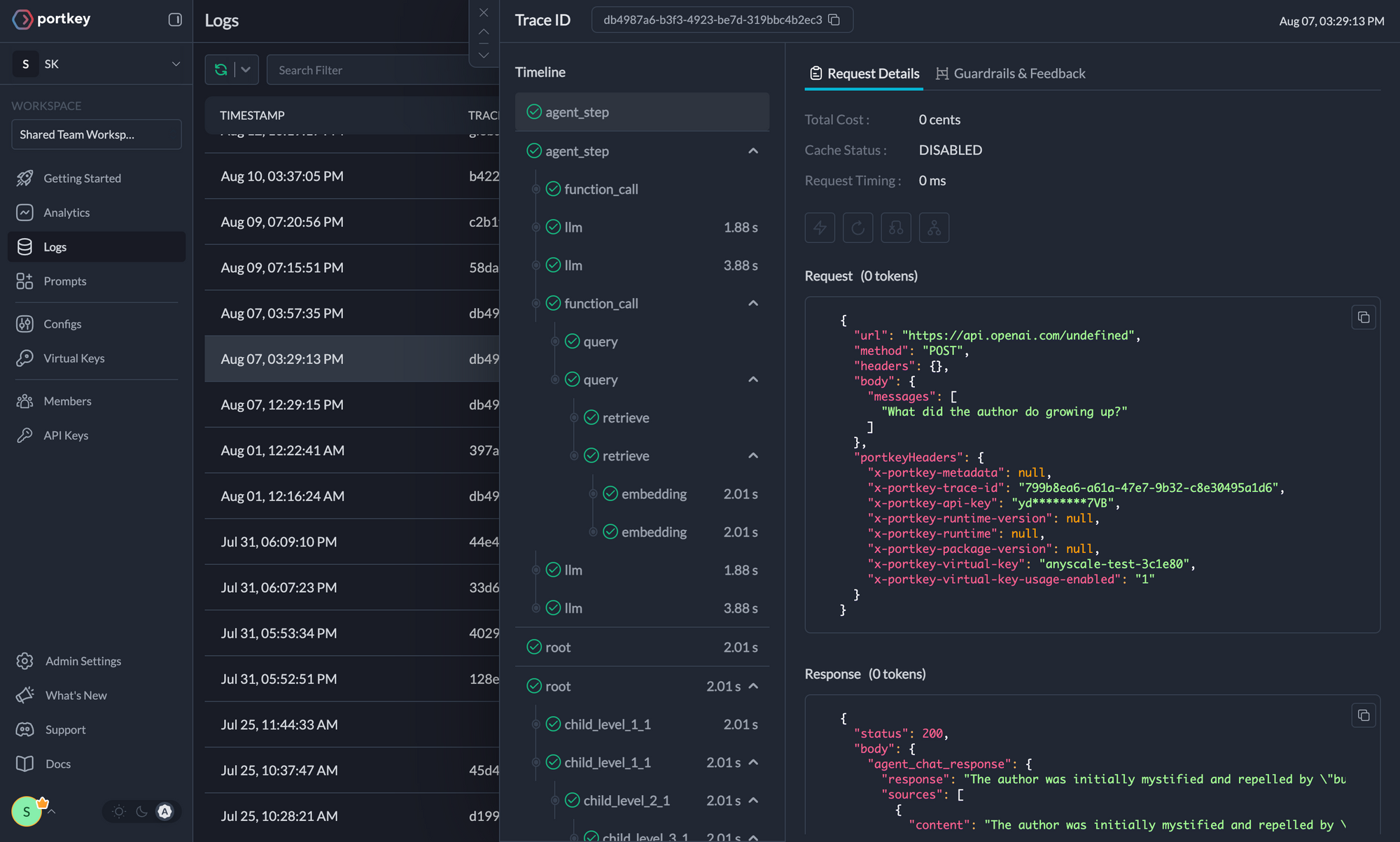
 ### 5. Advanced Logging and Tracing
Portkey provides comprehensive logging capabilities specifically designed for complex multi-agent systems like CrewAI. Track every interaction, decision, and outcome across your entire crew workflow.
#### CrewAI-Specific Logging Features
- **Agent Conversation Flows**: Complete conversation history between agents
- **Task Execution Traces**: Step-by-step task completion with timing
- **Tool Call Monitoring**: Detailed logs of all tool invocations and results
- **Memory Access Patterns**: Track knowledge retrieval and storage operations
- **Error Propagation**: Trace how errors flow through multi-agent workflows
#### Implementing Structured Logging
```python
import json
import os
from datetime import datetime
# Configure detailed logging for CrewAI workflows
logged_llm = LLM(
model="gpt-4",
base_url="https://api.portkey.ai/v1",
api_key=os.environ["PORTKEY_VIRTUAL_KEY"],
extra_headers={
"x-portkey-api-key": os.environ["PORTKEY_API_KEY"],
"x-portkey-virtual-key": os.environ["PORTKEY_VIRTUAL_KEY"],
"x-portkey-trace-id": f"crew_execution_{datetime.now().isoformat()}",
"x-portkey-metadata": json.dumps({
"workflow_type": "multi_agent_research",
"crew_size": 3,
"expected_duration": "5_minutes"
})
}
)
# Use with CrewAI for comprehensive observability
research_crew = Crew(
agents=[researcher, writer, reviewer],
tasks=[research_task, writing_task, review_task],
verbose=True # Enable CrewAI's built-in logging
)
```
### 5. Advanced Logging and Tracing
Portkey provides comprehensive logging capabilities specifically designed for complex multi-agent systems like CrewAI. Track every interaction, decision, and outcome across your entire crew workflow.
#### CrewAI-Specific Logging Features
- **Agent Conversation Flows**: Complete conversation history between agents
- **Task Execution Traces**: Step-by-step task completion with timing
- **Tool Call Monitoring**: Detailed logs of all tool invocations and results
- **Memory Access Patterns**: Track knowledge retrieval and storage operations
- **Error Propagation**: Trace how errors flow through multi-agent workflows
#### Implementing Structured Logging
```python
import json
import os
from datetime import datetime
# Configure detailed logging for CrewAI workflows
logged_llm = LLM(
model="gpt-4",
base_url="https://api.portkey.ai/v1",
api_key=os.environ["PORTKEY_VIRTUAL_KEY"],
extra_headers={
"x-portkey-api-key": os.environ["PORTKEY_API_KEY"],
"x-portkey-virtual-key": os.environ["PORTKEY_VIRTUAL_KEY"],
"x-portkey-trace-id": f"crew_execution_{datetime.now().isoformat()}",
"x-portkey-metadata": json.dumps({
"workflow_type": "multi_agent_research",
"crew_size": 3,
"expected_duration": "5_minutes"
})
}
)
# Use with CrewAI for comprehensive observability
research_crew = Crew(
agents=[researcher, writer, reviewer],
tasks=[research_task, writing_task, review_task],
verbose=True # Enable CrewAI's built-in logging
)
```
Traces
Logs
### 6. Enterprise Security Features
- **Budget Controls**: Set spending limits per Virtual Key to prevent cost overruns
- **Rate Limiting**: Control request frequency to prevent abuse
- **Role-Based Access**: Implement fine-grained permissions for team members
- **Audit Logging**: Track all system changes and access patterns
- **Data Retention**: Configure policies for log and metric retention
- **API Key Rotation**: Automated rotation of Virtual Keys for enhanced security
```python
import json
import os
# Example of budget-controlled LLM for production CrewAI deployments
budget_controlled_llm = LLM(
model="gpt-4",
base_url="https://api.portkey.ai/v1",
api_key=os.environ["PORTKEY_VIRTUAL_KEY"],
extra_headers={
"x-portkey-api-key": os.environ["PORTKEY_API_KEY"],
"x-portkey-virtual-key": os.environ["PORTKEY_VIRTUAL_KEY"],
"x-portkey-config": json.dumps({
"budget": {
"limit": 100.0, # $100 monthly limit
"period": "monthly"
},
"rate_limit": {
"requests_per_minute": 60
}
})
}
)
```
## CrewAI-Specific Integration Patterns
### Integration with CrewAI Flows
Portkey seamlessly integrates with CrewAI's Flow system for event-driven workflows:
```python
import json
import os
from crewai.flow.flow import Flow, listen, start
from crewai import Agent, Task
class ResearchFlow(Flow):
@start()
def initiate_research(self):
researcher = Agent(
role='Senior Researcher',
goal='Conduct comprehensive research',
backstory='Expert researcher with access to multiple data sources.',
llm=reliable_llm # Using Portkey-configured LLM
)
research_task = Task(
description="Research the latest trends in {topic}",
expected_output="Comprehensive research report",
agent=researcher
)
return research_task.execute()
@listen(initiate_research)
def analyze_findings(self, research_result):
analyst = Agent(
role='Data Analyst',
goal='Analyze research findings',
backstory='Expert in data analysis and pattern recognition.',
llm=cached_llm # Using cached LLM for efficiency
)
analysis_task = Task(
description="Analyze the research findings: {research_result}",
expected_output="Detailed analysis with insights",
agent=analyst
)
return analysis_task.execute()
# Run the flow with Portkey observability
flow = ResearchFlow()
result = flow.kickoff(inputs={"topic": "AI in healthcare"})
```
### Integration with CrewAI Memory Systems
Enhance CrewAI's memory capabilities with Portkey's observability:
```python
import json
import os
from crewai.memory import LongTermMemory, ShortTermMemory
# Configure memory-aware agents with Portkey tracking
memory_llm = LLM(
model="gpt-4",
base_url="https://api.portkey.ai/v1",
api_key=os.environ["PORTKEY_VIRTUAL_KEY"],
extra_headers={
"x-portkey-api-key": os.environ["PORTKEY_API_KEY"],
"x-portkey-virtual-key": os.environ["PORTKEY_VIRTUAL_KEY"],
"x-portkey-metadata": json.dumps({
"memory_enabled": True,
"memory_type": "long_term"
})
}
)
# Create crew with memory and Portkey observability
memory_crew = Crew(
agents=[knowledge_agent],
tasks=[learning_task],
memory=True, # Enable CrewAI memory
verbose=True
)
```
### Tool Integration Monitoring
Track tool usage across your CrewAI workflows:
```python
import os
from crewai_tools import SerperDevTool, FileReadTool
# Configure tools with Portkey tracking
search_tool = SerperDevTool()
file_tool = FileReadTool()
tool_aware_agent = Agent(
role='Research Assistant',
goal='Use tools effectively for research',
backstory='Expert in using various research tools.',
llm=logged_llm, # Portkey will track all tool calls
tools=[search_tool, file_tool]
)
```
## Enhanced Configuration Management
### PortkeyConfig Class
For complex deployments, use a structured configuration approach:
```python
import os
import json
from dataclasses import dataclass
from typing import Optional, Dict, Any, List
@dataclass
class PortkeyConfig:
"""
Configuration management for Portkey integration with CrewAI.
Attributes:
api_key: Portkey API key
virtual_key: Portkey Virtual key for LLM provider
environment: Deployment environment (development, staging, production)
budget_limit_usd: Maximum spend limit in USD
rate_limit_rpm: Requests per minute limit
enable_caching: Whether to enable semantic caching
fallback_models: List of fallback models if primary fails
custom_metadata: Additional metadata for tracking
"""
api_key: str
virtual_key: str
environment: str = "development"
budget_limit_usd: float = 100.0
rate_limit_rpm: int = 60
enable_caching: bool = True
fallback_models: Optional[List[str]] = None
custom_metadata: Optional[Dict[str, Any]] = None
@classmethod
def from_environment(cls, environment: str = "development") -> "PortkeyConfig":
"""
Create configuration from environment variables.
Args:
environment: Target environment
Returns:
PortkeyConfig instance
Raises:
PortkeyConfigurationError: If required variables are missing
"""
validate_portkey_configuration()
return cls(
api_key=os.environ["PORTKEY_API_KEY"],
virtual_key=os.environ["PORTKEY_VIRTUAL_KEY"],
environment=environment,
budget_limit_usd=float(os.environ.get("PORTKEY_BUDGET_LIMIT", "100.0")),
rate_limit_rpm=int(os.environ.get("PORTKEY_RATE_LIMIT", "60")),
enable_caching=os.environ.get("PORTKEY_ENABLE_CACHE", "true").lower() == "true"
)
def to_llm_config(self, model: str = "gpt-4") -> Dict[str, Any]:
"""
Convert to LLM configuration dictionary.
Args:
model: Model name to use
Returns:
Dictionary suitable for LLM initialization
"""
config = {
"retry": {"attempts": 3, "on_status_codes": [429, 500, 502, 503, 504]},
"request_timeout": 30000
}
if self.budget_limit_usd:
config["budget_limit"] = self.budget_limit_usd
if self.rate_limit_rpm:
config["rate_limit"] = {"requests_per_minute": self.rate_limit_rpm}
if self.enable_caching:
config["cache"] = {"mode": "semantic"}
if self.fallback_models:
config["fallbacks"] = [{"model": m} for m in self.fallback_models]
headers = {
"x-portkey-api-key": self.api_key,
"x-portkey-virtual-key": self.virtual_key,
"x-portkey-config": json.dumps(config)
}
if self.custom_metadata:
headers["x-portkey-metadata"] = json.dumps(self.custom_metadata)
return {
"model": model,
"base_url": "https://api.portkey.ai/v1",
"api_key": self.virtual_key,
"extra_headers": headers
}
# Usage example
config = PortkeyConfig.from_environment("production")
config.custom_metadata = {"team": "ai-research", "project": "customer-support"}
llm_config = config.to_llm_config("gpt-4")
production_llm = LLM(**llm_config)
```
## Version Compatibility Matrix
| Component | Minimum Version | Recommended Version | Notes |
|-----------|----------------|-------------------|-------|
| **CrewAI** | 0.80.0 | 0.90.0+ | Latest features require 0.90.0+ |
| **Portkey SDK** | 1.13.0 | 1.13.0+ | Built on OpenAI SDK compatibility |
| **Python** | 3.8 | 3.10+ | Type hints require 3.9+, async features optimized for 3.10+ |
| **OpenAI SDK** | 1.0.0 | 1.50.0+ | Required for Portkey compatibility |
### Migration Guide
#### From Legacy Portkey Integration (< 1.13.0)
If you're upgrading from an older Portkey integration:
```python
# OLD: Legacy pattern (deprecated)
from portkey_ai import createHeaders, PORTKEY_GATEWAY_URL
gpt_llm = LLM(
model="gpt-4",
base_url=PORTKEY_GATEWAY_URL,
api_key="dummy",
extra_headers=createHeaders(
api_key="YOUR_PORTKEY_API_KEY",
virtual_key="YOUR_VIRTUAL_KEY"
)
)
# NEW: Modern pattern (recommended)
from crewai import LLM
import os
gpt_llm = LLM(
model="gpt-4",
base_url="https://api.portkey.ai/v1",
api_key=os.environ["PORTKEY_VIRTUAL_KEY"],
extra_headers={
"x-portkey-api-key": os.environ["PORTKEY_API_KEY"],
"x-portkey-virtual-key": os.environ["PORTKEY_VIRTUAL_KEY"]
}
)
```
#### Migration Checklist
- [ ] Update Portkey SDK to 1.13.0+: `pip install -U portkey-ai`
- [ ] Replace `createHeaders` and `PORTKEY_GATEWAY_URL` imports
- [ ] Update header format to use `x-portkey-*` prefixes
- [ ] Add environment variable validation
- [ ] Test with your existing CrewAI workflows
- [ ] Update CI/CD pipelines with new environment variables
- [ ] Review and update any custom error handling
## Troubleshooting and Best Practices
### Enhanced Error Handling
```python
import logging
from typing import Dict, Any, Optional
from crewai import Crew
class PortkeyError(Exception):
"""Base exception for Portkey integration errors"""
pass
class PortkeyConfigurationError(PortkeyError):
"""Raised when Portkey configuration is invalid"""
pass
class PortkeyAPIError(PortkeyError):
"""Raised when Portkey API calls fail"""
pass
class PortkeyLogger:
"""Structured logging for Portkey operations"""
def __init__(self, name: str = "portkey"):
self.logger = logging.getLogger(name)
self.logger.setLevel(logging.INFO)
if not self.logger.handlers:
handler = logging.StreamHandler()
formatter = logging.Formatter(
'%(asctime)s - %(name)s - %(levelname)s - %(message)s'
)
handler.setFormatter(formatter)
self.logger.addHandler(handler)
def log_request(self, model: str, tokens: Optional[int] = None) -> None:
"""Log successful API request"""
self.logger.info(f"Portkey request successful - Model: {model}, Tokens: {tokens}")
def log_error(self, error: Exception, context: Dict[str, Any]) -> None:
"""Log API errors with context"""
self.logger.error(f"Portkey error: {error}, Context: {context}")
def execute_crew_with_error_handling(
crew: Crew,
inputs: Optional[Dict[str, Any]] = None,
max_retries: int = 3
) -> Any:
"""
Execute CrewAI crew with robust error handling.
Args:
crew: CrewAI crew instance
inputs: Input parameters for crew execution
max_retries: Maximum number of retry attempts
Returns:
Crew execution result
Raises:
PortkeyAPIError: If all retry attempts fail
"""
logger = PortkeyLogger()
for attempt in range(max_retries):
try:
if inputs:
result = crew.kickoff(inputs=inputs)
else:
result = crew.kickoff()
logger.log_request("crew_execution", None)
return result
except Exception as e:
context = {
"attempt": attempt + 1,
"max_retries": max_retries,
"crew_agents": len(crew.agents),
"crew_tasks": len(crew.tasks)
}
logger.log_error(e, context)
if attempt == max_retries - 1:
raise PortkeyAPIError(f"Crew execution failed after {max_retries} attempts: {e}")
# Wait before retry (exponential backoff)
import time
time.sleep(2 ** attempt)
# Usage example
try:
result = execute_crew_with_error_handling(
crew=research_crew,
inputs={"topic": "AI in healthcare"},
max_retries=3
)
except PortkeyAPIError as e:
print(f"Crew execution failed: {e}")
# Implement fallback logic here
```
### Common Integration Issues
#### API Key Configuration
```python
def validate_portkey_environment() -> None:
"""
Comprehensive environment validation for Portkey integration.
Raises:
PortkeyConfigurationError: If configuration is invalid
"""
required_vars = {
"PORTKEY_API_KEY": "Get from https://app.portkey.ai",
"PORTKEY_VIRTUAL_KEY": "Create in Portkey dashboard"
}
missing_vars = []
for var, help_text in required_vars.items():
value = os.getenv(var)
if not value:
missing_vars.append(f"{var} ({help_text})")
elif len(value.strip()) < 10: # Basic validation
missing_vars.append(f"{var} appears to be invalid (too short)")
if missing_vars:
raise PortkeyConfigurationError(
"Invalid Portkey configuration:\n" +
"\n".join(f"- {var}" for var in missing_vars) +
"\n\nPlease check your environment variables."
)
# Test API connectivity
try:
test_llm = LLM(
model="gpt-3.5-turbo",
base_url="https://api.portkey.ai/v1",
api_key=os.environ["PORTKEY_VIRTUAL_KEY"],
extra_headers={
"x-portkey-api-key": os.environ["PORTKEY_API_KEY"],
"x-portkey-virtual-key": os.environ["PORTKEY_VIRTUAL_KEY"]
}
)
# Note: Actual connectivity test would require a real API call
print("✅ Portkey configuration validated successfully")
except Exception as e:
raise PortkeyConfigurationError(f"Failed to initialize Portkey LLM: {e}")
```
### Performance Optimization Tips
#### 1. Caching Strategy
```python
# Configure semantic caching for repetitive CrewAI tasks
optimized_llm = LLM(
model="gpt-4",
base_url="https://api.portkey.ai/v1",
api_key=os.environ["PORTKEY_VIRTUAL_KEY"],
extra_headers={
"x-portkey-api-key": os.environ["PORTKEY_API_KEY"],
"x-portkey-virtual-key": os.environ["PORTKEY_VIRTUAL_KEY"],
"x-portkey-config": json.dumps({
"cache": {
"mode": "semantic",
"max_age": 3600 # 1 hour cache
}
})
}
)
```
#### 2. Load Balancing
```python
# Distribute load across multiple providers
load_balanced_config = {
"strategy": {
"mode": "loadbalance"
},
"targets": [
{"virtual_key": os.environ["OPENAI_VIRTUAL_KEY"], "weight": 70},
{"virtual_key": os.environ["ANTHROPIC_VIRTUAL_KEY"], "weight": 30}
]
}
```
#### 3. Performance Monitoring
- **Monitor Metrics**: Regularly review performance dashboards
- **Optimize Prompts**: Use Portkey's prompt analytics to improve efficiency
- **Batch Operations**: Group similar requests when possible
- **Track Latency**: Monitor response times across different models
- **Cost Analysis**: Review token usage and costs per agent/task
### Security Best Practices
#### 1. Environment-Based Configuration
```python
import os
from typing import Dict
def get_secure_config(environment: str) -> Dict[str, str]:
"""
Get environment-specific secure configuration.
Args:
environment: Target environment (dev, staging, prod)
Returns:
Secure configuration dictionary
"""
configs = {
"development": {
"api_key_var": "PORTKEY_API_KEY_DEV",
"virtual_key_var": "PORTKEY_VIRTUAL_KEY_DEV",
"budget_limit": "50.0"
},
"staging": {
"api_key_var": "PORTKEY_API_KEY_STAGING",
"virtual_key_var": "PORTKEY_VIRTUAL_KEY_STAGING",
"budget_limit": "200.0"
},
"production": {
"api_key_var": "PORTKEY_API_KEY_PROD",
"virtual_key_var": "PORTKEY_VIRTUAL_KEY_PROD",
"budget_limit": "1000.0"
}
}
if environment not in configs:
raise ValueError(f"Invalid environment: {environment}")
config = configs[environment]
return {
"api_key": os.environ[config["api_key_var"]],
"virtual_key": os.environ[config["virtual_key_var"]],
"budget_limit": config["budget_limit"]
}
```
#### 2. API Key Rotation
```python
def rotate_api_keys(old_key: str, new_key: str) -> None:
"""
Safely rotate Portkey API keys with zero downtime.
Args:
old_key: Current API key
new_key: New API key to rotate to
"""
# Implementation would depend on your deployment strategy
# This is a conceptual example
print(f"Rotating from {old_key[:8]}... to {new_key[:8]}...")
# Update environment variables
# Restart services with new keys
# Verify connectivity
# Deactivate old keys
```
#### 3. Security Checklist
- [ ] **Environment Variables**: Never hardcode API keys in source code
- [ ] **Virtual Keys**: Use Virtual Keys instead of direct provider keys
- [ ] **Budget Limits**: Set appropriate spending limits for production
- [ ] **Access Control**: Implement role-based access for team members
- [ ] **Regular Rotation**: Rotate API keys every 90 days
- [ ] **Audit Logging**: Enable comprehensive audit trails
- [ ] **Network Security**: Use HTTPS and validate SSL certificates
- [ ] **Monitoring**: Set up alerts for unusual usage patterns
- [ ] **Backup Keys**: Maintain secure backup of Virtual Keys
- [ ] **Team Training**: Ensure team understands security practices
For detailed information on creating and managing Configs, visit the [Portkey documentation](https://portkey.ai/docs/product/ai-gateway/configs).
## Resources
- [📘 Portkey Documentation](https://portkey.ai/docs)
- [📊 Portkey Dashboard](https://app.portkey.ai/?utm_source=crewai&utm_medium=crewai&utm_campaign=crewai)
- [🔧 Portkey Python SDK](https://github.com/Portkey-AI/portkey-python-sdk)
- [📦 PyPI Package](https://pypi.org/project/portkey-ai/)
- [🐦 Twitter](https://twitter.com/portkeyai)
- [💬 Discord Community](https://discord.gg/DD7vgKK299)
- [📚 CrewAI Examples with Portkey](https://github.com/crewAIInc/crewAI-examples)