---
title: Build Your First Flow
description: Learn how to create structured, event-driven workflows with precise control over execution.
icon: diagram-project
---
# Build Your First Flow
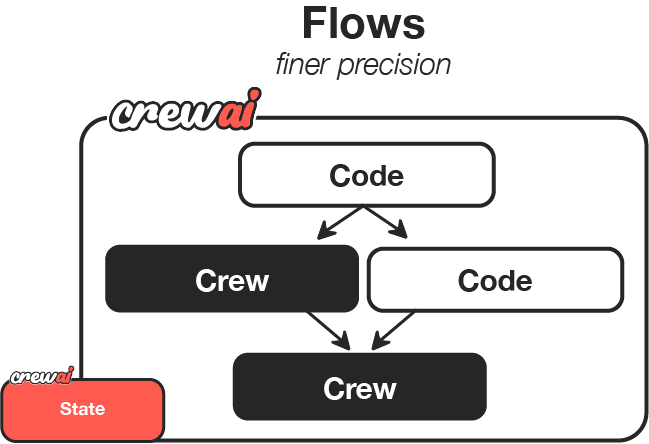
In this guide, we'll walk through creating a powerful CrewAI Flow that generates a comprehensive learning guide on any topic. This tutorial will demonstrate how Flows provide structured, event-driven control over your AI workflows by combining regular code, direct LLM calls, and crew-based processing.
## Prerequisites
Before starting, make sure you have:
1. Installed CrewAI following the [installation guide](/installation)
2. Set up your OpenAI API key in your environment variables
3. Basic understanding of Python
## Step 1: Create a New CrewAI Flow Project
First, let's create a new CrewAI Flow project using the CLI:
```bash
crewai create flow guide_creator_flow
cd guide_creator_flow
```
This will generate a project with the basic structure needed for your flow.
 ## Step 2: Understanding the Project Structure
The generated project has the following structure:
```
guide_creator_flow/
├── .gitignore
├── pyproject.toml
├── README.md
├── .env
├── main.py
├── crews/
│ └── poem_crew/
│ ├── config/
│ │ ├── agents.yaml
│ │ └── tasks.yaml
│ └── poem_crew.py
└── tools/
└── custom_tool.py
```
We'll modify this structure to create our guide creator flow.
## Step 3: Add a Content Writer Crew
Let's use the CrewAI CLI to add a content writer crew:
```bash
crewai flow add-crew content-crew
```
This command will automatically create the necessary directories and template files.
## Step 4: Configure the Content Writer Crew
Now, let's modify the generated files for the content writer crew:
1. First, update the agents configuration file:
```yaml
# src/guide_creator_flow/crews/content_crew/config/agents.yaml
content_writer:
role: >
Educational Content Writer
goal: >
Create engaging, informative content that thoroughly explains the assigned topic
and provides valuable insights to the reader
backstory: >
You are a talented educational writer with expertise in creating clear, engaging
content. You have a gift for explaining complex concepts in accessible language
and organizing information in a way that helps readers build their understanding.
llm: openai/gpt-4o-mini
content_reviewer:
role: >
Educational Content Reviewer and Editor
goal: >
Ensure content is accurate, comprehensive, well-structured, and maintains
consistency with previously written sections
backstory: >
You are a meticulous editor with years of experience reviewing educational
content. You have an eye for detail, clarity, and coherence. You excel at
improving content while maintaining the original author's voice and ensuring
consistent quality across multiple sections.
llm: openai/gpt-4o-mini
```
2. Next, update the tasks configuration file:
```yaml
# src/guide_creator_flow/crews/content_crew/config/tasks.yaml
write_section_task:
description: >
Write a comprehensive section on the topic: "{section_title}"
Section description: {section_description}
Target audience: {audience_level} level learners
Your content should:
1. Begin with a brief introduction to the section topic
2. Explain all key concepts clearly with examples
3. Include practical applications or exercises where appropriate
4. End with a summary of key points
5. Be approximately 500-800 words in length
Format your content in Markdown with appropriate headings, lists, and emphasis.
Previously written sections:
{previous_sections}
Make sure your content maintains consistency with previously written sections
and builds upon concepts that have already been explained.
expected_output: >
A well-structured, comprehensive section in Markdown format that thoroughly
explains the topic and is appropriate for the target audience.
agent: content_writer
review_section_task:
description: >
Review and improve the following section on "{section_title}":
{draft_content}
Target audience: {audience_level} level learners
Previously written sections:
{previous_sections}
Your review should:
1. Fix any grammatical or spelling errors
2. Improve clarity and readability
3. Ensure content is comprehensive and accurate
4. Verify consistency with previously written sections
5. Enhance the structure and flow
6. Add any missing key information
Provide the improved version of the section in Markdown format.
expected_output: >
An improved, polished version of the section that maintains the original
structure but enhances clarity, accuracy, and consistency.
agent: content_reviewer
context:
- write_section_task
```
3. Now, update the crew implementation file:
```python
# src/guide_creator_flow/crews/content_crew/content_crew.py
from crewai import Agent, Crew, Process, Task
from crewai.project import CrewBase, agent, crew, task
@CrewBase
class ContentCrew():
"""Content writing crew"""
@agent
def content_writer(self) -> Agent:
return Agent(
config=self.agents_config['content_writer'],
verbose=True
)
@agent
def content_reviewer(self) -> Agent:
return Agent(
config=self.agents_config['content_reviewer'],
verbose=True
)
@task
def write_section_task(self) -> Task:
return Task(
config=self.tasks_config['write_section_task']
)
@task
def review_section_task(self) -> Task:
return Task(
config=self.tasks_config['review_section_task'],
context=[self.write_section_task]
)
@crew
def crew(self) -> Crew:
"""Creates the content writing crew"""
return Crew(
agents=self.agents,
tasks=self.tasks,
process=Process.sequential,
verbose=True,
)
```
## Step 5: Create the Flow
Now, let's create our flow in the `main.py` file. This flow will:
1. Get user input for a topic
2. Make a direct LLM call to create a structured guide outline
3. Process each section in parallel using the content writer crew
4. Combine everything into a final document
```python
#!/usr/bin/env python
import json
from typing import List, Dict
from pydantic import BaseModel, Field
from crewai import LLM
from crewai.flow.flow import Flow, listen, start
from guide_creator_flow.crews.content_crew.content_crew import ContentCrew
# Define our models for structured data
class Section(BaseModel):
title: str = Field(description="Title of the section")
description: str = Field(description="Brief description of what the section should cover")
class GuideOutline(BaseModel):
title: str = Field(description="Title of the guide")
introduction: str = Field(description="Introduction to the topic")
target_audience: str = Field(description="Description of the target audience")
sections: List[Section] = Field(description="List of sections in the guide")
conclusion: str = Field(description="Conclusion or summary of the guide")
# Define our flow state
class GuideCreatorState(BaseModel):
topic: str = ""
audience_level: str = ""
guide_outline: GuideOutline = None
sections_content: Dict[str, str] = {}
class GuideCreatorFlow(Flow[GuideCreatorState]):
"""Flow for creating a comprehensive guide on any topic"""
@start()
def get_user_input(self):
"""Get input from the user about the guide topic and audience"""
print("\n=== Create Your Comprehensive Guide ===\n")
# Get user input
self.state.topic = input("What topic would you like to create a guide for? ")
# Get audience level with validation
while True:
audience = input("Who is your target audience? (beginner/intermediate/advanced) ").lower()
if audience in ["beginner", "intermediate", "advanced"]:
self.state.audience_level = audience
break
print("Please enter 'beginner', 'intermediate', or 'advanced'")
print(f"\nCreating a guide on {self.state.topic} for {self.state.audience_level} audience...\n")
return self.state
@listen(get_user_input)
def create_guide_outline(self, state):
"""Create a structured outline for the guide using a direct LLM call"""
print("Creating guide outline...")
# Initialize the LLM
llm = LLM(model="openai/gpt-4o-mini", response_format=GuideOutline)
# Create the messages for the outline
messages = [
{"role": "system", "content": "You are a helpful assistant designed to output JSON."},
{"role": "user", "content": f"""
Create a detailed outline for a comprehensive guide on "{state.topic}" for {state.audience_level} level learners.
The outline should include:
1. A compelling title for the guide
2. An introduction to the topic
3. 4-6 main sections that cover the most important aspects of the topic
4. A conclusion or summary
For each section, provide a clear title and a brief description of what it should cover.
"""}
]
# Make the LLM call with JSON response format
response = llm.call(messages=messages)
# Parse the JSON response
outline_dict = json.loads(response)
self.state.guide_outline = GuideOutline(**outline_dict)
# Save the outline to a file
with open("output/guide_outline.json", "w") as f:
json.dump(outline_dict, f, indent=2)
print(f"Guide outline created with {len(self.state.guide_outline.sections)} sections")
return self.state.guide_outline
@listen(create_guide_outline)
def write_and_compile_guide(self, outline):
"""Write all sections and compile the guide"""
print("Writing guide sections and compiling...")
completed_sections = []
# Process sections one by one to maintain context flow
for section in outline.sections:
print(f"Processing section: {section.title}")
# Build context from previous sections
previous_sections_text = ""
if completed_sections:
previous_sections_text = "# Previously Written Sections\n\n"
for title in completed_sections:
previous_sections_text += f"## {title}\n\n"
previous_sections_text += self.state.sections_content.get(title, "") + "\n\n"
else:
previous_sections_text = "No previous sections written yet."
# Run the content crew for this section
result = ContentCrew().crew().kickoff(inputs={
"section_title": section.title,
"section_description": section.description,
"audience_level": self.state.audience_level,
"previous_sections": previous_sections_text,
"draft_content": ""
})
# Store the content
self.state.sections_content[section.title] = result.raw
completed_sections.append(section.title)
print(f"Section completed: {section.title}")
# Compile the final guide
guide_content = f"# {outline.title}\n\n"
guide_content += f"## Introduction\n\n{outline.introduction}\n\n"
# Add each section in order
for section in outline.sections:
section_content = self.state.sections_content.get(section.title, "")
guide_content += f"\n\n{section_content}\n\n"
# Add conclusion
guide_content += f"## Conclusion\n\n{outline.conclusion}\n\n"
# Save the guide
with open("output/complete_guide.md", "w") as f:
f.write(guide_content)
print("\nComplete guide compiled and saved to output/complete_guide.md")
return "Guide creation completed successfully"
def kickoff():
"""Run the guide creator flow"""
GuideCreatorFlow().kickoff()
print("\n=== Flow Complete ===")
print("Your comprehensive guide is ready in the output directory.")
print("Open output/complete_guide.md to view it.")
def plot():
"""Generate a visualization of the flow"""
flow = GuideCreatorFlow()
flow.plot("guide_creator_flow")
print("Flow visualization saved to guide_creator_flow.html")
if __name__ == "__main__":
kickoff()
```
## Step 6: Set Up Your Environment Variables
Create a `.env` file in your project root with your API keys:
```
OPENAI_API_KEY=your_openai_api_key
```
## Step 7: Install Dependencies
Install the required dependencies:
```bash
crewai install
```
## Step 8: Run Your Flow
Now, run your flow using the CrewAI CLI:
```bash
crewai flow kickoff
```
Your flow will:
1. Prompt you for a topic and target audience
2. Make a direct LLM call to create a structured guide outline
3. Process each section in parallel using the content writer crew
4. Combine everything into a final comprehensive guide
This demonstrates the power of flows to orchestrate different types of operations, including user input, direct LLM interactions, and crew-based processing.
## Step 9: Visualize Your Flow
You can also generate a visualization of your flow:
```bash
crewai flow plot
```
This will create an HTML file that shows the structure of your flow, which can be helpful for understanding and debugging.
## Step 10: Review the Output
Once the flow completes, you'll find two files in the `output` directory:
1. `guide_outline.json`: Contains the structured outline of the guide
2. `complete_guide.md`: The comprehensive guide with all sections
## Key Features Demonstrated
This guide creator flow demonstrates several powerful features of CrewAI:
1. **User interaction**: The flow collects input directly from the user
2. **Direct LLM calls**: Uses the LLM class for efficient, single-purpose AI interactions
3. **Structured data with Pydantic**: Uses Pydantic models to ensure type safety
4. **Sequential processing with context**: Writes sections in order, providing previous sections for context
5. **Multi-agent crews**: Leverages specialized agents (writer and reviewer) for content creation
6. **State management**: Maintains state across different steps of the process
## Understanding the Flow Structure
Let's break down the key components of this flow:
### 1. Direct LLM Calls
The flow uses CrewAI's `LLM` class to make direct calls to the language model:
```python
llm = LLM(model="openai/gpt-4o-mini")
response = llm.call(prompt)
```
This is more efficient than using a crew when you need a simple, structured response.
### 2. Asynchronous Processing
The flow uses async/await to process multiple sections in parallel:
```python
@listen(create_guide_outline)
async def write_sections(self, outline):
# ...
section_tasks = []
for section in outline.sections:
task = self.write_section(section, outline.target_audience)
section_tasks.append(task)
sections_content = await asyncio.gather(*section_tasks)
# ...
```
This significantly speeds up the guide creation process.
### 3. Multi-Agent Crews
The flow uses a crew with multiple specialized agents:
```python
# Content creation crew with writer and reviewer
@agent
def content_writer(self) -> Agent:
return Agent(
config=self.agents_config['content_writer'],
verbose=True
)
@agent
def content_reviewer(self) -> Agent:
return Agent(
config=self.agents_config['content_reviewer'],
verbose=True
)
```
This demonstrates how flows can orchestrate crews with multiple specialized agents that work together on complex tasks.
### 4. Context-Aware Sequential Processing
The flow processes sections in order, providing previous sections as context:
```python
# Getting previous sections for context
previous_sections_text = ""
if self.state.completed_sections:
previous_sections_text = "# Previously Written Sections\n\n"
for title in self.state.completed_sections:
previous_sections_text += f"## {title}\n\n"
previous_sections_text += self.state.sections_content.get(title, "") + "\n\n"
```
This ensures coherence and continuity throughout the guide.
## Customizing Your Flow
You can customize your flow in several ways:
1. **Add more user inputs**: Collect additional information about the desired guide
2. **Enhance the outline**: Modify the LLM prompt to create more detailed outlines
3. **Add more crews**: Use different crews for different parts of the guide
4. **Add review steps**: Include a review and refinement step for the final guide
## Next Steps
Now that you've built your first flow, you can:
1. Experiment with more complex flow structures
2. Try using `@router()` to create conditional branches
3. Explore the `and_` and `or_` functions for more complex parallel execution
4. Connect your flow to external APIs or services
Congratulations! You've successfully built your first CrewAI Flow that combines regular code, direct LLM calls, and crew-based processing to create a comprehensive guide.
## Step 2: Understanding the Project Structure
The generated project has the following structure:
```
guide_creator_flow/
├── .gitignore
├── pyproject.toml
├── README.md
├── .env
├── main.py
├── crews/
│ └── poem_crew/
│ ├── config/
│ │ ├── agents.yaml
│ │ └── tasks.yaml
│ └── poem_crew.py
└── tools/
└── custom_tool.py
```
We'll modify this structure to create our guide creator flow.
## Step 3: Add a Content Writer Crew
Let's use the CrewAI CLI to add a content writer crew:
```bash
crewai flow add-crew content-crew
```
This command will automatically create the necessary directories and template files.
## Step 4: Configure the Content Writer Crew
Now, let's modify the generated files for the content writer crew:
1. First, update the agents configuration file:
```yaml
# src/guide_creator_flow/crews/content_crew/config/agents.yaml
content_writer:
role: >
Educational Content Writer
goal: >
Create engaging, informative content that thoroughly explains the assigned topic
and provides valuable insights to the reader
backstory: >
You are a talented educational writer with expertise in creating clear, engaging
content. You have a gift for explaining complex concepts in accessible language
and organizing information in a way that helps readers build their understanding.
llm: openai/gpt-4o-mini
content_reviewer:
role: >
Educational Content Reviewer and Editor
goal: >
Ensure content is accurate, comprehensive, well-structured, and maintains
consistency with previously written sections
backstory: >
You are a meticulous editor with years of experience reviewing educational
content. You have an eye for detail, clarity, and coherence. You excel at
improving content while maintaining the original author's voice and ensuring
consistent quality across multiple sections.
llm: openai/gpt-4o-mini
```
2. Next, update the tasks configuration file:
```yaml
# src/guide_creator_flow/crews/content_crew/config/tasks.yaml
write_section_task:
description: >
Write a comprehensive section on the topic: "{section_title}"
Section description: {section_description}
Target audience: {audience_level} level learners
Your content should:
1. Begin with a brief introduction to the section topic
2. Explain all key concepts clearly with examples
3. Include practical applications or exercises where appropriate
4. End with a summary of key points
5. Be approximately 500-800 words in length
Format your content in Markdown with appropriate headings, lists, and emphasis.
Previously written sections:
{previous_sections}
Make sure your content maintains consistency with previously written sections
and builds upon concepts that have already been explained.
expected_output: >
A well-structured, comprehensive section in Markdown format that thoroughly
explains the topic and is appropriate for the target audience.
agent: content_writer
review_section_task:
description: >
Review and improve the following section on "{section_title}":
{draft_content}
Target audience: {audience_level} level learners
Previously written sections:
{previous_sections}
Your review should:
1. Fix any grammatical or spelling errors
2. Improve clarity and readability
3. Ensure content is comprehensive and accurate
4. Verify consistency with previously written sections
5. Enhance the structure and flow
6. Add any missing key information
Provide the improved version of the section in Markdown format.
expected_output: >
An improved, polished version of the section that maintains the original
structure but enhances clarity, accuracy, and consistency.
agent: content_reviewer
context:
- write_section_task
```
3. Now, update the crew implementation file:
```python
# src/guide_creator_flow/crews/content_crew/content_crew.py
from crewai import Agent, Crew, Process, Task
from crewai.project import CrewBase, agent, crew, task
@CrewBase
class ContentCrew():
"""Content writing crew"""
@agent
def content_writer(self) -> Agent:
return Agent(
config=self.agents_config['content_writer'],
verbose=True
)
@agent
def content_reviewer(self) -> Agent:
return Agent(
config=self.agents_config['content_reviewer'],
verbose=True
)
@task
def write_section_task(self) -> Task:
return Task(
config=self.tasks_config['write_section_task']
)
@task
def review_section_task(self) -> Task:
return Task(
config=self.tasks_config['review_section_task'],
context=[self.write_section_task]
)
@crew
def crew(self) -> Crew:
"""Creates the content writing crew"""
return Crew(
agents=self.agents,
tasks=self.tasks,
process=Process.sequential,
verbose=True,
)
```
## Step 5: Create the Flow
Now, let's create our flow in the `main.py` file. This flow will:
1. Get user input for a topic
2. Make a direct LLM call to create a structured guide outline
3. Process each section in parallel using the content writer crew
4. Combine everything into a final document
```python
#!/usr/bin/env python
import json
from typing import List, Dict
from pydantic import BaseModel, Field
from crewai import LLM
from crewai.flow.flow import Flow, listen, start
from guide_creator_flow.crews.content_crew.content_crew import ContentCrew
# Define our models for structured data
class Section(BaseModel):
title: str = Field(description="Title of the section")
description: str = Field(description="Brief description of what the section should cover")
class GuideOutline(BaseModel):
title: str = Field(description="Title of the guide")
introduction: str = Field(description="Introduction to the topic")
target_audience: str = Field(description="Description of the target audience")
sections: List[Section] = Field(description="List of sections in the guide")
conclusion: str = Field(description="Conclusion or summary of the guide")
# Define our flow state
class GuideCreatorState(BaseModel):
topic: str = ""
audience_level: str = ""
guide_outline: GuideOutline = None
sections_content: Dict[str, str] = {}
class GuideCreatorFlow(Flow[GuideCreatorState]):
"""Flow for creating a comprehensive guide on any topic"""
@start()
def get_user_input(self):
"""Get input from the user about the guide topic and audience"""
print("\n=== Create Your Comprehensive Guide ===\n")
# Get user input
self.state.topic = input("What topic would you like to create a guide for? ")
# Get audience level with validation
while True:
audience = input("Who is your target audience? (beginner/intermediate/advanced) ").lower()
if audience in ["beginner", "intermediate", "advanced"]:
self.state.audience_level = audience
break
print("Please enter 'beginner', 'intermediate', or 'advanced'")
print(f"\nCreating a guide on {self.state.topic} for {self.state.audience_level} audience...\n")
return self.state
@listen(get_user_input)
def create_guide_outline(self, state):
"""Create a structured outline for the guide using a direct LLM call"""
print("Creating guide outline...")
# Initialize the LLM
llm = LLM(model="openai/gpt-4o-mini", response_format=GuideOutline)
# Create the messages for the outline
messages = [
{"role": "system", "content": "You are a helpful assistant designed to output JSON."},
{"role": "user", "content": f"""
Create a detailed outline for a comprehensive guide on "{state.topic}" for {state.audience_level} level learners.
The outline should include:
1. A compelling title for the guide
2. An introduction to the topic
3. 4-6 main sections that cover the most important aspects of the topic
4. A conclusion or summary
For each section, provide a clear title and a brief description of what it should cover.
"""}
]
# Make the LLM call with JSON response format
response = llm.call(messages=messages)
# Parse the JSON response
outline_dict = json.loads(response)
self.state.guide_outline = GuideOutline(**outline_dict)
# Save the outline to a file
with open("output/guide_outline.json", "w") as f:
json.dump(outline_dict, f, indent=2)
print(f"Guide outline created with {len(self.state.guide_outline.sections)} sections")
return self.state.guide_outline
@listen(create_guide_outline)
def write_and_compile_guide(self, outline):
"""Write all sections and compile the guide"""
print("Writing guide sections and compiling...")
completed_sections = []
# Process sections one by one to maintain context flow
for section in outline.sections:
print(f"Processing section: {section.title}")
# Build context from previous sections
previous_sections_text = ""
if completed_sections:
previous_sections_text = "# Previously Written Sections\n\n"
for title in completed_sections:
previous_sections_text += f"## {title}\n\n"
previous_sections_text += self.state.sections_content.get(title, "") + "\n\n"
else:
previous_sections_text = "No previous sections written yet."
# Run the content crew for this section
result = ContentCrew().crew().kickoff(inputs={
"section_title": section.title,
"section_description": section.description,
"audience_level": self.state.audience_level,
"previous_sections": previous_sections_text,
"draft_content": ""
})
# Store the content
self.state.sections_content[section.title] = result.raw
completed_sections.append(section.title)
print(f"Section completed: {section.title}")
# Compile the final guide
guide_content = f"# {outline.title}\n\n"
guide_content += f"## Introduction\n\n{outline.introduction}\n\n"
# Add each section in order
for section in outline.sections:
section_content = self.state.sections_content.get(section.title, "")
guide_content += f"\n\n{section_content}\n\n"
# Add conclusion
guide_content += f"## Conclusion\n\n{outline.conclusion}\n\n"
# Save the guide
with open("output/complete_guide.md", "w") as f:
f.write(guide_content)
print("\nComplete guide compiled and saved to output/complete_guide.md")
return "Guide creation completed successfully"
def kickoff():
"""Run the guide creator flow"""
GuideCreatorFlow().kickoff()
print("\n=== Flow Complete ===")
print("Your comprehensive guide is ready in the output directory.")
print("Open output/complete_guide.md to view it.")
def plot():
"""Generate a visualization of the flow"""
flow = GuideCreatorFlow()
flow.plot("guide_creator_flow")
print("Flow visualization saved to guide_creator_flow.html")
if __name__ == "__main__":
kickoff()
```
## Step 6: Set Up Your Environment Variables
Create a `.env` file in your project root with your API keys:
```
OPENAI_API_KEY=your_openai_api_key
```
## Step 7: Install Dependencies
Install the required dependencies:
```bash
crewai install
```
## Step 8: Run Your Flow
Now, run your flow using the CrewAI CLI:
```bash
crewai flow kickoff
```
Your flow will:
1. Prompt you for a topic and target audience
2. Make a direct LLM call to create a structured guide outline
3. Process each section in parallel using the content writer crew
4. Combine everything into a final comprehensive guide
This demonstrates the power of flows to orchestrate different types of operations, including user input, direct LLM interactions, and crew-based processing.
## Step 9: Visualize Your Flow
You can also generate a visualization of your flow:
```bash
crewai flow plot
```
This will create an HTML file that shows the structure of your flow, which can be helpful for understanding and debugging.
## Step 10: Review the Output
Once the flow completes, you'll find two files in the `output` directory:
1. `guide_outline.json`: Contains the structured outline of the guide
2. `complete_guide.md`: The comprehensive guide with all sections
## Key Features Demonstrated
This guide creator flow demonstrates several powerful features of CrewAI:
1. **User interaction**: The flow collects input directly from the user
2. **Direct LLM calls**: Uses the LLM class for efficient, single-purpose AI interactions
3. **Structured data with Pydantic**: Uses Pydantic models to ensure type safety
4. **Sequential processing with context**: Writes sections in order, providing previous sections for context
5. **Multi-agent crews**: Leverages specialized agents (writer and reviewer) for content creation
6. **State management**: Maintains state across different steps of the process
## Understanding the Flow Structure
Let's break down the key components of this flow:
### 1. Direct LLM Calls
The flow uses CrewAI's `LLM` class to make direct calls to the language model:
```python
llm = LLM(model="openai/gpt-4o-mini")
response = llm.call(prompt)
```
This is more efficient than using a crew when you need a simple, structured response.
### 2. Asynchronous Processing
The flow uses async/await to process multiple sections in parallel:
```python
@listen(create_guide_outline)
async def write_sections(self, outline):
# ...
section_tasks = []
for section in outline.sections:
task = self.write_section(section, outline.target_audience)
section_tasks.append(task)
sections_content = await asyncio.gather(*section_tasks)
# ...
```
This significantly speeds up the guide creation process.
### 3. Multi-Agent Crews
The flow uses a crew with multiple specialized agents:
```python
# Content creation crew with writer and reviewer
@agent
def content_writer(self) -> Agent:
return Agent(
config=self.agents_config['content_writer'],
verbose=True
)
@agent
def content_reviewer(self) -> Agent:
return Agent(
config=self.agents_config['content_reviewer'],
verbose=True
)
```
This demonstrates how flows can orchestrate crews with multiple specialized agents that work together on complex tasks.
### 4. Context-Aware Sequential Processing
The flow processes sections in order, providing previous sections as context:
```python
# Getting previous sections for context
previous_sections_text = ""
if self.state.completed_sections:
previous_sections_text = "# Previously Written Sections\n\n"
for title in self.state.completed_sections:
previous_sections_text += f"## {title}\n\n"
previous_sections_text += self.state.sections_content.get(title, "") + "\n\n"
```
This ensures coherence and continuity throughout the guide.
## Customizing Your Flow
You can customize your flow in several ways:
1. **Add more user inputs**: Collect additional information about the desired guide
2. **Enhance the outline**: Modify the LLM prompt to create more detailed outlines
3. **Add more crews**: Use different crews for different parts of the guide
4. **Add review steps**: Include a review and refinement step for the final guide
## Next Steps
Now that you've built your first flow, you can:
1. Experiment with more complex flow structures
2. Try using `@router()` to create conditional branches
3. Explore the `and_` and `or_` functions for more complex parallel execution
4. Connect your flow to external APIs or services
Congratulations! You've successfully built your first CrewAI Flow that combines regular code, direct LLM calls, and crew-based processing to create a comprehensive guide.