mirror of
https://github.com/crewAIInc/crewAI.git
synced 2025-12-17 12:58:31 +00:00
Compare commits
1 Commits
tm-add-tas
...
devin/1757
| Author | SHA1 | Date | |
|---|---|---|---|

|
3bfa1c6559 |
2
.gitignore
vendored
2
.gitignore
vendored
@@ -21,5 +21,3 @@ crew_tasks_output.json
|
|||||||
.mypy_cache
|
.mypy_cache
|
||||||
.ruff_cache
|
.ruff_cache
|
||||||
.venv
|
.venv
|
||||||
agentops.log
|
|
||||||
test_flow.html
|
|
||||||
187
README.md
187
README.md
@@ -1,18 +1,10 @@
|
|||||||
<div align="center">
|
<div align="center">
|
||||||
|
|
||||||

|

|
||||||
|
|
||||||
# **CrewAI**
|
# **CrewAI**
|
||||||
|
|
||||||
**CrewAI**: Production-grade framework for orchestrating sophisticated AI agent systems. From simple automations to complex real-world applications, CrewAI provides precise control and deep customization. By fostering collaborative intelligence through flexible, production-ready architecture, CrewAI empowers agents to work together seamlessly, tackling complex business challenges with predictable, consistent results.
|
🤖 **CrewAI**: Cutting-edge framework for orchestrating role-playing, autonomous AI agents. By fostering collaborative intelligence, CrewAI empowers agents to work together seamlessly, tackling complex tasks.
|
||||||
|
|
||||||
**CrewAI Enterprise**
|
|
||||||
Want to plan, build (+ no code), deploy, monitor and interare your agents: [CrewAI Enterprise](https://www.crewai.com/enterprise). Designed for complex, real-world applications, our enterprise solution offers:
|
|
||||||
|
|
||||||
- **Seamless Integrations**
|
|
||||||
- **Scalable & Secure Deployment**
|
|
||||||
- **Actionable Insights**
|
|
||||||
- **24/7 Support**
|
|
||||||
|
|
||||||
<h3>
|
<h3>
|
||||||
|
|
||||||
@@ -30,17 +22,13 @@ Want to plan, build (+ no code), deploy, monitor and interare your agents: [Crew
|
|||||||
- [Why CrewAI?](#why-crewai)
|
- [Why CrewAI?](#why-crewai)
|
||||||
- [Getting Started](#getting-started)
|
- [Getting Started](#getting-started)
|
||||||
- [Key Features](#key-features)
|
- [Key Features](#key-features)
|
||||||
- [Understanding Flows and Crews](#understanding-flows-and-crews)
|
|
||||||
- [CrewAI vs LangGraph](#how-crewai-compares)
|
|
||||||
- [Examples](#examples)
|
- [Examples](#examples)
|
||||||
- [Quick Tutorial](#quick-tutorial)
|
- [Quick Tutorial](#quick-tutorial)
|
||||||
- [Write Job Descriptions](#write-job-descriptions)
|
- [Write Job Descriptions](#write-job-descriptions)
|
||||||
- [Trip Planner](#trip-planner)
|
- [Trip Planner](#trip-planner)
|
||||||
- [Stock Analysis](#stock-analysis)
|
- [Stock Analysis](#stock-analysis)
|
||||||
- [Using Crews and Flows Together](#using-crews-and-flows-together)
|
|
||||||
- [Connecting Your Crew to a Model](#connecting-your-crew-to-a-model)
|
- [Connecting Your Crew to a Model](#connecting-your-crew-to-a-model)
|
||||||
- [How CrewAI Compares](#how-crewai-compares)
|
- [How CrewAI Compares](#how-crewai-compares)
|
||||||
- [Frequently Asked Questions (FAQ)](#frequently-asked-questions-faq)
|
|
||||||
- [Contribution](#contribution)
|
- [Contribution](#contribution)
|
||||||
- [Telemetry](#telemetry)
|
- [Telemetry](#telemetry)
|
||||||
- [License](#license)
|
- [License](#license)
|
||||||
@@ -48,40 +36,10 @@ Want to plan, build (+ no code), deploy, monitor and interare your agents: [Crew
|
|||||||
## Why CrewAI?
|
## Why CrewAI?
|
||||||
|
|
||||||
The power of AI collaboration has too much to offer.
|
The power of AI collaboration has too much to offer.
|
||||||
CrewAI is a standalone framework, built from the ground up without dependencies on Langchain or other agent frameworks. It's designed to enable AI agents to assume roles, share goals, and operate in a cohesive unit - much like a well-oiled crew. Whether you're building a smart assistant platform, an automated customer service ensemble, or a multi-agent research team, CrewAI provides the backbone for sophisticated multi-agent interactions.
|
CrewAI is designed to enable AI agents to assume roles, share goals, and operate in a cohesive unit - much like a well-oiled crew. Whether you're building a smart assistant platform, an automated customer service ensemble, or a multi-agent research team, CrewAI provides the backbone for sophisticated multi-agent interactions.
|
||||||
|
|
||||||
## Getting Started
|
## Getting Started
|
||||||
|
|
||||||
### Learning Resources
|
|
||||||
|
|
||||||
Learn CrewAI through our comprehensive courses:
|
|
||||||
- [Multi AI Agent Systems with CrewAI](https://www.deeplearning.ai/short-courses/multi-ai-agent-systems-with-crewai/) - Master the fundamentals of multi-agent systems
|
|
||||||
- [Practical Multi AI Agents and Advanced Use Cases](https://www.deeplearning.ai/short-courses/practical-multi-ai-agents-and-advanced-use-cases-with-crewai/) - Deep dive into advanced implementations
|
|
||||||
|
|
||||||
### Understanding Flows and Crews
|
|
||||||
|
|
||||||
CrewAI offers two powerful, complementary approaches that work seamlessly together to build sophisticated AI applications:
|
|
||||||
|
|
||||||
1. **Crews**: Teams of AI agents with true autonomy and agency, working together to accomplish complex tasks through role-based collaboration. Crews enable:
|
|
||||||
- Natural, autonomous decision-making between agents
|
|
||||||
- Dynamic task delegation and collaboration
|
|
||||||
- Specialized roles with defined goals and expertise
|
|
||||||
- Flexible problem-solving approaches
|
|
||||||
|
|
||||||
2. **Flows**: Production-ready, event-driven workflows that deliver precise control over complex automations. Flows provide:
|
|
||||||
- Fine-grained control over execution paths for real-world scenarios
|
|
||||||
- Secure, consistent state management between tasks
|
|
||||||
- Clean integration of AI agents with production Python code
|
|
||||||
- Conditional branching for complex business logic
|
|
||||||
|
|
||||||
The true power of CrewAI emerges when combining Crews and Flows. This synergy allows you to:
|
|
||||||
- Build complex, production-grade applications
|
|
||||||
- Balance autonomy with precise control
|
|
||||||
- Handle sophisticated real-world scenarios
|
|
||||||
- Maintain clean, maintainable code structure
|
|
||||||
|
|
||||||
### Getting Started with Installation
|
|
||||||
|
|
||||||
To get started with CrewAI, follow these simple steps:
|
To get started with CrewAI, follow these simple steps:
|
||||||
|
|
||||||
### 1. Installation
|
### 1. Installation
|
||||||
@@ -93,6 +51,7 @@ First, install CrewAI:
|
|||||||
```shell
|
```shell
|
||||||
pip install crewai
|
pip install crewai
|
||||||
```
|
```
|
||||||
|
|
||||||
If you want to install the 'crewai' package along with its optional features that include additional tools for agents, you can do so by using the following command:
|
If you want to install the 'crewai' package along with its optional features that include additional tools for agents, you can do so by using the following command:
|
||||||
|
|
||||||
```shell
|
```shell
|
||||||
@@ -100,22 +59,6 @@ pip install 'crewai[tools]'
|
|||||||
```
|
```
|
||||||
The command above installs the basic package and also adds extra components which require more dependencies to function.
|
The command above installs the basic package and also adds extra components which require more dependencies to function.
|
||||||
|
|
||||||
### Troubleshooting Dependencies
|
|
||||||
|
|
||||||
If you encounter issues during installation or usage, here are some common solutions:
|
|
||||||
|
|
||||||
#### Common Issues
|
|
||||||
|
|
||||||
1. **ModuleNotFoundError: No module named 'tiktoken'**
|
|
||||||
- Install tiktoken explicitly: `pip install 'crewai[embeddings]'`
|
|
||||||
- If using embedchain or other tools: `pip install 'crewai[tools]'`
|
|
||||||
|
|
||||||
2. **Failed building wheel for tiktoken**
|
|
||||||
- Ensure Rust compiler is installed (see installation steps above)
|
|
||||||
- For Windows: Verify Visual C++ Build Tools are installed
|
|
||||||
- Try upgrading pip: `pip install --upgrade pip`
|
|
||||||
- If issues persist, use a pre-built wheel: `pip install tiktoken --prefer-binary`
|
|
||||||
|
|
||||||
### 2. Setting Up Your Crew with the YAML Configuration
|
### 2. Setting Up Your Crew with the YAML Configuration
|
||||||
|
|
||||||
To create a new CrewAI project, run the following CLI (Command Line Interface) command:
|
To create a new CrewAI project, run the following CLI (Command Line Interface) command:
|
||||||
@@ -198,7 +141,7 @@ research_task:
|
|||||||
description: >
|
description: >
|
||||||
Conduct a thorough research about {topic}
|
Conduct a thorough research about {topic}
|
||||||
Make sure you find any interesting and relevant information given
|
Make sure you find any interesting and relevant information given
|
||||||
the current year is 2025.
|
the current year is 2024.
|
||||||
expected_output: >
|
expected_output: >
|
||||||
A list with 10 bullet points of the most relevant information about {topic}
|
A list with 10 bullet points of the most relevant information about {topic}
|
||||||
agent: researcher
|
agent: researcher
|
||||||
@@ -321,16 +264,13 @@ In addition to the sequential process, you can use the hierarchical process, whi
|
|||||||
|
|
||||||
## Key Features
|
## Key Features
|
||||||
|
|
||||||
**Note**: CrewAI is a standalone framework built from the ground up, without dependencies on Langchain or other agent frameworks.
|
- **Role-Based Agent Design**: Customize agents with specific roles, goals, and tools.
|
||||||
|
- **Autonomous Inter-Agent Delegation**: Agents can autonomously delegate tasks and inquire amongst themselves, enhancing problem-solving efficiency.
|
||||||
- **Deep Customization**: Build sophisticated agents with full control over the system - from overriding inner prompts to accessing low-level APIs. Customize roles, goals, tools, and behaviors while maintaining clean abstractions.
|
- **Flexible Task Management**: Define tasks with customizable tools and assign them to agents dynamically.
|
||||||
- **Autonomous Inter-Agent Delegation**: Agents can autonomously delegate tasks and inquire amongst themselves, enabling complex problem-solving in real-world scenarios.
|
- **Processes Driven**: Currently only supports `sequential` task execution and `hierarchical` processes, but more complex processes like consensual and autonomous are being worked on.
|
||||||
- **Flexible Task Management**: Define and customize tasks with granular control, from simple operations to complex multi-step processes.
|
- **Save output as file**: Save the output of individual tasks as a file, so you can use it later.
|
||||||
- **Production-Grade Architecture**: Support for both high-level abstractions and low-level customization, with robust error handling and state management.
|
- **Parse output as Pydantic or Json**: Parse the output of individual tasks as a Pydantic model or as a Json if you want to.
|
||||||
- **Predictable Results**: Ensure consistent, accurate outputs through programmatic guardrails, agent training capabilities, and flow-based execution control. See our [documentation on guardrails](https://docs.crewai.com/how-to/guardrails/) for implementation details.
|
- **Works with Open Source Models**: Run your crew using Open AI or open source models refer to the [Connect CrewAI to LLMs](https://docs.crewai.com/how-to/LLM-Connections/) page for details on configuring your agents' connections to models, even ones running locally!
|
||||||
- **Model Flexibility**: Run your crew using OpenAI or open source models with production-ready integrations. See [Connect CrewAI to LLMs](https://docs.crewai.com/how-to/LLM-Connections/) for detailed configuration options.
|
|
||||||
- **Event-Driven Flows**: Build complex, real-world workflows with precise control over execution paths, state management, and conditional logic.
|
|
||||||
- **Process Orchestration**: Achieve any workflow pattern through flows - from simple sequential and hierarchical processes to complex, custom orchestration patterns with conditional branching and parallel execution.
|
|
||||||
|
|
||||||

|

|
||||||
|
|
||||||
@@ -365,98 +305,6 @@ You can test different real life examples of AI crews in the [CrewAI-examples re
|
|||||||
|
|
||||||
[](https://www.youtube.com/watch?v=e0Uj4yWdaAg "Stock Analysis")
|
[](https://www.youtube.com/watch?v=e0Uj4yWdaAg "Stock Analysis")
|
||||||
|
|
||||||
### Using Crews and Flows Together
|
|
||||||
|
|
||||||
CrewAI's power truly shines when combining Crews with Flows to create sophisticated automation pipelines. Here's how you can orchestrate multiple Crews within a Flow:
|
|
||||||
|
|
||||||
```python
|
|
||||||
from crewai.flow.flow import Flow, listen, start, router
|
|
||||||
from crewai import Crew, Agent, Task
|
|
||||||
from pydantic import BaseModel
|
|
||||||
|
|
||||||
# Define structured state for precise control
|
|
||||||
class MarketState(BaseModel):
|
|
||||||
sentiment: str = "neutral"
|
|
||||||
confidence: float = 0.0
|
|
||||||
recommendations: list = []
|
|
||||||
|
|
||||||
class AdvancedAnalysisFlow(Flow[MarketState]):
|
|
||||||
@start()
|
|
||||||
def fetch_market_data(self):
|
|
||||||
# Demonstrate low-level control with structured state
|
|
||||||
self.state.sentiment = "analyzing"
|
|
||||||
return {"sector": "tech", "timeframe": "1W"} # These parameters match the task description template
|
|
||||||
|
|
||||||
@listen(fetch_market_data)
|
|
||||||
def analyze_with_crew(self, market_data):
|
|
||||||
# Show crew agency through specialized roles
|
|
||||||
analyst = Agent(
|
|
||||||
role="Senior Market Analyst",
|
|
||||||
goal="Conduct deep market analysis with expert insight",
|
|
||||||
backstory="You're a veteran analyst known for identifying subtle market patterns"
|
|
||||||
)
|
|
||||||
researcher = Agent(
|
|
||||||
role="Data Researcher",
|
|
||||||
goal="Gather and validate supporting market data",
|
|
||||||
backstory="You excel at finding and correlating multiple data sources"
|
|
||||||
)
|
|
||||||
|
|
||||||
analysis_task = Task(
|
|
||||||
description="Analyze {sector} sector data for the past {timeframe}",
|
|
||||||
expected_output="Detailed market analysis with confidence score",
|
|
||||||
agent=analyst
|
|
||||||
)
|
|
||||||
research_task = Task(
|
|
||||||
description="Find supporting data to validate the analysis",
|
|
||||||
expected_output="Corroborating evidence and potential contradictions",
|
|
||||||
agent=researcher
|
|
||||||
)
|
|
||||||
|
|
||||||
# Demonstrate crew autonomy
|
|
||||||
analysis_crew = Crew(
|
|
||||||
agents=[analyst, researcher],
|
|
||||||
tasks=[analysis_task, research_task],
|
|
||||||
process=Process.sequential,
|
|
||||||
verbose=True
|
|
||||||
)
|
|
||||||
return analysis_crew.kickoff(inputs=market_data) # Pass market_data as named inputs
|
|
||||||
|
|
||||||
@router(analyze_with_crew)
|
|
||||||
def determine_next_steps(self):
|
|
||||||
# Show flow control with conditional routing
|
|
||||||
if self.state.confidence > 0.8:
|
|
||||||
return "high_confidence"
|
|
||||||
elif self.state.confidence > 0.5:
|
|
||||||
return "medium_confidence"
|
|
||||||
return "low_confidence"
|
|
||||||
|
|
||||||
@listen("high_confidence")
|
|
||||||
def execute_strategy(self):
|
|
||||||
# Demonstrate complex decision making
|
|
||||||
strategy_crew = Crew(
|
|
||||||
agents=[
|
|
||||||
Agent(role="Strategy Expert",
|
|
||||||
goal="Develop optimal market strategy")
|
|
||||||
],
|
|
||||||
tasks=[
|
|
||||||
Task(description="Create detailed strategy based on analysis",
|
|
||||||
expected_output="Step-by-step action plan")
|
|
||||||
]
|
|
||||||
)
|
|
||||||
return strategy_crew.kickoff()
|
|
||||||
|
|
||||||
@listen("medium_confidence", "low_confidence")
|
|
||||||
def request_additional_analysis(self):
|
|
||||||
self.state.recommendations.append("Gather more data")
|
|
||||||
return "Additional analysis required"
|
|
||||||
```
|
|
||||||
|
|
||||||
This example demonstrates how to:
|
|
||||||
1. Use Python code for basic data operations
|
|
||||||
2. Create and execute Crews as steps in your workflow
|
|
||||||
3. Use Flow decorators to manage the sequence of operations
|
|
||||||
4. Implement conditional branching based on Crew results
|
|
||||||
|
|
||||||
## Connecting Your Crew to a Model
|
## Connecting Your Crew to a Model
|
||||||
|
|
||||||
CrewAI supports using various LLMs through a variety of connection options. By default your agents will use the OpenAI API when querying the model. However, there are several other ways to allow your agents to connect to models. For example, you can configure your agents to use a local model via the Ollama tool.
|
CrewAI supports using various LLMs through a variety of connection options. By default your agents will use the OpenAI API when querying the model. However, there are several other ways to allow your agents to connect to models. For example, you can configure your agents to use a local model via the Ollama tool.
|
||||||
@@ -465,13 +313,9 @@ Please refer to the [Connect CrewAI to LLMs](https://docs.crewai.com/how-to/LLM-
|
|||||||
|
|
||||||
## How CrewAI Compares
|
## How CrewAI Compares
|
||||||
|
|
||||||
**CrewAI's Advantage**: CrewAI combines autonomous agent intelligence with precise workflow control through its unique Crews and Flows architecture. The framework excels at both high-level orchestration and low-level customization, enabling complex, production-grade systems with granular control.
|
**CrewAI's Advantage**: CrewAI is built with production in mind. It offers the flexibility of Autogen's conversational agents and the structured process approach of ChatDev, but without the rigidity. CrewAI's processes are designed to be dynamic and adaptable, fitting seamlessly into both development and production workflows.
|
||||||
|
|
||||||
- **LangGraph**: While LangGraph provides a foundation for building agent workflows, its approach requires significant boilerplate code and complex state management patterns. The framework's tight coupling with LangChain can limit flexibility when implementing custom agent behaviors or integrating with external systems.
|
- **Autogen**: While Autogen does good in creating conversational agents capable of working together, it lacks an inherent concept of process. In Autogen, orchestrating agents' interactions requires additional programming, which can become complex and cumbersome as the scale of tasks grows.
|
||||||
|
|
||||||
*P.S. CrewAI demonstrates significant performance advantages over LangGraph, executing 5.76x faster in certain cases like this QA task example ([see comparison](https://github.com/crewAIInc/crewAI-examples/tree/main/Notebooks/CrewAI%20Flows%20%26%20Langgraph/QA%20Agent)) while achieving higher evaluation scores with faster completion times in certain coding tasks, like in this example ([detailed analysis](https://github.com/crewAIInc/crewAI-examples/blob/main/Notebooks/CrewAI%20Flows%20%26%20Langgraph/Coding%20Assistant/coding_assistant_eval.ipynb)).*
|
|
||||||
|
|
||||||
- **Autogen**: While Autogen excels at creating conversational agents capable of working together, it lacks an inherent concept of process. In Autogen, orchestrating agents' interactions requires additional programming, which can become complex and cumbersome as the scale of tasks grows.
|
|
||||||
|
|
||||||
- **ChatDev**: ChatDev introduced the idea of processes into the realm of AI agents, but its implementation is quite rigid. Customizations in ChatDev are limited and not geared towards production environments, which can hinder scalability and flexibility in real-world applications.
|
- **ChatDev**: ChatDev introduced the idea of processes into the realm of AI agents, but its implementation is quite rigid. Customizations in ChatDev are limited and not geared towards production environments, which can hinder scalability and flexibility in real-world applications.
|
||||||
|
|
||||||
@@ -596,8 +440,5 @@ A: CrewAI uses anonymous telemetry to collect usage data for improvement purpose
|
|||||||
### Q: Where can I find examples of CrewAI in action?
|
### Q: Where can I find examples of CrewAI in action?
|
||||||
A: You can find various real-life examples in the [CrewAI-examples repository](https://github.com/crewAIInc/crewAI-examples), including trip planners, stock analysis tools, and more.
|
A: You can find various real-life examples in the [CrewAI-examples repository](https://github.com/crewAIInc/crewAI-examples), including trip planners, stock analysis tools, and more.
|
||||||
|
|
||||||
### Q: What is the difference between Crews and Flows?
|
|
||||||
A: Crews and Flows serve different but complementary purposes in CrewAI. Crews are teams of AI agents working together to accomplish specific tasks through role-based collaboration, delivering accurate and predictable results. Flows, on the other hand, are event-driven workflows that can orchestrate both Crews and regular Python code, allowing you to build complex automation pipelines with secure state management and conditional execution paths.
|
|
||||||
|
|
||||||
### Q: How can I contribute to CrewAI?
|
### Q: How can I contribute to CrewAI?
|
||||||
A: Contributions are welcome! You can fork the repository, create a new branch for your feature, add your improvement, and send a pull request. Check the Contribution section in the README for more details.
|
A: Contributions are welcome! You can fork the repository, create a new branch for your feature, add your improvement, and send a pull request. Check the Contribution section in the README for more details.
|
||||||
|
|||||||
@@ -43,7 +43,7 @@ Think of an agent as a specialized team member with specific skills, expertise,
|
|||||||
| **Max Retry Limit** _(optional)_ | `max_retry_limit` | `int` | Maximum number of retries when an error occurs. Default is 2. |
|
| **Max Retry Limit** _(optional)_ | `max_retry_limit` | `int` | Maximum number of retries when an error occurs. Default is 2. |
|
||||||
| **Respect Context Window** _(optional)_ | `respect_context_window` | `bool` | Keep messages under context window size by summarizing. Default is True. |
|
| **Respect Context Window** _(optional)_ | `respect_context_window` | `bool` | Keep messages under context window size by summarizing. Default is True. |
|
||||||
| **Code Execution Mode** _(optional)_ | `code_execution_mode` | `Literal["safe", "unsafe"]` | Mode for code execution: 'safe' (using Docker) or 'unsafe' (direct). Default is 'safe'. |
|
| **Code Execution Mode** _(optional)_ | `code_execution_mode` | `Literal["safe", "unsafe"]` | Mode for code execution: 'safe' (using Docker) or 'unsafe' (direct). Default is 'safe'. |
|
||||||
| **Embedder** _(optional)_ | `embedder` | `Optional[Dict[str, Any]]` | Configuration for the embedder used by the agent. |
|
| **Embedder Config** _(optional)_ | `embedder_config` | `Optional[Dict[str, Any]]` | Configuration for the embedder used by the agent. |
|
||||||
| **Knowledge Sources** _(optional)_ | `knowledge_sources` | `Optional[List[BaseKnowledgeSource]]` | Knowledge sources available to the agent. |
|
| **Knowledge Sources** _(optional)_ | `knowledge_sources` | `Optional[List[BaseKnowledgeSource]]` | Knowledge sources available to the agent. |
|
||||||
| **Use System Prompt** _(optional)_ | `use_system_prompt` | `Optional[bool]` | Whether to use system prompt (for o1 model support). Default is True. |
|
| **Use System Prompt** _(optional)_ | `use_system_prompt` | `Optional[bool]` | Whether to use system prompt (for o1 model support). Default is True. |
|
||||||
|
|
||||||
@@ -101,8 +101,6 @@ from crewai_tools import SerperDevTool
|
|||||||
class LatestAiDevelopmentCrew():
|
class LatestAiDevelopmentCrew():
|
||||||
"""LatestAiDevelopment crew"""
|
"""LatestAiDevelopment crew"""
|
||||||
|
|
||||||
agents_config = "config/agents.yaml"
|
|
||||||
|
|
||||||
@agent
|
@agent
|
||||||
def researcher(self) -> Agent:
|
def researcher(self) -> Agent:
|
||||||
return Agent(
|
return Agent(
|
||||||
@@ -152,7 +150,7 @@ agent = Agent(
|
|||||||
use_system_prompt=True, # Default: True
|
use_system_prompt=True, # Default: True
|
||||||
tools=[SerperDevTool()], # Optional: List of tools
|
tools=[SerperDevTool()], # Optional: List of tools
|
||||||
knowledge_sources=None, # Optional: List of knowledge sources
|
knowledge_sources=None, # Optional: List of knowledge sources
|
||||||
embedder=None, # Optional: Custom embedder configuration
|
embedder_config=None, # Optional: Custom embedder configuration
|
||||||
system_template=None, # Optional: Custom system prompt template
|
system_template=None, # Optional: Custom system prompt template
|
||||||
prompt_template=None, # Optional: Custom prompt template
|
prompt_template=None, # Optional: Custom prompt template
|
||||||
response_template=None, # Optional: Custom response template
|
response_template=None, # Optional: Custom response template
|
||||||
|
|||||||
@@ -12,7 +12,7 @@ The CrewAI CLI provides a set of commands to interact with CrewAI, allowing you
|
|||||||
|
|
||||||
To use the CrewAI CLI, make sure you have CrewAI installed:
|
To use the CrewAI CLI, make sure you have CrewAI installed:
|
||||||
|
|
||||||
```shell Terminal
|
```shell
|
||||||
pip install crewai
|
pip install crewai
|
||||||
```
|
```
|
||||||
|
|
||||||
@@ -20,7 +20,7 @@ pip install crewai
|
|||||||
|
|
||||||
The basic structure of a CrewAI CLI command is:
|
The basic structure of a CrewAI CLI command is:
|
||||||
|
|
||||||
```shell Terminal
|
```shell
|
||||||
crewai [COMMAND] [OPTIONS] [ARGUMENTS]
|
crewai [COMMAND] [OPTIONS] [ARGUMENTS]
|
||||||
```
|
```
|
||||||
|
|
||||||
@@ -30,7 +30,7 @@ crewai [COMMAND] [OPTIONS] [ARGUMENTS]
|
|||||||
|
|
||||||
Create a new crew or flow.
|
Create a new crew or flow.
|
||||||
|
|
||||||
```shell Terminal
|
```shell
|
||||||
crewai create [OPTIONS] TYPE NAME
|
crewai create [OPTIONS] TYPE NAME
|
||||||
```
|
```
|
||||||
|
|
||||||
@@ -38,7 +38,7 @@ crewai create [OPTIONS] TYPE NAME
|
|||||||
- `NAME`: Name of the crew or flow
|
- `NAME`: Name of the crew or flow
|
||||||
|
|
||||||
Example:
|
Example:
|
||||||
```shell Terminal
|
```shell
|
||||||
crewai create crew my_new_crew
|
crewai create crew my_new_crew
|
||||||
crewai create flow my_new_flow
|
crewai create flow my_new_flow
|
||||||
```
|
```
|
||||||
@@ -47,14 +47,14 @@ crewai create flow my_new_flow
|
|||||||
|
|
||||||
Show the installed version of CrewAI.
|
Show the installed version of CrewAI.
|
||||||
|
|
||||||
```shell Terminal
|
```shell
|
||||||
crewai version [OPTIONS]
|
crewai version [OPTIONS]
|
||||||
```
|
```
|
||||||
|
|
||||||
- `--tools`: (Optional) Show the installed version of CrewAI tools
|
- `--tools`: (Optional) Show the installed version of CrewAI tools
|
||||||
|
|
||||||
Example:
|
Example:
|
||||||
```shell Terminal
|
```shell
|
||||||
crewai version
|
crewai version
|
||||||
crewai version --tools
|
crewai version --tools
|
||||||
```
|
```
|
||||||
@@ -63,7 +63,7 @@ crewai version --tools
|
|||||||
|
|
||||||
Train the crew for a specified number of iterations.
|
Train the crew for a specified number of iterations.
|
||||||
|
|
||||||
```shell Terminal
|
```shell
|
||||||
crewai train [OPTIONS]
|
crewai train [OPTIONS]
|
||||||
```
|
```
|
||||||
|
|
||||||
@@ -71,7 +71,7 @@ crewai train [OPTIONS]
|
|||||||
- `-f, --filename TEXT`: Path to a custom file for training (default: "trained_agents_data.pkl")
|
- `-f, --filename TEXT`: Path to a custom file for training (default: "trained_agents_data.pkl")
|
||||||
|
|
||||||
Example:
|
Example:
|
||||||
```shell Terminal
|
```shell
|
||||||
crewai train -n 10 -f my_training_data.pkl
|
crewai train -n 10 -f my_training_data.pkl
|
||||||
```
|
```
|
||||||
|
|
||||||
@@ -79,14 +79,14 @@ crewai train -n 10 -f my_training_data.pkl
|
|||||||
|
|
||||||
Replay the crew execution from a specific task.
|
Replay the crew execution from a specific task.
|
||||||
|
|
||||||
```shell Terminal
|
```shell
|
||||||
crewai replay [OPTIONS]
|
crewai replay [OPTIONS]
|
||||||
```
|
```
|
||||||
|
|
||||||
- `-t, --task_id TEXT`: Replay the crew from this task ID, including all subsequent tasks
|
- `-t, --task_id TEXT`: Replay the crew from this task ID, including all subsequent tasks
|
||||||
|
|
||||||
Example:
|
Example:
|
||||||
```shell Terminal
|
```shell
|
||||||
crewai replay -t task_123456
|
crewai replay -t task_123456
|
||||||
```
|
```
|
||||||
|
|
||||||
@@ -94,7 +94,7 @@ crewai replay -t task_123456
|
|||||||
|
|
||||||
Retrieve your latest crew.kickoff() task outputs.
|
Retrieve your latest crew.kickoff() task outputs.
|
||||||
|
|
||||||
```shell Terminal
|
```shell
|
||||||
crewai log-tasks-outputs
|
crewai log-tasks-outputs
|
||||||
```
|
```
|
||||||
|
|
||||||
@@ -102,7 +102,7 @@ crewai log-tasks-outputs
|
|||||||
|
|
||||||
Reset the crew memories (long, short, entity, latest_crew_kickoff_outputs).
|
Reset the crew memories (long, short, entity, latest_crew_kickoff_outputs).
|
||||||
|
|
||||||
```shell Terminal
|
```shell
|
||||||
crewai reset-memories [OPTIONS]
|
crewai reset-memories [OPTIONS]
|
||||||
```
|
```
|
||||||
|
|
||||||
@@ -113,7 +113,7 @@ crewai reset-memories [OPTIONS]
|
|||||||
- `-a, --all`: Reset ALL memories
|
- `-a, --all`: Reset ALL memories
|
||||||
|
|
||||||
Example:
|
Example:
|
||||||
```shell Terminal
|
```shell
|
||||||
crewai reset-memories --long --short
|
crewai reset-memories --long --short
|
||||||
crewai reset-memories --all
|
crewai reset-memories --all
|
||||||
```
|
```
|
||||||
@@ -122,7 +122,7 @@ crewai reset-memories --all
|
|||||||
|
|
||||||
Test the crew and evaluate the results.
|
Test the crew and evaluate the results.
|
||||||
|
|
||||||
```shell Terminal
|
```shell
|
||||||
crewai test [OPTIONS]
|
crewai test [OPTIONS]
|
||||||
```
|
```
|
||||||
|
|
||||||
@@ -130,56 +130,24 @@ crewai test [OPTIONS]
|
|||||||
- `-m, --model TEXT`: LLM Model to run the tests on the Crew (default: "gpt-4o-mini")
|
- `-m, --model TEXT`: LLM Model to run the tests on the Crew (default: "gpt-4o-mini")
|
||||||
|
|
||||||
Example:
|
Example:
|
||||||
```shell Terminal
|
```shell
|
||||||
crewai test -n 5 -m gpt-3.5-turbo
|
crewai test -n 5 -m gpt-3.5-turbo
|
||||||
```
|
```
|
||||||
|
|
||||||
### 8. Run
|
### 8. Run
|
||||||
|
|
||||||
Run the crew or flow.
|
Run the crew.
|
||||||
|
|
||||||
```shell Terminal
|
```shell
|
||||||
crewai run
|
crewai run
|
||||||
```
|
```
|
||||||
|
|
||||||
<Note>
|
|
||||||
Starting from version 0.103.0, the `crewai run` command can be used to run both standard crews and flows. For flows, it automatically detects the type from pyproject.toml and runs the appropriate command. This is now the recommended way to run both crews and flows.
|
|
||||||
</Note>
|
|
||||||
|
|
||||||
<Note>
|
<Note>
|
||||||
Make sure to run these commands from the directory where your CrewAI project is set up.
|
Make sure to run these commands from the directory where your CrewAI project is set up.
|
||||||
Some commands may require additional configuration or setup within your project structure.
|
Some commands may require additional configuration or setup within your project structure.
|
||||||
</Note>
|
</Note>
|
||||||
|
|
||||||
### 9. Chat
|
|
||||||
|
|
||||||
Starting in version `0.98.0`, when you run the `crewai chat` command, you start an interactive session with your crew. The AI assistant will guide you by asking for necessary inputs to execute the crew. Once all inputs are provided, the crew will execute its tasks.
|
### 9. API Keys
|
||||||
|
|
||||||
After receiving the results, you can continue interacting with the assistant for further instructions or questions.
|
|
||||||
|
|
||||||
```shell Terminal
|
|
||||||
crewai chat
|
|
||||||
```
|
|
||||||
<Note>
|
|
||||||
Ensure you execute these commands from your CrewAI project's root directory.
|
|
||||||
</Note>
|
|
||||||
<Note>
|
|
||||||
IMPORTANT: Set the `chat_llm` property in your `crew.py` file to enable this command.
|
|
||||||
|
|
||||||
```python
|
|
||||||
@crew
|
|
||||||
def crew(self) -> Crew:
|
|
||||||
return Crew(
|
|
||||||
agents=self.agents,
|
|
||||||
tasks=self.tasks,
|
|
||||||
process=Process.sequential,
|
|
||||||
verbose=True,
|
|
||||||
chat_llm="gpt-4o", # LLM for chat orchestration
|
|
||||||
)
|
|
||||||
```
|
|
||||||
</Note>
|
|
||||||
|
|
||||||
### 10. API Keys
|
|
||||||
|
|
||||||
When running ```crewai create crew``` command, the CLI will first show you the top 5 most common LLM providers and ask you to select one.
|
When running ```crewai create crew``` command, the CLI will first show you the top 5 most common LLM providers and ask you to select one.
|
||||||
|
|
||||||
@@ -193,7 +161,6 @@ The CLI will initially prompt for API keys for the following services:
|
|||||||
* Groq
|
* Groq
|
||||||
* Anthropic
|
* Anthropic
|
||||||
* Google Gemini
|
* Google Gemini
|
||||||
* SambaNova
|
|
||||||
|
|
||||||
When you select a provider, the CLI will prompt you to enter your API key.
|
When you select a provider, the CLI will prompt you to enter your API key.
|
||||||
|
|
||||||
|
|||||||
@@ -30,7 +30,7 @@ A crew in crewAI represents a collaborative group of agents working together to
|
|||||||
| **Step Callback** _(optional)_ | `step_callback` | A function that is called after each step of every agent. This can be used to log the agent's actions or to perform other operations; it won't override the agent-specific `step_callback`. |
|
| **Step Callback** _(optional)_ | `step_callback` | A function that is called after each step of every agent. This can be used to log the agent's actions or to perform other operations; it won't override the agent-specific `step_callback`. |
|
||||||
| **Task Callback** _(optional)_ | `task_callback` | A function that is called after the completion of each task. Useful for monitoring or additional operations post-task execution. |
|
| **Task Callback** _(optional)_ | `task_callback` | A function that is called after the completion of each task. Useful for monitoring or additional operations post-task execution. |
|
||||||
| **Share Crew** _(optional)_ | `share_crew` | Whether you want to share the complete crew information and execution with the crewAI team to make the library better, and allow us to train models. |
|
| **Share Crew** _(optional)_ | `share_crew` | Whether you want to share the complete crew information and execution with the crewAI team to make the library better, and allow us to train models. |
|
||||||
| **Output Log File** _(optional)_ | `output_log_file` | Set to True to save logs as logs.txt in the current directory or provide a file path. Logs will be in JSON format if the filename ends in .json, otherwise .txt. Defautls to `None`. |
|
| **Output Log File** _(optional)_ | `output_log_file` | Whether you want to have a file with the complete crew output and execution. You can set it using True and it will default to the folder you are currently in and it will be called logs.txt or passing a string with the full path and name of the file. |
|
||||||
| **Manager Agent** _(optional)_ | `manager_agent` | `manager` sets a custom agent that will be used as a manager. |
|
| **Manager Agent** _(optional)_ | `manager_agent` | `manager` sets a custom agent that will be used as a manager. |
|
||||||
| **Prompt File** _(optional)_ | `prompt_file` | Path to the prompt JSON file to be used for the crew. |
|
| **Prompt File** _(optional)_ | `prompt_file` | Path to the prompt JSON file to be used for the crew. |
|
||||||
| **Planning** *(optional)* | `planning` | Adds planning ability to the Crew. When activated before each Crew iteration, all Crew data is sent to an AgentPlanner that will plan the tasks and this plan will be added to each task description. |
|
| **Planning** *(optional)* | `planning` | Adds planning ability to the Crew. When activated before each Crew iteration, all Crew data is sent to an AgentPlanner that will plan the tasks and this plan will be added to each task description. |
|
||||||
@@ -240,23 +240,6 @@ print(f"Tasks Output: {crew_output.tasks_output}")
|
|||||||
print(f"Token Usage: {crew_output.token_usage}")
|
print(f"Token Usage: {crew_output.token_usage}")
|
||||||
```
|
```
|
||||||
|
|
||||||
## Accessing Crew Logs
|
|
||||||
|
|
||||||
You can see real time log of the crew execution, by setting `output_log_file` as a `True(Boolean)` or a `file_name(str)`. Supports logging of events as both `file_name.txt` and `file_name.json`.
|
|
||||||
In case of `True(Boolean)` will save as `logs.txt`.
|
|
||||||
|
|
||||||
In case of `output_log_file` is set as `False(Booelan)` or `None`, the logs will not be populated.
|
|
||||||
|
|
||||||
```python Code
|
|
||||||
# Save crew logs
|
|
||||||
crew = Crew(output_log_file = True) # Logs will be saved as logs.txt
|
|
||||||
crew = Crew(output_log_file = file_name) # Logs will be saved as file_name.txt
|
|
||||||
crew = Crew(output_log_file = file_name.txt) # Logs will be saved as file_name.txt
|
|
||||||
crew = Crew(output_log_file = file_name.json) # Logs will be saved as file_name.json
|
|
||||||
```
|
|
||||||
|
|
||||||
|
|
||||||
|
|
||||||
## Memory Utilization
|
## Memory Utilization
|
||||||
|
|
||||||
Crews can utilize memory (short-term, long-term, and entity memory) to enhance their execution and learning over time. This feature allows crews to store and recall execution memories, aiding in decision-making and task execution strategies.
|
Crews can utilize memory (short-term, long-term, and entity memory) to enhance their execution and learning over time. This feature allows crews to store and recall execution memories, aiding in decision-making and task execution strategies.
|
||||||
@@ -296,9 +279,9 @@ print(result)
|
|||||||
Once your crew is assembled, initiate the workflow with the appropriate kickoff method. CrewAI provides several methods for better control over the kickoff process: `kickoff()`, `kickoff_for_each()`, `kickoff_async()`, and `kickoff_for_each_async()`.
|
Once your crew is assembled, initiate the workflow with the appropriate kickoff method. CrewAI provides several methods for better control over the kickoff process: `kickoff()`, `kickoff_for_each()`, `kickoff_async()`, and `kickoff_for_each_async()`.
|
||||||
|
|
||||||
- `kickoff()`: Starts the execution process according to the defined process flow.
|
- `kickoff()`: Starts the execution process according to the defined process flow.
|
||||||
- `kickoff_for_each()`: Executes tasks sequentially for each provided input event or item in the collection.
|
- `kickoff_for_each()`: Executes tasks for each agent individually.
|
||||||
- `kickoff_async()`: Initiates the workflow asynchronously.
|
- `kickoff_async()`: Initiates the workflow asynchronously.
|
||||||
- `kickoff_for_each_async()`: Executes tasks concurrently for each provided input event or item, leveraging asynchronous processing.
|
- `kickoff_for_each_async()`: Executes tasks for each agent individually in an asynchronous manner.
|
||||||
|
|
||||||
```python Code
|
```python Code
|
||||||
# Start the crew's task execution
|
# Start the crew's task execution
|
||||||
|
|||||||
@@ -1,349 +0,0 @@
|
|||||||
---
|
|
||||||
title: 'Event Listeners'
|
|
||||||
description: 'Tap into CrewAI events to build custom integrations and monitoring'
|
|
||||||
---
|
|
||||||
|
|
||||||
# Event Listeners
|
|
||||||
|
|
||||||
CrewAI provides a powerful event system that allows you to listen for and react to various events that occur during the execution of your Crew. This feature enables you to build custom integrations, monitoring solutions, logging systems, or any other functionality that needs to be triggered based on CrewAI's internal events.
|
|
||||||
|
|
||||||
## How It Works
|
|
||||||
|
|
||||||
CrewAI uses an event bus architecture to emit events throughout the execution lifecycle. The event system is built on the following components:
|
|
||||||
|
|
||||||
1. **CrewAIEventsBus**: A singleton event bus that manages event registration and emission
|
|
||||||
2. **CrewEvent**: Base class for all events in the system
|
|
||||||
3. **BaseEventListener**: Abstract base class for creating custom event listeners
|
|
||||||
|
|
||||||
When specific actions occur in CrewAI (like a Crew starting execution, an Agent completing a task, or a tool being used), the system emits corresponding events. You can register handlers for these events to execute custom code when they occur.
|
|
||||||
|
|
||||||
## Creating a Custom Event Listener
|
|
||||||
|
|
||||||
To create a custom event listener, you need to:
|
|
||||||
|
|
||||||
1. Create a class that inherits from `BaseEventListener`
|
|
||||||
2. Implement the `setup_listeners` method
|
|
||||||
3. Register handlers for the events you're interested in
|
|
||||||
4. Create an instance of your listener in the appropriate file
|
|
||||||
|
|
||||||
Here's a simple example of a custom event listener class:
|
|
||||||
|
|
||||||
```python
|
|
||||||
from crewai.utilities.events import (
|
|
||||||
CrewKickoffStartedEvent,
|
|
||||||
CrewKickoffCompletedEvent,
|
|
||||||
AgentExecutionCompletedEvent,
|
|
||||||
)
|
|
||||||
from crewai.utilities.events.base_event_listener import BaseEventListener
|
|
||||||
|
|
||||||
class MyCustomListener(BaseEventListener):
|
|
||||||
def __init__(self):
|
|
||||||
super().__init__()
|
|
||||||
|
|
||||||
def setup_listeners(self, crewai_event_bus):
|
|
||||||
@crewai_event_bus.on(CrewKickoffStartedEvent)
|
|
||||||
def on_crew_started(source, event):
|
|
||||||
print(f"Crew '{event.crew_name}' has started execution!")
|
|
||||||
|
|
||||||
@crewai_event_bus.on(CrewKickoffCompletedEvent)
|
|
||||||
def on_crew_completed(source, event):
|
|
||||||
print(f"Crew '{event.crew_name}' has completed execution!")
|
|
||||||
print(f"Output: {event.output}")
|
|
||||||
|
|
||||||
@crewai_event_bus.on(AgentExecutionCompletedEvent)
|
|
||||||
def on_agent_execution_completed(source, event):
|
|
||||||
print(f"Agent '{event.agent.role}' completed task")
|
|
||||||
print(f"Output: {event.output}")
|
|
||||||
```
|
|
||||||
|
|
||||||
## Properly Registering Your Listener
|
|
||||||
|
|
||||||
Simply defining your listener class isn't enough. You need to create an instance of it and ensure it's imported in your application. This ensures that:
|
|
||||||
|
|
||||||
1. The event handlers are registered with the event bus
|
|
||||||
2. The listener instance remains in memory (not garbage collected)
|
|
||||||
3. The listener is active when events are emitted
|
|
||||||
|
|
||||||
### Option 1: Import and Instantiate in Your Crew or Flow Implementation
|
|
||||||
|
|
||||||
The most important thing is to create an instance of your listener in the file where your Crew or Flow is defined and executed:
|
|
||||||
|
|
||||||
#### For Crew-based Applications
|
|
||||||
|
|
||||||
Create and import your listener at the top of your Crew implementation file:
|
|
||||||
|
|
||||||
```python
|
|
||||||
# In your crew.py file
|
|
||||||
from crewai import Agent, Crew, Task
|
|
||||||
from my_listeners import MyCustomListener
|
|
||||||
|
|
||||||
# Create an instance of your listener
|
|
||||||
my_listener = MyCustomListener()
|
|
||||||
|
|
||||||
class MyCustomCrew:
|
|
||||||
# Your crew implementation...
|
|
||||||
|
|
||||||
def crew(self):
|
|
||||||
return Crew(
|
|
||||||
agents=[...],
|
|
||||||
tasks=[...],
|
|
||||||
# ...
|
|
||||||
)
|
|
||||||
```
|
|
||||||
|
|
||||||
#### For Flow-based Applications
|
|
||||||
|
|
||||||
Create and import your listener at the top of your Flow implementation file:
|
|
||||||
|
|
||||||
```python
|
|
||||||
# In your main.py or flow.py file
|
|
||||||
from crewai.flow import Flow, listen, start
|
|
||||||
from my_listeners import MyCustomListener
|
|
||||||
|
|
||||||
# Create an instance of your listener
|
|
||||||
my_listener = MyCustomListener()
|
|
||||||
|
|
||||||
class MyCustomFlow(Flow):
|
|
||||||
# Your flow implementation...
|
|
||||||
|
|
||||||
@start()
|
|
||||||
def first_step(self):
|
|
||||||
# ...
|
|
||||||
```
|
|
||||||
|
|
||||||
This ensures that your listener is loaded and active when your Crew or Flow is executed.
|
|
||||||
|
|
||||||
### Option 2: Create a Package for Your Listeners
|
|
||||||
|
|
||||||
For a more structured approach, especially if you have multiple listeners:
|
|
||||||
|
|
||||||
1. Create a package for your listeners:
|
|
||||||
|
|
||||||
```
|
|
||||||
my_project/
|
|
||||||
├── listeners/
|
|
||||||
│ ├── __init__.py
|
|
||||||
│ ├── my_custom_listener.py
|
|
||||||
│ └── another_listener.py
|
|
||||||
```
|
|
||||||
|
|
||||||
2. In `my_custom_listener.py`, define your listener class and create an instance:
|
|
||||||
|
|
||||||
```python
|
|
||||||
# my_custom_listener.py
|
|
||||||
from crewai.utilities.events.base_event_listener import BaseEventListener
|
|
||||||
# ... import events ...
|
|
||||||
|
|
||||||
class MyCustomListener(BaseEventListener):
|
|
||||||
# ... implementation ...
|
|
||||||
|
|
||||||
# Create an instance of your listener
|
|
||||||
my_custom_listener = MyCustomListener()
|
|
||||||
```
|
|
||||||
|
|
||||||
3. In `__init__.py`, import the listener instances to ensure they're loaded:
|
|
||||||
|
|
||||||
```python
|
|
||||||
# __init__.py
|
|
||||||
from .my_custom_listener import my_custom_listener
|
|
||||||
from .another_listener import another_listener
|
|
||||||
|
|
||||||
# Optionally export them if you need to access them elsewhere
|
|
||||||
__all__ = ['my_custom_listener', 'another_listener']
|
|
||||||
```
|
|
||||||
|
|
||||||
4. Import your listeners package in your Crew or Flow file:
|
|
||||||
|
|
||||||
```python
|
|
||||||
# In your crew.py or flow.py file
|
|
||||||
import my_project.listeners # This loads all your listeners
|
|
||||||
|
|
||||||
class MyCustomCrew:
|
|
||||||
# Your crew implementation...
|
|
||||||
```
|
|
||||||
|
|
||||||
This is exactly how CrewAI's built-in `agentops_listener` is registered. In the CrewAI codebase, you'll find:
|
|
||||||
|
|
||||||
```python
|
|
||||||
# src/crewai/utilities/events/third_party/__init__.py
|
|
||||||
from .agentops_listener import agentops_listener
|
|
||||||
```
|
|
||||||
|
|
||||||
This ensures the `agentops_listener` is loaded when the `crewai.utilities.events` package is imported.
|
|
||||||
|
|
||||||
## Available Event Types
|
|
||||||
|
|
||||||
CrewAI provides a wide range of events that you can listen for:
|
|
||||||
|
|
||||||
### Crew Events
|
|
||||||
|
|
||||||
- **CrewKickoffStartedEvent**: Emitted when a Crew starts execution
|
|
||||||
- **CrewKickoffCompletedEvent**: Emitted when a Crew completes execution
|
|
||||||
- **CrewKickoffFailedEvent**: Emitted when a Crew fails to complete execution
|
|
||||||
- **CrewTestStartedEvent**: Emitted when a Crew starts testing
|
|
||||||
- **CrewTestCompletedEvent**: Emitted when a Crew completes testing
|
|
||||||
- **CrewTestFailedEvent**: Emitted when a Crew fails to complete testing
|
|
||||||
- **CrewTrainStartedEvent**: Emitted when a Crew starts training
|
|
||||||
- **CrewTrainCompletedEvent**: Emitted when a Crew completes training
|
|
||||||
- **CrewTrainFailedEvent**: Emitted when a Crew fails to complete training
|
|
||||||
|
|
||||||
### Agent Events
|
|
||||||
|
|
||||||
- **AgentExecutionStartedEvent**: Emitted when an Agent starts executing a task
|
|
||||||
- **AgentExecutionCompletedEvent**: Emitted when an Agent completes executing a task
|
|
||||||
- **AgentExecutionErrorEvent**: Emitted when an Agent encounters an error during execution
|
|
||||||
|
|
||||||
### Task Events
|
|
||||||
|
|
||||||
- **TaskStartedEvent**: Emitted when a Task starts execution
|
|
||||||
- **TaskCompletedEvent**: Emitted when a Task completes execution
|
|
||||||
- **TaskFailedEvent**: Emitted when a Task fails to complete execution
|
|
||||||
- **TaskEvaluationEvent**: Emitted when a Task is evaluated
|
|
||||||
|
|
||||||
### Tool Usage Events
|
|
||||||
|
|
||||||
- **ToolUsageStartedEvent**: Emitted when a tool execution is started
|
|
||||||
- **ToolUsageFinishedEvent**: Emitted when a tool execution is completed
|
|
||||||
- **ToolUsageErrorEvent**: Emitted when a tool execution encounters an error
|
|
||||||
- **ToolValidateInputErrorEvent**: Emitted when a tool input validation encounters an error
|
|
||||||
- **ToolExecutionErrorEvent**: Emitted when a tool execution encounters an error
|
|
||||||
- **ToolSelectionErrorEvent**: Emitted when there's an error selecting a tool
|
|
||||||
|
|
||||||
### Flow Events
|
|
||||||
|
|
||||||
- **FlowCreatedEvent**: Emitted when a Flow is created
|
|
||||||
- **FlowStartedEvent**: Emitted when a Flow starts execution
|
|
||||||
- **FlowFinishedEvent**: Emitted when a Flow completes execution
|
|
||||||
- **FlowPlotEvent**: Emitted when a Flow is plotted
|
|
||||||
- **MethodExecutionStartedEvent**: Emitted when a Flow method starts execution
|
|
||||||
- **MethodExecutionFinishedEvent**: Emitted when a Flow method completes execution
|
|
||||||
- **MethodExecutionFailedEvent**: Emitted when a Flow method fails to complete execution
|
|
||||||
|
|
||||||
### LLM Events
|
|
||||||
|
|
||||||
- **LLMCallStartedEvent**: Emitted when an LLM call starts
|
|
||||||
- **LLMCallCompletedEvent**: Emitted when an LLM call completes
|
|
||||||
- **LLMCallFailedEvent**: Emitted when an LLM call fails
|
|
||||||
|
|
||||||
## Event Handler Structure
|
|
||||||
|
|
||||||
Each event handler receives two parameters:
|
|
||||||
|
|
||||||
1. **source**: The object that emitted the event
|
|
||||||
2. **event**: The event instance, containing event-specific data
|
|
||||||
|
|
||||||
The structure of the event object depends on the event type, but all events inherit from `CrewEvent` and include:
|
|
||||||
|
|
||||||
- **timestamp**: The time when the event was emitted
|
|
||||||
- **type**: A string identifier for the event type
|
|
||||||
|
|
||||||
Additional fields vary by event type. For example, `CrewKickoffCompletedEvent` includes `crew_name` and `output` fields.
|
|
||||||
|
|
||||||
## Real-World Example: Integration with AgentOps
|
|
||||||
|
|
||||||
CrewAI includes an example of a third-party integration with [AgentOps](https://github.com/AgentOps-AI/agentops), a monitoring and observability platform for AI agents. Here's how it's implemented:
|
|
||||||
|
|
||||||
```python
|
|
||||||
from typing import Optional
|
|
||||||
|
|
||||||
from crewai.utilities.events import (
|
|
||||||
CrewKickoffCompletedEvent,
|
|
||||||
ToolUsageErrorEvent,
|
|
||||||
ToolUsageStartedEvent,
|
|
||||||
)
|
|
||||||
from crewai.utilities.events.base_event_listener import BaseEventListener
|
|
||||||
from crewai.utilities.events.crew_events import CrewKickoffStartedEvent
|
|
||||||
from crewai.utilities.events.task_events import TaskEvaluationEvent
|
|
||||||
|
|
||||||
try:
|
|
||||||
import agentops
|
|
||||||
AGENTOPS_INSTALLED = True
|
|
||||||
except ImportError:
|
|
||||||
AGENTOPS_INSTALLED = False
|
|
||||||
|
|
||||||
class AgentOpsListener(BaseEventListener):
|
|
||||||
tool_event: Optional["agentops.ToolEvent"] = None
|
|
||||||
session: Optional["agentops.Session"] = None
|
|
||||||
|
|
||||||
def __init__(self):
|
|
||||||
super().__init__()
|
|
||||||
|
|
||||||
def setup_listeners(self, crewai_event_bus):
|
|
||||||
if not AGENTOPS_INSTALLED:
|
|
||||||
return
|
|
||||||
|
|
||||||
@crewai_event_bus.on(CrewKickoffStartedEvent)
|
|
||||||
def on_crew_kickoff_started(source, event: CrewKickoffStartedEvent):
|
|
||||||
self.session = agentops.init()
|
|
||||||
for agent in source.agents:
|
|
||||||
if self.session:
|
|
||||||
self.session.create_agent(
|
|
||||||
name=agent.role,
|
|
||||||
agent_id=str(agent.id),
|
|
||||||
)
|
|
||||||
|
|
||||||
@crewai_event_bus.on(CrewKickoffCompletedEvent)
|
|
||||||
def on_crew_kickoff_completed(source, event: CrewKickoffCompletedEvent):
|
|
||||||
if self.session:
|
|
||||||
self.session.end_session(
|
|
||||||
end_state="Success",
|
|
||||||
end_state_reason="Finished Execution",
|
|
||||||
)
|
|
||||||
|
|
||||||
@crewai_event_bus.on(ToolUsageStartedEvent)
|
|
||||||
def on_tool_usage_started(source, event: ToolUsageStartedEvent):
|
|
||||||
self.tool_event = agentops.ToolEvent(name=event.tool_name)
|
|
||||||
if self.session:
|
|
||||||
self.session.record(self.tool_event)
|
|
||||||
|
|
||||||
@crewai_event_bus.on(ToolUsageErrorEvent)
|
|
||||||
def on_tool_usage_error(source, event: ToolUsageErrorEvent):
|
|
||||||
agentops.ErrorEvent(exception=event.error, trigger_event=self.tool_event)
|
|
||||||
```
|
|
||||||
|
|
||||||
This listener initializes an AgentOps session when a Crew starts, registers agents with AgentOps, tracks tool usage, and ends the session when the Crew completes.
|
|
||||||
|
|
||||||
The AgentOps listener is registered in CrewAI's event system through the import in `src/crewai/utilities/events/third_party/__init__.py`:
|
|
||||||
|
|
||||||
```python
|
|
||||||
from .agentops_listener import agentops_listener
|
|
||||||
```
|
|
||||||
|
|
||||||
This ensures the `agentops_listener` is loaded when the `crewai.utilities.events` package is imported.
|
|
||||||
|
|
||||||
## Advanced Usage: Scoped Handlers
|
|
||||||
|
|
||||||
For temporary event handling (useful for testing or specific operations), you can use the `scoped_handlers` context manager:
|
|
||||||
|
|
||||||
```python
|
|
||||||
from crewai.utilities.events import crewai_event_bus, CrewKickoffStartedEvent
|
|
||||||
|
|
||||||
with crewai_event_bus.scoped_handlers():
|
|
||||||
@crewai_event_bus.on(CrewKickoffStartedEvent)
|
|
||||||
def temp_handler(source, event):
|
|
||||||
print("This handler only exists within this context")
|
|
||||||
|
|
||||||
# Do something that emits events
|
|
||||||
|
|
||||||
# Outside the context, the temporary handler is removed
|
|
||||||
```
|
|
||||||
|
|
||||||
## Use Cases
|
|
||||||
|
|
||||||
Event listeners can be used for a variety of purposes:
|
|
||||||
|
|
||||||
1. **Logging and Monitoring**: Track the execution of your Crew and log important events
|
|
||||||
2. **Analytics**: Collect data about your Crew's performance and behavior
|
|
||||||
3. **Debugging**: Set up temporary listeners to debug specific issues
|
|
||||||
4. **Integration**: Connect CrewAI with external systems like monitoring platforms, databases, or notification services
|
|
||||||
5. **Custom Behavior**: Trigger custom actions based on specific events
|
|
||||||
|
|
||||||
## Best Practices
|
|
||||||
|
|
||||||
1. **Keep Handlers Light**: Event handlers should be lightweight and avoid blocking operations
|
|
||||||
2. **Error Handling**: Include proper error handling in your event handlers to prevent exceptions from affecting the main execution
|
|
||||||
3. **Cleanup**: If your listener allocates resources, ensure they're properly cleaned up
|
|
||||||
4. **Selective Listening**: Only listen for events you actually need to handle
|
|
||||||
5. **Testing**: Test your event listeners in isolation to ensure they behave as expected
|
|
||||||
|
|
||||||
By leveraging CrewAI's event system, you can extend its functionality and integrate it seamlessly with your existing infrastructure.
|
|
||||||
@@ -35,8 +35,6 @@ class ExampleFlow(Flow):
|
|||||||
@start()
|
@start()
|
||||||
def generate_city(self):
|
def generate_city(self):
|
||||||
print("Starting flow")
|
print("Starting flow")
|
||||||
# Each flow state automatically gets a unique ID
|
|
||||||
print(f"Flow State ID: {self.state['id']}")
|
|
||||||
|
|
||||||
response = completion(
|
response = completion(
|
||||||
model=self.model,
|
model=self.model,
|
||||||
@@ -49,8 +47,6 @@ class ExampleFlow(Flow):
|
|||||||
)
|
)
|
||||||
|
|
||||||
random_city = response["choices"][0]["message"]["content"]
|
random_city = response["choices"][0]["message"]["content"]
|
||||||
# Store the city in our state
|
|
||||||
self.state["city"] = random_city
|
|
||||||
print(f"Random City: {random_city}")
|
print(f"Random City: {random_city}")
|
||||||
|
|
||||||
return random_city
|
return random_city
|
||||||
@@ -68,8 +64,6 @@ class ExampleFlow(Flow):
|
|||||||
)
|
)
|
||||||
|
|
||||||
fun_fact = response["choices"][0]["message"]["content"]
|
fun_fact = response["choices"][0]["message"]["content"]
|
||||||
# Store the fun fact in our state
|
|
||||||
self.state["fun_fact"] = fun_fact
|
|
||||||
return fun_fact
|
return fun_fact
|
||||||
|
|
||||||
|
|
||||||
@@ -82,15 +76,7 @@ print(f"Generated fun fact: {result}")
|
|||||||
|
|
||||||
In the above example, we have created a simple Flow that generates a random city using OpenAI and then generates a fun fact about that city. The Flow consists of two tasks: `generate_city` and `generate_fun_fact`. The `generate_city` task is the starting point of the Flow, and the `generate_fun_fact` task listens for the output of the `generate_city` task.
|
In the above example, we have created a simple Flow that generates a random city using OpenAI and then generates a fun fact about that city. The Flow consists of two tasks: `generate_city` and `generate_fun_fact`. The `generate_city` task is the starting point of the Flow, and the `generate_fun_fact` task listens for the output of the `generate_city` task.
|
||||||
|
|
||||||
Each Flow instance automatically receives a unique identifier (UUID) in its state, which helps track and manage flow executions. The state can also store additional data (like the generated city and fun fact) that persists throughout the flow's execution.
|
When you run the Flow, it will generate a random city and then generate a fun fact about that city. The output will be printed to the console.
|
||||||
|
|
||||||
When you run the Flow, it will:
|
|
||||||
1. Generate a unique ID for the flow state
|
|
||||||
2. Generate a random city and store it in the state
|
|
||||||
3. Generate a fun fact about that city and store it in the state
|
|
||||||
4. Print the results to the console
|
|
||||||
|
|
||||||
The state's unique ID and stored data can be useful for tracking flow executions and maintaining context between tasks.
|
|
||||||
|
|
||||||
**Note:** Ensure you have set up your `.env` file to store your `OPENAI_API_KEY`. This key is necessary for authenticating requests to the OpenAI API.
|
**Note:** Ensure you have set up your `.env` file to store your `OPENAI_API_KEY`. This key is necessary for authenticating requests to the OpenAI API.
|
||||||
|
|
||||||
@@ -150,12 +136,12 @@ final_output = flow.kickoff()
|
|||||||
|
|
||||||
print("---- Final Output ----")
|
print("---- Final Output ----")
|
||||||
print(final_output)
|
print(final_output)
|
||||||
```
|
````
|
||||||
|
|
||||||
```text Output
|
``` text Output
|
||||||
---- Final Output ----
|
---- Final Output ----
|
||||||
Second method received: Output from first_method
|
Second method received: Output from first_method
|
||||||
```
|
````
|
||||||
|
|
||||||
</CodeGroup>
|
</CodeGroup>
|
||||||
|
|
||||||
@@ -221,39 +207,34 @@ allowing developers to choose the approach that best fits their application's ne
|
|||||||
|
|
||||||
In unstructured state management, all state is stored in the `state` attribute of the `Flow` class.
|
In unstructured state management, all state is stored in the `state` attribute of the `Flow` class.
|
||||||
This approach offers flexibility, enabling developers to add or modify state attributes on the fly without defining a strict schema.
|
This approach offers flexibility, enabling developers to add or modify state attributes on the fly without defining a strict schema.
|
||||||
Even with unstructured states, CrewAI Flows automatically generates and maintains a unique identifier (UUID) for each state instance.
|
|
||||||
|
|
||||||
```python Code
|
```python Code
|
||||||
from crewai.flow.flow import Flow, listen, start
|
from crewai.flow.flow import Flow, listen, start
|
||||||
|
|
||||||
class UnstructuredExampleFlow(Flow):
|
class UntructuredExampleFlow(Flow):
|
||||||
|
|
||||||
@start()
|
@start()
|
||||||
def first_method(self):
|
def first_method(self):
|
||||||
# The state automatically includes an 'id' field
|
self.state.message = "Hello from structured flow"
|
||||||
print(f"State ID: {self.state['id']}")
|
self.state.counter = 0
|
||||||
self.state['counter'] = 0
|
|
||||||
self.state['message'] = "Hello from structured flow"
|
|
||||||
|
|
||||||
@listen(first_method)
|
@listen(first_method)
|
||||||
def second_method(self):
|
def second_method(self):
|
||||||
self.state['counter'] += 1
|
self.state.counter += 1
|
||||||
self.state['message'] += " - updated"
|
self.state.message += " - updated"
|
||||||
|
|
||||||
@listen(second_method)
|
@listen(second_method)
|
||||||
def third_method(self):
|
def third_method(self):
|
||||||
self.state['counter'] += 1
|
self.state.counter += 1
|
||||||
self.state['message'] += " - updated again"
|
self.state.message += " - updated again"
|
||||||
|
|
||||||
print(f"State after third_method: {self.state}")
|
print(f"State after third_method: {self.state}")
|
||||||
|
|
||||||
|
|
||||||
flow = UnstructuredExampleFlow()
|
flow = UntructuredExampleFlow()
|
||||||
flow.kickoff()
|
flow.kickoff()
|
||||||
```
|
```
|
||||||
|
|
||||||
**Note:** The `id` field is automatically generated and preserved throughout the flow's execution. You don't need to manage or set it manually, and it will be maintained even when updating the state with new data.
|
|
||||||
|
|
||||||
**Key Points:**
|
**Key Points:**
|
||||||
|
|
||||||
- **Flexibility:** You can dynamically add attributes to `self.state` without predefined constraints.
|
- **Flexibility:** You can dynamically add attributes to `self.state` without predefined constraints.
|
||||||
@@ -264,15 +245,12 @@ flow.kickoff()
|
|||||||
Structured state management leverages predefined schemas to ensure consistency and type safety across the workflow.
|
Structured state management leverages predefined schemas to ensure consistency and type safety across the workflow.
|
||||||
By using models like Pydantic's `BaseModel`, developers can define the exact shape of the state, enabling better validation and auto-completion in development environments.
|
By using models like Pydantic's `BaseModel`, developers can define the exact shape of the state, enabling better validation and auto-completion in development environments.
|
||||||
|
|
||||||
Each state in CrewAI Flows automatically receives a unique identifier (UUID) to help track and manage state instances. This ID is automatically generated and managed by the Flow system.
|
|
||||||
|
|
||||||
```python Code
|
```python Code
|
||||||
from crewai.flow.flow import Flow, listen, start
|
from crewai.flow.flow import Flow, listen, start
|
||||||
from pydantic import BaseModel
|
from pydantic import BaseModel
|
||||||
|
|
||||||
|
|
||||||
class ExampleState(BaseModel):
|
class ExampleState(BaseModel):
|
||||||
# Note: 'id' field is automatically added to all states
|
|
||||||
counter: int = 0
|
counter: int = 0
|
||||||
message: str = ""
|
message: str = ""
|
||||||
|
|
||||||
@@ -281,8 +259,6 @@ class StructuredExampleFlow(Flow[ExampleState]):
|
|||||||
|
|
||||||
@start()
|
@start()
|
||||||
def first_method(self):
|
def first_method(self):
|
||||||
# Access the auto-generated ID if needed
|
|
||||||
print(f"State ID: {self.state.id}")
|
|
||||||
self.state.message = "Hello from structured flow"
|
self.state.message = "Hello from structured flow"
|
||||||
|
|
||||||
@listen(first_method)
|
@listen(first_method)
|
||||||
@@ -323,91 +299,6 @@ flow.kickoff()
|
|||||||
|
|
||||||
By providing both unstructured and structured state management options, CrewAI Flows empowers developers to build AI workflows that are both flexible and robust, catering to a wide range of application requirements.
|
By providing both unstructured and structured state management options, CrewAI Flows empowers developers to build AI workflows that are both flexible and robust, catering to a wide range of application requirements.
|
||||||
|
|
||||||
## Flow Persistence
|
|
||||||
|
|
||||||
The @persist decorator enables automatic state persistence in CrewAI Flows, allowing you to maintain flow state across restarts or different workflow executions. This decorator can be applied at either the class level or method level, providing flexibility in how you manage state persistence.
|
|
||||||
|
|
||||||
### Class-Level Persistence
|
|
||||||
|
|
||||||
When applied at the class level, the @persist decorator automatically persists all flow method states:
|
|
||||||
|
|
||||||
```python
|
|
||||||
@persist # Using SQLiteFlowPersistence by default
|
|
||||||
class MyFlow(Flow[MyState]):
|
|
||||||
@start()
|
|
||||||
def initialize_flow(self):
|
|
||||||
# This method will automatically have its state persisted
|
|
||||||
self.state.counter = 1
|
|
||||||
print("Initialized flow. State ID:", self.state.id)
|
|
||||||
|
|
||||||
@listen(initialize_flow)
|
|
||||||
def next_step(self):
|
|
||||||
# The state (including self.state.id) is automatically reloaded
|
|
||||||
self.state.counter += 1
|
|
||||||
print("Flow state is persisted. Counter:", self.state.counter)
|
|
||||||
```
|
|
||||||
|
|
||||||
### Method-Level Persistence
|
|
||||||
|
|
||||||
For more granular control, you can apply @persist to specific methods:
|
|
||||||
|
|
||||||
```python
|
|
||||||
class AnotherFlow(Flow[dict]):
|
|
||||||
@persist # Persists only this method's state
|
|
||||||
@start()
|
|
||||||
def begin(self):
|
|
||||||
if "runs" not in self.state:
|
|
||||||
self.state["runs"] = 0
|
|
||||||
self.state["runs"] += 1
|
|
||||||
print("Method-level persisted runs:", self.state["runs"])
|
|
||||||
```
|
|
||||||
|
|
||||||
### How It Works
|
|
||||||
|
|
||||||
1. **Unique State Identification**
|
|
||||||
- Each flow state automatically receives a unique UUID
|
|
||||||
- The ID is preserved across state updates and method calls
|
|
||||||
- Supports both structured (Pydantic BaseModel) and unstructured (dictionary) states
|
|
||||||
|
|
||||||
2. **Default SQLite Backend**
|
|
||||||
- SQLiteFlowPersistence is the default storage backend
|
|
||||||
- States are automatically saved to a local SQLite database
|
|
||||||
- Robust error handling ensures clear messages if database operations fail
|
|
||||||
|
|
||||||
3. **Error Handling**
|
|
||||||
- Comprehensive error messages for database operations
|
|
||||||
- Automatic state validation during save and load
|
|
||||||
- Clear feedback when persistence operations encounter issues
|
|
||||||
|
|
||||||
### Important Considerations
|
|
||||||
|
|
||||||
- **State Types**: Both structured (Pydantic BaseModel) and unstructured (dictionary) states are supported
|
|
||||||
- **Automatic ID**: The `id` field is automatically added if not present
|
|
||||||
- **State Recovery**: Failed or restarted flows can automatically reload their previous state
|
|
||||||
- **Custom Implementation**: You can provide your own FlowPersistence implementation for specialized storage needs
|
|
||||||
|
|
||||||
### Technical Advantages
|
|
||||||
|
|
||||||
1. **Precise Control Through Low-Level Access**
|
|
||||||
- Direct access to persistence operations for advanced use cases
|
|
||||||
- Fine-grained control via method-level persistence decorators
|
|
||||||
- Built-in state inspection and debugging capabilities
|
|
||||||
- Full visibility into state changes and persistence operations
|
|
||||||
|
|
||||||
2. **Enhanced Reliability**
|
|
||||||
- Automatic state recovery after system failures or restarts
|
|
||||||
- Transaction-based state updates for data integrity
|
|
||||||
- Comprehensive error handling with clear error messages
|
|
||||||
- Robust validation during state save and load operations
|
|
||||||
|
|
||||||
3. **Extensible Architecture**
|
|
||||||
- Customizable persistence backend through FlowPersistence interface
|
|
||||||
- Support for specialized storage solutions beyond SQLite
|
|
||||||
- Compatible with both structured (Pydantic) and unstructured (dict) states
|
|
||||||
- Seamless integration with existing CrewAI flow patterns
|
|
||||||
|
|
||||||
The persistence system's architecture emphasizes technical precision and customization options, allowing developers to maintain full control over state management while benefiting from built-in reliability features.
|
|
||||||
|
|
||||||
## Flow Control
|
## Flow Control
|
||||||
|
|
||||||
### Conditional Logic: `or`
|
### Conditional Logic: `or`
|
||||||
@@ -738,34 +629,3 @@ Also, check out our YouTube video on how to use flows in CrewAI below!
|
|||||||
referrerpolicy="strict-origin-when-cross-origin"
|
referrerpolicy="strict-origin-when-cross-origin"
|
||||||
allowfullscreen
|
allowfullscreen
|
||||||
></iframe>
|
></iframe>
|
||||||
|
|
||||||
## Running Flows
|
|
||||||
|
|
||||||
There are two ways to run a flow:
|
|
||||||
|
|
||||||
### Using the Flow API
|
|
||||||
|
|
||||||
You can run a flow programmatically by creating an instance of your flow class and calling the `kickoff()` method:
|
|
||||||
|
|
||||||
```python
|
|
||||||
flow = ExampleFlow()
|
|
||||||
result = flow.kickoff()
|
|
||||||
```
|
|
||||||
|
|
||||||
### Using the CLI
|
|
||||||
|
|
||||||
Starting from version 0.103.0, you can run flows using the `crewai run` command:
|
|
||||||
|
|
||||||
```shell
|
|
||||||
crewai run
|
|
||||||
```
|
|
||||||
|
|
||||||
This command automatically detects if your project is a flow (based on the `type = "flow"` setting in your pyproject.toml) and runs it accordingly. This is the recommended way to run flows from the command line.
|
|
||||||
|
|
||||||
For backward compatibility, you can also use:
|
|
||||||
|
|
||||||
```shell
|
|
||||||
crewai flow kickoff
|
|
||||||
```
|
|
||||||
|
|
||||||
However, the `crewai run` command is now the preferred method as it works for both crews and flows.
|
|
||||||
|
|||||||
@@ -4,6 +4,8 @@ description: What is knowledge in CrewAI and how to use it.
|
|||||||
icon: book
|
icon: book
|
||||||
---
|
---
|
||||||
|
|
||||||
|
# Using Knowledge in CrewAI
|
||||||
|
|
||||||
## What is Knowledge?
|
## What is Knowledge?
|
||||||
|
|
||||||
Knowledge in CrewAI is a powerful system that allows AI agents to access and utilize external information sources during their tasks.
|
Knowledge in CrewAI is a powerful system that allows AI agents to access and utilize external information sources during their tasks.
|
||||||
@@ -34,20 +36,7 @@ CrewAI supports various types of knowledge sources out of the box:
|
|||||||
</Card>
|
</Card>
|
||||||
</CardGroup>
|
</CardGroup>
|
||||||
|
|
||||||
## Supported Knowledge Parameters
|
## Quick Start
|
||||||
|
|
||||||
| Parameter | Type | Required | Description |
|
|
||||||
| :--------------------------- | :---------------------------------- | :------- | :---------------------------------------------------------------------------------------------------------------------------------------------------- |
|
|
||||||
| `sources` | **List[BaseKnowledgeSource]** | Yes | List of knowledge sources that provide content to be stored and queried. Can include PDF, CSV, Excel, JSON, text files, or string content. |
|
|
||||||
| `collection_name` | **str** | No | Name of the collection where the knowledge will be stored. Used to identify different sets of knowledge. Defaults to "knowledge" if not provided. |
|
|
||||||
| `storage` | **Optional[KnowledgeStorage]** | No | Custom storage configuration for managing how the knowledge is stored and retrieved. If not provided, a default storage will be created. |
|
|
||||||
|
|
||||||
## Quickstart Example
|
|
||||||
|
|
||||||
<Tip>
|
|
||||||
For file-Based Knowledge Sources, make sure to place your files in a `knowledge` directory at the root of your project.
|
|
||||||
Also, use relative paths from the `knowledge` directory when creating the source.
|
|
||||||
</Tip>
|
|
||||||
|
|
||||||
Here's an example using string-based knowledge:
|
Here's an example using string-based knowledge:
|
||||||
|
|
||||||
@@ -91,14 +80,7 @@ result = crew.kickoff(inputs={"question": "What city does John live in and how o
|
|||||||
```
|
```
|
||||||
|
|
||||||
|
|
||||||
Here's another example with the `CrewDoclingSource`. The CrewDoclingSource is actually quite versatile and can handle multiple file formats including MD, PDF, DOCX, HTML, and more.
|
Here's another example with the `CrewDoclingSource`
|
||||||
|
|
||||||
<Note>
|
|
||||||
You need to install `docling` for the following example to work: `uv add docling`
|
|
||||||
</Note>
|
|
||||||
|
|
||||||
|
|
||||||
|
|
||||||
```python Code
|
```python Code
|
||||||
from crewai import LLM, Agent, Crew, Process, Task
|
from crewai import LLM, Agent, Crew, Process, Task
|
||||||
from crewai.knowledge.source.crew_docling_source import CrewDoclingSource
|
from crewai.knowledge.source.crew_docling_source import CrewDoclingSource
|
||||||
@@ -146,225 +128,39 @@ result = crew.kickoff(
|
|||||||
)
|
)
|
||||||
```
|
```
|
||||||
|
|
||||||
## More Examples
|
|
||||||
|
|
||||||
Here are examples of how to use different types of knowledge sources:
|
|
||||||
|
|
||||||
### Text File Knowledge Source
|
|
||||||
```python
|
|
||||||
from crewai.knowledge.source.text_file_knowledge_source import TextFileKnowledgeSource
|
|
||||||
|
|
||||||
# Create a text file knowledge source
|
|
||||||
text_source = TextFileKnowledgeSource(
|
|
||||||
file_paths=["document.txt", "another.txt"]
|
|
||||||
)
|
|
||||||
|
|
||||||
# Create crew with text file source on agents or crew level
|
|
||||||
agent = Agent(
|
|
||||||
...
|
|
||||||
knowledge_sources=[text_source]
|
|
||||||
)
|
|
||||||
|
|
||||||
crew = Crew(
|
|
||||||
...
|
|
||||||
knowledge_sources=[text_source]
|
|
||||||
)
|
|
||||||
```
|
|
||||||
|
|
||||||
### PDF Knowledge Source
|
|
||||||
```python
|
|
||||||
from crewai.knowledge.source.pdf_knowledge_source import PDFKnowledgeSource
|
|
||||||
|
|
||||||
# Create a PDF knowledge source
|
|
||||||
pdf_source = PDFKnowledgeSource(
|
|
||||||
file_paths=["document.pdf", "another.pdf"]
|
|
||||||
)
|
|
||||||
|
|
||||||
# Create crew with PDF knowledge source on agents or crew level
|
|
||||||
agent = Agent(
|
|
||||||
...
|
|
||||||
knowledge_sources=[pdf_source]
|
|
||||||
)
|
|
||||||
|
|
||||||
crew = Crew(
|
|
||||||
...
|
|
||||||
knowledge_sources=[pdf_source]
|
|
||||||
)
|
|
||||||
```
|
|
||||||
|
|
||||||
### CSV Knowledge Source
|
|
||||||
```python
|
|
||||||
from crewai.knowledge.source.csv_knowledge_source import CSVKnowledgeSource
|
|
||||||
|
|
||||||
# Create a CSV knowledge source
|
|
||||||
csv_source = CSVKnowledgeSource(
|
|
||||||
file_paths=["data.csv"]
|
|
||||||
)
|
|
||||||
|
|
||||||
# Create crew with CSV knowledge source or on agent level
|
|
||||||
agent = Agent(
|
|
||||||
...
|
|
||||||
knowledge_sources=[csv_source]
|
|
||||||
)
|
|
||||||
|
|
||||||
crew = Crew(
|
|
||||||
...
|
|
||||||
knowledge_sources=[csv_source]
|
|
||||||
)
|
|
||||||
```
|
|
||||||
|
|
||||||
### Excel Knowledge Source
|
|
||||||
```python
|
|
||||||
from crewai.knowledge.source.excel_knowledge_source import ExcelKnowledgeSource
|
|
||||||
|
|
||||||
# Create an Excel knowledge source
|
|
||||||
excel_source = ExcelKnowledgeSource(
|
|
||||||
file_paths=["spreadsheet.xlsx"]
|
|
||||||
)
|
|
||||||
|
|
||||||
# Create crew with Excel knowledge source on agents or crew level
|
|
||||||
agent = Agent(
|
|
||||||
...
|
|
||||||
knowledge_sources=[excel_source]
|
|
||||||
)
|
|
||||||
|
|
||||||
crew = Crew(
|
|
||||||
...
|
|
||||||
knowledge_sources=[excel_source]
|
|
||||||
)
|
|
||||||
```
|
|
||||||
|
|
||||||
### JSON Knowledge Source
|
|
||||||
```python
|
|
||||||
from crewai.knowledge.source.json_knowledge_source import JSONKnowledgeSource
|
|
||||||
|
|
||||||
# Create a JSON knowledge source
|
|
||||||
json_source = JSONKnowledgeSource(
|
|
||||||
file_paths=["data.json"]
|
|
||||||
)
|
|
||||||
|
|
||||||
# Create crew with JSON knowledge source on agents or crew level
|
|
||||||
agent = Agent(
|
|
||||||
...
|
|
||||||
knowledge_sources=[json_source]
|
|
||||||
)
|
|
||||||
|
|
||||||
crew = Crew(
|
|
||||||
...
|
|
||||||
knowledge_sources=[json_source]
|
|
||||||
)
|
|
||||||
```
|
|
||||||
|
|
||||||
## Knowledge Configuration
|
## Knowledge Configuration
|
||||||
|
|
||||||
### Chunking Configuration
|
### Chunking Configuration
|
||||||
|
|
||||||
Knowledge sources automatically chunk content for better processing.
|
Control how content is split for processing by setting the chunk size and overlap.
|
||||||
You can configure chunking behavior in your knowledge sources:
|
|
||||||
|
|
||||||
```python
|
```python Code
|
||||||
from crewai.knowledge.source.string_knowledge_source import StringKnowledgeSource
|
knowledge_source = StringKnowledgeSource(
|
||||||
|
content="Long content...",
|
||||||
source = StringKnowledgeSource(
|
chunk_size=4000, # Characters per chunk (default)
|
||||||
content="Your content here",
|
chunk_overlap=200 # Overlap between chunks (default)
|
||||||
chunk_size=4000, # Maximum size of each chunk (default: 4000)
|
|
||||||
chunk_overlap=200 # Overlap between chunks (default: 200)
|
|
||||||
)
|
)
|
||||||
```
|
```
|
||||||
|
|
||||||
The chunking configuration helps in:
|
## Embedder Configuration
|
||||||
- Breaking down large documents into manageable pieces
|
|
||||||
- Maintaining context through chunk overlap
|
|
||||||
- Optimizing retrieval accuracy
|
|
||||||
|
|
||||||
### Embeddings Configuration
|
You can also configure the embedder for the knowledge store. This is useful if you want to use a different embedder for the knowledge store than the one used for the agents.
|
||||||
|
|
||||||
You can also configure the embedder for the knowledge store.
|
```python Code
|
||||||
This is useful if you want to use a different embedder for the knowledge store than the one used for the agents.
|
...
|
||||||
The `embedder` parameter supports various embedding model providers that include:
|
|
||||||
- `openai`: OpenAI's embedding models
|
|
||||||
- `google`: Google's text embedding models
|
|
||||||
- `azure`: Azure OpenAI embeddings
|
|
||||||
- `ollama`: Local embeddings with Ollama
|
|
||||||
- `vertexai`: Google Cloud VertexAI embeddings
|
|
||||||
- `cohere`: Cohere's embedding models
|
|
||||||
- `voyageai`: VoyageAI's embedding models
|
|
||||||
- `bedrock`: AWS Bedrock embeddings
|
|
||||||
- `huggingface`: Hugging Face models
|
|
||||||
- `watson`: IBM Watson embeddings
|
|
||||||
|
|
||||||
Here's an example of how to configure the embedder for the knowledge store using Google's `text-embedding-004` model:
|
|
||||||
<CodeGroup>
|
|
||||||
```python Example
|
|
||||||
from crewai import Agent, Task, Crew, Process, LLM
|
|
||||||
from crewai.knowledge.source.string_knowledge_source import StringKnowledgeSource
|
|
||||||
import os
|
|
||||||
|
|
||||||
# Get the GEMINI API key
|
|
||||||
GEMINI_API_KEY = os.environ.get("GEMINI_API_KEY")
|
|
||||||
|
|
||||||
# Create a knowledge source
|
|
||||||
content = "Users name is John. He is 30 years old and lives in San Francisco."
|
|
||||||
string_source = StringKnowledgeSource(
|
string_source = StringKnowledgeSource(
|
||||||
content=content,
|
content="Users name is John. He is 30 years old and lives in San Francisco.",
|
||||||
)
|
)
|
||||||
|
|
||||||
# Create an LLM with a temperature of 0 to ensure deterministic outputs
|
|
||||||
gemini_llm = LLM(
|
|
||||||
model="gemini/gemini-1.5-pro-002",
|
|
||||||
api_key=GEMINI_API_KEY,
|
|
||||||
temperature=0,
|
|
||||||
)
|
|
||||||
|
|
||||||
# Create an agent with the knowledge store
|
|
||||||
agent = Agent(
|
|
||||||
role="About User",
|
|
||||||
goal="You know everything about the user.",
|
|
||||||
backstory="""You are a master at understanding people and their preferences.""",
|
|
||||||
verbose=True,
|
|
||||||
allow_delegation=False,
|
|
||||||
llm=gemini_llm,
|
|
||||||
embedder={
|
|
||||||
"provider": "google",
|
|
||||||
"config": {
|
|
||||||
"model": "models/text-embedding-004",
|
|
||||||
"api_key": GEMINI_API_KEY,
|
|
||||||
}
|
|
||||||
}
|
|
||||||
)
|
|
||||||
|
|
||||||
task = Task(
|
|
||||||
description="Answer the following questions about the user: {question}",
|
|
||||||
expected_output="An answer to the question.",
|
|
||||||
agent=agent,
|
|
||||||
)
|
|
||||||
|
|
||||||
crew = Crew(
|
crew = Crew(
|
||||||
agents=[agent],
|
...
|
||||||
tasks=[task],
|
|
||||||
verbose=True,
|
|
||||||
process=Process.sequential,
|
|
||||||
knowledge_sources=[string_source],
|
knowledge_sources=[string_source],
|
||||||
embedder={
|
embedder={
|
||||||
"provider": "google",
|
"provider": "openai",
|
||||||
"config": {
|
"config": {"model": "text-embedding-3-small"},
|
||||||
"model": "models/text-embedding-004",
|
},
|
||||||
"api_key": GEMINI_API_KEY,
|
|
||||||
}
|
|
||||||
}
|
|
||||||
)
|
)
|
||||||
|
|
||||||
result = crew.kickoff(inputs={"question": "What city does John live in and how old is he?"})
|
|
||||||
```
|
```
|
||||||
```text Output
|
|
||||||
# Agent: About User
|
|
||||||
## Task: Answer the following questions about the user: What city does John live in and how old is he?
|
|
||||||
|
|
||||||
# Agent: About User
|
|
||||||
## Final Answer:
|
|
||||||
John is 30 years old and lives in San Francisco.
|
|
||||||
```
|
|
||||||
</CodeGroup>
|
|
||||||
## Clearing Knowledge
|
## Clearing Knowledge
|
||||||
|
|
||||||
If you need to clear the knowledge stored in CrewAI, you can use the `crewai reset-memories` command with the `--knowledge` option.
|
If you need to clear the knowledge stored in CrewAI, you can use the `crewai reset-memories` command with the `--knowledge` option.
|
||||||
@@ -375,58 +171,6 @@ crewai reset-memories --knowledge
|
|||||||
|
|
||||||
This is useful when you've updated your knowledge sources and want to ensure that the agents are using the most recent information.
|
This is useful when you've updated your knowledge sources and want to ensure that the agents are using the most recent information.
|
||||||
|
|
||||||
## Agent-Specific Knowledge
|
|
||||||
|
|
||||||
While knowledge can be provided at the crew level using `crew.knowledge_sources`, individual agents can also have their own knowledge sources using the `knowledge_sources` parameter:
|
|
||||||
|
|
||||||
```python Code
|
|
||||||
from crewai import Agent, Task, Crew
|
|
||||||
from crewai.knowledge.source.string_knowledge_source import StringKnowledgeSource
|
|
||||||
|
|
||||||
# Create agent-specific knowledge about a product
|
|
||||||
product_specs = StringKnowledgeSource(
|
|
||||||
content="""The XPS 13 laptop features:
|
|
||||||
- 13.4-inch 4K display
|
|
||||||
- Intel Core i7 processor
|
|
||||||
- 16GB RAM
|
|
||||||
- 512GB SSD storage
|
|
||||||
- 12-hour battery life""",
|
|
||||||
metadata={"category": "product_specs"}
|
|
||||||
)
|
|
||||||
|
|
||||||
# Create a support agent with product knowledge
|
|
||||||
support_agent = Agent(
|
|
||||||
role="Technical Support Specialist",
|
|
||||||
goal="Provide accurate product information and support.",
|
|
||||||
backstory="You are an expert on our laptop products and specifications.",
|
|
||||||
knowledge_sources=[product_specs] # Agent-specific knowledge
|
|
||||||
)
|
|
||||||
|
|
||||||
# Create a task that requires product knowledge
|
|
||||||
support_task = Task(
|
|
||||||
description="Answer this customer question: {question}",
|
|
||||||
agent=support_agent
|
|
||||||
)
|
|
||||||
|
|
||||||
# Create and run the crew
|
|
||||||
crew = Crew(
|
|
||||||
agents=[support_agent],
|
|
||||||
tasks=[support_task]
|
|
||||||
)
|
|
||||||
|
|
||||||
# Get answer about the laptop's specifications
|
|
||||||
result = crew.kickoff(
|
|
||||||
inputs={"question": "What is the storage capacity of the XPS 13?"}
|
|
||||||
)
|
|
||||||
```
|
|
||||||
|
|
||||||
<Info>
|
|
||||||
Benefits of agent-specific knowledge:
|
|
||||||
- Give agents specialized information for their roles
|
|
||||||
- Maintain separation of concerns between agents
|
|
||||||
- Combine with crew-level knowledge for layered information access
|
|
||||||
</Info>
|
|
||||||
|
|
||||||
## Custom Knowledge Sources
|
## Custom Knowledge Sources
|
||||||
|
|
||||||
CrewAI allows you to create custom knowledge sources for any type of data by extending the `BaseKnowledgeSource` class. Let's create a practical example that fetches and processes space news articles.
|
CrewAI allows you to create custom knowledge sources for any type of data by extending the `BaseKnowledgeSource` class. Let's create a practical example that fetches and processes space news articles.
|
||||||
|
|||||||
@@ -27,6 +27,142 @@ Large Language Models (LLMs) are the core intelligence behind CrewAI agents. The
|
|||||||
</Card>
|
</Card>
|
||||||
</CardGroup>
|
</CardGroup>
|
||||||
|
|
||||||
|
## Available Models and Their Capabilities
|
||||||
|
|
||||||
|
Here's a detailed breakdown of supported models and their capabilities, you can compare performance at [lmarena.ai](https://lmarena.ai/?leaderboard) and [artificialanalysis.ai](https://artificialanalysis.ai/):
|
||||||
|
|
||||||
|
<Tabs>
|
||||||
|
<Tab title="OpenAI">
|
||||||
|
| Model | Context Window | Best For |
|
||||||
|
|-------|---------------|-----------|
|
||||||
|
| GPT-4 | 8,192 tokens | High-accuracy tasks, complex reasoning |
|
||||||
|
| GPT-4 Turbo | 128,000 tokens | Long-form content, document analysis |
|
||||||
|
| GPT-4o & GPT-4o-mini | 128,000 tokens | Cost-effective large context processing |
|
||||||
|
|
||||||
|
<Note>
|
||||||
|
1 token ≈ 4 characters in English. For example, 8,192 tokens ≈ 32,768 characters or about 6,000 words.
|
||||||
|
</Note>
|
||||||
|
</Tab>
|
||||||
|
<Tab title="Nvidia NIM">
|
||||||
|
| Model | Context Window | Best For |
|
||||||
|
|-------|---------------|-----------|
|
||||||
|
| nvidia/mistral-nemo-minitron-8b-8k-instruct | 8,192 tokens | State-of-the-art small language model delivering superior accuracy for chatbot, virtual assistants, and content generation. |
|
||||||
|
| nvidia/nemotron-4-mini-hindi-4b-instruct| 4,096 tokens | A bilingual Hindi-English SLM for on-device inference, tailored specifically for Hindi Language. |
|
||||||
|
| "nvidia/llama-3.1-nemotron-70b-instruct | 128k tokens | Llama-3.1-Nemotron-70B-Instruct is a large language model customized by NVIDIA in order to improve the helpfulness of LLM generated responses. |
|
||||||
|
| nvidia/llama3-chatqa-1.5-8b | 128k tokens | Advanced LLM to generate high-quality, context-aware responses for chatbots and search engines. |
|
||||||
|
| nvidia/llama3-chatqa-1.5-70b | 128k tokens | Advanced LLM to generate high-quality, context-aware responses for chatbots and search engines. |
|
||||||
|
| nvidia/vila | 128k tokens | Multi-modal vision-language model that understands text/img/video and creates informative responses |
|
||||||
|
| nvidia/neva-22| 4,096 tokens | Multi-modal vision-language model that understands text/images and generates informative responses |
|
||||||
|
| nvidia/nemotron-mini-4b-instruct | 8,192 tokens | General-purpose tasks |
|
||||||
|
| nvidia/usdcode-llama3-70b-instruct | 128k tokens | State-of-the-art LLM that answers OpenUSD knowledge queries and generates USD-Python code. |
|
||||||
|
| nvidia/nemotron-4-340b-instruct | 4,096 tokens | Creates diverse synthetic data that mimics the characteristics of real-world data. |
|
||||||
|
| meta/codellama-70b | 100k tokens | LLM capable of generating code from natural language and vice versa. |
|
||||||
|
| meta/llama2-70b | 4,096 tokens | Cutting-edge large language AI model capable of generating text and code in response to prompts. |
|
||||||
|
| meta/llama3-8b-instruct | 8,192 tokens | Advanced state-of-the-art LLM with language understanding, superior reasoning, and text generation. |
|
||||||
|
| meta/llama3-70b-instruct | 8,192 tokens | Powers complex conversations with superior contextual understanding, reasoning and text generation. |
|
||||||
|
| meta/llama-3.1-8b-instruct | 128k tokens | Advanced state-of-the-art model with language understanding, superior reasoning, and text generation. |
|
||||||
|
| meta/llama-3.1-70b-instruct | 128k tokens | Powers complex conversations with superior contextual understanding, reasoning and text generation. |
|
||||||
|
| meta/llama-3.1-405b-instruct | 128k tokens | Advanced LLM for synthetic data generation, distillation, and inference for chatbots, coding, and domain-specific tasks. |
|
||||||
|
| meta/llama-3.2-1b-instruct | 128k tokens | Advanced state-of-the-art small language model with language understanding, superior reasoning, and text generation. |
|
||||||
|
| meta/llama-3.2-3b-instruct | 128k tokens | Advanced state-of-the-art small language model with language understanding, superior reasoning, and text generation. |
|
||||||
|
| meta/llama-3.2-11b-vision-instruct | 128k tokens | Advanced state-of-the-art small language model with language understanding, superior reasoning, and text generation. |
|
||||||
|
| meta/llama-3.2-90b-vision-instruct | 128k tokens | Advanced state-of-the-art small language model with language understanding, superior reasoning, and text generation. |
|
||||||
|
| meta/llama-3.1-70b-instruct | 128k tokens | Powers complex conversations with superior contextual understanding, reasoning and text generation. |
|
||||||
|
| google/gemma-7b | 8,192 tokens | Cutting-edge text generation model text understanding, transformation, and code generation. |
|
||||||
|
| google/gemma-2b | 8,192 tokens | Cutting-edge text generation model text understanding, transformation, and code generation. |
|
||||||
|
| google/codegemma-7b | 8,192 tokens | Cutting-edge model built on Google's Gemma-7B specialized for code generation and code completion. |
|
||||||
|
| google/codegemma-1.1-7b | 8,192 tokens | Advanced programming model for code generation, completion, reasoning, and instruction following. |
|
||||||
|
| google/recurrentgemma-2b | 8,192 tokens | Novel recurrent architecture based language model for faster inference when generating long sequences. |
|
||||||
|
| google/gemma-2-9b-it | 8,192 tokens | Cutting-edge text generation model text understanding, transformation, and code generation. |
|
||||||
|
| google/gemma-2-27b-it | 8,192 tokens | Cutting-edge text generation model text understanding, transformation, and code generation. |
|
||||||
|
| google/gemma-2-2b-it | 8,192 tokens | Cutting-edge text generation model text understanding, transformation, and code generation. |
|
||||||
|
| google/deplot | 512 tokens | One-shot visual language understanding model that translates images of plots into tables. |
|
||||||
|
| google/paligemma | 8,192 tokens | Vision language model adept at comprehending text and visual inputs to produce informative responses. |
|
||||||
|
| mistralai/mistral-7b-instruct-v0.2 | 32k tokens | This LLM follows instructions, completes requests, and generates creative text. |
|
||||||
|
| mistralai/mixtral-8x7b-instruct-v0.1 | 8,192 tokens | An MOE LLM that follows instructions, completes requests, and generates creative text. |
|
||||||
|
| mistralai/mistral-large | 4,096 tokens | Creates diverse synthetic data that mimics the characteristics of real-world data. |
|
||||||
|
| mistralai/mixtral-8x22b-instruct-v0.1 | 8,192 tokens | Creates diverse synthetic data that mimics the characteristics of real-world data. |
|
||||||
|
| mistralai/mistral-7b-instruct-v0.3 | 32k tokens | This LLM follows instructions, completes requests, and generates creative text. |
|
||||||
|
| nv-mistralai/mistral-nemo-12b-instruct | 128k tokens | Most advanced language model for reasoning, code, multilingual tasks; runs on a single GPU. |
|
||||||
|
| mistralai/mamba-codestral-7b-v0.1 | 256k tokens | Model for writing and interacting with code across a wide range of programming languages and tasks. |
|
||||||
|
| microsoft/phi-3-mini-128k-instruct | 128K tokens | Lightweight, state-of-the-art open LLM with strong math and logical reasoning skills. |
|
||||||
|
| microsoft/phi-3-mini-4k-instruct | 4,096 tokens | Lightweight, state-of-the-art open LLM with strong math and logical reasoning skills. |
|
||||||
|
| microsoft/phi-3-small-8k-instruct | 8,192 tokens | Lightweight, state-of-the-art open LLM with strong math and logical reasoning skills. |
|
||||||
|
| microsoft/phi-3-small-128k-instruct | 128K tokens | Lightweight, state-of-the-art open LLM with strong math and logical reasoning skills. |
|
||||||
|
| microsoft/phi-3-medium-4k-instruct | 4,096 tokens | Lightweight, state-of-the-art open LLM with strong math and logical reasoning skills. |
|
||||||
|
| microsoft/phi-3-medium-128k-instruct | 128K tokens | Lightweight, state-of-the-art open LLM with strong math and logical reasoning skills. |
|
||||||
|
| microsoft/phi-3.5-mini-instruct | 128K tokens | Lightweight multilingual LLM powering AI applications in latency bound, memory/compute constrained environments |
|
||||||
|
| microsoft/phi-3.5-moe-instruct | 128K tokens | Advanced LLM based on Mixture of Experts architecure to deliver compute efficient content generation |
|
||||||
|
| microsoft/kosmos-2 | 1,024 tokens | Groundbreaking multimodal model designed to understand and reason about visual elements in images. |
|
||||||
|
| microsoft/phi-3-vision-128k-instruct | 128k tokens | Cutting-edge open multimodal model exceling in high-quality reasoning from images. |
|
||||||
|
| microsoft/phi-3.5-vision-instruct | 128k tokens | Cutting-edge open multimodal model exceling in high-quality reasoning from images. |
|
||||||
|
| databricks/dbrx-instruct | 12k tokens | A general-purpose LLM with state-of-the-art performance in language understanding, coding, and RAG. |
|
||||||
|
| snowflake/arctic | 1,024 tokens | Delivers high efficiency inference for enterprise applications focused on SQL generation and coding. |
|
||||||
|
| aisingapore/sea-lion-7b-instruct | 4,096 tokens | LLM to represent and serve the linguistic and cultural diversity of Southeast Asia |
|
||||||
|
| ibm/granite-8b-code-instruct | 4,096 tokens | Software programming LLM for code generation, completion, explanation, and multi-turn conversion. |
|
||||||
|
| ibm/granite-34b-code-instruct | 8,192 tokens | Software programming LLM for code generation, completion, explanation, and multi-turn conversion. |
|
||||||
|
| ibm/granite-3.0-8b-instruct | 4,096 tokens | Advanced Small Language Model supporting RAG, summarization, classification, code, and agentic AI |
|
||||||
|
| ibm/granite-3.0-3b-a800m-instruct | 4,096 tokens | Highly efficient Mixture of Experts model for RAG, summarization, entity extraction, and classification |
|
||||||
|
| mediatek/breeze-7b-instruct | 4,096 tokens | Creates diverse synthetic data that mimics the characteristics of real-world data. |
|
||||||
|
| upstage/solar-10.7b-instruct | 4,096 tokens | Excels in NLP tasks, particularly in instruction-following, reasoning, and mathematics. |
|
||||||
|
| writer/palmyra-med-70b-32k | 32k tokens | Leading LLM for accurate, contextually relevant responses in the medical domain. |
|
||||||
|
| writer/palmyra-med-70b | 32k tokens | Leading LLM for accurate, contextually relevant responses in the medical domain. |
|
||||||
|
| writer/palmyra-fin-70b-32k | 32k tokens | Specialized LLM for financial analysis, reporting, and data processing |
|
||||||
|
| 01-ai/yi-large | 32k tokens | Powerful model trained on English and Chinese for diverse tasks including chatbot and creative writing. |
|
||||||
|
| deepseek-ai/deepseek-coder-6.7b-instruct | 2k tokens | Powerful coding model offering advanced capabilities in code generation, completion, and infilling |
|
||||||
|
| rakuten/rakutenai-7b-instruct | 1,024 tokens | Advanced state-of-the-art LLM with language understanding, superior reasoning, and text generation. |
|
||||||
|
| rakuten/rakutenai-7b-chat | 1,024 tokens | Advanced state-of-the-art LLM with language understanding, superior reasoning, and text generation. |
|
||||||
|
| baichuan-inc/baichuan2-13b-chat | 4,096 tokens | Support Chinese and English chat, coding, math, instruction following, solving quizzes |
|
||||||
|
|
||||||
|
<Note>
|
||||||
|
NVIDIA's NIM support for models is expanding continuously! For the most up-to-date list of available models, please visit build.nvidia.com.
|
||||||
|
</Note>
|
||||||
|
</Tab>
|
||||||
|
<Tab title="Gemini">
|
||||||
|
| Model | Context Window | Best For |
|
||||||
|
|-------|---------------|-----------|
|
||||||
|
| gemini-2.0-flash-exp | 1M tokens | Higher quality at faster speed, multimodal model, good for most tasks |
|
||||||
|
| gemini-1.5-flash | 1M tokens | Balanced multimodal model, good for most tasks |
|
||||||
|
| gemini-1.5-flash-8B | 1M tokens | Fastest, most cost-efficient, good for high-frequency tasks |
|
||||||
|
| gemini-1.5-pro | 2M tokens | Best performing, wide variety of reasoning tasks including logical reasoning, coding, and creative collaboration |
|
||||||
|
|
||||||
|
<Tip>
|
||||||
|
Google's Gemini models are all multimodal, supporting audio, images, video and text, supporting context caching, json schema, function calling, etc.
|
||||||
|
|
||||||
|
These models are available via API_KEY from
|
||||||
|
[The Gemini API](https://ai.google.dev/gemini-api/docs) and also from
|
||||||
|
[Google Cloud Vertex](https://cloud.google.com/vertex-ai/generative-ai/docs/migrate/migrate-google-ai) as part of the
|
||||||
|
[Model Garden](https://cloud.google.com/vertex-ai/generative-ai/docs/model-garden/explore-models).
|
||||||
|
</Tip>
|
||||||
|
</Tab>
|
||||||
|
<Tab title="Groq">
|
||||||
|
| Model | Context Window | Best For |
|
||||||
|
|-------|---------------|-----------|
|
||||||
|
| Llama 3.1 70B/8B | 131,072 tokens | High-performance, large context tasks |
|
||||||
|
| Llama 3.2 Series | 8,192 tokens | General-purpose tasks |
|
||||||
|
| Mixtral 8x7B | 32,768 tokens | Balanced performance and context |
|
||||||
|
|
||||||
|
<Tip>
|
||||||
|
Groq is known for its fast inference speeds, making it suitable for real-time applications.
|
||||||
|
</Tip>
|
||||||
|
</Tab>
|
||||||
|
<Tab title="Others">
|
||||||
|
| Provider | Context Window | Key Features |
|
||||||
|
|----------|---------------|--------------|
|
||||||
|
| Deepseek Chat | 128,000 tokens | Specialized in technical discussions |
|
||||||
|
| Claude 3 | Up to 200K tokens | Strong reasoning, code understanding |
|
||||||
|
| Gemma Series | 8,192 tokens | Efficient, smaller-scale tasks |
|
||||||
|
|
||||||
|
<Info>
|
||||||
|
Provider selection should consider factors like:
|
||||||
|
- API availability in your region
|
||||||
|
- Pricing structure
|
||||||
|
- Required features (e.g., streaming, function calling)
|
||||||
|
- Performance requirements
|
||||||
|
</Info>
|
||||||
|
</Tab>
|
||||||
|
</Tabs>
|
||||||
|
|
||||||
## Setting Up Your LLM
|
## Setting Up Your LLM
|
||||||
|
|
||||||
There are three ways to configure LLMs in CrewAI. Choose the method that best fits your workflow:
|
There are three ways to configure LLMs in CrewAI. Choose the method that best fits your workflow:
|
||||||
@@ -55,12 +191,95 @@ There are three ways to configure LLMs in CrewAI. Choose the method that best fi
|
|||||||
|
|
||||||
```yaml
|
```yaml
|
||||||
researcher:
|
researcher:
|
||||||
|
# Agent Definition
|
||||||
role: Research Specialist
|
role: Research Specialist
|
||||||
goal: Conduct comprehensive research and analysis
|
goal: Conduct comprehensive research and analysis
|
||||||
backstory: A dedicated research professional with years of experience
|
backstory: A dedicated research professional with years of experience
|
||||||
verbose: true
|
verbose: true
|
||||||
llm: openai/gpt-4o-mini # your model here
|
|
||||||
# (see provider configuration examples below for more)
|
# Model Selection (uncomment your choice)
|
||||||
|
|
||||||
|
# OpenAI Models - Known for reliability and performance
|
||||||
|
llm: openai/gpt-4o-mini
|
||||||
|
# llm: openai/gpt-4 # More accurate but expensive
|
||||||
|
# llm: openai/gpt-4-turbo # Fast with large context
|
||||||
|
# llm: openai/gpt-4o # Optimized for longer texts
|
||||||
|
# llm: openai/o1-preview # Latest features
|
||||||
|
# llm: openai/o1-mini # Cost-effective
|
||||||
|
|
||||||
|
# Azure Models - For enterprise deployments
|
||||||
|
# llm: azure/gpt-4o-mini
|
||||||
|
# llm: azure/gpt-4
|
||||||
|
# llm: azure/gpt-35-turbo
|
||||||
|
|
||||||
|
# Anthropic Models - Strong reasoning capabilities
|
||||||
|
# llm: anthropic/claude-3-opus-20240229-v1:0
|
||||||
|
# llm: anthropic/claude-3-sonnet-20240229-v1:0
|
||||||
|
# llm: anthropic/claude-3-haiku-20240307-v1:0
|
||||||
|
# llm: anthropic/claude-2.1
|
||||||
|
# llm: anthropic/claude-2.0
|
||||||
|
|
||||||
|
# Google Models - Strong reasoning, large cachable context window, multimodal
|
||||||
|
# llm: gemini/gemini-1.5-pro-latest
|
||||||
|
# llm: gemini/gemini-1.5-flash-latest
|
||||||
|
# llm: gemini/gemini-1.5-flash-8b-latest
|
||||||
|
|
||||||
|
# AWS Bedrock Models - Enterprise-grade
|
||||||
|
# llm: bedrock/anthropic.claude-3-sonnet-20240229-v1:0
|
||||||
|
# llm: bedrock/anthropic.claude-v2:1
|
||||||
|
# llm: bedrock/amazon.titan-text-express-v1
|
||||||
|
# llm: bedrock/meta.llama2-70b-chat-v1
|
||||||
|
|
||||||
|
# Mistral Models - Open source alternative
|
||||||
|
# llm: mistral/mistral-large-latest
|
||||||
|
# llm: mistral/mistral-medium-latest
|
||||||
|
# llm: mistral/mistral-small-latest
|
||||||
|
|
||||||
|
# Groq Models - Fast inference
|
||||||
|
# llm: groq/mixtral-8x7b-32768
|
||||||
|
# llm: groq/llama-3.1-70b-versatile
|
||||||
|
# llm: groq/llama-3.2-90b-text-preview
|
||||||
|
# llm: groq/gemma2-9b-it
|
||||||
|
# llm: groq/gemma-7b-it
|
||||||
|
|
||||||
|
# IBM watsonx.ai Models - Enterprise features
|
||||||
|
# llm: watsonx/ibm/granite-13b-chat-v2
|
||||||
|
# llm: watsonx/meta-llama/llama-3-1-70b-instruct
|
||||||
|
# llm: watsonx/bigcode/starcoder2-15b
|
||||||
|
|
||||||
|
# Ollama Models - Local deployment
|
||||||
|
# llm: ollama/llama3:70b
|
||||||
|
# llm: ollama/codellama
|
||||||
|
# llm: ollama/mistral
|
||||||
|
# llm: ollama/mixtral
|
||||||
|
# llm: ollama/phi
|
||||||
|
|
||||||
|
# Fireworks AI Models - Specialized tasks
|
||||||
|
# llm: fireworks_ai/accounts/fireworks/models/llama-v3-70b-instruct
|
||||||
|
# llm: fireworks_ai/accounts/fireworks/models/mixtral-8x7b
|
||||||
|
# llm: fireworks_ai/accounts/fireworks/models/zephyr-7b-beta
|
||||||
|
|
||||||
|
# Perplexity AI Models - Research focused
|
||||||
|
# llm: pplx/llama-3.1-sonar-large-128k-online
|
||||||
|
# llm: pplx/mistral-7b-instruct
|
||||||
|
# llm: pplx/codellama-34b-instruct
|
||||||
|
# llm: pplx/mixtral-8x7b-instruct
|
||||||
|
|
||||||
|
# Hugging Face Models - Community models
|
||||||
|
# llm: huggingface/meta-llama/Meta-Llama-3.1-8B-Instruct
|
||||||
|
# llm: huggingface/mistralai/Mixtral-8x7B-Instruct-v0.1
|
||||||
|
# llm: huggingface/tiiuae/falcon-180B-chat
|
||||||
|
# llm: huggingface/google/gemma-7b-it
|
||||||
|
|
||||||
|
# Nvidia NIM Models - GPU-optimized
|
||||||
|
# llm: nvidia_nim/meta/llama3-70b-instruct
|
||||||
|
# llm: nvidia_nim/mistral/mixtral-8x7b
|
||||||
|
# llm: nvidia_nim/google/gemma-7b
|
||||||
|
|
||||||
|
# SambaNova Models - Enterprise AI
|
||||||
|
# llm: sambanova/Meta-Llama-3.1-8B-Instruct
|
||||||
|
# llm: sambanova/BioMistral-7B
|
||||||
|
# llm: sambanova/Falcon-180B
|
||||||
```
|
```
|
||||||
|
|
||||||
<Info>
|
<Info>
|
||||||
@@ -108,465 +327,6 @@ There are three ways to configure LLMs in CrewAI. Choose the method that best fi
|
|||||||
</Tab>
|
</Tab>
|
||||||
</Tabs>
|
</Tabs>
|
||||||
|
|
||||||
## Provider Configuration Examples
|
|
||||||
|
|
||||||
|
|
||||||
CrewAI supports a multitude of LLM providers, each offering unique features, authentication methods, and model capabilities.
|
|
||||||
In this section, you'll find detailed examples that help you select, configure, and optimize the LLM that best fits your project's needs.
|
|
||||||
|
|
||||||
<AccordionGroup>
|
|
||||||
<Accordion title="OpenAI">
|
|
||||||
Set the following environment variables in your `.env` file:
|
|
||||||
|
|
||||||
```toml Code
|
|
||||||
# Required
|
|
||||||
OPENAI_API_KEY=sk-...
|
|
||||||
|
|
||||||
# Optional
|
|
||||||
OPENAI_API_BASE=<custom-base-url>
|
|
||||||
OPENAI_ORGANIZATION=<your-org-id>
|
|
||||||
```
|
|
||||||
|
|
||||||
Example usage in your CrewAI project:
|
|
||||||
```python Code
|
|
||||||
from crewai import LLM
|
|
||||||
|
|
||||||
llm = LLM(
|
|
||||||
model="openai/gpt-4", # call model by provider/model_name
|
|
||||||
temperature=0.8,
|
|
||||||
max_tokens=150,
|
|
||||||
top_p=0.9,
|
|
||||||
frequency_penalty=0.1,
|
|
||||||
presence_penalty=0.1,
|
|
||||||
stop=["END"],
|
|
||||||
seed=42
|
|
||||||
)
|
|
||||||
```
|
|
||||||
|
|
||||||
OpenAI is one of the leading providers of LLMs with a wide range of models and features.
|
|
||||||
|
|
||||||
| Model | Context Window | Best For |
|
|
||||||
|---------------------|------------------|-----------------------------------------------|
|
|
||||||
| GPT-4 | 8,192 tokens | High-accuracy tasks, complex reasoning |
|
|
||||||
| GPT-4 Turbo | 128,000 tokens | Long-form content, document analysis |
|
|
||||||
| GPT-4o & GPT-4o-mini | 128,000 tokens | Cost-effective large context processing |
|
|
||||||
| o3-mini | 200,000 tokens | Fast reasoning, complex reasoning |
|
|
||||||
| o1-mini | 128,000 tokens | Fast reasoning, complex reasoning |
|
|
||||||
| o1-preview | 128,000 tokens | Fast reasoning, complex reasoning |
|
|
||||||
| o1 | 200,000 tokens | Fast reasoning, complex reasoning |
|
|
||||||
</Accordion>
|
|
||||||
|
|
||||||
<Accordion title="Anthropic">
|
|
||||||
```toml Code
|
|
||||||
ANTHROPIC_API_KEY=sk-ant-...
|
|
||||||
```
|
|
||||||
|
|
||||||
Example usage in your CrewAI project:
|
|
||||||
```python Code
|
|
||||||
llm = LLM(
|
|
||||||
model="anthropic/claude-3-sonnet-20240229-v1:0",
|
|
||||||
temperature=0.7
|
|
||||||
)
|
|
||||||
```
|
|
||||||
</Accordion>
|
|
||||||
|
|
||||||
<Accordion title="Google">
|
|
||||||
Set the following environment variables in your `.env` file:
|
|
||||||
|
|
||||||
```toml Code
|
|
||||||
# Option 1: Gemini accessed with an API key.
|
|
||||||
# https://ai.google.dev/gemini-api/docs/api-key
|
|
||||||
GEMINI_API_KEY=<your-api-key>
|
|
||||||
|
|
||||||
# Option 2: Vertex AI IAM credentials for Gemini, Anthropic, and Model Garden.
|
|
||||||
# https://cloud.google.com/vertex-ai/generative-ai/docs/overview
|
|
||||||
```
|
|
||||||
|
|
||||||
Get credentials from your Google Cloud Console and save it to a JSON file with the following code:
|
|
||||||
```python Code
|
|
||||||
import json
|
|
||||||
|
|
||||||
file_path = 'path/to/vertex_ai_service_account.json'
|
|
||||||
|
|
||||||
# Load the JSON file
|
|
||||||
with open(file_path, 'r') as file:
|
|
||||||
vertex_credentials = json.load(file)
|
|
||||||
|
|
||||||
# Convert the credentials to a JSON string
|
|
||||||
vertex_credentials_json = json.dumps(vertex_credentials)
|
|
||||||
```
|
|
||||||
|
|
||||||
Example usage in your CrewAI project:
|
|
||||||
```python Code
|
|
||||||
from crewai import LLM
|
|
||||||
|
|
||||||
llm = LLM(
|
|
||||||
model="gemini/gemini-1.5-pro-latest",
|
|
||||||
temperature=0.7,
|
|
||||||
vertex_credentials=vertex_credentials_json
|
|
||||||
)
|
|
||||||
```
|
|
||||||
Google offers a range of powerful models optimized for different use cases:
|
|
||||||
|
|
||||||
| Model | Context Window | Best For |
|
|
||||||
|-----------------------|----------------|------------------------------------------------------------------|
|
|
||||||
| gemini-2.0-flash-exp | 1M tokens | Higher quality at faster speed, multimodal model, good for most tasks |
|
|
||||||
| gemini-1.5-flash | 1M tokens | Balanced multimodal model, good for most tasks |
|
|
||||||
| gemini-1.5-flash-8B | 1M tokens | Fastest, most cost-efficient, good for high-frequency tasks |
|
|
||||||
| gemini-1.5-pro | 2M tokens | Best performing, wide variety of reasoning tasks including logical reasoning, coding, and creative collaboration |
|
|
||||||
</Accordion>
|
|
||||||
|
|
||||||
<Accordion title="Azure">
|
|
||||||
```toml Code
|
|
||||||
# Required
|
|
||||||
AZURE_API_KEY=<your-api-key>
|
|
||||||
AZURE_API_BASE=<your-resource-url>
|
|
||||||
AZURE_API_VERSION=<api-version>
|
|
||||||
|
|
||||||
# Optional
|
|
||||||
AZURE_AD_TOKEN=<your-azure-ad-token>
|
|
||||||
AZURE_API_TYPE=<your-azure-api-type>
|
|
||||||
```
|
|
||||||
|
|
||||||
Example usage in your CrewAI project:
|
|
||||||
```python Code
|
|
||||||
llm = LLM(
|
|
||||||
model="azure/gpt-4",
|
|
||||||
api_version="2023-05-15"
|
|
||||||
)
|
|
||||||
```
|
|
||||||
</Accordion>
|
|
||||||
|
|
||||||
<Accordion title="AWS Bedrock">
|
|
||||||
```toml Code
|
|
||||||
AWS_ACCESS_KEY_ID=<your-access-key>
|
|
||||||
AWS_SECRET_ACCESS_KEY=<your-secret-key>
|
|
||||||
AWS_DEFAULT_REGION=<your-region>
|
|
||||||
```
|
|
||||||
|
|
||||||
Example usage in your CrewAI project:
|
|
||||||
```python Code
|
|
||||||
llm = LLM(
|
|
||||||
model="bedrock/anthropic.claude-3-sonnet-20240229-v1:0"
|
|
||||||
)
|
|
||||||
```
|
|
||||||
</Accordion>
|
|
||||||
|
|
||||||
<Accordion title="Amazon SageMaker">
|
|
||||||
```toml Code
|
|
||||||
AWS_ACCESS_KEY_ID=<your-access-key>
|
|
||||||
AWS_SECRET_ACCESS_KEY=<your-secret-key>
|
|
||||||
AWS_DEFAULT_REGION=<your-region>
|
|
||||||
```
|
|
||||||
|
|
||||||
Example usage in your CrewAI project:
|
|
||||||
```python Code
|
|
||||||
llm = LLM(
|
|
||||||
model="sagemaker/<my-endpoint>"
|
|
||||||
)
|
|
||||||
```
|
|
||||||
</Accordion>
|
|
||||||
|
|
||||||
<Accordion title="Mistral">
|
|
||||||
Set the following environment variables in your `.env` file:
|
|
||||||
```toml Code
|
|
||||||
MISTRAL_API_KEY=<your-api-key>
|
|
||||||
```
|
|
||||||
|
|
||||||
Example usage in your CrewAI project:
|
|
||||||
```python Code
|
|
||||||
llm = LLM(
|
|
||||||
model="mistral/mistral-large-latest",
|
|
||||||
temperature=0.7
|
|
||||||
)
|
|
||||||
```
|
|
||||||
</Accordion>
|
|
||||||
|
|
||||||
<Accordion title="Nvidia NIM">
|
|
||||||
Set the following environment variables in your `.env` file:
|
|
||||||
```toml Code
|
|
||||||
NVIDIA_API_KEY=<your-api-key>
|
|
||||||
```
|
|
||||||
|
|
||||||
Example usage in your CrewAI project:
|
|
||||||
```python Code
|
|
||||||
llm = LLM(
|
|
||||||
model="nvidia_nim/meta/llama3-70b-instruct",
|
|
||||||
temperature=0.7
|
|
||||||
)
|
|
||||||
```
|
|
||||||
|
|
||||||
Nvidia NIM provides a comprehensive suite of models for various use cases, from general-purpose tasks to specialized applications.
|
|
||||||
|
|
||||||
| Model | Context Window | Best For |
|
|
||||||
|-------------------------------------------------------------------------|----------------|-------------------------------------------------------------------|
|
|
||||||
| nvidia/mistral-nemo-minitron-8b-8k-instruct | 8,192 tokens | State-of-the-art small language model delivering superior accuracy for chatbot, virtual assistants, and content generation. |
|
|
||||||
| nvidia/nemotron-4-mini-hindi-4b-instruct | 4,096 tokens | A bilingual Hindi-English SLM for on-device inference, tailored specifically for Hindi Language. |
|
|
||||||
| nvidia/llama-3.1-nemotron-70b-instruct | 128k tokens | Customized for enhanced helpfulness in responses |
|
|
||||||
| nvidia/llama3-chatqa-1.5-8b | 128k tokens | Advanced LLM to generate high-quality, context-aware responses for chatbots and search engines. |
|
|
||||||
| nvidia/llama3-chatqa-1.5-70b | 128k tokens | Advanced LLM to generate high-quality, context-aware responses for chatbots and search engines. |
|
|
||||||
| nvidia/vila | 128k tokens | Multi-modal vision-language model that understands text/img/video and creates informative responses |
|
|
||||||
| nvidia/neva-22 | 4,096 tokens | Multi-modal vision-language model that understands text/images and generates informative responses |
|
|
||||||
| nvidia/nemotron-mini-4b-instruct | 8,192 tokens | General-purpose tasks |
|
|
||||||
| nvidia/usdcode-llama3-70b-instruct | 128k tokens | State-of-the-art LLM that answers OpenUSD knowledge queries and generates USD-Python code. |
|
|
||||||
| nvidia/nemotron-4-340b-instruct | 4,096 tokens | Creates diverse synthetic data that mimics the characteristics of real-world data. |
|
|
||||||
| meta/codellama-70b | 100k tokens | LLM capable of generating code from natural language and vice versa. |
|
|
||||||
| meta/llama2-70b | 4,096 tokens | Cutting-edge large language AI model capable of generating text and code in response to prompts. |
|
|
||||||
| meta/llama3-8b-instruct | 8,192 tokens | Advanced state-of-the-art LLM with language understanding, superior reasoning, and text generation. |
|
|
||||||
| meta/llama3-70b-instruct | 8,192 tokens | Powers complex conversations with superior contextual understanding, reasoning and text generation. |
|
|
||||||
| meta/llama-3.1-8b-instruct | 128k tokens | Advanced state-of-the-art model with language understanding, superior reasoning, and text generation. |
|
|
||||||
| meta/llama-3.1-70b-instruct | 128k tokens | Powers complex conversations with superior contextual understanding, reasoning and text generation. |
|
|
||||||
| meta/llama-3.1-405b-instruct | 128k tokens | Advanced LLM for synthetic data generation, distillation, and inference for chatbots, coding, and domain-specific tasks. |
|
|
||||||
| meta/llama-3.2-1b-instruct | 128k tokens | Advanced state-of-the-art small language model with language understanding, superior reasoning, and text generation. |
|
|
||||||
| meta/llama-3.2-3b-instruct | 128k tokens | Advanced state-of-the-art small language model with language understanding, superior reasoning, and text generation. |
|
|
||||||
| meta/llama-3.2-11b-vision-instruct | 128k tokens | Advanced state-of-the-art small language model with language understanding, superior reasoning, and text generation. |
|
|
||||||
| meta/llama-3.2-90b-vision-instruct | 128k tokens | Advanced state-of-the-art small language model with language understanding, superior reasoning, and text generation. |
|
|
||||||
| google/gemma-7b | 8,192 tokens | Cutting-edge text generation model text understanding, transformation, and code generation. |
|
|
||||||
| google/gemma-2b | 8,192 tokens | Cutting-edge text generation model text understanding, transformation, and code generation. |
|
|
||||||
| google/codegemma-7b | 8,192 tokens | Cutting-edge model built on Google's Gemma-7B specialized for code generation and code completion. |
|
|
||||||
| google/codegemma-1.1-7b | 8,192 tokens | Advanced programming model for code generation, completion, reasoning, and instruction following. |
|
|
||||||
| google/recurrentgemma-2b | 8,192 tokens | Novel recurrent architecture based language model for faster inference when generating long sequences. |
|
|
||||||
| google/gemma-2-9b-it | 8,192 tokens | Cutting-edge text generation model text understanding, transformation, and code generation. |
|
|
||||||
| google/gemma-2-27b-it | 8,192 tokens | Cutting-edge text generation model text understanding, transformation, and code generation. |
|
|
||||||
| google/gemma-2-2b-it | 8,192 tokens | Cutting-edge text generation model text understanding, transformation, and code generation. |
|
|
||||||
| google/deplot | 512 tokens | One-shot visual language understanding model that translates images of plots into tables. |
|
|
||||||
| google/paligemma | 8,192 tokens | Vision language model adept at comprehending text and visual inputs to produce informative responses. |
|
|
||||||
| mistralai/mistral-7b-instruct-v0.2 | 32k tokens | This LLM follows instructions, completes requests, and generates creative text. |
|
|
||||||
| mistralai/mixtral-8x7b-instruct-v0.1 | 8,192 tokens | An MOE LLM that follows instructions, completes requests, and generates creative text. |
|
|
||||||
| mistralai/mistral-large | 4,096 tokens | Creates diverse synthetic data that mimics the characteristics of real-world data. |
|
|
||||||
| mistralai/mixtral-8x22b-instruct-v0.1 | 8,192 tokens | Creates diverse synthetic data that mimics the characteristics of real-world data. |
|
|
||||||
| mistralai/mistral-7b-instruct-v0.3 | 32k tokens | This LLM follows instructions, completes requests, and generates creative text. |
|
|
||||||
| nv-mistralai/mistral-nemo-12b-instruct | 128k tokens | Most advanced language model for reasoning, code, multilingual tasks; runs on a single GPU. |
|
|
||||||
| mistralai/mamba-codestral-7b-v0.1 | 256k tokens | Model for writing and interacting with code across a wide range of programming languages and tasks. |
|
|
||||||
| microsoft/phi-3-mini-128k-instruct | 128K tokens | Lightweight, state-of-the-art open LLM with strong math and logical reasoning skills. |
|
|
||||||
| microsoft/phi-3-mini-4k-instruct | 4,096 tokens | Lightweight, state-of-the-art open LLM with strong math and logical reasoning skills. |
|
|
||||||
| microsoft/phi-3-small-8k-instruct | 8,192 tokens | Lightweight, state-of-the-art open LLM with strong math and logical reasoning skills. |
|
|
||||||
| microsoft/phi-3-small-128k-instruct | 128K tokens | Lightweight, state-of-the-art open LLM with strong math and logical reasoning skills. |
|
|
||||||
| microsoft/phi-3-medium-4k-instruct | 4,096 tokens | Lightweight, state-of-the-art open LLM with strong math and logical reasoning skills. |
|
|
||||||
| microsoft/phi-3-medium-128k-instruct | 128K tokens | Lightweight, state-of-the-art open LLM with strong math and logical reasoning skills. |
|
|
||||||
| microsoft/phi-3.5-mini-instruct | 128K tokens | Lightweight multilingual LLM powering AI applications in latency bound, memory/compute constrained environments |
|
|
||||||
| microsoft/phi-3.5-moe-instruct | 128K tokens | Advanced LLM based on Mixture of Experts architecure to deliver compute efficient content generation |
|
|
||||||
| microsoft/kosmos-2 | 1,024 tokens | Groundbreaking multimodal model designed to understand and reason about visual elements in images. |
|
|
||||||
| microsoft/phi-3-vision-128k-instruct | 128k tokens | Cutting-edge open multimodal model exceling in high-quality reasoning from images. |
|
|
||||||
| microsoft/phi-3.5-vision-instruct | 128k tokens | Cutting-edge open multimodal model exceling in high-quality reasoning from images. |
|
|
||||||
| databricks/dbrx-instruct | 12k tokens | A general-purpose LLM with state-of-the-art performance in language understanding, coding, and RAG. |
|
|
||||||
| snowflake/arctic | 1,024 tokens | Delivers high efficiency inference for enterprise applications focused on SQL generation and coding. |
|
|
||||||
| aisingapore/sea-lion-7b-instruct | 4,096 tokens | LLM to represent and serve the linguistic and cultural diversity of Southeast Asia |
|
|
||||||
| ibm/granite-8b-code-instruct | 4,096 tokens | Software programming LLM for code generation, completion, explanation, and multi-turn conversion. |
|
|
||||||
| ibm/granite-34b-code-instruct | 8,192 tokens | Software programming LLM for code generation, completion, explanation, and multi-turn conversion. |
|
|
||||||
| ibm/granite-3.0-8b-instruct | 4,096 tokens | Advanced Small Language Model supporting RAG, summarization, classification, code, and agentic AI |
|
|
||||||
| ibm/granite-3.0-3b-a800m-instruct | 4,096 tokens | Highly efficient Mixture of Experts model for RAG, summarization, entity extraction, and classification |
|
|
||||||
| mediatek/breeze-7b-instruct | 4,096 tokens | Creates diverse synthetic data that mimics the characteristics of real-world data. |
|
|
||||||
| upstage/solar-10.7b-instruct | 4,096 tokens | Excels in NLP tasks, particularly in instruction-following, reasoning, and mathematics. |
|
|
||||||
| writer/palmyra-med-70b-32k | 32k tokens | Leading LLM for accurate, contextually relevant responses in the medical domain. |
|
|
||||||
| writer/palmyra-med-70b | 32k tokens | Leading LLM for accurate, contextually relevant responses in the medical domain. |
|
|
||||||
| writer/palmyra-fin-70b-32k | 32k tokens | Specialized LLM for financial analysis, reporting, and data processing |
|
|
||||||
| 01-ai/yi-large | 32k tokens | Powerful model trained on English and Chinese for diverse tasks including chatbot and creative writing. |
|
|
||||||
| deepseek-ai/deepseek-coder-6.7b-instruct | 2k tokens | Powerful coding model offering advanced capabilities in code generation, completion, and infilling |
|
|
||||||
| rakuten/rakutenai-7b-instruct | 1,024 tokens | Advanced state-of-the-art LLM with language understanding, superior reasoning, and text generation. |
|
|
||||||
| rakuten/rakutenai-7b-chat | 1,024 tokens | Advanced state-of-the-art LLM with language understanding, superior reasoning, and text generation. |
|
|
||||||
| baichuan-inc/baichuan2-13b-chat | 4,096 tokens | Support Chinese and English chat, coding, math, instruction following, solving quizzes |
|
|
||||||
</Accordion>
|
|
||||||
|
|
||||||
<Accordion title="Groq">
|
|
||||||
Set the following environment variables in your `.env` file:
|
|
||||||
|
|
||||||
```toml Code
|
|
||||||
GROQ_API_KEY=<your-api-key>
|
|
||||||
```
|
|
||||||
|
|
||||||
Example usage in your CrewAI project:
|
|
||||||
```python Code
|
|
||||||
llm = LLM(
|
|
||||||
model="groq/llama-3.2-90b-text-preview",
|
|
||||||
temperature=0.7
|
|
||||||
)
|
|
||||||
```
|
|
||||||
| Model | Context Window | Best For |
|
|
||||||
|-------------------|------------------|--------------------------------------------|
|
|
||||||
| Llama 3.1 70B/8B | 131,072 tokens | High-performance, large context tasks |
|
|
||||||
| Llama 3.2 Series | 8,192 tokens | General-purpose tasks |
|
|
||||||
| Mixtral 8x7B | 32,768 tokens | Balanced performance and context |
|
|
||||||
</Accordion>
|
|
||||||
|
|
||||||
<Accordion title="IBM watsonx.ai">
|
|
||||||
Set the following environment variables in your `.env` file:
|
|
||||||
```toml Code
|
|
||||||
# Required
|
|
||||||
WATSONX_URL=<your-url>
|
|
||||||
WATSONX_APIKEY=<your-apikey>
|
|
||||||
WATSONX_PROJECT_ID=<your-project-id>
|
|
||||||
|
|
||||||
# Optional
|
|
||||||
WATSONX_TOKEN=<your-token>
|
|
||||||
WATSONX_DEPLOYMENT_SPACE_ID=<your-space-id>
|
|
||||||
```
|
|
||||||
|
|
||||||
Example usage in your CrewAI project:
|
|
||||||
```python Code
|
|
||||||
llm = LLM(
|
|
||||||
model="watsonx/meta-llama/llama-3-1-70b-instruct",
|
|
||||||
base_url="https://api.watsonx.ai/v1"
|
|
||||||
)
|
|
||||||
```
|
|
||||||
</Accordion>
|
|
||||||
|
|
||||||
<Accordion title="Ollama (Local LLMs)">
|
|
||||||
1. Install Ollama: [ollama.ai](https://ollama.ai/)
|
|
||||||
2. Run a model: `ollama run llama2`
|
|
||||||
3. Configure:
|
|
||||||
|
|
||||||
```python Code
|
|
||||||
llm = LLM(
|
|
||||||
model="ollama/llama3:70b",
|
|
||||||
base_url="http://localhost:11434"
|
|
||||||
)
|
|
||||||
```
|
|
||||||
</Accordion>
|
|
||||||
|
|
||||||
<Accordion title="Fireworks AI">
|
|
||||||
Set the following environment variables in your `.env` file:
|
|
||||||
```toml Code
|
|
||||||
FIREWORKS_API_KEY=<your-api-key>
|
|
||||||
```
|
|
||||||
|
|
||||||
Example usage in your CrewAI project:
|
|
||||||
```python Code
|
|
||||||
llm = LLM(
|
|
||||||
model="fireworks_ai/accounts/fireworks/models/llama-v3-70b-instruct",
|
|
||||||
temperature=0.7
|
|
||||||
)
|
|
||||||
```
|
|
||||||
</Accordion>
|
|
||||||
|
|
||||||
<Accordion title="Perplexity AI">
|
|
||||||
Set the following environment variables in your `.env` file:
|
|
||||||
```toml Code
|
|
||||||
PERPLEXITY_API_KEY=<your-api-key>
|
|
||||||
```
|
|
||||||
|
|
||||||
Example usage in your CrewAI project:
|
|
||||||
```python Code
|
|
||||||
llm = LLM(
|
|
||||||
model="llama-3.1-sonar-large-128k-online",
|
|
||||||
base_url="https://api.perplexity.ai/"
|
|
||||||
)
|
|
||||||
```
|
|
||||||
</Accordion>
|
|
||||||
|
|
||||||
<Accordion title="Hugging Face">
|
|
||||||
Set the following environment variables in your `.env` file:
|
|
||||||
```toml Code
|
|
||||||
HUGGINGFACE_API_KEY=<your-api-key>
|
|
||||||
```
|
|
||||||
|
|
||||||
Example usage in your CrewAI project:
|
|
||||||
```python Code
|
|
||||||
llm = LLM(
|
|
||||||
model="huggingface/meta-llama/Meta-Llama-3.1-8B-Instruct",
|
|
||||||
base_url="your_api_endpoint"
|
|
||||||
)
|
|
||||||
```
|
|
||||||
</Accordion>
|
|
||||||
|
|
||||||
<Accordion title="SambaNova">
|
|
||||||
Set the following environment variables in your `.env` file:
|
|
||||||
|
|
||||||
```toml Code
|
|
||||||
SAMBANOVA_API_KEY=<your-api-key>
|
|
||||||
```
|
|
||||||
|
|
||||||
Example usage in your CrewAI project:
|
|
||||||
```python Code
|
|
||||||
llm = LLM(
|
|
||||||
model="sambanova/Meta-Llama-3.1-8B-Instruct",
|
|
||||||
temperature=0.7
|
|
||||||
)
|
|
||||||
```
|
|
||||||
| Model | Context Window | Best For |
|
|
||||||
|--------------------|------------------------|----------------------------------------------|
|
|
||||||
| Llama 3.1 70B/8B | Up to 131,072 tokens | High-performance, large context tasks |
|
|
||||||
| Llama 3.1 405B | 8,192 tokens | High-performance and output quality |
|
|
||||||
| Llama 3.2 Series | 8,192 tokens | General-purpose, multimodal tasks |
|
|
||||||
| Llama 3.3 70B | Up to 131,072 tokens | High-performance and output quality |
|
|
||||||
| Qwen2 familly | 8,192 tokens | High-performance and output quality |
|
|
||||||
</Accordion>
|
|
||||||
|
|
||||||
<Accordion title="Cerebras">
|
|
||||||
Set the following environment variables in your `.env` file:
|
|
||||||
```toml Code
|
|
||||||
# Required
|
|
||||||
CEREBRAS_API_KEY=<your-api-key>
|
|
||||||
```
|
|
||||||
|
|
||||||
Example usage in your CrewAI project:
|
|
||||||
```python Code
|
|
||||||
llm = LLM(
|
|
||||||
model="cerebras/llama3.1-70b",
|
|
||||||
temperature=0.7,
|
|
||||||
max_tokens=8192
|
|
||||||
)
|
|
||||||
```
|
|
||||||
|
|
||||||
<Info>
|
|
||||||
Cerebras features:
|
|
||||||
- Fast inference speeds
|
|
||||||
- Competitive pricing
|
|
||||||
- Good balance of speed and quality
|
|
||||||
- Support for long context windows
|
|
||||||
</Info>
|
|
||||||
</Accordion>
|
|
||||||
|
|
||||||
<Accordion title="Open Router">
|
|
||||||
Set the following environment variables in your `.env` file:
|
|
||||||
```toml Code
|
|
||||||
OPENROUTER_API_KEY=<your-api-key>
|
|
||||||
```
|
|
||||||
|
|
||||||
Example usage in your CrewAI project:
|
|
||||||
```python Code
|
|
||||||
llm = LLM(
|
|
||||||
model="openrouter/deepseek/deepseek-r1",
|
|
||||||
base_url="https://openrouter.ai/api/v1",
|
|
||||||
api_key=OPENROUTER_API_KEY
|
|
||||||
)
|
|
||||||
```
|
|
||||||
|
|
||||||
<Info>
|
|
||||||
Open Router models:
|
|
||||||
- openrouter/deepseek/deepseek-r1
|
|
||||||
- openrouter/deepseek/deepseek-chat
|
|
||||||
</Info>
|
|
||||||
</Accordion>
|
|
||||||
</AccordionGroup>
|
|
||||||
|
|
||||||
## Structured LLM Calls
|
|
||||||
|
|
||||||
CrewAI supports structured responses from LLM calls by allowing you to define a `response_format` using a Pydantic model. This enables the framework to automatically parse and validate the output, making it easier to integrate the response into your application without manual post-processing.
|
|
||||||
|
|
||||||
For example, you can define a Pydantic model to represent the expected response structure and pass it as the `response_format` when instantiating the LLM. The model will then be used to convert the LLM output into a structured Python object.
|
|
||||||
|
|
||||||
```python Code
|
|
||||||
from crewai import LLM
|
|
||||||
|
|
||||||
class Dog(BaseModel):
|
|
||||||
name: str
|
|
||||||
age: int
|
|
||||||
breed: str
|
|
||||||
|
|
||||||
|
|
||||||
llm = LLM(model="gpt-4o", response_format=Dog)
|
|
||||||
|
|
||||||
response = llm.call(
|
|
||||||
"Analyze the following messages and return the name, age, and breed. "
|
|
||||||
"Meet Kona! She is 3 years old and is a black german shepherd."
|
|
||||||
)
|
|
||||||
print(response)
|
|
||||||
|
|
||||||
# Output:
|
|
||||||
# Dog(name='Kona', age=3, breed='black german shepherd')
|
|
||||||
```
|
|
||||||
|
|
||||||
## Advanced Features and Optimization
|
## Advanced Features and Optimization
|
||||||
|
|
||||||
Learn how to get the most out of your LLM configuration:
|
Learn how to get the most out of your LLM configuration:
|
||||||
@@ -635,6 +395,262 @@ Learn how to get the most out of your LLM configuration:
|
|||||||
</Accordion>
|
</Accordion>
|
||||||
</AccordionGroup>
|
</AccordionGroup>
|
||||||
|
|
||||||
|
## Provider Configuration Examples
|
||||||
|
|
||||||
|
<AccordionGroup>
|
||||||
|
<Accordion title="OpenAI">
|
||||||
|
```python Code
|
||||||
|
# Required
|
||||||
|
OPENAI_API_KEY=sk-...
|
||||||
|
|
||||||
|
# Optional
|
||||||
|
OPENAI_API_BASE=<custom-base-url>
|
||||||
|
OPENAI_ORGANIZATION=<your-org-id>
|
||||||
|
```
|
||||||
|
|
||||||
|
Example usage:
|
||||||
|
```python Code
|
||||||
|
from crewai import LLM
|
||||||
|
|
||||||
|
llm = LLM(
|
||||||
|
model="gpt-4",
|
||||||
|
temperature=0.8,
|
||||||
|
max_tokens=150,
|
||||||
|
top_p=0.9,
|
||||||
|
frequency_penalty=0.1,
|
||||||
|
presence_penalty=0.1,
|
||||||
|
stop=["END"],
|
||||||
|
seed=42
|
||||||
|
)
|
||||||
|
```
|
||||||
|
</Accordion>
|
||||||
|
|
||||||
|
<Accordion title="Anthropic">
|
||||||
|
```python Code
|
||||||
|
ANTHROPIC_API_KEY=sk-ant-...
|
||||||
|
```
|
||||||
|
|
||||||
|
Example usage:
|
||||||
|
```python Code
|
||||||
|
llm = LLM(
|
||||||
|
model="anthropic/claude-3-sonnet-20240229-v1:0",
|
||||||
|
temperature=0.7
|
||||||
|
)
|
||||||
|
```
|
||||||
|
</Accordion>
|
||||||
|
|
||||||
|
<Accordion title="Google">
|
||||||
|
```python Code
|
||||||
|
# Option 1. Gemini accessed with an API key.
|
||||||
|
# https://ai.google.dev/gemini-api/docs/api-key
|
||||||
|
GEMINI_API_KEY=<your-api-key>
|
||||||
|
|
||||||
|
# Option 2. Vertex AI IAM credentials for Gemini, Anthropic, and anything in the Model Garden.
|
||||||
|
# https://cloud.google.com/vertex-ai/generative-ai/docs/overview
|
||||||
|
```
|
||||||
|
|
||||||
|
Example usage:
|
||||||
|
```python Code
|
||||||
|
llm = LLM(
|
||||||
|
model="gemini/gemini-1.5-pro-latest",
|
||||||
|
temperature=0.7
|
||||||
|
)
|
||||||
|
```
|
||||||
|
</Accordion>
|
||||||
|
|
||||||
|
<Accordion title="Azure">
|
||||||
|
```python Code
|
||||||
|
# Required
|
||||||
|
AZURE_API_KEY=<your-api-key>
|
||||||
|
AZURE_API_BASE=<your-resource-url>
|
||||||
|
AZURE_API_VERSION=<api-version>
|
||||||
|
|
||||||
|
# Optional
|
||||||
|
AZURE_AD_TOKEN=<your-azure-ad-token>
|
||||||
|
AZURE_API_TYPE=<your-azure-api-type>
|
||||||
|
```
|
||||||
|
|
||||||
|
Example usage:
|
||||||
|
```python Code
|
||||||
|
llm = LLM(
|
||||||
|
model="azure/gpt-4",
|
||||||
|
api_version="2023-05-15"
|
||||||
|
)
|
||||||
|
```
|
||||||
|
</Accordion>
|
||||||
|
|
||||||
|
<Accordion title="AWS Bedrock">
|
||||||
|
```python Code
|
||||||
|
AWS_ACCESS_KEY_ID=<your-access-key>
|
||||||
|
AWS_SECRET_ACCESS_KEY=<your-secret-key>
|
||||||
|
AWS_DEFAULT_REGION=<your-region>
|
||||||
|
```
|
||||||
|
|
||||||
|
Example usage:
|
||||||
|
```python Code
|
||||||
|
llm = LLM(
|
||||||
|
model="bedrock/anthropic.claude-3-sonnet-20240229-v1:0"
|
||||||
|
)
|
||||||
|
```
|
||||||
|
</Accordion>
|
||||||
|
|
||||||
|
<Accordion title="Mistral">
|
||||||
|
```python Code
|
||||||
|
MISTRAL_API_KEY=<your-api-key>
|
||||||
|
```
|
||||||
|
|
||||||
|
Example usage:
|
||||||
|
```python Code
|
||||||
|
llm = LLM(
|
||||||
|
model="mistral/mistral-large-latest",
|
||||||
|
temperature=0.7
|
||||||
|
)
|
||||||
|
```
|
||||||
|
</Accordion>
|
||||||
|
|
||||||
|
<Accordion title="Nvidia NIM">
|
||||||
|
```python Code
|
||||||
|
NVIDIA_API_KEY=<your-api-key>
|
||||||
|
```
|
||||||
|
|
||||||
|
Example usage:
|
||||||
|
```python Code
|
||||||
|
llm = LLM(
|
||||||
|
model="nvidia_nim/meta/llama3-70b-instruct",
|
||||||
|
temperature=0.7
|
||||||
|
)
|
||||||
|
```
|
||||||
|
</Accordion>
|
||||||
|
|
||||||
|
<Accordion title="Groq">
|
||||||
|
```python Code
|
||||||
|
GROQ_API_KEY=<your-api-key>
|
||||||
|
```
|
||||||
|
|
||||||
|
Example usage:
|
||||||
|
```python Code
|
||||||
|
llm = LLM(
|
||||||
|
model="groq/llama-3.2-90b-text-preview",
|
||||||
|
temperature=0.7
|
||||||
|
)
|
||||||
|
```
|
||||||
|
</Accordion>
|
||||||
|
|
||||||
|
<Accordion title="IBM watsonx.ai">
|
||||||
|
```python Code
|
||||||
|
# Required
|
||||||
|
WATSONX_URL=<your-url>
|
||||||
|
WATSONX_APIKEY=<your-apikey>
|
||||||
|
WATSONX_PROJECT_ID=<your-project-id>
|
||||||
|
|
||||||
|
# Optional
|
||||||
|
WATSONX_TOKEN=<your-token>
|
||||||
|
WATSONX_DEPLOYMENT_SPACE_ID=<your-space-id>
|
||||||
|
```
|
||||||
|
|
||||||
|
Example usage:
|
||||||
|
```python Code
|
||||||
|
llm = LLM(
|
||||||
|
model="watsonx/meta-llama/llama-3-1-70b-instruct",
|
||||||
|
base_url="https://api.watsonx.ai/v1"
|
||||||
|
)
|
||||||
|
```
|
||||||
|
</Accordion>
|
||||||
|
|
||||||
|
<Accordion title="Ollama (Local LLMs)">
|
||||||
|
1. Install Ollama: [ollama.ai](https://ollama.ai/)
|
||||||
|
2. Run a model: `ollama run llama2`
|
||||||
|
3. Configure:
|
||||||
|
|
||||||
|
```python Code
|
||||||
|
llm = LLM(
|
||||||
|
model="ollama/llama3:70b",
|
||||||
|
base_url="http://localhost:11434"
|
||||||
|
)
|
||||||
|
```
|
||||||
|
</Accordion>
|
||||||
|
|
||||||
|
<Accordion title="Fireworks AI">
|
||||||
|
```python Code
|
||||||
|
FIREWORKS_API_KEY=<your-api-key>
|
||||||
|
```
|
||||||
|
|
||||||
|
Example usage:
|
||||||
|
```python Code
|
||||||
|
llm = LLM(
|
||||||
|
model="fireworks_ai/accounts/fireworks/models/llama-v3-70b-instruct",
|
||||||
|
temperature=0.7
|
||||||
|
)
|
||||||
|
```
|
||||||
|
</Accordion>
|
||||||
|
|
||||||
|
<Accordion title="Perplexity AI">
|
||||||
|
```python Code
|
||||||
|
PERPLEXITY_API_KEY=<your-api-key>
|
||||||
|
```
|
||||||
|
|
||||||
|
Example usage:
|
||||||
|
```python Code
|
||||||
|
llm = LLM(
|
||||||
|
model="llama-3.1-sonar-large-128k-online",
|
||||||
|
base_url="https://api.perplexity.ai/"
|
||||||
|
)
|
||||||
|
```
|
||||||
|
</Accordion>
|
||||||
|
|
||||||
|
<Accordion title="Hugging Face">
|
||||||
|
```python Code
|
||||||
|
HUGGINGFACE_API_KEY=<your-api-key>
|
||||||
|
```
|
||||||
|
|
||||||
|
Example usage:
|
||||||
|
```python Code
|
||||||
|
llm = LLM(
|
||||||
|
model="huggingface/meta-llama/Meta-Llama-3.1-8B-Instruct",
|
||||||
|
base_url="your_api_endpoint"
|
||||||
|
)
|
||||||
|
```
|
||||||
|
</Accordion>
|
||||||
|
|
||||||
|
<Accordion title="SambaNova">
|
||||||
|
```python Code
|
||||||
|
SAMBANOVA_API_KEY=<your-api-key>
|
||||||
|
```
|
||||||
|
|
||||||
|
Example usage:
|
||||||
|
```python Code
|
||||||
|
llm = LLM(
|
||||||
|
model="sambanova/Meta-Llama-3.1-8B-Instruct",
|
||||||
|
temperature=0.7
|
||||||
|
)
|
||||||
|
```
|
||||||
|
</Accordion>
|
||||||
|
|
||||||
|
<Accordion title="Cerebras">
|
||||||
|
```python Code
|
||||||
|
# Required
|
||||||
|
CEREBRAS_API_KEY=<your-api-key>
|
||||||
|
```
|
||||||
|
|
||||||
|
Example usage:
|
||||||
|
```python Code
|
||||||
|
llm = LLM(
|
||||||
|
model="cerebras/llama3.1-70b",
|
||||||
|
temperature=0.7,
|
||||||
|
max_tokens=8192
|
||||||
|
)
|
||||||
|
```
|
||||||
|
|
||||||
|
<Info>
|
||||||
|
Cerebras features:
|
||||||
|
- Fast inference speeds
|
||||||
|
- Competitive pricing
|
||||||
|
- Good balance of speed and quality
|
||||||
|
- Support for long context windows
|
||||||
|
</Info>
|
||||||
|
</Accordion>
|
||||||
|
</AccordionGroup>
|
||||||
|
|
||||||
## Common Issues and Solutions
|
## Common Issues and Solutions
|
||||||
|
|
||||||
<Tabs>
|
<Tabs>
|
||||||
|
|||||||
@@ -58,107 +58,41 @@ my_crew = Crew(
|
|||||||
### Example: Use Custom Memory Instances e.g FAISS as the VectorDB
|
### Example: Use Custom Memory Instances e.g FAISS as the VectorDB
|
||||||
|
|
||||||
```python Code
|
```python Code
|
||||||
from crewai import Crew, Process
|
from crewai import Crew, Agent, Task, Process
|
||||||
from crewai.memory import LongTermMemory, ShortTermMemory, EntityMemory
|
|
||||||
from crewai.memory.storage import LTMSQLiteStorage, RAGStorage
|
|
||||||
from typing import List, Optional
|
|
||||||
|
|
||||||
# Assemble your crew with memory capabilities
|
# Assemble your crew with memory capabilities
|
||||||
my_crew: Crew = Crew(
|
my_crew = Crew(
|
||||||
agents = [...],
|
agents=[...],
|
||||||
tasks = [...],
|
tasks=[...],
|
||||||
process = Process.sequential,
|
process="Process.sequential",
|
||||||
memory = True,
|
memory=True,
|
||||||
# Long-term memory for persistent storage across sessions
|
long_term_memory=EnhanceLongTermMemory(
|
||||||
long_term_memory = LongTermMemory(
|
|
||||||
storage=LTMSQLiteStorage(
|
storage=LTMSQLiteStorage(
|
||||||
db_path="/my_crew1/long_term_memory_storage.db"
|
db_path="/my_data_dir/my_crew1/long_term_memory_storage.db"
|
||||||
)
|
)
|
||||||
),
|
),
|
||||||
# Short-term memory for current context using RAG
|
short_term_memory=EnhanceShortTermMemory(
|
||||||
short_term_memory = ShortTermMemory(
|
storage=CustomRAGStorage(
|
||||||
storage = RAGStorage(
|
crew_name="my_crew",
|
||||||
embedder_config={
|
storage_type="short_term",
|
||||||
"provider": "openai",
|
data_dir="//my_data_dir",
|
||||||
"config": {
|
model=embedder["model"],
|
||||||
"model": 'text-embedding-3-small'
|
dimension=embedder["dimension"],
|
||||||
}
|
|
||||||
},
|
|
||||||
type="short_term",
|
|
||||||
path="/my_crew1/"
|
|
||||||
)
|
|
||||||
),
|
),
|
||||||
),
|
),
|
||||||
# Entity memory for tracking key information about entities
|
entity_memory=EnhanceEntityMemory(
|
||||||
entity_memory = EntityMemory(
|
storage=CustomRAGStorage(
|
||||||
storage=RAGStorage(
|
crew_name="my_crew",
|
||||||
embedder_config={
|
storage_type="entities",
|
||||||
"provider": "openai",
|
data_dir="//my_data_dir",
|
||||||
"config": {
|
model=embedder["model"],
|
||||||
"model": 'text-embedding-3-small'
|
dimension=embedder["dimension"],
|
||||||
}
|
),
|
||||||
},
|
|
||||||
type="short_term",
|
|
||||||
path="/my_crew1/"
|
|
||||||
)
|
|
||||||
),
|
),
|
||||||
verbose=True,
|
verbose=True,
|
||||||
)
|
)
|
||||||
```
|
```
|
||||||
|
|
||||||
## Security Considerations
|
|
||||||
|
|
||||||
When configuring memory storage:
|
|
||||||
- Use environment variables for storage paths (e.g., `CREWAI_STORAGE_DIR`)
|
|
||||||
- Never hardcode sensitive information like database credentials
|
|
||||||
- Consider access permissions for storage directories
|
|
||||||
- Use relative paths when possible to maintain portability
|
|
||||||
|
|
||||||
Example using environment variables:
|
|
||||||
```python
|
|
||||||
import os
|
|
||||||
from crewai import Crew
|
|
||||||
from crewai.memory import LongTermMemory
|
|
||||||
from crewai.memory.storage import LTMSQLiteStorage
|
|
||||||
|
|
||||||
# Configure storage path using environment variable
|
|
||||||
storage_path = os.getenv("CREWAI_STORAGE_DIR", "./storage")
|
|
||||||
crew = Crew(
|
|
||||||
memory=True,
|
|
||||||
long_term_memory=LongTermMemory(
|
|
||||||
storage=LTMSQLiteStorage(
|
|
||||||
db_path="{storage_path}/memory.db".format(storage_path=storage_path)
|
|
||||||
)
|
|
||||||
)
|
|
||||||
)
|
|
||||||
```
|
|
||||||
|
|
||||||
## Configuration Examples
|
|
||||||
|
|
||||||
### Basic Memory Configuration
|
|
||||||
```python
|
|
||||||
from crewai import Crew
|
|
||||||
from crewai.memory import LongTermMemory
|
|
||||||
|
|
||||||
# Simple memory configuration
|
|
||||||
crew = Crew(memory=True) # Uses default storage locations
|
|
||||||
```
|
|
||||||
|
|
||||||
### Custom Storage Configuration
|
|
||||||
```python
|
|
||||||
from crewai import Crew
|
|
||||||
from crewai.memory import LongTermMemory
|
|
||||||
from crewai.memory.storage import LTMSQLiteStorage
|
|
||||||
|
|
||||||
# Configure custom storage paths
|
|
||||||
crew = Crew(
|
|
||||||
memory=True,
|
|
||||||
long_term_memory=LongTermMemory(
|
|
||||||
storage=LTMSQLiteStorage(db_path="./memory.db")
|
|
||||||
)
|
|
||||||
)
|
|
||||||
```
|
|
||||||
|
|
||||||
## Integrating Mem0 for Enhanced User Memory
|
## Integrating Mem0 for Enhanced User Memory
|
||||||
|
|
||||||
[Mem0](https://mem0.ai/) is a self-improving memory layer for LLM applications, enabling personalized AI experiences.
|
[Mem0](https://mem0.ai/) is a self-improving memory layer for LLM applications, enabling personalized AI experiences.
|
||||||
@@ -200,23 +134,6 @@ crew = Crew(
|
|||||||
)
|
)
|
||||||
```
|
```
|
||||||
|
|
||||||
## Memory Configuration Options
|
|
||||||
If you want to access a specific organization and project, you can set the `org_id` and `project_id` parameters in the memory configuration.
|
|
||||||
|
|
||||||
```python Code
|
|
||||||
from crewai import Crew
|
|
||||||
|
|
||||||
crew = Crew(
|
|
||||||
agents=[...],
|
|
||||||
tasks=[...],
|
|
||||||
verbose=True,
|
|
||||||
memory=True,
|
|
||||||
memory_config={
|
|
||||||
"provider": "mem0",
|
|
||||||
"config": {"user_id": "john", "org_id": "my_org_id", "project_id": "my_project_id"},
|
|
||||||
},
|
|
||||||
)
|
|
||||||
```
|
|
||||||
|
|
||||||
## Additional Embedding Providers
|
## Additional Embedding Providers
|
||||||
|
|
||||||
@@ -251,12 +168,7 @@ my_crew = Crew(
|
|||||||
process=Process.sequential,
|
process=Process.sequential,
|
||||||
memory=True,
|
memory=True,
|
||||||
verbose=True,
|
verbose=True,
|
||||||
embedder={
|
embedder=OpenAIEmbeddingFunction(api_key=os.getenv("OPENAI_API_KEY"), model_name="text-embedding-3-small"),
|
||||||
"provider": "openai",
|
|
||||||
"config": {
|
|
||||||
"model": 'text-embedding-3-small'
|
|
||||||
}
|
|
||||||
}
|
|
||||||
)
|
)
|
||||||
```
|
```
|
||||||
|
|
||||||
@@ -282,19 +194,6 @@ my_crew = Crew(
|
|||||||
|
|
||||||
### Using Google AI embeddings
|
### Using Google AI embeddings
|
||||||
|
|
||||||
#### Prerequisites
|
|
||||||
Before using Google AI embeddings, ensure you have:
|
|
||||||
- Access to the Gemini API
|
|
||||||
- The necessary API keys and permissions
|
|
||||||
|
|
||||||
You will need to update your *pyproject.toml* dependencies:
|
|
||||||
```YAML
|
|
||||||
dependencies = [
|
|
||||||
"google-generativeai>=0.8.4", #main version in January/2025 - crewai v.0.100.0 and crewai-tools 0.33.0
|
|
||||||
"crewai[tools]>=0.100.0,<1.0.0"
|
|
||||||
]
|
|
||||||
```
|
|
||||||
|
|
||||||
```python Code
|
```python Code
|
||||||
from crewai import Crew, Agent, Task, Process
|
from crewai import Crew, Agent, Task, Process
|
||||||
|
|
||||||
@@ -308,7 +207,7 @@ my_crew = Crew(
|
|||||||
"provider": "google",
|
"provider": "google",
|
||||||
"config": {
|
"config": {
|
||||||
"api_key": "<YOUR_API_KEY>",
|
"api_key": "<YOUR_API_KEY>",
|
||||||
"model": "<model_name>"
|
"model_name": "<model_name>"
|
||||||
}
|
}
|
||||||
}
|
}
|
||||||
)
|
)
|
||||||
@@ -326,15 +225,13 @@ my_crew = Crew(
|
|||||||
process=Process.sequential,
|
process=Process.sequential,
|
||||||
memory=True,
|
memory=True,
|
||||||
verbose=True,
|
verbose=True,
|
||||||
embedder={
|
embedder=OpenAIEmbeddingFunction(
|
||||||
"provider": "openai",
|
api_key="YOUR_API_KEY",
|
||||||
"config": {
|
api_base="YOUR_API_BASE_PATH",
|
||||||
"api_key": "YOUR_API_KEY",
|
api_type="azure",
|
||||||
"api_base": "YOUR_API_BASE_PATH",
|
api_version="YOUR_API_VERSION",
|
||||||
"api_version": "YOUR_API_VERSION",
|
model_name="text-embedding-3-small"
|
||||||
"model_name": 'text-embedding-3-small'
|
)
|
||||||
}
|
|
||||||
}
|
|
||||||
)
|
)
|
||||||
```
|
```
|
||||||
|
|
||||||
@@ -350,15 +247,12 @@ my_crew = Crew(
|
|||||||
process=Process.sequential,
|
process=Process.sequential,
|
||||||
memory=True,
|
memory=True,
|
||||||
verbose=True,
|
verbose=True,
|
||||||
embedder={
|
embedder=GoogleVertexEmbeddingFunction(
|
||||||
"provider": "vertexai",
|
project_id="YOUR_PROJECT_ID",
|
||||||
"config": {
|
region="YOUR_REGION",
|
||||||
"project_id"="YOUR_PROJECT_ID",
|
api_key="YOUR_API_KEY",
|
||||||
"region"="YOUR_REGION",
|
model_name="textembedding-gecko"
|
||||||
"api_key"="YOUR_API_KEY",
|
)
|
||||||
"model_name"="textembedding-gecko"
|
|
||||||
}
|
|
||||||
}
|
|
||||||
)
|
)
|
||||||
```
|
```
|
||||||
|
|
||||||
@@ -377,27 +271,7 @@ my_crew = Crew(
|
|||||||
"provider": "cohere",
|
"provider": "cohere",
|
||||||
"config": {
|
"config": {
|
||||||
"api_key": "YOUR_API_KEY",
|
"api_key": "YOUR_API_KEY",
|
||||||
"model": "<model_name>"
|
"model_name": "<model_name>"
|
||||||
}
|
|
||||||
}
|
|
||||||
)
|
|
||||||
```
|
|
||||||
### Using VoyageAI embeddings
|
|
||||||
|
|
||||||
```python Code
|
|
||||||
from crewai import Crew, Agent, Task, Process
|
|
||||||
|
|
||||||
my_crew = Crew(
|
|
||||||
agents=[...],
|
|
||||||
tasks=[...],
|
|
||||||
process=Process.sequential,
|
|
||||||
memory=True,
|
|
||||||
verbose=True,
|
|
||||||
embedder={
|
|
||||||
"provider": "voyageai",
|
|
||||||
"config": {
|
|
||||||
"api_key": "YOUR_API_KEY",
|
|
||||||
"model": "<model_name>"
|
|
||||||
}
|
}
|
||||||
}
|
}
|
||||||
)
|
)
|
||||||
@@ -447,66 +321,7 @@ my_crew = Crew(
|
|||||||
)
|
)
|
||||||
```
|
```
|
||||||
|
|
||||||
### Using Amazon Bedrock embeddings
|
### Resetting Memory
|
||||||
|
|
||||||
```python Code
|
|
||||||
# Note: Ensure you have installed `boto3` for Bedrock embeddings to work.
|
|
||||||
|
|
||||||
import os
|
|
||||||
import boto3
|
|
||||||
from crewai import Crew, Agent, Task, Process
|
|
||||||
|
|
||||||
boto3_session = boto3.Session(
|
|
||||||
region_name=os.environ.get("AWS_REGION_NAME"),
|
|
||||||
aws_access_key_id=os.environ.get("AWS_ACCESS_KEY_ID"),
|
|
||||||
aws_secret_access_key=os.environ.get("AWS_SECRET_ACCESS_KEY")
|
|
||||||
)
|
|
||||||
|
|
||||||
my_crew = Crew(
|
|
||||||
agents=[...],
|
|
||||||
tasks=[...],
|
|
||||||
process=Process.sequential,
|
|
||||||
memory=True,
|
|
||||||
embedder={
|
|
||||||
"provider": "bedrock",
|
|
||||||
"config":{
|
|
||||||
"session": boto3_session,
|
|
||||||
"model": "amazon.titan-embed-text-v2:0",
|
|
||||||
"vector_dimension": 1024
|
|
||||||
}
|
|
||||||
}
|
|
||||||
verbose=True
|
|
||||||
)
|
|
||||||
```
|
|
||||||
|
|
||||||
### Adding Custom Embedding Function
|
|
||||||
|
|
||||||
```python Code
|
|
||||||
from crewai import Crew, Agent, Task, Process
|
|
||||||
from chromadb import Documents, EmbeddingFunction, Embeddings
|
|
||||||
|
|
||||||
# Create a custom embedding function
|
|
||||||
class CustomEmbedder(EmbeddingFunction):
|
|
||||||
def __call__(self, input: Documents) -> Embeddings:
|
|
||||||
# generate embeddings
|
|
||||||
return [1, 2, 3] # this is a dummy embedding
|
|
||||||
|
|
||||||
my_crew = Crew(
|
|
||||||
agents=[...],
|
|
||||||
tasks=[...],
|
|
||||||
process=Process.sequential,
|
|
||||||
memory=True,
|
|
||||||
verbose=True,
|
|
||||||
embedder={
|
|
||||||
"provider": "custom",
|
|
||||||
"config": {
|
|
||||||
"embedder": CustomEmbedder()
|
|
||||||
}
|
|
||||||
}
|
|
||||||
)
|
|
||||||
```
|
|
||||||
|
|
||||||
### Resetting Memory via cli
|
|
||||||
|
|
||||||
```shell
|
```shell
|
||||||
crewai reset-memories [OPTIONS]
|
crewai reset-memories [OPTIONS]
|
||||||
@@ -520,46 +335,8 @@ crewai reset-memories [OPTIONS]
|
|||||||
| `-s`, `--short` | Reset SHORT TERM memory. | Flag (boolean) | False |
|
| `-s`, `--short` | Reset SHORT TERM memory. | Flag (boolean) | False |
|
||||||
| `-e`, `--entities` | Reset ENTITIES memory. | Flag (boolean) | False |
|
| `-e`, `--entities` | Reset ENTITIES memory. | Flag (boolean) | False |
|
||||||
| `-k`, `--kickoff-outputs` | Reset LATEST KICKOFF TASK OUTPUTS. | Flag (boolean) | False |
|
| `-k`, `--kickoff-outputs` | Reset LATEST KICKOFF TASK OUTPUTS. | Flag (boolean) | False |
|
||||||
| `-kn`, `--knowledge` | Reset KNOWLEDEGE storage | Flag (boolean) | False |
|
|
||||||
| `-a`, `--all` | Reset ALL memories. | Flag (boolean) | False |
|
| `-a`, `--all` | Reset ALL memories. | Flag (boolean) | False |
|
||||||
|
|
||||||
Note: To use the cli command you need to have your crew in a file called crew.py in the same directory.
|
|
||||||
|
|
||||||
|
|
||||||
|
|
||||||
|
|
||||||
### Resetting Memory via crew object
|
|
||||||
|
|
||||||
```python
|
|
||||||
|
|
||||||
my_crew = Crew(
|
|
||||||
agents=[...],
|
|
||||||
tasks=[...],
|
|
||||||
process=Process.sequential,
|
|
||||||
memory=True,
|
|
||||||
verbose=True,
|
|
||||||
embedder={
|
|
||||||
"provider": "custom",
|
|
||||||
"config": {
|
|
||||||
"embedder": CustomEmbedder()
|
|
||||||
}
|
|
||||||
}
|
|
||||||
)
|
|
||||||
|
|
||||||
my_crew.reset_memories(command_type = 'all') # Resets all the memory
|
|
||||||
```
|
|
||||||
|
|
||||||
#### Resetting Memory Options
|
|
||||||
|
|
||||||
| Command Type | Description |
|
|
||||||
| :----------------- | :------------------------------- |
|
|
||||||
| `long` | Reset LONG TERM memory. |
|
|
||||||
| `short` | Reset SHORT TERM memory. |
|
|
||||||
| `entities` | Reset ENTITIES memory. |
|
|
||||||
| `kickoff_outputs` | Reset LATEST KICKOFF TASK OUTPUTS. |
|
|
||||||
| `knowledge` | Reset KNOWLEDGE memory. |
|
|
||||||
| `all` | Reset ALL memories. |
|
|
||||||
|
|
||||||
|
|
||||||
## Benefits of Using CrewAI's Memory System
|
## Benefits of Using CrewAI's Memory System
|
||||||
|
|
||||||
|
|||||||
@@ -31,7 +31,7 @@ From this point on, your crew will have planning enabled, and the tasks will be
|
|||||||
|
|
||||||
#### Planning LLM
|
#### Planning LLM
|
||||||
|
|
||||||
Now you can define the LLM that will be used to plan the tasks.
|
Now you can define the LLM that will be used to plan the tasks. You can use any ChatOpenAI LLM model available.
|
||||||
|
|
||||||
When running the base case example, you will see something like the output below, which represents the output of the `AgentPlanner`
|
When running the base case example, you will see something like the output below, which represents the output of the `AgentPlanner`
|
||||||
responsible for creating the step-by-step logic to add to the Agents' tasks.
|
responsible for creating the step-by-step logic to add to the Agents' tasks.
|
||||||
@@ -39,6 +39,7 @@ responsible for creating the step-by-step logic to add to the Agents' tasks.
|
|||||||
<CodeGroup>
|
<CodeGroup>
|
||||||
```python Code
|
```python Code
|
||||||
from crewai import Crew, Agent, Task, Process
|
from crewai import Crew, Agent, Task, Process
|
||||||
|
from langchain_openai import ChatOpenAI
|
||||||
|
|
||||||
# Assemble your crew with planning capabilities and custom LLM
|
# Assemble your crew with planning capabilities and custom LLM
|
||||||
my_crew = Crew(
|
my_crew = Crew(
|
||||||
@@ -46,7 +47,7 @@ my_crew = Crew(
|
|||||||
tasks=self.tasks,
|
tasks=self.tasks,
|
||||||
process=Process.sequential,
|
process=Process.sequential,
|
||||||
planning=True,
|
planning=True,
|
||||||
planning_llm="gpt-4o"
|
planning_llm=ChatOpenAI(model="gpt-4o")
|
||||||
)
|
)
|
||||||
|
|
||||||
# Run the crew
|
# Run the crew
|
||||||
@@ -81,8 +82,8 @@ my_crew.kickoff()
|
|||||||
|
|
||||||
3. **Collect Data:**
|
3. **Collect Data:**
|
||||||
|
|
||||||
- Search for the latest papers, articles, and reports published in 2024 and early 2025.
|
- Search for the latest papers, articles, and reports published in 2023 and early 2024.
|
||||||
- Use keywords like "Large Language Models 2025", "AI LLM advancements", "AI ethics 2025", etc.
|
- Use keywords like "Large Language Models 2024", "AI LLM advancements", "AI ethics 2024", etc.
|
||||||
|
|
||||||
4. **Analyze Findings:**
|
4. **Analyze Findings:**
|
||||||
|
|
||||||
|
|||||||
@@ -23,7 +23,9 @@ Processes enable individual agents to operate as a cohesive unit, streamlining t
|
|||||||
To assign a process to a crew, specify the process type upon crew creation to set the execution strategy. For a hierarchical process, ensure to define `manager_llm` or `manager_agent` for the manager agent.
|
To assign a process to a crew, specify the process type upon crew creation to set the execution strategy. For a hierarchical process, ensure to define `manager_llm` or `manager_agent` for the manager agent.
|
||||||
|
|
||||||
```python
|
```python
|
||||||
from crewai import Crew, Process
|
from crewai import Crew
|
||||||
|
from crewai.process import Process
|
||||||
|
from langchain_openai import ChatOpenAI
|
||||||
|
|
||||||
# Example: Creating a crew with a sequential process
|
# Example: Creating a crew with a sequential process
|
||||||
crew = Crew(
|
crew = Crew(
|
||||||
@@ -38,7 +40,7 @@ crew = Crew(
|
|||||||
agents=my_agents,
|
agents=my_agents,
|
||||||
tasks=my_tasks,
|
tasks=my_tasks,
|
||||||
process=Process.hierarchical,
|
process=Process.hierarchical,
|
||||||
manager_llm="gpt-4o"
|
manager_llm=ChatOpenAI(model="gpt-4")
|
||||||
# or
|
# or
|
||||||
# manager_agent=my_manager_agent
|
# manager_agent=my_manager_agent
|
||||||
)
|
)
|
||||||
|
|||||||
@@ -38,7 +38,6 @@ crew = Crew(
|
|||||||
| **Tools** _(optional)_ | `tools` | `List[BaseTool]` | The tools/resources the agent is limited to use for this task. |
|
| **Tools** _(optional)_ | `tools` | `List[BaseTool]` | The tools/resources the agent is limited to use for this task. |
|
||||||
| **Context** _(optional)_ | `context` | `Optional[List["Task"]]` | Other tasks whose outputs will be used as context for this task. |
|
| **Context** _(optional)_ | `context` | `Optional[List["Task"]]` | Other tasks whose outputs will be used as context for this task. |
|
||||||
| **Async Execution** _(optional)_ | `async_execution` | `Optional[bool]` | Whether the task should be executed asynchronously. Defaults to False. |
|
| **Async Execution** _(optional)_ | `async_execution` | `Optional[bool]` | Whether the task should be executed asynchronously. Defaults to False. |
|
||||||
| **Human Input** _(optional)_ | `human_input` | `Optional[bool]` | Whether the task should have a human review the final answer of the agent. Defaults to False. |
|
|
||||||
| **Config** _(optional)_ | `config` | `Optional[Dict[str, Any]]` | Task-specific configuration parameters. |
|
| **Config** _(optional)_ | `config` | `Optional[Dict[str, Any]]` | Task-specific configuration parameters. |
|
||||||
| **Output File** _(optional)_ | `output_file` | `Optional[str]` | File path for storing the task output. |
|
| **Output File** _(optional)_ | `output_file` | `Optional[str]` | File path for storing the task output. |
|
||||||
| **Output JSON** _(optional)_ | `output_json` | `Optional[Type[BaseModel]]` | A Pydantic model to structure the JSON output. |
|
| **Output JSON** _(optional)_ | `output_json` | `Optional[Type[BaseModel]]` | A Pydantic model to structure the JSON output. |
|
||||||
@@ -69,7 +68,7 @@ research_task:
|
|||||||
description: >
|
description: >
|
||||||
Conduct a thorough research about {topic}
|
Conduct a thorough research about {topic}
|
||||||
Make sure you find any interesting and relevant information given
|
Make sure you find any interesting and relevant information given
|
||||||
the current year is 2025.
|
the current year is 2024.
|
||||||
expected_output: >
|
expected_output: >
|
||||||
A list with 10 bullet points of the most relevant information about {topic}
|
A list with 10 bullet points of the most relevant information about {topic}
|
||||||
agent: researcher
|
agent: researcher
|
||||||
@@ -155,7 +154,7 @@ research_task = Task(
|
|||||||
description="""
|
description="""
|
||||||
Conduct a thorough research about AI Agents.
|
Conduct a thorough research about AI Agents.
|
||||||
Make sure you find any interesting and relevant information given
|
Make sure you find any interesting and relevant information given
|
||||||
the current year is 2025.
|
the current year is 2024.
|
||||||
""",
|
""",
|
||||||
expected_output="""
|
expected_output="""
|
||||||
A list with 10 bullet points of the most relevant information about AI Agents
|
A list with 10 bullet points of the most relevant information about AI Agents
|
||||||
@@ -268,7 +267,7 @@ analysis_task = Task(
|
|||||||
|
|
||||||
Task guardrails provide a way to validate and transform task outputs before they
|
Task guardrails provide a way to validate and transform task outputs before they
|
||||||
are passed to the next task. This feature helps ensure data quality and provides
|
are passed to the next task. This feature helps ensure data quality and provides
|
||||||
feedback to agents when their output doesn't meet specific criteria.
|
efeedback to agents when their output doesn't meet specific criteria.
|
||||||
|
|
||||||
### Using Task Guardrails
|
### Using Task Guardrails
|
||||||
|
|
||||||
|
|||||||
@@ -150,20 +150,15 @@ There are two main ways for one to create a CrewAI tool:
|
|||||||
|
|
||||||
```python Code
|
```python Code
|
||||||
from crewai.tools import BaseTool
|
from crewai.tools import BaseTool
|
||||||
from pydantic import BaseModel, Field
|
|
||||||
|
|
||||||
class MyToolInput(BaseModel):
|
|
||||||
"""Input schema for MyCustomTool."""
|
|
||||||
argument: str = Field(..., description="Description of the argument.")
|
|
||||||
|
|
||||||
class MyCustomTool(BaseTool):
|
class MyCustomTool(BaseTool):
|
||||||
name: str = "Name of my tool"
|
name: str = "Name of my tool"
|
||||||
description: str = "What this tool does. It's vital for effective utilization."
|
description: str = "Clear description for what this tool is useful for, your agent will need this information to use it."
|
||||||
args_schema: Type[BaseModel] = MyToolInput
|
|
||||||
|
|
||||||
def _run(self, argument: str) -> str:
|
def _run(self, argument: str) -> str:
|
||||||
# Your tool's logic here
|
# Implementation goes here
|
||||||
return "Tool's result"
|
return "Result from custom tool"
|
||||||
```
|
```
|
||||||
|
|
||||||
### Utilizing the `tool` Decorator
|
### Utilizing the `tool` Decorator
|
||||||
|
|||||||
@@ -1,9 +1,4 @@
|
|||||||
---
|
# Portkey Integration with CrewAI
|
||||||
title: Agent Monitoring with Portkey
|
|
||||||
description: How to use Portkey with CrewAI
|
|
||||||
icon: key
|
|
||||||
---
|
|
||||||
|
|
||||||
<img src="https://raw.githubusercontent.com/siddharthsambharia-portkey/Portkey-Product-Images/main/Portkey-CrewAI.png" alt="Portkey CrewAI Header Image" width="70%" />
|
<img src="https://raw.githubusercontent.com/siddharthsambharia-portkey/Portkey-Product-Images/main/Portkey-CrewAI.png" alt="Portkey CrewAI Header Image" width="70%" />
|
||||||
|
|
||||||
|
|
||||||
@@ -15,24 +10,29 @@ Portkey adds 4 core production capabilities to any CrewAI agent:
|
|||||||
3. Full-stack tracing & cost, performance analytics
|
3. Full-stack tracing & cost, performance analytics
|
||||||
4. Real-time guardrails to enforce behavior
|
4. Real-time guardrails to enforce behavior
|
||||||
|
|
||||||
|
|
||||||
|
|
||||||
|
|
||||||
|
|
||||||
## Getting Started
|
## Getting Started
|
||||||
|
|
||||||
<Steps>
|
1. **Install Required Packages:**
|
||||||
<Step title="Install CrewAI and Portkey">
|
|
||||||
```bash
|
|
||||||
pip install -qU crewai portkey-ai
|
|
||||||
```
|
|
||||||
</Step>
|
|
||||||
<Step title="Configure the LLM Client">
|
|
||||||
To build CrewAI Agents with Portkey, you'll need two keys:
|
|
||||||
- **Portkey API Key**: Sign up on the [Portkey app](https://app.portkey.ai/?utm_source=crewai&utm_medium=crewai&utm_campaign=crewai) and copy your API key
|
|
||||||
- **Virtual Key**: Virtual Keys securely manage your LLM API keys in one place. Store your LLM provider API keys securely in Portkey's vault
|
|
||||||
|
|
||||||
```python
|
```bash
|
||||||
from crewai import LLM
|
pip install -qU crewai portkey-ai
|
||||||
from portkey_ai import createHeaders, PORTKEY_GATEWAY_URL
|
```
|
||||||
|
|
||||||
gpt_llm = LLM(
|
2. **Configure the LLM Client:**
|
||||||
|
|
||||||
|
To build CrewAI Agents with Portkey, you'll need two keys:
|
||||||
|
- **Portkey API Key**: Sign up on the [Portkey app](https://app.portkey.ai/?utm_source=crewai&utm_medium=crewai&utm_campaign=crewai) and copy your API key
|
||||||
|
- **Virtual Key**: Virtual Keys securely manage your LLM API keys in one place. Store your LLM provider API keys securely in Portkey's vault
|
||||||
|
|
||||||
|
```python
|
||||||
|
from crewai import LLM
|
||||||
|
from portkey_ai import createHeaders, PORTKEY_GATEWAY_URL
|
||||||
|
|
||||||
|
gpt_llm = LLM(
|
||||||
model="gpt-4",
|
model="gpt-4",
|
||||||
base_url=PORTKEY_GATEWAY_URL,
|
base_url=PORTKEY_GATEWAY_URL,
|
||||||
api_key="dummy", # We are using Virtual key
|
api_key="dummy", # We are using Virtual key
|
||||||
@@ -40,44 +40,44 @@ Portkey adds 4 core production capabilities to any CrewAI agent:
|
|||||||
api_key="YOUR_PORTKEY_API_KEY",
|
api_key="YOUR_PORTKEY_API_KEY",
|
||||||
virtual_key="YOUR_VIRTUAL_KEY", # Enter your Virtual key from Portkey
|
virtual_key="YOUR_VIRTUAL_KEY", # Enter your Virtual key from Portkey
|
||||||
)
|
)
|
||||||
)
|
)
|
||||||
```
|
```
|
||||||
</Step>
|
|
||||||
<Step title="Create and Run Your First Agent">
|
|
||||||
```python
|
|
||||||
from crewai import Agent, Task, Crew
|
|
||||||
|
|
||||||
# Define your agents with roles and goals
|
3. **Create and Run Your First Agent:**
|
||||||
coder = Agent(
|
|
||||||
|
```python
|
||||||
|
from crewai import Agent, Task, Crew
|
||||||
|
|
||||||
|
# Define your agents with roles and goals
|
||||||
|
coder = Agent(
|
||||||
role='Software developer',
|
role='Software developer',
|
||||||
goal='Write clear, concise code on demand',
|
goal='Write clear, concise code on demand',
|
||||||
backstory='An expert coder with a keen eye for software trends.',
|
backstory='An expert coder with a keen eye for software trends.',
|
||||||
llm=gpt_llm
|
llm=gpt_llm
|
||||||
)
|
)
|
||||||
|
|
||||||
# Create tasks for your agents
|
# Create tasks for your agents
|
||||||
task1 = Task(
|
task1 = Task(
|
||||||
description="Define the HTML for making a simple website with heading- Hello World! Portkey is working!",
|
description="Define the HTML for making a simple website with heading- Hello World! Portkey is working!",
|
||||||
expected_output="A clear and concise HTML code",
|
expected_output="A clear and concise HTML code",
|
||||||
agent=coder
|
agent=coder
|
||||||
)
|
)
|
||||||
|
|
||||||
# Instantiate your crew
|
# Instantiate your crew
|
||||||
crew = Crew(
|
crew = Crew(
|
||||||
agents=[coder],
|
agents=[coder],
|
||||||
tasks=[task1],
|
tasks=[task1],
|
||||||
)
|
)
|
||||||
|
|
||||||
|
result = crew.kickoff()
|
||||||
|
print(result)
|
||||||
|
```
|
||||||
|
|
||||||
result = crew.kickoff()
|
|
||||||
print(result)
|
|
||||||
```
|
|
||||||
</Step>
|
|
||||||
</Steps>
|
|
||||||
|
|
||||||
## Key Features
|
## Key Features
|
||||||
|
|
||||||
| Feature | Description |
|
| Feature | Description |
|
||||||
|:--------|:------------|
|
|---------|-------------|
|
||||||
| 🌐 Multi-LLM Support | Access OpenAI, Anthropic, Gemini, Azure, and 250+ providers through a unified interface |
|
| 🌐 Multi-LLM Support | Access OpenAI, Anthropic, Gemini, Azure, and 250+ providers through a unified interface |
|
||||||
| 🛡️ Production Reliability | Implement retries, timeouts, load balancing, and fallbacks |
|
| 🛡️ Production Reliability | Implement retries, timeouts, load balancing, and fallbacks |
|
||||||
| 📊 Advanced Observability | Track 40+ metrics including costs, tokens, latency, and custom metadata |
|
| 📊 Advanced Observability | Track 40+ metrics including costs, tokens, latency, and custom metadata |
|
||||||
@@ -200,3 +200,12 @@ For detailed information on creating and managing Configs, visit the [Portkey do
|
|||||||
- [📊 Portkey Dashboard](https://app.portkey.ai/?utm_source=crewai&utm_medium=crewai&utm_campaign=crewai)
|
- [📊 Portkey Dashboard](https://app.portkey.ai/?utm_source=crewai&utm_medium=crewai&utm_campaign=crewai)
|
||||||
- [🐦 Twitter](https://twitter.com/portkeyai)
|
- [🐦 Twitter](https://twitter.com/portkeyai)
|
||||||
- [💬 Discord Community](https://discord.gg/DD7vgKK299)
|
- [💬 Discord Community](https://discord.gg/DD7vgKK299)
|
||||||
|
|
||||||
|
|
||||||
|
|
||||||
|
|
||||||
|
|
||||||
|
|
||||||
|
|
||||||
|
|
||||||
|
|
||||||
@@ -73,9 +73,9 @@ result = crew.kickoff()
|
|||||||
If you're using the hierarchical process and don't want to set a custom manager agent, you can specify the language model for the manager:
|
If you're using the hierarchical process and don't want to set a custom manager agent, you can specify the language model for the manager:
|
||||||
|
|
||||||
```python Code
|
```python Code
|
||||||
from crewai import LLM
|
from langchain_openai import ChatOpenAI
|
||||||
|
|
||||||
manager_llm = LLM(model="gpt-4o")
|
manager_llm = ChatOpenAI(model_name="gpt-4")
|
||||||
|
|
||||||
crew = Crew(
|
crew = Crew(
|
||||||
agents=[researcher, writer],
|
agents=[researcher, writer],
|
||||||
|
|||||||
@@ -48,6 +48,7 @@ Define a crew with a designated manager and establish a clear chain of command.
|
|||||||
</Tip>
|
</Tip>
|
||||||
|
|
||||||
```python Code
|
```python Code
|
||||||
|
from langchain_openai import ChatOpenAI
|
||||||
from crewai import Crew, Process, Agent
|
from crewai import Crew, Process, Agent
|
||||||
|
|
||||||
# Agents are defined with attributes for backstory, cache, and verbose mode
|
# Agents are defined with attributes for backstory, cache, and verbose mode
|
||||||
@@ -55,51 +56,38 @@ researcher = Agent(
|
|||||||
role='Researcher',
|
role='Researcher',
|
||||||
goal='Conduct in-depth analysis',
|
goal='Conduct in-depth analysis',
|
||||||
backstory='Experienced data analyst with a knack for uncovering hidden trends.',
|
backstory='Experienced data analyst with a knack for uncovering hidden trends.',
|
||||||
|
cache=True,
|
||||||
|
verbose=False,
|
||||||
|
# tools=[] # This can be optionally specified; defaults to an empty list
|
||||||
|
use_system_prompt=True, # Enable or disable system prompts for this agent
|
||||||
|
max_rpm=30, # Limit on the number of requests per minute
|
||||||
|
max_iter=5 # Maximum number of iterations for a final answer
|
||||||
)
|
)
|
||||||
writer = Agent(
|
writer = Agent(
|
||||||
role='Writer',
|
role='Writer',
|
||||||
goal='Create engaging content',
|
goal='Create engaging content',
|
||||||
backstory='Creative writer passionate about storytelling in technical domains.',
|
backstory='Creative writer passionate about storytelling in technical domains.',
|
||||||
|
cache=True,
|
||||||
|
verbose=False,
|
||||||
|
# tools=[] # Optionally specify tools; defaults to an empty list
|
||||||
|
use_system_prompt=True, # Enable or disable system prompts for this agent
|
||||||
|
max_rpm=30, # Limit on the number of requests per minute
|
||||||
|
max_iter=5 # Maximum number of iterations for a final answer
|
||||||
)
|
)
|
||||||
|
|
||||||
# Establishing the crew with a hierarchical process and additional configurations
|
# Establishing the crew with a hierarchical process and additional configurations
|
||||||
project_crew = Crew(
|
project_crew = Crew(
|
||||||
tasks=[...], # Tasks to be delegated and executed under the manager's supervision
|
tasks=[...], # Tasks to be delegated and executed under the manager's supervision
|
||||||
agents=[researcher, writer],
|
agents=[researcher, writer],
|
||||||
manager_llm="gpt-4o", # Specify which LLM the manager should use
|
manager_llm=ChatOpenAI(temperature=0, model="gpt-4"), # Mandatory if manager_agent is not set
|
||||||
process=Process.hierarchical,
|
process=Process.hierarchical, # Specifies the hierarchical management approach
|
||||||
planning=True,
|
respect_context_window=True, # Enable respect of the context window for tasks
|
||||||
|
memory=True, # Enable memory usage for enhanced task execution
|
||||||
|
manager_agent=None, # Optional: explicitly set a specific agent as manager instead of the manager_llm
|
||||||
|
planning=True, # Enable planning feature for pre-execution strategy
|
||||||
)
|
)
|
||||||
```
|
```
|
||||||
|
|
||||||
### Using a Custom Manager Agent
|
|
||||||
|
|
||||||
Alternatively, you can create a custom manager agent with specific attributes tailored to your project's management needs. This gives you more control over the manager's behavior and capabilities.
|
|
||||||
|
|
||||||
```python
|
|
||||||
# Define a custom manager agent
|
|
||||||
manager = Agent(
|
|
||||||
role="Project Manager",
|
|
||||||
goal="Efficiently manage the crew and ensure high-quality task completion",
|
|
||||||
backstory="You're an experienced project manager, skilled in overseeing complex projects and guiding teams to success.",
|
|
||||||
allow_delegation=True,
|
|
||||||
)
|
|
||||||
|
|
||||||
# Use the custom manager in your crew
|
|
||||||
project_crew = Crew(
|
|
||||||
tasks=[...],
|
|
||||||
agents=[researcher, writer],
|
|
||||||
manager_agent=manager, # Use your custom manager agent
|
|
||||||
process=Process.hierarchical,
|
|
||||||
planning=True,
|
|
||||||
)
|
|
||||||
```
|
|
||||||
|
|
||||||
<Tip>
|
|
||||||
For more details on creating and customizing a manager agent, check out the [Custom Manager Agent documentation](https://docs.crewai.com/how-to/custom-manager-agent#custom-manager-agent).
|
|
||||||
</Tip>
|
|
||||||
|
|
||||||
|
|
||||||
### Workflow in Action
|
### Workflow in Action
|
||||||
|
|
||||||
1. **Task Assignment**: The manager assigns tasks strategically, considering each agent's capabilities and available tools.
|
1. **Task Assignment**: The manager assigns tasks strategically, considering each agent's capabilities and available tools.
|
||||||
|
|||||||
@@ -60,12 +60,12 @@ writer = Agent(
|
|||||||
# Create tasks for your agents
|
# Create tasks for your agents
|
||||||
task1 = Task(
|
task1 = Task(
|
||||||
description=(
|
description=(
|
||||||
"Conduct a comprehensive analysis of the latest advancements in AI in 2025. "
|
"Conduct a comprehensive analysis of the latest advancements in AI in 2024. "
|
||||||
"Identify key trends, breakthrough technologies, and potential industry impacts. "
|
"Identify key trends, breakthrough technologies, and potential industry impacts. "
|
||||||
"Compile your findings in a detailed report. "
|
"Compile your findings in a detailed report. "
|
||||||
"Make sure to check with a human if the draft is good before finalizing your answer."
|
"Make sure to check with a human if the draft is good before finalizing your answer."
|
||||||
),
|
),
|
||||||
expected_output='A comprehensive full report on the latest AI advancements in 2025, leave nothing out',
|
expected_output='A comprehensive full report on the latest AI advancements in 2024, leave nothing out',
|
||||||
agent=researcher,
|
agent=researcher,
|
||||||
human_input=True
|
human_input=True
|
||||||
)
|
)
|
||||||
@@ -76,7 +76,7 @@ task2 = Task(
|
|||||||
"Your post should be informative yet accessible, catering to a tech-savvy audience. "
|
"Your post should be informative yet accessible, catering to a tech-savvy audience. "
|
||||||
"Aim for a narrative that captures the essence of these breakthroughs and their implications for the future."
|
"Aim for a narrative that captures the essence of these breakthroughs and their implications for the future."
|
||||||
),
|
),
|
||||||
expected_output='A compelling 3 paragraphs blog post formatted as markdown about the latest AI advancements in 2025',
|
expected_output='A compelling 3 paragraphs blog post formatted as markdown about the latest AI advancements in 2024',
|
||||||
agent=writer,
|
agent=writer,
|
||||||
human_input=True
|
human_input=True
|
||||||
)
|
)
|
||||||
|
|||||||
@@ -54,8 +54,7 @@ coding_agent = Agent(
|
|||||||
# Create a task that requires code execution
|
# Create a task that requires code execution
|
||||||
data_analysis_task = Task(
|
data_analysis_task = Task(
|
||||||
description="Analyze the given dataset and calculate the average age of participants. Ages: {ages}",
|
description="Analyze the given dataset and calculate the average age of participants. Ages: {ages}",
|
||||||
agent=coding_agent,
|
agent=coding_agent
|
||||||
expected_output="The average age of the participants."
|
|
||||||
)
|
)
|
||||||
|
|
||||||
# Create a crew and add the task
|
# Create a crew and add the task
|
||||||
|
|||||||
@@ -1,100 +0,0 @@
|
|||||||
---
|
|
||||||
title: Agent Monitoring with Langfuse
|
|
||||||
description: Learn how to integrate Langfuse with CrewAI via OpenTelemetry using OpenLit
|
|
||||||
icon: magnifying-glass-chart
|
|
||||||
---
|
|
||||||
|
|
||||||
# Integrate Langfuse with CrewAI
|
|
||||||
|
|
||||||
This notebook demonstrates how to integrate **Langfuse** with **CrewAI** using OpenTelemetry via the **OpenLit** SDK. By the end of this notebook, you will be able to trace your CrewAI applications with Langfuse for improved observability and debugging.
|
|
||||||
|
|
||||||
> **What is Langfuse?** [Langfuse](https://langfuse.com) is an open-source LLM engineering platform. It provides tracing and monitoring capabilities for LLM applications, helping developers debug, analyze, and optimize their AI systems. Langfuse integrates with various tools and frameworks via native integrations, OpenTelemetry, and APIs/SDKs.
|
|
||||||
|
|
||||||
[](https://langfuse.com/watch-demo)
|
|
||||||
|
|
||||||
## Get Started
|
|
||||||
|
|
||||||
We'll walk through a simple example of using CrewAI and integrating it with Langfuse via OpenTelemetry using OpenLit.
|
|
||||||
|
|
||||||
### Step 1: Install Dependencies
|
|
||||||
|
|
||||||
|
|
||||||
```python
|
|
||||||
%pip install langfuse openlit crewai crewai_tools
|
|
||||||
```
|
|
||||||
|
|
||||||
### Step 2: Set Up Environment Variables
|
|
||||||
|
|
||||||
Set your Langfuse API keys and configure OpenTelemetry export settings to send traces to Langfuse. Please refer to the [Langfuse OpenTelemetry Docs](https://langfuse.com/docs/opentelemetry/get-started) for more information on the Langfuse OpenTelemetry endpoint `/api/public/otel` and authentication.
|
|
||||||
|
|
||||||
|
|
||||||
```python
|
|
||||||
import os
|
|
||||||
import base64
|
|
||||||
|
|
||||||
LANGFUSE_PUBLIC_KEY="pk-lf-..."
|
|
||||||
LANGFUSE_SECRET_KEY="sk-lf-..."
|
|
||||||
LANGFUSE_AUTH=base64.b64encode(f"{LANGFUSE_PUBLIC_KEY}:{LANGFUSE_SECRET_KEY}".encode()).decode()
|
|
||||||
|
|
||||||
os.environ["OTEL_EXPORTER_OTLP_ENDPOINT"] = "https://cloud.langfuse.com/api/public/otel" # EU data region
|
|
||||||
# os.environ["OTEL_EXPORTER_OTLP_ENDPOINT"] = "https://us.cloud.langfuse.com/api/public/otel" # US data region
|
|
||||||
os.environ["OTEL_EXPORTER_OTLP_HEADERS"] = f"Authorization=Basic {LANGFUSE_AUTH}"
|
|
||||||
|
|
||||||
# your openai key
|
|
||||||
os.environ["OPENAI_API_KEY"] = "sk-..."
|
|
||||||
```
|
|
||||||
|
|
||||||
### Step 3: Initialize OpenLit
|
|
||||||
|
|
||||||
Initialize the OpenLit OpenTelemetry instrumentation SDK to start capturing OpenTelemetry traces.
|
|
||||||
|
|
||||||
|
|
||||||
```python
|
|
||||||
import openlit
|
|
||||||
|
|
||||||
openlit.init()
|
|
||||||
```
|
|
||||||
|
|
||||||
### Step 4: Create a Simple CrewAI Application
|
|
||||||
|
|
||||||
We'll create a simple CrewAI application where multiple agents collaborate to answer a user's question.
|
|
||||||
|
|
||||||
|
|
||||||
```python
|
|
||||||
from crewai import Agent, Task, Crew
|
|
||||||
|
|
||||||
from crewai_tools import (
|
|
||||||
WebsiteSearchTool
|
|
||||||
)
|
|
||||||
|
|
||||||
web_rag_tool = WebsiteSearchTool()
|
|
||||||
|
|
||||||
writer = Agent(
|
|
||||||
role="Writer",
|
|
||||||
goal="You make math engaging and understandable for young children through poetry",
|
|
||||||
backstory="You're an expert in writing haikus but you know nothing of math.",
|
|
||||||
tools=[web_rag_tool],
|
|
||||||
)
|
|
||||||
|
|
||||||
task = Task(description=("What is {multiplication}?"),
|
|
||||||
expected_output=("Compose a haiku that includes the answer."),
|
|
||||||
agent=writer)
|
|
||||||
|
|
||||||
crew = Crew(
|
|
||||||
agents=[writer],
|
|
||||||
tasks=[task],
|
|
||||||
share_crew=False
|
|
||||||
)
|
|
||||||
```
|
|
||||||
|
|
||||||
### Step 5: See Traces in Langfuse
|
|
||||||
|
|
||||||
After running the agent, you can view the traces generated by your CrewAI application in [Langfuse](https://cloud.langfuse.com). You should see detailed steps of the LLM interactions, which can help you debug and optimize your AI agent.
|
|
||||||
|
|
||||||
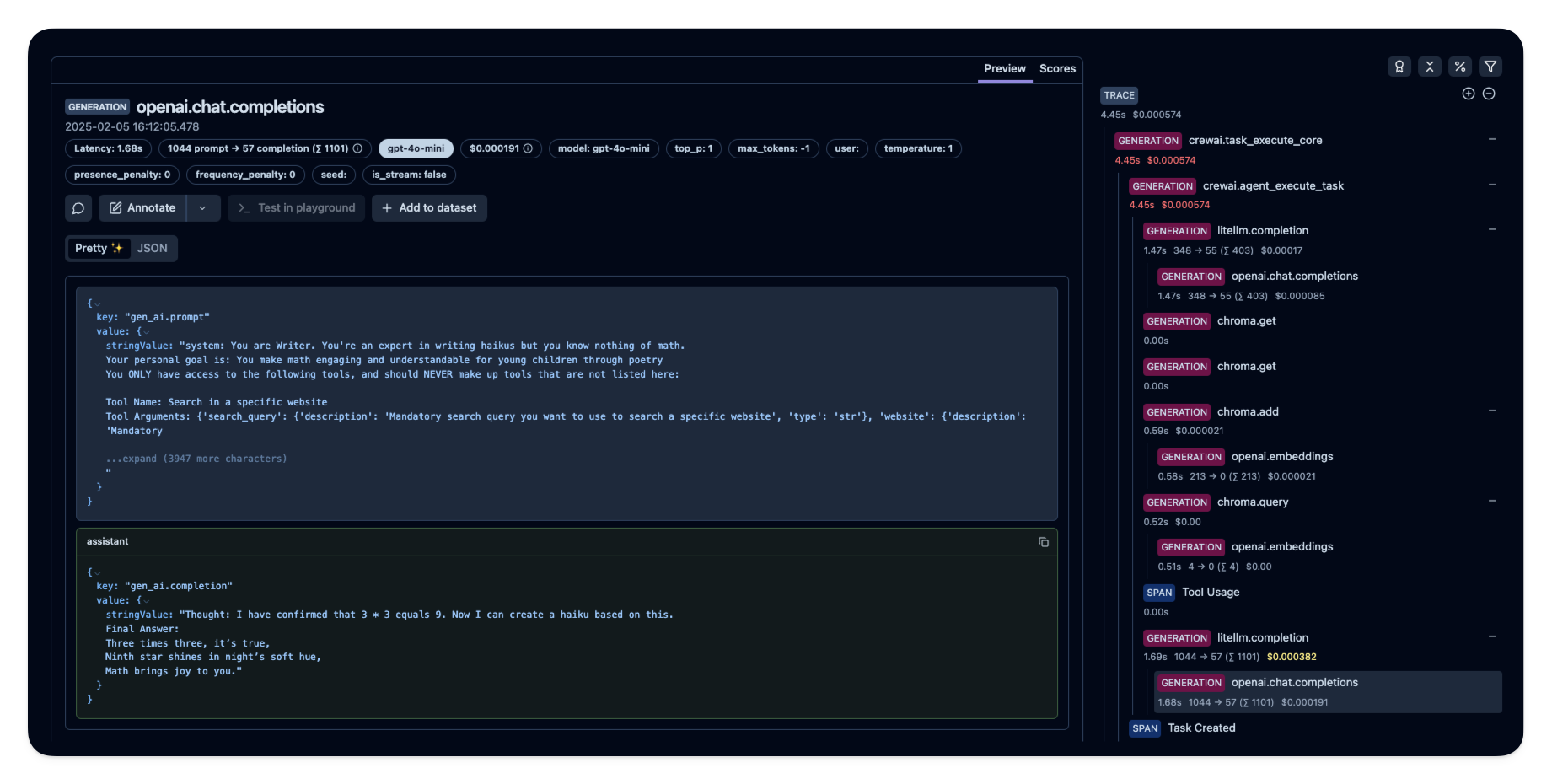
|
|
||||||
|
|
||||||
_[Public example trace in Langfuse](https://cloud.langfuse.com/project/cloramnkj0002jz088vzn1ja4/traces/e2cf380ffc8d47d28da98f136140642b?timestamp=2025-02-05T15%3A12%3A02.717Z&observation=3b32338ee6a5d9af)_
|
|
||||||
|
|
||||||
## References
|
|
||||||
|
|
||||||
- [Langfuse OpenTelemetry Docs](https://langfuse.com/docs/opentelemetry/get-started)
|
|
||||||
@@ -23,7 +23,6 @@ LiteLLM supports a wide range of providers, including but not limited to:
|
|||||||
- Azure OpenAI
|
- Azure OpenAI
|
||||||
- AWS (Bedrock, SageMaker)
|
- AWS (Bedrock, SageMaker)
|
||||||
- Cohere
|
- Cohere
|
||||||
- VoyageAI
|
|
||||||
- Hugging Face
|
- Hugging Face
|
||||||
- Ollama
|
- Ollama
|
||||||
- Mistral AI
|
- Mistral AI
|
||||||
@@ -33,7 +32,6 @@ LiteLLM supports a wide range of providers, including but not limited to:
|
|||||||
- Cloudflare Workers AI
|
- Cloudflare Workers AI
|
||||||
- DeepInfra
|
- DeepInfra
|
||||||
- Groq
|
- Groq
|
||||||
- SambaNova
|
|
||||||
- [NVIDIA NIMs](https://docs.api.nvidia.com/nim/reference/models-1)
|
- [NVIDIA NIMs](https://docs.api.nvidia.com/nim/reference/models-1)
|
||||||
- And many more!
|
- And many more!
|
||||||
|
|
||||||
|
|||||||
@@ -1,206 +0,0 @@
|
|||||||
---
|
|
||||||
title: Agent Monitoring with MLflow
|
|
||||||
description: Quickly start monitoring your Agents with MLflow.
|
|
||||||
icon: bars-staggered
|
|
||||||
---
|
|
||||||
|
|
||||||
# MLflow Overview
|
|
||||||
|
|
||||||
[MLflow](https://mlflow.org/) is an open-source platform to assist machine learning practitioners and teams in handling the complexities of the machine learning process.
|
|
||||||
|
|
||||||
It provides a tracing feature that enhances LLM observability in your Generative AI applications by capturing detailed information about the execution of your application’s services.
|
|
||||||
Tracing provides a way to record the inputs, outputs, and metadata associated with each intermediate step of a request, enabling you to easily pinpoint the source of bugs and unexpected behaviors.
|
|
||||||
|
|
||||||

|
|
||||||
|
|
||||||
### Features
|
|
||||||
|
|
||||||
- **Tracing Dashboard**: Monitor activities of your crewAI agents with detailed dashboards that include inputs, outputs and metadata of spans.
|
|
||||||
- **Automated Tracing**: A fully automated integration with crewAI, which can be enabled by running `mlflow.crewai.autolog()`.
|
|
||||||
- **Manual Trace Instrumentation with minor efforts**: Customize trace instrumentation through MLflow's high-level fluent APIs such as decorators, function wrappers and context managers.
|
|
||||||
- **OpenTelemetry Compatibility**: MLflow Tracing supports exporting traces to an OpenTelemetry Collector, which can then be used to export traces to various backends such as Jaeger, Zipkin, and AWS X-Ray.
|
|
||||||
- **Package and Deploy Agents**: Package and deploy your crewAI agents to an inference server with a variety of deployment targets.
|
|
||||||
- **Securely Host LLMs**: Host multiple LLM from various providers in one unified endpoint through MFflow gateway.
|
|
||||||
- **Evaluation**: Evaluate your crewAI agents with a wide range of metrics using a convenient API `mlflow.evaluate()`.
|
|
||||||
|
|
||||||
## Setup Instructions
|
|
||||||
|
|
||||||
<Steps>
|
|
||||||
<Step title="Install MLflow package">
|
|
||||||
```shell
|
|
||||||
# The crewAI integration is available in mlflow>=2.19.0
|
|
||||||
pip install mlflow
|
|
||||||
```
|
|
||||||
</Step>
|
|
||||||
<Step title="Start MFflow tracking server">
|
|
||||||
```shell
|
|
||||||
# This process is optional, but it is recommended to use MLflow tracking server for better visualization and broader features.
|
|
||||||
mlflow server
|
|
||||||
```
|
|
||||||
</Step>
|
|
||||||
<Step title="Initialize MLflow in Your Application">
|
|
||||||
Add the following two lines to your application code:
|
|
||||||
|
|
||||||
```python
|
|
||||||
import mlflow
|
|
||||||
|
|
||||||
mlflow.crewai.autolog()
|
|
||||||
|
|
||||||
# Optional: Set a tracking URI and an experiment name if you have a tracking server
|
|
||||||
mlflow.set_tracking_uri("http://localhost:5000")
|
|
||||||
mlflow.set_experiment("CrewAI")
|
|
||||||
```
|
|
||||||
|
|
||||||
Example Usage for tracing CrewAI Agents:
|
|
||||||
|
|
||||||
```python
|
|
||||||
from crewai import Agent, Crew, Task
|
|
||||||
from crewai.knowledge.source.string_knowledge_source import StringKnowledgeSource
|
|
||||||
from crewai_tools import SerperDevTool, WebsiteSearchTool
|
|
||||||
|
|
||||||
from textwrap import dedent
|
|
||||||
|
|
||||||
content = "Users name is John. He is 30 years old and lives in San Francisco."
|
|
||||||
string_source = StringKnowledgeSource(
|
|
||||||
content=content, metadata={"preference": "personal"}
|
|
||||||
)
|
|
||||||
|
|
||||||
search_tool = WebsiteSearchTool()
|
|
||||||
|
|
||||||
|
|
||||||
class TripAgents:
|
|
||||||
def city_selection_agent(self):
|
|
||||||
return Agent(
|
|
||||||
role="City Selection Expert",
|
|
||||||
goal="Select the best city based on weather, season, and prices",
|
|
||||||
backstory="An expert in analyzing travel data to pick ideal destinations",
|
|
||||||
tools=[
|
|
||||||
search_tool,
|
|
||||||
],
|
|
||||||
verbose=True,
|
|
||||||
)
|
|
||||||
|
|
||||||
def local_expert(self):
|
|
||||||
return Agent(
|
|
||||||
role="Local Expert at this city",
|
|
||||||
goal="Provide the BEST insights about the selected city",
|
|
||||||
backstory="""A knowledgeable local guide with extensive information
|
|
||||||
about the city, it's attractions and customs""",
|
|
||||||
tools=[search_tool],
|
|
||||||
verbose=True,
|
|
||||||
)
|
|
||||||
|
|
||||||
|
|
||||||
class TripTasks:
|
|
||||||
def identify_task(self, agent, origin, cities, interests, range):
|
|
||||||
return Task(
|
|
||||||
description=dedent(
|
|
||||||
f"""
|
|
||||||
Analyze and select the best city for the trip based
|
|
||||||
on specific criteria such as weather patterns, seasonal
|
|
||||||
events, and travel costs. This task involves comparing
|
|
||||||
multiple cities, considering factors like current weather
|
|
||||||
conditions, upcoming cultural or seasonal events, and
|
|
||||||
overall travel expenses.
|
|
||||||
Your final answer must be a detailed
|
|
||||||
report on the chosen city, and everything you found out
|
|
||||||
about it, including the actual flight costs, weather
|
|
||||||
forecast and attractions.
|
|
||||||
|
|
||||||
Traveling from: {origin}
|
|
||||||
City Options: {cities}
|
|
||||||
Trip Date: {range}
|
|
||||||
Traveler Interests: {interests}
|
|
||||||
"""
|
|
||||||
),
|
|
||||||
agent=agent,
|
|
||||||
expected_output="Detailed report on the chosen city including flight costs, weather forecast, and attractions",
|
|
||||||
)
|
|
||||||
|
|
||||||
def gather_task(self, agent, origin, interests, range):
|
|
||||||
return Task(
|
|
||||||
description=dedent(
|
|
||||||
f"""
|
|
||||||
As a local expert on this city you must compile an
|
|
||||||
in-depth guide for someone traveling there and wanting
|
|
||||||
to have THE BEST trip ever!
|
|
||||||
Gather information about key attractions, local customs,
|
|
||||||
special events, and daily activity recommendations.
|
|
||||||
Find the best spots to go to, the kind of place only a
|
|
||||||
local would know.
|
|
||||||
This guide should provide a thorough overview of what
|
|
||||||
the city has to offer, including hidden gems, cultural
|
|
||||||
hotspots, must-visit landmarks, weather forecasts, and
|
|
||||||
high level costs.
|
|
||||||
The final answer must be a comprehensive city guide,
|
|
||||||
rich in cultural insights and practical tips,
|
|
||||||
tailored to enhance the travel experience.
|
|
||||||
|
|
||||||
Trip Date: {range}
|
|
||||||
Traveling from: {origin}
|
|
||||||
Traveler Interests: {interests}
|
|
||||||
"""
|
|
||||||
),
|
|
||||||
agent=agent,
|
|
||||||
expected_output="Comprehensive city guide including hidden gems, cultural hotspots, and practical travel tips",
|
|
||||||
)
|
|
||||||
|
|
||||||
|
|
||||||
class TripCrew:
|
|
||||||
def __init__(self, origin, cities, date_range, interests):
|
|
||||||
self.cities = cities
|
|
||||||
self.origin = origin
|
|
||||||
self.interests = interests
|
|
||||||
self.date_range = date_range
|
|
||||||
|
|
||||||
def run(self):
|
|
||||||
agents = TripAgents()
|
|
||||||
tasks = TripTasks()
|
|
||||||
|
|
||||||
city_selector_agent = agents.city_selection_agent()
|
|
||||||
local_expert_agent = agents.local_expert()
|
|
||||||
|
|
||||||
identify_task = tasks.identify_task(
|
|
||||||
city_selector_agent,
|
|
||||||
self.origin,
|
|
||||||
self.cities,
|
|
||||||
self.interests,
|
|
||||||
self.date_range,
|
|
||||||
)
|
|
||||||
gather_task = tasks.gather_task(
|
|
||||||
local_expert_agent, self.origin, self.interests, self.date_range
|
|
||||||
)
|
|
||||||
|
|
||||||
crew = Crew(
|
|
||||||
agents=[city_selector_agent, local_expert_agent],
|
|
||||||
tasks=[identify_task, gather_task],
|
|
||||||
verbose=True,
|
|
||||||
memory=True,
|
|
||||||
knowledge={
|
|
||||||
"sources": [string_source],
|
|
||||||
"metadata": {"preference": "personal"},
|
|
||||||
},
|
|
||||||
)
|
|
||||||
|
|
||||||
result = crew.kickoff()
|
|
||||||
return result
|
|
||||||
|
|
||||||
|
|
||||||
trip_crew = TripCrew("California", "Tokyo", "Dec 12 - Dec 20", "sports")
|
|
||||||
result = trip_crew.run()
|
|
||||||
|
|
||||||
print(result)
|
|
||||||
```
|
|
||||||
Refer to [MLflow Tracing Documentation](https://mlflow.org/docs/latest/llms/tracing/index.html) for more configurations and use cases.
|
|
||||||
</Step>
|
|
||||||
<Step title="Visualize Activities of Agents">
|
|
||||||
Now traces for your crewAI agents are captured by MLflow.
|
|
||||||
Let's visit MLflow tracking server to view the traces and get insights into your Agents.
|
|
||||||
|
|
||||||
Open `127.0.0.1:5000` on your browser to visit MLflow tracking server.
|
|
||||||
<Frame caption="MLflow Tracing Dashboard">
|
|
||||||
<img src="/images/mlflow1.png" alt="MLflow tracing example with crewai" />
|
|
||||||
</Frame>
|
|
||||||
</Step>
|
|
||||||
</Steps>
|
|
||||||
|
|
||||||
@@ -1,14 +1,14 @@
|
|||||||
---
|
---
|
||||||
title: Using Multimodal Agents
|
title: Using Multimodal Agents
|
||||||
description: Learn how to enable and use multimodal capabilities in your agents for processing images and other non-text content within the CrewAI framework.
|
description: Learn how to enable and use multimodal capabilities in your agents for processing images and other non-text content within the CrewAI framework.
|
||||||
icon: video
|
icon: image
|
||||||
---
|
---
|
||||||
|
|
||||||
## Using Multimodal Agents
|
# Using Multimodal Agents
|
||||||
|
|
||||||
CrewAI supports multimodal agents that can process both text and non-text content like images. This guide will show you how to enable and use multimodal capabilities in your agents.
|
CrewAI supports multimodal agents that can process both text and non-text content like images. This guide will show you how to enable and use multimodal capabilities in your agents.
|
||||||
|
|
||||||
### Enabling Multimodal Capabilities
|
## Enabling Multimodal Capabilities
|
||||||
|
|
||||||
To create a multimodal agent, simply set the `multimodal` parameter to `True` when initializing your agent:
|
To create a multimodal agent, simply set the `multimodal` parameter to `True` when initializing your agent:
|
||||||
|
|
||||||
@@ -25,7 +25,7 @@ agent = Agent(
|
|||||||
|
|
||||||
When you set `multimodal=True`, the agent is automatically configured with the necessary tools for handling non-text content, including the `AddImageTool`.
|
When you set `multimodal=True`, the agent is automatically configured with the necessary tools for handling non-text content, including the `AddImageTool`.
|
||||||
|
|
||||||
### Working with Images
|
## Working with Images
|
||||||
|
|
||||||
The multimodal agent comes pre-configured with the `AddImageTool`, which allows it to process images. You don't need to manually add this tool - it's automatically included when you enable multimodal capabilities.
|
The multimodal agent comes pre-configured with the `AddImageTool`, which allows it to process images. You don't need to manually add this tool - it's automatically included when you enable multimodal capabilities.
|
||||||
|
|
||||||
@@ -45,7 +45,6 @@ image_analyst = Agent(
|
|||||||
# Create a task for image analysis
|
# Create a task for image analysis
|
||||||
task = Task(
|
task = Task(
|
||||||
description="Analyze the product image at https://example.com/product.jpg and provide a detailed description",
|
description="Analyze the product image at https://example.com/product.jpg and provide a detailed description",
|
||||||
expected_output="A detailed description of the product image",
|
|
||||||
agent=image_analyst
|
agent=image_analyst
|
||||||
)
|
)
|
||||||
|
|
||||||
@@ -82,7 +81,6 @@ inspection_task = Task(
|
|||||||
3. Compliance with standards
|
3. Compliance with standards
|
||||||
Provide a detailed report highlighting any issues found.
|
Provide a detailed report highlighting any issues found.
|
||||||
""",
|
""",
|
||||||
expected_output="A detailed report highlighting any issues found",
|
|
||||||
agent=expert_analyst
|
agent=expert_analyst
|
||||||
)
|
)
|
||||||
|
|
||||||
@@ -110,7 +108,7 @@ The multimodal agent will automatically handle the image processing through its
|
|||||||
- Process image content with optional context or specific questions
|
- Process image content with optional context or specific questions
|
||||||
- Provide analysis and insights based on the visual information and task requirements
|
- Provide analysis and insights based on the visual information and task requirements
|
||||||
|
|
||||||
### Best Practices
|
## Best Practices
|
||||||
|
|
||||||
When working with multimodal agents, keep these best practices in mind:
|
When working with multimodal agents, keep these best practices in mind:
|
||||||
|
|
||||||
|
|||||||

Binary file not shown.
|
Before Width: | Height: | Size: 16 MiB |

Binary file not shown.
|
Before Width: | Height: | Size: 382 KiB |
@@ -15,48 +15,10 @@ icon: wrench
|
|||||||
If you need to update Python, visit [python.org/downloads](https://python.org/downloads)
|
If you need to update Python, visit [python.org/downloads](https://python.org/downloads)
|
||||||
</Note>
|
</Note>
|
||||||
|
|
||||||
# Setting Up Your Environment
|
|
||||||
|
|
||||||
Before installing CrewAI, it's recommended to set up a virtual environment. This helps isolate your project dependencies and avoid conflicts.
|
|
||||||
|
|
||||||
<Steps>
|
|
||||||
<Step title="Create a Virtual Environment">
|
|
||||||
Choose your preferred method to create a virtual environment:
|
|
||||||
|
|
||||||
**Using venv (Python's built-in tool):**
|
|
||||||
```shell Terminal
|
|
||||||
python3 -m venv .venv
|
|
||||||
```
|
|
||||||
|
|
||||||
**Using conda:**
|
|
||||||
```shell Terminal
|
|
||||||
conda create -n crewai-env python=3.12
|
|
||||||
```
|
|
||||||
</Step>
|
|
||||||
|
|
||||||
<Step title="Activate the Virtual Environment">
|
|
||||||
Activate your virtual environment based on your platform:
|
|
||||||
|
|
||||||
**On macOS/Linux (venv):**
|
|
||||||
```shell Terminal
|
|
||||||
source .venv/bin/activate
|
|
||||||
```
|
|
||||||
|
|
||||||
**On Windows (venv):**
|
|
||||||
```shell Terminal
|
|
||||||
.venv\Scripts\activate
|
|
||||||
```
|
|
||||||
|
|
||||||
**Using conda (all platforms):**
|
|
||||||
```shell Terminal
|
|
||||||
conda activate crewai-env
|
|
||||||
```
|
|
||||||
</Step>
|
|
||||||
</Steps>
|
|
||||||
|
|
||||||
# Installing CrewAI
|
# Installing CrewAI
|
||||||
|
|
||||||
Now let's get you set up! 🚀
|
CrewAI is a flexible and powerful AI framework that enables you to create and manage AI agents, tools, and tasks efficiently.
|
||||||
|
Let's get you set up! 🚀
|
||||||
|
|
||||||
<Steps>
|
<Steps>
|
||||||
<Step title="Install CrewAI">
|
<Step title="Install CrewAI">
|
||||||
@@ -110,9 +72,9 @@ Now let's get you set up! 🚀
|
|||||||
|
|
||||||
# Creating a New Project
|
# Creating a New Project
|
||||||
|
|
||||||
<Tip>
|
<Info>
|
||||||
We recommend using the YAML Template scaffolding for a structured approach to defining agents and tasks.
|
We recommend using the YAML Template scaffolding for a structured approach to defining agents and tasks.
|
||||||
</Tip>
|
</Info>
|
||||||
|
|
||||||
<Steps>
|
<Steps>
|
||||||
<Step title="Generate Project Structure">
|
<Step title="Generate Project Structure">
|
||||||
@@ -144,17 +106,6 @@ Now let's get you set up! 🚀
|
|||||||
</Frame>
|
</Frame>
|
||||||
</Step>
|
</Step>
|
||||||
|
|
||||||
<Step title="Install Additional Tools">
|
|
||||||
You can install additional tools using UV:
|
|
||||||
```shell Terminal
|
|
||||||
uv add <tool-name>
|
|
||||||
```
|
|
||||||
|
|
||||||
<Tip>
|
|
||||||
UV is our preferred package manager as it's significantly faster than pip and provides better dependency resolution.
|
|
||||||
</Tip>
|
|
||||||
</Step>
|
|
||||||
|
|
||||||
<Step title="Customize Your Project">
|
<Step title="Customize Your Project">
|
||||||
Your project will contain these essential files:
|
Your project will contain these essential files:
|
||||||
|
|
||||||
|
|||||||
@@ -91,7 +91,6 @@
|
|||||||
"how-to/custom-manager-agent",
|
"how-to/custom-manager-agent",
|
||||||
"how-to/llm-connections",
|
"how-to/llm-connections",
|
||||||
"how-to/customizing-agents",
|
"how-to/customizing-agents",
|
||||||
"how-to/multimodal-agents",
|
|
||||||
"how-to/coding-agents",
|
"how-to/coding-agents",
|
||||||
"how-to/force-tool-output-as-result",
|
"how-to/force-tool-output-as-result",
|
||||||
"how-to/human-input-on-execution",
|
"how-to/human-input-on-execution",
|
||||||
@@ -101,10 +100,7 @@
|
|||||||
"how-to/conditional-tasks",
|
"how-to/conditional-tasks",
|
||||||
"how-to/agentops-observability",
|
"how-to/agentops-observability",
|
||||||
"how-to/langtrace-observability",
|
"how-to/langtrace-observability",
|
||||||
"how-to/mlflow-observability",
|
"how-to/openlit-observability"
|
||||||
"how-to/openlit-observability",
|
|
||||||
"how-to/portkey-observability",
|
|
||||||
"how-to/langfuse-observability"
|
|
||||||
]
|
]
|
||||||
},
|
},
|
||||||
{
|
{
|
||||||
@@ -139,7 +135,6 @@
|
|||||||
"tools/nl2sqltool",
|
"tools/nl2sqltool",
|
||||||
"tools/pdfsearchtool",
|
"tools/pdfsearchtool",
|
||||||
"tools/pgsearchtool",
|
"tools/pgsearchtool",
|
||||||
"tools/qdrantvectorsearchtool",
|
|
||||||
"tools/scrapewebsitetool",
|
"tools/scrapewebsitetool",
|
||||||
"tools/seleniumscrapingtool",
|
"tools/seleniumscrapingtool",
|
||||||
"tools/spidertool",
|
"tools/spidertool",
|
||||||
|
|||||||
@@ -58,7 +58,7 @@ Follow the steps below to get crewing! 🚣♂️
|
|||||||
description: >
|
description: >
|
||||||
Conduct a thorough research about {topic}
|
Conduct a thorough research about {topic}
|
||||||
Make sure you find any interesting and relevant information given
|
Make sure you find any interesting and relevant information given
|
||||||
the current year is 2025.
|
the current year is 2024.
|
||||||
expected_output: >
|
expected_output: >
|
||||||
A list with 10 bullet points of the most relevant information about {topic}
|
A list with 10 bullet points of the most relevant information about {topic}
|
||||||
agent: researcher
|
agent: researcher
|
||||||
@@ -195,10 +195,10 @@ Follow the steps below to get crewing! 🚣♂️
|
|||||||
|
|
||||||
<CodeGroup>
|
<CodeGroup>
|
||||||
```markdown output/report.md
|
```markdown output/report.md
|
||||||
# Comprehensive Report on the Rise and Impact of AI Agents in 2025
|
# Comprehensive Report on the Rise and Impact of AI Agents in 2024
|
||||||
|
|
||||||
## 1. Introduction to AI Agents
|
## 1. Introduction to AI Agents
|
||||||
In 2025, Artificial Intelligence (AI) agents are at the forefront of innovation across various industries. As intelligent systems that can perform tasks typically requiring human cognition, AI agents are paving the way for significant advancements in operational efficiency, decision-making, and overall productivity within sectors like Human Resources (HR) and Finance. This report aims to detail the rise of AI agents, their frameworks, applications, and potential implications on the workforce.
|
In 2024, Artificial Intelligence (AI) agents are at the forefront of innovation across various industries. As intelligent systems that can perform tasks typically requiring human cognition, AI agents are paving the way for significant advancements in operational efficiency, decision-making, and overall productivity within sectors like Human Resources (HR) and Finance. This report aims to detail the rise of AI agents, their frameworks, applications, and potential implications on the workforce.
|
||||||
|
|
||||||
## 2. Benefits of AI Agents
|
## 2. Benefits of AI Agents
|
||||||
AI agents bring numerous advantages that are transforming traditional work environments. Key benefits include:
|
AI agents bring numerous advantages that are transforming traditional work environments. Key benefits include:
|
||||||
@@ -252,7 +252,7 @@ Follow the steps below to get crewing! 🚣♂️
|
|||||||
To stay competitive and harness the full potential of AI agents, organizations must remain vigilant about latest developments in AI technology and consider continuous learning and adaptation in their strategic planning.
|
To stay competitive and harness the full potential of AI agents, organizations must remain vigilant about latest developments in AI technology and consider continuous learning and adaptation in their strategic planning.
|
||||||
|
|
||||||
## 8. Conclusion
|
## 8. Conclusion
|
||||||
The emergence of AI agents is undeniably reshaping the workplace landscape in 5. With their ability to automate tasks, enhance efficiency, and improve decision-making, AI agents are critical in driving operational success. Organizations must embrace and adapt to AI developments to thrive in an increasingly digital business environment.
|
The emergence of AI agents is undeniably reshaping the workplace landscape in 2024. With their ability to automate tasks, enhance efficiency, and improve decision-making, AI agents are critical in driving operational success. Organizations must embrace and adapt to AI developments to thrive in an increasingly digital business environment.
|
||||||
```
|
```
|
||||||
</CodeGroup>
|
</CodeGroup>
|
||||||
</Step>
|
</Step>
|
||||||
@@ -278,7 +278,7 @@ email_summarizer:
|
|||||||
Summarize emails into a concise and clear summary
|
Summarize emails into a concise and clear summary
|
||||||
backstory: >
|
backstory: >
|
||||||
You will create a 5 bullet point summary of the report
|
You will create a 5 bullet point summary of the report
|
||||||
llm: openai/gpt-4o
|
llm: mixtal_llm
|
||||||
```
|
```
|
||||||
|
|
||||||
<Tip>
|
<Tip>
|
||||||
@@ -301,166 +301,38 @@ Use the annotations to properly reference the agent and task in the `crew.py` fi
|
|||||||
|
|
||||||
### Annotations include:
|
### Annotations include:
|
||||||
|
|
||||||
Here are examples of how to use each annotation in your CrewAI project, and when you should use them:
|
* `@agent`
|
||||||
|
* `@task`
|
||||||
|
* `@crew`
|
||||||
|
* `@tool`
|
||||||
|
* `@before_kickoff`
|
||||||
|
* `@after_kickoff`
|
||||||
|
* `@callback`
|
||||||
|
* `@output_json`
|
||||||
|
* `@output_pydantic`
|
||||||
|
* `@cache_handler`
|
||||||
|
|
||||||
#### @agent
|
```python crew.py
|
||||||
Used to define an agent in your crew. Use this when:
|
# ...
|
||||||
- You need to create a specialized AI agent with a specific role
|
|
||||||
- You want the agent to be automatically collected and managed by the crew
|
|
||||||
- You need to reuse the same agent configuration across multiple tasks
|
|
||||||
|
|
||||||
```python
|
|
||||||
@agent
|
@agent
|
||||||
def research_agent(self) -> Agent:
|
def email_summarizer(self) -> Agent:
|
||||||
return Agent(
|
return Agent(
|
||||||
role="Research Analyst",
|
config=self.agents_config["email_summarizer"],
|
||||||
goal="Conduct thorough research on given topics",
|
|
||||||
backstory="Expert researcher with years of experience in data analysis",
|
|
||||||
tools=[SerperDevTool()],
|
|
||||||
verbose=True
|
|
||||||
)
|
)
|
||||||
```
|
|
||||||
|
|
||||||
#### @task
|
|
||||||
Used to define a task that can be executed by agents. Use this when:
|
|
||||||
- You need to define a specific piece of work for an agent
|
|
||||||
- You want tasks to be automatically sequenced and managed
|
|
||||||
- You need to establish dependencies between different tasks
|
|
||||||
|
|
||||||
```python
|
|
||||||
@task
|
@task
|
||||||
def research_task(self) -> Task:
|
def email_summarizer_task(self) -> Task:
|
||||||
return Task(
|
return Task(
|
||||||
description="Research the latest developments in AI technology",
|
config=self.tasks_config["email_summarizer_task"],
|
||||||
expected_output="A comprehensive report on AI advancements",
|
|
||||||
agent=self.research_agent(),
|
|
||||||
output_file="output/research.md"
|
|
||||||
)
|
)
|
||||||
|
# ...
|
||||||
```
|
```
|
||||||
|
|
||||||
#### @crew
|
<Tip>
|
||||||
Used to define your crew configuration. Use this when:
|
In addition to the [sequential process](../how-to/sequential-process), you can use the [hierarchical process](../how-to/hierarchical-process),
|
||||||
- You want to automatically collect all @agent and @task definitions
|
which automatically assigns a manager to the defined crew to properly coordinate the planning and execution of tasks through delegation and validation of results.
|
||||||
- You need to specify how tasks should be processed (sequential or hierarchical)
|
You can learn more about the core concepts [here](/concepts).
|
||||||
- You want to set up crew-wide configurations
|
</Tip>
|
||||||
|
|
||||||
```python
|
|
||||||
@crew
|
|
||||||
def research_crew(self) -> Crew:
|
|
||||||
return Crew(
|
|
||||||
agents=self.agents, # Automatically collected from @agent methods
|
|
||||||
tasks=self.tasks, # Automatically collected from @task methods
|
|
||||||
process=Process.sequential,
|
|
||||||
verbose=True
|
|
||||||
)
|
|
||||||
```
|
|
||||||
|
|
||||||
#### @tool
|
|
||||||
Used to create custom tools for your agents. Use this when:
|
|
||||||
- You need to give agents specific capabilities (like web search, data analysis)
|
|
||||||
- You want to encapsulate external API calls or complex operations
|
|
||||||
- You need to share functionality across multiple agents
|
|
||||||
|
|
||||||
```python
|
|
||||||
@tool
|
|
||||||
def web_search_tool(query: str, max_results: int = 5) -> list[str]:
|
|
||||||
"""
|
|
||||||
Search the web for information.
|
|
||||||
|
|
||||||
Args:
|
|
||||||
query: The search query
|
|
||||||
max_results: Maximum number of results to return
|
|
||||||
|
|
||||||
Returns:
|
|
||||||
List of search results
|
|
||||||
"""
|
|
||||||
# Implement your search logic here
|
|
||||||
return [f"Result {i} for: {query}" for i in range(max_results)]
|
|
||||||
```
|
|
||||||
|
|
||||||
#### @before_kickoff
|
|
||||||
Used to execute logic before the crew starts. Use this when:
|
|
||||||
- You need to validate or preprocess input data
|
|
||||||
- You want to set up resources or configurations before execution
|
|
||||||
- You need to perform any initialization logic
|
|
||||||
|
|
||||||
```python
|
|
||||||
@before_kickoff
|
|
||||||
def validate_inputs(self, inputs: Optional[Dict[str, Any]]) -> Optional[Dict[str, Any]]:
|
|
||||||
"""Validate and preprocess inputs before the crew starts."""
|
|
||||||
if inputs is None:
|
|
||||||
return None
|
|
||||||
|
|
||||||
if 'topic' not in inputs:
|
|
||||||
raise ValueError("Topic is required")
|
|
||||||
|
|
||||||
# Add additional context
|
|
||||||
inputs['timestamp'] = datetime.now().isoformat()
|
|
||||||
inputs['topic'] = inputs['topic'].strip().lower()
|
|
||||||
return inputs
|
|
||||||
```
|
|
||||||
|
|
||||||
#### @after_kickoff
|
|
||||||
Used to process results after the crew completes. Use this when:
|
|
||||||
- You need to format or transform the final output
|
|
||||||
- You want to perform cleanup operations
|
|
||||||
- You need to save or log the results in a specific way
|
|
||||||
|
|
||||||
```python
|
|
||||||
@after_kickoff
|
|
||||||
def process_results(self, result: CrewOutput) -> CrewOutput:
|
|
||||||
"""Process and format the results after the crew completes."""
|
|
||||||
result.raw = result.raw.strip()
|
|
||||||
result.raw = f"""
|
|
||||||
# Research Results
|
|
||||||
Generated on: {datetime.now().isoformat()}
|
|
||||||
|
|
||||||
{result.raw}
|
|
||||||
"""
|
|
||||||
return result
|
|
||||||
```
|
|
||||||
|
|
||||||
#### @callback
|
|
||||||
Used to handle events during crew execution. Use this when:
|
|
||||||
- You need to monitor task progress
|
|
||||||
- You want to log intermediate results
|
|
||||||
- You need to implement custom progress tracking or metrics
|
|
||||||
|
|
||||||
```python
|
|
||||||
@callback
|
|
||||||
def log_task_completion(self, task: Task, output: str):
|
|
||||||
"""Log task completion details for monitoring."""
|
|
||||||
print(f"Task '{task.description}' completed")
|
|
||||||
print(f"Output length: {len(output)} characters")
|
|
||||||
print(f"Agent used: {task.agent.role}")
|
|
||||||
print("-" * 50)
|
|
||||||
```
|
|
||||||
|
|
||||||
#### @cache_handler
|
|
||||||
Used to implement custom caching for task results. Use this when:
|
|
||||||
- You want to avoid redundant expensive operations
|
|
||||||
- You need to implement custom cache storage or expiration logic
|
|
||||||
- You want to persist results between runs
|
|
||||||
|
|
||||||
```python
|
|
||||||
@cache_handler
|
|
||||||
def custom_cache(self, key: str) -> Optional[str]:
|
|
||||||
"""Custom cache implementation for storing task results."""
|
|
||||||
cache_file = f"cache/{key}.json"
|
|
||||||
|
|
||||||
if os.path.exists(cache_file):
|
|
||||||
with open(cache_file, 'r') as f:
|
|
||||||
data = json.load(f)
|
|
||||||
# Check if cache is still valid (e.g., not expired)
|
|
||||||
if datetime.fromisoformat(data['timestamp']) > datetime.now() - timedelta(days=1):
|
|
||||||
return data['result']
|
|
||||||
return None
|
|
||||||
```
|
|
||||||
|
|
||||||
<Note>
|
|
||||||
These decorators are part of the CrewAI framework and help organize your crew's structure by automatically collecting agents, tasks, and handling various lifecycle events.
|
|
||||||
They should be used within a class decorated with `@CrewBase`.
|
|
||||||
</Note>
|
|
||||||
|
|
||||||
### Replay Tasks from Latest Crew Kickoff
|
### Replay Tasks from Latest Crew Kickoff
|
||||||
|
|
||||||
|
|||||||
@@ -1,118 +1,78 @@
|
|||||||
---
|
---
|
||||||
title: Composio Tool
|
title: Composio Tool
|
||||||
description: Composio provides 250+ production-ready tools for AI agents with flexible authentication management.
|
description: The `ComposioTool` is a wrapper around the composio set of tools and gives your agent access to a wide variety of tools from the Composio SDK.
|
||||||
icon: gear-code
|
icon: gear-code
|
||||||
---
|
---
|
||||||
|
|
||||||
# `ComposioToolSet`
|
# `ComposioTool`
|
||||||
|
|
||||||
## Description
|
## Description
|
||||||
Composio is an integration platform that allows you to connect your AI agents to 250+ tools. Key features include:
|
|
||||||
|
|
||||||
- **Enterprise-Grade Authentication**: Built-in support for OAuth, API Keys, JWT with automatic token refresh
|
This tools is a wrapper around the composio set of tools and gives your agent access to a wide variety of tools from the Composio SDK.
|
||||||
- **Full Observability**: Detailed tool usage logs, execution timestamps, and more
|
|
||||||
|
|
||||||
## Installation
|
## Installation
|
||||||
|
|
||||||
To incorporate Composio tools into your project, follow the instructions below:
|
To incorporate this tool into your project, follow the installation instructions below:
|
||||||
|
|
||||||
```shell
|
```shell
|
||||||
pip install composio-crewai
|
pip install composio-core
|
||||||
pip install crewai
|
pip install 'crewai[tools]'
|
||||||
```
|
```
|
||||||
|
|
||||||
After the installation is complete, either run `composio login` or export your composio API key as `COMPOSIO_API_KEY`. Get your Composio API key from [here](https://app.composio.dev)
|
after the installation is complete, either run `composio login` or export your composio API key as `COMPOSIO_API_KEY`.
|
||||||
|
|
||||||
## Example
|
## Example
|
||||||
|
|
||||||
The following example demonstrates how to initialize the tool and execute a github action:
|
The following example demonstrates how to initialize the tool and execute a github action:
|
||||||
|
|
||||||
1. Initialize Composio toolset
|
1. Initialize Composio tools
|
||||||
|
|
||||||
```python Code
|
```python Code
|
||||||
from composio_crewai import ComposioToolSet, App, Action
|
from composio import App
|
||||||
from crewai import Agent, Task, Crew
|
from crewai_tools import ComposioTool
|
||||||
|
from crewai import Agent, Task
|
||||||
|
|
||||||
toolset = ComposioToolSet()
|
|
||||||
|
tools = [ComposioTool.from_action(action=Action.GITHUB_ACTIVITY_STAR_REPO_FOR_AUTHENTICATED_USER)]
|
||||||
```
|
```
|
||||||
|
|
||||||
2. Connect your GitHub account
|
If you don't know what action you want to use, use `from_app` and `tags` filter to get relevant actions
|
||||||
<CodeGroup>
|
|
||||||
```shell CLI
|
|
||||||
composio add github
|
|
||||||
```
|
|
||||||
```python Code
|
```python Code
|
||||||
request = toolset.initiate_connection(app=App.GITHUB)
|
tools = ComposioTool.from_app(App.GITHUB, tags=["important"])
|
||||||
print(f"Open this URL to authenticate: {request.redirectUrl}")
|
|
||||||
```
|
```
|
||||||
</CodeGroup>
|
|
||||||
|
|
||||||
3. Get Tools
|
or use `use_case` to search relevant actions
|
||||||
|
|
||||||
- Retrieving all the tools from an app (not recommended for production):
|
|
||||||
```python Code
|
```python Code
|
||||||
tools = toolset.get_tools(apps=[App.GITHUB])
|
tools = ComposioTool.from_app(App.GITHUB, use_case="Star a github repository")
|
||||||
```
|
```
|
||||||
|
|
||||||
- Filtering tools based on tags:
|
2. Define agent
|
||||||
```python Code
|
|
||||||
tag = "users"
|
|
||||||
|
|
||||||
filtered_action_enums = toolset.find_actions_by_tags(
|
|
||||||
App.GITHUB,
|
|
||||||
tags=[tag],
|
|
||||||
)
|
|
||||||
|
|
||||||
tools = toolset.get_tools(actions=filtered_action_enums)
|
|
||||||
```
|
|
||||||
|
|
||||||
- Filtering tools based on use case:
|
|
||||||
```python Code
|
|
||||||
use_case = "Star a repository on GitHub"
|
|
||||||
|
|
||||||
filtered_action_enums = toolset.find_actions_by_use_case(
|
|
||||||
App.GITHUB, use_case=use_case, advanced=False
|
|
||||||
)
|
|
||||||
|
|
||||||
tools = toolset.get_tools(actions=filtered_action_enums)
|
|
||||||
```
|
|
||||||
<Tip>Set `advanced` to True to get actions for complex use cases</Tip>
|
|
||||||
|
|
||||||
- Using specific tools:
|
|
||||||
|
|
||||||
In this demo, we will use the `GITHUB_STAR_A_REPOSITORY_FOR_THE_AUTHENTICATED_USER` action from the GitHub app.
|
|
||||||
```python Code
|
|
||||||
tools = toolset.get_tools(
|
|
||||||
actions=[Action.GITHUB_STAR_A_REPOSITORY_FOR_THE_AUTHENTICATED_USER]
|
|
||||||
)
|
|
||||||
```
|
|
||||||
Learn more about filtering actions [here](https://docs.composio.dev/patterns/tools/use-tools/use-specific-actions)
|
|
||||||
|
|
||||||
4. Define agent
|
|
||||||
|
|
||||||
```python Code
|
```python Code
|
||||||
crewai_agent = Agent(
|
crewai_agent = Agent(
|
||||||
role="GitHub Agent",
|
role="Github Agent",
|
||||||
goal="You take action on GitHub using GitHub APIs",
|
goal="You take action on Github using Github APIs",
|
||||||
backstory="You are AI agent that is responsible for taking actions on GitHub on behalf of users using GitHub APIs",
|
backstory=(
|
||||||
|
"You are AI agent that is responsible for taking actions on Github "
|
||||||
|
"on users behalf. You need to take action on Github using Github APIs"
|
||||||
|
),
|
||||||
verbose=True,
|
verbose=True,
|
||||||
tools=tools,
|
tools=tools,
|
||||||
llm= # pass an llm
|
|
||||||
)
|
)
|
||||||
```
|
```
|
||||||
|
|
||||||
5. Execute task
|
3. Execute task
|
||||||
|
|
||||||
```python Code
|
```python Code
|
||||||
task = Task(
|
task = Task(
|
||||||
description="Star a repo composiohq/composio on GitHub",
|
description="Star a repo ComposioHQ/composio on GitHub",
|
||||||
agent=crewai_agent,
|
agent=crewai_agent,
|
||||||
expected_output="Status of the operation",
|
expected_output="if the star happened",
|
||||||
)
|
)
|
||||||
|
|
||||||
crew = Crew(agents=[crewai_agent], tasks=[task])
|
task.execute()
|
||||||
|
|
||||||
crew.kickoff()
|
|
||||||
```
|
```
|
||||||
|
|
||||||
* More detailed list of tools can be found [here](https://app.composio.dev)
|
* More detailed list of tools can be found [here](https://app.composio.dev)
|
||||||
@@ -8,9 +8,9 @@ icon: file-pen
|
|||||||
|
|
||||||
## Description
|
## Description
|
||||||
|
|
||||||
The `FileWriterTool` is a component of the crewai_tools package, designed to simplify the process of writing content to files with cross-platform compatibility (Windows, Linux, macOS).
|
The `FileWriterTool` is a component of the crewai_tools package, designed to simplify the process of writing content to files.
|
||||||
It is particularly useful in scenarios such as generating reports, saving logs, creating configuration files, and more.
|
It is particularly useful in scenarios such as generating reports, saving logs, creating configuration files, and more.
|
||||||
This tool handles path differences across operating systems, supports UTF-8 encoding, and automatically creates directories if they don't exist, making it easier to organize your output reliably across different platforms.
|
This tool supports creating new directories if they don't exist, making it easier to organize your output.
|
||||||
|
|
||||||
## Installation
|
## Installation
|
||||||
|
|
||||||
@@ -43,8 +43,6 @@ print(result)
|
|||||||
|
|
||||||
## Conclusion
|
## Conclusion
|
||||||
|
|
||||||
By integrating the `FileWriterTool` into your crews, the agents can reliably write content to files across different operating systems.
|
By integrating the `FileWriterTool` into your crews, the agents can execute the process of writing content to files and creating directories.
|
||||||
This tool is essential for tasks that require saving output data, creating structured file systems, and handling cross-platform file operations.
|
This tool is essential for tasks that require saving output data, creating structured file systems, and more. By adhering to the setup and usage guidelines provided,
|
||||||
It's particularly recommended for Windows users who may encounter file writing issues with standard Python file operations.
|
incorporating this tool into projects is straightforward and efficient.
|
||||||
|
|
||||||
By adhering to the setup and usage guidelines provided, incorporating this tool into projects is straightforward and ensures consistent file writing behavior across all platforms.
|
|
||||||
@@ -1,271 +0,0 @@
|
|||||||
---
|
|
||||||
title: 'Qdrant Vector Search Tool'
|
|
||||||
description: 'Semantic search capabilities for CrewAI agents using Qdrant vector database'
|
|
||||||
icon: magnifying-glass-plus
|
|
||||||
---
|
|
||||||
|
|
||||||
# `QdrantVectorSearchTool`
|
|
||||||
|
|
||||||
The Qdrant Vector Search Tool enables semantic search capabilities in your CrewAI agents by leveraging [Qdrant](https://qdrant.tech/), a vector similarity search engine. This tool allows your agents to search through documents stored in a Qdrant collection using semantic similarity.
|
|
||||||
|
|
||||||
## Installation
|
|
||||||
|
|
||||||
Install the required packages:
|
|
||||||
|
|
||||||
```bash
|
|
||||||
uv pip install 'crewai[tools] qdrant-client'
|
|
||||||
```
|
|
||||||
|
|
||||||
## Basic Usage
|
|
||||||
|
|
||||||
Here's a minimal example of how to use the tool:
|
|
||||||
|
|
||||||
```python
|
|
||||||
from crewai import Agent
|
|
||||||
from crewai_tools import QdrantVectorSearchTool
|
|
||||||
|
|
||||||
# Initialize the tool
|
|
||||||
qdrant_tool = QdrantVectorSearchTool(
|
|
||||||
qdrant_url="your_qdrant_url",
|
|
||||||
qdrant_api_key="your_qdrant_api_key",
|
|
||||||
collection_name="your_collection"
|
|
||||||
)
|
|
||||||
|
|
||||||
# Create an agent that uses the tool
|
|
||||||
agent = Agent(
|
|
||||||
role="Research Assistant",
|
|
||||||
goal="Find relevant information in documents",
|
|
||||||
tools=[qdrant_tool]
|
|
||||||
)
|
|
||||||
|
|
||||||
# The tool will automatically use OpenAI embeddings
|
|
||||||
# and return the 3 most relevant results with scores > 0.35
|
|
||||||
```
|
|
||||||
|
|
||||||
## Complete Working Example
|
|
||||||
|
|
||||||
Here's a complete example showing how to:
|
|
||||||
1. Extract text from a PDF
|
|
||||||
2. Generate embeddings using OpenAI
|
|
||||||
3. Store in Qdrant
|
|
||||||
4. Create a CrewAI agentic RAG workflow for semantic search
|
|
||||||
|
|
||||||
```python
|
|
||||||
import os
|
|
||||||
import uuid
|
|
||||||
import pdfplumber
|
|
||||||
from openai import OpenAI
|
|
||||||
from dotenv import load_dotenv
|
|
||||||
from crewai import Agent, Task, Crew, Process, LLM
|
|
||||||
from crewai_tools import QdrantVectorSearchTool
|
|
||||||
from qdrant_client import QdrantClient
|
|
||||||
from qdrant_client.models import PointStruct, Distance, VectorParams
|
|
||||||
|
|
||||||
# Load environment variables
|
|
||||||
load_dotenv()
|
|
||||||
|
|
||||||
# Initialize OpenAI client
|
|
||||||
client = OpenAI(api_key=os.getenv("OPENAI_API_KEY"))
|
|
||||||
|
|
||||||
# Extract text from PDF
|
|
||||||
def extract_text_from_pdf(pdf_path):
|
|
||||||
text = []
|
|
||||||
with pdfplumber.open(pdf_path) as pdf:
|
|
||||||
for page in pdf.pages:
|
|
||||||
page_text = page.extract_text()
|
|
||||||
if page_text:
|
|
||||||
text.append(page_text.strip())
|
|
||||||
return text
|
|
||||||
|
|
||||||
# Generate OpenAI embeddings
|
|
||||||
def get_openai_embedding(text):
|
|
||||||
response = client.embeddings.create(
|
|
||||||
input=text,
|
|
||||||
model="text-embedding-3-small"
|
|
||||||
)
|
|
||||||
return response.data[0].embedding
|
|
||||||
|
|
||||||
# Store text and embeddings in Qdrant
|
|
||||||
def load_pdf_to_qdrant(pdf_path, qdrant, collection_name):
|
|
||||||
# Extract text from PDF
|
|
||||||
text_chunks = extract_text_from_pdf(pdf_path)
|
|
||||||
|
|
||||||
# Create Qdrant collection
|
|
||||||
if qdrant.collection_exists(collection_name):
|
|
||||||
qdrant.delete_collection(collection_name)
|
|
||||||
qdrant.create_collection(
|
|
||||||
collection_name=collection_name,
|
|
||||||
vectors_config=VectorParams(size=1536, distance=Distance.COSINE)
|
|
||||||
)
|
|
||||||
|
|
||||||
# Store embeddings
|
|
||||||
points = []
|
|
||||||
for chunk in text_chunks:
|
|
||||||
embedding = get_openai_embedding(chunk)
|
|
||||||
points.append(PointStruct(
|
|
||||||
id=str(uuid.uuid4()),
|
|
||||||
vector=embedding,
|
|
||||||
payload={"text": chunk}
|
|
||||||
))
|
|
||||||
qdrant.upsert(collection_name=collection_name, points=points)
|
|
||||||
|
|
||||||
# Initialize Qdrant client and load data
|
|
||||||
qdrant = QdrantClient(
|
|
||||||
url=os.getenv("QDRANT_URL"),
|
|
||||||
api_key=os.getenv("QDRANT_API_KEY")
|
|
||||||
)
|
|
||||||
collection_name = "example_collection"
|
|
||||||
pdf_path = "path/to/your/document.pdf"
|
|
||||||
load_pdf_to_qdrant(pdf_path, qdrant, collection_name)
|
|
||||||
|
|
||||||
# Initialize Qdrant search tool
|
|
||||||
qdrant_tool = QdrantVectorSearchTool(
|
|
||||||
qdrant_url=os.getenv("QDRANT_URL"),
|
|
||||||
qdrant_api_key=os.getenv("QDRANT_API_KEY"),
|
|
||||||
collection_name=collection_name,
|
|
||||||
limit=3,
|
|
||||||
score_threshold=0.35
|
|
||||||
)
|
|
||||||
|
|
||||||
# Create CrewAI agents
|
|
||||||
search_agent = Agent(
|
|
||||||
role="Senior Semantic Search Agent",
|
|
||||||
goal="Find and analyze documents based on semantic search",
|
|
||||||
backstory="""You are an expert research assistant who can find relevant
|
|
||||||
information using semantic search in a Qdrant database.""",
|
|
||||||
tools=[qdrant_tool],
|
|
||||||
verbose=True
|
|
||||||
)
|
|
||||||
|
|
||||||
answer_agent = Agent(
|
|
||||||
role="Senior Answer Assistant",
|
|
||||||
goal="Generate answers to questions based on the context provided",
|
|
||||||
backstory="""You are an expert answer assistant who can generate
|
|
||||||
answers to questions based on the context provided.""",
|
|
||||||
tools=[qdrant_tool],
|
|
||||||
verbose=True
|
|
||||||
)
|
|
||||||
|
|
||||||
# Define tasks
|
|
||||||
search_task = Task(
|
|
||||||
description="""Search for relevant documents about the {query}.
|
|
||||||
Your final answer should include:
|
|
||||||
- The relevant information found
|
|
||||||
- The similarity scores of the results
|
|
||||||
- The metadata of the relevant documents""",
|
|
||||||
agent=search_agent
|
|
||||||
)
|
|
||||||
|
|
||||||
answer_task = Task(
|
|
||||||
description="""Given the context and metadata of relevant documents,
|
|
||||||
generate a final answer based on the context.""",
|
|
||||||
agent=answer_agent
|
|
||||||
)
|
|
||||||
|
|
||||||
# Run CrewAI workflow
|
|
||||||
crew = Crew(
|
|
||||||
agents=[search_agent, answer_agent],
|
|
||||||
tasks=[search_task, answer_task],
|
|
||||||
process=Process.sequential,
|
|
||||||
verbose=True
|
|
||||||
)
|
|
||||||
|
|
||||||
result = crew.kickoff(
|
|
||||||
inputs={"query": "What is the role of X in the document?"}
|
|
||||||
)
|
|
||||||
print(result)
|
|
||||||
```
|
|
||||||
|
|
||||||
## Tool Parameters
|
|
||||||
|
|
||||||
### Required Parameters
|
|
||||||
- `qdrant_url` (str): The URL of your Qdrant server
|
|
||||||
- `qdrant_api_key` (str): API key for authentication with Qdrant
|
|
||||||
- `collection_name` (str): Name of the Qdrant collection to search
|
|
||||||
|
|
||||||
### Optional Parameters
|
|
||||||
- `limit` (int): Maximum number of results to return (default: 3)
|
|
||||||
- `score_threshold` (float): Minimum similarity score threshold (default: 0.35)
|
|
||||||
- `custom_embedding_fn` (Callable[[str], list[float]]): Custom function for text vectorization
|
|
||||||
|
|
||||||
## Search Parameters
|
|
||||||
|
|
||||||
The tool accepts these parameters in its schema:
|
|
||||||
- `query` (str): The search query to find similar documents
|
|
||||||
- `filter_by` (str, optional): Metadata field to filter on
|
|
||||||
- `filter_value` (str, optional): Value to filter by
|
|
||||||
|
|
||||||
## Return Format
|
|
||||||
|
|
||||||
The tool returns results in JSON format:
|
|
||||||
|
|
||||||
```json
|
|
||||||
[
|
|
||||||
{
|
|
||||||
"metadata": {
|
|
||||||
// Any metadata stored with the document
|
|
||||||
},
|
|
||||||
"context": "The actual text content of the document",
|
|
||||||
"distance": 0.95 // Similarity score
|
|
||||||
}
|
|
||||||
]
|
|
||||||
```
|
|
||||||
|
|
||||||
## Default Embedding
|
|
||||||
|
|
||||||
By default, the tool uses OpenAI's `text-embedding-3-small` model for vectorization. This requires:
|
|
||||||
- OpenAI API key set in environment: `OPENAI_API_KEY`
|
|
||||||
|
|
||||||
## Custom Embeddings
|
|
||||||
|
|
||||||
Instead of using the default embedding model, you might want to use your own embedding function in cases where you:
|
|
||||||
|
|
||||||
1. Want to use a different embedding model (e.g., Cohere, HuggingFace, Ollama models)
|
|
||||||
2. Need to reduce costs by using open-source embedding models
|
|
||||||
3. Have specific requirements for vector dimensions or embedding quality
|
|
||||||
4. Want to use domain-specific embeddings (e.g., for medical or legal text)
|
|
||||||
|
|
||||||
Here's an example using a HuggingFace model:
|
|
||||||
|
|
||||||
```python
|
|
||||||
from transformers import AutoTokenizer, AutoModel
|
|
||||||
import torch
|
|
||||||
|
|
||||||
# Load model and tokenizer
|
|
||||||
tokenizer = AutoTokenizer.from_pretrained('sentence-transformers/all-MiniLM-L6-v2')
|
|
||||||
model = AutoModel.from_pretrained('sentence-transformers/all-MiniLM-L6-v2')
|
|
||||||
|
|
||||||
def custom_embeddings(text: str) -> list[float]:
|
|
||||||
# Tokenize and get model outputs
|
|
||||||
inputs = tokenizer(text, return_tensors="pt", padding=True, truncation=True)
|
|
||||||
outputs = model(**inputs)
|
|
||||||
|
|
||||||
# Use mean pooling to get text embedding
|
|
||||||
embeddings = outputs.last_hidden_state.mean(dim=1)
|
|
||||||
|
|
||||||
# Convert to list of floats and return
|
|
||||||
return embeddings[0].tolist()
|
|
||||||
|
|
||||||
# Use custom embeddings with the tool
|
|
||||||
tool = QdrantVectorSearchTool(
|
|
||||||
qdrant_url="your_url",
|
|
||||||
qdrant_api_key="your_key",
|
|
||||||
collection_name="your_collection",
|
|
||||||
custom_embedding_fn=custom_embeddings # Pass your custom function
|
|
||||||
)
|
|
||||||
```
|
|
||||||
|
|
||||||
## Error Handling
|
|
||||||
|
|
||||||
The tool handles these specific errors:
|
|
||||||
- Raises ImportError if `qdrant-client` is not installed (with option to auto-install)
|
|
||||||
- Raises ValueError if `QDRANT_URL` is not set
|
|
||||||
- Prompts to install `qdrant-client` if missing using `uv add qdrant-client`
|
|
||||||
|
|
||||||
## Environment Variables
|
|
||||||
|
|
||||||
Required environment variables:
|
|
||||||
```bash
|
|
||||||
export QDRANT_URL="your_qdrant_url" # If not provided in constructor
|
|
||||||
export QDRANT_API_KEY="your_api_key" # If not provided in constructor
|
|
||||||
export OPENAI_API_KEY="your_openai_key" # If using default embeddings
|
|
||||||
@@ -152,7 +152,6 @@ nav:
|
|||||||
- Agent Monitoring with AgentOps: 'how-to/AgentOps-Observability.md'
|
- Agent Monitoring with AgentOps: 'how-to/AgentOps-Observability.md'
|
||||||
- Agent Monitoring with LangTrace: 'how-to/Langtrace-Observability.md'
|
- Agent Monitoring with LangTrace: 'how-to/Langtrace-Observability.md'
|
||||||
- Agent Monitoring with OpenLIT: 'how-to/openlit-Observability.md'
|
- Agent Monitoring with OpenLIT: 'how-to/openlit-Observability.md'
|
||||||
- Agent Monitoring with MLflow: 'how-to/mlflow-Observability.md'
|
|
||||||
- Tools Docs:
|
- Tools Docs:
|
||||||
- Browserbase Web Loader: 'tools/BrowserbaseLoadTool.md'
|
- Browserbase Web Loader: 'tools/BrowserbaseLoadTool.md'
|
||||||
- Code Docs RAG Search: 'tools/CodeDocsSearchTool.md'
|
- Code Docs RAG Search: 'tools/CodeDocsSearchTool.md'
|
||||||
|
|||||||
@@ -1,6 +1,6 @@
|
|||||||
[project]
|
[project]
|
||||||
name = "crewai"
|
name = "crewai"
|
||||||
version = "0.102.0"
|
version = "0.86.0"
|
||||||
description = "Cutting-edge framework for orchestrating role-playing, autonomous AI agents. By fostering collaborative intelligence, CrewAI empowers agents to work together seamlessly, tackling complex tasks."
|
description = "Cutting-edge framework for orchestrating role-playing, autonomous AI agents. By fostering collaborative intelligence, CrewAI empowers agents to work together seamlessly, tackling complex tasks."
|
||||||
readme = "README.md"
|
readme = "README.md"
|
||||||
requires-python = ">=3.10,<3.13"
|
requires-python = ">=3.10,<3.13"
|
||||||
@@ -8,35 +8,28 @@ authors = [
|
|||||||
{ name = "Joao Moura", email = "joao@crewai.com" }
|
{ name = "Joao Moura", email = "joao@crewai.com" }
|
||||||
]
|
]
|
||||||
dependencies = [
|
dependencies = [
|
||||||
# Core Dependencies
|
|
||||||
"pydantic>=2.4.2",
|
"pydantic>=2.4.2",
|
||||||
"openai>=1.13.3",
|
"openai>=1.13.3",
|
||||||
"litellm==1.60.2",
|
|
||||||
"instructor>=1.3.3",
|
|
||||||
# Text Processing
|
|
||||||
"pdfplumber>=0.11.4",
|
|
||||||
"regex>=2024.9.11",
|
|
||||||
# Telemetry and Monitoring
|
|
||||||
"opentelemetry-api>=1.22.0",
|
"opentelemetry-api>=1.22.0",
|
||||||
"opentelemetry-sdk>=1.22.0",
|
"opentelemetry-sdk>=1.22.0",
|
||||||
"opentelemetry-exporter-otlp-proto-http>=1.22.0",
|
"opentelemetry-exporter-otlp-proto-http>=1.22.0",
|
||||||
# Data Handling
|
"instructor>=1.3.3",
|
||||||
"chromadb>=0.5.23",
|
"regex>=2024.9.11",
|
||||||
"openpyxl>=3.1.5",
|
|
||||||
"pyvis>=0.3.2",
|
|
||||||
# Authentication and Security
|
|
||||||
"auth0-python>=4.7.1",
|
|
||||||
"python-dotenv>=1.0.0",
|
|
||||||
# Configuration and Utils
|
|
||||||
"click>=8.1.7",
|
"click>=8.1.7",
|
||||||
|
"python-dotenv>=1.0.0",
|
||||||
"appdirs>=1.4.4",
|
"appdirs>=1.4.4",
|
||||||
"jsonref>=1.1.0",
|
"jsonref>=1.1.0",
|
||||||
"json-repair>=0.25.2",
|
"json-repair>=0.25.2",
|
||||||
|
"auth0-python>=4.7.1",
|
||||||
|
"litellm>=1.44.22",
|
||||||
|
"pyvis>=0.3.2",
|
||||||
"uv>=0.4.25",
|
"uv>=0.4.25",
|
||||||
"tomli-w>=1.1.0",
|
"tomli-w>=1.1.0",
|
||||||
"tomli>=2.0.2",
|
"tomli>=2.0.2",
|
||||||
|
"chromadb>=0.5.23",
|
||||||
|
"pdfplumber>=0.11.4",
|
||||||
|
"openpyxl>=3.1.5",
|
||||||
"blinker>=1.9.0",
|
"blinker>=1.9.0",
|
||||||
"json5>=0.10.0",
|
|
||||||
]
|
]
|
||||||
|
|
||||||
[project.urls]
|
[project.urls]
|
||||||
@@ -45,10 +38,7 @@ Documentation = "https://docs.crewai.com"
|
|||||||
Repository = "https://github.com/crewAIInc/crewAI"
|
Repository = "https://github.com/crewAIInc/crewAI"
|
||||||
|
|
||||||
[project.optional-dependencies]
|
[project.optional-dependencies]
|
||||||
tools = ["crewai-tools>=0.36.0"]
|
tools = ["crewai-tools>=0.17.0"]
|
||||||
embeddings = [
|
|
||||||
"tiktoken~=0.7.0"
|
|
||||||
]
|
|
||||||
agentops = ["agentops>=0.3.0"]
|
agentops = ["agentops>=0.3.0"]
|
||||||
fastembed = ["fastembed>=0.4.1"]
|
fastembed = ["fastembed>=0.4.1"]
|
||||||
pdfplumber = [
|
pdfplumber = [
|
||||||
|
|||||||
@@ -14,7 +14,7 @@ warnings.filterwarnings(
|
|||||||
category=UserWarning,
|
category=UserWarning,
|
||||||
module="pydantic.main",
|
module="pydantic.main",
|
||||||
)
|
)
|
||||||
__version__ = "0.102.0"
|
__version__ = "0.86.0"
|
||||||
__all__ = [
|
__all__ = [
|
||||||
"Agent",
|
"Agent",
|
||||||
"Crew",
|
"Crew",
|
||||||
|
|||||||
@@ -1,13 +1,14 @@
|
|||||||
import re
|
import os
|
||||||
import shutil
|
import shutil
|
||||||
import subprocess
|
import subprocess
|
||||||
from typing import Any, Dict, List, Literal, Optional, Sequence, Union
|
from typing import Any, Dict, List, Literal, Optional, Union
|
||||||
|
|
||||||
from pydantic import Field, InstanceOf, PrivateAttr, model_validator
|
from pydantic import Field, InstanceOf, PrivateAttr, model_validator
|
||||||
|
|
||||||
from crewai.agents import CacheHandler
|
from crewai.agents import CacheHandler
|
||||||
from crewai.agents.agent_builder.base_agent import BaseAgent
|
from crewai.agents.agent_builder.base_agent import BaseAgent
|
||||||
from crewai.agents.crew_agent_executor import CrewAgentExecutor
|
from crewai.agents.crew_agent_executor import CrewAgentExecutor
|
||||||
|
from crewai.cli.constants import ENV_VARS, LITELLM_PARAMS
|
||||||
from crewai.knowledge.knowledge import Knowledge
|
from crewai.knowledge.knowledge import Knowledge
|
||||||
from crewai.knowledge.source.base_knowledge_source import BaseKnowledgeSource
|
from crewai.knowledge.source.base_knowledge_source import BaseKnowledgeSource
|
||||||
from crewai.knowledge.utils.knowledge_utils import extract_knowledge_context
|
from crewai.knowledge.utils.knowledge_utils import extract_knowledge_context
|
||||||
@@ -16,20 +17,28 @@ from crewai.memory.contextual.contextual_memory import ContextualMemory
|
|||||||
from crewai.task import Task
|
from crewai.task import Task
|
||||||
from crewai.tools import BaseTool
|
from crewai.tools import BaseTool
|
||||||
from crewai.tools.agent_tools.agent_tools import AgentTools
|
from crewai.tools.agent_tools.agent_tools import AgentTools
|
||||||
|
from crewai.tools.base_tool import Tool
|
||||||
from crewai.utilities import Converter, Prompts
|
from crewai.utilities import Converter, Prompts
|
||||||
from crewai.utilities.constants import TRAINED_AGENTS_DATA_FILE, TRAINING_DATA_FILE
|
from crewai.utilities.constants import TRAINED_AGENTS_DATA_FILE, TRAINING_DATA_FILE
|
||||||
from crewai.utilities.converter import generate_model_description
|
from crewai.utilities.converter import generate_model_description
|
||||||
from crewai.utilities.events.agent_events import (
|
|
||||||
AgentExecutionCompletedEvent,
|
|
||||||
AgentExecutionErrorEvent,
|
|
||||||
AgentExecutionStartedEvent,
|
|
||||||
)
|
|
||||||
from crewai.utilities.events.crewai_event_bus import crewai_event_bus
|
|
||||||
from crewai.utilities.llm_utils import create_llm
|
|
||||||
from crewai.utilities.token_counter_callback import TokenCalcHandler
|
from crewai.utilities.token_counter_callback import TokenCalcHandler
|
||||||
from crewai.utilities.training_handler import CrewTrainingHandler
|
from crewai.utilities.training_handler import CrewTrainingHandler
|
||||||
|
|
||||||
|
agentops = None
|
||||||
|
|
||||||
|
try:
|
||||||
|
import agentops # type: ignore # Name "agentops" is already defined
|
||||||
|
from agentops import track_agent # type: ignore
|
||||||
|
except ImportError:
|
||||||
|
|
||||||
|
def track_agent():
|
||||||
|
def noop(f):
|
||||||
|
return f
|
||||||
|
|
||||||
|
return noop
|
||||||
|
|
||||||
|
|
||||||
|
@track_agent()
|
||||||
class Agent(BaseAgent):
|
class Agent(BaseAgent):
|
||||||
"""Represents an agent in a system.
|
"""Represents an agent in a system.
|
||||||
|
|
||||||
@@ -46,13 +55,13 @@ class Agent(BaseAgent):
|
|||||||
llm: The language model that will run the agent.
|
llm: The language model that will run the agent.
|
||||||
function_calling_llm: The language model that will handle the tool calling for this agent, it overrides the crew function_calling_llm.
|
function_calling_llm: The language model that will handle the tool calling for this agent, it overrides the crew function_calling_llm.
|
||||||
max_iter: Maximum number of iterations for an agent to execute a task.
|
max_iter: Maximum number of iterations for an agent to execute a task.
|
||||||
|
memory: Whether the agent should have memory or not.
|
||||||
max_rpm: Maximum number of requests per minute for the agent execution to be respected.
|
max_rpm: Maximum number of requests per minute for the agent execution to be respected.
|
||||||
verbose: Whether the agent execution should be in verbose mode.
|
verbose: Whether the agent execution should be in verbose mode.
|
||||||
allow_delegation: Whether the agent is allowed to delegate tasks to other agents.
|
allow_delegation: Whether the agent is allowed to delegate tasks to other agents.
|
||||||
tools: Tools at agents disposal
|
tools: Tools at agents disposal
|
||||||
step_callback: Callback to be executed after each step of the agent execution.
|
step_callback: Callback to be executed after each step of the agent execution.
|
||||||
knowledge_sources: Knowledge sources for the agent.
|
knowledge_sources: Knowledge sources for the agent.
|
||||||
embedder: Embedder configuration for the agent.
|
|
||||||
"""
|
"""
|
||||||
|
|
||||||
_times_executed: int = PrivateAttr(default=0)
|
_times_executed: int = PrivateAttr(default=0)
|
||||||
@@ -62,6 +71,9 @@ class Agent(BaseAgent):
|
|||||||
)
|
)
|
||||||
agent_ops_agent_name: str = None # type: ignore # Incompatible types in assignment (expression has type "None", variable has type "str")
|
agent_ops_agent_name: str = None # type: ignore # Incompatible types in assignment (expression has type "None", variable has type "str")
|
||||||
agent_ops_agent_id: str = None # type: ignore # Incompatible types in assignment (expression has type "None", variable has type "str")
|
agent_ops_agent_id: str = None # type: ignore # Incompatible types in assignment (expression has type "None", variable has type "str")
|
||||||
|
cache_handler: InstanceOf[CacheHandler] = Field(
|
||||||
|
default=None, description="An instance of the CacheHandler class."
|
||||||
|
)
|
||||||
step_callback: Optional[Any] = Field(
|
step_callback: Optional[Any] = Field(
|
||||||
default=None,
|
default=None,
|
||||||
description="Callback to be executed after each step of the agent execution.",
|
description="Callback to be executed after each step of the agent execution.",
|
||||||
@@ -73,7 +85,7 @@ class Agent(BaseAgent):
|
|||||||
llm: Union[str, InstanceOf[LLM], Any] = Field(
|
llm: Union[str, InstanceOf[LLM], Any] = Field(
|
||||||
description="Language model that will run the agent.", default=None
|
description="Language model that will run the agent.", default=None
|
||||||
)
|
)
|
||||||
function_calling_llm: Optional[Union[str, InstanceOf[LLM], Any]] = Field(
|
function_calling_llm: Optional[Any] = Field(
|
||||||
description="Language model that will run the agent.", default=None
|
description="Language model that will run the agent.", default=None
|
||||||
)
|
)
|
||||||
system_template: Optional[str] = Field(
|
system_template: Optional[str] = Field(
|
||||||
@@ -95,6 +107,10 @@ class Agent(BaseAgent):
|
|||||||
default=True,
|
default=True,
|
||||||
description="Keep messages under the context window size by summarizing content.",
|
description="Keep messages under the context window size by summarizing content.",
|
||||||
)
|
)
|
||||||
|
max_iter: int = Field(
|
||||||
|
default=20,
|
||||||
|
description="Maximum number of iterations for an agent to execute a task before giving it's best answer",
|
||||||
|
)
|
||||||
max_retry_limit: int = Field(
|
max_retry_limit: int = Field(
|
||||||
default=2,
|
default=2,
|
||||||
description="Maximum number of retries for an agent to execute a task when an error occurs.",
|
description="Maximum number of retries for an agent to execute a task when an error occurs.",
|
||||||
@@ -107,18 +123,105 @@ class Agent(BaseAgent):
|
|||||||
default="safe",
|
default="safe",
|
||||||
description="Mode for code execution: 'safe' (using Docker) or 'unsafe' (direct execution).",
|
description="Mode for code execution: 'safe' (using Docker) or 'unsafe' (direct execution).",
|
||||||
)
|
)
|
||||||
embedder: Optional[Dict[str, Any]] = Field(
|
embedder_config: Optional[Dict[str, Any]] = Field(
|
||||||
default=None,
|
default=None,
|
||||||
description="Embedder configuration for the agent.",
|
description="Embedder configuration for the agent.",
|
||||||
)
|
)
|
||||||
|
knowledge_sources: Optional[List[BaseKnowledgeSource]] = Field(
|
||||||
|
default=None,
|
||||||
|
description="Knowledge sources for the agent.",
|
||||||
|
)
|
||||||
|
_knowledge: Optional[Knowledge] = PrivateAttr(
|
||||||
|
default=None,
|
||||||
|
)
|
||||||
|
|
||||||
@model_validator(mode="after")
|
@model_validator(mode="after")
|
||||||
def post_init_setup(self):
|
def post_init_setup(self):
|
||||||
|
self._set_knowledge()
|
||||||
self.agent_ops_agent_name = self.role
|
self.agent_ops_agent_name = self.role
|
||||||
|
unaccepted_attributes = [
|
||||||
|
"AWS_ACCESS_KEY_ID",
|
||||||
|
"AWS_SECRET_ACCESS_KEY",
|
||||||
|
"AWS_REGION_NAME",
|
||||||
|
]
|
||||||
|
|
||||||
self.llm = create_llm(self.llm)
|
# Handle different cases for self.llm
|
||||||
if self.function_calling_llm and not isinstance(self.function_calling_llm, LLM):
|
if isinstance(self.llm, str):
|
||||||
self.function_calling_llm = create_llm(self.function_calling_llm)
|
# If it's a string, create an LLM instance
|
||||||
|
self.llm = LLM(model=self.llm)
|
||||||
|
elif isinstance(self.llm, LLM):
|
||||||
|
# If it's already an LLM instance, keep it as is
|
||||||
|
pass
|
||||||
|
elif self.llm is None:
|
||||||
|
# Determine the model name from environment variables or use default
|
||||||
|
model_name = (
|
||||||
|
os.environ.get("OPENAI_MODEL_NAME")
|
||||||
|
or os.environ.get("MODEL")
|
||||||
|
or "gpt-4o-mini"
|
||||||
|
)
|
||||||
|
llm_params = {"model": model_name}
|
||||||
|
|
||||||
|
api_base = os.environ.get("OPENAI_API_BASE") or os.environ.get(
|
||||||
|
"OPENAI_BASE_URL"
|
||||||
|
)
|
||||||
|
if api_base:
|
||||||
|
llm_params["base_url"] = api_base
|
||||||
|
|
||||||
|
set_provider = model_name.split("/")[0] if "/" in model_name else "openai"
|
||||||
|
|
||||||
|
# Iterate over all environment variables to find matching API keys or use defaults
|
||||||
|
for provider, env_vars in ENV_VARS.items():
|
||||||
|
if provider == set_provider:
|
||||||
|
for env_var in env_vars:
|
||||||
|
# Check if the environment variable is set
|
||||||
|
key_name = env_var.get("key_name")
|
||||||
|
if key_name and key_name not in unaccepted_attributes:
|
||||||
|
env_value = os.environ.get(key_name)
|
||||||
|
if env_value:
|
||||||
|
key_name = key_name.lower()
|
||||||
|
for pattern in LITELLM_PARAMS:
|
||||||
|
if pattern in key_name:
|
||||||
|
key_name = pattern
|
||||||
|
break
|
||||||
|
llm_params[key_name] = env_value
|
||||||
|
# Check for default values if the environment variable is not set
|
||||||
|
elif env_var.get("default", False):
|
||||||
|
for key, value in env_var.items():
|
||||||
|
if key not in ["prompt", "key_name", "default"]:
|
||||||
|
# Only add default if the key is already set in os.environ
|
||||||
|
if key in os.environ:
|
||||||
|
llm_params[key] = value
|
||||||
|
|
||||||
|
self.llm = LLM(**llm_params)
|
||||||
|
else:
|
||||||
|
# For any other type, attempt to extract relevant attributes
|
||||||
|
llm_params = {
|
||||||
|
"model": getattr(self.llm, "model_name", None)
|
||||||
|
or getattr(self.llm, "deployment_name", None)
|
||||||
|
or str(self.llm),
|
||||||
|
"temperature": getattr(self.llm, "temperature", None),
|
||||||
|
"max_tokens": getattr(self.llm, "max_tokens", None),
|
||||||
|
"logprobs": getattr(self.llm, "logprobs", None),
|
||||||
|
"timeout": getattr(self.llm, "timeout", None),
|
||||||
|
"max_retries": getattr(self.llm, "max_retries", None),
|
||||||
|
"api_key": getattr(self.llm, "api_key", None),
|
||||||
|
"base_url": getattr(self.llm, "base_url", None),
|
||||||
|
"organization": getattr(self.llm, "organization", None),
|
||||||
|
}
|
||||||
|
# Remove None values to avoid passing unnecessary parameters
|
||||||
|
llm_params = {k: v for k, v in llm_params.items() if v is not None}
|
||||||
|
self.llm = LLM(**llm_params)
|
||||||
|
|
||||||
|
# Similar handling for function_calling_llm
|
||||||
|
if self.function_calling_llm:
|
||||||
|
if isinstance(self.function_calling_llm, str):
|
||||||
|
self.function_calling_llm = LLM(model=self.function_calling_llm)
|
||||||
|
elif not isinstance(self.function_calling_llm, LLM):
|
||||||
|
self.function_calling_llm = LLM(
|
||||||
|
model=getattr(self.function_calling_llm, "model_name", None)
|
||||||
|
or getattr(self.function_calling_llm, "deployment_name", None)
|
||||||
|
or str(self.function_calling_llm)
|
||||||
|
)
|
||||||
|
|
||||||
if not self.agent_executor:
|
if not self.agent_executor:
|
||||||
self._setup_agent_executor()
|
self._setup_agent_executor()
|
||||||
@@ -133,22 +236,17 @@ class Agent(BaseAgent):
|
|||||||
self.cache_handler = CacheHandler()
|
self.cache_handler = CacheHandler()
|
||||||
self.set_cache_handler(self.cache_handler)
|
self.set_cache_handler(self.cache_handler)
|
||||||
|
|
||||||
def set_knowledge(self, crew_embedder: Optional[Dict[str, Any]] = None):
|
def _set_knowledge(self):
|
||||||
try:
|
try:
|
||||||
if self.embedder is None and crew_embedder:
|
|
||||||
self.embedder = crew_embedder
|
|
||||||
|
|
||||||
if self.knowledge_sources:
|
if self.knowledge_sources:
|
||||||
full_pattern = re.compile(r"[^a-zA-Z0-9\-_\r\n]|(\.\.)")
|
knowledge_agent_name = f"{self.role.replace(' ', '_')}"
|
||||||
knowledge_agent_name = f"{re.sub(full_pattern, '_', self.role)}"
|
|
||||||
if isinstance(self.knowledge_sources, list) and all(
|
if isinstance(self.knowledge_sources, list) and all(
|
||||||
isinstance(k, BaseKnowledgeSource) for k in self.knowledge_sources
|
isinstance(k, BaseKnowledgeSource) for k in self.knowledge_sources
|
||||||
):
|
):
|
||||||
self.knowledge = Knowledge(
|
self._knowledge = Knowledge(
|
||||||
sources=self.knowledge_sources,
|
sources=self.knowledge_sources,
|
||||||
embedder=self.embedder,
|
embedder_config=self.embedder_config,
|
||||||
collection_name=knowledge_agent_name,
|
collection_name=knowledge_agent_name,
|
||||||
storage=self.knowledge_storage or None,
|
|
||||||
)
|
)
|
||||||
except (TypeError, ValueError) as e:
|
except (TypeError, ValueError) as e:
|
||||||
raise ValueError(f"Invalid Knowledge Configuration: {str(e)}")
|
raise ValueError(f"Invalid Knowledge Configuration: {str(e)}")
|
||||||
@@ -182,15 +280,13 @@ class Agent(BaseAgent):
|
|||||||
if task.output_json:
|
if task.output_json:
|
||||||
# schema = json.dumps(task.output_json, indent=2)
|
# schema = json.dumps(task.output_json, indent=2)
|
||||||
schema = generate_model_description(task.output_json)
|
schema = generate_model_description(task.output_json)
|
||||||
task_prompt += "\n" + self.i18n.slice(
|
|
||||||
"formatted_task_instructions"
|
|
||||||
).format(output_format=schema)
|
|
||||||
|
|
||||||
elif task.output_pydantic:
|
elif task.output_pydantic:
|
||||||
schema = generate_model_description(task.output_pydantic)
|
schema = generate_model_description(task.output_pydantic)
|
||||||
task_prompt += "\n" + self.i18n.slice(
|
|
||||||
"formatted_task_instructions"
|
task_prompt += "\n" + self.i18n.slice("formatted_task_instructions").format(
|
||||||
).format(output_format=schema)
|
output_format=schema
|
||||||
|
)
|
||||||
|
|
||||||
if context:
|
if context:
|
||||||
task_prompt = self.i18n.slice("task_with_context").format(
|
task_prompt = self.i18n.slice("task_with_context").format(
|
||||||
@@ -209,8 +305,8 @@ class Agent(BaseAgent):
|
|||||||
if memory.strip() != "":
|
if memory.strip() != "":
|
||||||
task_prompt += self.i18n.slice("memory").format(memory=memory)
|
task_prompt += self.i18n.slice("memory").format(memory=memory)
|
||||||
|
|
||||||
if self.knowledge:
|
if self._knowledge:
|
||||||
agent_knowledge_snippets = self.knowledge.query([task.prompt()])
|
agent_knowledge_snippets = self._knowledge.query([task.prompt()])
|
||||||
if agent_knowledge_snippets:
|
if agent_knowledge_snippets:
|
||||||
agent_knowledge_context = extract_knowledge_context(
|
agent_knowledge_context = extract_knowledge_context(
|
||||||
agent_knowledge_snippets
|
agent_knowledge_snippets
|
||||||
@@ -234,15 +330,6 @@ class Agent(BaseAgent):
|
|||||||
task_prompt = self._use_trained_data(task_prompt=task_prompt)
|
task_prompt = self._use_trained_data(task_prompt=task_prompt)
|
||||||
|
|
||||||
try:
|
try:
|
||||||
crewai_event_bus.emit(
|
|
||||||
self,
|
|
||||||
event=AgentExecutionStartedEvent(
|
|
||||||
agent=self,
|
|
||||||
tools=self.tools,
|
|
||||||
task_prompt=task_prompt,
|
|
||||||
task=task,
|
|
||||||
),
|
|
||||||
)
|
|
||||||
result = self.agent_executor.invoke(
|
result = self.agent_executor.invoke(
|
||||||
{
|
{
|
||||||
"input": task_prompt,
|
"input": task_prompt,
|
||||||
@@ -252,27 +339,8 @@ class Agent(BaseAgent):
|
|||||||
}
|
}
|
||||||
)["output"]
|
)["output"]
|
||||||
except Exception as e:
|
except Exception as e:
|
||||||
if e.__class__.__module__.startswith("litellm"):
|
|
||||||
# Do not retry on litellm errors
|
|
||||||
crewai_event_bus.emit(
|
|
||||||
self,
|
|
||||||
event=AgentExecutionErrorEvent(
|
|
||||||
agent=self,
|
|
||||||
task=task,
|
|
||||||
error=str(e),
|
|
||||||
),
|
|
||||||
)
|
|
||||||
raise e
|
|
||||||
self._times_executed += 1
|
self._times_executed += 1
|
||||||
if self._times_executed > self.max_retry_limit:
|
if self._times_executed > self.max_retry_limit:
|
||||||
crewai_event_bus.emit(
|
|
||||||
self,
|
|
||||||
event=AgentExecutionErrorEvent(
|
|
||||||
agent=self,
|
|
||||||
task=task,
|
|
||||||
error=str(e),
|
|
||||||
),
|
|
||||||
)
|
|
||||||
raise e
|
raise e
|
||||||
result = self.execute_task(task, context, tools)
|
result = self.execute_task(task, context, tools)
|
||||||
|
|
||||||
@@ -285,10 +353,7 @@ class Agent(BaseAgent):
|
|||||||
for tool_result in self.tools_results: # type: ignore # Item "None" of "list[Any] | None" has no attribute "__iter__" (not iterable)
|
for tool_result in self.tools_results: # type: ignore # Item "None" of "list[Any] | None" has no attribute "__iter__" (not iterable)
|
||||||
if tool_result.get("result_as_answer", False):
|
if tool_result.get("result_as_answer", False):
|
||||||
result = tool_result["result"]
|
result = tool_result["result"]
|
||||||
crewai_event_bus.emit(
|
|
||||||
self,
|
|
||||||
event=AgentExecutionCompletedEvent(agent=self, task=task, output=result),
|
|
||||||
)
|
|
||||||
return result
|
return result
|
||||||
|
|
||||||
def create_agent_executor(
|
def create_agent_executor(
|
||||||
@@ -346,14 +411,13 @@ class Agent(BaseAgent):
|
|||||||
tools = agent_tools.tools()
|
tools = agent_tools.tools()
|
||||||
return tools
|
return tools
|
||||||
|
|
||||||
def get_multimodal_tools(self) -> Sequence[BaseTool]:
|
def get_multimodal_tools(self) -> List[Tool]:
|
||||||
from crewai.tools.agent_tools.add_image_tool import AddImageTool
|
from crewai.tools.agent_tools.add_image_tool import AddImageTool
|
||||||
|
|
||||||
return [AddImageTool()]
|
return [AddImageTool()]
|
||||||
|
|
||||||
def get_code_execution_tools(self):
|
def get_code_execution_tools(self):
|
||||||
try:
|
try:
|
||||||
from crewai_tools import CodeInterpreterTool # type: ignore
|
from crewai_tools import CodeInterpreterTool
|
||||||
|
|
||||||
# Set the unsafe_mode based on the code_execution_mode attribute
|
# Set the unsafe_mode based on the code_execution_mode attribute
|
||||||
unsafe_mode = self.code_execution_mode == "unsafe"
|
unsafe_mode = self.code_execution_mode == "unsafe"
|
||||||
|
|||||||
@@ -18,12 +18,10 @@ from pydantic_core import PydanticCustomError
|
|||||||
from crewai.agents.agent_builder.utilities.base_token_process import TokenProcess
|
from crewai.agents.agent_builder.utilities.base_token_process import TokenProcess
|
||||||
from crewai.agents.cache.cache_handler import CacheHandler
|
from crewai.agents.cache.cache_handler import CacheHandler
|
||||||
from crewai.agents.tools_handler import ToolsHandler
|
from crewai.agents.tools_handler import ToolsHandler
|
||||||
from crewai.knowledge.knowledge import Knowledge
|
from crewai.tools import BaseTool
|
||||||
from crewai.knowledge.source.base_knowledge_source import BaseKnowledgeSource
|
from crewai.tools.base_tool import Tool
|
||||||
from crewai.tools.base_tool import BaseTool, Tool
|
|
||||||
from crewai.utilities import I18N, Logger, RPMController
|
from crewai.utilities import I18N, Logger, RPMController
|
||||||
from crewai.utilities.config import process_config
|
from crewai.utilities.config import process_config
|
||||||
from crewai.utilities.converter import Converter
|
|
||||||
|
|
||||||
T = TypeVar("T", bound="BaseAgent")
|
T = TypeVar("T", bound="BaseAgent")
|
||||||
|
|
||||||
@@ -42,7 +40,7 @@ class BaseAgent(ABC, BaseModel):
|
|||||||
max_rpm (Optional[int]): Maximum number of requests per minute for the agent execution.
|
max_rpm (Optional[int]): Maximum number of requests per minute for the agent execution.
|
||||||
allow_delegation (bool): Allow delegation of tasks to agents.
|
allow_delegation (bool): Allow delegation of tasks to agents.
|
||||||
tools (Optional[List[Any]]): Tools at the agent's disposal.
|
tools (Optional[List[Any]]): Tools at the agent's disposal.
|
||||||
max_iter (int): Maximum iterations for an agent to execute a task.
|
max_iter (Optional[int]): Maximum iterations for an agent to execute a task.
|
||||||
agent_executor (InstanceOf): An instance of the CrewAgentExecutor class.
|
agent_executor (InstanceOf): An instance of the CrewAgentExecutor class.
|
||||||
llm (Any): Language model that will run the agent.
|
llm (Any): Language model that will run the agent.
|
||||||
crew (Any): Crew to which the agent belongs.
|
crew (Any): Crew to which the agent belongs.
|
||||||
@@ -50,8 +48,6 @@ class BaseAgent(ABC, BaseModel):
|
|||||||
cache_handler (InstanceOf[CacheHandler]): An instance of the CacheHandler class.
|
cache_handler (InstanceOf[CacheHandler]): An instance of the CacheHandler class.
|
||||||
tools_handler (InstanceOf[ToolsHandler]): An instance of the ToolsHandler class.
|
tools_handler (InstanceOf[ToolsHandler]): An instance of the ToolsHandler class.
|
||||||
max_tokens: Maximum number of tokens for the agent to generate in a response.
|
max_tokens: Maximum number of tokens for the agent to generate in a response.
|
||||||
knowledge_sources: Knowledge sources for the agent.
|
|
||||||
knowledge_storage: Custom knowledge storage for the agent.
|
|
||||||
|
|
||||||
|
|
||||||
Methods:
|
Methods:
|
||||||
@@ -111,10 +107,10 @@ class BaseAgent(ABC, BaseModel):
|
|||||||
default=False,
|
default=False,
|
||||||
description="Enable agent to delegate and ask questions among each other.",
|
description="Enable agent to delegate and ask questions among each other.",
|
||||||
)
|
)
|
||||||
tools: Optional[List[BaseTool]] = Field(
|
tools: Optional[List[Any]] = Field(
|
||||||
default_factory=list, description="Tools at agents' disposal"
|
default_factory=list, description="Tools at agents' disposal"
|
||||||
)
|
)
|
||||||
max_iter: int = Field(
|
max_iter: Optional[int] = Field(
|
||||||
default=25, description="Maximum iterations for an agent to execute a task"
|
default=25, description="Maximum iterations for an agent to execute a task"
|
||||||
)
|
)
|
||||||
agent_executor: InstanceOf = Field(
|
agent_executor: InstanceOf = Field(
|
||||||
@@ -125,27 +121,15 @@ class BaseAgent(ABC, BaseModel):
|
|||||||
)
|
)
|
||||||
crew: Any = Field(default=None, description="Crew to which the agent belongs.")
|
crew: Any = Field(default=None, description="Crew to which the agent belongs.")
|
||||||
i18n: I18N = Field(default=I18N(), description="Internationalization settings.")
|
i18n: I18N = Field(default=I18N(), description="Internationalization settings.")
|
||||||
cache_handler: Optional[InstanceOf[CacheHandler]] = Field(
|
cache_handler: InstanceOf[CacheHandler] = Field(
|
||||||
default=None, description="An instance of the CacheHandler class."
|
default=None, description="An instance of the CacheHandler class."
|
||||||
)
|
)
|
||||||
tools_handler: InstanceOf[ToolsHandler] = Field(
|
tools_handler: InstanceOf[ToolsHandler] = Field(
|
||||||
default_factory=ToolsHandler,
|
default=None, description="An instance of the ToolsHandler class."
|
||||||
description="An instance of the ToolsHandler class.",
|
|
||||||
)
|
)
|
||||||
max_tokens: Optional[int] = Field(
|
max_tokens: Optional[int] = Field(
|
||||||
default=None, description="Maximum number of tokens for the agent's execution."
|
default=None, description="Maximum number of tokens for the agent's execution."
|
||||||
)
|
)
|
||||||
knowledge: Optional[Knowledge] = Field(
|
|
||||||
default=None, description="Knowledge for the agent."
|
|
||||||
)
|
|
||||||
knowledge_sources: Optional[List[BaseKnowledgeSource]] = Field(
|
|
||||||
default=None,
|
|
||||||
description="Knowledge sources for the agent.",
|
|
||||||
)
|
|
||||||
knowledge_storage: Optional[Any] = Field(
|
|
||||||
default=None,
|
|
||||||
description="Custom knowledge storage for the agent.",
|
|
||||||
)
|
|
||||||
|
|
||||||
@model_validator(mode="before")
|
@model_validator(mode="before")
|
||||||
@classmethod
|
@classmethod
|
||||||
@@ -255,7 +239,7 @@ class BaseAgent(ABC, BaseModel):
|
|||||||
@abstractmethod
|
@abstractmethod
|
||||||
def get_output_converter(
|
def get_output_converter(
|
||||||
self, llm: Any, text: str, model: type[BaseModel] | None, instructions: str
|
self, llm: Any, text: str, model: type[BaseModel] | None, instructions: str
|
||||||
) -> Converter:
|
):
|
||||||
"""Get the converter class for the agent to create json/pydantic outputs."""
|
"""Get the converter class for the agent to create json/pydantic outputs."""
|
||||||
pass
|
pass
|
||||||
|
|
||||||
@@ -272,44 +256,13 @@ class BaseAgent(ABC, BaseModel):
|
|||||||
"tools_handler",
|
"tools_handler",
|
||||||
"cache_handler",
|
"cache_handler",
|
||||||
"llm",
|
"llm",
|
||||||
"knowledge_sources",
|
|
||||||
"knowledge_storage",
|
|
||||||
"knowledge",
|
|
||||||
}
|
}
|
||||||
|
|
||||||
# Copy llm
|
# Copy llm and clear callbacks
|
||||||
existing_llm = shallow_copy(self.llm)
|
existing_llm = shallow_copy(self.llm)
|
||||||
copied_knowledge = shallow_copy(self.knowledge)
|
|
||||||
copied_knowledge_storage = shallow_copy(self.knowledge_storage)
|
|
||||||
# Properly copy knowledge sources if they exist
|
|
||||||
existing_knowledge_sources = None
|
|
||||||
if self.knowledge_sources:
|
|
||||||
# Create a shared storage instance for all knowledge sources
|
|
||||||
shared_storage = (
|
|
||||||
self.knowledge_sources[0].storage if self.knowledge_sources else None
|
|
||||||
)
|
|
||||||
|
|
||||||
existing_knowledge_sources = []
|
|
||||||
for source in self.knowledge_sources:
|
|
||||||
copied_source = (
|
|
||||||
source.model_copy()
|
|
||||||
if hasattr(source, "model_copy")
|
|
||||||
else shallow_copy(source)
|
|
||||||
)
|
|
||||||
# Ensure all copied sources use the same storage instance
|
|
||||||
copied_source.storage = shared_storage
|
|
||||||
existing_knowledge_sources.append(copied_source)
|
|
||||||
|
|
||||||
copied_data = self.model_dump(exclude=exclude)
|
copied_data = self.model_dump(exclude=exclude)
|
||||||
copied_data = {k: v for k, v in copied_data.items() if v is not None}
|
copied_data = {k: v for k, v in copied_data.items() if v is not None}
|
||||||
copied_agent = type(self)(
|
copied_agent = type(self)(**copied_data, llm=existing_llm, tools=self.tools)
|
||||||
**copied_data,
|
|
||||||
llm=existing_llm,
|
|
||||||
tools=self.tools,
|
|
||||||
knowledge_sources=existing_knowledge_sources,
|
|
||||||
knowledge=copied_knowledge,
|
|
||||||
knowledge_storage=copied_knowledge_storage,
|
|
||||||
)
|
|
||||||
|
|
||||||
return copied_agent
|
return copied_agent
|
||||||
|
|
||||||
@@ -351,6 +304,3 @@ class BaseAgent(ABC, BaseModel):
|
|||||||
if not self._rpm_controller:
|
if not self._rpm_controller:
|
||||||
self._rpm_controller = rpm_controller
|
self._rpm_controller = rpm_controller
|
||||||
self.create_agent_executor()
|
self.create_agent_executor()
|
||||||
|
|
||||||
def set_knowledge(self, crew_embedder: Optional[Dict[str, Any]] = None):
|
|
||||||
pass
|
|
||||||
|
|||||||
@@ -19,10 +19,15 @@ class CrewAgentExecutorMixin:
|
|||||||
agent: Optional["BaseAgent"]
|
agent: Optional["BaseAgent"]
|
||||||
task: Optional["Task"]
|
task: Optional["Task"]
|
||||||
iterations: int
|
iterations: int
|
||||||
|
have_forced_answer: bool
|
||||||
max_iter: int
|
max_iter: int
|
||||||
_i18n: I18N
|
_i18n: I18N
|
||||||
_printer: Printer = Printer()
|
_printer: Printer = Printer()
|
||||||
|
|
||||||
|
def _should_force_answer(self) -> bool:
|
||||||
|
"""Determine if a forced answer is required based on iteration count."""
|
||||||
|
return (self.iterations >= self.max_iter) and not self.have_forced_answer
|
||||||
|
|
||||||
def _create_short_term_memory(self, output) -> None:
|
def _create_short_term_memory(self, output) -> None:
|
||||||
"""Create and save a short-term memory item if conditions are met."""
|
"""Create and save a short-term memory item if conditions are met."""
|
||||||
if (
|
if (
|
||||||
@@ -95,34 +100,18 @@ class CrewAgentExecutorMixin:
|
|||||||
pass
|
pass
|
||||||
|
|
||||||
def _ask_human_input(self, final_answer: str) -> str:
|
def _ask_human_input(self, final_answer: str) -> str:
|
||||||
"""Prompt human input with mode-appropriate messaging."""
|
"""Prompt human input for final decision making."""
|
||||||
self._printer.print(
|
self._printer.print(
|
||||||
content=f"\033[1m\033[95m ## Final Result:\033[00m \033[92m{final_answer}\033[00m"
|
content=f"\033[1m\033[95m ## Final Result:\033[00m \033[92m{final_answer}\033[00m"
|
||||||
)
|
)
|
||||||
|
|
||||||
# Training mode prompt (single iteration)
|
self._printer.print(
|
||||||
if self.crew and getattr(self.crew, "_train", False):
|
content=(
|
||||||
prompt = (
|
|
||||||
"\n\n=====\n"
|
"\n\n=====\n"
|
||||||
"## TRAINING MODE: Provide feedback to improve the agent's performance.\n"
|
"## Please provide feedback on the Final Result and the Agent's actions. "
|
||||||
"This will be used to train better versions of the agent.\n"
|
"Respond with 'looks good' or a similar phrase when you're satisfied.\n"
|
||||||
"Please provide detailed feedback about the result quality and reasoning process.\n"
|
|
||||||
"=====\n"
|
"=====\n"
|
||||||
|
),
|
||||||
|
color="bold_yellow",
|
||||||
)
|
)
|
||||||
# Regular human-in-the-loop prompt (multiple iterations)
|
return input()
|
||||||
else:
|
|
||||||
prompt = (
|
|
||||||
"\n\n=====\n"
|
|
||||||
"## HUMAN FEEDBACK: Provide feedback on the Final Result and Agent's actions.\n"
|
|
||||||
"Please follow these guidelines:\n"
|
|
||||||
" - If you are happy with the result, simply hit Enter without typing anything.\n"
|
|
||||||
" - Otherwise, provide specific improvement requests.\n"
|
|
||||||
" - You can provide multiple rounds of feedback until satisfied.\n"
|
|
||||||
"=====\n"
|
|
||||||
)
|
|
||||||
|
|
||||||
self._printer.print(content=prompt, color="bold_yellow")
|
|
||||||
response = input()
|
|
||||||
if response.strip() != "":
|
|
||||||
self._printer.print(content="\nProcessing your feedback...", color="cyan")
|
|
||||||
return response
|
|
||||||
|
|||||||
@@ -25,17 +25,17 @@ class OutputConverter(BaseModel, ABC):
|
|||||||
llm: Any = Field(description="The language model to be used to convert the text.")
|
llm: Any = Field(description="The language model to be used to convert the text.")
|
||||||
model: Any = Field(description="The model to be used to convert the text.")
|
model: Any = Field(description="The model to be used to convert the text.")
|
||||||
instructions: str = Field(description="Conversion instructions to the LLM.")
|
instructions: str = Field(description="Conversion instructions to the LLM.")
|
||||||
max_attempts: int = Field(
|
max_attempts: Optional[int] = Field(
|
||||||
description="Max number of attempts to try to get the output formatted.",
|
description="Max number of attempts to try to get the output formatted.",
|
||||||
default=3,
|
default=3,
|
||||||
)
|
)
|
||||||
|
|
||||||
@abstractmethod
|
@abstractmethod
|
||||||
def to_pydantic(self, current_attempt=1) -> BaseModel:
|
def to_pydantic(self, current_attempt=1):
|
||||||
"""Convert text to pydantic."""
|
"""Convert text to pydantic."""
|
||||||
pass
|
pass
|
||||||
|
|
||||||
@abstractmethod
|
@abstractmethod
|
||||||
def to_json(self, current_attempt=1) -> dict:
|
def to_json(self, current_attempt=1):
|
||||||
"""Convert text to json."""
|
"""Convert text to json."""
|
||||||
pass
|
pass
|
||||||
|
|||||||
@@ -2,26 +2,25 @@ from crewai.types.usage_metrics import UsageMetrics
|
|||||||
|
|
||||||
|
|
||||||
class TokenProcess:
|
class TokenProcess:
|
||||||
def __init__(self) -> None:
|
total_tokens: int = 0
|
||||||
self.total_tokens: int = 0
|
prompt_tokens: int = 0
|
||||||
self.prompt_tokens: int = 0
|
cached_prompt_tokens: int = 0
|
||||||
self.cached_prompt_tokens: int = 0
|
completion_tokens: int = 0
|
||||||
self.completion_tokens: int = 0
|
successful_requests: int = 0
|
||||||
self.successful_requests: int = 0
|
|
||||||
|
|
||||||
def sum_prompt_tokens(self, tokens: int) -> None:
|
def sum_prompt_tokens(self, tokens: int):
|
||||||
self.prompt_tokens += tokens
|
self.prompt_tokens = self.prompt_tokens + tokens
|
||||||
self.total_tokens += tokens
|
self.total_tokens = self.total_tokens + tokens
|
||||||
|
|
||||||
def sum_completion_tokens(self, tokens: int) -> None:
|
def sum_completion_tokens(self, tokens: int):
|
||||||
self.completion_tokens += tokens
|
self.completion_tokens = self.completion_tokens + tokens
|
||||||
self.total_tokens += tokens
|
self.total_tokens = self.total_tokens + tokens
|
||||||
|
|
||||||
def sum_cached_prompt_tokens(self, tokens: int) -> None:
|
def sum_cached_prompt_tokens(self, tokens: int):
|
||||||
self.cached_prompt_tokens += tokens
|
self.cached_prompt_tokens = self.cached_prompt_tokens + tokens
|
||||||
|
|
||||||
def sum_successful_requests(self, requests: int) -> None:
|
def sum_successful_requests(self, requests: int):
|
||||||
self.successful_requests += requests
|
self.successful_requests = self.successful_requests + requests
|
||||||
|
|
||||||
def get_summary(self) -> UsageMetrics:
|
def get_summary(self) -> UsageMetrics:
|
||||||
return UsageMetrics(
|
return UsageMetrics(
|
||||||
|
|||||||
@@ -1,7 +1,7 @@
|
|||||||
import json
|
import json
|
||||||
import re
|
import re
|
||||||
from dataclasses import dataclass
|
from dataclasses import dataclass
|
||||||
from typing import Any, Callable, Dict, List, Optional, Union
|
from typing import Any, Dict, List, Union
|
||||||
|
|
||||||
from crewai.agents.agent_builder.base_agent import BaseAgent
|
from crewai.agents.agent_builder.base_agent import BaseAgent
|
||||||
from crewai.agents.agent_builder.base_agent_executor_mixin import CrewAgentExecutorMixin
|
from crewai.agents.agent_builder.base_agent_executor_mixin import CrewAgentExecutorMixin
|
||||||
@@ -13,17 +13,10 @@ from crewai.agents.parser import (
|
|||||||
OutputParserException,
|
OutputParserException,
|
||||||
)
|
)
|
||||||
from crewai.agents.tools_handler import ToolsHandler
|
from crewai.agents.tools_handler import ToolsHandler
|
||||||
from crewai.llm import LLM
|
|
||||||
from crewai.tools.base_tool import BaseTool
|
from crewai.tools.base_tool import BaseTool
|
||||||
from crewai.tools.tool_usage import ToolUsage, ToolUsageErrorException
|
from crewai.tools.tool_usage import ToolUsage, ToolUsageErrorException
|
||||||
from crewai.utilities import I18N, Printer
|
from crewai.utilities import I18N, Printer
|
||||||
from crewai.utilities.constants import MAX_LLM_RETRY, TRAINING_DATA_FILE
|
from crewai.utilities.constants import MAX_LLM_RETRY, TRAINING_DATA_FILE
|
||||||
from crewai.utilities.events import (
|
|
||||||
ToolUsageErrorEvent,
|
|
||||||
ToolUsageStartedEvent,
|
|
||||||
crewai_event_bus,
|
|
||||||
)
|
|
||||||
from crewai.utilities.events.tool_usage_events import ToolUsageStartedEvent
|
|
||||||
from crewai.utilities.exceptions.context_window_exceeding_exception import (
|
from crewai.utilities.exceptions.context_window_exceeding_exception import (
|
||||||
LLMContextLengthExceededException,
|
LLMContextLengthExceededException,
|
||||||
)
|
)
|
||||||
@@ -57,11 +50,11 @@ class CrewAgentExecutor(CrewAgentExecutorMixin):
|
|||||||
original_tools: List[Any] = [],
|
original_tools: List[Any] = [],
|
||||||
function_calling_llm: Any = None,
|
function_calling_llm: Any = None,
|
||||||
respect_context_window: bool = False,
|
respect_context_window: bool = False,
|
||||||
request_within_rpm_limit: Optional[Callable[[], bool]] = None,
|
request_within_rpm_limit: Any = None,
|
||||||
callbacks: List[Any] = [],
|
callbacks: List[Any] = [],
|
||||||
):
|
):
|
||||||
self._i18n: I18N = I18N()
|
self._i18n: I18N = I18N()
|
||||||
self.llm: LLM = llm
|
self.llm = llm
|
||||||
self.task = task
|
self.task = task
|
||||||
self.agent = agent
|
self.agent = agent
|
||||||
self.crew = crew
|
self.crew = crew
|
||||||
@@ -84,11 +77,14 @@ class CrewAgentExecutor(CrewAgentExecutorMixin):
|
|||||||
self.messages: List[Dict[str, str]] = []
|
self.messages: List[Dict[str, str]] = []
|
||||||
self.iterations = 0
|
self.iterations = 0
|
||||||
self.log_error_after = 3
|
self.log_error_after = 3
|
||||||
|
self.have_forced_answer = False
|
||||||
self.tool_name_to_tool_map: Dict[str, BaseTool] = {
|
self.tool_name_to_tool_map: Dict[str, BaseTool] = {
|
||||||
tool.name: tool for tool in self.tools
|
tool.name: tool for tool in self.tools
|
||||||
}
|
}
|
||||||
self.stop = stop_words
|
if self.llm.stop:
|
||||||
self.llm.stop = list(set(self.llm.stop + self.stop))
|
self.llm.stop = list(set(self.llm.stop + self.stop))
|
||||||
|
else:
|
||||||
|
self.llm.stop = self.stop
|
||||||
|
|
||||||
def invoke(self, inputs: Dict[str, str]) -> Dict[str, Any]:
|
def invoke(self, inputs: Dict[str, str]) -> Dict[str, Any]:
|
||||||
if "system" in self.prompt:
|
if "system" in self.prompt:
|
||||||
@@ -103,22 +99,7 @@ class CrewAgentExecutor(CrewAgentExecutorMixin):
|
|||||||
self._show_start_logs()
|
self._show_start_logs()
|
||||||
|
|
||||||
self.ask_for_human_input = bool(inputs.get("ask_for_human_input", False))
|
self.ask_for_human_input = bool(inputs.get("ask_for_human_input", False))
|
||||||
|
|
||||||
try:
|
|
||||||
formatted_answer = self._invoke_loop()
|
formatted_answer = self._invoke_loop()
|
||||||
except AssertionError:
|
|
||||||
self._printer.print(
|
|
||||||
content="Agent failed to reach a final answer. This is likely a bug - please report it.",
|
|
||||||
color="red",
|
|
||||||
)
|
|
||||||
raise
|
|
||||||
except Exception as e:
|
|
||||||
self._handle_unknown_error(e)
|
|
||||||
if e.__class__.__module__.startswith("litellm"):
|
|
||||||
# Do not retry on litellm errors
|
|
||||||
raise e
|
|
||||||
else:
|
|
||||||
raise e
|
|
||||||
|
|
||||||
if self.ask_for_human_input:
|
if self.ask_for_human_input:
|
||||||
formatted_answer = self._handle_human_feedback(formatted_answer)
|
formatted_answer = self._handle_human_feedback(formatted_answer)
|
||||||
@@ -127,178 +108,108 @@ class CrewAgentExecutor(CrewAgentExecutorMixin):
|
|||||||
self._create_long_term_memory(formatted_answer)
|
self._create_long_term_memory(formatted_answer)
|
||||||
return {"output": formatted_answer.output}
|
return {"output": formatted_answer.output}
|
||||||
|
|
||||||
def _invoke_loop(self) -> AgentFinish:
|
def _invoke_loop(self, formatted_answer=None):
|
||||||
"""
|
|
||||||
Main loop to invoke the agent's thought process until it reaches a conclusion
|
|
||||||
or the maximum number of iterations is reached.
|
|
||||||
"""
|
|
||||||
formatted_answer = None
|
|
||||||
while not isinstance(formatted_answer, AgentFinish):
|
|
||||||
try:
|
try:
|
||||||
if self._has_reached_max_iterations():
|
while not isinstance(formatted_answer, AgentFinish):
|
||||||
formatted_answer = self._handle_max_iterations_exceeded(
|
if not self.request_within_rpm_limit or self.request_within_rpm_limit():
|
||||||
formatted_answer
|
self._check_context_length_before_call()
|
||||||
|
|
||||||
|
answer = self.llm.call(
|
||||||
|
self.messages,
|
||||||
|
callbacks=self.callbacks,
|
||||||
)
|
)
|
||||||
break
|
|
||||||
|
|
||||||
self._enforce_rpm_limit()
|
if answer is None or answer == "":
|
||||||
|
self._printer.print(
|
||||||
|
content="Received None or empty response from LLM call.",
|
||||||
|
color="red",
|
||||||
|
)
|
||||||
|
raise ValueError(
|
||||||
|
"Invalid response from LLM call - None or empty."
|
||||||
|
)
|
||||||
|
|
||||||
answer = self._get_llm_response()
|
if not self.use_stop_words:
|
||||||
formatted_answer = self._process_llm_response(answer)
|
try:
|
||||||
|
self._format_answer(answer)
|
||||||
|
except OutputParserException as e:
|
||||||
|
if (
|
||||||
|
FINAL_ANSWER_AND_PARSABLE_ACTION_ERROR_MESSAGE
|
||||||
|
in e.error
|
||||||
|
):
|
||||||
|
answer = answer.split("Observation:")[0].strip()
|
||||||
|
|
||||||
|
self.iterations += 1
|
||||||
|
formatted_answer = self._format_answer(answer)
|
||||||
|
|
||||||
if isinstance(formatted_answer, AgentAction):
|
if isinstance(formatted_answer, AgentAction):
|
||||||
tool_result = self._execute_tool_and_check_finality(
|
tool_result = self._execute_tool_and_check_finality(
|
||||||
formatted_answer
|
formatted_answer
|
||||||
)
|
)
|
||||||
formatted_answer = self._handle_agent_action(
|
|
||||||
formatted_answer, tool_result
|
|
||||||
)
|
|
||||||
|
|
||||||
self._invoke_step_callback(formatted_answer)
|
# Directly append the result to the messages if the
|
||||||
self._append_message(formatted_answer.text, role="assistant")
|
# tool is "Add image to content" in case of multimodal
|
||||||
|
# agents
|
||||||
except OutputParserException as e:
|
if formatted_answer.tool == self._i18n.tools("add_image")["name"]:
|
||||||
formatted_answer = self._handle_output_parser_exception(e)
|
|
||||||
|
|
||||||
except Exception as e:
|
|
||||||
if e.__class__.__module__.startswith("litellm"):
|
|
||||||
# Do not retry on litellm errors
|
|
||||||
raise e
|
|
||||||
if self._is_context_length_exceeded(e):
|
|
||||||
self._handle_context_length()
|
|
||||||
continue
|
|
||||||
else:
|
|
||||||
self._handle_unknown_error(e)
|
|
||||||
raise e
|
|
||||||
finally:
|
|
||||||
self.iterations += 1
|
|
||||||
|
|
||||||
# During the invoke loop, formatted_answer alternates between AgentAction
|
|
||||||
# (when the agent is using tools) and eventually becomes AgentFinish
|
|
||||||
# (when the agent reaches a final answer). This assertion confirms we've
|
|
||||||
# reached a final answer and helps type checking understand this transition.
|
|
||||||
assert isinstance(formatted_answer, AgentFinish)
|
|
||||||
self._show_logs(formatted_answer)
|
|
||||||
return formatted_answer
|
|
||||||
|
|
||||||
def _handle_unknown_error(self, exception: Exception) -> None:
|
|
||||||
"""Handle unknown errors by informing the user."""
|
|
||||||
self._printer.print(
|
|
||||||
content="An unknown error occurred. Please check the details below.",
|
|
||||||
color="red",
|
|
||||||
)
|
|
||||||
self._printer.print(
|
|
||||||
content=f"Error details: {exception}",
|
|
||||||
color="red",
|
|
||||||
)
|
|
||||||
|
|
||||||
def _has_reached_max_iterations(self) -> bool:
|
|
||||||
"""Check if the maximum number of iterations has been reached."""
|
|
||||||
return self.iterations >= self.max_iter
|
|
||||||
|
|
||||||
def _enforce_rpm_limit(self) -> None:
|
|
||||||
"""Enforce the requests per minute (RPM) limit if applicable."""
|
|
||||||
if self.request_within_rpm_limit:
|
|
||||||
self.request_within_rpm_limit()
|
|
||||||
|
|
||||||
def _get_llm_response(self) -> str:
|
|
||||||
"""Call the LLM and return the response, handling any invalid responses."""
|
|
||||||
try:
|
|
||||||
answer = self.llm.call(
|
|
||||||
self.messages,
|
|
||||||
callbacks=self.callbacks,
|
|
||||||
)
|
|
||||||
except Exception as e:
|
|
||||||
self._printer.print(
|
|
||||||
content=f"Error during LLM call: {e}",
|
|
||||||
color="red",
|
|
||||||
)
|
|
||||||
raise e
|
|
||||||
|
|
||||||
if not answer:
|
|
||||||
self._printer.print(
|
|
||||||
content="Received None or empty response from LLM call.",
|
|
||||||
color="red",
|
|
||||||
)
|
|
||||||
raise ValueError("Invalid response from LLM call - None or empty.")
|
|
||||||
|
|
||||||
return answer
|
|
||||||
|
|
||||||
def _process_llm_response(self, answer: str) -> Union[AgentAction, AgentFinish]:
|
|
||||||
"""Process the LLM response and format it into an AgentAction or AgentFinish."""
|
|
||||||
if not self.use_stop_words:
|
|
||||||
try:
|
|
||||||
# Preliminary parsing to check for errors.
|
|
||||||
self._format_answer(answer)
|
|
||||||
except OutputParserException as e:
|
|
||||||
if FINAL_ANSWER_AND_PARSABLE_ACTION_ERROR_MESSAGE in e.error:
|
|
||||||
answer = answer.split("Observation:")[0].strip()
|
|
||||||
|
|
||||||
return self._format_answer(answer)
|
|
||||||
|
|
||||||
def _handle_agent_action(
|
|
||||||
self, formatted_answer: AgentAction, tool_result: ToolResult
|
|
||||||
) -> Union[AgentAction, AgentFinish]:
|
|
||||||
"""Handle the AgentAction, execute tools, and process the results."""
|
|
||||||
add_image_tool = self._i18n.tools("add_image")
|
|
||||||
if (
|
|
||||||
isinstance(add_image_tool, dict)
|
|
||||||
and formatted_answer.tool.casefold().strip()
|
|
||||||
== add_image_tool.get("name", "").casefold().strip()
|
|
||||||
):
|
|
||||||
self.messages.append(tool_result.result)
|
self.messages.append(tool_result.result)
|
||||||
return formatted_answer # Continue the loop
|
continue
|
||||||
|
|
||||||
|
else:
|
||||||
if self.step_callback:
|
if self.step_callback:
|
||||||
self.step_callback(tool_result)
|
self.step_callback(tool_result)
|
||||||
|
|
||||||
formatted_answer.text += f"\nObservation: {tool_result.result}"
|
formatted_answer.text += f"\nObservation: {tool_result.result}"
|
||||||
formatted_answer.result = tool_result.result
|
|
||||||
|
|
||||||
|
formatted_answer.result = tool_result.result
|
||||||
if tool_result.result_as_answer:
|
if tool_result.result_as_answer:
|
||||||
return AgentFinish(
|
return AgentFinish(
|
||||||
thought="",
|
thought="",
|
||||||
output=tool_result.result,
|
output=tool_result.result,
|
||||||
text=formatted_answer.text,
|
text=formatted_answer.text,
|
||||||
)
|
)
|
||||||
|
|
||||||
self._show_logs(formatted_answer)
|
self._show_logs(formatted_answer)
|
||||||
return formatted_answer
|
|
||||||
|
|
||||||
def _invoke_step_callback(self, formatted_answer) -> None:
|
|
||||||
"""Invoke the step callback if it exists."""
|
|
||||||
if self.step_callback:
|
if self.step_callback:
|
||||||
self.step_callback(formatted_answer)
|
self.step_callback(formatted_answer)
|
||||||
|
|
||||||
def _append_message(self, text: str, role: str = "assistant") -> None:
|
if self._should_force_answer():
|
||||||
"""Append a message to the message list with the given role."""
|
if self.have_forced_answer:
|
||||||
self.messages.append(self._format_msg(text, role=role))
|
return AgentFinish(
|
||||||
|
|
||||||
def _handle_output_parser_exception(self, e: OutputParserException) -> AgentAction:
|
|
||||||
"""Handle OutputParserException by updating messages and formatted_answer."""
|
|
||||||
self.messages.append({"role": "user", "content": e.error})
|
|
||||||
|
|
||||||
formatted_answer = AgentAction(
|
|
||||||
text=e.error,
|
|
||||||
tool="",
|
|
||||||
tool_input="",
|
|
||||||
thought="",
|
thought="",
|
||||||
|
output=self._i18n.errors(
|
||||||
|
"force_final_answer_error"
|
||||||
|
).format(formatted_answer.text),
|
||||||
|
text=formatted_answer.text,
|
||||||
|
)
|
||||||
|
else:
|
||||||
|
formatted_answer.text += (
|
||||||
|
f'\n{self._i18n.errors("force_final_answer")}'
|
||||||
|
)
|
||||||
|
self.have_forced_answer = True
|
||||||
|
self.messages.append(
|
||||||
|
self._format_msg(formatted_answer.text, role="assistant")
|
||||||
)
|
)
|
||||||
|
|
||||||
|
except OutputParserException as e:
|
||||||
|
self.messages.append({"role": "user", "content": e.error})
|
||||||
if self.iterations > self.log_error_after:
|
if self.iterations > self.log_error_after:
|
||||||
self._printer.print(
|
self._printer.print(
|
||||||
content=f"Error parsing LLM output, agent will retry: {e.error}",
|
content=f"Error parsing LLM output, agent will retry: {e.error}",
|
||||||
color="red",
|
color="red",
|
||||||
)
|
)
|
||||||
|
return self._invoke_loop(formatted_answer)
|
||||||
|
|
||||||
|
except Exception as e:
|
||||||
|
if LLMContextLengthExceededException(str(e))._is_context_limit_error(
|
||||||
|
str(e)
|
||||||
|
):
|
||||||
|
self._handle_context_length()
|
||||||
|
return self._invoke_loop(formatted_answer)
|
||||||
|
else:
|
||||||
|
raise e
|
||||||
|
|
||||||
|
self._show_logs(formatted_answer)
|
||||||
return formatted_answer
|
return formatted_answer
|
||||||
|
|
||||||
def _is_context_length_exceeded(self, exception: Exception) -> bool:
|
|
||||||
"""Check if the exception is due to context length exceeding."""
|
|
||||||
return LLMContextLengthExceededException(
|
|
||||||
str(exception)
|
|
||||||
)._is_context_limit_error(str(exception))
|
|
||||||
|
|
||||||
def _show_start_logs(self):
|
def _show_start_logs(self):
|
||||||
if self.agent is None:
|
if self.agent is None:
|
||||||
raise ValueError("Agent cannot be None")
|
raise ValueError("Agent cannot be None")
|
||||||
@@ -309,11 +220,8 @@ class CrewAgentExecutor(CrewAgentExecutorMixin):
|
|||||||
self._printer.print(
|
self._printer.print(
|
||||||
content=f"\033[1m\033[95m# Agent:\033[00m \033[1m\033[92m{agent_role}\033[00m"
|
content=f"\033[1m\033[95m# Agent:\033[00m \033[1m\033[92m{agent_role}\033[00m"
|
||||||
)
|
)
|
||||||
description = (
|
|
||||||
getattr(self.task, "description") if self.task else "Not Found"
|
|
||||||
)
|
|
||||||
self._printer.print(
|
self._printer.print(
|
||||||
content=f"\033[95m## Task:\033[00m \033[92m{description}\033[00m"
|
content=f"\033[95m## Task:\033[00m \033[92m{self.task.description}\033[00m"
|
||||||
)
|
)
|
||||||
|
|
||||||
def _show_logs(self, formatted_answer: Union[AgentAction, AgentFinish]):
|
def _show_logs(self, formatted_answer: Union[AgentAction, AgentFinish]):
|
||||||
@@ -355,18 +263,6 @@ class CrewAgentExecutor(CrewAgentExecutorMixin):
|
|||||||
)
|
)
|
||||||
|
|
||||||
def _execute_tool_and_check_finality(self, agent_action: AgentAction) -> ToolResult:
|
def _execute_tool_and_check_finality(self, agent_action: AgentAction) -> ToolResult:
|
||||||
try:
|
|
||||||
if self.agent:
|
|
||||||
crewai_event_bus.emit(
|
|
||||||
self,
|
|
||||||
event=ToolUsageStartedEvent(
|
|
||||||
agent_key=self.agent.key,
|
|
||||||
agent_role=self.agent.role,
|
|
||||||
tool_name=agent_action.tool,
|
|
||||||
tool_args=agent_action.tool_input,
|
|
||||||
tool_class=agent_action.tool,
|
|
||||||
),
|
|
||||||
)
|
|
||||||
tool_usage = ToolUsage(
|
tool_usage = ToolUsage(
|
||||||
tools_handler=self.tools_handler,
|
tools_handler=self.tools_handler,
|
||||||
tools=self.tools,
|
tools=self.tools,
|
||||||
@@ -378,7 +274,7 @@ class CrewAgentExecutor(CrewAgentExecutorMixin):
|
|||||||
agent=self.agent,
|
agent=self.agent,
|
||||||
action=agent_action,
|
action=agent_action,
|
||||||
)
|
)
|
||||||
tool_calling = tool_usage.parse_tool_calling(agent_action.text)
|
tool_calling = tool_usage.parse(agent_action.text)
|
||||||
|
|
||||||
if isinstance(tool_calling, ToolUsageErrorException):
|
if isinstance(tool_calling, ToolUsageErrorException):
|
||||||
tool_result = tool_calling.message
|
tool_result = tool_calling.message
|
||||||
@@ -402,22 +298,6 @@ class CrewAgentExecutor(CrewAgentExecutorMixin):
|
|||||||
)
|
)
|
||||||
return ToolResult(result=tool_result, result_as_answer=False)
|
return ToolResult(result=tool_result, result_as_answer=False)
|
||||||
|
|
||||||
except Exception as e:
|
|
||||||
# TODO: drop
|
|
||||||
if self.agent:
|
|
||||||
crewai_event_bus.emit(
|
|
||||||
self,
|
|
||||||
event=ToolUsageErrorEvent( # validation error
|
|
||||||
agent_key=self.agent.key,
|
|
||||||
agent_role=self.agent.role,
|
|
||||||
tool_name=agent_action.tool,
|
|
||||||
tool_args=agent_action.tool_input,
|
|
||||||
tool_class=agent_action.tool,
|
|
||||||
error=str(e),
|
|
||||||
),
|
|
||||||
)
|
|
||||||
raise e
|
|
||||||
|
|
||||||
def _summarize_messages(self) -> None:
|
def _summarize_messages(self) -> None:
|
||||||
messages_groups = []
|
messages_groups = []
|
||||||
for message in self.messages:
|
for message in self.messages:
|
||||||
@@ -449,6 +329,19 @@ class CrewAgentExecutor(CrewAgentExecutorMixin):
|
|||||||
)
|
)
|
||||||
]
|
]
|
||||||
|
|
||||||
|
def _check_context_length_before_call(self) -> None:
|
||||||
|
total_chars = sum(len(msg.get("content", "")) for msg in self.messages)
|
||||||
|
estimated_tokens = total_chars // 4
|
||||||
|
|
||||||
|
context_window_size = self.llm.get_context_window_size()
|
||||||
|
|
||||||
|
if estimated_tokens > context_window_size:
|
||||||
|
self._printer.print(
|
||||||
|
content=f"Estimated token count ({estimated_tokens}) exceeds context window ({context_window_size}). Handling proactively.",
|
||||||
|
color="yellow",
|
||||||
|
)
|
||||||
|
self._handle_context_length()
|
||||||
|
|
||||||
def _handle_context_length(self) -> None:
|
def _handle_context_length(self) -> None:
|
||||||
if self.respect_context_window:
|
if self.respect_context_window:
|
||||||
self._printer.print(
|
self._printer.print(
|
||||||
@@ -466,50 +359,58 @@ class CrewAgentExecutor(CrewAgentExecutorMixin):
|
|||||||
)
|
)
|
||||||
|
|
||||||
def _handle_crew_training_output(
|
def _handle_crew_training_output(
|
||||||
self, result: AgentFinish, human_feedback: Optional[str] = None
|
self, result: AgentFinish, human_feedback: str | None = None
|
||||||
) -> None:
|
) -> None:
|
||||||
"""Handle the process of saving training data."""
|
"""Function to handle the process of the training data."""
|
||||||
agent_id = str(self.agent.id) # type: ignore
|
agent_id = str(self.agent.id) # type: ignore
|
||||||
train_iteration = (
|
|
||||||
getattr(self.crew, "_train_iteration", None) if self.crew else None
|
|
||||||
)
|
|
||||||
|
|
||||||
if train_iteration is None or not isinstance(train_iteration, int):
|
# Load training data
|
||||||
|
training_handler = CrewTrainingHandler(TRAINING_DATA_FILE)
|
||||||
|
training_data = training_handler.load()
|
||||||
|
|
||||||
|
# Check if training data exists, human input is not requested, and self.crew is valid
|
||||||
|
if training_data and not self.ask_for_human_input:
|
||||||
|
if self.crew is not None and hasattr(self.crew, "_train_iteration"):
|
||||||
|
train_iteration = self.crew._train_iteration
|
||||||
|
if agent_id in training_data and isinstance(train_iteration, int):
|
||||||
|
training_data[agent_id][train_iteration][
|
||||||
|
"improved_output"
|
||||||
|
] = result.output
|
||||||
|
training_handler.save(training_data)
|
||||||
|
else:
|
||||||
self._printer.print(
|
self._printer.print(
|
||||||
content="Invalid or missing train iteration. Cannot save training data.",
|
content="Invalid train iteration type or agent_id not in training data.",
|
||||||
|
color="red",
|
||||||
|
)
|
||||||
|
else:
|
||||||
|
self._printer.print(
|
||||||
|
content="Crew is None or does not have _train_iteration attribute.",
|
||||||
color="red",
|
color="red",
|
||||||
)
|
)
|
||||||
return
|
|
||||||
|
|
||||||
training_handler = CrewTrainingHandler(TRAINING_DATA_FILE)
|
if self.ask_for_human_input and human_feedback is not None:
|
||||||
training_data = training_handler.load() or {}
|
training_data = {
|
||||||
|
|
||||||
# Initialize or retrieve agent's training data
|
|
||||||
agent_training_data = training_data.get(agent_id, {})
|
|
||||||
|
|
||||||
if human_feedback is not None:
|
|
||||||
# Save initial output and human feedback
|
|
||||||
agent_training_data[train_iteration] = {
|
|
||||||
"initial_output": result.output,
|
"initial_output": result.output,
|
||||||
"human_feedback": human_feedback,
|
"human_feedback": human_feedback,
|
||||||
|
"agent": agent_id,
|
||||||
|
"agent_role": self.agent.role, # type: ignore
|
||||||
}
|
}
|
||||||
else:
|
if self.crew is not None and hasattr(self.crew, "_train_iteration"):
|
||||||
# Save improved output
|
train_iteration = self.crew._train_iteration
|
||||||
if train_iteration in agent_training_data:
|
if isinstance(train_iteration, int):
|
||||||
agent_training_data[train_iteration]["improved_output"] = result.output
|
CrewTrainingHandler(TRAINING_DATA_FILE).append(
|
||||||
|
train_iteration, agent_id, training_data
|
||||||
|
)
|
||||||
else:
|
else:
|
||||||
self._printer.print(
|
self._printer.print(
|
||||||
content=(
|
content="Invalid train iteration type. Expected int.",
|
||||||
f"No existing training data for agent {agent_id} and iteration "
|
color="red",
|
||||||
f"{train_iteration}. Cannot save improved output."
|
)
|
||||||
),
|
else:
|
||||||
|
self._printer.print(
|
||||||
|
content="Crew is None or does not have _train_iteration attribute.",
|
||||||
color="red",
|
color="red",
|
||||||
)
|
)
|
||||||
return
|
|
||||||
|
|
||||||
# Update the training data and save
|
|
||||||
training_data[agent_id] = agent_training_data
|
|
||||||
training_handler.save(training_data)
|
|
||||||
|
|
||||||
def _format_prompt(self, prompt: str, inputs: Dict[str, str]) -> str:
|
def _format_prompt(self, prompt: str, inputs: Dict[str, str]) -> str:
|
||||||
prompt = prompt.replace("{input}", inputs["input"])
|
prompt = prompt.replace("{input}", inputs["input"])
|
||||||
@@ -525,124 +426,79 @@ class CrewAgentExecutor(CrewAgentExecutorMixin):
|
|||||||
return {"role": role, "content": prompt}
|
return {"role": role, "content": prompt}
|
||||||
|
|
||||||
def _handle_human_feedback(self, formatted_answer: AgentFinish) -> AgentFinish:
|
def _handle_human_feedback(self, formatted_answer: AgentFinish) -> AgentFinish:
|
||||||
"""Handle human feedback with different flows for training vs regular use.
|
|
||||||
|
|
||||||
Args:
|
|
||||||
formatted_answer: The initial AgentFinish result to get feedback on
|
|
||||||
|
|
||||||
Returns:
|
|
||||||
AgentFinish: The final answer after processing feedback
|
|
||||||
"""
|
"""
|
||||||
human_feedback = self._ask_human_input(formatted_answer.output)
|
Handles the human feedback loop, allowing the user to provide feedback
|
||||||
|
on the agent's output and determining if additional iterations are needed.
|
||||||
if self._is_training_mode():
|
|
||||||
return self._handle_training_feedback(formatted_answer, human_feedback)
|
|
||||||
|
|
||||||
return self._handle_regular_feedback(formatted_answer, human_feedback)
|
|
||||||
|
|
||||||
def _is_training_mode(self) -> bool:
|
|
||||||
"""Check if crew is in training mode."""
|
|
||||||
return bool(self.crew and self.crew._train)
|
|
||||||
|
|
||||||
def _handle_training_feedback(
|
|
||||||
self, initial_answer: AgentFinish, feedback: str
|
|
||||||
) -> AgentFinish:
|
|
||||||
"""Process feedback for training scenarios with single iteration."""
|
|
||||||
self._handle_crew_training_output(initial_answer, feedback)
|
|
||||||
self.messages.append(
|
|
||||||
self._format_msg(
|
|
||||||
self._i18n.slice("feedback_instructions").format(feedback=feedback)
|
|
||||||
)
|
|
||||||
)
|
|
||||||
improved_answer = self._invoke_loop()
|
|
||||||
self._handle_crew_training_output(improved_answer)
|
|
||||||
self.ask_for_human_input = False
|
|
||||||
return improved_answer
|
|
||||||
|
|
||||||
def _handle_regular_feedback(
|
|
||||||
self, current_answer: AgentFinish, initial_feedback: str
|
|
||||||
) -> AgentFinish:
|
|
||||||
"""Process feedback for regular use with potential multiple iterations."""
|
|
||||||
feedback = initial_feedback
|
|
||||||
answer = current_answer
|
|
||||||
|
|
||||||
while self.ask_for_human_input:
|
|
||||||
# If the user provides a blank response, assume they are happy with the result
|
|
||||||
if feedback.strip() == "":
|
|
||||||
self.ask_for_human_input = False
|
|
||||||
else:
|
|
||||||
answer = self._process_feedback_iteration(feedback)
|
|
||||||
feedback = self._ask_human_input(answer.output)
|
|
||||||
|
|
||||||
return answer
|
|
||||||
|
|
||||||
def _process_feedback_iteration(self, feedback: str) -> AgentFinish:
|
|
||||||
"""Process a single feedback iteration."""
|
|
||||||
self.messages.append(
|
|
||||||
self._format_msg(
|
|
||||||
self._i18n.slice("feedback_instructions").format(feedback=feedback)
|
|
||||||
)
|
|
||||||
)
|
|
||||||
return self._invoke_loop()
|
|
||||||
|
|
||||||
def _log_feedback_error(self, retry_count: int, error: Exception) -> None:
|
|
||||||
"""Log feedback processing errors."""
|
|
||||||
self._printer.print(
|
|
||||||
content=(
|
|
||||||
f"Error processing feedback: {error}. "
|
|
||||||
f"Retrying... ({retry_count + 1}/{MAX_LLM_RETRY})"
|
|
||||||
),
|
|
||||||
color="red",
|
|
||||||
)
|
|
||||||
|
|
||||||
def _log_max_retries_exceeded(self) -> None:
|
|
||||||
"""Log when max retries for feedback processing are exceeded."""
|
|
||||||
self._printer.print(
|
|
||||||
content=(
|
|
||||||
f"Failed to process feedback after {MAX_LLM_RETRY} attempts. "
|
|
||||||
"Ending feedback loop."
|
|
||||||
),
|
|
||||||
color="red",
|
|
||||||
)
|
|
||||||
|
|
||||||
def _handle_max_iterations_exceeded(self, formatted_answer):
|
|
||||||
"""
|
|
||||||
Handles the case when the maximum number of iterations is exceeded.
|
|
||||||
Performs one more LLM call to get the final answer.
|
|
||||||
|
|
||||||
Parameters:
|
Parameters:
|
||||||
formatted_answer: The last formatted answer from the agent.
|
formatted_answer (AgentFinish): The initial output from the agent.
|
||||||
|
|
||||||
Returns:
|
Returns:
|
||||||
The final formatted answer after exceeding max iterations.
|
AgentFinish: The final output after incorporating human feedback.
|
||||||
"""
|
"""
|
||||||
self._printer.print(
|
while self.ask_for_human_input:
|
||||||
content="Maximum iterations reached. Requesting final answer.",
|
human_feedback = self._ask_human_input(formatted_answer.output)
|
||||||
color="yellow",
|
|
||||||
|
if self.crew and self.crew._train:
|
||||||
|
self._handle_crew_training_output(formatted_answer, human_feedback)
|
||||||
|
|
||||||
|
# Make an LLM call to verify if additional changes are requested based on human feedback
|
||||||
|
additional_changes_prompt = self._i18n.slice(
|
||||||
|
"human_feedback_classification"
|
||||||
|
).format(feedback=human_feedback)
|
||||||
|
|
||||||
|
retry_count = 0
|
||||||
|
llm_call_successful = False
|
||||||
|
additional_changes_response = None
|
||||||
|
|
||||||
|
while retry_count < MAX_LLM_RETRY and not llm_call_successful:
|
||||||
|
try:
|
||||||
|
additional_changes_response = (
|
||||||
|
self.llm.call(
|
||||||
|
[
|
||||||
|
self._format_msg(
|
||||||
|
additional_changes_prompt, role="system"
|
||||||
)
|
)
|
||||||
|
],
|
||||||
if formatted_answer and hasattr(formatted_answer, "text"):
|
|
||||||
assistant_message = (
|
|
||||||
formatted_answer.text + f'\n{self._i18n.errors("force_final_answer")}'
|
|
||||||
)
|
|
||||||
else:
|
|
||||||
assistant_message = self._i18n.errors("force_final_answer")
|
|
||||||
|
|
||||||
self.messages.append(self._format_msg(assistant_message, role="assistant"))
|
|
||||||
|
|
||||||
# Perform one more LLM call to get the final answer
|
|
||||||
answer = self.llm.call(
|
|
||||||
self.messages,
|
|
||||||
callbacks=self.callbacks,
|
callbacks=self.callbacks,
|
||||||
)
|
)
|
||||||
|
.strip()
|
||||||
|
.lower()
|
||||||
|
)
|
||||||
|
llm_call_successful = True
|
||||||
|
except Exception as e:
|
||||||
|
retry_count += 1
|
||||||
|
|
||||||
if answer is None or answer == "":
|
|
||||||
self._printer.print(
|
self._printer.print(
|
||||||
content="Received None or empty response from LLM call.",
|
content=f"Error during LLM call to classify human feedback: {e}. Retrying... ({retry_count}/{MAX_LLM_RETRY})",
|
||||||
color="red",
|
color="red",
|
||||||
)
|
)
|
||||||
raise ValueError("Invalid response from LLM call - None or empty.")
|
|
||||||
|
|
||||||
formatted_answer = self._format_answer(answer)
|
if not llm_call_successful:
|
||||||
# Return the formatted answer, regardless of its type
|
self._printer.print(
|
||||||
|
content="Error processing feedback after multiple attempts.",
|
||||||
|
color="red",
|
||||||
|
)
|
||||||
|
self.ask_for_human_input = False
|
||||||
|
break
|
||||||
|
|
||||||
|
if additional_changes_response == "false":
|
||||||
|
self.ask_for_human_input = False
|
||||||
|
elif additional_changes_response == "true":
|
||||||
|
self.ask_for_human_input = True
|
||||||
|
# Add human feedback to messages
|
||||||
|
self.messages.append(self._format_msg(f"Feedback: {human_feedback}"))
|
||||||
|
# Invoke the loop again with updated messages
|
||||||
|
formatted_answer = self._invoke_loop()
|
||||||
|
|
||||||
|
if self.crew and self.crew._train:
|
||||||
|
self._handle_crew_training_output(formatted_answer)
|
||||||
|
else:
|
||||||
|
# Unexpected response
|
||||||
|
self._printer.print(
|
||||||
|
content=f"Unexpected response from LLM: '{additional_changes_response}'. Assuming no additional changes requested.",
|
||||||
|
color="red",
|
||||||
|
)
|
||||||
|
self.ask_for_human_input = False
|
||||||
|
|
||||||
return formatted_answer
|
return formatted_answer
|
||||||
|
|||||||
@@ -94,13 +94,6 @@ class CrewAgentParser:
|
|||||||
|
|
||||||
elif includes_answer:
|
elif includes_answer:
|
||||||
final_answer = text.split(FINAL_ANSWER_ACTION)[-1].strip()
|
final_answer = text.split(FINAL_ANSWER_ACTION)[-1].strip()
|
||||||
# Check whether the final answer ends with triple backticks.
|
|
||||||
if final_answer.endswith("```"):
|
|
||||||
# Count occurrences of triple backticks in the final answer.
|
|
||||||
count = final_answer.count("```")
|
|
||||||
# If count is odd then it's an unmatched trailing set; remove it.
|
|
||||||
if count % 2 != 0:
|
|
||||||
final_answer = final_answer[:-3].rstrip()
|
|
||||||
return AgentFinish(thought, final_answer, text)
|
return AgentFinish(thought, final_answer, text)
|
||||||
|
|
||||||
if not re.search(r"Action\s*\d*\s*:[\s]*(.*?)", text, re.DOTALL):
|
if not re.search(r"Action\s*\d*\s*:[\s]*(.*?)", text, re.DOTALL):
|
||||||
@@ -124,15 +117,11 @@ class CrewAgentParser:
|
|||||||
)
|
)
|
||||||
|
|
||||||
def _extract_thought(self, text: str) -> str:
|
def _extract_thought(self, text: str) -> str:
|
||||||
thought_index = text.find("\n\nAction")
|
regex = r"(.*?)(?:\n\nAction|\n\nFinal Answer)"
|
||||||
if thought_index == -1:
|
thought_match = re.search(regex, text, re.DOTALL)
|
||||||
thought_index = text.find("\n\nFinal Answer")
|
if thought_match:
|
||||||
if thought_index == -1:
|
return thought_match.group(1).strip()
|
||||||
return ""
|
return ""
|
||||||
thought = text[:thought_index].strip()
|
|
||||||
# Remove any triple backticks from the thought string
|
|
||||||
thought = thought.replace("```", "").strip()
|
|
||||||
return thought
|
|
||||||
|
|
||||||
def _clean_action(self, text: str) -> str:
|
def _clean_action(self, text: str) -> str:
|
||||||
"""Clean action string by removing non-essential formatting characters."""
|
"""Clean action string by removing non-essential formatting characters."""
|
||||||
|
|||||||
@@ -1,13 +1,11 @@
|
|||||||
import os
|
|
||||||
from importlib.metadata import version as get_version
|
from importlib.metadata import version as get_version
|
||||||
from typing import Optional, Tuple
|
from typing import Optional
|
||||||
|
|
||||||
import click
|
import click
|
||||||
|
|
||||||
from crewai.cli.add_crew_to_flow import add_crew_to_flow
|
from crewai.cli.add_crew_to_flow import add_crew_to_flow
|
||||||
from crewai.cli.create_crew import create_crew
|
from crewai.cli.create_crew import create_crew
|
||||||
from crewai.cli.create_flow import create_flow
|
from crewai.cli.create_flow import create_flow
|
||||||
from crewai.cli.crew_chat import run_chat
|
|
||||||
from crewai.memory.storage.kickoff_task_outputs_storage import (
|
from crewai.memory.storage.kickoff_task_outputs_storage import (
|
||||||
KickoffTaskOutputsSQLiteStorage,
|
KickoffTaskOutputsSQLiteStorage,
|
||||||
)
|
)
|
||||||
@@ -203,6 +201,7 @@ def install(context):
|
|||||||
@crewai.command()
|
@crewai.command()
|
||||||
def run():
|
def run():
|
||||||
"""Run the Crew."""
|
"""Run the Crew."""
|
||||||
|
click.echo("Running the Crew")
|
||||||
run_crew()
|
run_crew()
|
||||||
|
|
||||||
|
|
||||||
@@ -343,18 +342,5 @@ def flow_add_crew(crew_name):
|
|||||||
add_crew_to_flow(crew_name)
|
add_crew_to_flow(crew_name)
|
||||||
|
|
||||||
|
|
||||||
@crewai.command()
|
|
||||||
def chat():
|
|
||||||
"""
|
|
||||||
Start a conversation with the Crew, collecting user-supplied inputs,
|
|
||||||
and using the Chat LLM to generate responses.
|
|
||||||
"""
|
|
||||||
click.secho(
|
|
||||||
"\nStarting a conversation with the Crew\n" "Type 'exit' or Ctrl+C to quit.\n",
|
|
||||||
)
|
|
||||||
|
|
||||||
run_chat()
|
|
||||||
|
|
||||||
|
|
||||||
if __name__ == "__main__":
|
if __name__ == "__main__":
|
||||||
crewai()
|
crewai()
|
||||||
|
|||||||
@@ -17,12 +17,6 @@ ENV_VARS = {
|
|||||||
"key_name": "GEMINI_API_KEY",
|
"key_name": "GEMINI_API_KEY",
|
||||||
}
|
}
|
||||||
],
|
],
|
||||||
"nvidia_nim": [
|
|
||||||
{
|
|
||||||
"prompt": "Enter your NVIDIA API key (press Enter to skip)",
|
|
||||||
"key_name": "NVIDIA_NIM_API_KEY",
|
|
||||||
}
|
|
||||||
],
|
|
||||||
"groq": [
|
"groq": [
|
||||||
{
|
{
|
||||||
"prompt": "Enter your GROQ API key (press Enter to skip)",
|
"prompt": "Enter your GROQ API key (press Enter to skip)",
|
||||||
@@ -91,12 +85,6 @@ ENV_VARS = {
|
|||||||
"key_name": "CEREBRAS_API_KEY",
|
"key_name": "CEREBRAS_API_KEY",
|
||||||
},
|
},
|
||||||
],
|
],
|
||||||
"sambanova": [
|
|
||||||
{
|
|
||||||
"prompt": "Enter your SambaNovaCloud API key (press Enter to skip)",
|
|
||||||
"key_name": "SAMBANOVA_API_KEY",
|
|
||||||
}
|
|
||||||
],
|
|
||||||
}
|
}
|
||||||
|
|
||||||
|
|
||||||
@@ -104,14 +92,12 @@ PROVIDERS = [
|
|||||||
"openai",
|
"openai",
|
||||||
"anthropic",
|
"anthropic",
|
||||||
"gemini",
|
"gemini",
|
||||||
"nvidia_nim",
|
|
||||||
"groq",
|
"groq",
|
||||||
"ollama",
|
"ollama",
|
||||||
"watson",
|
"watson",
|
||||||
"bedrock",
|
"bedrock",
|
||||||
"azure",
|
"azure",
|
||||||
"cerebras",
|
"cerebras",
|
||||||
"sambanova",
|
|
||||||
]
|
]
|
||||||
|
|
||||||
MODELS = {
|
MODELS = {
|
||||||
@@ -128,75 +114,6 @@ MODELS = {
|
|||||||
"gemini/gemini-gemma-2-9b-it",
|
"gemini/gemini-gemma-2-9b-it",
|
||||||
"gemini/gemini-gemma-2-27b-it",
|
"gemini/gemini-gemma-2-27b-it",
|
||||||
],
|
],
|
||||||
"nvidia_nim": [
|
|
||||||
"nvidia_nim/nvidia/mistral-nemo-minitron-8b-8k-instruct",
|
|
||||||
"nvidia_nim/nvidia/nemotron-4-mini-hindi-4b-instruct",
|
|
||||||
"nvidia_nim/nvidia/llama-3.1-nemotron-70b-instruct",
|
|
||||||
"nvidia_nim/nvidia/llama3-chatqa-1.5-8b",
|
|
||||||
"nvidia_nim/nvidia/llama3-chatqa-1.5-70b",
|
|
||||||
"nvidia_nim/nvidia/vila",
|
|
||||||
"nvidia_nim/nvidia/neva-22",
|
|
||||||
"nvidia_nim/nvidia/nemotron-mini-4b-instruct",
|
|
||||||
"nvidia_nim/nvidia/usdcode-llama3-70b-instruct",
|
|
||||||
"nvidia_nim/nvidia/nemotron-4-340b-instruct",
|
|
||||||
"nvidia_nim/meta/codellama-70b",
|
|
||||||
"nvidia_nim/meta/llama2-70b",
|
|
||||||
"nvidia_nim/meta/llama3-8b-instruct",
|
|
||||||
"nvidia_nim/meta/llama3-70b-instruct",
|
|
||||||
"nvidia_nim/meta/llama-3.1-8b-instruct",
|
|
||||||
"nvidia_nim/meta/llama-3.1-70b-instruct",
|
|
||||||
"nvidia_nim/meta/llama-3.1-405b-instruct",
|
|
||||||
"nvidia_nim/meta/llama-3.2-1b-instruct",
|
|
||||||
"nvidia_nim/meta/llama-3.2-3b-instruct",
|
|
||||||
"nvidia_nim/meta/llama-3.2-11b-vision-instruct",
|
|
||||||
"nvidia_nim/meta/llama-3.2-90b-vision-instruct",
|
|
||||||
"nvidia_nim/meta/llama-3.1-70b-instruct",
|
|
||||||
"nvidia_nim/google/gemma-7b",
|
|
||||||
"nvidia_nim/google/gemma-2b",
|
|
||||||
"nvidia_nim/google/codegemma-7b",
|
|
||||||
"nvidia_nim/google/codegemma-1.1-7b",
|
|
||||||
"nvidia_nim/google/recurrentgemma-2b",
|
|
||||||
"nvidia_nim/google/gemma-2-9b-it",
|
|
||||||
"nvidia_nim/google/gemma-2-27b-it",
|
|
||||||
"nvidia_nim/google/gemma-2-2b-it",
|
|
||||||
"nvidia_nim/google/deplot",
|
|
||||||
"nvidia_nim/google/paligemma",
|
|
||||||
"nvidia_nim/mistralai/mistral-7b-instruct-v0.2",
|
|
||||||
"nvidia_nim/mistralai/mixtral-8x7b-instruct-v0.1",
|
|
||||||
"nvidia_nim/mistralai/mistral-large",
|
|
||||||
"nvidia_nim/mistralai/mixtral-8x22b-instruct-v0.1",
|
|
||||||
"nvidia_nim/mistralai/mistral-7b-instruct-v0.3",
|
|
||||||
"nvidia_nim/nv-mistralai/mistral-nemo-12b-instruct",
|
|
||||||
"nvidia_nim/mistralai/mamba-codestral-7b-v0.1",
|
|
||||||
"nvidia_nim/microsoft/phi-3-mini-128k-instruct",
|
|
||||||
"nvidia_nim/microsoft/phi-3-mini-4k-instruct",
|
|
||||||
"nvidia_nim/microsoft/phi-3-small-8k-instruct",
|
|
||||||
"nvidia_nim/microsoft/phi-3-small-128k-instruct",
|
|
||||||
"nvidia_nim/microsoft/phi-3-medium-4k-instruct",
|
|
||||||
"nvidia_nim/microsoft/phi-3-medium-128k-instruct",
|
|
||||||
"nvidia_nim/microsoft/phi-3.5-mini-instruct",
|
|
||||||
"nvidia_nim/microsoft/phi-3.5-moe-instruct",
|
|
||||||
"nvidia_nim/microsoft/kosmos-2",
|
|
||||||
"nvidia_nim/microsoft/phi-3-vision-128k-instruct",
|
|
||||||
"nvidia_nim/microsoft/phi-3.5-vision-instruct",
|
|
||||||
"nvidia_nim/databricks/dbrx-instruct",
|
|
||||||
"nvidia_nim/snowflake/arctic",
|
|
||||||
"nvidia_nim/aisingapore/sea-lion-7b-instruct",
|
|
||||||
"nvidia_nim/ibm/granite-8b-code-instruct",
|
|
||||||
"nvidia_nim/ibm/granite-34b-code-instruct",
|
|
||||||
"nvidia_nim/ibm/granite-3.0-8b-instruct",
|
|
||||||
"nvidia_nim/ibm/granite-3.0-3b-a800m-instruct",
|
|
||||||
"nvidia_nim/mediatek/breeze-7b-instruct",
|
|
||||||
"nvidia_nim/upstage/solar-10.7b-instruct",
|
|
||||||
"nvidia_nim/writer/palmyra-med-70b-32k",
|
|
||||||
"nvidia_nim/writer/palmyra-med-70b",
|
|
||||||
"nvidia_nim/writer/palmyra-fin-70b-32k",
|
|
||||||
"nvidia_nim/01-ai/yi-large",
|
|
||||||
"nvidia_nim/deepseek-ai/deepseek-coder-6.7b-instruct",
|
|
||||||
"nvidia_nim/rakuten/rakutenai-7b-instruct",
|
|
||||||
"nvidia_nim/rakuten/rakutenai-7b-chat",
|
|
||||||
"nvidia_nim/baichuan-inc/baichuan2-13b-chat",
|
|
||||||
],
|
|
||||||
"groq": [
|
"groq": [
|
||||||
"groq/llama-3.1-8b-instant",
|
"groq/llama-3.1-8b-instant",
|
||||||
"groq/llama-3.1-70b-versatile",
|
"groq/llama-3.1-70b-versatile",
|
||||||
@@ -216,43 +133,10 @@ MODELS = {
|
|||||||
"watsonx/ibm/granite-3-8b-instruct",
|
"watsonx/ibm/granite-3-8b-instruct",
|
||||||
],
|
],
|
||||||
"bedrock": [
|
"bedrock": [
|
||||||
"bedrock/us.amazon.nova-pro-v1:0",
|
|
||||||
"bedrock/us.amazon.nova-micro-v1:0",
|
|
||||||
"bedrock/us.amazon.nova-lite-v1:0",
|
|
||||||
"bedrock/us.anthropic.claude-3-5-sonnet-20240620-v1:0",
|
|
||||||
"bedrock/us.anthropic.claude-3-5-haiku-20241022-v1:0",
|
|
||||||
"bedrock/us.anthropic.claude-3-5-sonnet-20241022-v2:0",
|
|
||||||
"bedrock/us.anthropic.claude-3-7-sonnet-20250219-v1:0",
|
|
||||||
"bedrock/us.anthropic.claude-3-sonnet-20240229-v1:0",
|
|
||||||
"bedrock/us.anthropic.claude-3-opus-20240229-v1:0",
|
|
||||||
"bedrock/us.anthropic.claude-3-haiku-20240307-v1:0",
|
|
||||||
"bedrock/us.meta.llama3-2-11b-instruct-v1:0",
|
|
||||||
"bedrock/us.meta.llama3-2-3b-instruct-v1:0",
|
|
||||||
"bedrock/us.meta.llama3-2-90b-instruct-v1:0",
|
|
||||||
"bedrock/us.meta.llama3-2-1b-instruct-v1:0",
|
|
||||||
"bedrock/us.meta.llama3-1-8b-instruct-v1:0",
|
|
||||||
"bedrock/us.meta.llama3-1-70b-instruct-v1:0",
|
|
||||||
"bedrock/us.meta.llama3-3-70b-instruct-v1:0",
|
|
||||||
"bedrock/us.meta.llama3-1-405b-instruct-v1:0",
|
|
||||||
"bedrock/eu.anthropic.claude-3-5-sonnet-20240620-v1:0",
|
|
||||||
"bedrock/eu.anthropic.claude-3-sonnet-20240229-v1:0",
|
|
||||||
"bedrock/eu.anthropic.claude-3-haiku-20240307-v1:0",
|
|
||||||
"bedrock/eu.meta.llama3-2-3b-instruct-v1:0",
|
|
||||||
"bedrock/eu.meta.llama3-2-1b-instruct-v1:0",
|
|
||||||
"bedrock/apac.anthropic.claude-3-5-sonnet-20240620-v1:0",
|
|
||||||
"bedrock/apac.anthropic.claude-3-5-sonnet-20241022-v2:0",
|
|
||||||
"bedrock/apac.anthropic.claude-3-sonnet-20240229-v1:0",
|
|
||||||
"bedrock/apac.anthropic.claude-3-haiku-20240307-v1:0",
|
|
||||||
"bedrock/amazon.nova-pro-v1:0",
|
|
||||||
"bedrock/amazon.nova-micro-v1:0",
|
|
||||||
"bedrock/amazon.nova-lite-v1:0",
|
|
||||||
"bedrock/anthropic.claude-3-5-sonnet-20240620-v1:0",
|
"bedrock/anthropic.claude-3-5-sonnet-20240620-v1:0",
|
||||||
"bedrock/anthropic.claude-3-5-haiku-20241022-v1:0",
|
|
||||||
"bedrock/anthropic.claude-3-5-sonnet-20241022-v2:0",
|
|
||||||
"bedrock/anthropic.claude-3-7-sonnet-20250219-v1:0",
|
|
||||||
"bedrock/anthropic.claude-3-sonnet-20240229-v1:0",
|
"bedrock/anthropic.claude-3-sonnet-20240229-v1:0",
|
||||||
"bedrock/anthropic.claude-3-opus-20240229-v1:0",
|
|
||||||
"bedrock/anthropic.claude-3-haiku-20240307-v1:0",
|
"bedrock/anthropic.claude-3-haiku-20240307-v1:0",
|
||||||
|
"bedrock/anthropic.claude-3-opus-20240229-v1:0",
|
||||||
"bedrock/anthropic.claude-v2:1",
|
"bedrock/anthropic.claude-v2:1",
|
||||||
"bedrock/anthropic.claude-v2",
|
"bedrock/anthropic.claude-v2",
|
||||||
"bedrock/anthropic.claude-instant-v1",
|
"bedrock/anthropic.claude-instant-v1",
|
||||||
@@ -267,26 +151,13 @@ MODELS = {
|
|||||||
"bedrock/ai21.j2-mid-v1",
|
"bedrock/ai21.j2-mid-v1",
|
||||||
"bedrock/ai21.j2-ultra-v1",
|
"bedrock/ai21.j2-ultra-v1",
|
||||||
"bedrock/ai21.jamba-instruct-v1:0",
|
"bedrock/ai21.jamba-instruct-v1:0",
|
||||||
|
"bedrock/meta.llama2-13b-chat-v1",
|
||||||
|
"bedrock/meta.llama2-70b-chat-v1",
|
||||||
"bedrock/mistral.mistral-7b-instruct-v0:2",
|
"bedrock/mistral.mistral-7b-instruct-v0:2",
|
||||||
"bedrock/mistral.mixtral-8x7b-instruct-v0:1",
|
"bedrock/mistral.mixtral-8x7b-instruct-v0:1",
|
||||||
],
|
],
|
||||||
"sambanova": [
|
|
||||||
"sambanova/Meta-Llama-3.3-70B-Instruct",
|
|
||||||
"sambanova/QwQ-32B-Preview",
|
|
||||||
"sambanova/Qwen2.5-72B-Instruct",
|
|
||||||
"sambanova/Qwen2.5-Coder-32B-Instruct",
|
|
||||||
"sambanova/Meta-Llama-3.1-405B-Instruct",
|
|
||||||
"sambanova/Meta-Llama-3.1-70B-Instruct",
|
|
||||||
"sambanova/Meta-Llama-3.1-8B-Instruct",
|
|
||||||
"sambanova/Llama-3.2-90B-Vision-Instruct",
|
|
||||||
"sambanova/Llama-3.2-11B-Vision-Instruct",
|
|
||||||
"sambanova/Meta-Llama-3.2-3B-Instruct",
|
|
||||||
"sambanova/Meta-Llama-3.2-1B-Instruct",
|
|
||||||
],
|
|
||||||
}
|
}
|
||||||
|
|
||||||
DEFAULT_LLM_MODEL = "gpt-4o-mini"
|
|
||||||
|
|
||||||
JSON_URL = "https://raw.githubusercontent.com/BerriAI/litellm/main/model_prices_and_context_window.json"
|
JSON_URL = "https://raw.githubusercontent.com/BerriAI/litellm/main/model_prices_and_context_window.json"
|
||||||
|
|
||||||
|
|
||||||
|
|||||||
@@ -1,536 +0,0 @@
|
|||||||
import json
|
|
||||||
import platform
|
|
||||||
import re
|
|
||||||
import sys
|
|
||||||
import threading
|
|
||||||
import time
|
|
||||||
from pathlib import Path
|
|
||||||
from typing import Any, Dict, List, Optional, Set, Tuple
|
|
||||||
|
|
||||||
import click
|
|
||||||
import tomli
|
|
||||||
from packaging import version
|
|
||||||
|
|
||||||
from crewai.cli.utils import read_toml
|
|
||||||
from crewai.cli.version import get_crewai_version
|
|
||||||
from crewai.crew import Crew
|
|
||||||
from crewai.llm import LLM
|
|
||||||
from crewai.types.crew_chat import ChatInputField, ChatInputs
|
|
||||||
from crewai.utilities.llm_utils import create_llm
|
|
||||||
|
|
||||||
MIN_REQUIRED_VERSION = "0.98.0"
|
|
||||||
|
|
||||||
|
|
||||||
def check_conversational_crews_version(
|
|
||||||
crewai_version: str, pyproject_data: dict
|
|
||||||
) -> bool:
|
|
||||||
"""
|
|
||||||
Check if the installed crewAI version supports conversational crews.
|
|
||||||
|
|
||||||
Args:
|
|
||||||
crewai_version: The current version of crewAI.
|
|
||||||
pyproject_data: Dictionary containing pyproject.toml data.
|
|
||||||
|
|
||||||
Returns:
|
|
||||||
bool: True if version check passes, False otherwise.
|
|
||||||
"""
|
|
||||||
try:
|
|
||||||
if version.parse(crewai_version) < version.parse(MIN_REQUIRED_VERSION):
|
|
||||||
click.secho(
|
|
||||||
"You are using an older version of crewAI that doesn't support conversational crews. "
|
|
||||||
"Run 'uv upgrade crewai' to get the latest version.",
|
|
||||||
fg="red",
|
|
||||||
)
|
|
||||||
return False
|
|
||||||
except version.InvalidVersion:
|
|
||||||
click.secho("Invalid crewAI version format detected.", fg="red")
|
|
||||||
return False
|
|
||||||
return True
|
|
||||||
|
|
||||||
|
|
||||||
def run_chat():
|
|
||||||
"""
|
|
||||||
Runs an interactive chat loop using the Crew's chat LLM with function calling.
|
|
||||||
Incorporates crew_name, crew_description, and input fields to build a tool schema.
|
|
||||||
Exits if crew_name or crew_description are missing.
|
|
||||||
"""
|
|
||||||
crewai_version = get_crewai_version()
|
|
||||||
pyproject_data = read_toml()
|
|
||||||
|
|
||||||
if not check_conversational_crews_version(crewai_version, pyproject_data):
|
|
||||||
return
|
|
||||||
|
|
||||||
crew, crew_name = load_crew_and_name()
|
|
||||||
chat_llm = initialize_chat_llm(crew)
|
|
||||||
if not chat_llm:
|
|
||||||
return
|
|
||||||
|
|
||||||
# Indicate that the crew is being analyzed
|
|
||||||
click.secho(
|
|
||||||
"\nAnalyzing crew and required inputs - this may take 3 to 30 seconds "
|
|
||||||
"depending on the complexity of your crew.",
|
|
||||||
fg="white",
|
|
||||||
)
|
|
||||||
|
|
||||||
# Start loading indicator
|
|
||||||
loading_complete = threading.Event()
|
|
||||||
loading_thread = threading.Thread(target=show_loading, args=(loading_complete,))
|
|
||||||
loading_thread.start()
|
|
||||||
|
|
||||||
try:
|
|
||||||
crew_chat_inputs = generate_crew_chat_inputs(crew, crew_name, chat_llm)
|
|
||||||
crew_tool_schema = generate_crew_tool_schema(crew_chat_inputs)
|
|
||||||
system_message = build_system_message(crew_chat_inputs)
|
|
||||||
|
|
||||||
# Call the LLM to generate the introductory message
|
|
||||||
introductory_message = chat_llm.call(
|
|
||||||
messages=[{"role": "system", "content": system_message}]
|
|
||||||
)
|
|
||||||
finally:
|
|
||||||
# Stop loading indicator
|
|
||||||
loading_complete.set()
|
|
||||||
loading_thread.join()
|
|
||||||
|
|
||||||
# Indicate that the analysis is complete
|
|
||||||
click.secho("\nFinished analyzing crew.\n", fg="white")
|
|
||||||
|
|
||||||
click.secho(f"Assistant: {introductory_message}\n", fg="green")
|
|
||||||
|
|
||||||
messages = [
|
|
||||||
{"role": "system", "content": system_message},
|
|
||||||
{"role": "assistant", "content": introductory_message},
|
|
||||||
]
|
|
||||||
|
|
||||||
available_functions = {
|
|
||||||
crew_chat_inputs.crew_name: create_tool_function(crew, messages),
|
|
||||||
}
|
|
||||||
|
|
||||||
chat_loop(chat_llm, messages, crew_tool_schema, available_functions)
|
|
||||||
|
|
||||||
|
|
||||||
def show_loading(event: threading.Event):
|
|
||||||
"""Display animated loading dots while processing."""
|
|
||||||
while not event.is_set():
|
|
||||||
print(".", end="", flush=True)
|
|
||||||
time.sleep(1)
|
|
||||||
print()
|
|
||||||
|
|
||||||
|
|
||||||
def initialize_chat_llm(crew: Crew) -> Optional[LLM]:
|
|
||||||
"""Initializes the chat LLM and handles exceptions."""
|
|
||||||
try:
|
|
||||||
return create_llm(crew.chat_llm)
|
|
||||||
except Exception as e:
|
|
||||||
click.secho(
|
|
||||||
f"Unable to find a Chat LLM. Please make sure you set chat_llm on the crew: {e}",
|
|
||||||
fg="red",
|
|
||||||
)
|
|
||||||
return None
|
|
||||||
|
|
||||||
|
|
||||||
def build_system_message(crew_chat_inputs: ChatInputs) -> str:
|
|
||||||
"""Builds the initial system message for the chat."""
|
|
||||||
required_fields_str = (
|
|
||||||
", ".join(
|
|
||||||
f"{field.name} (desc: {field.description or 'n/a'})"
|
|
||||||
for field in crew_chat_inputs.inputs
|
|
||||||
)
|
|
||||||
or "(No required fields detected)"
|
|
||||||
)
|
|
||||||
|
|
||||||
return (
|
|
||||||
"You are a helpful AI assistant for the CrewAI platform. "
|
|
||||||
"Your primary purpose is to assist users with the crew's specific tasks. "
|
|
||||||
"You can answer general questions, but should guide users back to the crew's purpose afterward. "
|
|
||||||
"For example, after answering a general question, remind the user of your main purpose, such as generating a research report, and prompt them to specify a topic or task related to the crew's purpose. "
|
|
||||||
"You have a function (tool) you can call by name if you have all required inputs. "
|
|
||||||
f"Those required inputs are: {required_fields_str}. "
|
|
||||||
"Once you have them, call the function. "
|
|
||||||
"Please keep your responses concise and friendly. "
|
|
||||||
"If a user asks a question outside the crew's scope, provide a brief answer and remind them of the crew's purpose. "
|
|
||||||
"After calling the tool, be prepared to take user feedback and make adjustments as needed. "
|
|
||||||
"If you are ever unsure about a user's request or need clarification, ask the user for more information. "
|
|
||||||
"Before doing anything else, introduce yourself with a friendly message like: 'Hey! I'm here to help you with [crew's purpose]. Could you please provide me with [inputs] so we can get started?' "
|
|
||||||
"For example: 'Hey! I'm here to help you with uncovering and reporting cutting-edge developments through thorough research and detailed analysis. Could you please provide me with a topic you're interested in? This will help us generate a comprehensive research report and detailed analysis.'"
|
|
||||||
f"\nCrew Name: {crew_chat_inputs.crew_name}"
|
|
||||||
f"\nCrew Description: {crew_chat_inputs.crew_description}"
|
|
||||||
)
|
|
||||||
|
|
||||||
|
|
||||||
def create_tool_function(crew: Crew, messages: List[Dict[str, str]]) -> Any:
|
|
||||||
"""Creates a wrapper function for running the crew tool with messages."""
|
|
||||||
|
|
||||||
def run_crew_tool_with_messages(**kwargs):
|
|
||||||
return run_crew_tool(crew, messages, **kwargs)
|
|
||||||
|
|
||||||
return run_crew_tool_with_messages
|
|
||||||
|
|
||||||
|
|
||||||
def flush_input():
|
|
||||||
"""Flush any pending input from the user."""
|
|
||||||
if platform.system() == "Windows":
|
|
||||||
# Windows platform
|
|
||||||
import msvcrt
|
|
||||||
|
|
||||||
while msvcrt.kbhit():
|
|
||||||
msvcrt.getch()
|
|
||||||
else:
|
|
||||||
# Unix-like platforms (Linux, macOS)
|
|
||||||
import termios
|
|
||||||
|
|
||||||
termios.tcflush(sys.stdin, termios.TCIFLUSH)
|
|
||||||
|
|
||||||
|
|
||||||
def chat_loop(chat_llm, messages, crew_tool_schema, available_functions):
|
|
||||||
"""Main chat loop for interacting with the user."""
|
|
||||||
while True:
|
|
||||||
try:
|
|
||||||
# Flush any pending input before accepting new input
|
|
||||||
flush_input()
|
|
||||||
|
|
||||||
user_input = get_user_input()
|
|
||||||
handle_user_input(
|
|
||||||
user_input, chat_llm, messages, crew_tool_schema, available_functions
|
|
||||||
)
|
|
||||||
|
|
||||||
except KeyboardInterrupt:
|
|
||||||
click.echo("\nExiting chat. Goodbye!")
|
|
||||||
break
|
|
||||||
except Exception as e:
|
|
||||||
click.secho(f"An error occurred: {e}", fg="red")
|
|
||||||
break
|
|
||||||
|
|
||||||
|
|
||||||
def get_user_input() -> str:
|
|
||||||
"""Collect multi-line user input with exit handling."""
|
|
||||||
click.secho(
|
|
||||||
"\nYou (type your message below. Press 'Enter' twice when you're done):",
|
|
||||||
fg="blue",
|
|
||||||
)
|
|
||||||
user_input_lines = []
|
|
||||||
while True:
|
|
||||||
line = input()
|
|
||||||
if line.strip().lower() == "exit":
|
|
||||||
return "exit"
|
|
||||||
if line == "":
|
|
||||||
break
|
|
||||||
user_input_lines.append(line)
|
|
||||||
return "\n".join(user_input_lines)
|
|
||||||
|
|
||||||
|
|
||||||
def handle_user_input(
|
|
||||||
user_input: str,
|
|
||||||
chat_llm: LLM,
|
|
||||||
messages: List[Dict[str, str]],
|
|
||||||
crew_tool_schema: Dict[str, Any],
|
|
||||||
available_functions: Dict[str, Any],
|
|
||||||
) -> None:
|
|
||||||
if user_input.strip().lower() == "exit":
|
|
||||||
click.echo("Exiting chat. Goodbye!")
|
|
||||||
return
|
|
||||||
|
|
||||||
if not user_input.strip():
|
|
||||||
click.echo("Empty message. Please provide input or type 'exit' to quit.")
|
|
||||||
return
|
|
||||||
|
|
||||||
messages.append({"role": "user", "content": user_input})
|
|
||||||
|
|
||||||
# Indicate that assistant is processing
|
|
||||||
click.echo()
|
|
||||||
click.secho("Assistant is processing your input. Please wait...", fg="green")
|
|
||||||
|
|
||||||
# Process assistant's response
|
|
||||||
final_response = chat_llm.call(
|
|
||||||
messages=messages,
|
|
||||||
tools=[crew_tool_schema],
|
|
||||||
available_functions=available_functions,
|
|
||||||
)
|
|
||||||
|
|
||||||
messages.append({"role": "assistant", "content": final_response})
|
|
||||||
click.secho(f"\nAssistant: {final_response}\n", fg="green")
|
|
||||||
|
|
||||||
|
|
||||||
def generate_crew_tool_schema(crew_inputs: ChatInputs) -> dict:
|
|
||||||
"""
|
|
||||||
Dynamically build a Littellm 'function' schema for the given crew.
|
|
||||||
|
|
||||||
crew_name: The name of the crew (used for the function 'name').
|
|
||||||
crew_inputs: A ChatInputs object containing crew_description
|
|
||||||
and a list of input fields (each with a name & description).
|
|
||||||
"""
|
|
||||||
properties = {}
|
|
||||||
for field in crew_inputs.inputs:
|
|
||||||
properties[field.name] = {
|
|
||||||
"type": "string",
|
|
||||||
"description": field.description or "No description provided",
|
|
||||||
}
|
|
||||||
|
|
||||||
required_fields = [field.name for field in crew_inputs.inputs]
|
|
||||||
|
|
||||||
return {
|
|
||||||
"type": "function",
|
|
||||||
"function": {
|
|
||||||
"name": crew_inputs.crew_name,
|
|
||||||
"description": crew_inputs.crew_description or "No crew description",
|
|
||||||
"parameters": {
|
|
||||||
"type": "object",
|
|
||||||
"properties": properties,
|
|
||||||
"required": required_fields,
|
|
||||||
},
|
|
||||||
},
|
|
||||||
}
|
|
||||||
|
|
||||||
|
|
||||||
def run_crew_tool(crew: Crew, messages: List[Dict[str, str]], **kwargs):
|
|
||||||
"""
|
|
||||||
Runs the crew using crew.kickoff(inputs=kwargs) and returns the output.
|
|
||||||
|
|
||||||
Args:
|
|
||||||
crew (Crew): The crew instance to run.
|
|
||||||
messages (List[Dict[str, str]]): The chat messages up to this point.
|
|
||||||
**kwargs: The inputs collected from the user.
|
|
||||||
|
|
||||||
Returns:
|
|
||||||
str: The output from the crew's execution.
|
|
||||||
|
|
||||||
Raises:
|
|
||||||
SystemExit: Exits the chat if an error occurs during crew execution.
|
|
||||||
"""
|
|
||||||
try:
|
|
||||||
# Serialize 'messages' to JSON string before adding to kwargs
|
|
||||||
kwargs["crew_chat_messages"] = json.dumps(messages)
|
|
||||||
|
|
||||||
# Run the crew with the provided inputs
|
|
||||||
crew_output = crew.kickoff(inputs=kwargs)
|
|
||||||
|
|
||||||
# Convert CrewOutput to a string to send back to the user
|
|
||||||
result = str(crew_output)
|
|
||||||
|
|
||||||
return result
|
|
||||||
except Exception as e:
|
|
||||||
# Exit the chat and show the error message
|
|
||||||
click.secho("An error occurred while running the crew:", fg="red")
|
|
||||||
click.secho(str(e), fg="red")
|
|
||||||
sys.exit(1)
|
|
||||||
|
|
||||||
|
|
||||||
def load_crew_and_name() -> Tuple[Crew, str]:
|
|
||||||
"""
|
|
||||||
Loads the crew by importing the crew class from the user's project.
|
|
||||||
|
|
||||||
Returns:
|
|
||||||
Tuple[Crew, str]: A tuple containing the Crew instance and the name of the crew.
|
|
||||||
"""
|
|
||||||
# Get the current working directory
|
|
||||||
cwd = Path.cwd()
|
|
||||||
|
|
||||||
# Path to the pyproject.toml file
|
|
||||||
pyproject_path = cwd / "pyproject.toml"
|
|
||||||
if not pyproject_path.exists():
|
|
||||||
raise FileNotFoundError("pyproject.toml not found in the current directory.")
|
|
||||||
|
|
||||||
# Load the pyproject.toml file using 'tomli'
|
|
||||||
with pyproject_path.open("rb") as f:
|
|
||||||
pyproject_data = tomli.load(f)
|
|
||||||
|
|
||||||
# Get the project name from the 'project' section
|
|
||||||
project_name = pyproject_data["project"]["name"]
|
|
||||||
folder_name = project_name
|
|
||||||
|
|
||||||
# Derive the crew class name from the project name
|
|
||||||
# E.g., if project_name is 'my_project', crew_class_name is 'MyProject'
|
|
||||||
crew_class_name = project_name.replace("_", " ").title().replace(" ", "")
|
|
||||||
|
|
||||||
# Add the 'src' directory to sys.path
|
|
||||||
src_path = cwd / "src"
|
|
||||||
if str(src_path) not in sys.path:
|
|
||||||
sys.path.insert(0, str(src_path))
|
|
||||||
|
|
||||||
# Import the crew module
|
|
||||||
crew_module_name = f"{folder_name}.crew"
|
|
||||||
try:
|
|
||||||
crew_module = __import__(crew_module_name, fromlist=[crew_class_name])
|
|
||||||
except ImportError as e:
|
|
||||||
raise ImportError(f"Failed to import crew module {crew_module_name}: {e}")
|
|
||||||
|
|
||||||
# Get the crew class from the module
|
|
||||||
try:
|
|
||||||
crew_class = getattr(crew_module, crew_class_name)
|
|
||||||
except AttributeError:
|
|
||||||
raise AttributeError(
|
|
||||||
f"Crew class {crew_class_name} not found in module {crew_module_name}"
|
|
||||||
)
|
|
||||||
|
|
||||||
# Instantiate the crew
|
|
||||||
crew_instance = crew_class().crew()
|
|
||||||
return crew_instance, crew_class_name
|
|
||||||
|
|
||||||
|
|
||||||
def generate_crew_chat_inputs(crew: Crew, crew_name: str, chat_llm) -> ChatInputs:
|
|
||||||
"""
|
|
||||||
Generates the ChatInputs required for the crew by analyzing the tasks and agents.
|
|
||||||
|
|
||||||
Args:
|
|
||||||
crew (Crew): The crew object containing tasks and agents.
|
|
||||||
crew_name (str): The name of the crew.
|
|
||||||
chat_llm: The chat language model to use for AI calls.
|
|
||||||
|
|
||||||
Returns:
|
|
||||||
ChatInputs: An object containing the crew's name, description, and input fields.
|
|
||||||
"""
|
|
||||||
# Extract placeholders from tasks and agents
|
|
||||||
required_inputs = fetch_required_inputs(crew)
|
|
||||||
|
|
||||||
# Generate descriptions for each input using AI
|
|
||||||
input_fields = []
|
|
||||||
for input_name in required_inputs:
|
|
||||||
description = generate_input_description_with_ai(input_name, crew, chat_llm)
|
|
||||||
input_fields.append(ChatInputField(name=input_name, description=description))
|
|
||||||
|
|
||||||
# Generate crew description using AI
|
|
||||||
crew_description = generate_crew_description_with_ai(crew, chat_llm)
|
|
||||||
|
|
||||||
return ChatInputs(
|
|
||||||
crew_name=crew_name, crew_description=crew_description, inputs=input_fields
|
|
||||||
)
|
|
||||||
|
|
||||||
|
|
||||||
def fetch_required_inputs(crew: Crew) -> Set[str]:
|
|
||||||
"""
|
|
||||||
Extracts placeholders from the crew's tasks and agents.
|
|
||||||
|
|
||||||
Args:
|
|
||||||
crew (Crew): The crew object.
|
|
||||||
|
|
||||||
Returns:
|
|
||||||
Set[str]: A set of placeholder names.
|
|
||||||
"""
|
|
||||||
placeholder_pattern = re.compile(r"\{(.+?)\}")
|
|
||||||
required_inputs: Set[str] = set()
|
|
||||||
|
|
||||||
# Scan tasks
|
|
||||||
for task in crew.tasks:
|
|
||||||
text = f"{task.description or ''} {task.expected_output or ''}"
|
|
||||||
required_inputs.update(placeholder_pattern.findall(text))
|
|
||||||
|
|
||||||
# Scan agents
|
|
||||||
for agent in crew.agents:
|
|
||||||
text = f"{agent.role or ''} {agent.goal or ''} {agent.backstory or ''}"
|
|
||||||
required_inputs.update(placeholder_pattern.findall(text))
|
|
||||||
|
|
||||||
return required_inputs
|
|
||||||
|
|
||||||
|
|
||||||
def generate_input_description_with_ai(input_name: str, crew: Crew, chat_llm) -> str:
|
|
||||||
"""
|
|
||||||
Generates an input description using AI based on the context of the crew.
|
|
||||||
|
|
||||||
Args:
|
|
||||||
input_name (str): The name of the input placeholder.
|
|
||||||
crew (Crew): The crew object.
|
|
||||||
chat_llm: The chat language model to use for AI calls.
|
|
||||||
|
|
||||||
Returns:
|
|
||||||
str: A concise description of the input.
|
|
||||||
"""
|
|
||||||
# Gather context from tasks and agents where the input is used
|
|
||||||
context_texts = []
|
|
||||||
placeholder_pattern = re.compile(r"\{(.+?)\}")
|
|
||||||
|
|
||||||
for task in crew.tasks:
|
|
||||||
if (
|
|
||||||
f"{{{input_name}}}" in task.description
|
|
||||||
or f"{{{input_name}}}" in task.expected_output
|
|
||||||
):
|
|
||||||
# Replace placeholders with input names
|
|
||||||
task_description = placeholder_pattern.sub(
|
|
||||||
lambda m: m.group(1), task.description or ""
|
|
||||||
)
|
|
||||||
expected_output = placeholder_pattern.sub(
|
|
||||||
lambda m: m.group(1), task.expected_output or ""
|
|
||||||
)
|
|
||||||
context_texts.append(f"Task Description: {task_description}")
|
|
||||||
context_texts.append(f"Expected Output: {expected_output}")
|
|
||||||
for agent in crew.agents:
|
|
||||||
if (
|
|
||||||
f"{{{input_name}}}" in agent.role
|
|
||||||
or f"{{{input_name}}}" in agent.goal
|
|
||||||
or f"{{{input_name}}}" in agent.backstory
|
|
||||||
):
|
|
||||||
# Replace placeholders with input names
|
|
||||||
agent_role = placeholder_pattern.sub(lambda m: m.group(1), agent.role or "")
|
|
||||||
agent_goal = placeholder_pattern.sub(lambda m: m.group(1), agent.goal or "")
|
|
||||||
agent_backstory = placeholder_pattern.sub(
|
|
||||||
lambda m: m.group(1), agent.backstory or ""
|
|
||||||
)
|
|
||||||
context_texts.append(f"Agent Role: {agent_role}")
|
|
||||||
context_texts.append(f"Agent Goal: {agent_goal}")
|
|
||||||
context_texts.append(f"Agent Backstory: {agent_backstory}")
|
|
||||||
|
|
||||||
context = "\n".join(context_texts)
|
|
||||||
if not context:
|
|
||||||
# If no context is found for the input, raise an exception as per instruction
|
|
||||||
raise ValueError(f"No context found for input '{input_name}'.")
|
|
||||||
|
|
||||||
prompt = (
|
|
||||||
f"Based on the following context, write a concise description (15 words or less) of the input '{input_name}'.\n"
|
|
||||||
"Provide only the description, without any extra text or labels. Do not include placeholders like '{topic}' in the description.\n"
|
|
||||||
"Context:\n"
|
|
||||||
f"{context}"
|
|
||||||
)
|
|
||||||
response = chat_llm.call(messages=[{"role": "user", "content": prompt}])
|
|
||||||
description = response.strip()
|
|
||||||
|
|
||||||
return description
|
|
||||||
|
|
||||||
|
|
||||||
def generate_crew_description_with_ai(crew: Crew, chat_llm) -> str:
|
|
||||||
"""
|
|
||||||
Generates a brief description of the crew using AI.
|
|
||||||
|
|
||||||
Args:
|
|
||||||
crew (Crew): The crew object.
|
|
||||||
chat_llm: The chat language model to use for AI calls.
|
|
||||||
|
|
||||||
Returns:
|
|
||||||
str: A concise description of the crew's purpose (15 words or less).
|
|
||||||
"""
|
|
||||||
# Gather context from tasks and agents
|
|
||||||
context_texts = []
|
|
||||||
placeholder_pattern = re.compile(r"\{(.+?)\}")
|
|
||||||
|
|
||||||
for task in crew.tasks:
|
|
||||||
# Replace placeholders with input names
|
|
||||||
task_description = placeholder_pattern.sub(
|
|
||||||
lambda m: m.group(1), task.description or ""
|
|
||||||
)
|
|
||||||
expected_output = placeholder_pattern.sub(
|
|
||||||
lambda m: m.group(1), task.expected_output or ""
|
|
||||||
)
|
|
||||||
context_texts.append(f"Task Description: {task_description}")
|
|
||||||
context_texts.append(f"Expected Output: {expected_output}")
|
|
||||||
for agent in crew.agents:
|
|
||||||
# Replace placeholders with input names
|
|
||||||
agent_role = placeholder_pattern.sub(lambda m: m.group(1), agent.role or "")
|
|
||||||
agent_goal = placeholder_pattern.sub(lambda m: m.group(1), agent.goal or "")
|
|
||||||
agent_backstory = placeholder_pattern.sub(
|
|
||||||
lambda m: m.group(1), agent.backstory or ""
|
|
||||||
)
|
|
||||||
context_texts.append(f"Agent Role: {agent_role}")
|
|
||||||
context_texts.append(f"Agent Goal: {agent_goal}")
|
|
||||||
context_texts.append(f"Agent Backstory: {agent_backstory}")
|
|
||||||
|
|
||||||
context = "\n".join(context_texts)
|
|
||||||
if not context:
|
|
||||||
raise ValueError("No context found for generating crew description.")
|
|
||||||
|
|
||||||
prompt = (
|
|
||||||
"Based on the following context, write a concise, action-oriented description (15 words or less) of the crew's purpose.\n"
|
|
||||||
"Provide only the description, without any extra text or labels. Do not include placeholders like '{topic}' in the description.\n"
|
|
||||||
"Context:\n"
|
|
||||||
f"{context}"
|
|
||||||
)
|
|
||||||
response = chat_llm.call(messages=[{"role": "user", "content": prompt}])
|
|
||||||
crew_description = response.strip()
|
|
||||||
|
|
||||||
return crew_description
|
|
||||||
@@ -2,7 +2,11 @@ import subprocess
|
|||||||
|
|
||||||
import click
|
import click
|
||||||
|
|
||||||
from crewai.cli.utils import get_crew
|
from crewai.knowledge.storage.knowledge_storage import KnowledgeStorage
|
||||||
|
from crewai.memory.entity.entity_memory import EntityMemory
|
||||||
|
from crewai.memory.long_term.long_term_memory import LongTermMemory
|
||||||
|
from crewai.memory.short_term.short_term_memory import ShortTermMemory
|
||||||
|
from crewai.utilities.task_output_storage_handler import TaskOutputStorageHandler
|
||||||
|
|
||||||
|
|
||||||
def reset_memories_command(
|
def reset_memories_command(
|
||||||
@@ -26,34 +30,29 @@ def reset_memories_command(
|
|||||||
"""
|
"""
|
||||||
|
|
||||||
try:
|
try:
|
||||||
crew = get_crew()
|
|
||||||
if not crew:
|
|
||||||
raise ValueError("No crew found.")
|
|
||||||
if all:
|
if all:
|
||||||
crew.reset_memories(command_type="all")
|
ShortTermMemory().reset()
|
||||||
|
EntityMemory().reset()
|
||||||
|
LongTermMemory().reset()
|
||||||
|
TaskOutputStorageHandler().reset()
|
||||||
|
KnowledgeStorage().reset()
|
||||||
click.echo("All memories have been reset.")
|
click.echo("All memories have been reset.")
|
||||||
return
|
else:
|
||||||
|
|
||||||
if not any([long, short, entity, kickoff_outputs, knowledge]):
|
|
||||||
click.echo(
|
|
||||||
"No memory type specified. Please specify at least one type to reset."
|
|
||||||
)
|
|
||||||
return
|
|
||||||
|
|
||||||
if long:
|
if long:
|
||||||
crew.reset_memories(command_type="long")
|
LongTermMemory().reset()
|
||||||
click.echo("Long term memory has been reset.")
|
click.echo("Long term memory has been reset.")
|
||||||
|
|
||||||
if short:
|
if short:
|
||||||
crew.reset_memories(command_type="short")
|
ShortTermMemory().reset()
|
||||||
click.echo("Short term memory has been reset.")
|
click.echo("Short term memory has been reset.")
|
||||||
if entity:
|
if entity:
|
||||||
crew.reset_memories(command_type="entity")
|
EntityMemory().reset()
|
||||||
click.echo("Entity memory has been reset.")
|
click.echo("Entity memory has been reset.")
|
||||||
if kickoff_outputs:
|
if kickoff_outputs:
|
||||||
crew.reset_memories(command_type="kickoff_outputs")
|
TaskOutputStorageHandler().reset()
|
||||||
click.echo("Latest Kickoff outputs stored has been reset.")
|
click.echo("Latest Kickoff outputs stored has been reset.")
|
||||||
if knowledge:
|
if knowledge:
|
||||||
crew.reset_memories(command_type="knowledge")
|
KnowledgeStorage().reset()
|
||||||
click.echo("Knowledge has been reset.")
|
click.echo("Knowledge has been reset.")
|
||||||
|
|
||||||
except subprocess.CalledProcessError as e:
|
except subprocess.CalledProcessError as e:
|
||||||
|
|||||||
@@ -1,6 +1,4 @@
|
|||||||
import subprocess
|
import subprocess
|
||||||
from enum import Enum
|
|
||||||
from typing import List, Optional
|
|
||||||
|
|
||||||
import click
|
import click
|
||||||
from packaging import version
|
from packaging import version
|
||||||
@@ -9,24 +7,16 @@ from crewai.cli.utils import read_toml
|
|||||||
from crewai.cli.version import get_crewai_version
|
from crewai.cli.version import get_crewai_version
|
||||||
|
|
||||||
|
|
||||||
class CrewType(Enum):
|
|
||||||
STANDARD = "standard"
|
|
||||||
FLOW = "flow"
|
|
||||||
|
|
||||||
|
|
||||||
def run_crew() -> None:
|
def run_crew() -> None:
|
||||||
"""
|
"""
|
||||||
Run the crew or flow by running a command in the UV environment.
|
Run the crew by running a command in the UV environment.
|
||||||
|
|
||||||
Starting from version 0.103.0, this command can be used to run both
|
|
||||||
standard crews and flows. For flows, it detects the type from pyproject.toml
|
|
||||||
and automatically runs the appropriate command.
|
|
||||||
"""
|
"""
|
||||||
|
command = ["uv", "run", "run_crew"]
|
||||||
crewai_version = get_crewai_version()
|
crewai_version = get_crewai_version()
|
||||||
min_required_version = "0.71.0"
|
min_required_version = "0.71.0"
|
||||||
|
|
||||||
pyproject_data = read_toml()
|
pyproject_data = read_toml()
|
||||||
|
|
||||||
# Check for legacy poetry configuration
|
|
||||||
if pyproject_data.get("tool", {}).get("poetry") and (
|
if pyproject_data.get("tool", {}).get("poetry") and (
|
||||||
version.parse(crewai_version) < version.parse(min_required_version)
|
version.parse(crewai_version) < version.parse(min_required_version)
|
||||||
):
|
):
|
||||||
@@ -36,54 +26,18 @@ def run_crew() -> None:
|
|||||||
fg="red",
|
fg="red",
|
||||||
)
|
)
|
||||||
|
|
||||||
# Determine crew type
|
|
||||||
is_flow = pyproject_data.get("tool", {}).get("crewai", {}).get("type") == "flow"
|
|
||||||
crew_type = CrewType.FLOW if is_flow else CrewType.STANDARD
|
|
||||||
|
|
||||||
# Display appropriate message
|
|
||||||
click.echo(f"Running the {'Flow' if is_flow else 'Crew'}")
|
|
||||||
|
|
||||||
# Execute the appropriate command
|
|
||||||
execute_command(crew_type)
|
|
||||||
|
|
||||||
|
|
||||||
def execute_command(crew_type: CrewType) -> None:
|
|
||||||
"""
|
|
||||||
Execute the appropriate command based on crew type.
|
|
||||||
|
|
||||||
Args:
|
|
||||||
crew_type: The type of crew to run
|
|
||||||
"""
|
|
||||||
command = ["uv", "run", "kickoff" if crew_type == CrewType.FLOW else "run_crew"]
|
|
||||||
|
|
||||||
try:
|
try:
|
||||||
subprocess.run(command, capture_output=False, text=True, check=True)
|
subprocess.run(command, capture_output=False, text=True, check=True)
|
||||||
|
|
||||||
except subprocess.CalledProcessError as e:
|
except subprocess.CalledProcessError as e:
|
||||||
handle_error(e, crew_type)
|
click.echo(f"An error occurred while running the crew: {e}", err=True)
|
||||||
|
click.echo(e.output, err=True, nl=True)
|
||||||
|
|
||||||
|
if pyproject_data.get("tool", {}).get("poetry"):
|
||||||
|
click.secho(
|
||||||
|
"It's possible that you are using an old version of crewAI that uses poetry, please run `crewai update` to update your pyproject.toml to use uv.",
|
||||||
|
fg="yellow",
|
||||||
|
)
|
||||||
|
|
||||||
except Exception as e:
|
except Exception as e:
|
||||||
click.echo(f"An unexpected error occurred: {e}", err=True)
|
click.echo(f"An unexpected error occurred: {e}", err=True)
|
||||||
|
|
||||||
|
|
||||||
def handle_error(error: subprocess.CalledProcessError, crew_type: CrewType) -> None:
|
|
||||||
"""
|
|
||||||
Handle subprocess errors with appropriate messaging.
|
|
||||||
|
|
||||||
Args:
|
|
||||||
error: The subprocess error that occurred
|
|
||||||
crew_type: The type of crew that was being run
|
|
||||||
"""
|
|
||||||
entity_type = "flow" if crew_type == CrewType.FLOW else "crew"
|
|
||||||
click.echo(f"An error occurred while running the {entity_type}: {error}", err=True)
|
|
||||||
|
|
||||||
if error.output:
|
|
||||||
click.echo(error.output, err=True, nl=True)
|
|
||||||
|
|
||||||
pyproject_data = read_toml()
|
|
||||||
if pyproject_data.get("tool", {}).get("poetry"):
|
|
||||||
click.secho(
|
|
||||||
"It's possible that you are using an old version of crewAI that uses poetry, "
|
|
||||||
"please run `crewai update` to update your pyproject.toml to use uv.",
|
|
||||||
fg="yellow",
|
|
||||||
)
|
|
||||||
|
|||||||
1
src/crewai/cli/templates/crew/.gitignore
vendored
1
src/crewai/cli/templates/crew/.gitignore
vendored
@@ -1,3 +1,2 @@
|
|||||||
.env
|
.env
|
||||||
__pycache__/
|
__pycache__/
|
||||||
.DS_Store
|
|
||||||
|
|||||||
@@ -2,7 +2,7 @@ research_task:
|
|||||||
description: >
|
description: >
|
||||||
Conduct a thorough research about {topic}
|
Conduct a thorough research about {topic}
|
||||||
Make sure you find any interesting and relevant information given
|
Make sure you find any interesting and relevant information given
|
||||||
the current year is {current_year}.
|
the current year is 2024.
|
||||||
expected_output: >
|
expected_output: >
|
||||||
A list with 10 bullet points of the most relevant information about {topic}
|
A list with 10 bullet points of the most relevant information about {topic}
|
||||||
agent: researcher
|
agent: researcher
|
||||||
|
|||||||
@@ -2,8 +2,6 @@
|
|||||||
import sys
|
import sys
|
||||||
import warnings
|
import warnings
|
||||||
|
|
||||||
from datetime import datetime
|
|
||||||
|
|
||||||
from {{folder_name}}.crew import {{crew_name}}
|
from {{folder_name}}.crew import {{crew_name}}
|
||||||
|
|
||||||
warnings.filterwarnings("ignore", category=SyntaxWarning, module="pysbd")
|
warnings.filterwarnings("ignore", category=SyntaxWarning, module="pysbd")
|
||||||
@@ -18,14 +16,9 @@ def run():
|
|||||||
Run the crew.
|
Run the crew.
|
||||||
"""
|
"""
|
||||||
inputs = {
|
inputs = {
|
||||||
'topic': 'AI LLMs',
|
'topic': 'AI LLMs'
|
||||||
'current_year': str(datetime.now().year)
|
|
||||||
}
|
}
|
||||||
|
|
||||||
try:
|
|
||||||
{{crew_name}}().crew().kickoff(inputs=inputs)
|
{{crew_name}}().crew().kickoff(inputs=inputs)
|
||||||
except Exception as e:
|
|
||||||
raise Exception(f"An error occurred while running the crew: {e}")
|
|
||||||
|
|
||||||
|
|
||||||
def train():
|
def train():
|
||||||
@@ -56,11 +49,10 @@ def test():
|
|||||||
Test the crew execution and returns the results.
|
Test the crew execution and returns the results.
|
||||||
"""
|
"""
|
||||||
inputs = {
|
inputs = {
|
||||||
"topic": "AI LLMs",
|
"topic": "AI LLMs"
|
||||||
"current_year": str(datetime.now().year)
|
|
||||||
}
|
}
|
||||||
try:
|
try:
|
||||||
{{crew_name}}().crew().test(n_iterations=int(sys.argv[1]), openai_model_name=sys.argv[2], inputs=inputs)
|
{{crew_name}}().crew().test(n_iterations=int(sys.argv[1]), openai_model_name=sys.argv[2], inputs=inputs)
|
||||||
|
|
||||||
except Exception as e:
|
except Exception as e:
|
||||||
raise Exception(f"An error occurred while testing the crew: {e}")
|
raise Exception(f"An error occurred while replaying the crew: {e}")
|
||||||
|
|||||||
@@ -5,7 +5,7 @@ description = "{{name}} using crewAI"
|
|||||||
authors = [{ name = "Your Name", email = "you@example.com" }]
|
authors = [{ name = "Your Name", email = "you@example.com" }]
|
||||||
requires-python = ">=3.10,<3.13"
|
requires-python = ">=3.10,<3.13"
|
||||||
dependencies = [
|
dependencies = [
|
||||||
"crewai[tools]>=0.102.0,<1.0.0"
|
"crewai[tools]>=0.86.0,<1.0.0"
|
||||||
]
|
]
|
||||||
|
|
||||||
[project.scripts]
|
[project.scripts]
|
||||||
|
|||||||
1
src/crewai/cli/templates/flow/.gitignore
vendored
1
src/crewai/cli/templates/flow/.gitignore
vendored
@@ -1,4 +1,3 @@
|
|||||||
.env
|
.env
|
||||||
__pycache__/
|
__pycache__/
|
||||||
lib/
|
lib/
|
||||||
.DS_Store
|
|
||||||
|
|||||||
@@ -30,13 +30,13 @@ crewai install
|
|||||||
|
|
||||||
## Running the Project
|
## Running the Project
|
||||||
|
|
||||||
To kickstart your flow and begin execution, run this from the root folder of your project:
|
To kickstart your crew of AI agents and begin task execution, run this from the root folder of your project:
|
||||||
|
|
||||||
```bash
|
```bash
|
||||||
crewai run
|
crewai run
|
||||||
```
|
```
|
||||||
|
|
||||||
This command initializes the {{name}} Flow as defined in your configuration.
|
This command initializes the {{name}} Crew, assembling the agents and assigning them tasks as defined in your configuration.
|
||||||
|
|
||||||
This example, unmodified, will run the create a `report.md` file with the output of a research on LLMs in the root folder.
|
This example, unmodified, will run the create a `report.md` file with the output of a research on LLMs in the root folder.
|
||||||
|
|
||||||
|
|||||||
@@ -3,7 +3,7 @@ from random import randint
|
|||||||
|
|
||||||
from pydantic import BaseModel
|
from pydantic import BaseModel
|
||||||
|
|
||||||
from crewai.flow import Flow, listen, start
|
from crewai.flow.flow import Flow, listen, start
|
||||||
|
|
||||||
from {{folder_name}}.crews.poem_crew.poem_crew import PoemCrew
|
from {{folder_name}}.crews.poem_crew.poem_crew import PoemCrew
|
||||||
|
|
||||||
|
|||||||
@@ -5,7 +5,7 @@ description = "{{name}} using crewAI"
|
|||||||
authors = [{ name = "Your Name", email = "you@example.com" }]
|
authors = [{ name = "Your Name", email = "you@example.com" }]
|
||||||
requires-python = ">=3.10,<3.13"
|
requires-python = ">=3.10,<3.13"
|
||||||
dependencies = [
|
dependencies = [
|
||||||
"crewai[tools]>=0.102.0,<1.0.0",
|
"crewai[tools]>=0.86.0,<1.0.0",
|
||||||
]
|
]
|
||||||
|
|
||||||
[project.scripts]
|
[project.scripts]
|
||||||
|
|||||||
@@ -5,7 +5,7 @@ description = "Power up your crews with {{folder_name}}"
|
|||||||
readme = "README.md"
|
readme = "README.md"
|
||||||
requires-python = ">=3.10,<3.13"
|
requires-python = ">=3.10,<3.13"
|
||||||
dependencies = [
|
dependencies = [
|
||||||
"crewai[tools]>=0.102.0"
|
"crewai[tools]>=0.86.0"
|
||||||
]
|
]
|
||||||
|
|
||||||
[tool.crewai]
|
[tool.crewai]
|
||||||
|
|||||||
@@ -9,7 +9,6 @@ import tomli
|
|||||||
from rich.console import Console
|
from rich.console import Console
|
||||||
|
|
||||||
from crewai.cli.constants import ENV_VARS
|
from crewai.cli.constants import ENV_VARS
|
||||||
from crewai.crew import Crew
|
|
||||||
|
|
||||||
if sys.version_info >= (3, 11):
|
if sys.version_info >= (3, 11):
|
||||||
import tomllib
|
import tomllib
|
||||||
@@ -248,66 +247,3 @@ def write_env_file(folder_path, env_vars):
|
|||||||
with open(env_file_path, "w") as file:
|
with open(env_file_path, "w") as file:
|
||||||
for key, value in env_vars.items():
|
for key, value in env_vars.items():
|
||||||
file.write(f"{key}={value}\n")
|
file.write(f"{key}={value}\n")
|
||||||
|
|
||||||
|
|
||||||
def get_crew(crew_path: str = "crew.py", require: bool = False) -> Crew | None:
|
|
||||||
"""Get the crew instance from the crew.py file."""
|
|
||||||
try:
|
|
||||||
import importlib.util
|
|
||||||
import os
|
|
||||||
|
|
||||||
for root, _, files in os.walk("."):
|
|
||||||
if crew_path in files:
|
|
||||||
crew_os_path = os.path.join(root, crew_path)
|
|
||||||
try:
|
|
||||||
spec = importlib.util.spec_from_file_location(
|
|
||||||
"crew_module", crew_os_path
|
|
||||||
)
|
|
||||||
if not spec or not spec.loader:
|
|
||||||
continue
|
|
||||||
module = importlib.util.module_from_spec(spec)
|
|
||||||
try:
|
|
||||||
sys.modules[spec.name] = module
|
|
||||||
spec.loader.exec_module(module)
|
|
||||||
|
|
||||||
for attr_name in dir(module):
|
|
||||||
attr = getattr(module, attr_name)
|
|
||||||
try:
|
|
||||||
if isinstance(attr, Crew) and hasattr(attr, "kickoff"):
|
|
||||||
print(
|
|
||||||
f"Found valid crew object in attribute '{attr_name}' at {crew_os_path}."
|
|
||||||
)
|
|
||||||
return attr
|
|
||||||
|
|
||||||
except Exception as e:
|
|
||||||
print(f"Error processing attribute {attr_name}: {e}")
|
|
||||||
continue
|
|
||||||
|
|
||||||
except Exception as exec_error:
|
|
||||||
print(f"Error executing module: {exec_error}")
|
|
||||||
import traceback
|
|
||||||
|
|
||||||
print(f"Traceback: {traceback.format_exc()}")
|
|
||||||
|
|
||||||
except (ImportError, AttributeError) as e:
|
|
||||||
if require:
|
|
||||||
console.print(
|
|
||||||
f"Error importing crew from {crew_path}: {str(e)}",
|
|
||||||
style="bold red",
|
|
||||||
)
|
|
||||||
continue
|
|
||||||
|
|
||||||
break
|
|
||||||
|
|
||||||
if require:
|
|
||||||
console.print("No valid Crew instance found in crew.py", style="bold red")
|
|
||||||
raise SystemExit
|
|
||||||
return None
|
|
||||||
|
|
||||||
except Exception as e:
|
|
||||||
if require:
|
|
||||||
console.print(
|
|
||||||
f"Unexpected error while loading crew: {str(e)}", style="bold red"
|
|
||||||
)
|
|
||||||
raise SystemExit
|
|
||||||
return None
|
|
||||||
|
|||||||
@@ -1,12 +1,10 @@
|
|||||||
import asyncio
|
import asyncio
|
||||||
import json
|
import json
|
||||||
import re
|
|
||||||
import uuid
|
import uuid
|
||||||
import warnings
|
import warnings
|
||||||
from concurrent.futures import Future
|
from concurrent.futures import Future
|
||||||
from copy import copy as shallow_copy
|
|
||||||
from hashlib import md5
|
from hashlib import md5
|
||||||
from typing import Any, Callable, Dict, List, Optional, Set, Tuple, Union
|
from typing import Any, Callable, Dict, List, Optional, Tuple, Union
|
||||||
|
|
||||||
from pydantic import (
|
from pydantic import (
|
||||||
UUID4,
|
UUID4,
|
||||||
@@ -35,6 +33,7 @@ from crewai.process import Process
|
|||||||
from crewai.task import Task
|
from crewai.task import Task
|
||||||
from crewai.tasks.conditional_task import ConditionalTask
|
from crewai.tasks.conditional_task import ConditionalTask
|
||||||
from crewai.tasks.task_output import TaskOutput
|
from crewai.tasks.task_output import TaskOutput
|
||||||
|
from crewai.telemetry import Telemetry
|
||||||
from crewai.tools.agent_tools.agent_tools import AgentTools
|
from crewai.tools.agent_tools.agent_tools import AgentTools
|
||||||
from crewai.tools.base_tool import Tool
|
from crewai.tools.base_tool import Tool
|
||||||
from crewai.types.usage_metrics import UsageMetrics
|
from crewai.types.usage_metrics import UsageMetrics
|
||||||
@@ -42,27 +41,20 @@ from crewai.utilities import I18N, FileHandler, Logger, RPMController
|
|||||||
from crewai.utilities.constants import TRAINING_DATA_FILE
|
from crewai.utilities.constants import TRAINING_DATA_FILE
|
||||||
from crewai.utilities.evaluators.crew_evaluator_handler import CrewEvaluator
|
from crewai.utilities.evaluators.crew_evaluator_handler import CrewEvaluator
|
||||||
from crewai.utilities.evaluators.task_evaluator import TaskEvaluator
|
from crewai.utilities.evaluators.task_evaluator import TaskEvaluator
|
||||||
from crewai.utilities.events.crew_events import (
|
|
||||||
CrewKickoffCompletedEvent,
|
|
||||||
CrewKickoffFailedEvent,
|
|
||||||
CrewKickoffStartedEvent,
|
|
||||||
CrewTestCompletedEvent,
|
|
||||||
CrewTestFailedEvent,
|
|
||||||
CrewTestStartedEvent,
|
|
||||||
CrewTrainCompletedEvent,
|
|
||||||
CrewTrainFailedEvent,
|
|
||||||
CrewTrainStartedEvent,
|
|
||||||
)
|
|
||||||
from crewai.utilities.events.crewai_event_bus import crewai_event_bus
|
|
||||||
from crewai.utilities.formatter import (
|
from crewai.utilities.formatter import (
|
||||||
aggregate_raw_outputs_from_task_outputs,
|
aggregate_raw_outputs_from_task_outputs,
|
||||||
aggregate_raw_outputs_from_tasks,
|
aggregate_raw_outputs_from_tasks,
|
||||||
)
|
)
|
||||||
from crewai.utilities.llm_utils import create_llm
|
|
||||||
from crewai.utilities.planning_handler import CrewPlanner
|
from crewai.utilities.planning_handler import CrewPlanner
|
||||||
from crewai.utilities.task_output_storage_handler import TaskOutputStorageHandler
|
from crewai.utilities.task_output_storage_handler import TaskOutputStorageHandler
|
||||||
from crewai.utilities.training_handler import CrewTrainingHandler
|
from crewai.utilities.training_handler import CrewTrainingHandler
|
||||||
|
|
||||||
|
try:
|
||||||
|
import agentops # type: ignore
|
||||||
|
except ImportError:
|
||||||
|
agentops = None
|
||||||
|
|
||||||
|
|
||||||
warnings.filterwarnings("ignore", category=SyntaxWarning, module="pysbd")
|
warnings.filterwarnings("ignore", category=SyntaxWarning, module="pysbd")
|
||||||
|
|
||||||
|
|
||||||
@@ -89,7 +81,6 @@ class Crew(BaseModel):
|
|||||||
step_callback: Callback to be executed after each step for every agents execution.
|
step_callback: Callback to be executed after each step for every agents execution.
|
||||||
share_crew: Whether you want to share the complete crew information and execution with crewAI to make the library better, and allow us to train models.
|
share_crew: Whether you want to share the complete crew information and execution with crewAI to make the library better, and allow us to train models.
|
||||||
planning: Plan the crew execution and add the plan to the crew.
|
planning: Plan the crew execution and add the plan to the crew.
|
||||||
chat_llm: The language model used for orchestrating chat interactions with the crew.
|
|
||||||
"""
|
"""
|
||||||
|
|
||||||
__hash__ = object.__hash__ # type: ignore
|
__hash__ = object.__hash__ # type: ignore
|
||||||
@@ -156,7 +147,7 @@ class Crew(BaseModel):
|
|||||||
manager_agent: Optional[BaseAgent] = Field(
|
manager_agent: Optional[BaseAgent] = Field(
|
||||||
description="Custom agent that will be used as manager.", default=None
|
description="Custom agent that will be used as manager.", default=None
|
||||||
)
|
)
|
||||||
function_calling_llm: Optional[Union[str, InstanceOf[LLM], Any]] = Field(
|
function_calling_llm: Optional[Any] = Field(
|
||||||
description="Language model that will run the agent.", default=None
|
description="Language model that will run the agent.", default=None
|
||||||
)
|
)
|
||||||
config: Optional[Union[Json, Dict[str, Any]]] = Field(default=None)
|
config: Optional[Union[Json, Dict[str, Any]]] = Field(default=None)
|
||||||
@@ -188,9 +179,9 @@ class Crew(BaseModel):
|
|||||||
default=None,
|
default=None,
|
||||||
description="Path to the prompt json file to be used for the crew.",
|
description="Path to the prompt json file to be used for the crew.",
|
||||||
)
|
)
|
||||||
output_log_file: Optional[Union[bool, str]] = Field(
|
output_log_file: Optional[str] = Field(
|
||||||
default=None,
|
default=None,
|
||||||
description="Path to the log file to be saved",
|
description="output_log_file",
|
||||||
)
|
)
|
||||||
planning: Optional[bool] = Field(
|
planning: Optional[bool] = Field(
|
||||||
default=False,
|
default=False,
|
||||||
@@ -212,13 +203,8 @@ class Crew(BaseModel):
|
|||||||
default=None,
|
default=None,
|
||||||
description="Knowledge sources for the crew. Add knowledge sources to the knowledge object.",
|
description="Knowledge sources for the crew. Add knowledge sources to the knowledge object.",
|
||||||
)
|
)
|
||||||
chat_llm: Optional[Any] = Field(
|
_knowledge: Optional[Knowledge] = PrivateAttr(
|
||||||
default=None,
|
default=None,
|
||||||
description="LLM used to handle chatting with the crew.",
|
|
||||||
)
|
|
||||||
knowledge: Optional[Knowledge] = Field(
|
|
||||||
default=None,
|
|
||||||
description="Knowledge for the crew.",
|
|
||||||
)
|
)
|
||||||
|
|
||||||
@field_validator("id", mode="before")
|
@field_validator("id", mode="before")
|
||||||
@@ -253,9 +239,17 @@ class Crew(BaseModel):
|
|||||||
if self.output_log_file:
|
if self.output_log_file:
|
||||||
self._file_handler = FileHandler(self.output_log_file)
|
self._file_handler = FileHandler(self.output_log_file)
|
||||||
self._rpm_controller = RPMController(max_rpm=self.max_rpm, logger=self._logger)
|
self._rpm_controller = RPMController(max_rpm=self.max_rpm, logger=self._logger)
|
||||||
if self.function_calling_llm and not isinstance(self.function_calling_llm, LLM):
|
if self.function_calling_llm:
|
||||||
self.function_calling_llm = create_llm(self.function_calling_llm)
|
if isinstance(self.function_calling_llm, str):
|
||||||
|
self.function_calling_llm = LLM(model=self.function_calling_llm)
|
||||||
|
elif not isinstance(self.function_calling_llm, LLM):
|
||||||
|
self.function_calling_llm = LLM(
|
||||||
|
model=getattr(self.function_calling_llm, "model_name", None)
|
||||||
|
or getattr(self.function_calling_llm, "deployment_name", None)
|
||||||
|
or str(self.function_calling_llm)
|
||||||
|
)
|
||||||
|
self._telemetry = Telemetry()
|
||||||
|
self._telemetry.set_tracer()
|
||||||
return self
|
return self
|
||||||
|
|
||||||
@model_validator(mode="after")
|
@model_validator(mode="after")
|
||||||
@@ -278,26 +272,12 @@ class Crew(BaseModel):
|
|||||||
if self.entity_memory
|
if self.entity_memory
|
||||||
else EntityMemory(crew=self, embedder_config=self.embedder)
|
else EntityMemory(crew=self, embedder_config=self.embedder)
|
||||||
)
|
)
|
||||||
if (
|
if hasattr(self, "memory_config") and self.memory_config is not None:
|
||||||
self.memory_config and "user_memory" in self.memory_config
|
self._user_memory = (
|
||||||
): # Check for user_memory in config
|
self.user_memory if self.user_memory else UserMemory(crew=self)
|
||||||
user_memory_config = self.memory_config["user_memory"]
|
|
||||||
if isinstance(
|
|
||||||
user_memory_config, UserMemory
|
|
||||||
): # Check if it is already an instance
|
|
||||||
self._user_memory = user_memory_config
|
|
||||||
elif isinstance(
|
|
||||||
user_memory_config, dict
|
|
||||||
): # Check if it's a configuration dict
|
|
||||||
self._user_memory = UserMemory(
|
|
||||||
crew=self, **user_memory_config
|
|
||||||
) # Initialize with config
|
|
||||||
else:
|
|
||||||
raise TypeError(
|
|
||||||
"user_memory must be a UserMemory instance or a configuration dictionary"
|
|
||||||
)
|
)
|
||||||
else:
|
else:
|
||||||
self._user_memory = None # No user memory if not in config
|
self._user_memory = None
|
||||||
return self
|
return self
|
||||||
|
|
||||||
@model_validator(mode="after")
|
@model_validator(mode="after")
|
||||||
@@ -308,9 +288,9 @@ class Crew(BaseModel):
|
|||||||
if isinstance(self.knowledge_sources, list) and all(
|
if isinstance(self.knowledge_sources, list) and all(
|
||||||
isinstance(k, BaseKnowledgeSource) for k in self.knowledge_sources
|
isinstance(k, BaseKnowledgeSource) for k in self.knowledge_sources
|
||||||
):
|
):
|
||||||
self.knowledge = Knowledge(
|
self._knowledge = Knowledge(
|
||||||
sources=self.knowledge_sources,
|
sources=self.knowledge_sources,
|
||||||
embedder=self.embedder,
|
embedder_config=self.embedder,
|
||||||
collection_name="crew",
|
collection_name="crew",
|
||||||
)
|
)
|
||||||
|
|
||||||
@@ -397,22 +377,6 @@ class Crew(BaseModel):
|
|||||||
|
|
||||||
return self
|
return self
|
||||||
|
|
||||||
@model_validator(mode="after")
|
|
||||||
def validate_must_have_non_conditional_task(self) -> "Crew":
|
|
||||||
"""Ensure that a crew has at least one non-conditional task."""
|
|
||||||
if not self.tasks:
|
|
||||||
return self
|
|
||||||
non_conditional_count = sum(
|
|
||||||
1 for task in self.tasks if not isinstance(task, ConditionalTask)
|
|
||||||
)
|
|
||||||
if non_conditional_count == 0:
|
|
||||||
raise PydanticCustomError(
|
|
||||||
"only_conditional_tasks",
|
|
||||||
"Crew must include at least one non-conditional task",
|
|
||||||
{},
|
|
||||||
)
|
|
||||||
return self
|
|
||||||
|
|
||||||
@model_validator(mode="after")
|
@model_validator(mode="after")
|
||||||
def validate_first_task(self) -> "Crew":
|
def validate_first_task(self) -> "Crew":
|
||||||
"""Ensure the first task is not a ConditionalTask."""
|
"""Ensure the first task is not a ConditionalTask."""
|
||||||
@@ -524,16 +488,6 @@ class Crew(BaseModel):
|
|||||||
self, n_iterations: int, filename: str, inputs: Optional[Dict[str, Any]] = {}
|
self, n_iterations: int, filename: str, inputs: Optional[Dict[str, Any]] = {}
|
||||||
) -> None:
|
) -> None:
|
||||||
"""Trains the crew for a given number of iterations."""
|
"""Trains the crew for a given number of iterations."""
|
||||||
try:
|
|
||||||
crewai_event_bus.emit(
|
|
||||||
self,
|
|
||||||
CrewTrainStartedEvent(
|
|
||||||
crew_name=self.name or "crew",
|
|
||||||
n_iterations=n_iterations,
|
|
||||||
filename=filename,
|
|
||||||
inputs=inputs,
|
|
||||||
),
|
|
||||||
)
|
|
||||||
train_crew = self.copy()
|
train_crew = self.copy()
|
||||||
train_crew._setup_for_training(filename)
|
train_crew._setup_for_training(filename)
|
||||||
|
|
||||||
@@ -548,44 +502,20 @@ class Crew(BaseModel):
|
|||||||
result = TaskEvaluator(agent).evaluate_training_data(
|
result = TaskEvaluator(agent).evaluate_training_data(
|
||||||
training_data=training_data, agent_id=str(agent.id)
|
training_data=training_data, agent_id=str(agent.id)
|
||||||
)
|
)
|
||||||
|
|
||||||
CrewTrainingHandler(filename).save_trained_data(
|
CrewTrainingHandler(filename).save_trained_data(
|
||||||
agent_id=str(agent.role), trained_data=result.model_dump()
|
agent_id=str(agent.role), trained_data=result.model_dump()
|
||||||
)
|
)
|
||||||
|
|
||||||
crewai_event_bus.emit(
|
|
||||||
self,
|
|
||||||
CrewTrainCompletedEvent(
|
|
||||||
crew_name=self.name or "crew",
|
|
||||||
n_iterations=n_iterations,
|
|
||||||
filename=filename,
|
|
||||||
),
|
|
||||||
)
|
|
||||||
except Exception as e:
|
|
||||||
crewai_event_bus.emit(
|
|
||||||
self,
|
|
||||||
CrewTrainFailedEvent(error=str(e), crew_name=self.name or "crew"),
|
|
||||||
)
|
|
||||||
self._logger.log("error", f"Training failed: {e}", color="red")
|
|
||||||
CrewTrainingHandler(TRAINING_DATA_FILE).clear()
|
|
||||||
CrewTrainingHandler(filename).clear()
|
|
||||||
raise
|
|
||||||
|
|
||||||
def kickoff(
|
def kickoff(
|
||||||
self,
|
self,
|
||||||
inputs: Optional[Dict[str, Any]] = None,
|
inputs: Optional[Dict[str, Any]] = None,
|
||||||
) -> CrewOutput:
|
) -> CrewOutput:
|
||||||
try:
|
|
||||||
for before_callback in self.before_kickoff_callbacks:
|
for before_callback in self.before_kickoff_callbacks:
|
||||||
if inputs is None:
|
|
||||||
inputs = {}
|
|
||||||
inputs = before_callback(inputs)
|
inputs = before_callback(inputs)
|
||||||
|
|
||||||
crewai_event_bus.emit(
|
"""Starts the crew to work on its assigned tasks."""
|
||||||
self,
|
self._execution_span = self._telemetry.crew_execution_span(self, inputs)
|
||||||
CrewKickoffStartedEvent(crew_name=self.name or "crew", inputs=inputs),
|
|
||||||
)
|
|
||||||
|
|
||||||
# Starts the crew to work on its assigned tasks.
|
|
||||||
self._task_output_handler.reset()
|
self._task_output_handler.reset()
|
||||||
self._logging_color = "bold_purple"
|
self._logging_color = "bold_purple"
|
||||||
|
|
||||||
@@ -600,7 +530,6 @@ class Crew(BaseModel):
|
|||||||
agent.i18n = i18n
|
agent.i18n = i18n
|
||||||
# type: ignore[attr-defined] # Argument 1 to "_interpolate_inputs" of "Crew" has incompatible type "dict[str, Any] | None"; expected "dict[str, Any]"
|
# type: ignore[attr-defined] # Argument 1 to "_interpolate_inputs" of "Crew" has incompatible type "dict[str, Any] | None"; expected "dict[str, Any]"
|
||||||
agent.crew = self # type: ignore[attr-defined]
|
agent.crew = self # type: ignore[attr-defined]
|
||||||
agent.set_knowledge(crew_embedder=self.embedder)
|
|
||||||
# TODO: Create an AgentFunctionCalling protocol for future refactoring
|
# TODO: Create an AgentFunctionCalling protocol for future refactoring
|
||||||
if not agent.function_calling_llm: # type: ignore # "BaseAgent" has no attribute "function_calling_llm"
|
if not agent.function_calling_llm: # type: ignore # "BaseAgent" has no attribute "function_calling_llm"
|
||||||
agent.function_calling_llm = self.function_calling_llm # type: ignore # "BaseAgent" has no attribute "function_calling_llm"
|
agent.function_calling_llm = self.function_calling_llm # type: ignore # "BaseAgent" has no attribute "function_calling_llm"
|
||||||
@@ -632,13 +561,8 @@ class Crew(BaseModel):
|
|||||||
self.usage_metrics = UsageMetrics()
|
self.usage_metrics = UsageMetrics()
|
||||||
for metric in metrics:
|
for metric in metrics:
|
||||||
self.usage_metrics.add_usage_metrics(metric)
|
self.usage_metrics.add_usage_metrics(metric)
|
||||||
|
|
||||||
return result
|
return result
|
||||||
except Exception as e:
|
|
||||||
crewai_event_bus.emit(
|
|
||||||
self,
|
|
||||||
CrewKickoffFailedEvent(error=str(e), crew_name=self.name or "crew"),
|
|
||||||
)
|
|
||||||
raise
|
|
||||||
|
|
||||||
def kickoff_for_each(self, inputs: List[Dict[str, Any]]) -> List[CrewOutput]:
|
def kickoff_for_each(self, inputs: List[Dict[str, Any]]) -> List[CrewOutput]:
|
||||||
"""Executes the Crew's workflow for each input in the list and aggregates results."""
|
"""Executes the Crew's workflow for each input in the list and aggregates results."""
|
||||||
@@ -747,7 +671,11 @@ class Crew(BaseModel):
|
|||||||
manager.tools = []
|
manager.tools = []
|
||||||
raise Exception("Manager agent should not have tools")
|
raise Exception("Manager agent should not have tools")
|
||||||
else:
|
else:
|
||||||
self.manager_llm = create_llm(self.manager_llm)
|
self.manager_llm = (
|
||||||
|
getattr(self.manager_llm, "model_name", None)
|
||||||
|
or getattr(self.manager_llm, "deployment_name", None)
|
||||||
|
or self.manager_llm
|
||||||
|
)
|
||||||
manager = Agent(
|
manager = Agent(
|
||||||
role=i18n.retrieve("hierarchical_manager_agent", "role"),
|
role=i18n.retrieve("hierarchical_manager_agent", "role"),
|
||||||
goal=i18n.retrieve("hierarchical_manager_agent", "goal"),
|
goal=i18n.retrieve("hierarchical_manager_agent", "goal"),
|
||||||
@@ -798,7 +726,11 @@ class Crew(BaseModel):
|
|||||||
|
|
||||||
# Determine which tools to use - task tools take precedence over agent tools
|
# Determine which tools to use - task tools take precedence over agent tools
|
||||||
tools_for_task = task.tools or agent_to_use.tools or []
|
tools_for_task = task.tools or agent_to_use.tools or []
|
||||||
tools_for_task = self._prepare_tools(agent_to_use, task, tools_for_task)
|
tools_for_task = self._prepare_tools(
|
||||||
|
agent_to_use,
|
||||||
|
task,
|
||||||
|
tools_for_task
|
||||||
|
)
|
||||||
|
|
||||||
self._log_task_start(task, agent_to_use.role)
|
self._log_task_start(task, agent_to_use.role)
|
||||||
|
|
||||||
@@ -807,7 +739,6 @@ class Crew(BaseModel):
|
|||||||
task, task_outputs, futures, task_index, was_replayed
|
task, task_outputs, futures, task_index, was_replayed
|
||||||
)
|
)
|
||||||
if skipped_task_output:
|
if skipped_task_output:
|
||||||
task_outputs.append(skipped_task_output)
|
|
||||||
continue
|
continue
|
||||||
|
|
||||||
if task.async_execution:
|
if task.async_execution:
|
||||||
@@ -831,7 +762,7 @@ class Crew(BaseModel):
|
|||||||
context=context,
|
context=context,
|
||||||
tools=tools_for_task,
|
tools=tools_for_task,
|
||||||
)
|
)
|
||||||
task_outputs.append(task_output)
|
task_outputs = [task_output]
|
||||||
self._process_task_result(task, task_output)
|
self._process_task_result(task, task_output)
|
||||||
self._store_execution_log(task, task_output, task_index, was_replayed)
|
self._store_execution_log(task, task_output, task_index, was_replayed)
|
||||||
|
|
||||||
@@ -852,7 +783,7 @@ class Crew(BaseModel):
|
|||||||
task_outputs = self._process_async_tasks(futures, was_replayed)
|
task_outputs = self._process_async_tasks(futures, was_replayed)
|
||||||
futures.clear()
|
futures.clear()
|
||||||
|
|
||||||
previous_output = task_outputs[-1] if task_outputs else None
|
previous_output = task_outputs[task_index - 1] if task_outputs else None
|
||||||
if previous_output is not None and not task.should_execute(previous_output):
|
if previous_output is not None and not task.should_execute(previous_output):
|
||||||
self._logger.log(
|
self._logger.log(
|
||||||
"debug",
|
"debug",
|
||||||
@@ -866,18 +797,14 @@ class Crew(BaseModel):
|
|||||||
return skipped_task_output
|
return skipped_task_output
|
||||||
return None
|
return None
|
||||||
|
|
||||||
def _prepare_tools(
|
def _prepare_tools(self, agent: BaseAgent, task: Task, tools: List[Tool]) -> List[Tool]:
|
||||||
self, agent: BaseAgent, task: Task, tools: List[Tool]
|
|
||||||
) -> List[Tool]:
|
|
||||||
# Add delegation tools if agent allows delegation
|
# Add delegation tools if agent allows delegation
|
||||||
if agent.allow_delegation:
|
if agent.allow_delegation:
|
||||||
if self.process == Process.hierarchical:
|
if self.process == Process.hierarchical:
|
||||||
if self.manager_agent:
|
if self.manager_agent:
|
||||||
tools = self._update_manager_tools(task, tools)
|
tools = self._update_manager_tools(task, tools)
|
||||||
else:
|
else:
|
||||||
raise ValueError(
|
raise ValueError("Manager agent is required for hierarchical process.")
|
||||||
"Manager agent is required for hierarchical process."
|
|
||||||
)
|
|
||||||
|
|
||||||
elif agent and agent.allow_delegation:
|
elif agent and agent.allow_delegation:
|
||||||
tools = self._add_delegation_tools(task, tools)
|
tools = self._add_delegation_tools(task, tools)
|
||||||
@@ -896,9 +823,7 @@ class Crew(BaseModel):
|
|||||||
return self.manager_agent
|
return self.manager_agent
|
||||||
return task.agent
|
return task.agent
|
||||||
|
|
||||||
def _merge_tools(
|
def _merge_tools(self, existing_tools: List[Tool], new_tools: List[Tool]) -> List[Tool]:
|
||||||
self, existing_tools: List[Tool], new_tools: List[Tool]
|
|
||||||
) -> List[Tool]:
|
|
||||||
"""Merge new tools into existing tools list, avoiding duplicates by tool name."""
|
"""Merge new tools into existing tools list, avoiding duplicates by tool name."""
|
||||||
if not new_tools:
|
if not new_tools:
|
||||||
return existing_tools
|
return existing_tools
|
||||||
@@ -914,9 +839,7 @@ class Crew(BaseModel):
|
|||||||
|
|
||||||
return tools
|
return tools
|
||||||
|
|
||||||
def _inject_delegation_tools(
|
def _inject_delegation_tools(self, tools: List[Tool], task_agent: BaseAgent, agents: List[BaseAgent]):
|
||||||
self, tools: List[Tool], task_agent: BaseAgent, agents: List[BaseAgent]
|
|
||||||
):
|
|
||||||
delegation_tools = task_agent.get_delegation_tools(agents)
|
delegation_tools = task_agent.get_delegation_tools(agents)
|
||||||
return self._merge_tools(tools, delegation_tools)
|
return self._merge_tools(tools, delegation_tools)
|
||||||
|
|
||||||
@@ -933,9 +856,7 @@ class Crew(BaseModel):
|
|||||||
if len(self.agents) > 1 and len(agents_for_delegation) > 0 and task.agent:
|
if len(self.agents) > 1 and len(agents_for_delegation) > 0 and task.agent:
|
||||||
if not tools:
|
if not tools:
|
||||||
tools = []
|
tools = []
|
||||||
tools = self._inject_delegation_tools(
|
tools = self._inject_delegation_tools(tools, task.agent, agents_for_delegation)
|
||||||
tools, task.agent, agents_for_delegation
|
|
||||||
)
|
|
||||||
return tools
|
return tools
|
||||||
|
|
||||||
def _log_task_start(self, task: Task, role: str = "None"):
|
def _log_task_start(self, task: Task, role: str = "None"):
|
||||||
@@ -949,9 +870,7 @@ class Crew(BaseModel):
|
|||||||
if task.agent:
|
if task.agent:
|
||||||
tools = self._inject_delegation_tools(tools, task.agent, [task.agent])
|
tools = self._inject_delegation_tools(tools, task.agent, [task.agent])
|
||||||
else:
|
else:
|
||||||
tools = self._inject_delegation_tools(
|
tools = self._inject_delegation_tools(tools, self.manager_agent, self.agents)
|
||||||
tools, self.manager_agent, self.agents
|
|
||||||
)
|
|
||||||
return tools
|
return tools
|
||||||
|
|
||||||
def _get_context(self, task: Task, task_outputs: List[TaskOutput]):
|
def _get_context(self, task: Task, task_outputs: List[TaskOutput]):
|
||||||
@@ -974,29 +893,20 @@ class Crew(BaseModel):
|
|||||||
)
|
)
|
||||||
|
|
||||||
def _create_crew_output(self, task_outputs: List[TaskOutput]) -> CrewOutput:
|
def _create_crew_output(self, task_outputs: List[TaskOutput]) -> CrewOutput:
|
||||||
if not task_outputs:
|
if len(task_outputs) != 1:
|
||||||
raise ValueError("No task outputs available to create crew output.")
|
raise ValueError(
|
||||||
|
"Something went wrong. Kickoff should return only one task output."
|
||||||
# Filter out empty outputs and get the last valid one as the main output
|
)
|
||||||
valid_outputs = [t for t in task_outputs if t.raw]
|
final_task_output = task_outputs[0]
|
||||||
if not valid_outputs:
|
|
||||||
raise ValueError("No valid task outputs available to create crew output.")
|
|
||||||
final_task_output = valid_outputs[-1]
|
|
||||||
|
|
||||||
final_string_output = final_task_output.raw
|
final_string_output = final_task_output.raw
|
||||||
self._finish_execution(final_string_output)
|
self._finish_execution(final_string_output)
|
||||||
token_usage = self.calculate_usage_metrics()
|
token_usage = self.calculate_usage_metrics()
|
||||||
crewai_event_bus.emit(
|
|
||||||
self,
|
|
||||||
CrewKickoffCompletedEvent(
|
|
||||||
crew_name=self.name or "crew", output=final_task_output
|
|
||||||
),
|
|
||||||
)
|
|
||||||
return CrewOutput(
|
return CrewOutput(
|
||||||
raw=final_task_output.raw,
|
raw=final_task_output.raw,
|
||||||
pydantic=final_task_output.pydantic,
|
pydantic=final_task_output.pydantic,
|
||||||
json_dict=final_task_output.json_dict,
|
json_dict=final_task_output.json_dict,
|
||||||
tasks_output=task_outputs,
|
tasks_output=[task.output for task in self.tasks if task.output],
|
||||||
token_usage=token_usage,
|
token_usage=token_usage,
|
||||||
)
|
)
|
||||||
|
|
||||||
@@ -1069,35 +979,10 @@ class Crew(BaseModel):
|
|||||||
return result
|
return result
|
||||||
|
|
||||||
def query_knowledge(self, query: List[str]) -> Union[List[Dict[str, Any]], None]:
|
def query_knowledge(self, query: List[str]) -> Union[List[Dict[str, Any]], None]:
|
||||||
if self.knowledge:
|
if self._knowledge:
|
||||||
return self.knowledge.query(query)
|
return self._knowledge.query(query)
|
||||||
return None
|
return None
|
||||||
|
|
||||||
def fetch_inputs(self) -> Set[str]:
|
|
||||||
"""
|
|
||||||
Gathers placeholders (e.g., {something}) referenced in tasks or agents.
|
|
||||||
Scans each task's 'description' + 'expected_output', and each agent's
|
|
||||||
'role', 'goal', and 'backstory'.
|
|
||||||
|
|
||||||
Returns a set of all discovered placeholder names.
|
|
||||||
"""
|
|
||||||
placeholder_pattern = re.compile(r"\{(.+?)\}")
|
|
||||||
required_inputs: Set[str] = set()
|
|
||||||
|
|
||||||
# Scan tasks for inputs
|
|
||||||
for task in self.tasks:
|
|
||||||
# description and expected_output might contain e.g. {topic}, {user_name}, etc.
|
|
||||||
text = f"{task.description or ''} {task.expected_output or ''}"
|
|
||||||
required_inputs.update(placeholder_pattern.findall(text))
|
|
||||||
|
|
||||||
# Scan agents for inputs
|
|
||||||
for agent in self.agents:
|
|
||||||
# role, goal, backstory might have placeholders like {role_detail}, etc.
|
|
||||||
text = f"{agent.role or ''} {agent.goal or ''} {agent.backstory or ''}"
|
|
||||||
required_inputs.update(placeholder_pattern.findall(text))
|
|
||||||
|
|
||||||
return required_inputs
|
|
||||||
|
|
||||||
def copy(self):
|
def copy(self):
|
||||||
"""Create a deep copy of the Crew."""
|
"""Create a deep copy of the Crew."""
|
||||||
|
|
||||||
@@ -1111,10 +996,9 @@ class Crew(BaseModel):
|
|||||||
"_short_term_memory",
|
"_short_term_memory",
|
||||||
"_long_term_memory",
|
"_long_term_memory",
|
||||||
"_entity_memory",
|
"_entity_memory",
|
||||||
|
"_telemetry",
|
||||||
"agents",
|
"agents",
|
||||||
"tasks",
|
"tasks",
|
||||||
"knowledge_sources",
|
|
||||||
"knowledge",
|
|
||||||
}
|
}
|
||||||
|
|
||||||
cloned_agents = [agent.copy() for agent in self.agents]
|
cloned_agents = [agent.copy() for agent in self.agents]
|
||||||
@@ -1122,9 +1006,6 @@ class Crew(BaseModel):
|
|||||||
task_mapping = {}
|
task_mapping = {}
|
||||||
|
|
||||||
cloned_tasks = []
|
cloned_tasks = []
|
||||||
existing_knowledge_sources = shallow_copy(self.knowledge_sources)
|
|
||||||
existing_knowledge = shallow_copy(self.knowledge)
|
|
||||||
|
|
||||||
for task in self.tasks:
|
for task in self.tasks:
|
||||||
cloned_task = task.copy(cloned_agents, task_mapping)
|
cloned_task = task.copy(cloned_agents, task_mapping)
|
||||||
cloned_tasks.append(cloned_task)
|
cloned_tasks.append(cloned_task)
|
||||||
@@ -1144,13 +1025,7 @@ class Crew(BaseModel):
|
|||||||
copied_data.pop("agents", None)
|
copied_data.pop("agents", None)
|
||||||
copied_data.pop("tasks", None)
|
copied_data.pop("tasks", None)
|
||||||
|
|
||||||
copied_crew = Crew(
|
copied_crew = Crew(**copied_data, agents=cloned_agents, tasks=cloned_tasks)
|
||||||
**copied_data,
|
|
||||||
agents=cloned_agents,
|
|
||||||
tasks=cloned_tasks,
|
|
||||||
knowledge_sources=existing_knowledge_sources,
|
|
||||||
knowledge=existing_knowledge,
|
|
||||||
)
|
|
||||||
|
|
||||||
return copied_crew
|
return copied_crew
|
||||||
|
|
||||||
@@ -1163,7 +1038,7 @@ class Crew(BaseModel):
|
|||||||
def _interpolate_inputs(self, inputs: Dict[str, Any]) -> None:
|
def _interpolate_inputs(self, inputs: Dict[str, Any]) -> None:
|
||||||
"""Interpolates the inputs in the tasks and agents."""
|
"""Interpolates the inputs in the tasks and agents."""
|
||||||
[
|
[
|
||||||
task.interpolate_inputs_and_add_conversation_history(
|
task.interpolate_inputs(
|
||||||
# type: ignore # "interpolate_inputs" of "Task" does not return a value (it only ever returns None)
|
# type: ignore # "interpolate_inputs" of "Task" does not return a value (it only ever returns None)
|
||||||
inputs
|
inputs
|
||||||
)
|
)
|
||||||
@@ -1176,6 +1051,13 @@ class Crew(BaseModel):
|
|||||||
def _finish_execution(self, final_string_output: str) -> None:
|
def _finish_execution(self, final_string_output: str) -> None:
|
||||||
if self.max_rpm:
|
if self.max_rpm:
|
||||||
self._rpm_controller.stop_rpm_counter()
|
self._rpm_controller.stop_rpm_counter()
|
||||||
|
if agentops:
|
||||||
|
agentops.end_session(
|
||||||
|
end_state="Success",
|
||||||
|
end_state_reason="Finished Execution",
|
||||||
|
is_auto_end=True,
|
||||||
|
)
|
||||||
|
self._telemetry.end_crew(self, final_string_output)
|
||||||
|
|
||||||
def calculate_usage_metrics(self) -> UsageMetrics:
|
def calculate_usage_metrics(self) -> UsageMetrics:
|
||||||
"""Calculates and returns the usage metrics."""
|
"""Calculates and returns the usage metrics."""
|
||||||
@@ -1193,26 +1075,19 @@ class Crew(BaseModel):
|
|||||||
def test(
|
def test(
|
||||||
self,
|
self,
|
||||||
n_iterations: int,
|
n_iterations: int,
|
||||||
eval_llm: Union[str, InstanceOf[LLM]],
|
openai_model_name: Optional[str] = None,
|
||||||
inputs: Optional[Dict[str, Any]] = None,
|
inputs: Optional[Dict[str, Any]] = None,
|
||||||
) -> None:
|
) -> None:
|
||||||
"""Test and evaluate the Crew with the given inputs for n iterations concurrently using concurrent.futures."""
|
"""Test and evaluate the Crew with the given inputs for n iterations concurrently using concurrent.futures."""
|
||||||
try:
|
|
||||||
eval_llm = create_llm(eval_llm)
|
|
||||||
if not eval_llm:
|
|
||||||
raise ValueError("Failed to create LLM instance.")
|
|
||||||
|
|
||||||
crewai_event_bus.emit(
|
|
||||||
self,
|
|
||||||
CrewTestStartedEvent(
|
|
||||||
crew_name=self.name or "crew",
|
|
||||||
n_iterations=n_iterations,
|
|
||||||
eval_llm=eval_llm,
|
|
||||||
inputs=inputs,
|
|
||||||
),
|
|
||||||
)
|
|
||||||
test_crew = self.copy()
|
test_crew = self.copy()
|
||||||
evaluator = CrewEvaluator(test_crew, eval_llm) # type: ignore[arg-type]
|
|
||||||
|
self._test_execution_span = test_crew._telemetry.test_execution_span(
|
||||||
|
test_crew,
|
||||||
|
n_iterations,
|
||||||
|
inputs,
|
||||||
|
openai_model_name, # type: ignore[arg-type]
|
||||||
|
) # type: ignore[arg-type]
|
||||||
|
evaluator = CrewEvaluator(test_crew, openai_model_name) # type: ignore[arg-type]
|
||||||
|
|
||||||
for i in range(1, n_iterations + 1):
|
for i in range(1, n_iterations + 1):
|
||||||
evaluator.set_iteration(i)
|
evaluator.set_iteration(i)
|
||||||
@@ -1220,95 +1095,5 @@ class Crew(BaseModel):
|
|||||||
|
|
||||||
evaluator.print_crew_evaluation_result()
|
evaluator.print_crew_evaluation_result()
|
||||||
|
|
||||||
crewai_event_bus.emit(
|
|
||||||
self,
|
|
||||||
CrewTestCompletedEvent(
|
|
||||||
crew_name=self.name or "crew",
|
|
||||||
),
|
|
||||||
)
|
|
||||||
except Exception as e:
|
|
||||||
crewai_event_bus.emit(
|
|
||||||
self,
|
|
||||||
CrewTestFailedEvent(error=str(e), crew_name=self.name or "crew"),
|
|
||||||
)
|
|
||||||
raise
|
|
||||||
|
|
||||||
def __repr__(self):
|
def __repr__(self):
|
||||||
return f"Crew(id={self.id}, process={self.process}, number_of_agents={len(self.agents)}, number_of_tasks={len(self.tasks)})"
|
return f"Crew(id={self.id}, process={self.process}, number_of_agents={len(self.agents)}, number_of_tasks={len(self.tasks)})"
|
||||||
|
|
||||||
def reset_memories(self, command_type: str) -> None:
|
|
||||||
"""Reset specific or all memories for the crew.
|
|
||||||
|
|
||||||
Args:
|
|
||||||
command_type: Type of memory to reset.
|
|
||||||
Valid options: 'long', 'short', 'entity', 'knowledge',
|
|
||||||
'kickoff_outputs', or 'all'
|
|
||||||
|
|
||||||
Raises:
|
|
||||||
ValueError: If an invalid command type is provided.
|
|
||||||
RuntimeError: If memory reset operation fails.
|
|
||||||
"""
|
|
||||||
VALID_TYPES = frozenset(
|
|
||||||
["long", "short", "entity", "knowledge", "kickoff_outputs", "all"]
|
|
||||||
)
|
|
||||||
|
|
||||||
if command_type not in VALID_TYPES:
|
|
||||||
raise ValueError(
|
|
||||||
f"Invalid command type. Must be one of: {', '.join(sorted(VALID_TYPES))}"
|
|
||||||
)
|
|
||||||
|
|
||||||
try:
|
|
||||||
if command_type == "all":
|
|
||||||
self._reset_all_memories()
|
|
||||||
else:
|
|
||||||
self._reset_specific_memory(command_type)
|
|
||||||
|
|
||||||
self._logger.log("info", f"{command_type} memory has been reset")
|
|
||||||
|
|
||||||
except Exception as e:
|
|
||||||
error_msg = f"Failed to reset {command_type} memory: {str(e)}"
|
|
||||||
self._logger.log("error", error_msg)
|
|
||||||
raise RuntimeError(error_msg) from e
|
|
||||||
|
|
||||||
def _reset_all_memories(self) -> None:
|
|
||||||
"""Reset all available memory systems."""
|
|
||||||
memory_systems = [
|
|
||||||
("short term", getattr(self, "_short_term_memory", None)),
|
|
||||||
("entity", getattr(self, "_entity_memory", None)),
|
|
||||||
("long term", getattr(self, "_long_term_memory", None)),
|
|
||||||
("task output", getattr(self, "_task_output_handler", None)),
|
|
||||||
("knowledge", getattr(self, "knowledge", None)),
|
|
||||||
]
|
|
||||||
|
|
||||||
for name, system in memory_systems:
|
|
||||||
if system is not None:
|
|
||||||
try:
|
|
||||||
system.reset()
|
|
||||||
except Exception as e:
|
|
||||||
raise RuntimeError(f"Failed to reset {name} memory") from e
|
|
||||||
|
|
||||||
def _reset_specific_memory(self, memory_type: str) -> None:
|
|
||||||
"""Reset a specific memory system.
|
|
||||||
|
|
||||||
Args:
|
|
||||||
memory_type: Type of memory to reset
|
|
||||||
|
|
||||||
Raises:
|
|
||||||
RuntimeError: If the specified memory system fails to reset
|
|
||||||
"""
|
|
||||||
reset_functions = {
|
|
||||||
"long": (self._long_term_memory, "long term"),
|
|
||||||
"short": (self._short_term_memory, "short term"),
|
|
||||||
"entity": (self._entity_memory, "entity"),
|
|
||||||
"knowledge": (self.knowledge, "knowledge"),
|
|
||||||
"kickoff_outputs": (self._task_output_handler, "task output"),
|
|
||||||
}
|
|
||||||
|
|
||||||
memory_system, name = reset_functions[memory_type]
|
|
||||||
if memory_system is None:
|
|
||||||
raise RuntimeError(f"{name} memory system is not initialized")
|
|
||||||
|
|
||||||
try:
|
|
||||||
memory_system.reset()
|
|
||||||
except Exception as e:
|
|
||||||
raise RuntimeError(f"Failed to reset {name} memory") from e
|
|
||||||
|
|||||||
@@ -1,5 +1,3 @@
|
|||||||
from crewai.flow.flow import Flow, start, listen, or_, and_, router
|
from crewai.flow.flow import Flow
|
||||||
from crewai.flow.persistence import persist
|
|
||||||
|
|
||||||
__all__ = ["Flow", "start", "listen", "or_", "and_", "router", "persist"]
|
|
||||||
|
|
||||||
|
__all__ = ["Flow"]
|
||||||
|
|||||||
File diff suppressed because it is too large
Load Diff
33
src/crewai/flow/flow_events.py
Normal file
33
src/crewai/flow/flow_events.py
Normal file
@@ -0,0 +1,33 @@
|
|||||||
|
from dataclasses import dataclass, field
|
||||||
|
from datetime import datetime
|
||||||
|
from typing import Any, Optional
|
||||||
|
|
||||||
|
|
||||||
|
@dataclass
|
||||||
|
class Event:
|
||||||
|
type: str
|
||||||
|
flow_name: str
|
||||||
|
timestamp: datetime = field(init=False)
|
||||||
|
|
||||||
|
def __post_init__(self):
|
||||||
|
self.timestamp = datetime.now()
|
||||||
|
|
||||||
|
|
||||||
|
@dataclass
|
||||||
|
class FlowStartedEvent(Event):
|
||||||
|
pass
|
||||||
|
|
||||||
|
|
||||||
|
@dataclass
|
||||||
|
class MethodExecutionStartedEvent(Event):
|
||||||
|
method_name: str
|
||||||
|
|
||||||
|
|
||||||
|
@dataclass
|
||||||
|
class MethodExecutionFinishedEvent(Event):
|
||||||
|
method_name: str
|
||||||
|
|
||||||
|
|
||||||
|
@dataclass
|
||||||
|
class FlowFinishedEvent(Event):
|
||||||
|
result: Optional[Any] = None
|
||||||
@@ -1,14 +1,12 @@
|
|||||||
# flow_visualizer.py
|
# flow_visualizer.py
|
||||||
|
|
||||||
import os
|
import os
|
||||||
from pathlib import Path
|
|
||||||
|
|
||||||
from pyvis.network import Network
|
from pyvis.network import Network
|
||||||
|
|
||||||
from crewai.flow.config import COLORS, NODE_STYLES
|
from crewai.flow.config import COLORS, NODE_STYLES
|
||||||
from crewai.flow.html_template_handler import HTMLTemplateHandler
|
from crewai.flow.html_template_handler import HTMLTemplateHandler
|
||||||
from crewai.flow.legend_generator import generate_legend_items_html, get_legend_items
|
from crewai.flow.legend_generator import generate_legend_items_html, get_legend_items
|
||||||
from crewai.flow.path_utils import safe_path_join, validate_path_exists
|
|
||||||
from crewai.flow.utils import calculate_node_levels
|
from crewai.flow.utils import calculate_node_levels
|
||||||
from crewai.flow.visualization_utils import (
|
from crewai.flow.visualization_utils import (
|
||||||
add_edges,
|
add_edges,
|
||||||
@@ -18,56 +16,12 @@ from crewai.flow.visualization_utils import (
|
|||||||
|
|
||||||
|
|
||||||
class FlowPlot:
|
class FlowPlot:
|
||||||
"""Handles the creation and rendering of flow visualization diagrams."""
|
|
||||||
|
|
||||||
def __init__(self, flow):
|
def __init__(self, flow):
|
||||||
"""
|
|
||||||
Initialize FlowPlot with a flow object.
|
|
||||||
|
|
||||||
Parameters
|
|
||||||
----------
|
|
||||||
flow : Flow
|
|
||||||
A Flow instance to visualize.
|
|
||||||
|
|
||||||
Raises
|
|
||||||
------
|
|
||||||
ValueError
|
|
||||||
If flow object is invalid or missing required attributes.
|
|
||||||
"""
|
|
||||||
if not hasattr(flow, '_methods'):
|
|
||||||
raise ValueError("Invalid flow object: missing '_methods' attribute")
|
|
||||||
if not hasattr(flow, '_listeners'):
|
|
||||||
raise ValueError("Invalid flow object: missing '_listeners' attribute")
|
|
||||||
if not hasattr(flow, '_start_methods'):
|
|
||||||
raise ValueError("Invalid flow object: missing '_start_methods' attribute")
|
|
||||||
|
|
||||||
self.flow = flow
|
self.flow = flow
|
||||||
self.colors = COLORS
|
self.colors = COLORS
|
||||||
self.node_styles = NODE_STYLES
|
self.node_styles = NODE_STYLES
|
||||||
|
|
||||||
def plot(self, filename):
|
def plot(self, filename):
|
||||||
"""
|
|
||||||
Generate and save an HTML visualization of the flow.
|
|
||||||
|
|
||||||
Parameters
|
|
||||||
----------
|
|
||||||
filename : str
|
|
||||||
Name of the output file (without extension).
|
|
||||||
|
|
||||||
Raises
|
|
||||||
------
|
|
||||||
ValueError
|
|
||||||
If filename is invalid or network generation fails.
|
|
||||||
IOError
|
|
||||||
If file operations fail or visualization cannot be generated.
|
|
||||||
RuntimeError
|
|
||||||
If network visualization generation fails.
|
|
||||||
"""
|
|
||||||
if not filename or not isinstance(filename, str):
|
|
||||||
raise ValueError("Filename must be a non-empty string")
|
|
||||||
|
|
||||||
try:
|
|
||||||
# Initialize network
|
|
||||||
net = Network(
|
net = Network(
|
||||||
directed=True,
|
directed=True,
|
||||||
height="750px",
|
height="750px",
|
||||||
@@ -93,85 +47,34 @@ class FlowPlot:
|
|||||||
)
|
)
|
||||||
|
|
||||||
# Calculate levels for nodes
|
# Calculate levels for nodes
|
||||||
try:
|
|
||||||
node_levels = calculate_node_levels(self.flow)
|
node_levels = calculate_node_levels(self.flow)
|
||||||
except Exception as e:
|
|
||||||
raise ValueError(f"Failed to calculate node levels: {str(e)}")
|
|
||||||
|
|
||||||
# Compute positions
|
# Compute positions
|
||||||
try:
|
|
||||||
node_positions = compute_positions(self.flow, node_levels)
|
node_positions = compute_positions(self.flow, node_levels)
|
||||||
except Exception as e:
|
|
||||||
raise ValueError(f"Failed to compute node positions: {str(e)}")
|
|
||||||
|
|
||||||
# Add nodes to the network
|
# Add nodes to the network
|
||||||
try:
|
|
||||||
add_nodes_to_network(net, self.flow, node_positions, self.node_styles)
|
add_nodes_to_network(net, self.flow, node_positions, self.node_styles)
|
||||||
except Exception as e:
|
|
||||||
raise RuntimeError(f"Failed to add nodes to network: {str(e)}")
|
|
||||||
|
|
||||||
# Add edges to the network
|
# Add edges to the network
|
||||||
try:
|
|
||||||
add_edges(net, self.flow, node_positions, self.colors)
|
add_edges(net, self.flow, node_positions, self.colors)
|
||||||
except Exception as e:
|
|
||||||
raise RuntimeError(f"Failed to add edges to network: {str(e)}")
|
|
||||||
|
|
||||||
# Generate HTML
|
|
||||||
try:
|
|
||||||
network_html = net.generate_html()
|
network_html = net.generate_html()
|
||||||
final_html_content = self._generate_final_html(network_html)
|
final_html_content = self._generate_final_html(network_html)
|
||||||
except Exception as e:
|
|
||||||
raise RuntimeError(f"Failed to generate network visualization: {str(e)}")
|
|
||||||
|
|
||||||
# Save the final HTML content to the file
|
# Save the final HTML content to the file
|
||||||
try:
|
|
||||||
with open(f"{filename}.html", "w", encoding="utf-8") as f:
|
with open(f"{filename}.html", "w", encoding="utf-8") as f:
|
||||||
f.write(final_html_content)
|
f.write(final_html_content)
|
||||||
print(f"Plot saved as {filename}.html")
|
print(f"Plot saved as {filename}.html")
|
||||||
except IOError as e:
|
|
||||||
raise IOError(f"Failed to save flow visualization to {filename}.html: {str(e)}")
|
|
||||||
|
|
||||||
except (ValueError, RuntimeError, IOError) as e:
|
|
||||||
raise e
|
|
||||||
except Exception as e:
|
|
||||||
raise RuntimeError(f"Unexpected error during flow visualization: {str(e)}")
|
|
||||||
finally:
|
|
||||||
self._cleanup_pyvis_lib()
|
self._cleanup_pyvis_lib()
|
||||||
|
|
||||||
def _generate_final_html(self, network_html):
|
def _generate_final_html(self, network_html):
|
||||||
"""
|
|
||||||
Generate the final HTML content with network visualization and legend.
|
|
||||||
|
|
||||||
Parameters
|
|
||||||
----------
|
|
||||||
network_html : str
|
|
||||||
HTML content generated by pyvis Network.
|
|
||||||
|
|
||||||
Returns
|
|
||||||
-------
|
|
||||||
str
|
|
||||||
Complete HTML content with styling and legend.
|
|
||||||
|
|
||||||
Raises
|
|
||||||
------
|
|
||||||
IOError
|
|
||||||
If template or logo files cannot be accessed.
|
|
||||||
ValueError
|
|
||||||
If network_html is invalid.
|
|
||||||
"""
|
|
||||||
if not network_html:
|
|
||||||
raise ValueError("Invalid network HTML content")
|
|
||||||
|
|
||||||
try:
|
|
||||||
# Extract just the body content from the generated HTML
|
# Extract just the body content from the generated HTML
|
||||||
current_dir = os.path.dirname(__file__)
|
current_dir = os.path.dirname(__file__)
|
||||||
template_path = safe_path_join("assets", "crewai_flow_visual_template.html", root=current_dir)
|
template_path = os.path.join(
|
||||||
logo_path = safe_path_join("assets", "crewai_logo.svg", root=current_dir)
|
current_dir, "assets", "crewai_flow_visual_template.html"
|
||||||
|
)
|
||||||
if not os.path.exists(template_path):
|
logo_path = os.path.join(current_dir, "assets", "crewai_logo.svg")
|
||||||
raise IOError(f"Template file not found: {template_path}")
|
|
||||||
if not os.path.exists(logo_path):
|
|
||||||
raise IOError(f"Logo file not found: {logo_path}")
|
|
||||||
|
|
||||||
html_handler = HTMLTemplateHandler(template_path, logo_path)
|
html_handler = HTMLTemplateHandler(template_path, logo_path)
|
||||||
network_body = html_handler.extract_body_content(network_html)
|
network_body = html_handler.extract_body_content(network_html)
|
||||||
@@ -183,44 +86,19 @@ class FlowPlot:
|
|||||||
network_body, legend_items_html
|
network_body, legend_items_html
|
||||||
)
|
)
|
||||||
return final_html_content
|
return final_html_content
|
||||||
except Exception as e:
|
|
||||||
raise IOError(f"Failed to generate visualization HTML: {str(e)}")
|
|
||||||
|
|
||||||
def _cleanup_pyvis_lib(self):
|
def _cleanup_pyvis_lib(self):
|
||||||
"""
|
# Clean up the generated lib folder
|
||||||
Clean up the generated lib folder from pyvis.
|
lib_folder = os.path.join(os.getcwd(), "lib")
|
||||||
|
|
||||||
This method safely removes the temporary lib directory created by pyvis
|
|
||||||
during network visualization generation.
|
|
||||||
"""
|
|
||||||
try:
|
try:
|
||||||
lib_folder = safe_path_join("lib", root=os.getcwd())
|
|
||||||
if os.path.exists(lib_folder) and os.path.isdir(lib_folder):
|
if os.path.exists(lib_folder) and os.path.isdir(lib_folder):
|
||||||
import shutil
|
import shutil
|
||||||
|
|
||||||
shutil.rmtree(lib_folder)
|
shutil.rmtree(lib_folder)
|
||||||
except ValueError as e:
|
|
||||||
print(f"Error validating lib folder path: {e}")
|
|
||||||
except Exception as e:
|
except Exception as e:
|
||||||
print(f"Error cleaning up lib folder: {e}")
|
print(f"Error cleaning up {lib_folder}: {e}")
|
||||||
|
|
||||||
|
|
||||||
def plot_flow(flow, filename="flow_plot"):
|
def plot_flow(flow, filename="flow_plot"):
|
||||||
"""
|
|
||||||
Convenience function to create and save a flow visualization.
|
|
||||||
|
|
||||||
Parameters
|
|
||||||
----------
|
|
||||||
flow : Flow
|
|
||||||
Flow instance to visualize.
|
|
||||||
filename : str, optional
|
|
||||||
Output filename without extension, by default "flow_plot".
|
|
||||||
|
|
||||||
Raises
|
|
||||||
------
|
|
||||||
ValueError
|
|
||||||
If flow object or filename is invalid.
|
|
||||||
IOError
|
|
||||||
If file operations fail.
|
|
||||||
"""
|
|
||||||
visualizer = FlowPlot(flow)
|
visualizer = FlowPlot(flow)
|
||||||
visualizer.plot(filename)
|
visualizer.plot(filename)
|
||||||
|
|||||||
@@ -1,53 +1,26 @@
|
|||||||
import base64
|
import base64
|
||||||
import re
|
import re
|
||||||
from pathlib import Path
|
|
||||||
|
|
||||||
from crewai.flow.path_utils import safe_path_join, validate_path_exists
|
|
||||||
|
|
||||||
|
|
||||||
class HTMLTemplateHandler:
|
class HTMLTemplateHandler:
|
||||||
"""Handles HTML template processing and generation for flow visualization diagrams."""
|
|
||||||
|
|
||||||
def __init__(self, template_path, logo_path):
|
def __init__(self, template_path, logo_path):
|
||||||
"""
|
self.template_path = template_path
|
||||||
Initialize HTMLTemplateHandler with validated template and logo paths.
|
self.logo_path = logo_path
|
||||||
|
|
||||||
Parameters
|
|
||||||
----------
|
|
||||||
template_path : str
|
|
||||||
Path to the HTML template file.
|
|
||||||
logo_path : str
|
|
||||||
Path to the logo image file.
|
|
||||||
|
|
||||||
Raises
|
|
||||||
------
|
|
||||||
ValueError
|
|
||||||
If template or logo paths are invalid or files don't exist.
|
|
||||||
"""
|
|
||||||
try:
|
|
||||||
self.template_path = validate_path_exists(template_path, "file")
|
|
||||||
self.logo_path = validate_path_exists(logo_path, "file")
|
|
||||||
except ValueError as e:
|
|
||||||
raise ValueError(f"Invalid template or logo path: {e}")
|
|
||||||
|
|
||||||
def read_template(self):
|
def read_template(self):
|
||||||
"""Read and return the HTML template file contents."""
|
|
||||||
with open(self.template_path, "r", encoding="utf-8") as f:
|
with open(self.template_path, "r", encoding="utf-8") as f:
|
||||||
return f.read()
|
return f.read()
|
||||||
|
|
||||||
def encode_logo(self):
|
def encode_logo(self):
|
||||||
"""Convert the logo SVG file to base64 encoded string."""
|
|
||||||
with open(self.logo_path, "rb") as logo_file:
|
with open(self.logo_path, "rb") as logo_file:
|
||||||
logo_svg_data = logo_file.read()
|
logo_svg_data = logo_file.read()
|
||||||
return base64.b64encode(logo_svg_data).decode("utf-8")
|
return base64.b64encode(logo_svg_data).decode("utf-8")
|
||||||
|
|
||||||
def extract_body_content(self, html):
|
def extract_body_content(self, html):
|
||||||
"""Extract and return content between body tags from HTML string."""
|
|
||||||
match = re.search("<body.*?>(.*?)</body>", html, re.DOTALL)
|
match = re.search("<body.*?>(.*?)</body>", html, re.DOTALL)
|
||||||
return match.group(1) if match else ""
|
return match.group(1) if match else ""
|
||||||
|
|
||||||
def generate_legend_items_html(self, legend_items):
|
def generate_legend_items_html(self, legend_items):
|
||||||
"""Generate HTML markup for the legend items."""
|
|
||||||
legend_items_html = ""
|
legend_items_html = ""
|
||||||
for item in legend_items:
|
for item in legend_items:
|
||||||
if "border" in item:
|
if "border" in item:
|
||||||
@@ -75,7 +48,6 @@ class HTMLTemplateHandler:
|
|||||||
return legend_items_html
|
return legend_items_html
|
||||||
|
|
||||||
def generate_final_html(self, network_body, legend_items_html, title="Flow Plot"):
|
def generate_final_html(self, network_body, legend_items_html, title="Flow Plot"):
|
||||||
"""Combine all components into final HTML document with network visualization."""
|
|
||||||
html_template = self.read_template()
|
html_template = self.read_template()
|
||||||
logo_svg_base64 = self.encode_logo()
|
logo_svg_base64 = self.encode_logo()
|
||||||
|
|
||||||
|
|||||||
@@ -1,4 +1,3 @@
|
|||||||
|
|
||||||
def get_legend_items(colors):
|
def get_legend_items(colors):
|
||||||
return [
|
return [
|
||||||
{"label": "Start Method", "color": colors["start"]},
|
{"label": "Start Method", "color": colors["start"]},
|
||||||
|
|||||||
@@ -1,135 +0,0 @@
|
|||||||
"""
|
|
||||||
Path utilities for secure file operations in CrewAI flow module.
|
|
||||||
|
|
||||||
This module provides utilities for secure path handling to prevent directory
|
|
||||||
traversal attacks and ensure paths remain within allowed boundaries.
|
|
||||||
"""
|
|
||||||
|
|
||||||
import os
|
|
||||||
from pathlib import Path
|
|
||||||
from typing import List, Union
|
|
||||||
|
|
||||||
|
|
||||||
def safe_path_join(*parts: str, root: Union[str, Path, None] = None) -> str:
|
|
||||||
"""
|
|
||||||
Safely join path components and ensure the result is within allowed boundaries.
|
|
||||||
|
|
||||||
Parameters
|
|
||||||
----------
|
|
||||||
*parts : str
|
|
||||||
Variable number of path components to join.
|
|
||||||
root : Union[str, Path, None], optional
|
|
||||||
Root directory to use as base. If None, uses current working directory.
|
|
||||||
|
|
||||||
Returns
|
|
||||||
-------
|
|
||||||
str
|
|
||||||
String representation of the resolved path.
|
|
||||||
|
|
||||||
Raises
|
|
||||||
------
|
|
||||||
ValueError
|
|
||||||
If the resulting path would be outside the root directory
|
|
||||||
or if any path component is invalid.
|
|
||||||
"""
|
|
||||||
if not parts:
|
|
||||||
raise ValueError("No path components provided")
|
|
||||||
|
|
||||||
try:
|
|
||||||
# Convert all parts to strings and clean them
|
|
||||||
clean_parts = [str(part).strip() for part in parts if part]
|
|
||||||
if not clean_parts:
|
|
||||||
raise ValueError("No valid path components provided")
|
|
||||||
|
|
||||||
# Establish root directory
|
|
||||||
root_path = Path(root).resolve() if root else Path.cwd()
|
|
||||||
|
|
||||||
# Join and resolve the full path
|
|
||||||
full_path = Path(root_path, *clean_parts).resolve()
|
|
||||||
|
|
||||||
# Check if the resolved path is within root
|
|
||||||
if not str(full_path).startswith(str(root_path)):
|
|
||||||
raise ValueError(
|
|
||||||
f"Invalid path: Potential directory traversal. Path must be within {root_path}"
|
|
||||||
)
|
|
||||||
|
|
||||||
return str(full_path)
|
|
||||||
|
|
||||||
except Exception as e:
|
|
||||||
if isinstance(e, ValueError):
|
|
||||||
raise
|
|
||||||
raise ValueError(f"Invalid path components: {str(e)}")
|
|
||||||
|
|
||||||
|
|
||||||
def validate_path_exists(path: Union[str, Path], file_type: str = "file") -> str:
|
|
||||||
"""
|
|
||||||
Validate that a path exists and is of the expected type.
|
|
||||||
|
|
||||||
Parameters
|
|
||||||
----------
|
|
||||||
path : Union[str, Path]
|
|
||||||
Path to validate.
|
|
||||||
file_type : str, optional
|
|
||||||
Expected type ('file' or 'directory'), by default 'file'.
|
|
||||||
|
|
||||||
Returns
|
|
||||||
-------
|
|
||||||
str
|
|
||||||
Validated path as string.
|
|
||||||
|
|
||||||
Raises
|
|
||||||
------
|
|
||||||
ValueError
|
|
||||||
If path doesn't exist or is not of expected type.
|
|
||||||
"""
|
|
||||||
try:
|
|
||||||
path_obj = Path(path).resolve()
|
|
||||||
|
|
||||||
if not path_obj.exists():
|
|
||||||
raise ValueError(f"Path does not exist: {path}")
|
|
||||||
|
|
||||||
if file_type == "file" and not path_obj.is_file():
|
|
||||||
raise ValueError(f"Path is not a file: {path}")
|
|
||||||
elif file_type == "directory" and not path_obj.is_dir():
|
|
||||||
raise ValueError(f"Path is not a directory: {path}")
|
|
||||||
|
|
||||||
return str(path_obj)
|
|
||||||
|
|
||||||
except Exception as e:
|
|
||||||
if isinstance(e, ValueError):
|
|
||||||
raise
|
|
||||||
raise ValueError(f"Invalid path: {str(e)}")
|
|
||||||
|
|
||||||
|
|
||||||
def list_files(directory: Union[str, Path], pattern: str = "*") -> List[str]:
|
|
||||||
"""
|
|
||||||
Safely list files in a directory matching a pattern.
|
|
||||||
|
|
||||||
Parameters
|
|
||||||
----------
|
|
||||||
directory : Union[str, Path]
|
|
||||||
Directory to search in.
|
|
||||||
pattern : str, optional
|
|
||||||
Glob pattern to match files against, by default "*".
|
|
||||||
|
|
||||||
Returns
|
|
||||||
-------
|
|
||||||
List[str]
|
|
||||||
List of matching file paths.
|
|
||||||
|
|
||||||
Raises
|
|
||||||
------
|
|
||||||
ValueError
|
|
||||||
If directory is invalid or inaccessible.
|
|
||||||
"""
|
|
||||||
try:
|
|
||||||
dir_path = Path(directory).resolve()
|
|
||||||
if not dir_path.is_dir():
|
|
||||||
raise ValueError(f"Not a directory: {directory}")
|
|
||||||
|
|
||||||
return [str(p) for p in dir_path.glob(pattern) if p.is_file()]
|
|
||||||
|
|
||||||
except Exception as e:
|
|
||||||
if isinstance(e, ValueError):
|
|
||||||
raise
|
|
||||||
raise ValueError(f"Error listing files: {str(e)}")
|
|
||||||
@@ -1,18 +0,0 @@
|
|||||||
"""
|
|
||||||
CrewAI Flow Persistence.
|
|
||||||
|
|
||||||
This module provides interfaces and implementations for persisting flow states.
|
|
||||||
"""
|
|
||||||
|
|
||||||
from typing import Any, Dict, TypeVar, Union
|
|
||||||
|
|
||||||
from pydantic import BaseModel
|
|
||||||
|
|
||||||
from crewai.flow.persistence.base import FlowPersistence
|
|
||||||
from crewai.flow.persistence.decorators import persist
|
|
||||||
from crewai.flow.persistence.sqlite import SQLiteFlowPersistence
|
|
||||||
|
|
||||||
__all__ = ["FlowPersistence", "persist", "SQLiteFlowPersistence"]
|
|
||||||
|
|
||||||
StateType = TypeVar('StateType', bound=Union[Dict[str, Any], BaseModel])
|
|
||||||
DictStateType = Dict[str, Any]
|
|
||||||
@@ -1,53 +0,0 @@
|
|||||||
"""Base class for flow state persistence."""
|
|
||||||
|
|
||||||
import abc
|
|
||||||
from typing import Any, Dict, Optional, Union
|
|
||||||
|
|
||||||
from pydantic import BaseModel
|
|
||||||
|
|
||||||
|
|
||||||
class FlowPersistence(abc.ABC):
|
|
||||||
"""Abstract base class for flow state persistence.
|
|
||||||
|
|
||||||
This class defines the interface that all persistence implementations must follow.
|
|
||||||
It supports both structured (Pydantic BaseModel) and unstructured (dict) states.
|
|
||||||
"""
|
|
||||||
|
|
||||||
@abc.abstractmethod
|
|
||||||
def init_db(self) -> None:
|
|
||||||
"""Initialize the persistence backend.
|
|
||||||
|
|
||||||
This method should handle any necessary setup, such as:
|
|
||||||
- Creating tables
|
|
||||||
- Establishing connections
|
|
||||||
- Setting up indexes
|
|
||||||
"""
|
|
||||||
pass
|
|
||||||
|
|
||||||
@abc.abstractmethod
|
|
||||||
def save_state(
|
|
||||||
self,
|
|
||||||
flow_uuid: str,
|
|
||||||
method_name: str,
|
|
||||||
state_data: Union[Dict[str, Any], BaseModel]
|
|
||||||
) -> None:
|
|
||||||
"""Persist the flow state after method completion.
|
|
||||||
|
|
||||||
Args:
|
|
||||||
flow_uuid: Unique identifier for the flow instance
|
|
||||||
method_name: Name of the method that just completed
|
|
||||||
state_data: Current state data (either dict or Pydantic model)
|
|
||||||
"""
|
|
||||||
pass
|
|
||||||
|
|
||||||
@abc.abstractmethod
|
|
||||||
def load_state(self, flow_uuid: str) -> Optional[Dict[str, Any]]:
|
|
||||||
"""Load the most recent state for a given flow UUID.
|
|
||||||
|
|
||||||
Args:
|
|
||||||
flow_uuid: Unique identifier for the flow instance
|
|
||||||
|
|
||||||
Returns:
|
|
||||||
The most recent state as a dictionary, or None if no state exists
|
|
||||||
"""
|
|
||||||
pass
|
|
||||||
@@ -1,254 +0,0 @@
|
|||||||
"""
|
|
||||||
Decorators for flow state persistence.
|
|
||||||
|
|
||||||
Example:
|
|
||||||
```python
|
|
||||||
from crewai.flow.flow import Flow, start
|
|
||||||
from crewai.flow.persistence import persist, SQLiteFlowPersistence
|
|
||||||
|
|
||||||
class MyFlow(Flow):
|
|
||||||
@start()
|
|
||||||
@persist(SQLiteFlowPersistence())
|
|
||||||
def sync_method(self):
|
|
||||||
# Synchronous method implementation
|
|
||||||
pass
|
|
||||||
|
|
||||||
@start()
|
|
||||||
@persist(SQLiteFlowPersistence())
|
|
||||||
async def async_method(self):
|
|
||||||
# Asynchronous method implementation
|
|
||||||
await some_async_operation()
|
|
||||||
```
|
|
||||||
"""
|
|
||||||
|
|
||||||
import asyncio
|
|
||||||
import functools
|
|
||||||
import logging
|
|
||||||
from typing import (
|
|
||||||
Any,
|
|
||||||
Callable,
|
|
||||||
Optional,
|
|
||||||
Type,
|
|
||||||
TypeVar,
|
|
||||||
Union,
|
|
||||||
cast,
|
|
||||||
)
|
|
||||||
|
|
||||||
from pydantic import BaseModel
|
|
||||||
|
|
||||||
from crewai.flow.persistence.base import FlowPersistence
|
|
||||||
from crewai.flow.persistence.sqlite import SQLiteFlowPersistence
|
|
||||||
from crewai.utilities.printer import Printer
|
|
||||||
|
|
||||||
logger = logging.getLogger(__name__)
|
|
||||||
T = TypeVar("T")
|
|
||||||
|
|
||||||
# Constants for log messages
|
|
||||||
LOG_MESSAGES = {
|
|
||||||
"save_state": "Saving flow state to memory for ID: {}",
|
|
||||||
"save_error": "Failed to persist state for method {}: {}",
|
|
||||||
"state_missing": "Flow instance has no state",
|
|
||||||
"id_missing": "Flow state must have an 'id' field for persistence"
|
|
||||||
}
|
|
||||||
|
|
||||||
|
|
||||||
class PersistenceDecorator:
|
|
||||||
"""Class to handle flow state persistence with consistent logging."""
|
|
||||||
|
|
||||||
_printer = Printer() # Class-level printer instance
|
|
||||||
|
|
||||||
@classmethod
|
|
||||||
def persist_state(cls, flow_instance: Any, method_name: str, persistence_instance: FlowPersistence, verbose: bool = False) -> None:
|
|
||||||
"""Persist flow state with proper error handling and logging.
|
|
||||||
|
|
||||||
This method handles the persistence of flow state data, including proper
|
|
||||||
error handling and colored console output for status updates.
|
|
||||||
|
|
||||||
Args:
|
|
||||||
flow_instance: The flow instance whose state to persist
|
|
||||||
method_name: Name of the method that triggered persistence
|
|
||||||
persistence_instance: The persistence backend to use
|
|
||||||
verbose: Whether to log persistence operations
|
|
||||||
|
|
||||||
Raises:
|
|
||||||
ValueError: If flow has no state or state lacks an ID
|
|
||||||
RuntimeError: If state persistence fails
|
|
||||||
AttributeError: If flow instance lacks required state attributes
|
|
||||||
"""
|
|
||||||
try:
|
|
||||||
state = getattr(flow_instance, 'state', None)
|
|
||||||
if state is None:
|
|
||||||
raise ValueError("Flow instance has no state")
|
|
||||||
|
|
||||||
flow_uuid: Optional[str] = None
|
|
||||||
if isinstance(state, dict):
|
|
||||||
flow_uuid = state.get('id')
|
|
||||||
elif isinstance(state, BaseModel):
|
|
||||||
flow_uuid = getattr(state, 'id', None)
|
|
||||||
|
|
||||||
if not flow_uuid:
|
|
||||||
raise ValueError("Flow state must have an 'id' field for persistence")
|
|
||||||
|
|
||||||
# Log state saving only if verbose is True
|
|
||||||
if verbose:
|
|
||||||
cls._printer.print(LOG_MESSAGES["save_state"].format(flow_uuid), color="cyan")
|
|
||||||
logger.info(LOG_MESSAGES["save_state"].format(flow_uuid))
|
|
||||||
|
|
||||||
try:
|
|
||||||
persistence_instance.save_state(
|
|
||||||
flow_uuid=flow_uuid,
|
|
||||||
method_name=method_name,
|
|
||||||
state_data=state,
|
|
||||||
)
|
|
||||||
except Exception as e:
|
|
||||||
error_msg = LOG_MESSAGES["save_error"].format(method_name, str(e))
|
|
||||||
cls._printer.print(error_msg, color="red")
|
|
||||||
logger.error(error_msg)
|
|
||||||
raise RuntimeError(f"State persistence failed: {str(e)}") from e
|
|
||||||
except AttributeError:
|
|
||||||
error_msg = LOG_MESSAGES["state_missing"]
|
|
||||||
cls._printer.print(error_msg, color="red")
|
|
||||||
logger.error(error_msg)
|
|
||||||
raise ValueError(error_msg)
|
|
||||||
except (TypeError, ValueError) as e:
|
|
||||||
error_msg = LOG_MESSAGES["id_missing"]
|
|
||||||
cls._printer.print(error_msg, color="red")
|
|
||||||
logger.error(error_msg)
|
|
||||||
raise ValueError(error_msg) from e
|
|
||||||
|
|
||||||
|
|
||||||
def persist(persistence: Optional[FlowPersistence] = None, verbose: bool = False):
|
|
||||||
"""Decorator to persist flow state.
|
|
||||||
|
|
||||||
This decorator can be applied at either the class level or method level.
|
|
||||||
When applied at the class level, it automatically persists all flow method
|
|
||||||
states. When applied at the method level, it persists only that method's
|
|
||||||
state.
|
|
||||||
|
|
||||||
Args:
|
|
||||||
persistence: Optional FlowPersistence implementation to use.
|
|
||||||
If not provided, uses SQLiteFlowPersistence.
|
|
||||||
verbose: Whether to log persistence operations. Defaults to False.
|
|
||||||
|
|
||||||
Returns:
|
|
||||||
A decorator that can be applied to either a class or method
|
|
||||||
|
|
||||||
Raises:
|
|
||||||
ValueError: If the flow state doesn't have an 'id' field
|
|
||||||
RuntimeError: If state persistence fails
|
|
||||||
|
|
||||||
Example:
|
|
||||||
@persist(verbose=True) # Class-level persistence with logging
|
|
||||||
class MyFlow(Flow[MyState]):
|
|
||||||
@start()
|
|
||||||
def begin(self):
|
|
||||||
pass
|
|
||||||
"""
|
|
||||||
def decorator(target: Union[Type, Callable[..., T]]) -> Union[Type, Callable[..., T]]:
|
|
||||||
"""Decorator that handles both class and method decoration."""
|
|
||||||
actual_persistence = persistence or SQLiteFlowPersistence()
|
|
||||||
|
|
||||||
if isinstance(target, type):
|
|
||||||
# Class decoration
|
|
||||||
original_init = getattr(target, "__init__")
|
|
||||||
|
|
||||||
@functools.wraps(original_init)
|
|
||||||
def new_init(self: Any, *args: Any, **kwargs: Any) -> None:
|
|
||||||
if 'persistence' not in kwargs:
|
|
||||||
kwargs['persistence'] = actual_persistence
|
|
||||||
original_init(self, *args, **kwargs)
|
|
||||||
|
|
||||||
setattr(target, "__init__", new_init)
|
|
||||||
|
|
||||||
# Store original methods to preserve their decorators
|
|
||||||
original_methods = {}
|
|
||||||
|
|
||||||
for name, method in target.__dict__.items():
|
|
||||||
if callable(method) and (
|
|
||||||
hasattr(method, "__is_start_method__") or
|
|
||||||
hasattr(method, "__trigger_methods__") or
|
|
||||||
hasattr(method, "__condition_type__") or
|
|
||||||
hasattr(method, "__is_flow_method__") or
|
|
||||||
hasattr(method, "__is_router__")
|
|
||||||
):
|
|
||||||
original_methods[name] = method
|
|
||||||
|
|
||||||
# Create wrapped versions of the methods that include persistence
|
|
||||||
for name, method in original_methods.items():
|
|
||||||
if asyncio.iscoroutinefunction(method):
|
|
||||||
# Create a closure to capture the current name and method
|
|
||||||
def create_async_wrapper(method_name: str, original_method: Callable):
|
|
||||||
@functools.wraps(original_method)
|
|
||||||
async def method_wrapper(self: Any, *args: Any, **kwargs: Any) -> Any:
|
|
||||||
result = await original_method(self, *args, **kwargs)
|
|
||||||
PersistenceDecorator.persist_state(self, method_name, actual_persistence, verbose)
|
|
||||||
return result
|
|
||||||
return method_wrapper
|
|
||||||
|
|
||||||
wrapped = create_async_wrapper(name, method)
|
|
||||||
|
|
||||||
# Preserve all original decorators and attributes
|
|
||||||
for attr in ["__is_start_method__", "__trigger_methods__", "__condition_type__", "__is_router__"]:
|
|
||||||
if hasattr(method, attr):
|
|
||||||
setattr(wrapped, attr, getattr(method, attr))
|
|
||||||
setattr(wrapped, "__is_flow_method__", True)
|
|
||||||
|
|
||||||
# Update the class with the wrapped method
|
|
||||||
setattr(target, name, wrapped)
|
|
||||||
else:
|
|
||||||
# Create a closure to capture the current name and method
|
|
||||||
def create_sync_wrapper(method_name: str, original_method: Callable):
|
|
||||||
@functools.wraps(original_method)
|
|
||||||
def method_wrapper(self: Any, *args: Any, **kwargs: Any) -> Any:
|
|
||||||
result = original_method(self, *args, **kwargs)
|
|
||||||
PersistenceDecorator.persist_state(self, method_name, actual_persistence, verbose)
|
|
||||||
return result
|
|
||||||
return method_wrapper
|
|
||||||
|
|
||||||
wrapped = create_sync_wrapper(name, method)
|
|
||||||
|
|
||||||
# Preserve all original decorators and attributes
|
|
||||||
for attr in ["__is_start_method__", "__trigger_methods__", "__condition_type__", "__is_router__"]:
|
|
||||||
if hasattr(method, attr):
|
|
||||||
setattr(wrapped, attr, getattr(method, attr))
|
|
||||||
setattr(wrapped, "__is_flow_method__", True)
|
|
||||||
|
|
||||||
# Update the class with the wrapped method
|
|
||||||
setattr(target, name, wrapped)
|
|
||||||
|
|
||||||
return target
|
|
||||||
else:
|
|
||||||
# Method decoration
|
|
||||||
method = target
|
|
||||||
setattr(method, "__is_flow_method__", True)
|
|
||||||
|
|
||||||
if asyncio.iscoroutinefunction(method):
|
|
||||||
@functools.wraps(method)
|
|
||||||
async def method_async_wrapper(flow_instance: Any, *args: Any, **kwargs: Any) -> T:
|
|
||||||
method_coro = method(flow_instance, *args, **kwargs)
|
|
||||||
if asyncio.iscoroutine(method_coro):
|
|
||||||
result = await method_coro
|
|
||||||
else:
|
|
||||||
result = method_coro
|
|
||||||
PersistenceDecorator.persist_state(flow_instance, method.__name__, actual_persistence, verbose)
|
|
||||||
return result
|
|
||||||
|
|
||||||
for attr in ["__is_start_method__", "__trigger_methods__", "__condition_type__", "__is_router__"]:
|
|
||||||
if hasattr(method, attr):
|
|
||||||
setattr(method_async_wrapper, attr, getattr(method, attr))
|
|
||||||
setattr(method_async_wrapper, "__is_flow_method__", True)
|
|
||||||
return cast(Callable[..., T], method_async_wrapper)
|
|
||||||
else:
|
|
||||||
@functools.wraps(method)
|
|
||||||
def method_sync_wrapper(flow_instance: Any, *args: Any, **kwargs: Any) -> T:
|
|
||||||
result = method(flow_instance, *args, **kwargs)
|
|
||||||
PersistenceDecorator.persist_state(flow_instance, method.__name__, actual_persistence, verbose)
|
|
||||||
return result
|
|
||||||
|
|
||||||
for attr in ["__is_start_method__", "__trigger_methods__", "__condition_type__", "__is_router__"]:
|
|
||||||
if hasattr(method, attr):
|
|
||||||
setattr(method_sync_wrapper, attr, getattr(method, attr))
|
|
||||||
setattr(method_sync_wrapper, "__is_flow_method__", True)
|
|
||||||
return cast(Callable[..., T], method_sync_wrapper)
|
|
||||||
|
|
||||||
return decorator
|
|
||||||
@@ -1,134 +0,0 @@
|
|||||||
"""
|
|
||||||
SQLite-based implementation of flow state persistence.
|
|
||||||
"""
|
|
||||||
|
|
||||||
import json
|
|
||||||
import sqlite3
|
|
||||||
from datetime import datetime, timezone
|
|
||||||
from pathlib import Path
|
|
||||||
from typing import Any, Dict, Optional, Union
|
|
||||||
|
|
||||||
from pydantic import BaseModel
|
|
||||||
|
|
||||||
from crewai.flow.persistence.base import FlowPersistence
|
|
||||||
|
|
||||||
|
|
||||||
class SQLiteFlowPersistence(FlowPersistence):
|
|
||||||
"""SQLite-based implementation of flow state persistence.
|
|
||||||
|
|
||||||
This class provides a simple, file-based persistence implementation using SQLite.
|
|
||||||
It's suitable for development and testing, or for production use cases with
|
|
||||||
moderate performance requirements.
|
|
||||||
"""
|
|
||||||
|
|
||||||
db_path: str # Type annotation for instance variable
|
|
||||||
|
|
||||||
def __init__(self, db_path: Optional[str] = None):
|
|
||||||
"""Initialize SQLite persistence.
|
|
||||||
|
|
||||||
Args:
|
|
||||||
db_path: Path to the SQLite database file. If not provided, uses
|
|
||||||
db_storage_path() from utilities.paths.
|
|
||||||
|
|
||||||
Raises:
|
|
||||||
ValueError: If db_path is invalid
|
|
||||||
"""
|
|
||||||
from crewai.utilities.paths import db_storage_path
|
|
||||||
|
|
||||||
# Get path from argument or default location
|
|
||||||
path = db_path or str(Path(db_storage_path()) / "flow_states.db")
|
|
||||||
|
|
||||||
if not path:
|
|
||||||
raise ValueError("Database path must be provided")
|
|
||||||
|
|
||||||
self.db_path = path # Now mypy knows this is str
|
|
||||||
self.init_db()
|
|
||||||
|
|
||||||
def init_db(self) -> None:
|
|
||||||
"""Create the necessary tables if they don't exist."""
|
|
||||||
with sqlite3.connect(self.db_path) as conn:
|
|
||||||
conn.execute(
|
|
||||||
"""
|
|
||||||
CREATE TABLE IF NOT EXISTS flow_states (
|
|
||||||
id INTEGER PRIMARY KEY AUTOINCREMENT,
|
|
||||||
flow_uuid TEXT NOT NULL,
|
|
||||||
method_name TEXT NOT NULL,
|
|
||||||
timestamp DATETIME NOT NULL,
|
|
||||||
state_json TEXT NOT NULL
|
|
||||||
)
|
|
||||||
"""
|
|
||||||
)
|
|
||||||
# Add index for faster UUID lookups
|
|
||||||
conn.execute(
|
|
||||||
"""
|
|
||||||
CREATE INDEX IF NOT EXISTS idx_flow_states_uuid
|
|
||||||
ON flow_states(flow_uuid)
|
|
||||||
"""
|
|
||||||
)
|
|
||||||
|
|
||||||
def save_state(
|
|
||||||
self,
|
|
||||||
flow_uuid: str,
|
|
||||||
method_name: str,
|
|
||||||
state_data: Union[Dict[str, Any], BaseModel],
|
|
||||||
) -> None:
|
|
||||||
"""Save the current flow state to SQLite.
|
|
||||||
|
|
||||||
Args:
|
|
||||||
flow_uuid: Unique identifier for the flow instance
|
|
||||||
method_name: Name of the method that just completed
|
|
||||||
state_data: Current state data (either dict or Pydantic model)
|
|
||||||
"""
|
|
||||||
# Convert state_data to dict, handling both Pydantic and dict cases
|
|
||||||
if isinstance(state_data, BaseModel):
|
|
||||||
state_dict = dict(state_data) # Use dict() for better type compatibility
|
|
||||||
elif isinstance(state_data, dict):
|
|
||||||
state_dict = state_data
|
|
||||||
else:
|
|
||||||
raise ValueError(
|
|
||||||
f"state_data must be either a Pydantic BaseModel or dict, got {type(state_data)}"
|
|
||||||
)
|
|
||||||
|
|
||||||
with sqlite3.connect(self.db_path) as conn:
|
|
||||||
conn.execute(
|
|
||||||
"""
|
|
||||||
INSERT INTO flow_states (
|
|
||||||
flow_uuid,
|
|
||||||
method_name,
|
|
||||||
timestamp,
|
|
||||||
state_json
|
|
||||||
) VALUES (?, ?, ?, ?)
|
|
||||||
""",
|
|
||||||
(
|
|
||||||
flow_uuid,
|
|
||||||
method_name,
|
|
||||||
datetime.now(timezone.utc).isoformat(),
|
|
||||||
json.dumps(state_dict),
|
|
||||||
),
|
|
||||||
)
|
|
||||||
|
|
||||||
def load_state(self, flow_uuid: str) -> Optional[Dict[str, Any]]:
|
|
||||||
"""Load the most recent state for a given flow UUID.
|
|
||||||
|
|
||||||
Args:
|
|
||||||
flow_uuid: Unique identifier for the flow instance
|
|
||||||
|
|
||||||
Returns:
|
|
||||||
The most recent state as a dictionary, or None if no state exists
|
|
||||||
"""
|
|
||||||
with sqlite3.connect(self.db_path) as conn:
|
|
||||||
cursor = conn.execute(
|
|
||||||
"""
|
|
||||||
SELECT state_json
|
|
||||||
FROM flow_states
|
|
||||||
WHERE flow_uuid = ?
|
|
||||||
ORDER BY id DESC
|
|
||||||
LIMIT 1
|
|
||||||
""",
|
|
||||||
(flow_uuid,),
|
|
||||||
)
|
|
||||||
row = cursor.fetchone()
|
|
||||||
|
|
||||||
if row:
|
|
||||||
return json.loads(row[0])
|
|
||||||
return None
|
|
||||||
@@ -1,91 +0,0 @@
|
|||||||
import json
|
|
||||||
from datetime import date, datetime
|
|
||||||
from typing import Any, Dict, List, Union
|
|
||||||
|
|
||||||
from pydantic import BaseModel
|
|
||||||
|
|
||||||
from crewai.flow import Flow
|
|
||||||
|
|
||||||
SerializablePrimitive = Union[str, int, float, bool, None]
|
|
||||||
Serializable = Union[
|
|
||||||
SerializablePrimitive, List["Serializable"], Dict[str, "Serializable"]
|
|
||||||
]
|
|
||||||
|
|
||||||
|
|
||||||
def export_state(flow: Flow) -> dict[str, Serializable]:
|
|
||||||
"""Exports the Flow's internal state as JSON-compatible data structures.
|
|
||||||
|
|
||||||
Performs a one-way transformation of a Flow's state into basic Python types
|
|
||||||
that can be safely serialized to JSON. To prevent infinite recursion with
|
|
||||||
circular references, the conversion is limited to a depth of 5 levels.
|
|
||||||
|
|
||||||
Args:
|
|
||||||
flow: The Flow object whose state needs to be exported
|
|
||||||
|
|
||||||
Returns:
|
|
||||||
dict[str, Any]: The transformed state using JSON-compatible Python
|
|
||||||
types.
|
|
||||||
"""
|
|
||||||
result = to_serializable(flow._state)
|
|
||||||
assert isinstance(result, dict)
|
|
||||||
return result
|
|
||||||
|
|
||||||
|
|
||||||
def to_serializable(
|
|
||||||
obj: Any, max_depth: int = 5, _current_depth: int = 0
|
|
||||||
) -> Serializable:
|
|
||||||
"""Converts a Python object into a JSON-compatible representation.
|
|
||||||
|
|
||||||
Supports primitives, datetime objects, collections, dictionaries, and
|
|
||||||
Pydantic models. Recursion depth is limited to prevent infinite nesting.
|
|
||||||
Non-convertible objects default to their string representations.
|
|
||||||
|
|
||||||
Args:
|
|
||||||
obj (Any): Object to transform.
|
|
||||||
max_depth (int, optional): Maximum recursion depth. Defaults to 5.
|
|
||||||
|
|
||||||
Returns:
|
|
||||||
Serializable: A JSON-compatible structure.
|
|
||||||
"""
|
|
||||||
if _current_depth >= max_depth:
|
|
||||||
return repr(obj)
|
|
||||||
|
|
||||||
if isinstance(obj, (str, int, float, bool, type(None))):
|
|
||||||
return obj
|
|
||||||
elif isinstance(obj, (date, datetime)):
|
|
||||||
return obj.isoformat()
|
|
||||||
elif isinstance(obj, (list, tuple, set)):
|
|
||||||
return [to_serializable(item, max_depth, _current_depth + 1) for item in obj]
|
|
||||||
elif isinstance(obj, dict):
|
|
||||||
return {
|
|
||||||
_to_serializable_key(key): to_serializable(
|
|
||||||
value, max_depth, _current_depth + 1
|
|
||||||
)
|
|
||||||
for key, value in obj.items()
|
|
||||||
}
|
|
||||||
elif isinstance(obj, BaseModel):
|
|
||||||
return to_serializable(obj.model_dump(), max_depth, _current_depth + 1)
|
|
||||||
else:
|
|
||||||
return repr(obj)
|
|
||||||
|
|
||||||
|
|
||||||
def _to_serializable_key(key: Any) -> str:
|
|
||||||
if isinstance(key, (str, int)):
|
|
||||||
return str(key)
|
|
||||||
return f"key_{id(key)}_{repr(key)}"
|
|
||||||
|
|
||||||
|
|
||||||
def to_string(obj: Any) -> str | None:
|
|
||||||
"""Serializes an object into a JSON string.
|
|
||||||
|
|
||||||
Args:
|
|
||||||
obj (Any): Object to serialize.
|
|
||||||
|
|
||||||
Returns:
|
|
||||||
str | None: A JSON-formatted string or `None` if empty.
|
|
||||||
"""
|
|
||||||
serializable = to_serializable(obj)
|
|
||||||
if serializable is None:
|
|
||||||
return None
|
|
||||||
else:
|
|
||||||
return json.dumps(serializable)
|
|
||||||
@@ -1,26 +1,9 @@
|
|||||||
"""
|
|
||||||
Utility functions for flow visualization and dependency analysis.
|
|
||||||
|
|
||||||
This module provides core functionality for analyzing and manipulating flow structures,
|
|
||||||
including node level calculation, ancestor tracking, and return value analysis.
|
|
||||||
Functions in this module are primarily used by the visualization system to create
|
|
||||||
accurate and informative flow diagrams.
|
|
||||||
|
|
||||||
Example
|
|
||||||
-------
|
|
||||||
>>> flow = Flow()
|
|
||||||
>>> node_levels = calculate_node_levels(flow)
|
|
||||||
>>> ancestors = build_ancestor_dict(flow)
|
|
||||||
"""
|
|
||||||
|
|
||||||
import ast
|
import ast
|
||||||
import inspect
|
import inspect
|
||||||
import textwrap
|
import textwrap
|
||||||
from collections import defaultdict, deque
|
|
||||||
from typing import Any, Deque, Dict, List, Optional, Set, Union
|
|
||||||
|
|
||||||
|
|
||||||
def get_possible_return_constants(function: Any) -> Optional[List[str]]:
|
def get_possible_return_constants(function):
|
||||||
try:
|
try:
|
||||||
source = inspect.getsource(function)
|
source = inspect.getsource(function)
|
||||||
except OSError:
|
except OSError:
|
||||||
@@ -94,34 +77,11 @@ def get_possible_return_constants(function: Any) -> Optional[List[str]]:
|
|||||||
return list(return_values) if return_values else None
|
return list(return_values) if return_values else None
|
||||||
|
|
||||||
|
|
||||||
def calculate_node_levels(flow: Any) -> Dict[str, int]:
|
def calculate_node_levels(flow):
|
||||||
"""
|
levels = {}
|
||||||
Calculate the hierarchical level of each node in the flow.
|
queue = []
|
||||||
|
visited = set()
|
||||||
Performs a breadth-first traversal of the flow graph to assign levels
|
pending_and_listeners = {}
|
||||||
to nodes, starting with start methods at level 0.
|
|
||||||
|
|
||||||
Parameters
|
|
||||||
----------
|
|
||||||
flow : Any
|
|
||||||
The flow instance containing methods, listeners, and router configurations.
|
|
||||||
|
|
||||||
Returns
|
|
||||||
-------
|
|
||||||
Dict[str, int]
|
|
||||||
Dictionary mapping method names to their hierarchical levels.
|
|
||||||
|
|
||||||
Notes
|
|
||||||
-----
|
|
||||||
- Start methods are assigned level 0
|
|
||||||
- Each subsequent connected node is assigned level = parent_level + 1
|
|
||||||
- Handles both OR and AND conditions for listeners
|
|
||||||
- Processes router paths separately
|
|
||||||
"""
|
|
||||||
levels: Dict[str, int] = {}
|
|
||||||
queue: Deque[str] = deque()
|
|
||||||
visited: Set[str] = set()
|
|
||||||
pending_and_listeners: Dict[str, Set[str]] = {}
|
|
||||||
|
|
||||||
# Make all start methods at level 0
|
# Make all start methods at level 0
|
||||||
for method_name, method in flow._methods.items():
|
for method_name, method in flow._methods.items():
|
||||||
@@ -129,35 +89,28 @@ def calculate_node_levels(flow: Any) -> Dict[str, int]:
|
|||||||
levels[method_name] = 0
|
levels[method_name] = 0
|
||||||
queue.append(method_name)
|
queue.append(method_name)
|
||||||
|
|
||||||
# Precompute listener dependencies
|
|
||||||
or_listeners = defaultdict(list)
|
|
||||||
and_listeners = defaultdict(set)
|
|
||||||
for listener_name, (condition_type, trigger_methods) in flow._listeners.items():
|
|
||||||
if condition_type == "OR":
|
|
||||||
for method in trigger_methods:
|
|
||||||
or_listeners[method].append(listener_name)
|
|
||||||
elif condition_type == "AND":
|
|
||||||
and_listeners[listener_name] = set(trigger_methods)
|
|
||||||
|
|
||||||
# Breadth-first traversal to assign levels
|
# Breadth-first traversal to assign levels
|
||||||
while queue:
|
while queue:
|
||||||
current = queue.popleft()
|
current = queue.pop(0)
|
||||||
current_level = levels[current]
|
current_level = levels[current]
|
||||||
visited.add(current)
|
visited.add(current)
|
||||||
|
|
||||||
for listener_name in or_listeners[current]:
|
for listener_name, (condition_type, trigger_methods) in flow._listeners.items():
|
||||||
if listener_name not in levels or levels[listener_name] > current_level + 1:
|
if condition_type == "OR":
|
||||||
|
if current in trigger_methods:
|
||||||
|
if (
|
||||||
|
listener_name not in levels
|
||||||
|
or levels[listener_name] > current_level + 1
|
||||||
|
):
|
||||||
levels[listener_name] = current_level + 1
|
levels[listener_name] = current_level + 1
|
||||||
if listener_name not in visited:
|
if listener_name not in visited:
|
||||||
queue.append(listener_name)
|
queue.append(listener_name)
|
||||||
|
elif condition_type == "AND":
|
||||||
for listener_name, required_methods in and_listeners.items():
|
|
||||||
if current in required_methods:
|
|
||||||
if listener_name not in pending_and_listeners:
|
if listener_name not in pending_and_listeners:
|
||||||
pending_and_listeners[listener_name] = set()
|
pending_and_listeners[listener_name] = set()
|
||||||
|
if current in trigger_methods:
|
||||||
pending_and_listeners[listener_name].add(current)
|
pending_and_listeners[listener_name].add(current)
|
||||||
|
if set(trigger_methods) == pending_and_listeners[listener_name]:
|
||||||
if required_methods == pending_and_listeners[listener_name]:
|
|
||||||
if (
|
if (
|
||||||
listener_name not in levels
|
listener_name not in levels
|
||||||
or levels[listener_name] > current_level + 1
|
or levels[listener_name] > current_level + 1
|
||||||
@@ -167,25 +120,27 @@ def calculate_node_levels(flow: Any) -> Dict[str, int]:
|
|||||||
queue.append(listener_name)
|
queue.append(listener_name)
|
||||||
|
|
||||||
# Handle router connections
|
# Handle router connections
|
||||||
process_router_paths(flow, current, current_level, levels, queue)
|
if current in flow._routers:
|
||||||
|
router_method_name = current
|
||||||
|
paths = flow._router_paths.get(router_method_name, [])
|
||||||
|
for path in paths:
|
||||||
|
for listener_name, (
|
||||||
|
condition_type,
|
||||||
|
trigger_methods,
|
||||||
|
) in flow._listeners.items():
|
||||||
|
if path in trigger_methods:
|
||||||
|
if (
|
||||||
|
listener_name not in levels
|
||||||
|
or levels[listener_name] > current_level + 1
|
||||||
|
):
|
||||||
|
levels[listener_name] = current_level + 1
|
||||||
|
if listener_name not in visited:
|
||||||
|
queue.append(listener_name)
|
||||||
|
|
||||||
return levels
|
return levels
|
||||||
|
|
||||||
|
|
||||||
def count_outgoing_edges(flow: Any) -> Dict[str, int]:
|
def count_outgoing_edges(flow):
|
||||||
"""
|
|
||||||
Count the number of outgoing edges for each method in the flow.
|
|
||||||
|
|
||||||
Parameters
|
|
||||||
----------
|
|
||||||
flow : Any
|
|
||||||
The flow instance to analyze.
|
|
||||||
|
|
||||||
Returns
|
|
||||||
-------
|
|
||||||
Dict[str, int]
|
|
||||||
Dictionary mapping method names to their outgoing edge count.
|
|
||||||
"""
|
|
||||||
counts = {}
|
counts = {}
|
||||||
for method_name in flow._methods:
|
for method_name in flow._methods:
|
||||||
counts[method_name] = 0
|
counts[method_name] = 0
|
||||||
@@ -197,50 +152,16 @@ def count_outgoing_edges(flow: Any) -> Dict[str, int]:
|
|||||||
return counts
|
return counts
|
||||||
|
|
||||||
|
|
||||||
def build_ancestor_dict(flow: Any) -> Dict[str, Set[str]]:
|
def build_ancestor_dict(flow):
|
||||||
"""
|
ancestors = {node: set() for node in flow._methods}
|
||||||
Build a dictionary mapping each node to its ancestor nodes.
|
visited = set()
|
||||||
|
|
||||||
Parameters
|
|
||||||
----------
|
|
||||||
flow : Any
|
|
||||||
The flow instance to analyze.
|
|
||||||
|
|
||||||
Returns
|
|
||||||
-------
|
|
||||||
Dict[str, Set[str]]
|
|
||||||
Dictionary mapping each node to a set of its ancestor nodes.
|
|
||||||
"""
|
|
||||||
ancestors: Dict[str, Set[str]] = {node: set() for node in flow._methods}
|
|
||||||
visited: Set[str] = set()
|
|
||||||
for node in flow._methods:
|
for node in flow._methods:
|
||||||
if node not in visited:
|
if node not in visited:
|
||||||
dfs_ancestors(node, ancestors, visited, flow)
|
dfs_ancestors(node, ancestors, visited, flow)
|
||||||
return ancestors
|
return ancestors
|
||||||
|
|
||||||
|
|
||||||
def dfs_ancestors(
|
def dfs_ancestors(node, ancestors, visited, flow):
|
||||||
node: str, ancestors: Dict[str, Set[str]], visited: Set[str], flow: Any
|
|
||||||
) -> None:
|
|
||||||
"""
|
|
||||||
Perform depth-first search to build ancestor relationships.
|
|
||||||
|
|
||||||
Parameters
|
|
||||||
----------
|
|
||||||
node : str
|
|
||||||
Current node being processed.
|
|
||||||
ancestors : Dict[str, Set[str]]
|
|
||||||
Dictionary tracking ancestor relationships.
|
|
||||||
visited : Set[str]
|
|
||||||
Set of already visited nodes.
|
|
||||||
flow : Any
|
|
||||||
The flow instance being analyzed.
|
|
||||||
|
|
||||||
Notes
|
|
||||||
-----
|
|
||||||
This function modifies the ancestors dictionary in-place to build
|
|
||||||
the complete ancestor graph.
|
|
||||||
"""
|
|
||||||
if node in visited:
|
if node in visited:
|
||||||
return
|
return
|
||||||
visited.add(node)
|
visited.add(node)
|
||||||
@@ -264,50 +185,12 @@ def dfs_ancestors(
|
|||||||
dfs_ancestors(listener_name, ancestors, visited, flow)
|
dfs_ancestors(listener_name, ancestors, visited, flow)
|
||||||
|
|
||||||
|
|
||||||
def is_ancestor(
|
def is_ancestor(node, ancestor_candidate, ancestors):
|
||||||
node: str, ancestor_candidate: str, ancestors: Dict[str, Set[str]]
|
|
||||||
) -> bool:
|
|
||||||
"""
|
|
||||||
Check if one node is an ancestor of another.
|
|
||||||
|
|
||||||
Parameters
|
|
||||||
----------
|
|
||||||
node : str
|
|
||||||
The node to check ancestors for.
|
|
||||||
ancestor_candidate : str
|
|
||||||
The potential ancestor node.
|
|
||||||
ancestors : Dict[str, Set[str]]
|
|
||||||
Dictionary containing ancestor relationships.
|
|
||||||
|
|
||||||
Returns
|
|
||||||
-------
|
|
||||||
bool
|
|
||||||
True if ancestor_candidate is an ancestor of node, False otherwise.
|
|
||||||
"""
|
|
||||||
return ancestor_candidate in ancestors.get(node, set())
|
return ancestor_candidate in ancestors.get(node, set())
|
||||||
|
|
||||||
|
|
||||||
def build_parent_children_dict(flow: Any) -> Dict[str, List[str]]:
|
def build_parent_children_dict(flow):
|
||||||
"""
|
parent_children = {}
|
||||||
Build a dictionary mapping parent nodes to their children.
|
|
||||||
|
|
||||||
Parameters
|
|
||||||
----------
|
|
||||||
flow : Any
|
|
||||||
The flow instance to analyze.
|
|
||||||
|
|
||||||
Returns
|
|
||||||
-------
|
|
||||||
Dict[str, List[str]]
|
|
||||||
Dictionary mapping parent method names to lists of their child method names.
|
|
||||||
|
|
||||||
Notes
|
|
||||||
-----
|
|
||||||
- Maps listeners to their trigger methods
|
|
||||||
- Maps router methods to their paths and listeners
|
|
||||||
- Children lists are sorted for consistent ordering
|
|
||||||
"""
|
|
||||||
parent_children: Dict[str, List[str]] = {}
|
|
||||||
|
|
||||||
# Map listeners to their trigger methods
|
# Map listeners to their trigger methods
|
||||||
for listener_name, (_, trigger_methods) in flow._listeners.items():
|
for listener_name, (_, trigger_methods) in flow._listeners.items():
|
||||||
@@ -331,46 +214,7 @@ def build_parent_children_dict(flow: Any) -> Dict[str, List[str]]:
|
|||||||
return parent_children
|
return parent_children
|
||||||
|
|
||||||
|
|
||||||
def get_child_index(
|
def get_child_index(parent, child, parent_children):
|
||||||
parent: str, child: str, parent_children: Dict[str, List[str]]
|
|
||||||
) -> int:
|
|
||||||
"""
|
|
||||||
Get the index of a child node in its parent's sorted children list.
|
|
||||||
|
|
||||||
Parameters
|
|
||||||
----------
|
|
||||||
parent : str
|
|
||||||
The parent node name.
|
|
||||||
child : str
|
|
||||||
The child node name to find the index for.
|
|
||||||
parent_children : Dict[str, List[str]]
|
|
||||||
Dictionary mapping parents to their children lists.
|
|
||||||
|
|
||||||
Returns
|
|
||||||
-------
|
|
||||||
int
|
|
||||||
Zero-based index of the child in its parent's sorted children list.
|
|
||||||
"""
|
|
||||||
children = parent_children.get(parent, [])
|
children = parent_children.get(parent, [])
|
||||||
children.sort()
|
children.sort()
|
||||||
return children.index(child)
|
return children.index(child)
|
||||||
|
|
||||||
|
|
||||||
def process_router_paths(flow, current, current_level, levels, queue):
|
|
||||||
"""
|
|
||||||
Handle the router connections for the current node.
|
|
||||||
"""
|
|
||||||
if current in flow._routers:
|
|
||||||
paths = flow._router_paths.get(current, [])
|
|
||||||
for path in paths:
|
|
||||||
for listener_name, (
|
|
||||||
condition_type,
|
|
||||||
trigger_methods,
|
|
||||||
) in flow._listeners.items():
|
|
||||||
if path in trigger_methods:
|
|
||||||
if (
|
|
||||||
listener_name not in levels
|
|
||||||
or levels[listener_name] > current_level + 1
|
|
||||||
):
|
|
||||||
levels[listener_name] = current_level + 1
|
|
||||||
queue.append(listener_name)
|
|
||||||
|
|||||||
@@ -1,23 +1,5 @@
|
|||||||
"""
|
|
||||||
Utilities for creating visual representations of flow structures.
|
|
||||||
|
|
||||||
This module provides functions for generating network visualizations of flows,
|
|
||||||
including node placement, edge creation, and visual styling. It handles the
|
|
||||||
conversion of flow structures into visual network graphs with appropriate
|
|
||||||
styling and layout.
|
|
||||||
|
|
||||||
Example
|
|
||||||
-------
|
|
||||||
>>> flow = Flow()
|
|
||||||
>>> net = Network(directed=True)
|
|
||||||
>>> node_positions = compute_positions(flow, node_levels)
|
|
||||||
>>> add_nodes_to_network(net, flow, node_positions, node_styles)
|
|
||||||
>>> add_edges(net, flow, node_positions, colors)
|
|
||||||
"""
|
|
||||||
|
|
||||||
import ast
|
import ast
|
||||||
import inspect
|
import inspect
|
||||||
from typing import Any, Dict, List, Optional, Tuple, Union
|
|
||||||
|
|
||||||
from .utils import (
|
from .utils import (
|
||||||
build_ancestor_dict,
|
build_ancestor_dict,
|
||||||
@@ -27,25 +9,8 @@ from .utils import (
|
|||||||
)
|
)
|
||||||
|
|
||||||
|
|
||||||
def method_calls_crew(method: Any) -> bool:
|
def method_calls_crew(method):
|
||||||
"""
|
"""Check if the method calls `.crew()`."""
|
||||||
Check if the method contains a call to `.crew()`.
|
|
||||||
|
|
||||||
Parameters
|
|
||||||
----------
|
|
||||||
method : Any
|
|
||||||
The method to analyze for crew() calls.
|
|
||||||
|
|
||||||
Returns
|
|
||||||
-------
|
|
||||||
bool
|
|
||||||
True if the method calls .crew(), False otherwise.
|
|
||||||
|
|
||||||
Notes
|
|
||||||
-----
|
|
||||||
Uses AST analysis to detect method calls, specifically looking for
|
|
||||||
attribute access of 'crew'.
|
|
||||||
"""
|
|
||||||
try:
|
try:
|
||||||
source = inspect.getsource(method)
|
source = inspect.getsource(method)
|
||||||
source = inspect.cleandoc(source)
|
source = inspect.cleandoc(source)
|
||||||
@@ -55,7 +20,6 @@ def method_calls_crew(method: Any) -> bool:
|
|||||||
return False
|
return False
|
||||||
|
|
||||||
class CrewCallVisitor(ast.NodeVisitor):
|
class CrewCallVisitor(ast.NodeVisitor):
|
||||||
"""AST visitor to detect .crew() method calls."""
|
|
||||||
def __init__(self):
|
def __init__(self):
|
||||||
self.found = False
|
self.found = False
|
||||||
|
|
||||||
@@ -70,34 +34,7 @@ def method_calls_crew(method: Any) -> bool:
|
|||||||
return visitor.found
|
return visitor.found
|
||||||
|
|
||||||
|
|
||||||
def add_nodes_to_network(
|
def add_nodes_to_network(net, flow, node_positions, node_styles):
|
||||||
net: Any,
|
|
||||||
flow: Any,
|
|
||||||
node_positions: Dict[str, Tuple[float, float]],
|
|
||||||
node_styles: Dict[str, Dict[str, Any]]
|
|
||||||
) -> None:
|
|
||||||
"""
|
|
||||||
Add nodes to the network visualization with appropriate styling.
|
|
||||||
|
|
||||||
Parameters
|
|
||||||
----------
|
|
||||||
net : Any
|
|
||||||
The pyvis Network instance to add nodes to.
|
|
||||||
flow : Any
|
|
||||||
The flow instance containing method information.
|
|
||||||
node_positions : Dict[str, Tuple[float, float]]
|
|
||||||
Dictionary mapping node names to their (x, y) positions.
|
|
||||||
node_styles : Dict[str, Dict[str, Any]]
|
|
||||||
Dictionary containing style configurations for different node types.
|
|
||||||
|
|
||||||
Notes
|
|
||||||
-----
|
|
||||||
Node types include:
|
|
||||||
- Start methods
|
|
||||||
- Router methods
|
|
||||||
- Crew methods
|
|
||||||
- Regular methods
|
|
||||||
"""
|
|
||||||
def human_friendly_label(method_name):
|
def human_friendly_label(method_name):
|
||||||
return method_name.replace("_", " ").title()
|
return method_name.replace("_", " ").title()
|
||||||
|
|
||||||
@@ -136,33 +73,9 @@ def add_nodes_to_network(
|
|||||||
)
|
)
|
||||||
|
|
||||||
|
|
||||||
def compute_positions(
|
def compute_positions(flow, node_levels, y_spacing=150, x_spacing=150):
|
||||||
flow: Any,
|
level_nodes = {}
|
||||||
node_levels: Dict[str, int],
|
node_positions = {}
|
||||||
y_spacing: float = 150,
|
|
||||||
x_spacing: float = 150
|
|
||||||
) -> Dict[str, Tuple[float, float]]:
|
|
||||||
"""
|
|
||||||
Compute the (x, y) positions for each node in the flow graph.
|
|
||||||
|
|
||||||
Parameters
|
|
||||||
----------
|
|
||||||
flow : Any
|
|
||||||
The flow instance to compute positions for.
|
|
||||||
node_levels : Dict[str, int]
|
|
||||||
Dictionary mapping node names to their hierarchical levels.
|
|
||||||
y_spacing : float, optional
|
|
||||||
Vertical spacing between levels, by default 150.
|
|
||||||
x_spacing : float, optional
|
|
||||||
Horizontal spacing between nodes, by default 150.
|
|
||||||
|
|
||||||
Returns
|
|
||||||
-------
|
|
||||||
Dict[str, Tuple[float, float]]
|
|
||||||
Dictionary mapping node names to their (x, y) coordinates.
|
|
||||||
"""
|
|
||||||
level_nodes: Dict[int, List[str]] = {}
|
|
||||||
node_positions: Dict[str, Tuple[float, float]] = {}
|
|
||||||
|
|
||||||
for method_name, level in node_levels.items():
|
for method_name, level in node_levels.items():
|
||||||
level_nodes.setdefault(level, []).append(method_name)
|
level_nodes.setdefault(level, []).append(method_name)
|
||||||
@@ -177,33 +90,7 @@ def compute_positions(
|
|||||||
return node_positions
|
return node_positions
|
||||||
|
|
||||||
|
|
||||||
def add_edges(
|
def add_edges(net, flow, node_positions, colors):
|
||||||
net: Any,
|
|
||||||
flow: Any,
|
|
||||||
node_positions: Dict[str, Tuple[float, float]],
|
|
||||||
colors: Dict[str, str]
|
|
||||||
) -> None:
|
|
||||||
edge_smooth: Dict[str, Union[str, float]] = {"type": "continuous"} # Default value
|
|
||||||
"""
|
|
||||||
Add edges to the network visualization with appropriate styling.
|
|
||||||
|
|
||||||
Parameters
|
|
||||||
----------
|
|
||||||
net : Any
|
|
||||||
The pyvis Network instance to add edges to.
|
|
||||||
flow : Any
|
|
||||||
The flow instance containing edge information.
|
|
||||||
node_positions : Dict[str, Tuple[float, float]]
|
|
||||||
Dictionary mapping node names to their positions.
|
|
||||||
colors : Dict[str, str]
|
|
||||||
Dictionary mapping edge types to their colors.
|
|
||||||
|
|
||||||
Notes
|
|
||||||
-----
|
|
||||||
- Handles both normal listener edges and router edges
|
|
||||||
- Applies appropriate styling (color, dashes) based on edge type
|
|
||||||
- Adds curvature to edges when needed (cycles or multiple children)
|
|
||||||
"""
|
|
||||||
ancestors = build_ancestor_dict(flow)
|
ancestors = build_ancestor_dict(flow)
|
||||||
parent_children = build_parent_children_dict(flow)
|
parent_children = build_parent_children_dict(flow)
|
||||||
|
|
||||||
@@ -239,7 +126,7 @@ def add_edges(
|
|||||||
else:
|
else:
|
||||||
edge_smooth = {"type": "cubicBezier"}
|
edge_smooth = {"type": "cubicBezier"}
|
||||||
else:
|
else:
|
||||||
edge_smooth.update({"type": "continuous"})
|
edge_smooth = False
|
||||||
|
|
||||||
edge_style = {
|
edge_style = {
|
||||||
"color": edge_color,
|
"color": edge_color,
|
||||||
@@ -302,7 +189,7 @@ def add_edges(
|
|||||||
else:
|
else:
|
||||||
edge_smooth = {"type": "cubicBezier"}
|
edge_smooth = {"type": "cubicBezier"}
|
||||||
else:
|
else:
|
||||||
edge_smooth.update({"type": "continuous"})
|
edge_smooth = False
|
||||||
|
|
||||||
edge_style = {
|
edge_style = {
|
||||||
"color": colors["router_edge"],
|
"color": colors["router_edge"],
|
||||||
|
|||||||
@@ -14,21 +14,21 @@ class Knowledge(BaseModel):
|
|||||||
Knowledge is a collection of sources and setup for the vector store to save and query relevant context.
|
Knowledge is a collection of sources and setup for the vector store to save and query relevant context.
|
||||||
Args:
|
Args:
|
||||||
sources: List[BaseKnowledgeSource] = Field(default_factory=list)
|
sources: List[BaseKnowledgeSource] = Field(default_factory=list)
|
||||||
storage: Optional[KnowledgeStorage] = Field(default=None)
|
storage: KnowledgeStorage = Field(default_factory=KnowledgeStorage)
|
||||||
embedder: Optional[Dict[str, Any]] = None
|
embedder_config: Optional[Dict[str, Any]] = None
|
||||||
"""
|
"""
|
||||||
|
|
||||||
sources: List[BaseKnowledgeSource] = Field(default_factory=list)
|
sources: List[BaseKnowledgeSource] = Field(default_factory=list)
|
||||||
model_config = ConfigDict(arbitrary_types_allowed=True)
|
model_config = ConfigDict(arbitrary_types_allowed=True)
|
||||||
storage: Optional[KnowledgeStorage] = Field(default=None)
|
storage: KnowledgeStorage = Field(default_factory=KnowledgeStorage)
|
||||||
embedder: Optional[Dict[str, Any]] = None
|
embedder_config: Optional[Dict[str, Any]] = None
|
||||||
collection_name: Optional[str] = None
|
collection_name: Optional[str] = None
|
||||||
|
|
||||||
def __init__(
|
def __init__(
|
||||||
self,
|
self,
|
||||||
collection_name: str,
|
collection_name: str,
|
||||||
sources: List[BaseKnowledgeSource],
|
sources: List[BaseKnowledgeSource],
|
||||||
embedder: Optional[Dict[str, Any]] = None,
|
embedder_config: Optional[Dict[str, Any]] = None,
|
||||||
storage: Optional[KnowledgeStorage] = None,
|
storage: Optional[KnowledgeStorage] = None,
|
||||||
**data,
|
**data,
|
||||||
):
|
):
|
||||||
@@ -37,22 +37,19 @@ class Knowledge(BaseModel):
|
|||||||
self.storage = storage
|
self.storage = storage
|
||||||
else:
|
else:
|
||||||
self.storage = KnowledgeStorage(
|
self.storage = KnowledgeStorage(
|
||||||
embedder=embedder, collection_name=collection_name
|
embedder_config=embedder_config, collection_name=collection_name
|
||||||
)
|
)
|
||||||
self.sources = sources
|
self.sources = sources
|
||||||
self.storage.initialize_knowledge_storage()
|
self.storage.initialize_knowledge_storage()
|
||||||
self._add_sources()
|
for source in sources:
|
||||||
|
source.storage = self.storage
|
||||||
|
source.add()
|
||||||
|
|
||||||
def query(self, query: List[str], limit: int = 3) -> List[Dict[str, Any]]:
|
def query(self, query: List[str], limit: int = 3) -> List[Dict[str, Any]]:
|
||||||
"""
|
"""
|
||||||
Query across all knowledge sources to find the most relevant information.
|
Query across all knowledge sources to find the most relevant information.
|
||||||
Returns the top_k most relevant chunks.
|
Returns the top_k most relevant chunks.
|
||||||
|
|
||||||
Raises:
|
|
||||||
ValueError: If storage is not initialized.
|
|
||||||
"""
|
"""
|
||||||
if self.storage is None:
|
|
||||||
raise ValueError("Storage is not initialized.")
|
|
||||||
|
|
||||||
results = self.storage.search(
|
results = self.storage.search(
|
||||||
query,
|
query,
|
||||||
@@ -61,15 +58,6 @@ class Knowledge(BaseModel):
|
|||||||
return results
|
return results
|
||||||
|
|
||||||
def _add_sources(self):
|
def _add_sources(self):
|
||||||
try:
|
|
||||||
for source in self.sources:
|
for source in self.sources:
|
||||||
source.storage = self.storage
|
source.storage = self.storage
|
||||||
source.add()
|
source.add()
|
||||||
except Exception as e:
|
|
||||||
raise e
|
|
||||||
|
|
||||||
def reset(self) -> None:
|
|
||||||
if self.storage:
|
|
||||||
self.storage.reset()
|
|
||||||
else:
|
|
||||||
raise ValueError("Storage is not initialized.")
|
|
||||||
|
|||||||
@@ -22,20 +22,13 @@ class BaseFileKnowledgeSource(BaseKnowledgeSource, ABC):
|
|||||||
default_factory=list, description="The path to the file"
|
default_factory=list, description="The path to the file"
|
||||||
)
|
)
|
||||||
content: Dict[Path, str] = Field(init=False, default_factory=dict)
|
content: Dict[Path, str] = Field(init=False, default_factory=dict)
|
||||||
storage: Optional[KnowledgeStorage] = Field(default=None)
|
storage: KnowledgeStorage = Field(default_factory=KnowledgeStorage)
|
||||||
safe_file_paths: List[Path] = Field(default_factory=list)
|
safe_file_paths: List[Path] = Field(default_factory=list)
|
||||||
|
|
||||||
@field_validator("file_path", "file_paths", mode="before")
|
@field_validator("file_path", "file_paths", mode="before")
|
||||||
def validate_file_path(cls, v, info):
|
def validate_file_path(cls, v, values):
|
||||||
"""Validate that at least one of file_path or file_paths is provided."""
|
"""Validate that at least one of file_path or file_paths is provided."""
|
||||||
# Single check if both are None, O(1) instead of nested conditions
|
if v is None and ("file_path" not in values or values.get("file_path") is None):
|
||||||
if (
|
|
||||||
v is None
|
|
||||||
and info.data.get(
|
|
||||||
"file_path" if info.field_name == "file_paths" else "file_paths"
|
|
||||||
)
|
|
||||||
is None
|
|
||||||
):
|
|
||||||
raise ValueError("Either file_path or file_paths must be provided")
|
raise ValueError("Either file_path or file_paths must be provided")
|
||||||
return v
|
return v
|
||||||
|
|
||||||
@@ -69,10 +62,7 @@ class BaseFileKnowledgeSource(BaseKnowledgeSource, ABC):
|
|||||||
|
|
||||||
def _save_documents(self):
|
def _save_documents(self):
|
||||||
"""Save the documents to the storage."""
|
"""Save the documents to the storage."""
|
||||||
if self.storage:
|
|
||||||
self.storage.save(self.chunks)
|
self.storage.save(self.chunks)
|
||||||
else:
|
|
||||||
raise ValueError("No storage found to save documents.")
|
|
||||||
|
|
||||||
def convert_to_path(self, path: Union[Path, str]) -> Path:
|
def convert_to_path(self, path: Union[Path, str]) -> Path:
|
||||||
"""Convert a path to a Path object."""
|
"""Convert a path to a Path object."""
|
||||||
|
|||||||
@@ -16,7 +16,7 @@ class BaseKnowledgeSource(BaseModel, ABC):
|
|||||||
chunk_embeddings: List[np.ndarray] = Field(default_factory=list)
|
chunk_embeddings: List[np.ndarray] = Field(default_factory=list)
|
||||||
|
|
||||||
model_config = ConfigDict(arbitrary_types_allowed=True)
|
model_config = ConfigDict(arbitrary_types_allowed=True)
|
||||||
storage: Optional[KnowledgeStorage] = Field(default=None)
|
storage: KnowledgeStorage = Field(default_factory=KnowledgeStorage)
|
||||||
metadata: Dict[str, Any] = Field(default_factory=dict) # Currently unused
|
metadata: Dict[str, Any] = Field(default_factory=dict) # Currently unused
|
||||||
collection_name: Optional[str] = Field(default=None)
|
collection_name: Optional[str] = Field(default=None)
|
||||||
|
|
||||||
@@ -46,7 +46,4 @@ class BaseKnowledgeSource(BaseModel, ABC):
|
|||||||
Save the documents to the storage.
|
Save the documents to the storage.
|
||||||
This method should be called after the chunks and embeddings are generated.
|
This method should be called after the chunks and embeddings are generated.
|
||||||
"""
|
"""
|
||||||
if self.storage:
|
|
||||||
self.storage.save(self.chunks)
|
self.storage.save(self.chunks)
|
||||||
else:
|
|
||||||
raise ValueError("No storage found to save documents.")
|
|
||||||
|
|||||||
@@ -2,17 +2,11 @@ from pathlib import Path
|
|||||||
from typing import Iterator, List, Optional, Union
|
from typing import Iterator, List, Optional, Union
|
||||||
from urllib.parse import urlparse
|
from urllib.parse import urlparse
|
||||||
|
|
||||||
try:
|
from docling.datamodel.base_models import InputFormat
|
||||||
from docling.datamodel.base_models import InputFormat
|
from docling.document_converter import DocumentConverter
|
||||||
from docling.document_converter import DocumentConverter
|
from docling.exceptions import ConversionError
|
||||||
from docling.exceptions import ConversionError
|
from docling_core.transforms.chunker.hierarchical_chunker import HierarchicalChunker
|
||||||
from docling_core.transforms.chunker.hierarchical_chunker import HierarchicalChunker
|
from docling_core.types.doc.document import DoclingDocument
|
||||||
from docling_core.types.doc.document import DoclingDocument
|
|
||||||
|
|
||||||
DOCLING_AVAILABLE = True
|
|
||||||
except ImportError:
|
|
||||||
DOCLING_AVAILABLE = False
|
|
||||||
|
|
||||||
from pydantic import Field
|
from pydantic import Field
|
||||||
|
|
||||||
from crewai.knowledge.source.base_knowledge_source import BaseKnowledgeSource
|
from crewai.knowledge.source.base_knowledge_source import BaseKnowledgeSource
|
||||||
@@ -25,22 +19,14 @@ class CrewDoclingSource(BaseKnowledgeSource):
|
|||||||
This will auto support PDF, DOCX, and TXT, XLSX, Images, and HTML files without any additional dependencies and follows the docling package as the source of truth.
|
This will auto support PDF, DOCX, and TXT, XLSX, Images, and HTML files without any additional dependencies and follows the docling package as the source of truth.
|
||||||
"""
|
"""
|
||||||
|
|
||||||
def __init__(self, *args, **kwargs):
|
|
||||||
if not DOCLING_AVAILABLE:
|
|
||||||
raise ImportError(
|
|
||||||
"The docling package is required to use CrewDoclingSource. "
|
|
||||||
"Please install it using: uv add docling"
|
|
||||||
)
|
|
||||||
super().__init__(*args, **kwargs)
|
|
||||||
|
|
||||||
_logger: Logger = Logger(verbose=True)
|
_logger: Logger = Logger(verbose=True)
|
||||||
|
|
||||||
file_path: Optional[List[Union[Path, str]]] = Field(default=None)
|
file_path: Optional[List[Union[Path, str]]] = Field(default=None)
|
||||||
file_paths: List[Union[Path, str]] = Field(default_factory=list)
|
file_paths: List[Union[Path, str]] = Field(default_factory=list)
|
||||||
chunks: List[str] = Field(default_factory=list)
|
chunks: List[str] = Field(default_factory=list)
|
||||||
safe_file_paths: List[Union[Path, str]] = Field(default_factory=list)
|
safe_file_paths: List[Union[Path, str]] = Field(default_factory=list)
|
||||||
content: List["DoclingDocument"] = Field(default_factory=list)
|
content: List[DoclingDocument] = Field(default_factory=list)
|
||||||
document_converter: "DocumentConverter" = Field(
|
document_converter: DocumentConverter = Field(
|
||||||
default_factory=lambda: DocumentConverter(
|
default_factory=lambda: DocumentConverter(
|
||||||
allowed_formats=[
|
allowed_formats=[
|
||||||
InputFormat.MD,
|
InputFormat.MD,
|
||||||
@@ -66,7 +52,7 @@ class CrewDoclingSource(BaseKnowledgeSource):
|
|||||||
self.safe_file_paths = self.validate_content()
|
self.safe_file_paths = self.validate_content()
|
||||||
self.content = self._load_content()
|
self.content = self._load_content()
|
||||||
|
|
||||||
def _load_content(self) -> List["DoclingDocument"]:
|
def _load_content(self) -> List[DoclingDocument]:
|
||||||
try:
|
try:
|
||||||
return self._convert_source_to_docling_documents()
|
return self._convert_source_to_docling_documents()
|
||||||
except ConversionError as e:
|
except ConversionError as e:
|
||||||
@@ -88,11 +74,11 @@ class CrewDoclingSource(BaseKnowledgeSource):
|
|||||||
self.chunks.extend(list(new_chunks_iterable))
|
self.chunks.extend(list(new_chunks_iterable))
|
||||||
self._save_documents()
|
self._save_documents()
|
||||||
|
|
||||||
def _convert_source_to_docling_documents(self) -> List["DoclingDocument"]:
|
def _convert_source_to_docling_documents(self) -> List[DoclingDocument]:
|
||||||
conv_results_iter = self.document_converter.convert_all(self.safe_file_paths)
|
conv_results_iter = self.document_converter.convert_all(self.safe_file_paths)
|
||||||
return [result.document for result in conv_results_iter]
|
return [result.document for result in conv_results_iter]
|
||||||
|
|
||||||
def _chunk_doc(self, doc: "DoclingDocument") -> Iterator[str]:
|
def _chunk_doc(self, doc: DoclingDocument) -> Iterator[str]:
|
||||||
chunker = HierarchicalChunker()
|
chunker = HierarchicalChunker()
|
||||||
for chunk in chunker.chunk(doc):
|
for chunk in chunker.chunk(doc):
|
||||||
yield chunk.text
|
yield chunk.text
|
||||||
|
|||||||
@@ -1,138 +1,28 @@
|
|||||||
from pathlib import Path
|
from pathlib import Path
|
||||||
from typing import Dict, Iterator, List, Optional, Union
|
from typing import Dict, List
|
||||||
from urllib.parse import urlparse
|
|
||||||
|
|
||||||
from pydantic import Field, field_validator
|
from crewai.knowledge.source.base_file_knowledge_source import BaseFileKnowledgeSource
|
||||||
|
|
||||||
from crewai.knowledge.source.base_knowledge_source import BaseKnowledgeSource
|
|
||||||
from crewai.utilities.constants import KNOWLEDGE_DIRECTORY
|
|
||||||
from crewai.utilities.logger import Logger
|
|
||||||
|
|
||||||
|
|
||||||
class ExcelKnowledgeSource(BaseKnowledgeSource):
|
class ExcelKnowledgeSource(BaseFileKnowledgeSource):
|
||||||
"""A knowledge source that stores and queries Excel file content using embeddings."""
|
"""A knowledge source that stores and queries Excel file content using embeddings."""
|
||||||
|
|
||||||
# override content to be a dict of file paths to sheet names to csv content
|
def load_content(self) -> Dict[Path, str]:
|
||||||
|
"""Load and preprocess Excel file content."""
|
||||||
_logger: Logger = Logger(verbose=True)
|
|
||||||
|
|
||||||
file_path: Optional[Union[Path, List[Path], str, List[str]]] = Field(
|
|
||||||
default=None,
|
|
||||||
description="[Deprecated] The path to the file. Use file_paths instead.",
|
|
||||||
)
|
|
||||||
file_paths: Optional[Union[Path, List[Path], str, List[str]]] = Field(
|
|
||||||
default_factory=list, description="The path to the file"
|
|
||||||
)
|
|
||||||
chunks: List[str] = Field(default_factory=list)
|
|
||||||
content: Dict[Path, Dict[str, str]] = Field(default_factory=dict)
|
|
||||||
safe_file_paths: List[Path] = Field(default_factory=list)
|
|
||||||
|
|
||||||
@field_validator("file_path", "file_paths", mode="before")
|
|
||||||
def validate_file_path(cls, v, info):
|
|
||||||
"""Validate that at least one of file_path or file_paths is provided."""
|
|
||||||
# Single check if both are None, O(1) instead of nested conditions
|
|
||||||
if (
|
|
||||||
v is None
|
|
||||||
and info.data.get(
|
|
||||||
"file_path" if info.field_name == "file_paths" else "file_paths"
|
|
||||||
)
|
|
||||||
is None
|
|
||||||
):
|
|
||||||
raise ValueError("Either file_path or file_paths must be provided")
|
|
||||||
return v
|
|
||||||
|
|
||||||
def _process_file_paths(self) -> List[Path]:
|
|
||||||
"""Convert file_path to a list of Path objects."""
|
|
||||||
|
|
||||||
if hasattr(self, "file_path") and self.file_path is not None:
|
|
||||||
self._logger.log(
|
|
||||||
"warning",
|
|
||||||
"The 'file_path' attribute is deprecated and will be removed in a future version. Please use 'file_paths' instead.",
|
|
||||||
color="yellow",
|
|
||||||
)
|
|
||||||
self.file_paths = self.file_path
|
|
||||||
|
|
||||||
if self.file_paths is None:
|
|
||||||
raise ValueError("Your source must be provided with a file_paths: []")
|
|
||||||
|
|
||||||
# Convert single path to list
|
|
||||||
path_list: List[Union[Path, str]] = (
|
|
||||||
[self.file_paths]
|
|
||||||
if isinstance(self.file_paths, (str, Path))
|
|
||||||
else list(self.file_paths)
|
|
||||||
if isinstance(self.file_paths, list)
|
|
||||||
else []
|
|
||||||
)
|
|
||||||
|
|
||||||
if not path_list:
|
|
||||||
raise ValueError(
|
|
||||||
"file_path/file_paths must be a Path, str, or a list of these types"
|
|
||||||
)
|
|
||||||
|
|
||||||
return [self.convert_to_path(path) for path in path_list]
|
|
||||||
|
|
||||||
def validate_content(self):
|
|
||||||
"""Validate the paths."""
|
|
||||||
for path in self.safe_file_paths:
|
|
||||||
if not path.exists():
|
|
||||||
self._logger.log(
|
|
||||||
"error",
|
|
||||||
f"File not found: {path}. Try adding sources to the knowledge directory. If it's inside the knowledge directory, use the relative path.",
|
|
||||||
color="red",
|
|
||||||
)
|
|
||||||
raise FileNotFoundError(f"File not found: {path}")
|
|
||||||
if not path.is_file():
|
|
||||||
self._logger.log(
|
|
||||||
"error",
|
|
||||||
f"Path is not a file: {path}",
|
|
||||||
color="red",
|
|
||||||
)
|
|
||||||
|
|
||||||
def model_post_init(self, _) -> None:
|
|
||||||
if self.file_path:
|
|
||||||
self._logger.log(
|
|
||||||
"warning",
|
|
||||||
"The 'file_path' attribute is deprecated and will be removed in a future version. Please use 'file_paths' instead.",
|
|
||||||
color="yellow",
|
|
||||||
)
|
|
||||||
self.file_paths = self.file_path
|
|
||||||
self.safe_file_paths = self._process_file_paths()
|
|
||||||
self.validate_content()
|
|
||||||
self.content = self._load_content()
|
|
||||||
|
|
||||||
def _load_content(self) -> Dict[Path, Dict[str, str]]:
|
|
||||||
"""Load and preprocess Excel file content from multiple sheets.
|
|
||||||
|
|
||||||
Each sheet's content is converted to CSV format and stored.
|
|
||||||
|
|
||||||
Returns:
|
|
||||||
Dict[Path, Dict[str, str]]: A mapping of file paths to their respective sheet contents.
|
|
||||||
|
|
||||||
Raises:
|
|
||||||
ImportError: If required dependencies are missing.
|
|
||||||
FileNotFoundError: If the specified Excel file cannot be opened.
|
|
||||||
"""
|
|
||||||
pd = self._import_dependencies()
|
pd = self._import_dependencies()
|
||||||
|
|
||||||
content_dict = {}
|
content_dict = {}
|
||||||
for file_path in self.safe_file_paths:
|
for file_path in self.safe_file_paths:
|
||||||
file_path = self.convert_to_path(file_path)
|
file_path = self.convert_to_path(file_path)
|
||||||
with pd.ExcelFile(file_path) as xl:
|
df = pd.read_excel(file_path)
|
||||||
sheet_dict = {
|
content = df.to_csv(index=False)
|
||||||
str(sheet_name): str(
|
content_dict[file_path] = content
|
||||||
pd.read_excel(xl, sheet_name).to_csv(index=False)
|
|
||||||
)
|
|
||||||
for sheet_name in xl.sheet_names
|
|
||||||
}
|
|
||||||
content_dict[file_path] = sheet_dict
|
|
||||||
return content_dict
|
return content_dict
|
||||||
|
|
||||||
def convert_to_path(self, path: Union[Path, str]) -> Path:
|
|
||||||
"""Convert a path to a Path object."""
|
|
||||||
return Path(KNOWLEDGE_DIRECTORY + "/" + path) if isinstance(path, str) else path
|
|
||||||
|
|
||||||
def _import_dependencies(self):
|
def _import_dependencies(self):
|
||||||
"""Dynamically import dependencies."""
|
"""Dynamically import dependencies."""
|
||||||
try:
|
try:
|
||||||
|
import openpyxl # noqa
|
||||||
import pandas as pd
|
import pandas as pd
|
||||||
|
|
||||||
return pd
|
return pd
|
||||||
@@ -148,14 +38,10 @@ class ExcelKnowledgeSource(BaseKnowledgeSource):
|
|||||||
and save the embeddings.
|
and save the embeddings.
|
||||||
"""
|
"""
|
||||||
# Convert dictionary values to a single string if content is a dictionary
|
# Convert dictionary values to a single string if content is a dictionary
|
||||||
# Updated to account for .xlsx workbooks with multiple tabs/sheets
|
if isinstance(self.content, dict):
|
||||||
content_str = ""
|
content_str = "\n".join(str(value) for value in self.content.values())
|
||||||
for value in self.content.values():
|
|
||||||
if isinstance(value, dict):
|
|
||||||
for sheet_value in value.values():
|
|
||||||
content_str += str(sheet_value) + "\n"
|
|
||||||
else:
|
else:
|
||||||
content_str += str(value) + "\n"
|
content_str = str(self.content)
|
||||||
|
|
||||||
new_chunks = self._chunk_text(content_str)
|
new_chunks = self._chunk_text(content_str)
|
||||||
self.chunks.extend(new_chunks)
|
self.chunks.extend(new_chunks)
|
||||||
|
|||||||
@@ -48,11 +48,11 @@ class KnowledgeStorage(BaseKnowledgeStorage):
|
|||||||
|
|
||||||
def __init__(
|
def __init__(
|
||||||
self,
|
self,
|
||||||
embedder: Optional[Dict[str, Any]] = None,
|
embedder_config: Optional[Dict[str, Any]] = None,
|
||||||
collection_name: Optional[str] = None,
|
collection_name: Optional[str] = None,
|
||||||
):
|
):
|
||||||
self.collection_name = collection_name
|
self.collection_name = collection_name
|
||||||
self._set_embedder_config(embedder)
|
self._set_embedder_config(embedder_config)
|
||||||
|
|
||||||
def search(
|
def search(
|
||||||
self,
|
self,
|
||||||
@@ -76,7 +76,7 @@ class KnowledgeStorage(BaseKnowledgeStorage):
|
|||||||
"context": fetched["documents"][0][i], # type: ignore
|
"context": fetched["documents"][0][i], # type: ignore
|
||||||
"score": fetched["distances"][0][i], # type: ignore
|
"score": fetched["distances"][0][i], # type: ignore
|
||||||
}
|
}
|
||||||
if result["score"] >= score_threshold:
|
if result["score"] >= score_threshold: # type: ignore
|
||||||
results.append(result)
|
results.append(result)
|
||||||
return results
|
return results
|
||||||
else:
|
else:
|
||||||
@@ -99,7 +99,7 @@ class KnowledgeStorage(BaseKnowledgeStorage):
|
|||||||
)
|
)
|
||||||
if self.app:
|
if self.app:
|
||||||
self.collection = self.app.get_or_create_collection(
|
self.collection = self.app.get_or_create_collection(
|
||||||
name=collection_name, embedding_function=self.embedder
|
name=collection_name, embedding_function=self.embedder_config
|
||||||
)
|
)
|
||||||
else:
|
else:
|
||||||
raise Exception("Vector Database Client not initialized")
|
raise Exception("Vector Database Client not initialized")
|
||||||
@@ -187,15 +187,17 @@ class KnowledgeStorage(BaseKnowledgeStorage):
|
|||||||
api_key=os.getenv("OPENAI_API_KEY"), model_name="text-embedding-3-small"
|
api_key=os.getenv("OPENAI_API_KEY"), model_name="text-embedding-3-small"
|
||||||
)
|
)
|
||||||
|
|
||||||
def _set_embedder_config(self, embedder: Optional[Dict[str, Any]] = None) -> None:
|
def _set_embedder_config(
|
||||||
|
self, embedder_config: Optional[Dict[str, Any]] = None
|
||||||
|
) -> None:
|
||||||
"""Set the embedding configuration for the knowledge storage.
|
"""Set the embedding configuration for the knowledge storage.
|
||||||
|
|
||||||
Args:
|
Args:
|
||||||
embedder_config (Optional[Dict[str, Any]]): Configuration dictionary for the embedder.
|
embedder_config (Optional[Dict[str, Any]]): Configuration dictionary for the embedder.
|
||||||
If None or empty, defaults to the default embedding function.
|
If None or empty, defaults to the default embedding function.
|
||||||
"""
|
"""
|
||||||
self.embedder = (
|
self.embedder_config = (
|
||||||
EmbeddingConfigurator().configure_embedder(embedder)
|
EmbeddingConfigurator().configure_embedder(embedder_config)
|
||||||
if embedder
|
if embedder_config
|
||||||
else self._create_default_embedding_function()
|
else self._create_default_embedding_function()
|
||||||
)
|
)
|
||||||
|
|||||||
@@ -1,38 +1,18 @@
|
|||||||
import json
|
|
||||||
import logging
|
import logging
|
||||||
import os
|
import os
|
||||||
import sys
|
import sys
|
||||||
import threading
|
import threading
|
||||||
import warnings
|
import warnings
|
||||||
from contextlib import contextmanager
|
from contextlib import contextmanager
|
||||||
from typing import Any, Dict, List, Literal, Optional, Type, Union, cast
|
from typing import Any, Dict, List, Optional, Union
|
||||||
|
|
||||||
from dotenv import load_dotenv
|
import litellm
|
||||||
from pydantic import BaseModel
|
from litellm import get_supported_openai_params
|
||||||
|
|
||||||
from crewai.utilities.events.llm_events import (
|
|
||||||
LLMCallCompletedEvent,
|
|
||||||
LLMCallFailedEvent,
|
|
||||||
LLMCallStartedEvent,
|
|
||||||
LLMCallType,
|
|
||||||
)
|
|
||||||
from crewai.utilities.events.tool_usage_events import ToolExecutionErrorEvent
|
|
||||||
|
|
||||||
with warnings.catch_warnings():
|
|
||||||
warnings.simplefilter("ignore", UserWarning)
|
|
||||||
import litellm
|
|
||||||
from litellm import Choices
|
|
||||||
from litellm.types.utils import ModelResponse
|
|
||||||
from litellm.utils import get_supported_openai_params, supports_response_schema
|
|
||||||
|
|
||||||
|
|
||||||
from crewai.utilities.events import crewai_event_bus
|
|
||||||
from crewai.utilities.exceptions.context_window_exceeding_exception import (
|
from crewai.utilities.exceptions.context_window_exceeding_exception import (
|
||||||
LLMContextLengthExceededException,
|
LLMContextLengthExceededException,
|
||||||
)
|
)
|
||||||
|
|
||||||
load_dotenv()
|
|
||||||
|
|
||||||
|
|
||||||
class FilteredStream:
|
class FilteredStream:
|
||||||
def __init__(self, original_stream):
|
def __init__(self, original_stream):
|
||||||
@@ -41,7 +21,6 @@ class FilteredStream:
|
|||||||
|
|
||||||
def write(self, s) -> int:
|
def write(self, s) -> int:
|
||||||
with self._lock:
|
with self._lock:
|
||||||
# Filter out extraneous messages from LiteLLM
|
|
||||||
if (
|
if (
|
||||||
"Give Feedback / Get Help: https://github.com/BerriAI/litellm/issues/new"
|
"Give Feedback / Get Help: https://github.com/BerriAI/litellm/issues/new"
|
||||||
in s
|
in s
|
||||||
@@ -64,7 +43,6 @@ LLM_CONTEXT_WINDOW_SIZES = {
|
|||||||
"gpt-4-turbo": 128000,
|
"gpt-4-turbo": 128000,
|
||||||
"o1-preview": 128000,
|
"o1-preview": 128000,
|
||||||
"o1-mini": 128000,
|
"o1-mini": 128000,
|
||||||
"o3-mini": 200000, # Based on official o3-mini specifications
|
|
||||||
# gemini
|
# gemini
|
||||||
"gemini-2.0-flash": 1048576,
|
"gemini-2.0-flash": 1048576,
|
||||||
"gemini-1.5-pro": 2097152,
|
"gemini-1.5-pro": 2097152,
|
||||||
@@ -88,18 +66,6 @@ LLM_CONTEXT_WINDOW_SIZES = {
|
|||||||
"mixtral-8x7b-32768": 32768,
|
"mixtral-8x7b-32768": 32768,
|
||||||
"llama-3.3-70b-versatile": 128000,
|
"llama-3.3-70b-versatile": 128000,
|
||||||
"llama-3.3-70b-instruct": 128000,
|
"llama-3.3-70b-instruct": 128000,
|
||||||
# sambanova
|
|
||||||
"Meta-Llama-3.3-70B-Instruct": 131072,
|
|
||||||
"QwQ-32B-Preview": 8192,
|
|
||||||
"Qwen2.5-72B-Instruct": 8192,
|
|
||||||
"Qwen2.5-Coder-32B-Instruct": 8192,
|
|
||||||
"Meta-Llama-3.1-405B-Instruct": 8192,
|
|
||||||
"Meta-Llama-3.1-70B-Instruct": 131072,
|
|
||||||
"Meta-Llama-3.1-8B-Instruct": 131072,
|
|
||||||
"Llama-3.2-90B-Vision-Instruct": 16384,
|
|
||||||
"Llama-3.2-11B-Vision-Instruct": 16384,
|
|
||||||
"Meta-Llama-3.2-3B-Instruct": 4096,
|
|
||||||
"Meta-Llama-3.2-1B-Instruct": 16384,
|
|
||||||
}
|
}
|
||||||
|
|
||||||
DEFAULT_CONTEXT_WINDOW_SIZE = 8192
|
DEFAULT_CONTEXT_WINDOW_SIZE = 8192
|
||||||
@@ -110,18 +76,17 @@ CONTEXT_WINDOW_USAGE_RATIO = 0.75
|
|||||||
def suppress_warnings():
|
def suppress_warnings():
|
||||||
with warnings.catch_warnings():
|
with warnings.catch_warnings():
|
||||||
warnings.filterwarnings("ignore")
|
warnings.filterwarnings("ignore")
|
||||||
warnings.filterwarnings(
|
|
||||||
"ignore", message="open_text is deprecated*", category=DeprecationWarning
|
|
||||||
)
|
|
||||||
|
|
||||||
# Redirect stdout and stderr
|
# Redirect stdout and stderr
|
||||||
old_stdout = sys.stdout
|
old_stdout = sys.stdout
|
||||||
old_stderr = sys.stderr
|
old_stderr = sys.stderr
|
||||||
sys.stdout = FilteredStream(old_stdout)
|
sys.stdout = FilteredStream(old_stdout)
|
||||||
sys.stderr = FilteredStream(old_stderr)
|
sys.stderr = FilteredStream(old_stderr)
|
||||||
|
|
||||||
try:
|
try:
|
||||||
yield
|
yield
|
||||||
finally:
|
finally:
|
||||||
|
# Restore stdout and stderr
|
||||||
sys.stdout = old_stdout
|
sys.stdout = old_stdout
|
||||||
sys.stderr = old_stderr
|
sys.stderr = old_stderr
|
||||||
|
|
||||||
@@ -140,16 +105,14 @@ class LLM:
|
|||||||
presence_penalty: Optional[float] = None,
|
presence_penalty: Optional[float] = None,
|
||||||
frequency_penalty: Optional[float] = None,
|
frequency_penalty: Optional[float] = None,
|
||||||
logit_bias: Optional[Dict[int, float]] = None,
|
logit_bias: Optional[Dict[int, float]] = None,
|
||||||
response_format: Optional[Type[BaseModel]] = None,
|
response_format: Optional[Dict[str, Any]] = None,
|
||||||
seed: Optional[int] = None,
|
seed: Optional[int] = None,
|
||||||
logprobs: Optional[int] = None,
|
logprobs: Optional[bool] = None,
|
||||||
top_logprobs: Optional[int] = None,
|
top_logprobs: Optional[int] = None,
|
||||||
base_url: Optional[str] = None,
|
base_url: Optional[str] = None,
|
||||||
api_base: Optional[str] = None,
|
|
||||||
api_version: Optional[str] = None,
|
api_version: Optional[str] = None,
|
||||||
api_key: Optional[str] = None,
|
api_key: Optional[str] = None,
|
||||||
callbacks: List[Any] = [],
|
callbacks: List[Any] = [],
|
||||||
reasoning_effort: Optional[Literal["none", "low", "medium", "high"]] = None,
|
|
||||||
**kwargs,
|
**kwargs,
|
||||||
):
|
):
|
||||||
self.model = model
|
self.model = model
|
||||||
@@ -157,6 +120,7 @@ class LLM:
|
|||||||
self.temperature = temperature
|
self.temperature = temperature
|
||||||
self.top_p = top_p
|
self.top_p = top_p
|
||||||
self.n = n
|
self.n = n
|
||||||
|
self.stop = stop
|
||||||
self.max_completion_tokens = max_completion_tokens
|
self.max_completion_tokens = max_completion_tokens
|
||||||
self.max_tokens = max_tokens
|
self.max_tokens = max_tokens
|
||||||
self.presence_penalty = presence_penalty
|
self.presence_penalty = presence_penalty
|
||||||
@@ -167,119 +131,26 @@ class LLM:
|
|||||||
self.logprobs = logprobs
|
self.logprobs = logprobs
|
||||||
self.top_logprobs = top_logprobs
|
self.top_logprobs = top_logprobs
|
||||||
self.base_url = base_url
|
self.base_url = base_url
|
||||||
self.api_base = api_base
|
|
||||||
self.api_version = api_version
|
self.api_version = api_version
|
||||||
self.api_key = api_key
|
self.api_key = api_key
|
||||||
self.callbacks = callbacks
|
self.callbacks = callbacks
|
||||||
self.context_window_size = 0
|
self.context_window_size = 0
|
||||||
self.reasoning_effort = reasoning_effort
|
self.kwargs = kwargs
|
||||||
self.additional_params = kwargs
|
|
||||||
self.is_anthropic = self._is_anthropic_model(model)
|
|
||||||
|
|
||||||
litellm.drop_params = True
|
litellm.drop_params = True
|
||||||
|
litellm.set_verbose = False
|
||||||
# Normalize self.stop to always be a List[str]
|
|
||||||
if stop is None:
|
|
||||||
self.stop: List[str] = []
|
|
||||||
elif isinstance(stop, str):
|
|
||||||
self.stop = [stop]
|
|
||||||
else:
|
|
||||||
self.stop = stop
|
|
||||||
|
|
||||||
self.set_callbacks(callbacks)
|
self.set_callbacks(callbacks)
|
||||||
self.set_env_callbacks()
|
self.set_env_callbacks()
|
||||||
|
|
||||||
def _is_anthropic_model(self, model: str) -> bool:
|
def call(self, messages: List[Dict[str, str]], callbacks: List[Any] = []) -> str:
|
||||||
"""Determine if the model is from Anthropic provider.
|
|
||||||
|
|
||||||
Args:
|
|
||||||
model: The model identifier string.
|
|
||||||
|
|
||||||
Returns:
|
|
||||||
bool: True if the model is from Anthropic, False otherwise.
|
|
||||||
"""
|
|
||||||
ANTHROPIC_PREFIXES = ("anthropic/", "claude-", "claude/")
|
|
||||||
return any(prefix in model.lower() for prefix in ANTHROPIC_PREFIXES)
|
|
||||||
|
|
||||||
def call(
|
|
||||||
self,
|
|
||||||
messages: Union[str, List[Dict[str, str]]],
|
|
||||||
tools: Optional[List[dict]] = None,
|
|
||||||
callbacks: Optional[List[Any]] = None,
|
|
||||||
available_functions: Optional[Dict[str, Any]] = None,
|
|
||||||
) -> Union[str, Any]:
|
|
||||||
"""High-level LLM call method.
|
|
||||||
|
|
||||||
Args:
|
|
||||||
messages: Input messages for the LLM.
|
|
||||||
Can be a string or list of message dictionaries.
|
|
||||||
If string, it will be converted to a single user message.
|
|
||||||
If list, each dict must have 'role' and 'content' keys.
|
|
||||||
tools: Optional list of tool schemas for function calling.
|
|
||||||
Each tool should define its name, description, and parameters.
|
|
||||||
callbacks: Optional list of callback functions to be executed
|
|
||||||
during and after the LLM call.
|
|
||||||
available_functions: Optional dict mapping function names to callables
|
|
||||||
that can be invoked by the LLM.
|
|
||||||
|
|
||||||
Returns:
|
|
||||||
Union[str, Any]: Either a text response from the LLM (str) or
|
|
||||||
the result of a tool function call (Any).
|
|
||||||
|
|
||||||
Raises:
|
|
||||||
TypeError: If messages format is invalid
|
|
||||||
ValueError: If response format is not supported
|
|
||||||
LLMContextLengthExceededException: If input exceeds model's context limit
|
|
||||||
|
|
||||||
Examples:
|
|
||||||
# Example 1: Simple string input
|
|
||||||
>>> response = llm.call("Return the name of a random city.")
|
|
||||||
>>> print(response)
|
|
||||||
"Paris"
|
|
||||||
|
|
||||||
# Example 2: Message list with system and user messages
|
|
||||||
>>> messages = [
|
|
||||||
... {"role": "system", "content": "You are a geography expert"},
|
|
||||||
... {"role": "user", "content": "What is France's capital?"}
|
|
||||||
... ]
|
|
||||||
>>> response = llm.call(messages)
|
|
||||||
>>> print(response)
|
|
||||||
"The capital of France is Paris."
|
|
||||||
"""
|
|
||||||
crewai_event_bus.emit(
|
|
||||||
self,
|
|
||||||
event=LLMCallStartedEvent(
|
|
||||||
messages=messages,
|
|
||||||
tools=tools,
|
|
||||||
callbacks=callbacks,
|
|
||||||
available_functions=available_functions,
|
|
||||||
),
|
|
||||||
)
|
|
||||||
# Validate parameters before proceeding with the call.
|
|
||||||
self._validate_call_params()
|
|
||||||
|
|
||||||
if isinstance(messages, str):
|
|
||||||
messages = [{"role": "user", "content": messages}]
|
|
||||||
|
|
||||||
# For O1 models, system messages are not supported.
|
|
||||||
# Convert any system messages into assistant messages.
|
|
||||||
if "o1" in self.model.lower():
|
|
||||||
for message in messages:
|
|
||||||
if message.get("role") == "system":
|
|
||||||
message["role"] = "assistant"
|
|
||||||
|
|
||||||
with suppress_warnings():
|
with suppress_warnings():
|
||||||
if callbacks and len(callbacks) > 0:
|
if callbacks and len(callbacks) > 0:
|
||||||
self.set_callbacks(callbacks)
|
self.set_callbacks(callbacks)
|
||||||
|
|
||||||
try:
|
try:
|
||||||
# --- 1) Format messages according to provider requirements
|
|
||||||
formatted_messages = self._format_messages_for_provider(messages)
|
|
||||||
|
|
||||||
# --- 2) Prepare the parameters for the completion call
|
|
||||||
params = {
|
params = {
|
||||||
"model": self.model,
|
"model": self.model,
|
||||||
"messages": formatted_messages,
|
"messages": messages,
|
||||||
"timeout": self.timeout,
|
"timeout": self.timeout,
|
||||||
"temperature": self.temperature,
|
"temperature": self.temperature,
|
||||||
"top_p": self.top_p,
|
"top_p": self.top_p,
|
||||||
@@ -293,183 +164,30 @@ class LLM:
|
|||||||
"seed": self.seed,
|
"seed": self.seed,
|
||||||
"logprobs": self.logprobs,
|
"logprobs": self.logprobs,
|
||||||
"top_logprobs": self.top_logprobs,
|
"top_logprobs": self.top_logprobs,
|
||||||
"api_base": self.api_base,
|
"api_base": self.base_url,
|
||||||
"base_url": self.base_url,
|
|
||||||
"api_version": self.api_version,
|
"api_version": self.api_version,
|
||||||
"api_key": self.api_key,
|
"api_key": self.api_key,
|
||||||
"stream": False,
|
"stream": False,
|
||||||
"tools": tools,
|
**self.kwargs,
|
||||||
"reasoning_effort": self.reasoning_effort,
|
|
||||||
**self.additional_params,
|
|
||||||
}
|
}
|
||||||
|
|
||||||
# Remove None values from params
|
# Remove None values to avoid passing unnecessary parameters
|
||||||
params = {k: v for k, v in params.items() if v is not None}
|
params = {k: v for k, v in params.items() if v is not None}
|
||||||
|
|
||||||
# --- 2) Make the completion call
|
|
||||||
response = litellm.completion(**params)
|
response = litellm.completion(**params)
|
||||||
response_message = cast(Choices, cast(ModelResponse, response).choices)[
|
return response["choices"][0]["message"]["content"]
|
||||||
0
|
|
||||||
].message
|
|
||||||
text_response = response_message.content or ""
|
|
||||||
tool_calls = getattr(response_message, "tool_calls", [])
|
|
||||||
|
|
||||||
# --- 3) Handle callbacks with usage info
|
|
||||||
if callbacks and len(callbacks) > 0:
|
|
||||||
for callback in callbacks:
|
|
||||||
if hasattr(callback, "log_success_event"):
|
|
||||||
usage_info = getattr(response, "usage", None)
|
|
||||||
if usage_info:
|
|
||||||
callback.log_success_event(
|
|
||||||
kwargs=params,
|
|
||||||
response_obj={"usage": usage_info},
|
|
||||||
start_time=0,
|
|
||||||
end_time=0,
|
|
||||||
)
|
|
||||||
|
|
||||||
# --- 4) If no tool calls, return the text response
|
|
||||||
if not tool_calls or not available_functions:
|
|
||||||
self._handle_emit_call_events(text_response, LLMCallType.LLM_CALL)
|
|
||||||
return text_response
|
|
||||||
|
|
||||||
# --- 5) Handle the tool call
|
|
||||||
tool_call = tool_calls[0]
|
|
||||||
function_name = tool_call.function.name
|
|
||||||
|
|
||||||
if function_name in available_functions:
|
|
||||||
try:
|
|
||||||
function_args = json.loads(tool_call.function.arguments)
|
|
||||||
except json.JSONDecodeError as e:
|
|
||||||
logging.warning(f"Failed to parse function arguments: {e}")
|
|
||||||
return text_response
|
|
||||||
|
|
||||||
fn = available_functions[function_name]
|
|
||||||
try:
|
|
||||||
# Call the actual tool function
|
|
||||||
result = fn(**function_args)
|
|
||||||
self._handle_emit_call_events(result, LLMCallType.TOOL_CALL)
|
|
||||||
return result
|
|
||||||
|
|
||||||
except Exception as e:
|
except Exception as e:
|
||||||
logging.error(
|
|
||||||
f"Error executing function '{function_name}': {e}"
|
|
||||||
)
|
|
||||||
crewai_event_bus.emit(
|
|
||||||
self,
|
|
||||||
event=ToolExecutionErrorEvent(
|
|
||||||
tool_name=function_name,
|
|
||||||
tool_args=function_args,
|
|
||||||
tool_class=fn,
|
|
||||||
error=str(e),
|
|
||||||
),
|
|
||||||
)
|
|
||||||
crewai_event_bus.emit(
|
|
||||||
self,
|
|
||||||
event=LLMCallFailedEvent(
|
|
||||||
error=f"Tool execution error: {str(e)}"
|
|
||||||
),
|
|
||||||
)
|
|
||||||
return text_response
|
|
||||||
|
|
||||||
else:
|
|
||||||
logging.warning(
|
|
||||||
f"Tool call requested unknown function '{function_name}'"
|
|
||||||
)
|
|
||||||
return text_response
|
|
||||||
|
|
||||||
except Exception as e:
|
|
||||||
crewai_event_bus.emit(
|
|
||||||
self,
|
|
||||||
event=LLMCallFailedEvent(error=str(e)),
|
|
||||||
)
|
|
||||||
if not LLMContextLengthExceededException(
|
if not LLMContextLengthExceededException(
|
||||||
str(e)
|
str(e)
|
||||||
)._is_context_limit_error(str(e)):
|
)._is_context_limit_error(str(e)):
|
||||||
logging.error(f"LiteLLM call failed: {str(e)}")
|
logging.error(f"LiteLLM call failed: {str(e)}")
|
||||||
raise
|
|
||||||
|
|
||||||
def _handle_emit_call_events(self, response: Any, call_type: LLMCallType):
|
raise # Re-raise the exception after logging
|
||||||
"""Handle the events for the LLM call.
|
|
||||||
|
|
||||||
Args:
|
|
||||||
response (str): The response from the LLM call.
|
|
||||||
call_type (str): The type of call, either "tool_call" or "llm_call".
|
|
||||||
"""
|
|
||||||
crewai_event_bus.emit(
|
|
||||||
self,
|
|
||||||
event=LLMCallCompletedEvent(response=response, call_type=call_type),
|
|
||||||
)
|
|
||||||
|
|
||||||
def _format_messages_for_provider(
|
|
||||||
self, messages: List[Dict[str, str]]
|
|
||||||
) -> List[Dict[str, str]]:
|
|
||||||
"""Format messages according to provider requirements.
|
|
||||||
|
|
||||||
Args:
|
|
||||||
messages: List of message dictionaries with 'role' and 'content' keys.
|
|
||||||
Can be empty or None.
|
|
||||||
|
|
||||||
Returns:
|
|
||||||
List of formatted messages according to provider requirements.
|
|
||||||
For Anthropic models, ensures first message has 'user' role.
|
|
||||||
|
|
||||||
Raises:
|
|
||||||
TypeError: If messages is None or contains invalid message format.
|
|
||||||
"""
|
|
||||||
if messages is None:
|
|
||||||
raise TypeError("Messages cannot be None")
|
|
||||||
|
|
||||||
# Validate message format first
|
|
||||||
for msg in messages:
|
|
||||||
if not isinstance(msg, dict) or "role" not in msg or "content" not in msg:
|
|
||||||
raise TypeError(
|
|
||||||
"Invalid message format. Each message must be a dict with 'role' and 'content' keys"
|
|
||||||
)
|
|
||||||
|
|
||||||
if not self.is_anthropic:
|
|
||||||
return messages
|
|
||||||
|
|
||||||
# Anthropic requires messages to start with 'user' role
|
|
||||||
if not messages or messages[0]["role"] == "system":
|
|
||||||
# If first message is system or empty, add a placeholder user message
|
|
||||||
return [{"role": "user", "content": "."}, *messages]
|
|
||||||
|
|
||||||
return messages
|
|
||||||
|
|
||||||
def _get_custom_llm_provider(self) -> str:
|
|
||||||
"""
|
|
||||||
Derives the custom_llm_provider from the model string.
|
|
||||||
- For example, if the model is "openrouter/deepseek/deepseek-chat", returns "openrouter".
|
|
||||||
- If the model is "gemini/gemini-1.5-pro", returns "gemini".
|
|
||||||
- If there is no '/', defaults to "openai".
|
|
||||||
"""
|
|
||||||
if "/" in self.model:
|
|
||||||
return self.model.split("/")[0]
|
|
||||||
return "openai"
|
|
||||||
|
|
||||||
def _validate_call_params(self) -> None:
|
|
||||||
"""
|
|
||||||
Validate parameters before making a call. Currently this only checks if
|
|
||||||
a response_format is provided and whether the model supports it.
|
|
||||||
The custom_llm_provider is dynamically determined from the model:
|
|
||||||
- E.g., "openrouter/deepseek/deepseek-chat" yields "openrouter"
|
|
||||||
- "gemini/gemini-1.5-pro" yields "gemini"
|
|
||||||
- If no slash is present, "openai" is assumed.
|
|
||||||
"""
|
|
||||||
provider = self._get_custom_llm_provider()
|
|
||||||
if self.response_format is not None and not supports_response_schema(
|
|
||||||
model=self.model,
|
|
||||||
custom_llm_provider=provider,
|
|
||||||
):
|
|
||||||
raise ValueError(
|
|
||||||
f"The model {self.model} does not support response_format for provider '{provider}'. "
|
|
||||||
"Please remove response_format or use a supported model."
|
|
||||||
)
|
|
||||||
|
|
||||||
def supports_function_calling(self) -> bool:
|
def supports_function_calling(self) -> bool:
|
||||||
try:
|
try:
|
||||||
params = get_supported_openai_params(model=self.model)
|
params = get_supported_openai_params(model=self.model)
|
||||||
return params is not None and "tools" in params
|
return "response_format" in params
|
||||||
except Exception as e:
|
except Exception as e:
|
||||||
logging.error(f"Failed to get supported params: {str(e)}")
|
logging.error(f"Failed to get supported params: {str(e)}")
|
||||||
return False
|
return False
|
||||||
@@ -477,32 +195,16 @@ class LLM:
|
|||||||
def supports_stop_words(self) -> bool:
|
def supports_stop_words(self) -> bool:
|
||||||
try:
|
try:
|
||||||
params = get_supported_openai_params(model=self.model)
|
params = get_supported_openai_params(model=self.model)
|
||||||
return params is not None and "stop" in params
|
return "stop" in params
|
||||||
except Exception as e:
|
except Exception as e:
|
||||||
logging.error(f"Failed to get supported params: {str(e)}")
|
logging.error(f"Failed to get supported params: {str(e)}")
|
||||||
return False
|
return False
|
||||||
|
|
||||||
def get_context_window_size(self) -> int:
|
def get_context_window_size(self) -> int:
|
||||||
"""
|
# Only using 75% of the context window size to avoid cutting the message in the middle
|
||||||
Returns the context window size, using 75% of the maximum to avoid
|
|
||||||
cutting off messages mid-thread.
|
|
||||||
|
|
||||||
Raises:
|
|
||||||
ValueError: If a model's context window size is outside valid bounds (1024-2097152)
|
|
||||||
"""
|
|
||||||
if self.context_window_size != 0:
|
if self.context_window_size != 0:
|
||||||
return self.context_window_size
|
return self.context_window_size
|
||||||
|
|
||||||
MIN_CONTEXT = 1024
|
|
||||||
MAX_CONTEXT = 2097152 # Current max from gemini-1.5-pro
|
|
||||||
|
|
||||||
# Validate all context window sizes
|
|
||||||
for key, value in LLM_CONTEXT_WINDOW_SIZES.items():
|
|
||||||
if value < MIN_CONTEXT or value > MAX_CONTEXT:
|
|
||||||
raise ValueError(
|
|
||||||
f"Context window for {key} must be between {MIN_CONTEXT} and {MAX_CONTEXT}"
|
|
||||||
)
|
|
||||||
|
|
||||||
self.context_window_size = int(
|
self.context_window_size = int(
|
||||||
DEFAULT_CONTEXT_WINDOW_SIZE * CONTEXT_WINDOW_USAGE_RATIO
|
DEFAULT_CONTEXT_WINDOW_SIZE * CONTEXT_WINDOW_USAGE_RATIO
|
||||||
)
|
)
|
||||||
@@ -512,11 +214,6 @@ class LLM:
|
|||||||
return self.context_window_size
|
return self.context_window_size
|
||||||
|
|
||||||
def set_callbacks(self, callbacks: List[Any]):
|
def set_callbacks(self, callbacks: List[Any]):
|
||||||
"""
|
|
||||||
Attempt to keep a single set of callbacks in litellm by removing old
|
|
||||||
duplicates and adding new ones.
|
|
||||||
"""
|
|
||||||
with suppress_warnings():
|
|
||||||
callback_types = [type(callback) for callback in callbacks]
|
callback_types = [type(callback) for callback in callbacks]
|
||||||
for callback in litellm.success_callback[:]:
|
for callback in litellm.success_callback[:]:
|
||||||
if type(callback) in callback_types:
|
if type(callback) in callback_types:
|
||||||
@@ -547,19 +244,18 @@ class LLM:
|
|||||||
This will set `litellm.success_callback` to ["langfuse", "langsmith"] and
|
This will set `litellm.success_callback` to ["langfuse", "langsmith"] and
|
||||||
`litellm.failure_callback` to ["langfuse"].
|
`litellm.failure_callback` to ["langfuse"].
|
||||||
"""
|
"""
|
||||||
with suppress_warnings():
|
|
||||||
success_callbacks_str = os.environ.get("LITELLM_SUCCESS_CALLBACKS", "")
|
success_callbacks_str = os.environ.get("LITELLM_SUCCESS_CALLBACKS", "")
|
||||||
success_callbacks = []
|
success_callbacks = []
|
||||||
if success_callbacks_str:
|
if success_callbacks_str:
|
||||||
success_callbacks = [
|
success_callbacks = [
|
||||||
cb.strip() for cb in success_callbacks_str.split(",") if cb.strip()
|
callback.strip() for callback in success_callbacks_str.split(",")
|
||||||
]
|
]
|
||||||
|
|
||||||
failure_callbacks_str = os.environ.get("LITELLM_FAILURE_CALLBACKS", "")
|
failure_callbacks_str = os.environ.get("LITELLM_FAILURE_CALLBACKS", "")
|
||||||
failure_callbacks = []
|
failure_callbacks = []
|
||||||
if failure_callbacks_str:
|
if failure_callbacks_str:
|
||||||
failure_callbacks = [
|
failure_callbacks = [
|
||||||
cb.strip() for cb in failure_callbacks_str.split(",") if cb.strip()
|
callback.strip() for callback in failure_callbacks_str.split(",")
|
||||||
]
|
]
|
||||||
|
|
||||||
litellm.success_callback = success_callbacks
|
litellm.success_callback = success_callbacks
|
||||||
|
|||||||
@@ -1,7 +1,3 @@
|
|||||||
from typing import Optional
|
|
||||||
|
|
||||||
from pydantic import PrivateAttr
|
|
||||||
|
|
||||||
from crewai.memory.entity.entity_memory_item import EntityMemoryItem
|
from crewai.memory.entity.entity_memory_item import EntityMemoryItem
|
||||||
from crewai.memory.memory import Memory
|
from crewai.memory.memory import Memory
|
||||||
from crewai.memory.storage.rag_storage import RAGStorage
|
from crewai.memory.storage.rag_storage import RAGStorage
|
||||||
@@ -14,15 +10,13 @@ class EntityMemory(Memory):
|
|||||||
Inherits from the Memory class.
|
Inherits from the Memory class.
|
||||||
"""
|
"""
|
||||||
|
|
||||||
_memory_provider: Optional[str] = PrivateAttr()
|
|
||||||
|
|
||||||
def __init__(self, crew=None, embedder_config=None, storage=None, path=None):
|
def __init__(self, crew=None, embedder_config=None, storage=None, path=None):
|
||||||
if crew and hasattr(crew, "memory_config") and crew.memory_config is not None:
|
if hasattr(crew, "memory_config") and crew.memory_config is not None:
|
||||||
memory_provider = crew.memory_config.get("provider")
|
self.memory_provider = crew.memory_config.get("provider")
|
||||||
else:
|
else:
|
||||||
memory_provider = None
|
self.memory_provider = None
|
||||||
|
|
||||||
if memory_provider == "mem0":
|
if self.memory_provider == "mem0":
|
||||||
try:
|
try:
|
||||||
from crewai.memory.storage.mem0_storage import Mem0Storage
|
from crewai.memory.storage.mem0_storage import Mem0Storage
|
||||||
except ImportError:
|
except ImportError:
|
||||||
@@ -42,13 +36,11 @@ class EntityMemory(Memory):
|
|||||||
path=path,
|
path=path,
|
||||||
)
|
)
|
||||||
)
|
)
|
||||||
|
super().__init__(storage)
|
||||||
super().__init__(storage=storage)
|
|
||||||
self._memory_provider = memory_provider
|
|
||||||
|
|
||||||
def save(self, item: EntityMemoryItem) -> None: # type: ignore # BUG?: Signature of "save" incompatible with supertype "Memory"
|
def save(self, item: EntityMemoryItem) -> None: # type: ignore # BUG?: Signature of "save" incompatible with supertype "Memory"
|
||||||
"""Saves an entity item into the SQLite storage."""
|
"""Saves an entity item into the SQLite storage."""
|
||||||
if self._memory_provider == "mem0":
|
if self.memory_provider == "mem0":
|
||||||
data = f"""
|
data = f"""
|
||||||
Remember details about the following entity:
|
Remember details about the following entity:
|
||||||
Name: {item.name}
|
Name: {item.name}
|
||||||
|
|||||||
@@ -17,7 +17,7 @@ class LongTermMemory(Memory):
|
|||||||
def __init__(self, storage=None, path=None):
|
def __init__(self, storage=None, path=None):
|
||||||
if not storage:
|
if not storage:
|
||||||
storage = LTMSQLiteStorage(db_path=path) if path else LTMSQLiteStorage()
|
storage = LTMSQLiteStorage(db_path=path) if path else LTMSQLiteStorage()
|
||||||
super().__init__(storage=storage)
|
super().__init__(storage)
|
||||||
|
|
||||||
def save(self, item: LongTermMemoryItem) -> None: # type: ignore # BUG?: Signature of "save" incompatible with supertype "Memory"
|
def save(self, item: LongTermMemoryItem) -> None: # type: ignore # BUG?: Signature of "save" incompatible with supertype "Memory"
|
||||||
metadata = item.metadata
|
metadata = item.metadata
|
||||||
|
|||||||
@@ -1,19 +1,15 @@
|
|||||||
from typing import Any, Dict, List, Optional
|
from typing import Any, Dict, List, Optional
|
||||||
|
|
||||||
from pydantic import BaseModel
|
from crewai.memory.storage.rag_storage import RAGStorage
|
||||||
|
|
||||||
|
|
||||||
class Memory(BaseModel):
|
class Memory:
|
||||||
"""
|
"""
|
||||||
Base class for memory, now supporting agent tags and generic metadata.
|
Base class for memory, now supporting agent tags and generic metadata.
|
||||||
"""
|
"""
|
||||||
|
|
||||||
embedder_config: Optional[Dict[str, Any]] = None
|
def __init__(self, storage: RAGStorage):
|
||||||
|
self.storage = storage
|
||||||
storage: Any
|
|
||||||
|
|
||||||
def __init__(self, storage: Any, **data: Any):
|
|
||||||
super().__init__(storage=storage, **data)
|
|
||||||
|
|
||||||
def save(
|
def save(
|
||||||
self,
|
self,
|
||||||
|
|||||||
@@ -1,7 +1,5 @@
|
|||||||
from typing import Any, Dict, Optional
|
from typing import Any, Dict, Optional
|
||||||
|
|
||||||
from pydantic import PrivateAttr
|
|
||||||
|
|
||||||
from crewai.memory.memory import Memory
|
from crewai.memory.memory import Memory
|
||||||
from crewai.memory.short_term.short_term_memory_item import ShortTermMemoryItem
|
from crewai.memory.short_term.short_term_memory_item import ShortTermMemoryItem
|
||||||
from crewai.memory.storage.rag_storage import RAGStorage
|
from crewai.memory.storage.rag_storage import RAGStorage
|
||||||
@@ -16,15 +14,13 @@ class ShortTermMemory(Memory):
|
|||||||
MemoryItem instances.
|
MemoryItem instances.
|
||||||
"""
|
"""
|
||||||
|
|
||||||
_memory_provider: Optional[str] = PrivateAttr()
|
|
||||||
|
|
||||||
def __init__(self, crew=None, embedder_config=None, storage=None, path=None):
|
def __init__(self, crew=None, embedder_config=None, storage=None, path=None):
|
||||||
if crew and hasattr(crew, "memory_config") and crew.memory_config is not None:
|
if hasattr(crew, "memory_config") and crew.memory_config is not None:
|
||||||
memory_provider = crew.memory_config.get("provider")
|
self.memory_provider = crew.memory_config.get("provider")
|
||||||
else:
|
else:
|
||||||
memory_provider = None
|
self.memory_provider = None
|
||||||
|
|
||||||
if memory_provider == "mem0":
|
if self.memory_provider == "mem0":
|
||||||
try:
|
try:
|
||||||
from crewai.memory.storage.mem0_storage import Mem0Storage
|
from crewai.memory.storage.mem0_storage import Mem0Storage
|
||||||
except ImportError:
|
except ImportError:
|
||||||
@@ -43,8 +39,7 @@ class ShortTermMemory(Memory):
|
|||||||
path=path,
|
path=path,
|
||||||
)
|
)
|
||||||
)
|
)
|
||||||
super().__init__(storage=storage)
|
super().__init__(storage)
|
||||||
self._memory_provider = memory_provider
|
|
||||||
|
|
||||||
def save(
|
def save(
|
||||||
self,
|
self,
|
||||||
@@ -53,7 +48,7 @@ class ShortTermMemory(Memory):
|
|||||||
agent: Optional[str] = None,
|
agent: Optional[str] = None,
|
||||||
) -> None:
|
) -> None:
|
||||||
item = ShortTermMemoryItem(data=value, metadata=metadata, agent=agent)
|
item = ShortTermMemoryItem(data=value, metadata=metadata, agent=agent)
|
||||||
if self._memory_provider == "mem0":
|
if self.memory_provider == "mem0":
|
||||||
item.data = f"Remember the following insights from Agent run: {item.data}"
|
item.data = f"Remember the following insights from Agent run: {item.data}"
|
||||||
|
|
||||||
super().save(value=item.data, metadata=item.metadata, agent=item.agent)
|
super().save(value=item.data, metadata=item.metadata, agent=item.agent)
|
||||||
|
|||||||
@@ -13,7 +13,7 @@ class BaseRAGStorage(ABC):
|
|||||||
self,
|
self,
|
||||||
type: str,
|
type: str,
|
||||||
allow_reset: bool = True,
|
allow_reset: bool = True,
|
||||||
embedder_config: Optional[Dict[str, Any]] = None,
|
embedder_config: Optional[Any] = None,
|
||||||
crew: Any = None,
|
crew: Any = None,
|
||||||
):
|
):
|
||||||
self.type = type
|
self.type = type
|
||||||
|
|||||||
@@ -1,17 +1,12 @@
|
|||||||
import json
|
import json
|
||||||
import logging
|
|
||||||
import sqlite3
|
import sqlite3
|
||||||
from pathlib import Path
|
|
||||||
from typing import Any, Dict, List, Optional
|
from typing import Any, Dict, List, Optional
|
||||||
|
|
||||||
from crewai.task import Task
|
from crewai.task import Task
|
||||||
from crewai.utilities import Printer
|
from crewai.utilities import Printer
|
||||||
from crewai.utilities.crew_json_encoder import CrewJSONEncoder
|
from crewai.utilities.crew_json_encoder import CrewJSONEncoder
|
||||||
from crewai.utilities.errors import DatabaseError, DatabaseOperationError
|
|
||||||
from crewai.utilities.paths import db_storage_path
|
from crewai.utilities.paths import db_storage_path
|
||||||
|
|
||||||
logger = logging.getLogger(__name__)
|
|
||||||
|
|
||||||
|
|
||||||
class KickoffTaskOutputsSQLiteStorage:
|
class KickoffTaskOutputsSQLiteStorage:
|
||||||
"""
|
"""
|
||||||
@@ -19,24 +14,15 @@ class KickoffTaskOutputsSQLiteStorage:
|
|||||||
"""
|
"""
|
||||||
|
|
||||||
def __init__(
|
def __init__(
|
||||||
self, db_path: Optional[str] = None
|
self, db_path: str = f"{db_storage_path()}/latest_kickoff_task_outputs.db"
|
||||||
) -> None:
|
) -> None:
|
||||||
if db_path is None:
|
|
||||||
# Get the parent directory of the default db path and create our db file there
|
|
||||||
db_path = str(Path(db_storage_path()) / "latest_kickoff_task_outputs.db")
|
|
||||||
self.db_path = db_path
|
self.db_path = db_path
|
||||||
self._printer: Printer = Printer()
|
self._printer: Printer = Printer()
|
||||||
self._initialize_db()
|
self._initialize_db()
|
||||||
|
|
||||||
def _initialize_db(self) -> None:
|
def _initialize_db(self):
|
||||||
"""Initialize the SQLite database and create the latest_kickoff_task_outputs table.
|
"""
|
||||||
|
Initializes the SQLite database and creates LTM table
|
||||||
This method sets up the database schema for storing task outputs. It creates
|
|
||||||
a table with columns for task_id, expected_output, output (as JSON),
|
|
||||||
task_index, inputs (as JSON), was_replayed flag, and timestamp.
|
|
||||||
|
|
||||||
Raises:
|
|
||||||
DatabaseOperationError: If database initialization fails due to SQLite errors.
|
|
||||||
"""
|
"""
|
||||||
try:
|
try:
|
||||||
with sqlite3.connect(self.db_path) as conn:
|
with sqlite3.connect(self.db_path) as conn:
|
||||||
@@ -57,9 +43,10 @@ class KickoffTaskOutputsSQLiteStorage:
|
|||||||
|
|
||||||
conn.commit()
|
conn.commit()
|
||||||
except sqlite3.Error as e:
|
except sqlite3.Error as e:
|
||||||
error_msg = DatabaseError.format_error(DatabaseError.INIT_ERROR, e)
|
self._printer.print(
|
||||||
logger.error(error_msg)
|
content=f"SAVING KICKOFF TASK OUTPUTS ERROR: An error occurred during database initialization: {e}",
|
||||||
raise DatabaseOperationError(error_msg, e)
|
color="red",
|
||||||
|
)
|
||||||
|
|
||||||
def add(
|
def add(
|
||||||
self,
|
self,
|
||||||
@@ -68,22 +55,9 @@ class KickoffTaskOutputsSQLiteStorage:
|
|||||||
task_index: int,
|
task_index: int,
|
||||||
was_replayed: bool = False,
|
was_replayed: bool = False,
|
||||||
inputs: Dict[str, Any] = {},
|
inputs: Dict[str, Any] = {},
|
||||||
) -> None:
|
):
|
||||||
"""Add a new task output record to the database.
|
|
||||||
|
|
||||||
Args:
|
|
||||||
task: The Task object containing task details.
|
|
||||||
output: Dictionary containing the task's output data.
|
|
||||||
task_index: Integer index of the task in the sequence.
|
|
||||||
was_replayed: Boolean indicating if this was a replay execution.
|
|
||||||
inputs: Dictionary of input parameters used for the task.
|
|
||||||
|
|
||||||
Raises:
|
|
||||||
DatabaseOperationError: If saving the task output fails due to SQLite errors.
|
|
||||||
"""
|
|
||||||
try:
|
try:
|
||||||
with sqlite3.connect(self.db_path) as conn:
|
with sqlite3.connect(self.db_path) as conn:
|
||||||
conn.execute("BEGIN TRANSACTION")
|
|
||||||
cursor = conn.cursor()
|
cursor = conn.cursor()
|
||||||
cursor.execute(
|
cursor.execute(
|
||||||
"""
|
"""
|
||||||
@@ -102,31 +76,21 @@ class KickoffTaskOutputsSQLiteStorage:
|
|||||||
)
|
)
|
||||||
conn.commit()
|
conn.commit()
|
||||||
except sqlite3.Error as e:
|
except sqlite3.Error as e:
|
||||||
error_msg = DatabaseError.format_error(DatabaseError.SAVE_ERROR, e)
|
self._printer.print(
|
||||||
logger.error(error_msg)
|
content=f"SAVING KICKOFF TASK OUTPUTS ERROR: An error occurred during database initialization: {e}",
|
||||||
raise DatabaseOperationError(error_msg, e)
|
color="red",
|
||||||
|
)
|
||||||
|
|
||||||
def update(
|
def update(
|
||||||
self,
|
self,
|
||||||
task_index: int,
|
task_index: int,
|
||||||
**kwargs: Any,
|
**kwargs,
|
||||||
) -> None:
|
):
|
||||||
"""Update an existing task output record in the database.
|
"""
|
||||||
|
Updates an existing row in the latest_kickoff_task_outputs table based on task_index.
|
||||||
Updates fields of a task output record identified by task_index. The fields
|
|
||||||
to update are provided as keyword arguments.
|
|
||||||
|
|
||||||
Args:
|
|
||||||
task_index: Integer index of the task to update.
|
|
||||||
**kwargs: Arbitrary keyword arguments representing fields to update.
|
|
||||||
Values that are dictionaries will be JSON encoded.
|
|
||||||
|
|
||||||
Raises:
|
|
||||||
DatabaseOperationError: If updating the task output fails due to SQLite errors.
|
|
||||||
"""
|
"""
|
||||||
try:
|
try:
|
||||||
with sqlite3.connect(self.db_path) as conn:
|
with sqlite3.connect(self.db_path) as conn:
|
||||||
conn.execute("BEGIN TRANSACTION")
|
|
||||||
cursor = conn.cursor()
|
cursor = conn.cursor()
|
||||||
|
|
||||||
fields = []
|
fields = []
|
||||||
@@ -146,23 +110,14 @@ class KickoffTaskOutputsSQLiteStorage:
|
|||||||
conn.commit()
|
conn.commit()
|
||||||
|
|
||||||
if cursor.rowcount == 0:
|
if cursor.rowcount == 0:
|
||||||
logger.warning(f"No row found with task_index {task_index}. No update performed.")
|
self._printer.print(
|
||||||
|
f"No row found with task_index {task_index}. No update performed.",
|
||||||
|
color="red",
|
||||||
|
)
|
||||||
except sqlite3.Error as e:
|
except sqlite3.Error as e:
|
||||||
error_msg = DatabaseError.format_error(DatabaseError.UPDATE_ERROR, e)
|
self._printer.print(f"UPDATE KICKOFF TASK OUTPUTS ERROR: {e}", color="red")
|
||||||
logger.error(error_msg)
|
|
||||||
raise DatabaseOperationError(error_msg, e)
|
|
||||||
|
|
||||||
def load(self) -> List[Dict[str, Any]]:
|
def load(self) -> Optional[List[Dict[str, Any]]]:
|
||||||
"""Load all task output records from the database.
|
|
||||||
|
|
||||||
Returns:
|
|
||||||
List of dictionaries containing task output records, ordered by task_index.
|
|
||||||
Each dictionary contains: task_id, expected_output, output, task_index,
|
|
||||||
inputs, was_replayed, and timestamp.
|
|
||||||
|
|
||||||
Raises:
|
|
||||||
DatabaseOperationError: If loading task outputs fails due to SQLite errors.
|
|
||||||
"""
|
|
||||||
try:
|
try:
|
||||||
with sqlite3.connect(self.db_path) as conn:
|
with sqlite3.connect(self.db_path) as conn:
|
||||||
cursor = conn.cursor()
|
cursor = conn.cursor()
|
||||||
@@ -189,26 +144,23 @@ class KickoffTaskOutputsSQLiteStorage:
|
|||||||
return results
|
return results
|
||||||
|
|
||||||
except sqlite3.Error as e:
|
except sqlite3.Error as e:
|
||||||
error_msg = DatabaseError.format_error(DatabaseError.LOAD_ERROR, e)
|
self._printer.print(
|
||||||
logger.error(error_msg)
|
content=f"LOADING KICKOFF TASK OUTPUTS ERROR: An error occurred while querying kickoff task outputs: {e}",
|
||||||
raise DatabaseOperationError(error_msg, e)
|
color="red",
|
||||||
|
)
|
||||||
|
return None
|
||||||
|
|
||||||
def delete_all(self) -> None:
|
def delete_all(self):
|
||||||
"""Delete all task output records from the database.
|
"""
|
||||||
|
Deletes all rows from the latest_kickoff_task_outputs table.
|
||||||
This method removes all records from the latest_kickoff_task_outputs table.
|
|
||||||
Use with caution as this operation cannot be undone.
|
|
||||||
|
|
||||||
Raises:
|
|
||||||
DatabaseOperationError: If deleting task outputs fails due to SQLite errors.
|
|
||||||
"""
|
"""
|
||||||
try:
|
try:
|
||||||
with sqlite3.connect(self.db_path) as conn:
|
with sqlite3.connect(self.db_path) as conn:
|
||||||
conn.execute("BEGIN TRANSACTION")
|
|
||||||
cursor = conn.cursor()
|
cursor = conn.cursor()
|
||||||
cursor.execute("DELETE FROM latest_kickoff_task_outputs")
|
cursor.execute("DELETE FROM latest_kickoff_task_outputs")
|
||||||
conn.commit()
|
conn.commit()
|
||||||
except sqlite3.Error as e:
|
except sqlite3.Error as e:
|
||||||
error_msg = DatabaseError.format_error(DatabaseError.DELETE_ERROR, e)
|
self._printer.print(
|
||||||
logger.error(error_msg)
|
content=f"ERROR: Failed to delete all kickoff task outputs: {e}",
|
||||||
raise DatabaseOperationError(error_msg, e)
|
color="red",
|
||||||
|
)
|
||||||
|
|||||||
@@ -1,6 +1,5 @@
|
|||||||
import json
|
import json
|
||||||
import sqlite3
|
import sqlite3
|
||||||
from pathlib import Path
|
|
||||||
from typing import Any, Dict, List, Optional, Union
|
from typing import Any, Dict, List, Optional, Union
|
||||||
|
|
||||||
from crewai.utilities import Printer
|
from crewai.utilities import Printer
|
||||||
@@ -13,15 +12,10 @@ class LTMSQLiteStorage:
|
|||||||
"""
|
"""
|
||||||
|
|
||||||
def __init__(
|
def __init__(
|
||||||
self, db_path: Optional[str] = None
|
self, db_path: str = f"{db_storage_path()}/long_term_memory_storage.db"
|
||||||
) -> None:
|
) -> None:
|
||||||
if db_path is None:
|
|
||||||
# Get the parent directory of the default db path and create our db file there
|
|
||||||
db_path = str(Path(db_storage_path()) / "long_term_memory_storage.db")
|
|
||||||
self.db_path = db_path
|
self.db_path = db_path
|
||||||
self._printer: Printer = Printer()
|
self._printer: Printer = Printer()
|
||||||
# Ensure parent directory exists
|
|
||||||
Path(self.db_path).parent.mkdir(parents=True, exist_ok=True)
|
|
||||||
self._initialize_db()
|
self._initialize_db()
|
||||||
|
|
||||||
def _initialize_db(self):
|
def _initialize_db(self):
|
||||||
|
|||||||
@@ -27,17 +27,9 @@ class Mem0Storage(Storage):
|
|||||||
raise ValueError("User ID is required for user memory type")
|
raise ValueError("User ID is required for user memory type")
|
||||||
|
|
||||||
# API key in memory config overrides the environment variable
|
# API key in memory config overrides the environment variable
|
||||||
config = self.memory_config.get("config", {})
|
mem0_api_key = self.memory_config.get("config", {}).get("api_key") or os.getenv(
|
||||||
mem0_api_key = config.get("api_key") or os.getenv("MEM0_API_KEY")
|
"MEM0_API_KEY"
|
||||||
mem0_org_id = config.get("org_id")
|
|
||||||
mem0_project_id = config.get("project_id")
|
|
||||||
|
|
||||||
# Initialize MemoryClient with available parameters
|
|
||||||
if mem0_org_id and mem0_project_id:
|
|
||||||
self.memory = MemoryClient(
|
|
||||||
api_key=mem0_api_key, org_id=mem0_org_id, project_id=mem0_project_id
|
|
||||||
)
|
)
|
||||||
else:
|
|
||||||
self.memory = MemoryClient(api_key=mem0_api_key)
|
self.memory = MemoryClient(api_key=mem0_api_key)
|
||||||
|
|
||||||
def _sanitize_role(self, role: str) -> str:
|
def _sanitize_role(self, role: str) -> str:
|
||||||
@@ -65,7 +57,7 @@ class Mem0Storage(Storage):
|
|||||||
metadata={"type": "long_term", **metadata},
|
metadata={"type": "long_term", **metadata},
|
||||||
)
|
)
|
||||||
elif self.memory_type == "entities":
|
elif self.memory_type == "entities":
|
||||||
entity_name = self._get_agent_name()
|
entity_name = None
|
||||||
self.memory.add(
|
self.memory.add(
|
||||||
value, user_id=entity_name, metadata={"type": "entity", **metadata}
|
value, user_id=entity_name, metadata={"type": "entity", **metadata}
|
||||||
)
|
)
|
||||||
|
|||||||
@@ -4,23 +4,18 @@ from typing import Callable
|
|||||||
from crewai import Crew
|
from crewai import Crew
|
||||||
from crewai.project.utils import memoize
|
from crewai.project.utils import memoize
|
||||||
|
|
||||||
"""Decorators for defining crew components and their behaviors."""
|
|
||||||
|
|
||||||
|
|
||||||
def before_kickoff(func):
|
def before_kickoff(func):
|
||||||
"""Marks a method to execute before crew kickoff."""
|
|
||||||
func.is_before_kickoff = True
|
func.is_before_kickoff = True
|
||||||
return func
|
return func
|
||||||
|
|
||||||
|
|
||||||
def after_kickoff(func):
|
def after_kickoff(func):
|
||||||
"""Marks a method to execute after crew kickoff."""
|
|
||||||
func.is_after_kickoff = True
|
func.is_after_kickoff = True
|
||||||
return func
|
return func
|
||||||
|
|
||||||
|
|
||||||
def task(func):
|
def task(func):
|
||||||
"""Marks a method as a crew task."""
|
|
||||||
func.is_task = True
|
func.is_task = True
|
||||||
|
|
||||||
@wraps(func)
|
@wraps(func)
|
||||||
@@ -34,51 +29,43 @@ def task(func):
|
|||||||
|
|
||||||
|
|
||||||
def agent(func):
|
def agent(func):
|
||||||
"""Marks a method as a crew agent."""
|
|
||||||
func.is_agent = True
|
func.is_agent = True
|
||||||
func = memoize(func)
|
func = memoize(func)
|
||||||
return func
|
return func
|
||||||
|
|
||||||
|
|
||||||
def llm(func):
|
def llm(func):
|
||||||
"""Marks a method as an LLM provider."""
|
|
||||||
func.is_llm = True
|
func.is_llm = True
|
||||||
func = memoize(func)
|
func = memoize(func)
|
||||||
return func
|
return func
|
||||||
|
|
||||||
|
|
||||||
def output_json(cls):
|
def output_json(cls):
|
||||||
"""Marks a class as JSON output format."""
|
|
||||||
cls.is_output_json = True
|
cls.is_output_json = True
|
||||||
return cls
|
return cls
|
||||||
|
|
||||||
|
|
||||||
def output_pydantic(cls):
|
def output_pydantic(cls):
|
||||||
"""Marks a class as Pydantic output format."""
|
|
||||||
cls.is_output_pydantic = True
|
cls.is_output_pydantic = True
|
||||||
return cls
|
return cls
|
||||||
|
|
||||||
|
|
||||||
def tool(func):
|
def tool(func):
|
||||||
"""Marks a method as a crew tool."""
|
|
||||||
func.is_tool = True
|
func.is_tool = True
|
||||||
return memoize(func)
|
return memoize(func)
|
||||||
|
|
||||||
|
|
||||||
def callback(func):
|
def callback(func):
|
||||||
"""Marks a method as a crew callback."""
|
|
||||||
func.is_callback = True
|
func.is_callback = True
|
||||||
return memoize(func)
|
return memoize(func)
|
||||||
|
|
||||||
|
|
||||||
def cache_handler(func):
|
def cache_handler(func):
|
||||||
"""Marks a method as a cache handler."""
|
|
||||||
func.is_cache_handler = True
|
func.is_cache_handler = True
|
||||||
return memoize(func)
|
return memoize(func)
|
||||||
|
|
||||||
|
|
||||||
def crew(func) -> Callable[..., Crew]:
|
def crew(func) -> Callable[..., Crew]:
|
||||||
"""Marks a method as the main crew execution point."""
|
|
||||||
|
|
||||||
@wraps(func)
|
@wraps(func)
|
||||||
def wrapper(self, *args, **kwargs) -> Crew:
|
def wrapper(self, *args, **kwargs) -> Crew:
|
||||||
|
|||||||
@@ -1,5 +1,4 @@
|
|||||||
import inspect
|
import inspect
|
||||||
import logging
|
|
||||||
from pathlib import Path
|
from pathlib import Path
|
||||||
from typing import Any, Callable, Dict, TypeVar, cast
|
from typing import Any, Callable, Dict, TypeVar, cast
|
||||||
|
|
||||||
@@ -8,16 +7,10 @@ from dotenv import load_dotenv
|
|||||||
|
|
||||||
load_dotenv()
|
load_dotenv()
|
||||||
|
|
||||||
logging.basicConfig(level=logging.WARNING)
|
|
||||||
|
|
||||||
T = TypeVar("T", bound=type)
|
T = TypeVar("T", bound=type)
|
||||||
|
|
||||||
"""Base decorator for creating crew classes with configuration and function management."""
|
|
||||||
|
|
||||||
|
|
||||||
def CrewBase(cls: T) -> T:
|
def CrewBase(cls: T) -> T:
|
||||||
"""Wraps a class with crew functionality and configuration management."""
|
|
||||||
|
|
||||||
class WrappedClass(cls): # type: ignore
|
class WrappedClass(cls): # type: ignore
|
||||||
is_crew_class: bool = True # type: ignore
|
is_crew_class: bool = True # type: ignore
|
||||||
|
|
||||||
@@ -31,9 +24,16 @@ def CrewBase(cls: T) -> T:
|
|||||||
|
|
||||||
def __init__(self, *args, **kwargs):
|
def __init__(self, *args, **kwargs):
|
||||||
super().__init__(*args, **kwargs)
|
super().__init__(*args, **kwargs)
|
||||||
self.load_configurations()
|
|
||||||
|
agents_config_path = self.base_directory / self.original_agents_config_path
|
||||||
|
tasks_config_path = self.base_directory / self.original_tasks_config_path
|
||||||
|
|
||||||
|
self.agents_config = self.load_yaml(agents_config_path)
|
||||||
|
self.tasks_config = self.load_yaml(tasks_config_path)
|
||||||
|
|
||||||
self.map_all_agent_variables()
|
self.map_all_agent_variables()
|
||||||
self.map_all_task_variables()
|
self.map_all_task_variables()
|
||||||
|
|
||||||
# Preserve all decorated functions
|
# Preserve all decorated functions
|
||||||
self._original_functions = {
|
self._original_functions = {
|
||||||
name: method
|
name: method
|
||||||
@@ -49,6 +49,7 @@ def CrewBase(cls: T) -> T:
|
|||||||
]
|
]
|
||||||
)
|
)
|
||||||
}
|
}
|
||||||
|
|
||||||
# Store specific function types
|
# Store specific function types
|
||||||
self._original_tasks = self._filter_functions(
|
self._original_tasks = self._filter_functions(
|
||||||
self._original_functions, "is_task"
|
self._original_functions, "is_task"
|
||||||
@@ -66,44 +67,6 @@ def CrewBase(cls: T) -> T:
|
|||||||
self._original_functions, "is_kickoff"
|
self._original_functions, "is_kickoff"
|
||||||
)
|
)
|
||||||
|
|
||||||
def load_configurations(self):
|
|
||||||
"""Load agent and task configurations from YAML files."""
|
|
||||||
if isinstance(self.original_agents_config_path, str):
|
|
||||||
agents_config_path = (
|
|
||||||
self.base_directory / self.original_agents_config_path
|
|
||||||
)
|
|
||||||
try:
|
|
||||||
self.agents_config = self.load_yaml(agents_config_path)
|
|
||||||
except FileNotFoundError:
|
|
||||||
logging.warning(
|
|
||||||
f"Agent config file not found at {agents_config_path}. "
|
|
||||||
"Proceeding with empty agent configurations."
|
|
||||||
)
|
|
||||||
self.agents_config = {}
|
|
||||||
else:
|
|
||||||
logging.warning(
|
|
||||||
"No agent configuration path provided. Proceeding with empty agent configurations."
|
|
||||||
)
|
|
||||||
self.agents_config = {}
|
|
||||||
|
|
||||||
if isinstance(self.original_tasks_config_path, str):
|
|
||||||
tasks_config_path = (
|
|
||||||
self.base_directory / self.original_tasks_config_path
|
|
||||||
)
|
|
||||||
try:
|
|
||||||
self.tasks_config = self.load_yaml(tasks_config_path)
|
|
||||||
except FileNotFoundError:
|
|
||||||
logging.warning(
|
|
||||||
f"Task config file not found at {tasks_config_path}. "
|
|
||||||
"Proceeding with empty task configurations."
|
|
||||||
)
|
|
||||||
self.tasks_config = {}
|
|
||||||
else:
|
|
||||||
logging.warning(
|
|
||||||
"No task configuration path provided. Proceeding with empty task configurations."
|
|
||||||
)
|
|
||||||
self.tasks_config = {}
|
|
||||||
|
|
||||||
@staticmethod
|
@staticmethod
|
||||||
def load_yaml(config_path: Path):
|
def load_yaml(config_path: Path):
|
||||||
try:
|
try:
|
||||||
|
|||||||
@@ -21,6 +21,7 @@ from typing import (
|
|||||||
Union,
|
Union,
|
||||||
)
|
)
|
||||||
|
|
||||||
|
from opentelemetry.trace import Span
|
||||||
from pydantic import (
|
from pydantic import (
|
||||||
UUID4,
|
UUID4,
|
||||||
BaseModel,
|
BaseModel,
|
||||||
@@ -35,17 +36,11 @@ from crewai.agents.agent_builder.base_agent import BaseAgent
|
|||||||
from crewai.tasks.guardrail_result import GuardrailResult
|
from crewai.tasks.guardrail_result import GuardrailResult
|
||||||
from crewai.tasks.output_format import OutputFormat
|
from crewai.tasks.output_format import OutputFormat
|
||||||
from crewai.tasks.task_output import TaskOutput
|
from crewai.tasks.task_output import TaskOutput
|
||||||
|
from crewai.telemetry.telemetry import Telemetry
|
||||||
from crewai.tools.base_tool import BaseTool
|
from crewai.tools.base_tool import BaseTool
|
||||||
from crewai.utilities.config import process_config
|
from crewai.utilities.config import process_config
|
||||||
from crewai.utilities.converter import Converter, convert_to_model
|
from crewai.utilities.converter import Converter, convert_to_model
|
||||||
from crewai.utilities.events import (
|
|
||||||
TaskCompletedEvent,
|
|
||||||
TaskFailedEvent,
|
|
||||||
TaskStartedEvent,
|
|
||||||
)
|
|
||||||
from crewai.utilities.events.crewai_event_bus import crewai_event_bus
|
|
||||||
from crewai.utilities.i18n import I18N
|
from crewai.utilities.i18n import I18N
|
||||||
from crewai.utilities.printer import Printer
|
|
||||||
|
|
||||||
|
|
||||||
class Task(BaseModel):
|
class Task(BaseModel):
|
||||||
@@ -132,17 +127,15 @@ class Task(BaseModel):
|
|||||||
processed_by_agents: Set[str] = Field(default_factory=set)
|
processed_by_agents: Set[str] = Field(default_factory=set)
|
||||||
guardrail: Optional[Callable[[TaskOutput], Tuple[bool, Any]]] = Field(
|
guardrail: Optional[Callable[[TaskOutput], Tuple[bool, Any]]] = Field(
|
||||||
default=None,
|
default=None,
|
||||||
description="Function to validate task output before proceeding to next task",
|
description="Function to validate task output before proceeding to next task"
|
||||||
)
|
)
|
||||||
max_retries: int = Field(
|
max_retries: int = Field(
|
||||||
default=3, description="Maximum number of retries when guardrail fails"
|
default=3,
|
||||||
|
description="Maximum number of retries when guardrail fails"
|
||||||
)
|
)
|
||||||
retry_count: int = Field(default=0, description="Current number of retries")
|
retry_count: int = Field(
|
||||||
start_time: Optional[datetime.datetime] = Field(
|
default=0,
|
||||||
default=None, description="Start time of the task execution"
|
description="Current number of retries"
|
||||||
)
|
|
||||||
end_time: Optional[datetime.datetime] = Field(
|
|
||||||
default=None, description="End time of the task execution"
|
|
||||||
)
|
)
|
||||||
|
|
||||||
@field_validator("guardrail")
|
@field_validator("guardrail")
|
||||||
@@ -178,19 +171,16 @@ class Task(BaseModel):
|
|||||||
# Check return annotation if present, but don't require it
|
# Check return annotation if present, but don't require it
|
||||||
return_annotation = sig.return_annotation
|
return_annotation = sig.return_annotation
|
||||||
if return_annotation != inspect.Signature.empty:
|
if return_annotation != inspect.Signature.empty:
|
||||||
if not (
|
if not (return_annotation == Tuple[bool, Any] or str(return_annotation) == 'Tuple[bool, Any]'):
|
||||||
return_annotation == Tuple[bool, Any]
|
raise ValueError("If return type is annotated, it must be Tuple[bool, Any]")
|
||||||
or str(return_annotation) == "Tuple[bool, Any]"
|
|
||||||
):
|
|
||||||
raise ValueError(
|
|
||||||
"If return type is annotated, it must be Tuple[bool, Any]"
|
|
||||||
)
|
|
||||||
return v
|
return v
|
||||||
|
|
||||||
|
_telemetry: Telemetry = PrivateAttr(default_factory=Telemetry)
|
||||||
|
_execution_span: Optional[Span] = PrivateAttr(default=None)
|
||||||
_original_description: Optional[str] = PrivateAttr(default=None)
|
_original_description: Optional[str] = PrivateAttr(default=None)
|
||||||
_original_expected_output: Optional[str] = PrivateAttr(default=None)
|
_original_expected_output: Optional[str] = PrivateAttr(default=None)
|
||||||
_original_output_file: Optional[str] = PrivateAttr(default=None)
|
|
||||||
_thread: Optional[threading.Thread] = PrivateAttr(default=None)
|
_thread: Optional[threading.Thread] = PrivateAttr(default=None)
|
||||||
|
_execution_time: Optional[float] = PrivateAttr(default=None)
|
||||||
|
|
||||||
@model_validator(mode="before")
|
@model_validator(mode="before")
|
||||||
@classmethod
|
@classmethod
|
||||||
@@ -215,54 +205,16 @@ class Task(BaseModel):
|
|||||||
"may_not_set_field", "This field is not to be set by the user.", {}
|
"may_not_set_field", "This field is not to be set by the user.", {}
|
||||||
)
|
)
|
||||||
|
|
||||||
|
def _set_start_execution_time(self) -> float:
|
||||||
|
return datetime.datetime.now().timestamp()
|
||||||
|
|
||||||
|
def _set_end_execution_time(self, start_time: float) -> None:
|
||||||
|
self._execution_time = datetime.datetime.now().timestamp() - start_time
|
||||||
|
|
||||||
@field_validator("output_file")
|
@field_validator("output_file")
|
||||||
@classmethod
|
@classmethod
|
||||||
def output_file_validation(cls, value: Optional[str]) -> Optional[str]:
|
def output_file_validation(cls, value: str) -> str:
|
||||||
"""Validate the output file path.
|
"""Validate the output file path by removing the / from the beginning of the path."""
|
||||||
|
|
||||||
Args:
|
|
||||||
value: The output file path to validate. Can be None or a string.
|
|
||||||
If the path contains template variables (e.g. {var}), leading slashes are preserved.
|
|
||||||
For regular paths, leading slashes are stripped.
|
|
||||||
|
|
||||||
Returns:
|
|
||||||
The validated and potentially modified path, or None if no path was provided.
|
|
||||||
|
|
||||||
Raises:
|
|
||||||
ValueError: If the path contains invalid characters, path traversal attempts,
|
|
||||||
or other security concerns.
|
|
||||||
"""
|
|
||||||
if value is None:
|
|
||||||
return None
|
|
||||||
|
|
||||||
# Basic security checks
|
|
||||||
if ".." in value:
|
|
||||||
raise ValueError(
|
|
||||||
"Path traversal attempts are not allowed in output_file paths"
|
|
||||||
)
|
|
||||||
|
|
||||||
# Check for shell expansion first
|
|
||||||
if value.startswith("~") or value.startswith("$"):
|
|
||||||
raise ValueError(
|
|
||||||
"Shell expansion characters are not allowed in output_file paths"
|
|
||||||
)
|
|
||||||
|
|
||||||
# Then check other shell special characters
|
|
||||||
if any(char in value for char in ["|", ">", "<", "&", ";"]):
|
|
||||||
raise ValueError(
|
|
||||||
"Shell special characters are not allowed in output_file paths"
|
|
||||||
)
|
|
||||||
|
|
||||||
# Don't strip leading slash if it's a template path with variables
|
|
||||||
if "{" in value or "}" in value:
|
|
||||||
# Validate template variable format
|
|
||||||
template_vars = [part.split("}")[0] for part in value.split("{")[1:]]
|
|
||||||
for var in template_vars:
|
|
||||||
if not var.isidentifier():
|
|
||||||
raise ValueError(f"Invalid template variable name: {var}")
|
|
||||||
return value
|
|
||||||
|
|
||||||
# Strip leading slash for regular paths
|
|
||||||
if value.startswith("/"):
|
if value.startswith("/"):
|
||||||
return value[1:]
|
return value[1:]
|
||||||
return value
|
return value
|
||||||
@@ -311,12 +263,6 @@ class Task(BaseModel):
|
|||||||
|
|
||||||
return md5("|".join(source).encode(), usedforsecurity=False).hexdigest()
|
return md5("|".join(source).encode(), usedforsecurity=False).hexdigest()
|
||||||
|
|
||||||
@property
|
|
||||||
def execution_duration(self) -> float | None:
|
|
||||||
if not self.start_time or not self.end_time:
|
|
||||||
return None
|
|
||||||
return (self.end_time - self.start_time).total_seconds()
|
|
||||||
|
|
||||||
def execute_async(
|
def execute_async(
|
||||||
self,
|
self,
|
||||||
agent: BaseAgent | None = None,
|
agent: BaseAgent | None = None,
|
||||||
@@ -350,7 +296,6 @@ class Task(BaseModel):
|
|||||||
tools: Optional[List[Any]],
|
tools: Optional[List[Any]],
|
||||||
) -> TaskOutput:
|
) -> TaskOutput:
|
||||||
"""Run the core execution logic of the task."""
|
"""Run the core execution logic of the task."""
|
||||||
try:
|
|
||||||
agent = agent or self.agent
|
agent = agent or self.agent
|
||||||
self.agent = agent
|
self.agent = agent
|
||||||
if not agent:
|
if not agent:
|
||||||
@@ -358,13 +303,14 @@ class Task(BaseModel):
|
|||||||
f"The task '{self.description}' has no agent assigned, therefore it can't be executed directly and should be executed in a Crew using a specific process that support that, like hierarchical."
|
f"The task '{self.description}' has no agent assigned, therefore it can't be executed directly and should be executed in a Crew using a specific process that support that, like hierarchical."
|
||||||
)
|
)
|
||||||
|
|
||||||
self.start_time = datetime.datetime.now()
|
start_time = self._set_start_execution_time()
|
||||||
|
self._execution_span = self._telemetry.task_started(crew=agent.crew, task=self)
|
||||||
|
|
||||||
self.prompt_context = context
|
self.prompt_context = context
|
||||||
tools = tools or self.tools or []
|
tools = tools or self.tools or []
|
||||||
|
|
||||||
self.processed_by_agents.add(agent.role)
|
self.processed_by_agents.add(agent.role)
|
||||||
crewai_event_bus.emit(self, TaskStartedEvent(context=context))
|
|
||||||
result = agent.execute_task(
|
result = agent.execute_task(
|
||||||
task=self,
|
task=self,
|
||||||
context=context,
|
context=context,
|
||||||
@@ -373,7 +319,6 @@ class Task(BaseModel):
|
|||||||
|
|
||||||
pydantic_output, json_output = self._export_output(result)
|
pydantic_output, json_output = self._export_output(result)
|
||||||
task_output = TaskOutput(
|
task_output = TaskOutput(
|
||||||
key=self.key,
|
|
||||||
name=self.name,
|
name=self.name,
|
||||||
description=self.description,
|
description=self.description,
|
||||||
expected_output=self.expected_output,
|
expected_output=self.expected_output,
|
||||||
@@ -385,9 +330,7 @@ class Task(BaseModel):
|
|||||||
)
|
)
|
||||||
|
|
||||||
if self.guardrail:
|
if self.guardrail:
|
||||||
guardrail_result = GuardrailResult.from_tuple(
|
guardrail_result = GuardrailResult.from_tuple(self.guardrail(task_output))
|
||||||
self.guardrail(task_output)
|
|
||||||
)
|
|
||||||
if not guardrail_result.success:
|
if not guardrail_result.success:
|
||||||
if self.retry_count >= self.max_retries:
|
if self.retry_count >= self.max_retries:
|
||||||
raise Exception(
|
raise Exception(
|
||||||
@@ -396,14 +339,10 @@ class Task(BaseModel):
|
|||||||
)
|
)
|
||||||
|
|
||||||
self.retry_count += 1
|
self.retry_count += 1
|
||||||
context = self.i18n.errors("validation_error").format(
|
context = (
|
||||||
guardrail_result_error=guardrail_result.error,
|
f"### Previous attempt failed validation: {guardrail_result.error}\n\n\n"
|
||||||
task_output=task_output.raw,
|
f"### Previous result:\n{task_output.raw}\n\n\n"
|
||||||
)
|
"Try again, making sure to address the validation error."
|
||||||
printer = Printer()
|
|
||||||
printer.print(
|
|
||||||
content=f"Guardrail blocked, retrying, due to: {guardrail_result.error}\n",
|
|
||||||
color="yellow",
|
|
||||||
)
|
)
|
||||||
return self._execute_core(agent, context, tools)
|
return self._execute_core(agent, context, tools)
|
||||||
|
|
||||||
@@ -414,39 +353,31 @@ class Task(BaseModel):
|
|||||||
|
|
||||||
if isinstance(guardrail_result.result, str):
|
if isinstance(guardrail_result.result, str):
|
||||||
task_output.raw = guardrail_result.result
|
task_output.raw = guardrail_result.result
|
||||||
pydantic_output, json_output = self._export_output(
|
pydantic_output, json_output = self._export_output(guardrail_result.result)
|
||||||
guardrail_result.result
|
|
||||||
)
|
|
||||||
task_output.pydantic = pydantic_output
|
task_output.pydantic = pydantic_output
|
||||||
task_output.json_dict = json_output
|
task_output.json_dict = json_output
|
||||||
elif isinstance(guardrail_result.result, TaskOutput):
|
elif isinstance(guardrail_result.result, TaskOutput):
|
||||||
task_output = guardrail_result.result
|
task_output = guardrail_result.result
|
||||||
|
|
||||||
self.output = task_output
|
self.output = task_output
|
||||||
self.end_time = datetime.datetime.now()
|
|
||||||
|
|
||||||
|
self._set_end_execution_time(start_time)
|
||||||
if self.callback:
|
if self.callback:
|
||||||
self.callback(self.output)
|
self.callback(self.output)
|
||||||
|
|
||||||
crew = self.agent.crew # type: ignore[union-attr]
|
if self._execution_span:
|
||||||
if crew and crew.task_callback and crew.task_callback != self.callback:
|
self._telemetry.task_ended(self._execution_span, self, agent.crew)
|
||||||
crew.task_callback(self.output)
|
self._execution_span = None
|
||||||
|
|
||||||
if self.output_file:
|
if self.output_file:
|
||||||
content = (
|
content = (
|
||||||
json_output
|
json_output
|
||||||
if json_output
|
if json_output
|
||||||
else pydantic_output.model_dump_json()
|
else pydantic_output.model_dump_json() if pydantic_output else result
|
||||||
if pydantic_output
|
|
||||||
else result
|
|
||||||
)
|
)
|
||||||
self._save_file(content)
|
self._save_file(content)
|
||||||
crewai_event_bus.emit(self, TaskCompletedEvent(output=task_output))
|
|
||||||
return task_output
|
return task_output
|
||||||
except Exception as e:
|
|
||||||
self.end_time = datetime.datetime.now()
|
|
||||||
crewai_event_bus.emit(self, TaskFailedEvent(error=str(e)))
|
|
||||||
raise e # Re-raise the exception after emitting the event
|
|
||||||
|
|
||||||
def prompt(self) -> str:
|
def prompt(self) -> str:
|
||||||
"""Prompt the task.
|
"""Prompt the task.
|
||||||
@@ -462,143 +393,27 @@ class Task(BaseModel):
|
|||||||
tasks_slices = [self.description, output]
|
tasks_slices = [self.description, output]
|
||||||
return "\n".join(tasks_slices)
|
return "\n".join(tasks_slices)
|
||||||
|
|
||||||
def interpolate_inputs_and_add_conversation_history(
|
def interpolate_inputs(self, inputs: Dict[str, Any]) -> None:
|
||||||
self, inputs: Dict[str, Union[str, int, float, Dict[str, Any], List[Any]]]
|
"""Interpolate inputs into the task description and expected output."""
|
||||||
) -> None:
|
|
||||||
"""Interpolate inputs into the task description, expected output, and output file path.
|
|
||||||
Add conversation history if present.
|
|
||||||
|
|
||||||
Args:
|
|
||||||
inputs: Dictionary mapping template variables to their values.
|
|
||||||
Supported value types are strings, integers, and floats.
|
|
||||||
|
|
||||||
Raises:
|
|
||||||
ValueError: If a required template variable is missing from inputs.
|
|
||||||
"""
|
|
||||||
if self._original_description is None:
|
if self._original_description is None:
|
||||||
self._original_description = self.description
|
self._original_description = self.description
|
||||||
if self._original_expected_output is None:
|
if self._original_expected_output is None:
|
||||||
self._original_expected_output = self.expected_output
|
self._original_expected_output = self.expected_output
|
||||||
if self.output_file is not None and self._original_output_file is None:
|
|
||||||
self._original_output_file = self.output_file
|
|
||||||
|
|
||||||
if not inputs:
|
if inputs:
|
||||||
return
|
|
||||||
|
|
||||||
try:
|
|
||||||
self.description = self._original_description.format(**inputs)
|
self.description = self._original_description.format(**inputs)
|
||||||
except KeyError as e:
|
|
||||||
raise ValueError(
|
|
||||||
f"Missing required template variable '{e.args[0]}' in description"
|
|
||||||
) from e
|
|
||||||
except ValueError as e:
|
|
||||||
raise ValueError(f"Error interpolating description: {str(e)}") from e
|
|
||||||
|
|
||||||
try:
|
|
||||||
self.expected_output = self.interpolate_only(
|
self.expected_output = self.interpolate_only(
|
||||||
input_string=self._original_expected_output, inputs=inputs
|
input_string=self._original_expected_output, inputs=inputs
|
||||||
)
|
)
|
||||||
except (KeyError, ValueError) as e:
|
|
||||||
raise ValueError(f"Error interpolating expected_output: {str(e)}") from e
|
|
||||||
|
|
||||||
if self.output_file is not None:
|
def interpolate_only(self, input_string: str, inputs: Dict[str, Any]) -> str:
|
||||||
try:
|
"""Interpolate placeholders (e.g., {key}) in a string while leaving JSON untouched."""
|
||||||
self.output_file = self.interpolate_only(
|
|
||||||
input_string=self._original_output_file, inputs=inputs
|
|
||||||
)
|
|
||||||
except (KeyError, ValueError) as e:
|
|
||||||
raise ValueError(
|
|
||||||
f"Error interpolating output_file path: {str(e)}"
|
|
||||||
) from e
|
|
||||||
|
|
||||||
if "crew_chat_messages" in inputs and inputs["crew_chat_messages"]:
|
|
||||||
conversation_instruction = self.i18n.slice(
|
|
||||||
"conversation_history_instruction"
|
|
||||||
)
|
|
||||||
|
|
||||||
crew_chat_messages_json = str(inputs["crew_chat_messages"])
|
|
||||||
|
|
||||||
try:
|
|
||||||
crew_chat_messages = json.loads(crew_chat_messages_json)
|
|
||||||
except json.JSONDecodeError as e:
|
|
||||||
print("An error occurred while parsing crew chat messages:", e)
|
|
||||||
raise
|
|
||||||
|
|
||||||
conversation_history = "\n".join(
|
|
||||||
f"{msg['role'].capitalize()}: {msg['content']}"
|
|
||||||
for msg in crew_chat_messages
|
|
||||||
if isinstance(msg, dict) and "role" in msg and "content" in msg
|
|
||||||
)
|
|
||||||
|
|
||||||
self.description += (
|
|
||||||
f"\n\n{conversation_instruction}\n\n{conversation_history}"
|
|
||||||
)
|
|
||||||
|
|
||||||
def interpolate_only(
|
|
||||||
self,
|
|
||||||
input_string: Optional[str],
|
|
||||||
inputs: Dict[str, Union[str, int, float, Dict[str, Any], List[Any]]],
|
|
||||||
) -> str:
|
|
||||||
"""Interpolate placeholders (e.g., {key}) in a string while leaving JSON untouched.
|
|
||||||
|
|
||||||
Args:
|
|
||||||
input_string: The string containing template variables to interpolate.
|
|
||||||
Can be None or empty, in which case an empty string is returned.
|
|
||||||
inputs: Dictionary mapping template variables to their values.
|
|
||||||
Supported value types are strings, integers, floats, and dicts/lists
|
|
||||||
containing only these types and other nested dicts/lists.
|
|
||||||
|
|
||||||
Returns:
|
|
||||||
The interpolated string with all template variables replaced with their values.
|
|
||||||
Empty string if input_string is None or empty.
|
|
||||||
|
|
||||||
Raises:
|
|
||||||
ValueError: If a value contains unsupported types
|
|
||||||
"""
|
|
||||||
|
|
||||||
# Validation function for recursive type checking
|
|
||||||
def validate_type(value: Any) -> None:
|
|
||||||
if value is None:
|
|
||||||
return
|
|
||||||
if isinstance(value, (str, int, float, bool)):
|
|
||||||
return
|
|
||||||
if isinstance(value, (dict, list)):
|
|
||||||
for item in value.values() if isinstance(value, dict) else value:
|
|
||||||
validate_type(item)
|
|
||||||
return
|
|
||||||
raise ValueError(
|
|
||||||
f"Unsupported type {type(value).__name__} in inputs. "
|
|
||||||
"Only str, int, float, bool, dict, and list are allowed."
|
|
||||||
)
|
|
||||||
|
|
||||||
# Validate all input values
|
|
||||||
for key, value in inputs.items():
|
|
||||||
try:
|
|
||||||
validate_type(value)
|
|
||||||
except ValueError as e:
|
|
||||||
raise ValueError(f"Invalid value for key '{key}': {str(e)}") from e
|
|
||||||
|
|
||||||
if input_string is None or not input_string:
|
|
||||||
return ""
|
|
||||||
if "{" not in input_string and "}" not in input_string:
|
|
||||||
return input_string
|
|
||||||
if not inputs:
|
|
||||||
raise ValueError(
|
|
||||||
"Inputs dictionary cannot be empty when interpolating variables"
|
|
||||||
)
|
|
||||||
try:
|
|
||||||
escaped_string = input_string.replace("{", "{{").replace("}", "}}")
|
escaped_string = input_string.replace("{", "{{").replace("}", "}}")
|
||||||
|
|
||||||
for key in inputs.keys():
|
for key in inputs.keys():
|
||||||
escaped_string = escaped_string.replace(f"{{{{{key}}}}}", f"{{{key}}}")
|
escaped_string = escaped_string.replace(f"{{{{{key}}}}}", f"{{{key}}}")
|
||||||
|
|
||||||
return escaped_string.format(**inputs)
|
return escaped_string.format(**inputs)
|
||||||
except KeyError as e:
|
|
||||||
raise KeyError(
|
|
||||||
f"Template variable '{e.args[0]}' not found in inputs dictionary"
|
|
||||||
) from e
|
|
||||||
except ValueError as e:
|
|
||||||
raise ValueError(f"Error during string interpolation: {str(e)}") from e
|
|
||||||
|
|
||||||
def increment_tools_errors(self) -> None:
|
def increment_tools_errors(self) -> None:
|
||||||
"""Increment the tools errors counter."""
|
"""Increment the tools errors counter."""
|
||||||
@@ -679,32 +494,19 @@ class Task(BaseModel):
|
|||||||
return OutputFormat.PYDANTIC
|
return OutputFormat.PYDANTIC
|
||||||
return OutputFormat.RAW
|
return OutputFormat.RAW
|
||||||
|
|
||||||
def _save_file(self, result: Union[Dict, str, Any]) -> None:
|
def _save_file(self, result: Any) -> None:
|
||||||
"""Save task output to a file.
|
"""Save task output to a file.
|
||||||
|
|
||||||
Note:
|
|
||||||
For cross-platform file writing, especially on Windows, consider using FileWriterTool
|
|
||||||
from the crewai_tools package:
|
|
||||||
pip install 'crewai[tools]'
|
|
||||||
from crewai_tools import FileWriterTool
|
|
||||||
|
|
||||||
Args:
|
Args:
|
||||||
result: The result to save to the file. Can be a dict or any stringifiable object.
|
result: The result to save to the file. Can be a dict or any stringifiable object.
|
||||||
|
|
||||||
Raises:
|
Raises:
|
||||||
ValueError: If output_file is not set
|
ValueError: If output_file is not set
|
||||||
RuntimeError: If there is an error writing to the file. For cross-platform
|
RuntimeError: If there is an error writing to the file
|
||||||
compatibility, especially on Windows, use FileWriterTool from crewai_tools
|
|
||||||
package.
|
|
||||||
"""
|
"""
|
||||||
if self.output_file is None:
|
if self.output_file is None:
|
||||||
raise ValueError("output_file is not set.")
|
raise ValueError("output_file is not set.")
|
||||||
|
|
||||||
FILEWRITER_RECOMMENDATION = (
|
|
||||||
"For cross-platform file writing, especially on Windows, "
|
|
||||||
"use FileWriterTool from crewai_tools package."
|
|
||||||
)
|
|
||||||
|
|
||||||
try:
|
try:
|
||||||
resolved_path = Path(self.output_file).expanduser().resolve()
|
resolved_path = Path(self.output_file).expanduser().resolve()
|
||||||
directory = resolved_path.parent
|
directory = resolved_path.parent
|
||||||
@@ -715,16 +517,11 @@ class Task(BaseModel):
|
|||||||
with resolved_path.open("w", encoding="utf-8") as file:
|
with resolved_path.open("w", encoding="utf-8") as file:
|
||||||
if isinstance(result, dict):
|
if isinstance(result, dict):
|
||||||
import json
|
import json
|
||||||
|
|
||||||
json.dump(result, file, ensure_ascii=False, indent=2)
|
json.dump(result, file, ensure_ascii=False, indent=2)
|
||||||
else:
|
else:
|
||||||
file.write(str(result))
|
file.write(str(result))
|
||||||
except (OSError, IOError) as e:
|
except (OSError, IOError) as e:
|
||||||
raise RuntimeError(
|
raise RuntimeError(f"Failed to save output file: {e}")
|
||||||
"\n".join(
|
|
||||||
[f"Failed to save output file: {e}", FILEWRITER_RECOMMENDATION]
|
|
||||||
)
|
|
||||||
)
|
|
||||||
return None
|
return None
|
||||||
|
|
||||||
def __repr__(self):
|
def __repr__(self):
|
||||||
|
|||||||
@@ -9,7 +9,6 @@ from crewai.tasks.output_format import OutputFormat
|
|||||||
class TaskOutput(BaseModel):
|
class TaskOutput(BaseModel):
|
||||||
"""Class that represents the result of a task."""
|
"""Class that represents the result of a task."""
|
||||||
|
|
||||||
key: Optional[str] = Field(description="Key of the task", default=None)
|
|
||||||
description: str = Field(description="Description of the task")
|
description: str = Field(description="Description of the task")
|
||||||
name: Optional[str] = Field(description="Name of the task", default=None)
|
name: Optional[str] = Field(description="Name of the task", default=None)
|
||||||
expected_output: Optional[str] = Field(
|
expected_output: Optional[str] = Field(
|
||||||
|
|||||||
@@ -7,11 +7,11 @@ from crewai.utilities import I18N
|
|||||||
|
|
||||||
i18n = I18N()
|
i18n = I18N()
|
||||||
|
|
||||||
|
|
||||||
class AddImageToolSchema(BaseModel):
|
class AddImageToolSchema(BaseModel):
|
||||||
image_url: str = Field(..., description="The URL or path of the image to add")
|
image_url: str = Field(..., description="The URL or path of the image to add")
|
||||||
action: Optional[str] = Field(
|
action: Optional[str] = Field(
|
||||||
default=None, description="Optional context or question about the image"
|
default=None,
|
||||||
|
description="Optional context or question about the image"
|
||||||
)
|
)
|
||||||
|
|
||||||
|
|
||||||
@@ -36,7 +36,10 @@ class AddImageTool(BaseTool):
|
|||||||
"image_url": {
|
"image_url": {
|
||||||
"url": image_url,
|
"url": image_url,
|
||||||
},
|
},
|
||||||
},
|
}
|
||||||
]
|
]
|
||||||
|
|
||||||
return {"role": "user", "content": content}
|
return {
|
||||||
|
"role": "user",
|
||||||
|
"content": content
|
||||||
|
}
|
||||||
|
|||||||
@@ -1,5 +1,4 @@
|
|||||||
import logging
|
from typing import Optional, Union
|
||||||
from typing import Optional
|
|
||||||
|
|
||||||
from pydantic import Field
|
from pydantic import Field
|
||||||
|
|
||||||
@@ -8,8 +7,6 @@ from crewai.task import Task
|
|||||||
from crewai.tools.base_tool import BaseTool
|
from crewai.tools.base_tool import BaseTool
|
||||||
from crewai.utilities import I18N
|
from crewai.utilities import I18N
|
||||||
|
|
||||||
logger = logging.getLogger(__name__)
|
|
||||||
|
|
||||||
|
|
||||||
class BaseAgentTool(BaseTool):
|
class BaseAgentTool(BaseTool):
|
||||||
"""Base class for agent-related tools"""
|
"""Base class for agent-related tools"""
|
||||||
@@ -19,25 +16,6 @@ class BaseAgentTool(BaseTool):
|
|||||||
default_factory=I18N, description="Internationalization settings"
|
default_factory=I18N, description="Internationalization settings"
|
||||||
)
|
)
|
||||||
|
|
||||||
def sanitize_agent_name(self, name: str) -> str:
|
|
||||||
"""
|
|
||||||
Sanitize agent role name by normalizing whitespace and setting to lowercase.
|
|
||||||
Converts all whitespace (including newlines) to single spaces and removes quotes.
|
|
||||||
|
|
||||||
Args:
|
|
||||||
name (str): The agent role name to sanitize
|
|
||||||
|
|
||||||
Returns:
|
|
||||||
str: The sanitized agent role name, with whitespace normalized,
|
|
||||||
converted to lowercase, and quotes removed
|
|
||||||
"""
|
|
||||||
if not name:
|
|
||||||
return ""
|
|
||||||
# Normalize all whitespace (including newlines) to single spaces
|
|
||||||
normalized = " ".join(name.split())
|
|
||||||
# Remove quotes and convert to lowercase
|
|
||||||
return normalized.replace('"', "").casefold()
|
|
||||||
|
|
||||||
def _get_coworker(self, coworker: Optional[str], **kwargs) -> Optional[str]:
|
def _get_coworker(self, coworker: Optional[str], **kwargs) -> Optional[str]:
|
||||||
coworker = coworker or kwargs.get("co_worker") or kwargs.get("coworker")
|
coworker = coworker or kwargs.get("co_worker") or kwargs.get("coworker")
|
||||||
if coworker:
|
if coworker:
|
||||||
@@ -47,27 +25,11 @@ class BaseAgentTool(BaseTool):
|
|||||||
return coworker
|
return coworker
|
||||||
|
|
||||||
def _execute(
|
def _execute(
|
||||||
self,
|
self, agent_name: Union[str, None], task: str, context: Union[str, None]
|
||||||
agent_name: Optional[str],
|
|
||||||
task: str,
|
|
||||||
context: Optional[str] = None
|
|
||||||
) -> str:
|
) -> str:
|
||||||
"""
|
|
||||||
Execute delegation to an agent with case-insensitive and whitespace-tolerant matching.
|
|
||||||
|
|
||||||
Args:
|
|
||||||
agent_name: Name/role of the agent to delegate to (case-insensitive)
|
|
||||||
task: The specific question or task to delegate
|
|
||||||
context: Optional additional context for the task execution
|
|
||||||
|
|
||||||
Returns:
|
|
||||||
str: The execution result from the delegated agent or an error message
|
|
||||||
if the agent cannot be found
|
|
||||||
"""
|
|
||||||
try:
|
try:
|
||||||
if agent_name is None:
|
if agent_name is None:
|
||||||
agent_name = ""
|
agent_name = ""
|
||||||
logger.debug("No agent name provided, using empty string")
|
|
||||||
|
|
||||||
# It is important to remove the quotes from the agent name.
|
# It is important to remove the quotes from the agent name.
|
||||||
# The reason we have to do this is because less-powerful LLM's
|
# The reason we have to do this is because less-powerful LLM's
|
||||||
@@ -76,49 +38,31 @@ class BaseAgentTool(BaseTool):
|
|||||||
# {"task": "....", "coworker": "....
|
# {"task": "....", "coworker": "....
|
||||||
# when it should look like this:
|
# when it should look like this:
|
||||||
# {"task": "....", "coworker": "...."}
|
# {"task": "....", "coworker": "...."}
|
||||||
sanitized_name = self.sanitize_agent_name(agent_name)
|
agent_name = agent_name.casefold().replace('"', "").replace("\n", "")
|
||||||
logger.debug(f"Sanitized agent name from '{agent_name}' to '{sanitized_name}'")
|
|
||||||
|
|
||||||
available_agents = [agent.role for agent in self.agents]
|
|
||||||
logger.debug(f"Available agents: {available_agents}")
|
|
||||||
|
|
||||||
agent = [ # type: ignore # Incompatible types in assignment (expression has type "list[BaseAgent]", variable has type "str | None")
|
agent = [ # type: ignore # Incompatible types in assignment (expression has type "list[BaseAgent]", variable has type "str | None")
|
||||||
available_agent
|
available_agent
|
||||||
for available_agent in self.agents
|
for available_agent in self.agents
|
||||||
if self.sanitize_agent_name(available_agent.role) == sanitized_name
|
if available_agent.role.casefold().replace("\n", "") == agent_name
|
||||||
]
|
]
|
||||||
logger.debug(f"Found {len(agent)} matching agents for role '{sanitized_name}'")
|
except Exception as _:
|
||||||
except (AttributeError, ValueError) as e:
|
|
||||||
# Handle specific exceptions that might occur during role name processing
|
|
||||||
return self.i18n.errors("agent_tool_unexisting_coworker").format(
|
return self.i18n.errors("agent_tool_unexisting_coworker").format(
|
||||||
coworkers="\n".join(
|
coworkers="\n".join(
|
||||||
[f"- {self.sanitize_agent_name(agent.role)}" for agent in self.agents]
|
[f"- {agent.role.casefold()}" for agent in self.agents]
|
||||||
),
|
)
|
||||||
error=str(e)
|
|
||||||
)
|
)
|
||||||
|
|
||||||
if not agent:
|
if not agent:
|
||||||
# No matching agent found after sanitization
|
|
||||||
return self.i18n.errors("agent_tool_unexisting_coworker").format(
|
return self.i18n.errors("agent_tool_unexisting_coworker").format(
|
||||||
coworkers="\n".join(
|
coworkers="\n".join(
|
||||||
[f"- {self.sanitize_agent_name(agent.role)}" for agent in self.agents]
|
[f"- {agent.role.casefold()}" for agent in self.agents]
|
||||||
),
|
)
|
||||||
error=f"No agent found with role '{sanitized_name}'"
|
|
||||||
)
|
)
|
||||||
|
|
||||||
agent = agent[0]
|
agent = agent[0]
|
||||||
try:
|
task_with_assigned_agent = Task( # type: ignore # Incompatible types in assignment (expression has type "Task", variable has type "str")
|
||||||
task_with_assigned_agent = Task(
|
|
||||||
description=task,
|
description=task,
|
||||||
agent=agent,
|
agent=agent,
|
||||||
expected_output=agent.i18n.slice("manager_request"),
|
expected_output=agent.i18n.slice("manager_request"),
|
||||||
i18n=agent.i18n,
|
i18n=agent.i18n,
|
||||||
)
|
)
|
||||||
logger.debug(f"Created task for agent '{self.sanitize_agent_name(agent.role)}': {task}")
|
|
||||||
return agent.execute_task(task_with_assigned_agent, context)
|
return agent.execute_task(task_with_assigned_agent, context)
|
||||||
except Exception as e:
|
|
||||||
# Handle task creation or execution errors
|
|
||||||
return self.i18n.errors("agent_tool_execution_error").format(
|
|
||||||
agent_role=self.sanitize_agent_name(agent.role),
|
|
||||||
error=str(e)
|
|
||||||
)
|
|
||||||
|
|||||||
@@ -1,23 +1,12 @@
|
|||||||
import warnings
|
|
||||||
from abc import ABC, abstractmethod
|
from abc import ABC, abstractmethod
|
||||||
from inspect import signature
|
from inspect import signature
|
||||||
from typing import Any, Callable, Type, get_args, get_origin
|
from typing import Any, Callable, Type, get_args, get_origin
|
||||||
|
|
||||||
from pydantic import (
|
from pydantic import BaseModel, ConfigDict, Field, create_model, validator
|
||||||
BaseModel,
|
|
||||||
ConfigDict,
|
|
||||||
Field,
|
|
||||||
PydanticDeprecatedSince20,
|
|
||||||
create_model,
|
|
||||||
validator,
|
|
||||||
)
|
|
||||||
from pydantic import BaseModel as PydanticBaseModel
|
from pydantic import BaseModel as PydanticBaseModel
|
||||||
|
|
||||||
from crewai.tools.structured_tool import CrewStructuredTool
|
from crewai.tools.structured_tool import CrewStructuredTool
|
||||||
|
|
||||||
# Ignore all "PydanticDeprecatedSince20" warnings globally
|
|
||||||
warnings.filterwarnings("ignore", category=PydanticDeprecatedSince20)
|
|
||||||
|
|
||||||
|
|
||||||
class BaseTool(BaseModel, ABC):
|
class BaseTool(BaseModel, ABC):
|
||||||
class _ArgsSchemaPlaceholder(PydanticBaseModel):
|
class _ArgsSchemaPlaceholder(PydanticBaseModel):
|
||||||
|
|||||||
@@ -1,39 +1,25 @@
|
|||||||
import ast
|
import ast
|
||||||
import datetime
|
import datetime
|
||||||
import json
|
|
||||||
import time
|
import time
|
||||||
from difflib import SequenceMatcher
|
from difflib import SequenceMatcher
|
||||||
from json import JSONDecodeError
|
|
||||||
from textwrap import dedent
|
from textwrap import dedent
|
||||||
from typing import Any, Dict, List, Optional, Union
|
from typing import Any, List, Union
|
||||||
|
|
||||||
import json5
|
|
||||||
from json_repair import repair_json
|
|
||||||
|
|
||||||
|
import crewai.utilities.events as events
|
||||||
from crewai.agents.tools_handler import ToolsHandler
|
from crewai.agents.tools_handler import ToolsHandler
|
||||||
from crewai.task import Task
|
from crewai.task import Task
|
||||||
from crewai.telemetry import Telemetry
|
from crewai.telemetry import Telemetry
|
||||||
from crewai.tools import BaseTool
|
from crewai.tools import BaseTool
|
||||||
from crewai.tools.structured_tool import CrewStructuredTool
|
from crewai.tools.structured_tool import CrewStructuredTool
|
||||||
from crewai.tools.tool_calling import InstructorToolCalling, ToolCalling
|
from crewai.tools.tool_calling import InstructorToolCalling, ToolCalling
|
||||||
|
from crewai.tools.tool_usage_events import ToolUsageError, ToolUsageFinished
|
||||||
from crewai.utilities import I18N, Converter, ConverterError, Printer
|
from crewai.utilities import I18N, Converter, ConverterError, Printer
|
||||||
from crewai.utilities.events.crewai_event_bus import crewai_event_bus
|
|
||||||
from crewai.utilities.events.tool_usage_events import (
|
|
||||||
ToolSelectionErrorEvent,
|
|
||||||
ToolUsageErrorEvent,
|
|
||||||
ToolUsageFinishedEvent,
|
|
||||||
ToolValidateInputErrorEvent,
|
|
||||||
)
|
|
||||||
|
|
||||||
OPENAI_BIGGER_MODELS = [
|
try:
|
||||||
"gpt-4",
|
import agentops # type: ignore
|
||||||
"gpt-4o",
|
except ImportError:
|
||||||
"o1-preview",
|
agentops = None
|
||||||
"o1-mini",
|
OPENAI_BIGGER_MODELS = ["gpt-4", "gpt-4o", "o1-preview", "o1-mini", "o1", "o3", "o3-mini"]
|
||||||
"o1",
|
|
||||||
"o3",
|
|
||||||
"o3-mini",
|
|
||||||
]
|
|
||||||
|
|
||||||
|
|
||||||
class ToolUsageErrorException(Exception):
|
class ToolUsageErrorException(Exception):
|
||||||
@@ -94,7 +80,7 @@ class ToolUsage:
|
|||||||
self._max_parsing_attempts = 2
|
self._max_parsing_attempts = 2
|
||||||
self._remember_format_after_usages = 4
|
self._remember_format_after_usages = 4
|
||||||
|
|
||||||
def parse_tool_calling(self, tool_string: str):
|
def parse(self, tool_string: str):
|
||||||
"""Parse the tool string and return the tool calling."""
|
"""Parse the tool string and return the tool calling."""
|
||||||
return self._tool_calling(tool_string)
|
return self._tool_calling(tool_string)
|
||||||
|
|
||||||
@@ -108,6 +94,7 @@ class ToolUsage:
|
|||||||
self.task.increment_tools_errors()
|
self.task.increment_tools_errors()
|
||||||
return error
|
return error
|
||||||
|
|
||||||
|
# BUG? The code below seems to be unreachable
|
||||||
try:
|
try:
|
||||||
tool = self._select_tool(calling.tool_name)
|
tool = self._select_tool(calling.tool_name)
|
||||||
except Exception as e:
|
except Exception as e:
|
||||||
@@ -129,7 +116,7 @@ class ToolUsage:
|
|||||||
self._printer.print(content=f"\n\n{error}\n", color="red")
|
self._printer.print(content=f"\n\n{error}\n", color="red")
|
||||||
return error
|
return error
|
||||||
|
|
||||||
return f"{self._use(tool_string=tool_string, tool=tool, calling=calling)}"
|
return f"{self._use(tool_string=tool_string, tool=tool, calling=calling)}" # type: ignore # BUG?: "_use" of "ToolUsage" does not return a value (it only ever returns None)
|
||||||
|
|
||||||
def _use(
|
def _use(
|
||||||
self,
|
self,
|
||||||
@@ -137,6 +124,7 @@ class ToolUsage:
|
|||||||
tool: Any,
|
tool: Any,
|
||||||
calling: Union[ToolCalling, InstructorToolCalling],
|
calling: Union[ToolCalling, InstructorToolCalling],
|
||||||
) -> str: # TODO: Fix this return type
|
) -> str: # TODO: Fix this return type
|
||||||
|
tool_event = agentops.ToolEvent(name=calling.tool_name) if agentops else None # type: ignore
|
||||||
if self._check_tool_repeated_usage(calling=calling): # type: ignore # _check_tool_repeated_usage of "ToolUsage" does not return a value (it only ever returns None)
|
if self._check_tool_repeated_usage(calling=calling): # type: ignore # _check_tool_repeated_usage of "ToolUsage" does not return a value (it only ever returns None)
|
||||||
try:
|
try:
|
||||||
result = self._i18n.errors("task_repeated_usage").format(
|
result = self._i18n.errors("task_repeated_usage").format(
|
||||||
@@ -181,7 +169,7 @@ class ToolUsage:
|
|||||||
|
|
||||||
if calling.arguments:
|
if calling.arguments:
|
||||||
try:
|
try:
|
||||||
acceptable_args = tool.args_schema.model_json_schema()["properties"].keys() # type: ignore
|
acceptable_args = tool.args_schema.schema()["properties"].keys() # type: ignore # Item "None" of "type[BaseModel] | None" has no attribute "schema"
|
||||||
arguments = {
|
arguments = {
|
||||||
k: v
|
k: v
|
||||||
for k, v in calling.arguments.items()
|
for k, v in calling.arguments.items()
|
||||||
@@ -212,6 +200,10 @@ class ToolUsage:
|
|||||||
return error # type: ignore # No return value expected
|
return error # type: ignore # No return value expected
|
||||||
|
|
||||||
self.task.increment_tools_errors()
|
self.task.increment_tools_errors()
|
||||||
|
if agentops:
|
||||||
|
agentops.record(
|
||||||
|
agentops.ErrorEvent(exception=e, trigger_event=tool_event)
|
||||||
|
)
|
||||||
return self.use(calling=calling, tool_string=tool_string) # type: ignore # No return value expected
|
return self.use(calling=calling, tool_string=tool_string) # type: ignore # No return value expected
|
||||||
|
|
||||||
if self.tools_handler:
|
if self.tools_handler:
|
||||||
@@ -227,6 +219,9 @@ class ToolUsage:
|
|||||||
self.tools_handler.on_tool_use(
|
self.tools_handler.on_tool_use(
|
||||||
calling=calling, output=result, should_cache=should_cache
|
calling=calling, output=result, should_cache=should_cache
|
||||||
)
|
)
|
||||||
|
|
||||||
|
if agentops:
|
||||||
|
agentops.record(tool_event)
|
||||||
self._telemetry.tool_usage(
|
self._telemetry.tool_usage(
|
||||||
llm=self.function_calling_llm,
|
llm=self.function_calling_llm,
|
||||||
tool_name=tool.name,
|
tool_name=tool.name,
|
||||||
@@ -301,33 +296,14 @@ class ToolUsage:
|
|||||||
):
|
):
|
||||||
return tool
|
return tool
|
||||||
self.task.increment_tools_errors()
|
self.task.increment_tools_errors()
|
||||||
tool_selection_data = {
|
|
||||||
"agent_key": self.agent.key,
|
|
||||||
"agent_role": self.agent.role,
|
|
||||||
"tool_name": tool_name,
|
|
||||||
"tool_args": {},
|
|
||||||
"tool_class": self.tools_description,
|
|
||||||
}
|
|
||||||
if tool_name and tool_name != "":
|
if tool_name and tool_name != "":
|
||||||
error = f"Action '{tool_name}' don't exist, these are the only available Actions:\n{self.tools_description}"
|
raise Exception(
|
||||||
crewai_event_bus.emit(
|
f"Action '{tool_name}' don't exist, these are the only available Actions:\n{self.tools_description}"
|
||||||
self,
|
|
||||||
ToolSelectionErrorEvent(
|
|
||||||
**tool_selection_data,
|
|
||||||
error=error,
|
|
||||||
),
|
|
||||||
)
|
)
|
||||||
raise Exception(error)
|
|
||||||
else:
|
else:
|
||||||
error = f"I forgot the Action name, these are the only available Actions: {self.tools_description}"
|
raise Exception(
|
||||||
crewai_event_bus.emit(
|
f"I forgot the Action name, these are the only available Actions: {self.tools_description}"
|
||||||
self,
|
|
||||||
ToolSelectionErrorEvent(
|
|
||||||
**tool_selection_data,
|
|
||||||
error=error,
|
|
||||||
),
|
|
||||||
)
|
)
|
||||||
raise Exception(error)
|
|
||||||
|
|
||||||
def _render(self) -> str:
|
def _render(self) -> str:
|
||||||
"""Render the tool name and description in plain text."""
|
"""Render the tool name and description in plain text."""
|
||||||
@@ -373,13 +349,13 @@ class ToolUsage:
|
|||||||
tool_name = self.action.tool
|
tool_name = self.action.tool
|
||||||
tool = self._select_tool(tool_name)
|
tool = self._select_tool(tool_name)
|
||||||
try:
|
try:
|
||||||
arguments = self._validate_tool_input(self.action.tool_input)
|
tool_input = self._validate_tool_input(self.action.tool_input)
|
||||||
|
arguments = ast.literal_eval(tool_input)
|
||||||
except Exception:
|
except Exception:
|
||||||
if raise_error:
|
if raise_error:
|
||||||
raise
|
raise
|
||||||
else:
|
else:
|
||||||
return ToolUsageErrorException(
|
return ToolUsageErrorException( # type: ignore # Incompatible return value type (got "ToolUsageErrorException", expected "ToolCalling | InstructorToolCalling")
|
||||||
f'{self._i18n.errors("tool_arguments_error")}'
|
f'{self._i18n.errors("tool_arguments_error")}'
|
||||||
)
|
)
|
||||||
|
|
||||||
@@ -387,14 +363,14 @@ class ToolUsage:
|
|||||||
if raise_error:
|
if raise_error:
|
||||||
raise
|
raise
|
||||||
else:
|
else:
|
||||||
return ToolUsageErrorException(
|
return ToolUsageErrorException( # type: ignore # Incompatible return value type (got "ToolUsageErrorException", expected "ToolCalling | InstructorToolCalling")
|
||||||
f'{self._i18n.errors("tool_arguments_error")}'
|
f'{self._i18n.errors("tool_arguments_error")}'
|
||||||
)
|
)
|
||||||
|
|
||||||
return ToolCalling(
|
return ToolCalling(
|
||||||
tool_name=tool.name,
|
tool_name=tool.name,
|
||||||
arguments=arguments,
|
arguments=arguments,
|
||||||
log=tool_string,
|
log=tool_string, # type: ignore
|
||||||
)
|
)
|
||||||
|
|
||||||
def _tool_calling(
|
def _tool_calling(
|
||||||
@@ -420,76 +396,63 @@ class ToolUsage:
|
|||||||
)
|
)
|
||||||
return self._tool_calling(tool_string)
|
return self._tool_calling(tool_string)
|
||||||
|
|
||||||
def _validate_tool_input(self, tool_input: Optional[str]) -> Dict[str, Any]:
|
def _validate_tool_input(self, tool_input: str) -> str:
|
||||||
if tool_input is None:
|
|
||||||
return {}
|
|
||||||
|
|
||||||
if not isinstance(tool_input, str) or not tool_input.strip():
|
|
||||||
raise Exception(
|
|
||||||
"Tool input must be a valid dictionary in JSON or Python literal format"
|
|
||||||
)
|
|
||||||
|
|
||||||
# Attempt 1: Parse as JSON
|
|
||||||
try:
|
try:
|
||||||
arguments = json.loads(tool_input)
|
ast.literal_eval(tool_input)
|
||||||
if isinstance(arguments, dict):
|
return tool_input
|
||||||
return arguments
|
except Exception:
|
||||||
except (JSONDecodeError, TypeError):
|
# Clean and ensure the string is properly enclosed in braces
|
||||||
pass # Continue to the next parsing attempt
|
tool_input = tool_input.strip()
|
||||||
|
if not tool_input.startswith("{"):
|
||||||
|
tool_input = "{" + tool_input
|
||||||
|
if not tool_input.endswith("}"):
|
||||||
|
tool_input += "}"
|
||||||
|
|
||||||
# Attempt 2: Parse as Python literal
|
# Manually split the input into key-value pairs
|
||||||
try:
|
entries = tool_input.strip("{} ").split(",")
|
||||||
arguments = ast.literal_eval(tool_input)
|
formatted_entries = []
|
||||||
if isinstance(arguments, dict):
|
|
||||||
return arguments
|
|
||||||
except (ValueError, SyntaxError):
|
|
||||||
pass # Continue to the next parsing attempt
|
|
||||||
|
|
||||||
# Attempt 3: Parse as JSON5
|
for entry in entries:
|
||||||
try:
|
if ":" not in entry:
|
||||||
arguments = json5.loads(tool_input)
|
continue # Skip malformed entries
|
||||||
if isinstance(arguments, dict):
|
key, value = entry.split(":", 1)
|
||||||
return arguments
|
|
||||||
except (JSONDecodeError, ValueError, TypeError):
|
|
||||||
pass # Continue to the next parsing attempt
|
|
||||||
|
|
||||||
# Attempt 4: Repair JSON
|
# Remove extraneous white spaces and quotes, replace single quotes
|
||||||
try:
|
key = key.strip().strip('"').replace("'", '"')
|
||||||
repaired_input = repair_json(tool_input)
|
value = value.strip()
|
||||||
self._printer.print(
|
|
||||||
content=f"Repaired JSON: {repaired_input}", color="blue"
|
|
||||||
)
|
|
||||||
arguments = json.loads(repaired_input)
|
|
||||||
if isinstance(arguments, dict):
|
|
||||||
return arguments
|
|
||||||
except Exception as e:
|
|
||||||
error = f"Failed to repair JSON: {e}"
|
|
||||||
self._printer.print(content=error, color="red")
|
|
||||||
|
|
||||||
error_message = (
|
# Handle replacement of single quotes at the start and end of the value string
|
||||||
"Tool input must be a valid dictionary in JSON or Python literal format"
|
if value.startswith("'") and value.endswith("'"):
|
||||||
)
|
value = value[1:-1] # Remove single quotes
|
||||||
self._emit_validate_input_error(error_message)
|
value = (
|
||||||
# If all parsing attempts fail, raise an error
|
'"' + value.replace('"', '\\"') + '"'
|
||||||
raise Exception(error_message)
|
) # Re-encapsulate with double quotes
|
||||||
|
elif value.isdigit(): # Check if value is a digit, hence integer
|
||||||
|
value = value
|
||||||
|
elif value.lower() in [
|
||||||
|
"true",
|
||||||
|
"false",
|
||||||
|
]: # Check for boolean and null values
|
||||||
|
value = value.lower().capitalize()
|
||||||
|
elif value.lower() == "null":
|
||||||
|
value = "None"
|
||||||
|
else:
|
||||||
|
# Assume the value is a string and needs quotes
|
||||||
|
value = '"' + value.replace('"', '\\"') + '"'
|
||||||
|
|
||||||
def _emit_validate_input_error(self, final_error: str):
|
# Rebuild the entry with proper quoting
|
||||||
tool_selection_data = {
|
formatted_entry = f'"{key}": {value}'
|
||||||
"agent_key": self.agent.key,
|
formatted_entries.append(formatted_entry)
|
||||||
"agent_role": self.agent.role,
|
|
||||||
"tool_name": self.action.tool,
|
|
||||||
"tool_args": str(self.action.tool_input),
|
|
||||||
"tool_class": self.__class__.__name__,
|
|
||||||
}
|
|
||||||
|
|
||||||
crewai_event_bus.emit(
|
# Reconstruct the JSON string
|
||||||
self,
|
new_json_string = "{" + ", ".join(formatted_entries) + "}"
|
||||||
ToolValidateInputErrorEvent(**tool_selection_data, error=final_error),
|
return new_json_string
|
||||||
)
|
|
||||||
|
|
||||||
def on_tool_error(self, tool: Any, tool_calling: ToolCalling, e: Exception) -> None:
|
def on_tool_error(self, tool: Any, tool_calling: ToolCalling, e: Exception) -> None:
|
||||||
event_data = self._prepare_event_data(tool, tool_calling)
|
event_data = self._prepare_event_data(tool, tool_calling)
|
||||||
crewai_event_bus.emit(self, ToolUsageErrorEvent(**{**event_data, "error": e}))
|
events.emit(
|
||||||
|
source=self, event=ToolUsageError(**{**event_data, "error": str(e)})
|
||||||
|
)
|
||||||
|
|
||||||
def on_tool_use_finished(
|
def on_tool_use_finished(
|
||||||
self, tool: Any, tool_calling: ToolCalling, from_cache: bool, started_at: float
|
self, tool: Any, tool_calling: ToolCalling, from_cache: bool, started_at: float
|
||||||
@@ -503,7 +466,7 @@ class ToolUsage:
|
|||||||
"from_cache": from_cache,
|
"from_cache": from_cache,
|
||||||
}
|
}
|
||||||
)
|
)
|
||||||
crewai_event_bus.emit(self, ToolUsageFinishedEvent(**event_data))
|
events.emit(source=self, event=ToolUsageFinished(**event_data))
|
||||||
|
|
||||||
def _prepare_event_data(self, tool: Any, tool_calling: ToolCalling) -> dict:
|
def _prepare_event_data(self, tool: Any, tool_calling: ToolCalling) -> dict:
|
||||||
return {
|
return {
|
||||||
|
|||||||
24
src/crewai/tools/tool_usage_events.py
Normal file
24
src/crewai/tools/tool_usage_events.py
Normal file
@@ -0,0 +1,24 @@
|
|||||||
|
from datetime import datetime
|
||||||
|
from typing import Any, Dict
|
||||||
|
|
||||||
|
from pydantic import BaseModel
|
||||||
|
|
||||||
|
|
||||||
|
class ToolUsageEvent(BaseModel):
|
||||||
|
agent_key: str
|
||||||
|
agent_role: str
|
||||||
|
tool_name: str
|
||||||
|
tool_args: Dict[str, Any]
|
||||||
|
tool_class: str
|
||||||
|
run_attempts: int | None = None
|
||||||
|
delegations: int | None = None
|
||||||
|
|
||||||
|
|
||||||
|
class ToolUsageFinished(ToolUsageEvent):
|
||||||
|
started_at: datetime
|
||||||
|
finished_at: datetime
|
||||||
|
from_cache: bool = False
|
||||||
|
|
||||||
|
|
||||||
|
class ToolUsageError(ToolUsageEvent):
|
||||||
|
error: str
|
||||||
@@ -9,13 +9,13 @@
|
|||||||
"task": "\nCurrent Task: {input}\n\nBegin! This is VERY important to you, use the tools available and give your best Final Answer, your job depends on it!\n\nThought:",
|
"task": "\nCurrent Task: {input}\n\nBegin! This is VERY important to you, use the tools available and give your best Final Answer, your job depends on it!\n\nThought:",
|
||||||
"memory": "\n\n# Useful context: \n{memory}",
|
"memory": "\n\n# Useful context: \n{memory}",
|
||||||
"role_playing": "You are {role}. {backstory}\nYour personal goal is: {goal}",
|
"role_playing": "You are {role}. {backstory}\nYour personal goal is: {goal}",
|
||||||
"tools": "\nYou ONLY have access to the following tools, and should NEVER make up tools that are not listed here:\n\n{tools}\n\nIMPORTANT: Use the following format in your response:\n\n```\nThought: you should always think about what to do\nAction: the action to take, only one name of [{tool_names}], just the name, exactly as it's written.\nAction Input: the input to the action, just a simple JSON object, enclosed in curly braces, using \" to wrap keys and values.\nObservation: the result of the action\n```\n\nOnce all necessary information is gathered, return the following format:\n\n```\nThought: I now know the final answer\nFinal Answer: the final answer to the original input question\n```",
|
"tools": "\nYou ONLY have access to the following tools, and should NEVER make up tools that are not listed here:\n\n{tools}\n\nUse the following format:\n\nThought: you should always think about what to do\nAction: the action to take, only one name of [{tool_names}], just the name, exactly as it's written.\nAction Input: the input to the action, just a simple python dictionary, enclosed in curly braces, using \" to wrap keys and values.\nObservation: the result of the action\n\nOnce all necessary information is gathered:\n\nThought: I now know the final answer\nFinal Answer: the final answer to the original input question\n",
|
||||||
"no_tools": "\nTo give my best complete final answer to the task respond using the exact following format:\n\nThought: I now can give a great answer\nFinal Answer: Your final answer must be the great and the most complete as possible, it must be outcome described.\n\nI MUST use these formats, my job depends on it!",
|
"no_tools": "\nTo give my best complete final answer to the task use the exact following format:\n\nThought: I now can give a great answer\nFinal Answer: Your final answer must be the great and the most complete as possible, it must be outcome described.\n\nI MUST use these formats, my job depends on it!",
|
||||||
"format": "I MUST either use a tool (use one at time) OR give my best final answer not both at the same time. When responding, I must use the following format:\n\n```\nThought: you should always think about what to do\nAction: the action to take, should be one of [{tool_names}]\nAction Input: the input to the action, dictionary enclosed in curly braces\nObservation: the result of the action\n```\nThis Thought/Action/Action Input/Result can repeat N times. Once I know the final answer, I must return the following format:\n\n```\nThought: I now can give a great answer\nFinal Answer: Your final answer must be the great and the most complete as possible, it must be outcome described\n\n```",
|
"format": "I MUST either use a tool (use one at time) OR give my best final answer not both at the same time. To Use the following format:\n\nThought: you should always think about what to do\nAction: the action to take, should be one of [{tool_names}]\nAction Input: the input to the action, dictionary enclosed in curly braces\nObservation: the result of the action\n... (this Thought/Action/Action Input/Result can repeat N times)\nThought: I now can give a great answer\nFinal Answer: Your final answer must be the great and the most complete as possible, it must be outcome described\n\n",
|
||||||
"final_answer_format": "If you don't need to use any more tools, you must give your best complete final answer, make sure it satisfies the expected criteria, use the EXACT format below:\n\n```\nThought: I now can give a great answer\nFinal Answer: my best complete final answer to the task.\n\n```",
|
"final_answer_format": "If you don't need to use any more tools, you must give your best complete final answer, make sure it satisfies the expected criteria, use the EXACT format below:\n\nThought: I now can give a great answer\nFinal Answer: my best complete final answer to the task.\n\n",
|
||||||
"format_without_tools": "\nSorry, I didn't use the right format. I MUST either use a tool (among the available ones), OR give my best final answer.\nHere is the expected format I must follow:\n\n```\nQuestion: the input question you must answer\nThought: you should always think about what to do\nAction: the action to take, should be one of [{tool_names}]\nAction Input: the input to the action\nObservation: the result of the action\n```\n This Thought/Action/Action Input/Result process can repeat N times. Once I know the final answer, I must return the following format:\n\n```\nThought: I now can give a great answer\nFinal Answer: Your final answer must be the great and the most complete as possible, it must be outcome described\n\n```",
|
"format_without_tools": "\nSorry, I didn't use the right format. I MUST either use a tool (among the available ones), OR give my best final answer.\nI just remembered the expected format I must follow:\n\nQuestion: the input question you must answer\nThought: you should always think about what to do\nAction: the action to take, should be one of [{tool_names}]\nAction Input: the input to the action\nObservation: the result of the action\n... (this Thought/Action/Action Input/Result can repeat N times)\nThought: I now can give a great answer\nFinal Answer: Your final answer must be the great and the most complete as possible, it must be outcome described\n\n",
|
||||||
"task_with_context": "{task}\n\nThis is the context you're working with:\n{context}",
|
"task_with_context": "{task}\n\nThis is the context you're working with:\n{context}",
|
||||||
"expected_output": "\nThis is the expected criteria for your final answer: {expected_output}\nyou MUST return the actual complete content as the final answer, not a summary.",
|
"expected_output": "\nThis is the expect criteria for your final answer: {expected_output}\nyou MUST return the actual complete content as the final answer, not a summary.",
|
||||||
"human_feedback": "You got human feedback on your work, re-evaluate it and give a new Final Answer when ready.\n {human_feedback}",
|
"human_feedback": "You got human feedback on your work, re-evaluate it and give a new Final Answer when ready.\n {human_feedback}",
|
||||||
"getting_input": "This is the agent's final answer: {final_answer}\n\n",
|
"getting_input": "This is the agent's final answer: {final_answer}\n\n",
|
||||||
"summarizer_system_message": "You are a helpful assistant that summarizes text.",
|
"summarizer_system_message": "You are a helpful assistant that summarizes text.",
|
||||||
@@ -23,27 +23,24 @@
|
|||||||
"summary": "This is a summary of our conversation so far:\n{merged_summary}",
|
"summary": "This is a summary of our conversation so far:\n{merged_summary}",
|
||||||
"manager_request": "Your best answer to your coworker asking you this, accounting for the context shared.",
|
"manager_request": "Your best answer to your coworker asking you this, accounting for the context shared.",
|
||||||
"formatted_task_instructions": "Ensure your final answer contains only the content in the following format: {output_format}\n\nEnsure the final output does not include any code block markers like ```json or ```python.",
|
"formatted_task_instructions": "Ensure your final answer contains only the content in the following format: {output_format}\n\nEnsure the final output does not include any code block markers like ```json or ```python.",
|
||||||
"conversation_history_instruction": "You are a member of a crew collaborating to achieve a common goal. Your task is a specific action that contributes to this larger objective. For additional context, please review the conversation history between you and the user that led to the initiation of this crew. Use any relevant information or feedback from the conversation to inform your task execution and ensure your response aligns with both the immediate task and the crew's overall goals.",
|
"human_feedback_classification": "Determine if the following feedback indicates that the user is satisfied or if further changes are needed. Respond with 'True' if further changes are needed, or 'False' if the user is satisfied. **Important** Do not include any additional commentary outside of your 'True' or 'False' response.\n\nFeedback: \"{feedback}\""
|
||||||
"feedback_instructions": "User feedback: {feedback}\nInstructions: Use this feedback to enhance the next output iteration.\nNote: Do not respond or add commentary."
|
|
||||||
},
|
},
|
||||||
"errors": {
|
"errors": {
|
||||||
"force_final_answer_error": "You can't keep going, here is the best final answer you generated:\n\n {formatted_answer}",
|
"force_final_answer_error": "You can't keep going, this was the best you could do.\n {formatted_answer.text}",
|
||||||
"force_final_answer": "Now it's time you MUST give your absolute best final answer. You'll ignore all previous instructions, stop using any tools, and just return your absolute BEST Final answer.",
|
"force_final_answer": "Now it's time you MUST give your absolute best final answer. You'll ignore all previous instructions, stop using any tools, and just return your absolute BEST Final answer.",
|
||||||
"agent_tool_unexisting_coworker": "\nError executing tool. coworker mentioned not found, it must be one of the following options:\n{coworkers}\n",
|
"agent_tool_unexisting_coworker": "\nError executing tool. coworker mentioned not found, it must be one of the following options:\n{coworkers}\n",
|
||||||
"task_repeated_usage": "I tried reusing the same input, I must stop using this action input. I'll try something else instead.\n\n",
|
"task_repeated_usage": "I tried reusing the same input, I must stop using this action input. I'll try something else instead.\n\n",
|
||||||
"tool_usage_error": "I encountered an error: {error}",
|
"tool_usage_error": "I encountered an error: {error}",
|
||||||
"tool_arguments_error": "Error: the Action Input is not a valid key, value dictionary.",
|
"tool_arguments_error": "Error: the Action Input is not a valid key, value dictionary.",
|
||||||
"wrong_tool_name": "You tried to use the tool {tool}, but it doesn't exist. You must use one of the following tools, use one at time: {tools}.",
|
"wrong_tool_name": "You tried to use the tool {tool}, but it doesn't exist. You must use one of the following tools, use one at time: {tools}.",
|
||||||
"tool_usage_exception": "I encountered an error while trying to use the tool. This was the error: {error}.\n Tool {tool} accepts these inputs: {tool_inputs}",
|
"tool_usage_exception": "I encountered an error while trying to use the tool. This was the error: {error}.\n Tool {tool} accepts these inputs: {tool_inputs}"
|
||||||
"agent_tool_execution_error": "Error executing task with agent '{agent_role}'. Error: {error}",
|
|
||||||
"validation_error": "### Previous attempt failed validation: {guardrail_result_error}\n\n\n### Previous result:\n{task_output}\n\n\nTry again, making sure to address the validation error."
|
|
||||||
},
|
},
|
||||||
"tools": {
|
"tools": {
|
||||||
"delegate_work": "Delegate a specific task to one of the following coworkers: {coworkers}\nThe input to this tool should be the coworker, the task you want them to do, and ALL necessary context to execute the task, they know nothing about the task, so share absolutely everything you know, don't reference things but instead explain them.",
|
"delegate_work": "Delegate a specific task to one of the following coworkers: {coworkers}\nThe input to this tool should be the coworker, the task you want them to do, and ALL necessary context to execute the task, they know nothing about the task, so share absolute everything you know, don't reference things but instead explain them.",
|
||||||
"ask_question": "Ask a specific question to one of the following coworkers: {coworkers}\nThe input to this tool should be the coworker, the question you have for them, and ALL necessary context to ask the question properly, they know nothing about the question, so share absolutely everything you know, don't reference things but instead explain them.",
|
"ask_question": "Ask a specific question to one of the following coworkers: {coworkers}\nThe input to this tool should be the coworker, the question you have for them, and ALL necessary context to ask the question properly, they know nothing about the question, so share absolute everything you know, don't reference things but instead explain them.",
|
||||||
"add_image": {
|
"add_image": {
|
||||||
"name": "Add image to content",
|
"name": "Add image to content",
|
||||||
"description": "See image to understand its content, you can optionally ask a question about the image",
|
"description": "See image to understand it's content, you can optionally ask a question about the image",
|
||||||
"default_action": "Please provide a detailed description of this image, including all visual elements, context, and any notable details you can observe."
|
"default_action": "Please provide a detailed description of this image, including all visual elements, context, and any notable details you can observe."
|
||||||
}
|
}
|
||||||
}
|
}
|
||||||
|
|||||||
@@ -1,40 +0,0 @@
|
|||||||
from typing import List
|
|
||||||
|
|
||||||
from pydantic import BaseModel, Field
|
|
||||||
|
|
||||||
|
|
||||||
class ChatInputField(BaseModel):
|
|
||||||
"""
|
|
||||||
Represents a single required input for the crew, with a name and short description.
|
|
||||||
Example:
|
|
||||||
{
|
|
||||||
"name": "topic",
|
|
||||||
"description": "The topic to focus on for the conversation"
|
|
||||||
}
|
|
||||||
"""
|
|
||||||
|
|
||||||
name: str = Field(..., description="The name of the input field")
|
|
||||||
description: str = Field(..., description="A short description of the input field")
|
|
||||||
|
|
||||||
|
|
||||||
class ChatInputs(BaseModel):
|
|
||||||
"""
|
|
||||||
Holds a high-level crew_description plus a list of ChatInputFields.
|
|
||||||
Example:
|
|
||||||
{
|
|
||||||
"crew_name": "topic-based-qa",
|
|
||||||
"crew_description": "Use this crew for topic-based Q&A",
|
|
||||||
"inputs": [
|
|
||||||
{"name": "topic", "description": "The topic to focus on"},
|
|
||||||
{"name": "username", "description": "Name of the user"},
|
|
||||||
]
|
|
||||||
}
|
|
||||||
"""
|
|
||||||
|
|
||||||
crew_name: str = Field(..., description="The name of the crew")
|
|
||||||
crew_description: str = Field(
|
|
||||||
..., description="A description of the crew's purpose"
|
|
||||||
)
|
|
||||||
inputs: List[ChatInputField] = Field(
|
|
||||||
default_factory=list, description="A list of input fields for the crew"
|
|
||||||
)
|
|
||||||
@@ -4,4 +4,3 @@ DEFAULT_SCORE_THRESHOLD = 0.35
|
|||||||
KNOWLEDGE_DIRECTORY = "knowledge"
|
KNOWLEDGE_DIRECTORY = "knowledge"
|
||||||
MAX_LLM_RETRY = 3
|
MAX_LLM_RETRY = 3
|
||||||
MAX_FILE_NAME_LENGTH = 255
|
MAX_FILE_NAME_LENGTH = 255
|
||||||
EMITTER_COLOR = "bold_blue"
|
|
||||||
|
|||||||
@@ -20,52 +20,23 @@ class ConverterError(Exception):
|
|||||||
class Converter(OutputConverter):
|
class Converter(OutputConverter):
|
||||||
"""Class that converts text into either pydantic or json."""
|
"""Class that converts text into either pydantic or json."""
|
||||||
|
|
||||||
def to_pydantic(self, current_attempt=1) -> BaseModel:
|
def to_pydantic(self, current_attempt=1):
|
||||||
"""Convert text to pydantic."""
|
"""Convert text to pydantic."""
|
||||||
try:
|
try:
|
||||||
if self.llm.supports_function_calling():
|
if self.llm.supports_function_calling():
|
||||||
result = self._create_instructor().to_pydantic()
|
return self._create_instructor().to_pydantic()
|
||||||
else:
|
else:
|
||||||
response = self.llm.call(
|
return self.llm.call(
|
||||||
[
|
[
|
||||||
{"role": "system", "content": self.instructions},
|
{"role": "system", "content": self.instructions},
|
||||||
{"role": "user", "content": self.text},
|
{"role": "user", "content": self.text},
|
||||||
]
|
]
|
||||||
)
|
)
|
||||||
try:
|
|
||||||
# Try to directly validate the response JSON
|
|
||||||
result = self.model.model_validate_json(response)
|
|
||||||
except ValidationError:
|
|
||||||
# If direct validation fails, attempt to extract valid JSON
|
|
||||||
result = handle_partial_json(response, self.model, False, None)
|
|
||||||
# Ensure result is a BaseModel instance
|
|
||||||
if not isinstance(result, BaseModel):
|
|
||||||
if isinstance(result, dict):
|
|
||||||
result = self.model.parse_obj(result)
|
|
||||||
elif isinstance(result, str):
|
|
||||||
try:
|
|
||||||
parsed = json.loads(result)
|
|
||||||
result = self.model.parse_obj(parsed)
|
|
||||||
except Exception as parse_err:
|
|
||||||
raise ConverterError(
|
|
||||||
f"Failed to convert partial JSON result into Pydantic: {parse_err}"
|
|
||||||
)
|
|
||||||
else:
|
|
||||||
raise ConverterError(
|
|
||||||
"handle_partial_json returned an unexpected type."
|
|
||||||
)
|
|
||||||
return result
|
|
||||||
except ValidationError as e:
|
|
||||||
if current_attempt < self.max_attempts:
|
|
||||||
return self.to_pydantic(current_attempt + 1)
|
|
||||||
raise ConverterError(
|
|
||||||
f"Failed to convert text into a Pydantic model due to validation error: {e}"
|
|
||||||
)
|
|
||||||
except Exception as e:
|
except Exception as e:
|
||||||
if current_attempt < self.max_attempts:
|
if current_attempt < self.max_attempts:
|
||||||
return self.to_pydantic(current_attempt + 1)
|
return self.to_pydantic(current_attempt + 1)
|
||||||
raise ConverterError(
|
return ConverterError(
|
||||||
f"Failed to convert text into a Pydantic model due to error: {e}"
|
f"Failed to convert text into a pydantic model due to the following error: {e}"
|
||||||
)
|
)
|
||||||
|
|
||||||
def to_json(self, current_attempt=1):
|
def to_json(self, current_attempt=1):
|
||||||
@@ -95,6 +66,7 @@ class Converter(OutputConverter):
|
|||||||
llm=self.llm,
|
llm=self.llm,
|
||||||
model=self.model,
|
model=self.model,
|
||||||
content=self.text,
|
content=self.text,
|
||||||
|
instructions=self.instructions,
|
||||||
)
|
)
|
||||||
return inst
|
return inst
|
||||||
|
|
||||||
@@ -215,19 +187,10 @@ def convert_with_instructions(
|
|||||||
|
|
||||||
|
|
||||||
def get_conversion_instructions(model: Type[BaseModel], llm: Any) -> str:
|
def get_conversion_instructions(model: Type[BaseModel], llm: Any) -> str:
|
||||||
instructions = "Please convert the following text into valid JSON."
|
instructions = "I'm gonna convert this raw text into valid JSON."
|
||||||
if llm.supports_function_calling():
|
if llm.supports_function_calling():
|
||||||
model_schema = PydanticSchemaParser(model=model).get_schema()
|
model_schema = PydanticSchemaParser(model=model).get_schema()
|
||||||
instructions += (
|
instructions = f"{instructions}\n\nThe json should have the following structure, with the following keys:\n{model_schema}"
|
||||||
f"\n\nOutput ONLY the valid JSON and nothing else.\n\n"
|
|
||||||
f"The JSON must follow this schema exactly:\n```json\n{model_schema}\n```"
|
|
||||||
)
|
|
||||||
else:
|
|
||||||
model_description = generate_model_description(model)
|
|
||||||
instructions += (
|
|
||||||
f"\n\nOutput ONLY the valid JSON and nothing else.\n\n"
|
|
||||||
f"The JSON must follow this format exactly:\n{model_description}"
|
|
||||||
)
|
|
||||||
return instructions
|
return instructions
|
||||||
|
|
||||||
|
|
||||||
@@ -267,13 +230,9 @@ def generate_model_description(model: Type[BaseModel]) -> str:
|
|||||||
origin = get_origin(field_type)
|
origin = get_origin(field_type)
|
||||||
args = get_args(field_type)
|
args = get_args(field_type)
|
||||||
|
|
||||||
if origin is Union or (origin is None and len(args) > 0):
|
if origin is Union and type(None) in args:
|
||||||
# Handle both Union and the new '|' syntax
|
|
||||||
non_none_args = [arg for arg in args if arg is not type(None)]
|
non_none_args = [arg for arg in args if arg is not type(None)]
|
||||||
if len(non_none_args) == 1:
|
|
||||||
return f"Optional[{describe_field(non_none_args[0])}]"
|
return f"Optional[{describe_field(non_none_args[0])}]"
|
||||||
else:
|
|
||||||
return f"Optional[Union[{', '.join(describe_field(arg) for arg in non_none_args)}]]"
|
|
||||||
elif origin is list:
|
elif origin is list:
|
||||||
return f"List[{describe_field(args[0])}]"
|
return f"List[{describe_field(args[0])}]"
|
||||||
elif origin is dict:
|
elif origin is dict:
|
||||||
@@ -282,10 +241,8 @@ def generate_model_description(model: Type[BaseModel]) -> str:
|
|||||||
return f"Dict[{key_type}, {value_type}]"
|
return f"Dict[{key_type}, {value_type}]"
|
||||||
elif isinstance(field_type, type) and issubclass(field_type, BaseModel):
|
elif isinstance(field_type, type) and issubclass(field_type, BaseModel):
|
||||||
return generate_model_description(field_type)
|
return generate_model_description(field_type)
|
||||||
elif hasattr(field_type, "__name__"):
|
|
||||||
return field_type.__name__
|
|
||||||
else:
|
else:
|
||||||
return str(field_type)
|
return field_type.__name__
|
||||||
|
|
||||||
fields = model.__annotations__
|
fields = model.__annotations__
|
||||||
field_descriptions = [
|
field_descriptions = [
|
||||||
|
|||||||
@@ -1,5 +1,3 @@
|
|||||||
"""JSON encoder for handling CrewAI specific types."""
|
|
||||||
|
|
||||||
import json
|
import json
|
||||||
from datetime import date, datetime
|
from datetime import date, datetime
|
||||||
from decimal import Decimal
|
from decimal import Decimal
|
||||||
@@ -10,7 +8,6 @@ from pydantic import BaseModel
|
|||||||
|
|
||||||
|
|
||||||
class CrewJSONEncoder(json.JSONEncoder):
|
class CrewJSONEncoder(json.JSONEncoder):
|
||||||
"""Custom JSON encoder for CrewAI objects and special types."""
|
|
||||||
def default(self, obj):
|
def default(self, obj):
|
||||||
if isinstance(obj, BaseModel):
|
if isinstance(obj, BaseModel):
|
||||||
return self._handle_pydantic_model(obj)
|
return self._handle_pydantic_model(obj)
|
||||||
|
|||||||
Some files were not shown because too many files have changed in this diff Show More
Reference in New Issue
Block a user